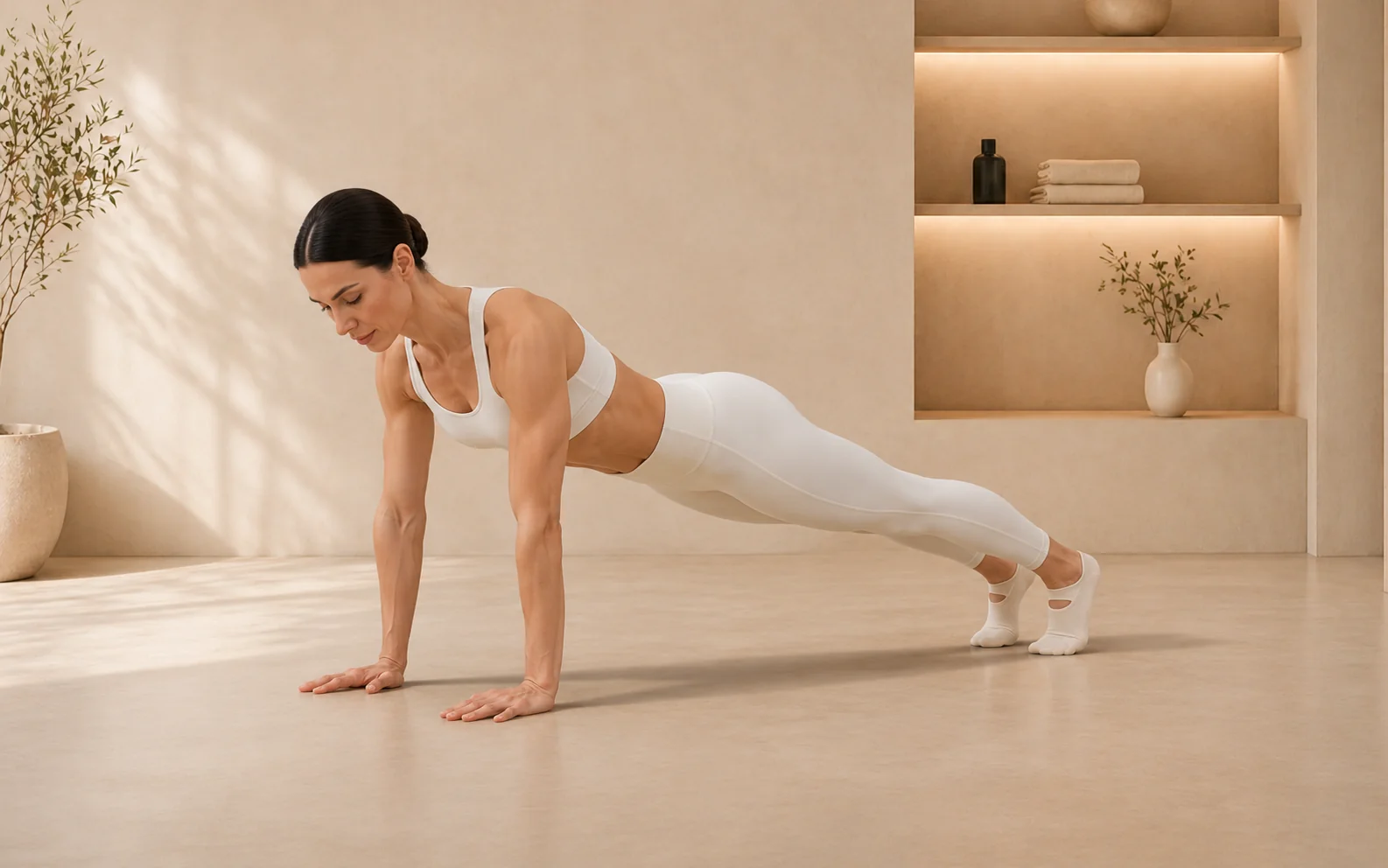
Upper-body calisthenics includes presses, pulls and holds. This guide is for readers who already control basic pushing and pulling movements and want to compare exercise variations. If you are new to resistance training, start with the basic options in this beginner calisthenics plan for home.
The seven movements have different equipment and skill demands. A repetition count for one exercise does not establish readiness for another. Choose a variation that you can enter, perform and leave with control.
Key takeaways
These points summarize how upper-body calisthenics exercises build strength and what to expect.
> * In 23 moderately trained men, four weeks of progressive push-ups and bench pressing both improved bench-press strength (1).
> * In 18 young men, eight weeks of adjusted push-ups or bench presses at a matched low load increased chest and triceps thickness (2).
> * A 2026 review of resistance training guidance for healthy adults supports progressive training with a workload adapted to the person and the goal (3).
> * Chin-ups showed higher biceps and chest activity than pull-ups, while pull-ups showed more lower trapezius activity (4).
> * A narrow hand position produced more chest and triceps activity than a wide one during push-ups (5).
> * In an eight-week lower-body trial in trained adults, adding repetitions and adding load produced broadly similar muscle adaptations (6).
> * Use the movement-specific setup and easier option for each exercise. Get qualified coaching before attempting advanced bodyweight skills.
Can calisthenics build the upper body?
Yes, you can build your upper-body muscles with calisthenics. Bodyweight exercises create resistance, and harder versions raise that resistance as you get stronger.
One randomized trial compared progressive push-ups with the bench press in 23 moderately trained men. Both groups trained 3 days a week for 4 weeks, and both improved their 1-rep bench press (1). Muscle thickness did not change significantly in either group over that short period.
A second trial in 18 young men used push-ups adjusted to about 40% of each person’s bench press max. After 8 weeks, chest and triceps thickness rose by a similar amount to low-load bench pressing (2). Both studies were small, so the results are encouraging but limited.
Exercises such as push-ups, pull-ups, and dips primarily target the chest, back, and arms. For example, pull-ups work your biceps and back while also engaging your shoulders and core. Similarly, push-ups target the chest, triceps, and deltoids, while also engaging the abs.
How do you make upper-body calisthenics harder over time?
Upper-body calisthenics gets harder when you change the exercise version, reps, or tempo. Progressive overload means asking your muscles for a little more work over time.
You can add difficulty in five practical ways:
> * Do more reps with the same version.
> * Add a set.
> * Slow the lowering phase to 3 or 4 seconds.
> * Change your body angle, for example by raising your feet during a push-up.
> * Move to a one-sided version, such as an archer push-up.
The current adult position stand supports progressive resistance training and individualizing the program to the trainee and goal (3). Use repetitions for exercises that move through a range and comfortable hold time for supported positions.
An eight-week study of trained adults compared adding repetitions with increasing load in a lower-body program. Both strategies produced broadly similar muscle adaptations, with small differences across outcomes (6). The trial did not assess advanced upper-body calisthenics skills.
Increase difficulty only when you can set up, perform and exit the selected exercise with control. Take a smaller step or ask a qualified coach to assess a new skill.
Which muscles do upper-body calisthenics exercises work?
Pushing moves train the chest, front shoulders, and triceps. Pulling moves train the lats, upper back, rear shoulders, and biceps.
Hand position changes how the work is shared. In one study of 40 adults, narrow-hand push-ups produced more chest and triceps activity than wide-hand push-ups (5). The study measured muscle activity during single reps. Use the result as a guide for exercise choice.
Grip changes pulling work too. Chin-ups, with palms facing you, showed higher biceps and chest activity than pull-ups (4). Pull-ups, with palms facing away, showed more lower trapezius activity. The lats were highly active in both versions.
For another example of pressing and shoulder preparation, see this calisthenics shoulder workout.
What are 7 upper-body calisthenics exercises to try?
The following options cover horizontal and vertical pushing, pulling and supported practice for body control. The table lists possible variations. Treat the more demanding options as separate skills that may require qualified instruction.
|
Exercise |
Main muscles |
Easier step |
Harder step |
|---|---|---|---|
|
Archer push-up |
Chest, shoulders, triceps |
Wide push-up |
One-arm push-up |
|
Typewriter pull-up |
Lats, upper back, biceps |
Wide-grip pull-up |
Archer pull-up |
|
Assisted parallel-bar dip |
Chest, triceps and shoulders |
More assistance or a shorter controlled range |
Less assistance after coached setup |
|
Feet-supported planche lean |
Shoulders and trunk control |
High plank with feet supported |
Small supported lean with control |
|
One-arm push-up |
Chest, shoulders, triceps, core |
Incline one-arm push-up |
Feet closer together |
|
Pike push-up |
Shoulders and triceps |
Incline two-arm push-up |
Progressively steeper pike under qualified guidance |
|
Feet-supported inverted row |
Upper back and biceps |
More upright row on a fixed rated bar |
Lower body angle with the feet supported |
Use each example only with the required equipment and a range you can manage. A basic repetition target cannot establish readiness for an inversion or a lever skill.
Archer push-ups
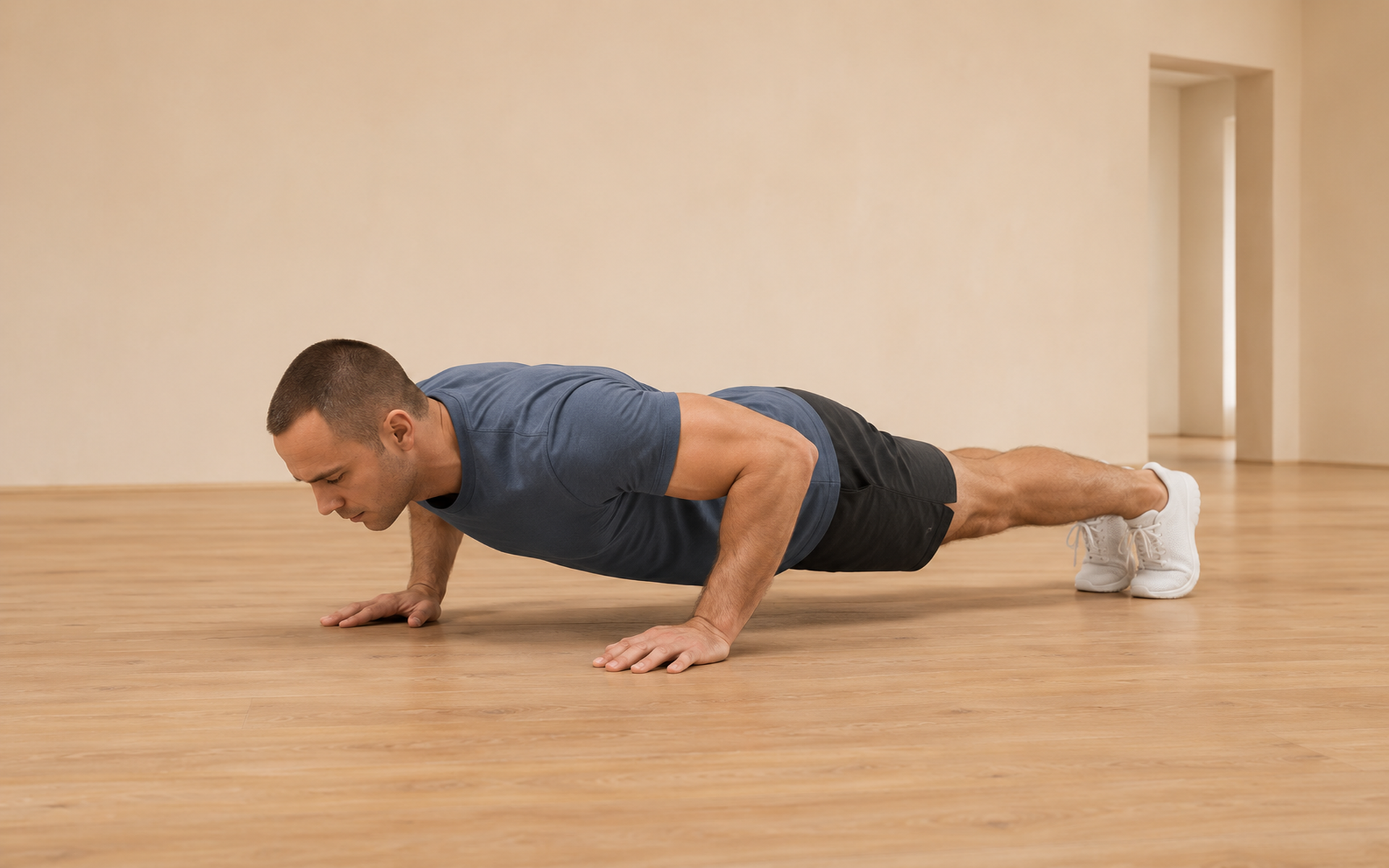
Archer push-ups are a variation of the standard push-up that targets the chest, shoulders, and triceps. The working arm takes most of your body weight on each rep. Archer push-ups build strength and balance on one side at a time.
> 1. Start in a push-up position with your hands about twice shoulder width apart.
> 2. Turn your fingers slightly out to the sides.
> 3. Lower your chest toward your right hand while your left arm stays straight.
> 4. Push back up to the center.
> 5. Repeat toward the left hand.
Typewriter pull-ups
Typewriter pull-ups require control of a full pull-up and a side-to-side shift at the top. Use standard assisted or unweighted pull-ups if you have not learned the lateral movement with qualified instruction.
> 1. Use a purpose-built pull-up bar installed and rated for your load. Check the clearance and take a secure overhand grip before starting.
> 2. Pull yourself up until your chin is level with the bar.
> 3. Shift your body toward your right hand while keeping your chin near the bar.
> 4. Shift slowly across to your left hand.
> 5. Return to the center and lower your body to a full hang.
Assisted or controlled parallel-bar dips
Choose a rated dip station or an assisted dip machine. L-sit dips add a separate leg-hold demand and are an advanced skill to discuss with a qualified coach.
> 1. Use the equipment’s intended entry support and take a stable grip on both bars.
> 2. Choose the assisted version if you cannot control the supported starting position.
> 3. Bend your elbows only within a comfortable range you can control.
> 4. Press back to the starting position and use the entry support to step down.
Feet-supported planche lean
A supported lean lets you practice a small shift of weight onto your hands while both feet remain on the floor. A full tuck planche adds a separate balance skill.
> 1. Begin in a stable high plank on the floor with both feet supported.
> 2. Shift your shoulders forward only a small amount while keeping control of the trunk.
> 3. Keep both feet in contact with the floor throughout.
> 4. Return to the starting plank as soon as the position becomes difficult to control.
> 5. Lower your knees to finish. Choose an ordinary supported plank if your wrists or shoulders feel uncomfortable.
One-arm push-ups
A one-arm push-up is an advanced unilateral press. Start with a two-arm push-up or an incline variation on a fixed exercise support when the full version is beyond your current control.
> 1. Start in a push-up position with your feet wider apart for stability.
> 2. Place one hand behind your back.
> 3. Lower your chest toward the floor with your working arm.
> 4. Push back up and switch arms after your set.
Pike push-ups
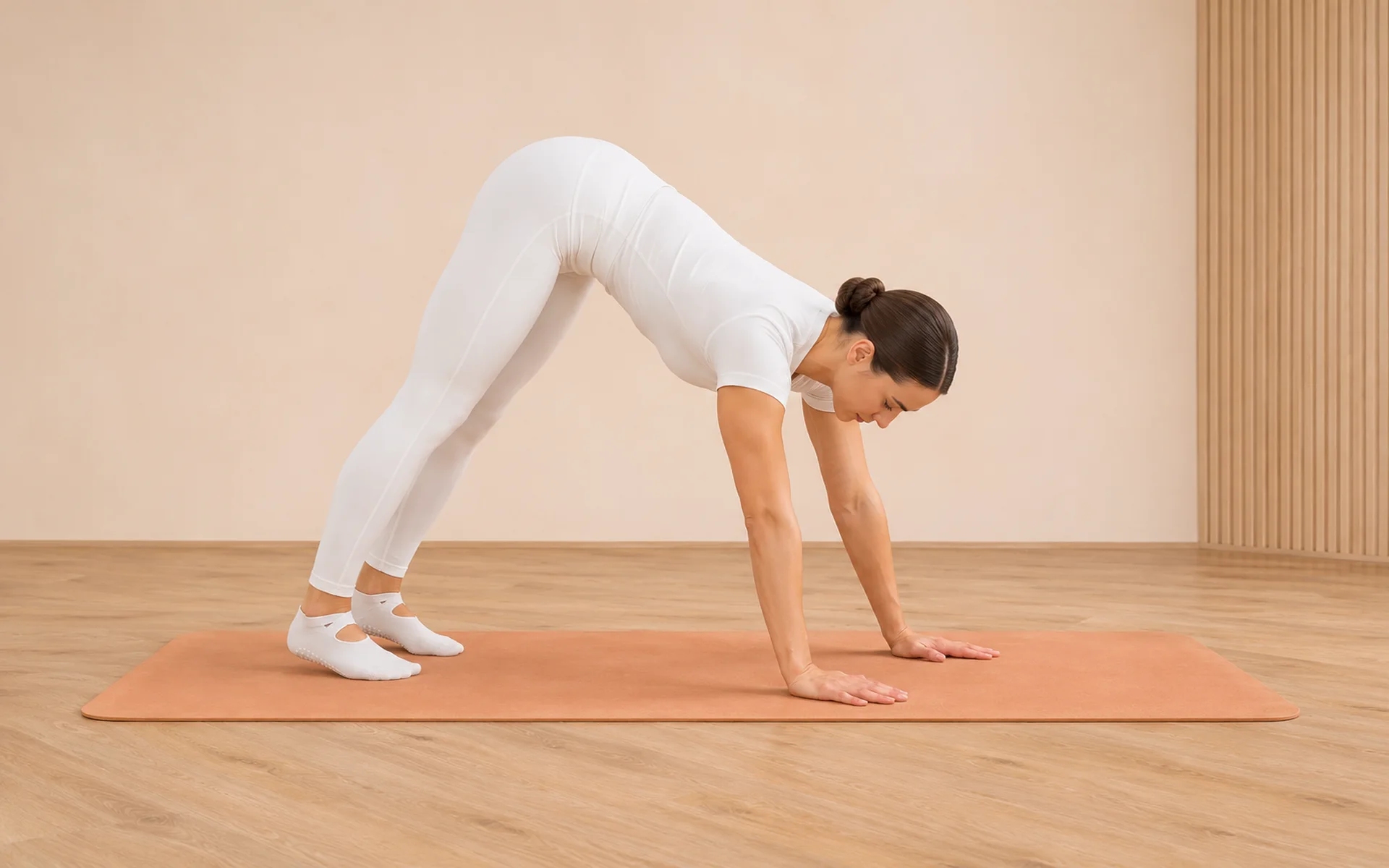
A pike push-up provides a feet-supported shoulder pressing option. Inverted handstand push-ups require separate training in entry, balance and a controlled exit with a qualified coach.
> 1. Place your hands on the floor and keep both feet supported as you lift your hips.
> 2. Bend your elbows through a small, controlled range, keeping your head clear of the floor.
> 3. Use a shallower range or an easier two-arm incline press if you cannot control the lowering phase.
> 4. Press through your hands and return to the starting position.
Feet-supported inverted rows
This row uses a fixed low bar and keeps the feet on the floor. A front lever is a different advanced skill and calls for separate instruction.
> 1. Use a purpose-built low bar installed according to the manufacturer’s instructions and rated for your body weight.
> 2. Take a secure grip with the feet planted and choose an angle you can control.
> 3. Pull your chest toward the bar while keeping your trunk steady.
> 4. Lower with control. Make the angle more upright if the movement is too demanding.
How do you start upper-body calisthenics as a beginner?
Begin with an incline push-up and a supported row using suitable exercise equipment. Assisted pulling and pressing can be added when the setup and range are manageable.
Choose the easiest variation you can set up and leave without jumping or losing control. The following options can help you practice the relevant movements.
> 1. Practice two-arm incline push-ups on a fixed exercise support and adjust its height to your ability.
> 2. For hanging work, use an installed bar rated for your load and a purpose-designed access step. Choose a supported row if you cannot enter and exit the hang steadily.
> 3. If a coach includes a lowering-only pull-up, use a rated step or assisted setup for a controlled start. Choose an assisted pull-up or supported row when this setup is unavailable.
> 4. Hold a hollow body position on your back for 20 to 30 seconds to build body tension.
A qualified coach can adjust the starting movement and setup to your skill level.
Clean form usually matters more than extra reps. Film a set or use a mirror to check your body line and range of motion.
How often should you train your upper body with calisthenics?
Two or three sessions a week are one possible schedule for someone who can recover between sessions. A current position stand for healthy adults supports progressive training tailored to the person and goal (3). It does not test this seven-exercise schedule.
Leave at least one day between hard sessions for the same muscles. A simple approach alternates pushing and pulling days. A calisthenics push workout and a calisthenics pull workout show how to build each session.
Adult activity guidance includes strengthening the major muscle groups on at least two days a week (7). Upper-body training can form part of a wider plan that also includes lower-body activity.
Frequently Asked Questions
What are 10 upper body exercises?
Examples include two-arm push-ups, incline push-ups, pike push-ups, archer push-ups, assisted dips, pull-ups, assisted pull-ups, chin-ups, feet-supported rows and high planks. Select movements that fit your current skill and equipment. Learn advanced inversions and lever skills with qualified instruction.
How big can you get with only calisthenics?
Muscle size from calisthenics depends on your training, food intake, sleep, and genetics. Progressive push-ups built chest and triceps thickness in one 8-week trial (2). Results vary from person to person.
Is calisthenics 3x a week enough?
Three sessions are one scheduling option. Choose the frequency and workload according to your experience, recovery and other weekly training. The schedule alone cannot predict your rate of progress.
Do you need equipment for upper-body calisthenics?
Floor push-ups and supported planks need clear floor space. Pulling and dipping movements require a purpose-built bar, rings or dip station installed as directed and rated for the intended load. Use a floor press variation when suitable equipment is unavailable.
The bottom line
Choose a press and a pull you can set up, perform and leave under control. Record repetitions for moving exercises and hold time for supported positions. Adjust one part of the workload when you are ready. BetterMe offers a calisthenics workout program.
DISCLAIMER:
This article is intended for general informational purposes only and does not serve to address individual circumstances. It is not a substitute for professional advice or help and should not be relied on for making any kind of decision-making. Any action taken as a direct or indirect result of the information in this article is entirely at your own risk and is your sole responsibility.
BetterMe, its content staff, and its medical advisors accept no responsibility for inaccuracies, errors, misstatements, inconsistencies, or omissions and specifically disclaim any liability, loss or risk, personal, professional or otherwise, which may be incurred as a consequence, directly or indirectly, of the use and/or application of any content.
You should always seek the advice of your physician or other qualified health provider with any questions you may have regarding a medical condition or your specific situation. Never disregard professional medical advice or delay seeking it because of BetterMe content. If you suspect or think you may have a medical emergency, call your doctor.
SOURCES:
- Effect of Progressive Calisthenic Push-up Training on Muscle Strength and Thickness (2018, nih.gov)
- Low-load bench press and push-up induce similar muscle hypertrophy and strength gain (2017, nih.gov)
- Resistance Training Prescription for Muscle Function, Hypertrophy, and Physical Performance in Healthy Adults: An Overview of Reviews (2026, nih.gov)
- Surface electromyographic activation patterns and elbow joint motion during a pull-up, chin-up, or perfect-pullup rotational exercise (2010, nih.gov)
- Comparison of muscle activation using various hand positions during the push-up exercise (2005, nih.gov)
- Progressive overload without progressing load? The effects of load or repetition progression on muscular adaptations (2022, nih.gov)
- World Health Organization 2020 guidelines on physical activity and sedentary behaviour (2020, nih.gov)
 Reviewed by

 Reviewed by
 Reviewed by