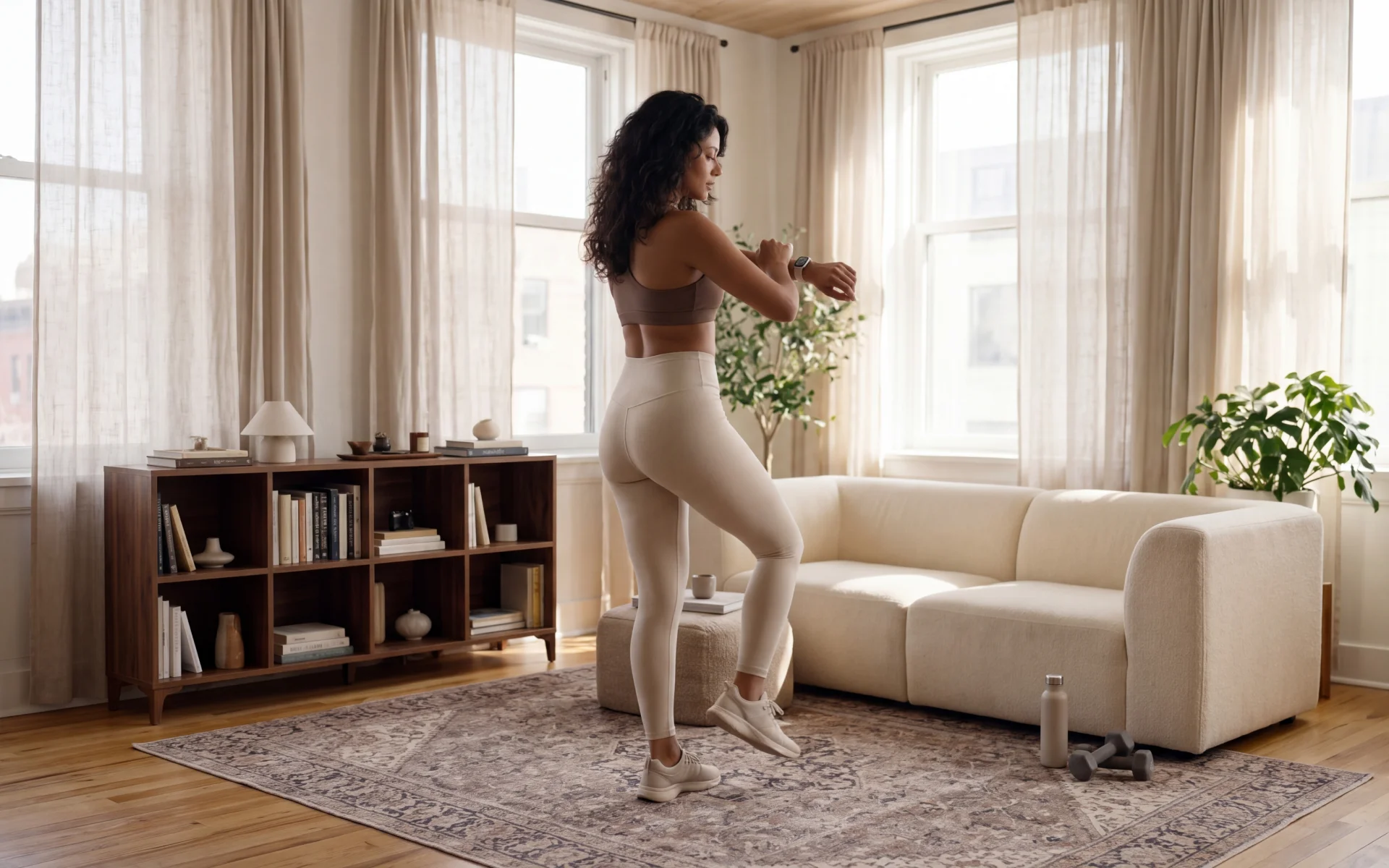
Yes, walking in place counts as steps: each time you lift a foot and shift your weight, you take a step. At a brisk 100 to 120 steps per minute, 30 minutes can add roughly 3,000 to 3,600 steps. Walking in place to stay active indoors is an easy way to add steps, though some trackers may undercount.
This article is for general information only and isn’t medical advice. It touches on weight-related topics and on activity for older adults. Individual results vary. Consider speaking with a qualified professional before changing your activity level.
Following exercise and diet plans is the key in your fitness journey and greatly impacts results. In 4 weeks users can typically expect to lose not more than 1-2 lbs per week. Individual results may vary.
Key takeaways
Stepping in place produces real steps and real activity, and the main difference is how well your device records them.
- Walking in place produces real steps, though wrist-worn trackers may record fewer than you actually take (1).
- A quick cadence of 100 to 120 steps per minute adds roughly 1,000 to 1,200 steps every 10 minutes.
- One lab study of adults aged 41 to 60 linked about 100 steps per minute with moderate-intensity effort (2).
- In one lab study, stepping in place used about 258 calories per hour, compared with about 304 for treadmill walking at 3 mph (3).
- Research links roughly 7,000 to 8,000 steps a day with benefits for many adults (4, 5).
- At about 110 steps per minute, three 15-minute blocks add roughly 4,950 steps toward a 10,000-step day.
- In one lab study, adults who stepped in place during TV ad breaks for 1 hour took about 2,100 steps (3).
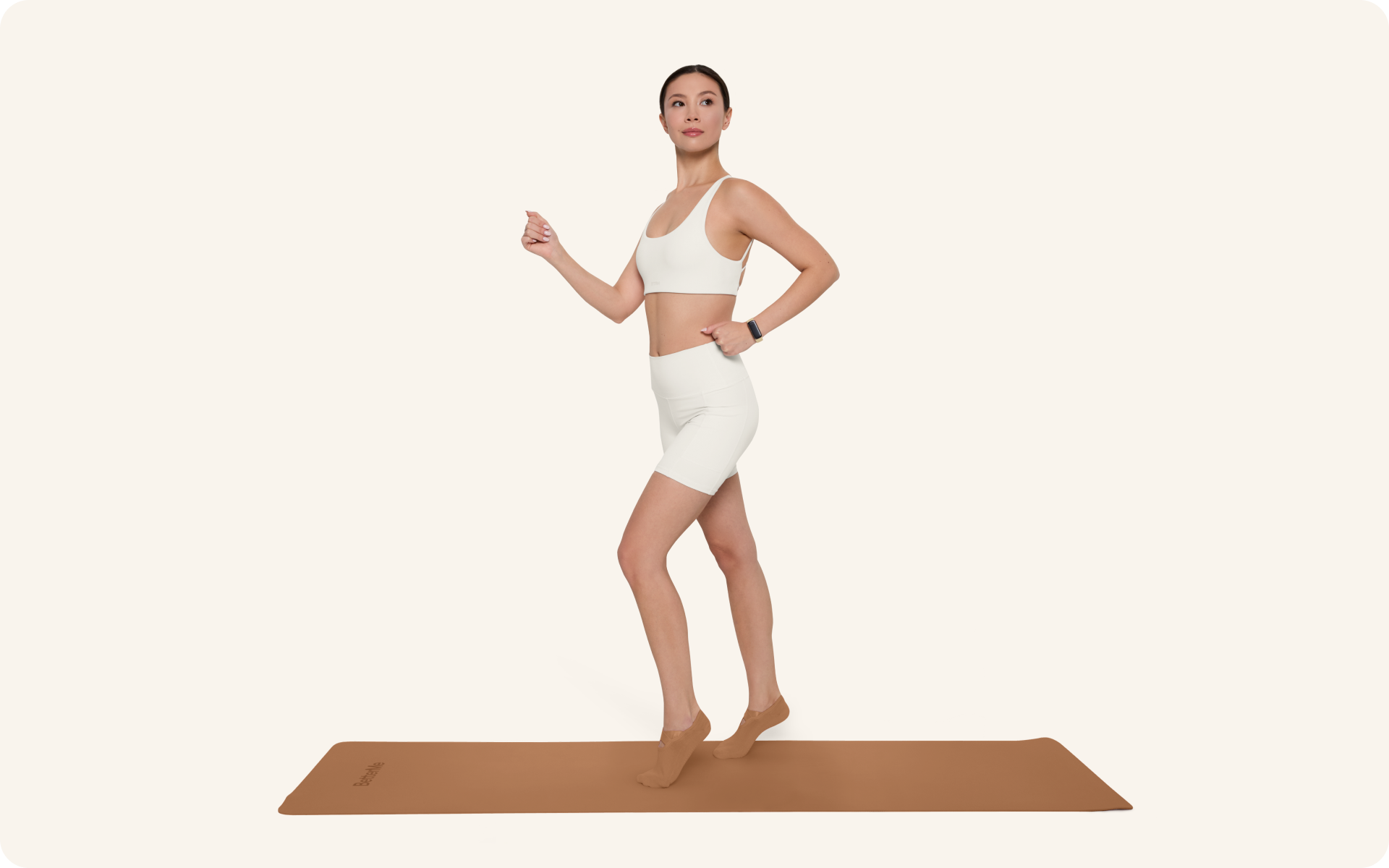
Does walking in place count as steps toward your daily total?
Walking in place does count toward your step total, because each rise and plant of a foot is a step.
It also counts as physical activity, which means any body movement that uses more energy than resting (6). A short march in your living room helps you accumulate both steps and active minutes, which can help if you are sedentary for long hours.
Do fitness trackers count steps when you walk in place?
Many fitness trackers count steps when you walk in place, though they may record fewer than you take. A 2022 systematic review found wrist-worn devices tended to undercount steps, and accuracy varied between devices and settings (1).
Several factors may affect what shows up on your screen:
- Where you wear the device: wrist, hip, or pocket
- How much your arms move: still arms may mean fewer recorded steps
- How light your steps are: soft, low shuffles may not register
- Your pace: very slow stepping may be missed more often
Few studies have tested whether walking in place is tracked accurately, so treat the number as an estimate.
Read more: Indoor walking exercises: easy walking workouts to do at home
How can I make sure my steps are counted accurately indoors?
To count more accurately at home, wear the device well, swing your arms, and check a manual tally.
| Tracking method | How it detects steps | Common limitation |
|---|---|---|
| Wrist tracker or smartwatch | Arm movement | May undercount if arms are still |
| Phone in a front pocket | Body movement and accelerometer | Less accurate in hand or on a table |
| Clip-on pedometer at the hip | Hip movement | Can shift out of position |
- Keep swinging your arms naturally if you wear a wrist tracker.
- Keep your phone in a front pocket, not in your hand or on a nearby surface.
- Run a quick self-check: say 100 steps out loud as you go and compare with your device.
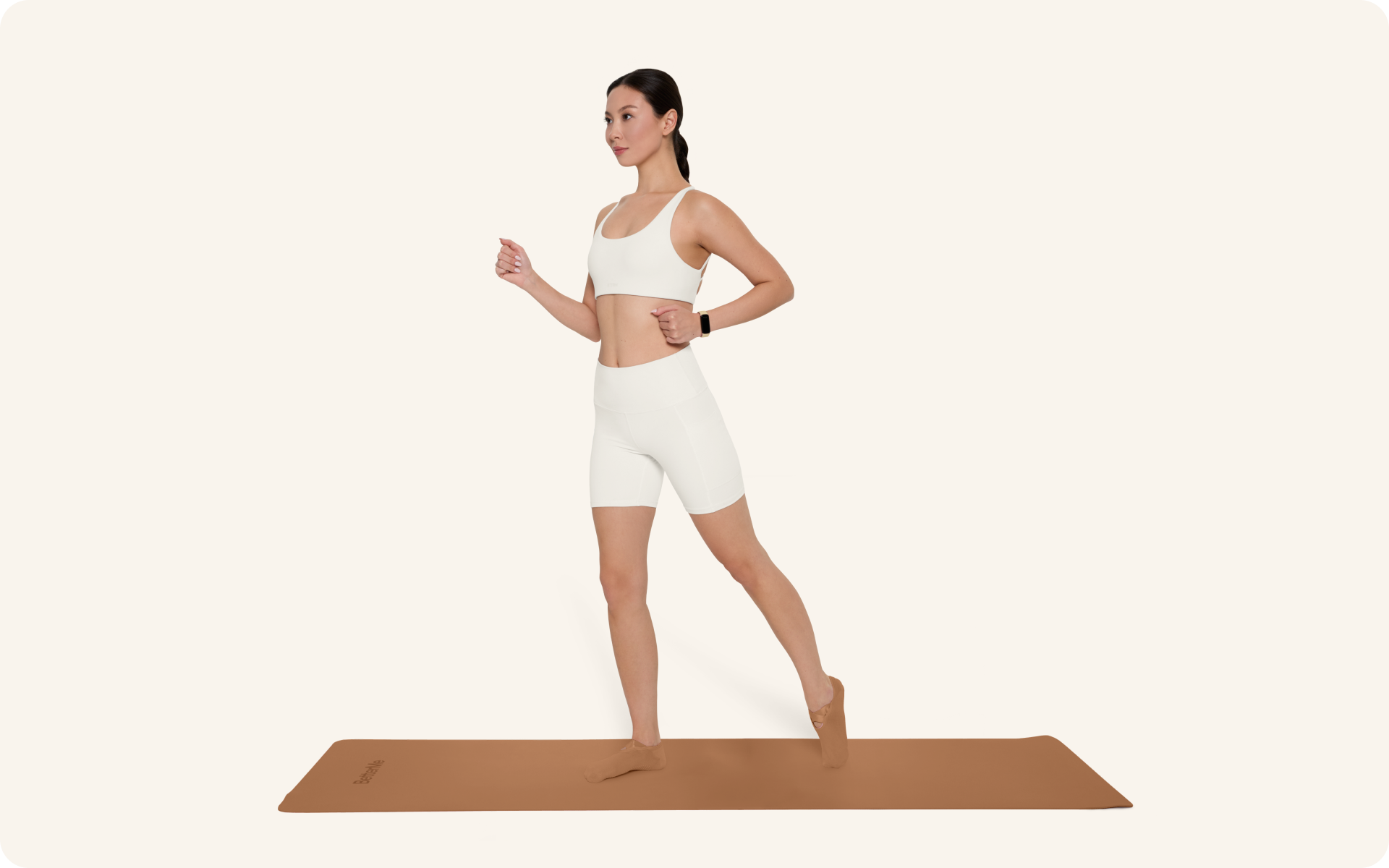
How many steps can you get by walking in place?
You can get roughly 80 to 135 steps per minute, depending on how fast you move. Your total depends on cadence, which is the number of steps you take per minute (7).
One lab study of adults aged 41 to 60 found that about 100 steps per minute lined up with moderate effort, and around 130 tended to match vigorous effort (2). Moderate effort means you breathe harder but can still talk; vigorous effort means you can say only a few words before pausing (8).
| Pace | Steps per minute | Steps in 10 minutes | Steps in 30 minutes | How it may feel |
|---|---|---|---|---|
| Easy | 80 to 100 | 800 to 1,000 | 2,400 to 3,000 | Relaxed; you can chat freely |
| Brisk | 100 to 120 | 1,000 to 1,200 | 3,000 to 3,600 | Breathing harder; you can talk but not sing |
| Energetic, with high steps | 120 to 135 | 1,200 to 1,350 | 3,600 to 4,050 | You can say only short phrases |
These studies used treadmill walking, so the figures are estimates based on cadence research and simple math. In a separate lab study, adults who stepped in place during ad breaks while watching TV for 1 hour took about 2,100 steps and gained about 25 minutes of activity (3).
BetterMe offers a variety of workouts, recipes, challenges, and support tools to help you stay more consistent with your wellness routine. Explore the app to find features that fit your goals, preferences, and schedule.
How can I get 10,000 steps without leaving the house?
You can reach 10,000 steps without leaving the house by adding short blocks to your usual movement, such as three 15-minute sessions. At about 110 steps per minute, those three blocks add roughly 4,950 steps.
| Step goal | Time at 100 steps per minute | Time at 120 steps per minute |
|---|---|---|
| 1 | 10 minutes | About 8 minutes |
| 3 | 30 minutes | 25 minutes |
| 5 | 50 minutes | About 42 minutes |
| 7 | 70 minutes | About 58 minutes |
| 10 | 100 minutes | About 83 minutes |
Cooking, folding laundry, pacing during calls, and walking in place while waiting in line add steps throughout the day. If your average sits around 4,000, a 30-minute workout could bring you to roughly 7,000 to 7,600.
The 10,000 figure is one popular goal among several. Research links roughly 7,000 to 8,000 steps with benefits for many adults (4, 5). One 2023 study found that reaching 8,000 steps on just 1 to 2 days a week was linked with benefits similar to reaching it more often (5). For much higher targets, our article on walking 20,000 steps a day explores what that volume may involve.
What is a simple walking-in-place workout for beginners?
A simple beginner workout can last 20 minutes and mix a steady rhythm with three 1-minute faster bursts. This routine uses cadence targets from walking research (2).
| Phase | Movement | Time | Target steps per minute | How it may feel |
|---|---|---|---|---|
| 1. Warm-up | Gentle march | 3 minutes | 80 to 90 | Easy; you can chat freely |
| 2. Steady | Steady march | 4 minutes | About 100 | You can talk in full sentences |
| 3. Burst | Arm-pump march | 1 minute | 110 to 120 | Breathing harder |
| 4. Steady | Steady march | 3 minutes | About 100 | Comfortable rhythm |
| 5. Burst | High-knee march | 1 minute | 115 to 125 | Short phrases only |
| 6. Steady | Steady march | 3 minutes | About 100 | Finding your breath |
| 7. Burst | Fast arm-drive march | 1 minute | 120 to 130 | Finish strong |
| 8. Cool-down | Slow, easy march | 4 minutes | 70 to 80 | Relaxed; breath slowing |
To start walking in place with good form, follow these steps:
- Stand tall with your feet hip-width apart and a soft bend in your knees.
- Raise one knee to about mid-thigh height, lower it, then switch legs.
- Bend your elbows slightly and move your arms in time with the opposite leg.
- Keep your chest open, your gaze forward, and your core gently engaged.
- During bursts, drive your arms harder and raise your knees toward hip height if comfortable.
- In the cool-down, go slower gradually, then stand still for 30 seconds and roll your shoulders back.
Music at 100 to 120 beats per minute can help you keep walking at a steady rhythm without tallying. If anything feels uncomfortable, slow down or stop. Our guide to Indoor Walking Exercises covers more options you can do at home.
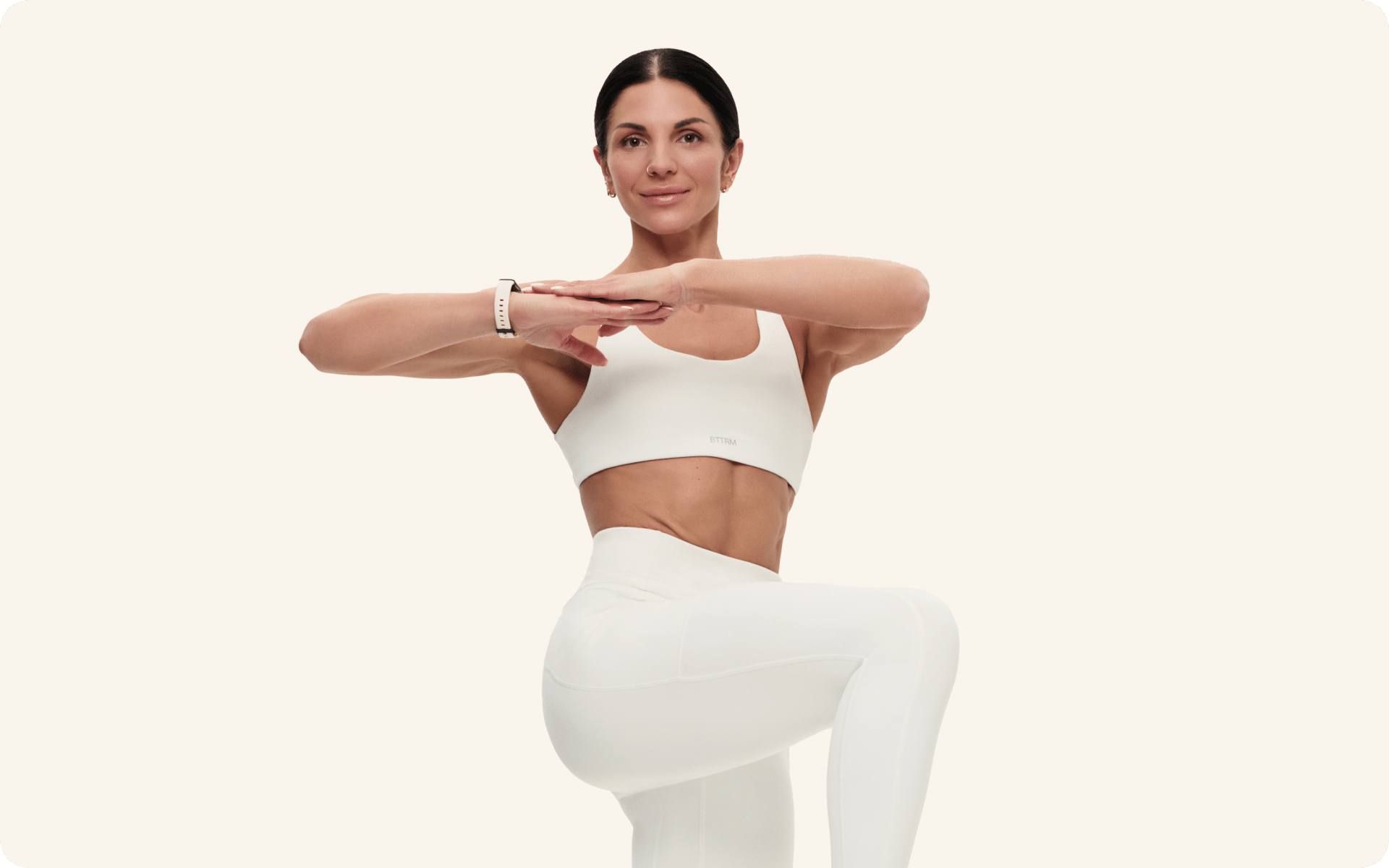
Is walking in place as good as regular walking?
Walking in place can be close to regular walking when your effort matches, though it is not identical. Both use the same walking motion. Marching on the spot has no forward travel, terrain, or natural changes in speed.
In one lab study, stepping in place used about 85% of the energy of treadmill walking at 3 mph (3). That makes it a practical way to get moving on rainy days or between tasks.
How many calories can walking in place burn?
Walking in place may burn roughly 250 to 260 calories per hour at a steady rhythm, based on one small study. That lab study found about 258 calories per hour in 23 adults with an average age of about 28 (3). Your number depends on body size, effort, and how high you step.
Calorie use is often estimated with METs, or metabolic equivalents, which compare an activity’s energy use with sitting still. A 2024 update of a widely used reference assigns higher values to faster, more effortful walking (9).
| Style | Effort level | Likely energy use vs. easy outdoor walking |
|---|---|---|
| Light shuffle, arms still | Low (below 3 METs) | Probably less |
| Steady march, arms moving | Moderate (about 3 METs) | Roughly similar |
| High-knee intervals | Moderate to vigorous (3 to 5 METs) | Potentially more |
These are estimates only, and actual energy use varies between people.
Read more: Is walking in place the same as walking? Steps, calories, and weight
Can I lose weight walking in place?
Walking in place may help some people manage weight as part of a wider routine. On its own, it is unlikely to be enough. Weight change depends on many factors, including food, sleep, and overall activity (10).
Pair it with balanced meals and a healthy lifestyle, set a step goal, and track your steps over several weeks.

Is walking in place good exercise?
Yes, walking in place can be good exercise when your rhythm raises your heart rate and breathing. About 100 steps per minute matched moderate effort in one lab study (2). At moderate effort, you can talk but not sing (8).
Regular moderate-intensity exercise may support overall health and physical fitness. Guidelines include it in a weekly target of 150 minutes (11). Older adults and people returning to this form of exercise may prefer to hold a counter or chair for balance.
How can I make walking in place more challenging?
You can make walking in place more challenging by raising your cadence, using your arms, and adding faster bursts. Two 2022 studies suggest both volume and intensity matter: a faster stepping rate was linked with benefits beyond total steps (12). Brief vigorous moments of about 1 minute were linked with lower health risks (13).
- Aim for a cadence of 100 to 120 steps per minute.
- Use your arms. Bend your elbows to about 90 degrees and drive them forward and back. This adds effort and may help a wrist tracker register more steps.
- Add 1-minute bursts every 2 to 3 minutes. Speed up and step higher, then ease back; repeat 3 to 5 times.
Build up your exercise gradually, and see what feels right for your body. To learn how walking styles affect lower-body muscles, read Does Walking Make Your Butt Bigger.
Whether you’re just starting your fitness journey or looking to add more structure to your routine, BetterMe offers tools that can support different wellness goals. Explore the app and see how its workout, nutrition, and habit-building features can fit into your lifestyle.

FAQs
Are runners fitter than walkers?
Often, yes: people who run tend to have higher cardiorespiratory fitness on average (14).
Is it better to walk faster or longer?
Both appear to matter. One large 2022 analysis found the total number of steps each day was the strongest factor (15). A separate 2022 study linked a faster stepping rate with added benefits (12). Build your total first, then add faster bursts.
How many steps should I take by age?
No single goal fits everyone. A 2022 analysis of about 47,000 adults found benefits leveled off around 6,000 to 8,000 steps a day for adults 60 and older and around 8,000 to 10,000 for adults under 60 (15). A practical starting point for many people is adding 1,000 steps to their current daily average.
The bottom line
Walking in place counts as steps, and it can also serve as a simple home workout. Pick a pace that suits your health and fitness level, add a little more each week, and build from there.
DISCLAIMER:
This article is intended for general informational purposes only and does not serve to address individual circumstances. It is not a substitute for professional advice or help and should not be relied on for making any kind of decision-making. Any action taken as a direct or indirect result of the information in this article is entirely at your own risk and is your sole responsibility.
BetterMe, its content staff, and its medical advisors accept no responsibility for inaccuracies, errors, misstatements, inconsistencies, or omissions and specifically disclaim any liability, loss or risk, personal, professional or otherwise, which may be incurred as a consequence, directly or indirectly, of the use and/or application of any content.
You should always seek the advice of your physician or other qualified health provider with any questions you may have regarding a medical condition or your specific situation. Never disregard professional medical advice or delay seeking it because of BetterMe content. If you suspect or think you may have a medical emergency, call your doctor.
SOURCES:
- Accuracy and Acceptability of Wrist-Wearable Activity-Tracking Devices: Systematic Review of the Literature (2022, pmc.ncbi.nlm.nih.gov)
- Walking cadence (steps/min) and intensity in 41 to 60-year-old adults: the CADENCE-adults study (2020, link.springer.com)
- Energy cost of stepping in place while watching television commercials (2012, pubmed.ncbi.nlm.nih.gov)
- Daily steps and health outcomes in adults: a systematic review and dose-response meta-analysis (2025, thelancet.com)
- Association of Daily Step Patterns With Mortality in US Adults (2023, jamanetwork.com)
- What Is Physical Activity? (2022, nhlbi.nih.gov)
- Cadence as a Behavioral Target in Physical Activity Interventions: A Narrative Review (2024, pmc.ncbi.nlm.nih.gov)
- How to Measure Physical Activity Intensity (2025, cdc.gov)
- 2024 Adult Compendium of Physical Activities: A third update of the energy costs of human activities (2024, sciencedirect.com)
- Dietary and Behavioral Strategies for Weight Loss and Weight Loss Maintenance: A Narrative Review (2025, mdpi.com)
- Adult Activity: An Overview (2023, cdc.gov)
- Prospective Associations of Daily Step Counts and Intensity With Cancer and Cardiovascular Disease Incidence and Mortality and All-Cause Mortality (2022, jamanetwork.com)
- Association of wearable device-measured vigorous intermittent lifestyle physical activity with mortality (2022, nature.com)
- Physical activity, cardiorespiratory fitness, and cardiovascular health: A clinical practice statement of the American Society for Preventive Cardiology Part I (2022, sciencedirect.com)
- Daily steps and all-cause mortality: a meta-analysis of 15 international cohorts (2022, thelancet.com)
 Reviewed by
 Reviewed by


 Reviewed by