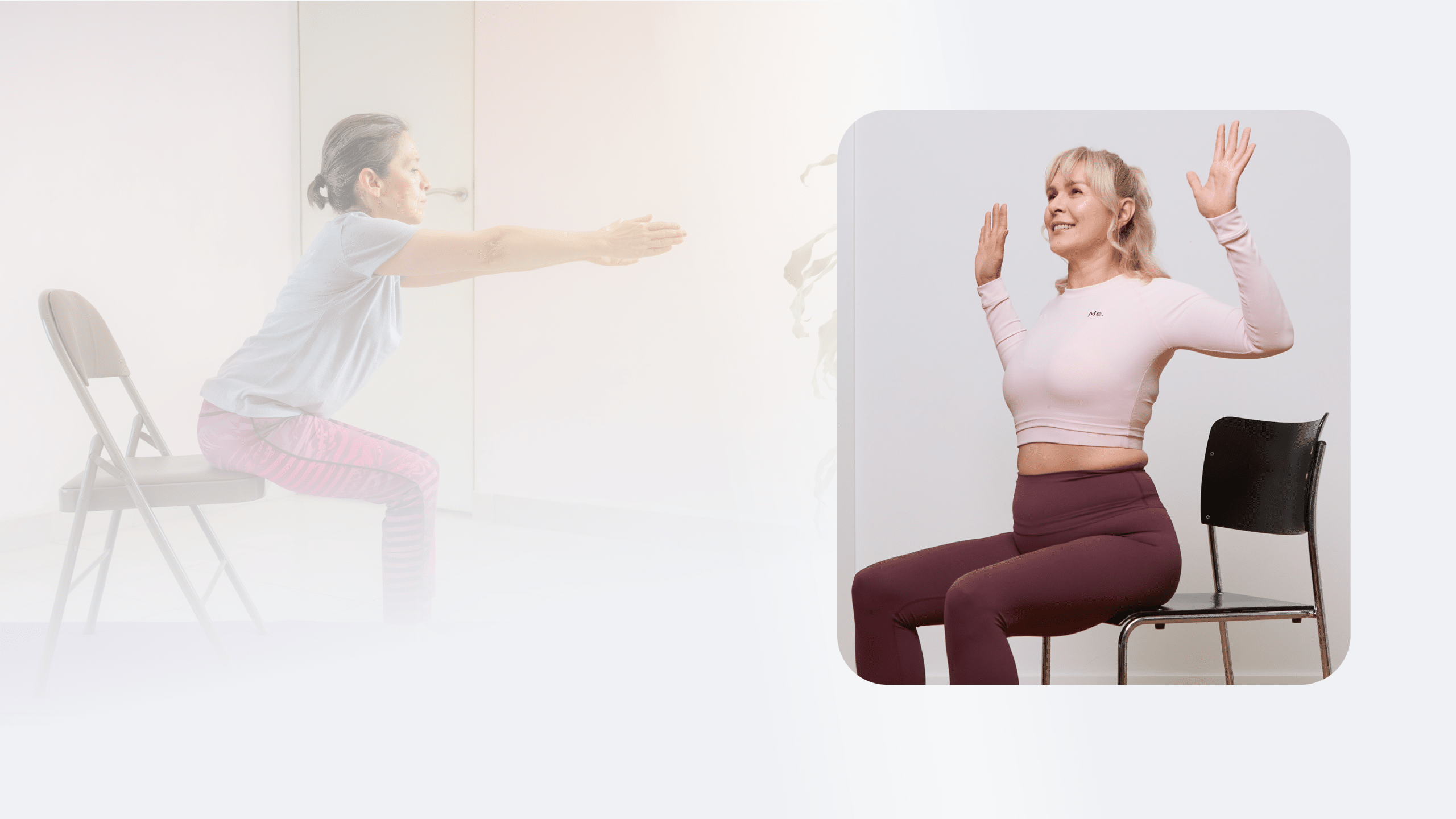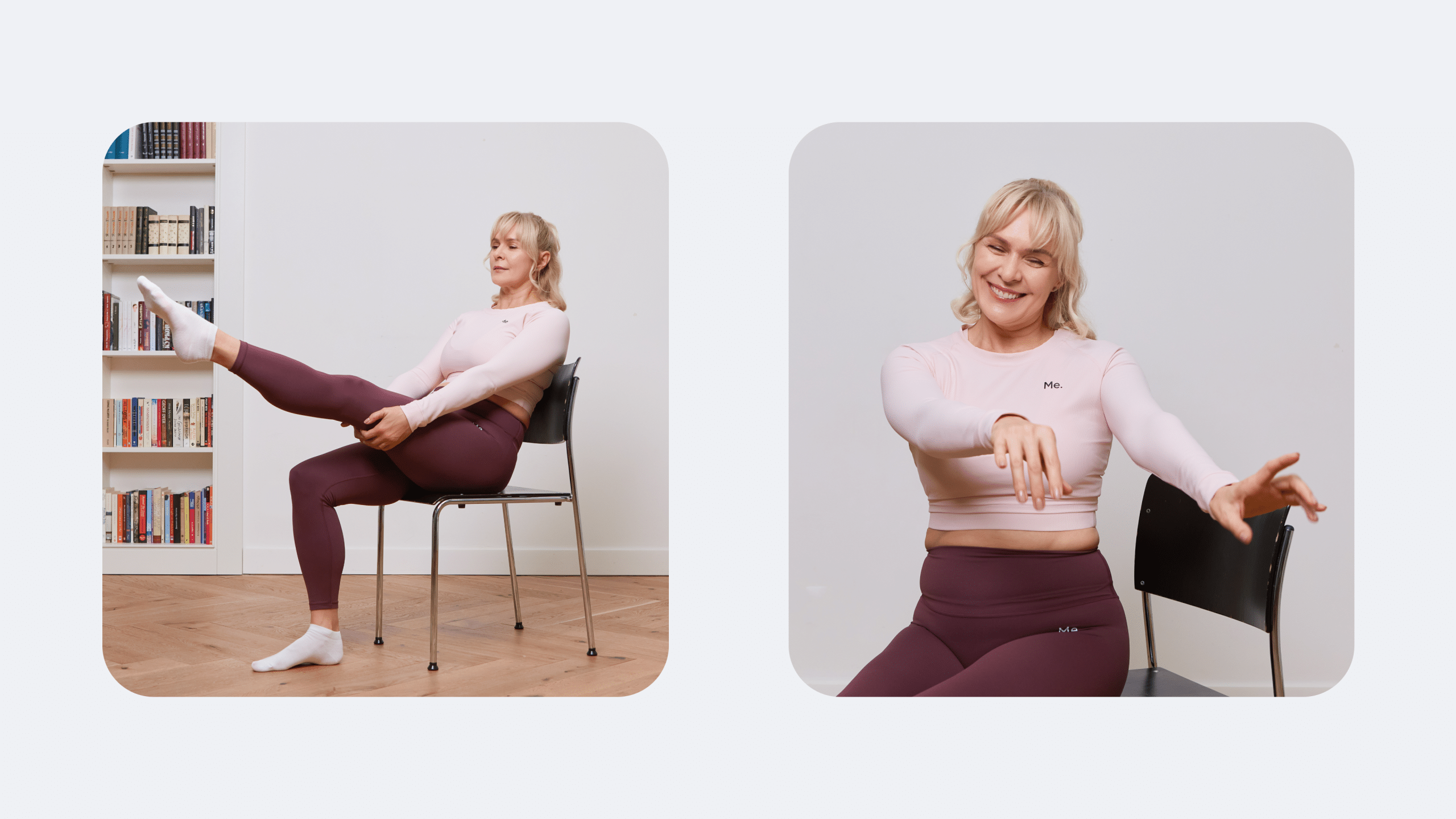
Chair yoga for seniors uses a chair to support familiar movements without floor transitions. This guide offers ten seated pose options and a short sample sequence. Start with a stable chair, supported feet, and a few familiar movements, adapting the range and pauses to your capacity.

If you have joint, muscle, or spine-related concerns, please consult your physician before starting this workout.
For a timed routine, see our chair yoga sequence for seniors.
Key takeaways
- This BetterMe pose library offers ten seated options with easier variations.
- A stable chair without wheels and supported feet are practical setup choices (1).
- You do not need to perform all ten poses in one session.
- Individual needs may require yoga poses to be modified or omitted (2).
- General older-adult guidance includes aerobic, strengthening, and balance activities; seated yoga does not automatically cover all of them (3).
- The sample sequence uses four two-minute sections, including an opening and finish.
How do you prepare for the pose library?
Prepare a solid chair on a nonslip surface and sit with your feet supported. Public seated-exercise guidance recommends a stable chair without wheels and enough room for movement (1). Choose clothing that lets you move comfortably, and keep water nearby.
Use a qualified instructor to learn unfamiliar poses (2). The options are fully seated, but seated does not mean suitable for every person. Avoid forcing leg crossing, twisting, reaching, or a deep fold.

How do you perform the ten seated poses?
Perform each pose through a comfortable range, with normal breathing and unhurried transitions. Use the easier option when the full position does not suit you.
Seated overhead stretch
- Sit with supported feet for the seated overhead stretch.
- Raise your arms only as high as comfortable during the overhead stretch.
- Lower your arms from the seated overhead stretch slowly.
Easier option: keep your hands near chest or shoulder height.
Seated neck stretch
- Sit with relaxed shoulders for the seated neck stretch.
- Tilt your head a little during the seated neck stretch without pulling with your hand.
- Return from the seated neck stretch before changing sides.
Easier option: use a small head turn instead of a tilt. General flexibility guidance includes small, controlled neck movements (4).
Seated chest opener
- Sit in a stable position for the seated chest opener.
- Open your arms slightly during the chest opener without forcing them behind your body.
- Return your arms from the seated chest opener.
Easier option: rest your hands on your thighs and make a small shoulder movement.
Seated twist
- Ground both feet for the seated twist.
- Turn your upper torso slightly during the seated twist without pulling on the chair.
- Return from the seated twist before changing sides.
Easier option: keep the torso nearly still and make a small upper-chest turn.
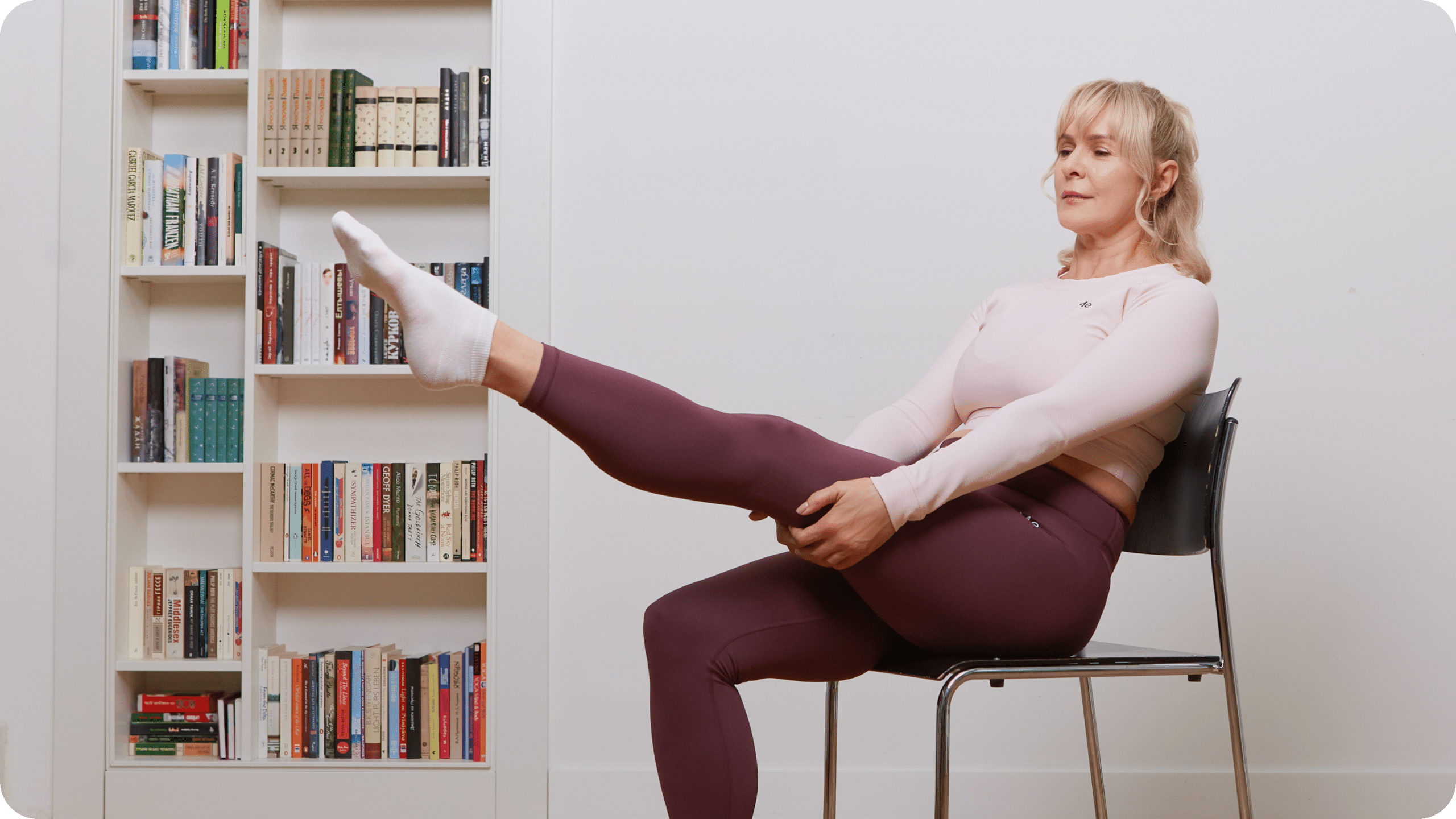
Seated pigeon pose
- Sit with both feet supported for the seated pigeon option.
- Place one ankle over the opposite lower leg only if comfortable.
- Return the foot from the seated pigeon position slowly.
Easier option: keep both feet grounded and gently open one knee outward. You do not need to reach a full figure-four shape.
Seated forward bend
- Sit with your feet supported for the seated forward bend.
- Hinge forward a little during the seated forward bend with hands resting on thighs.
- Return upright from the seated forward bend slowly.
Easier option: remain upright. A deep fold is not required.
Seated cat-cow stretch
- Place your hands on your thighs for seated cat-cow.
- Make a small chest-opening movement during seated cat-cow.
- Return through a gentle rounded position during seated cat-cow.
Easier option: keep the torso nearly still and focus on comfortable breathing.
Seated eagle pose
- Sit with relaxed shoulders for the seated eagle-arm variation.
- Bring your arms into a light self-hug during seated eagle.
- Release your arms from the seated eagle variation.
Easier option: keep your hands on opposite shoulders without crossing further. Leg wrapping is optional and can be omitted.
Seated mountain pose
- Sit with both feet supported for seated mountain.
- Lengthen your torso gently during seated mountain.
- Rest your hands comfortably during seated mountain.
Easier option: use the backrest.
Seated warrior pose
- Sit in a stable forward-facing position for the seated warrior variation.
- Open your arms sideways through a comfortable seated warrior range.
- Lower your arms from the seated warrior variation.
Easier option: keep arms low and both feet in their usual supported position. Side-facing or wide-leg versions need separate instruction.
Our chair yoga guide for women over 60 offers a smaller starting menu.
If you wish to cinch your waist, tone up your bat wings, blast away the muffin top – our fitness app was created to cater to all your needs! BetterMe won’t give excess weight a chance!
What is a short sample sequence?
The eight-minute sample uses four sections with time for transitions and pauses. Choose familiar movements and shorten the sections when needed.
|
Section |
Movement |
Time choice |
|---|---|---|
|
Opening |
Seated mountain |
About 2 minutes |
|
Upper body |
Chest opener and shoulder movement |
About 2 minutes |
|
Torso |
Small-range cat-cow |
About 2 minutes |
|
Finish |
Seated mountain and relaxed breathing |
About 2 minutes |
Shorten any section or pause as needed. Use our chair yoga workout plan to organize practice days.
What can help you choose a smaller pose group?
Choose poses with compatible starting positions and movements you already understand. The ten-pose library is a menu. You can use seated mountain as an opening and finish, then add one or two familiar movements between them. You do not need a new pose in every session.
Reaching and chest opening
An overhead reach can stop below head height. Keep the shoulders comfortable and lower the arms before beginning another movement. Interlacing fingers, pulling the arms backward, or holding for a long breath count is optional. None is required to complete the seated stretch.
For the chest opener, move the arms only through the range taught to you. Avoid forcing them behind the chair. A small shoulder movement with hands on the thighs can be another option. Check whether chair arms obstruct the reach before practicing.
Neck and torso movement
For the neck option, begin in a comfortable supported sitting position. Use a small head turn or tilt without pulling with a hand. Return to the middle before changing direction. A full circular neck motion or deep tilt is unnecessary for this library.
For the twist, keep both feet supported and allow only a small upper-torso turn. Do not pull on the seat or backrest to reach farther. The head can remain comfortable instead of looking over the shoulder. Return slowly before repeating on the other side.
The forward bend can remain a shallow hinge with hands on thighs. A deep fold between the legs is not required. If that position does not fit your range or guidance, remain upright and select another familiar pose. Getting farther down is not a completion criterion.
Leg-crossing alternatives
Seated pigeon and eagle can include crossing a leg, but that shape is optional. Try only the version selected for you. If placing the ankle across the opposite leg is awkward, keep both feet down rather than lifting and pulling the leg into position.
Do not press a raised knee downward or add a deeper forward fold to make the pose more intense. A grounded-foot alternative can keep the practice seated and simple. Ask for instruction when you cannot enter or leave the position comfortably.
Mountain and warrior choices
Seated mountain can use the backrest when appropriate. An upright torso does not require sitting rigidly for the whole session. Let the arms rest and breathe normally. You can return to this position between more active movements.
For this seated warrior variation, keep both feet supported and raise your arms only as far as comfortable. Ask for separate instruction before trying a sideways stance or a wider leg position.
How do you arrange transitions and pauses?
Finish one movement and return to a stable seated position before starting the next. The chair should remain still. If you need to move it or change its height, stop the practice and reset the space rather than making adjustments while holding a pose.
Allow time to change sides. A timer can help organize a section, but it should not rush the switch. The sample eight-minute sequence includes pauses and transitions inside its sections, and you can finish earlier.
If one movement is omitted, continue with another familiar option or rest. There is no need to replace every missed minute with a deeper stretch. A shorter sequence is still the sequence you chose for that day.
What should an instructor help you check?
Ask about chair height, support, movement range, and how to leave each pose. Show the version you actually intend to practice at home. A demonstration using another chair may need adjusting to your setup.
Bring relevant clinician restrictions to the conversation. An instructor can help with technique within those limits but cannot establish a medical explanation for discomfort. Stop an uncomfortable movement and seek appropriate advice rather than repeatedly practicing it to see whether it improves.
After a few manageable sessions, choose whether to keep the same selection or add one suitable pose. Changing range, duration, and pose count at once makes the practice harder to compare. Keep progress tied to a repeatable routine rather than finishing all ten shapes.
How should you build difficulty?
Build difficulty by improving familiarity first, then adding a little time or another suitable pose. More range is not automatically better. Skip a pose that does not fit your current guidance rather than treating the full library as a checklist to complete.
If additional strength work is appropriate, general bodyweight exercises such as sit-to-stand provide a separate option (5). A slow seated practice may stay below moderate aerobic intensity; the talk test helps distinguish moderate activity from gentle movement (6).
BetterMe is your fast-track ticket to a long-lasting weight loss! Tailor your fitness journey and maximize your results with just a couple of swipes!
Does the pose library replace balance and aerobic exercise?
No, a seated pose library does not automatically meet broader activity recommendations. Guidance for adults 65 and older includes aerobic, strengthening, and balance activities, adjusted to ability and circumstances (3).
Our chair yoga guide for women over 50 explains why age and ability should remain separate.

Frequently Asked Questions
Should you do all ten poses every day?
No, you can choose a smaller group and practice less often. Use a manageable frequency rather than treating ten poses as a daily requirement.
Can you use a chair with arms?
Arms may obstruct some reaches or twists. Choose a stable chair that fits your planned movements, and ask an instructor about alternatives if you need arm support.
Can seated yoga relieve joint pain?
This pose library is not a treatment or a promise of pain relief. Discuss ongoing concerns with a clinician and choose movements within your individual guidance.
The bottom line
Choose a few familiar poses from the library and begin with a short sequence. Record the versions and support you used so you can repeat them. Ask for guidance before adding a pose you cannot enter or leave comfortably.
DISCLAIMER:
This article is intended for general informational purposes only and does not serve to address individual circumstances. It is not a substitute for professional advice or help and should not be relied on for making any kind of decision-making. Any action taken as a direct or indirect result of the information in this article is entirely at your own risk and is your sole responsibility.
BetterMe, its content staff, and its medical advisors accept no responsibility for inaccuracies, errors, misstatements, inconsistencies, or omissions and specifically disclaim any liability, loss or risk, personal, professional or otherwise, which may be incurred as a consequence, directly or indirectly, of the use and/or application of any content.
You should always seek the advice of your physician or other qualified health provider with any questions you may have regarding a medical condition or your specific situation. Never disregard professional medical advice or delay seeking it because of BetterMe content. If you suspect or think you may have a medical emergency, call your doctor.
SOURCES:
- Sitting exercises (2024, nhs.uk)
- Yoga: Effectiveness and Safety (2023, nccih.nih.gov)
- Older Adult Activity: An Overview (2025, cdc.gov)
- Flexibility exercises (2023, nhs.uk)
- Strength exercises (2024, nhs.uk)
- How to Measure Physical Activity Intensity (2025, cdc.gov)

 Reviewed by
 Reviewed by
 Reviewed by
 Reviewed by