A 28-day chair yoga challenge is four weeks of short seated and chair-supported sessions, usually three to five a week. The format suits beginners and people who prefer support while they move. This guide gives a weekly schedule, 11 poses, and a sample session. First, read about the benefits of chair yoga.
If you have joint, muscle, or spine-related concerns, please consult your physician before starting this workout.
Key takeaways
A 28-day chair yoga challenge works as a routine builder, and the research behind it is modest.
- Use a solid, stable chair without wheels, with your feet flat and knees at right angles (1).
- In an 8-week trial in older adults with joint problems in the legs, twice-weekly 45-minute chair yoga sessions improved walking speed and fatigue during the program (2).
- The same trial found no effect of chair yoga on balance (2).
- A review of six trials in people aged 60 and over found small balance gains from yoga (3).
- Adults are advised to get 150 minutes of moderate activity and two strength days each week (4).
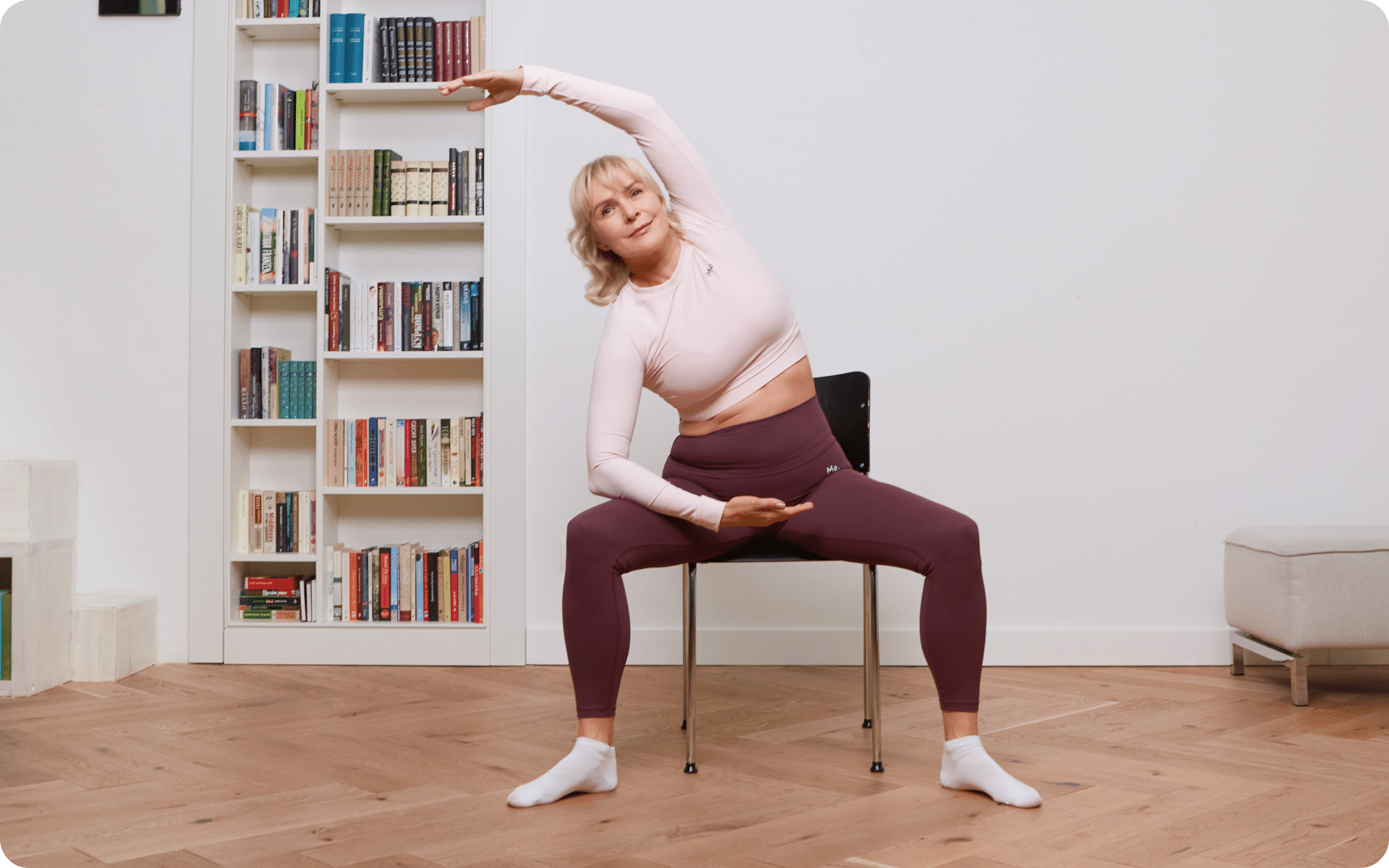
- Yoga is generally a low-impact activity, and older adults may need to modify some poses (5).
- Short sessions of 10 to 20 minutes are enough to complete this challenge.
What is the 28-day chair yoga challenge?
The 28-day chair yoga challenge is a four-week plan of yoga poses done on or beside a chair. The chair gives support, so you can focus on slow movement and breathing.
Sessions last 10 to 20 minutes. Each week adds a few poses or a little time. Most weeks keep a rest day between sessions, and repeating a week is always allowed.
The challenge is a schedule, not a test. Finishing 28 days matters less than finding sessions you want to keep.
What do you need before you start?
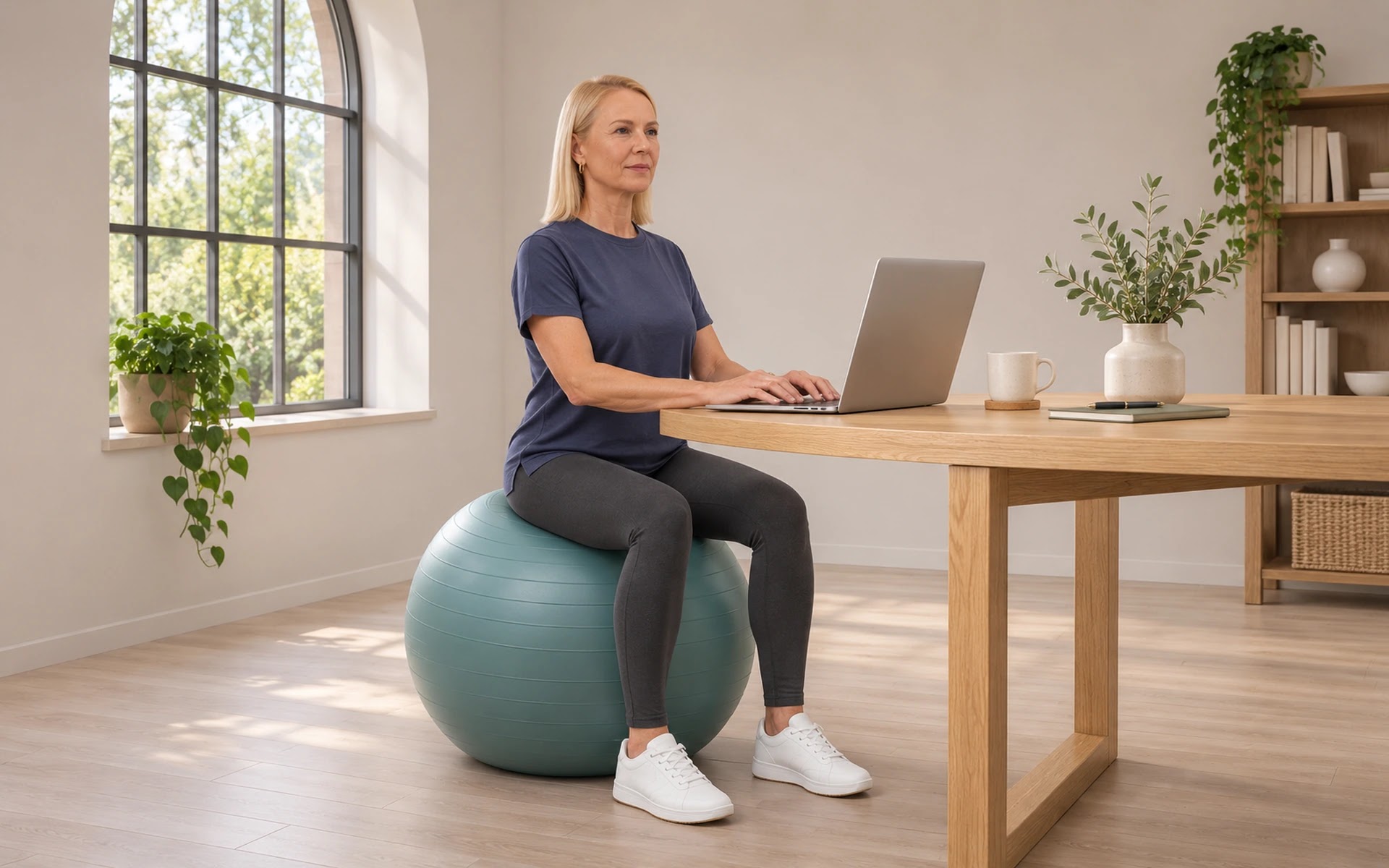
You need a sturdy chair, comfortable clothes, and a clear space around you. No other equipment is required.
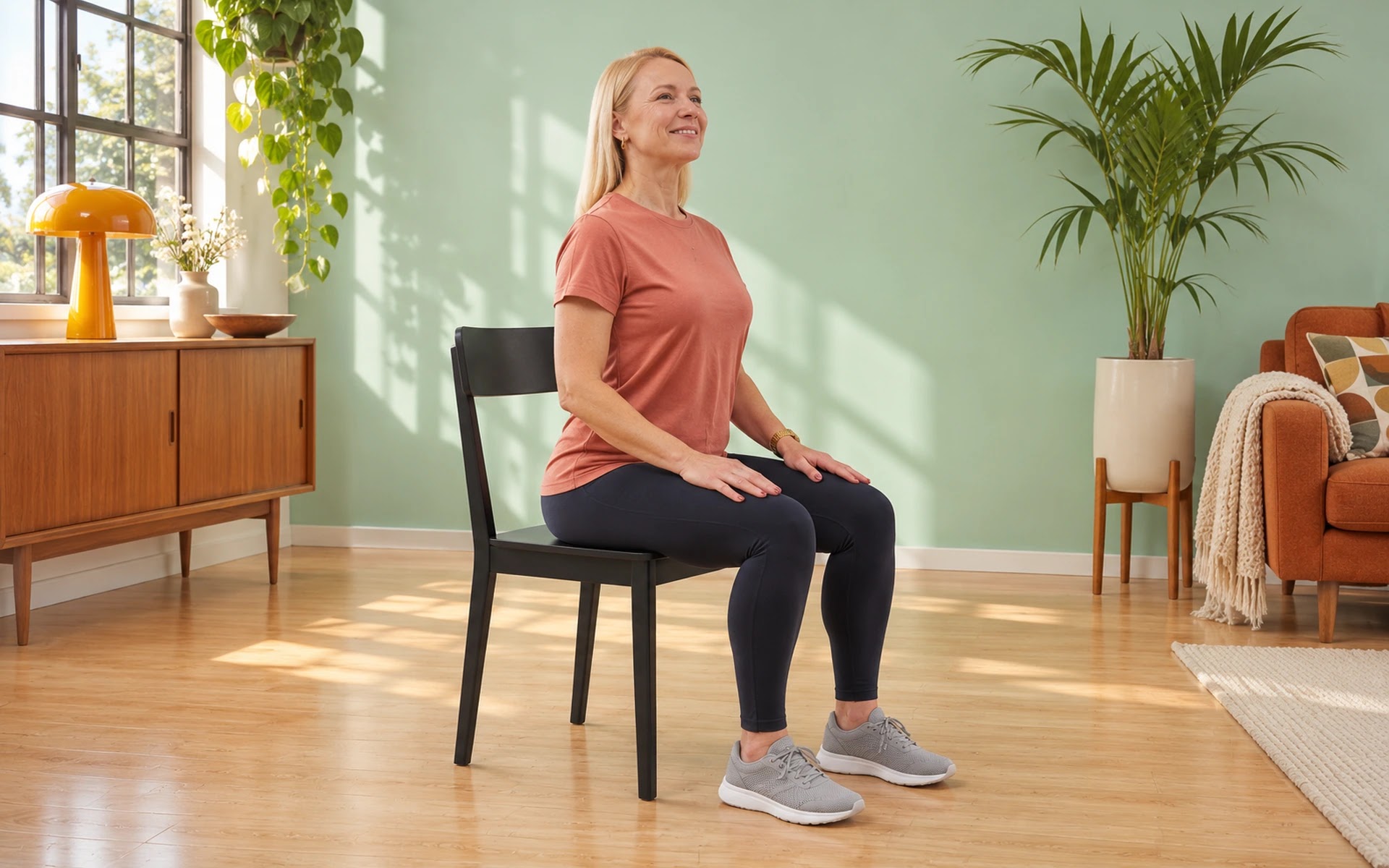
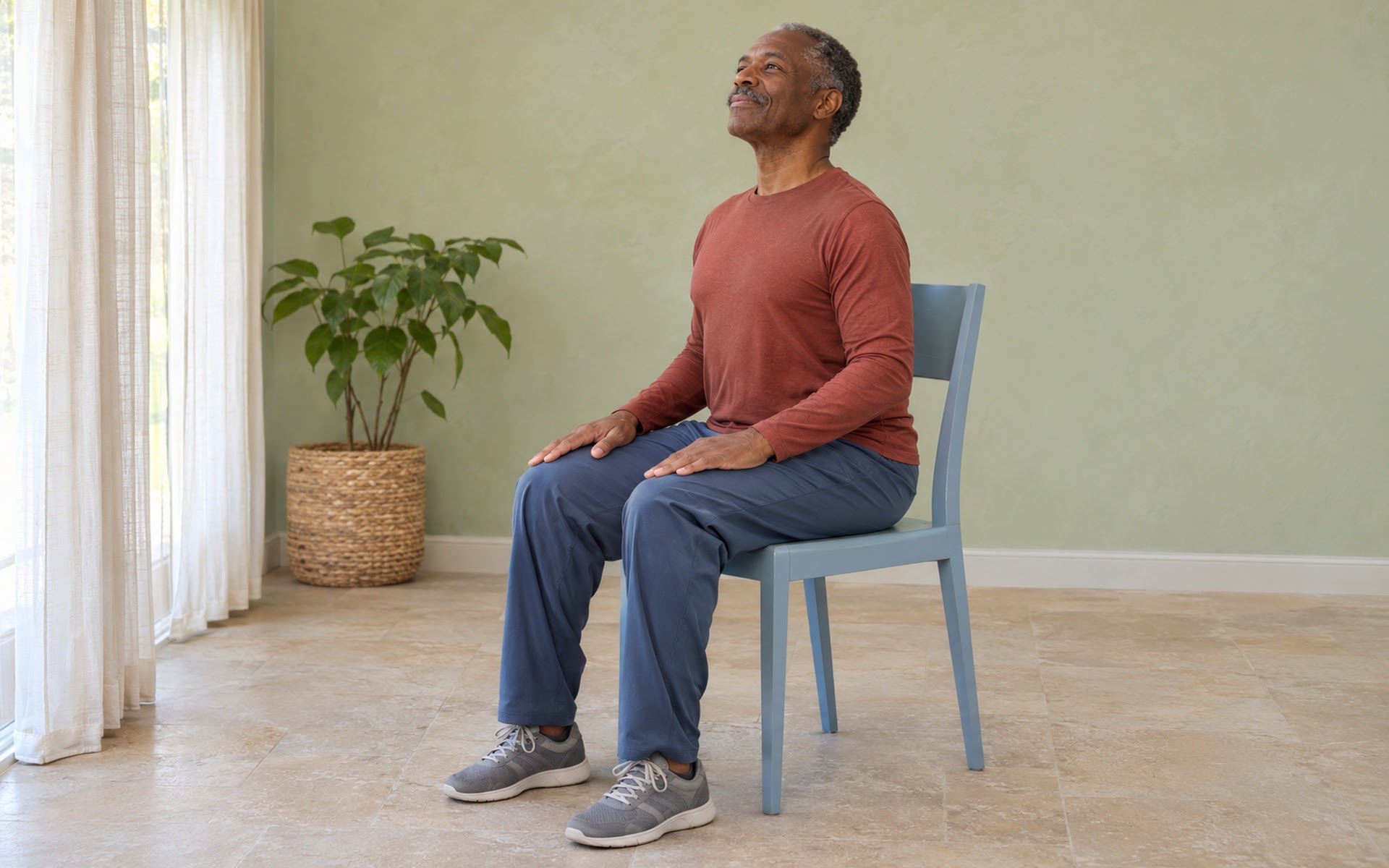
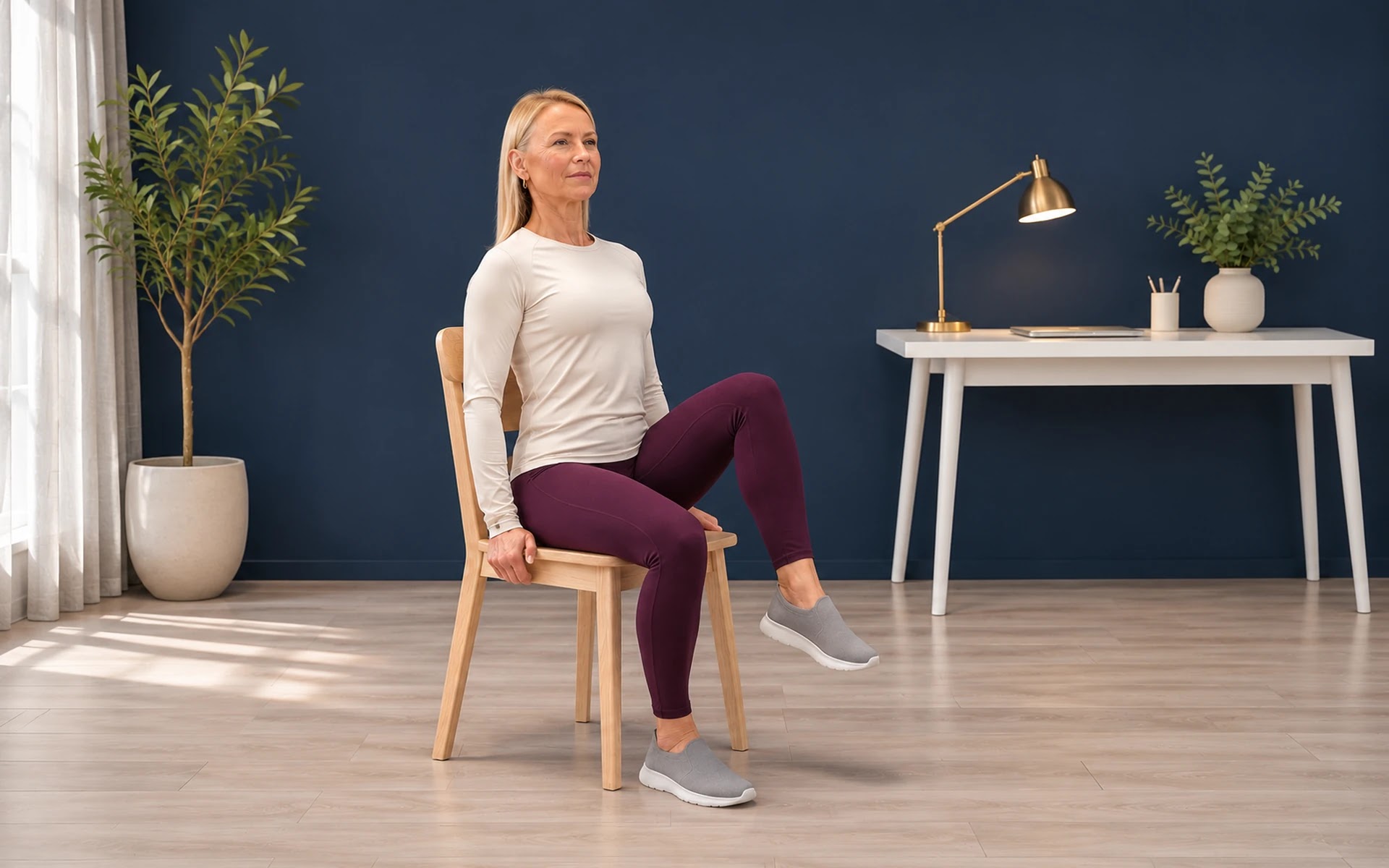
Seated exercise guidance describes the right chair. Choose a solid, stable chair without wheels. Sit with your feet flat on the floor and your knees bent at right angles (1). The same guidance suggests avoiding chairs with arms, which limit movement (1).
Place the chair on a non-slip surface or against a wall. Wear shoes with grip or go barefoot on a mat. Keep water nearby.
What does the 28-day schedule look like?
The schedule starts with three sessions a week and builds to five. The table is an editorial example that you can adjust.
| Week | Sessions | Minutes per session | Poses | Focus |
|---|---|---|---|---|
| 1 | 3 | 10 | Poses 1, 6, 7, 9, 10 | Learn the setup and breathe slowly |
| 2 | 4 | 12 to 15 | Add poses 2 and 8 | Hold each pose a little longer |
| 3 | 4 | 15 | Add poses 3, 4, and 11 | Link poses into a sequence |
| 4 | 5 | 15 to 20 | All 11 poses | Add pose 5 and repeat your favorites |
A simple weekly pattern keeps rest days in place.
- Pick fixed days, such as Monday, Wednesday, and Friday in week 1.
- Add Saturday in weeks 2 and 3.
- Add Tuesday in week 4.
- Keep at least one full rest day each week.
- Repeat a week if the next one feels like too much.
For a shorter program, see our 21-day chair yoga plan.
Which 11 poses are in the challenge?
The challenge uses 11 poses: six seated and five standing with the chair for support. The table shows the position and purpose of each.
| Pose | Position | What you practice |
|---|---|---|
| 1. Mountain pose | Standing beside the chair | Upright posture and steady breathing |
| 2. Chair-assisted forward fold | Standing, hands on the seat | Hinging at the hips |
| 3. Chair warrior I | Standing, one hand on the chair | A long stance with arms lifted |
| 4. Chair warrior II | Standing, one hand on the chair | A wide stance with open hips |
| 5. Chair tree pose | Standing, one hand on the chair | Balance on one leg |
| 6. Cat-cow | Seated | Moving the spine forward and back |
| 7. Seated forward bend | Seated | Folding forward with a long back |
| 8. Seated pigeon | Seated | Opening the outer hip |
| 9. Seated side stretch | Seated | Lengthening the side of the body |
| 10. Seated spinal twist | Seated | Rotating through the upper back |
| 11. Seated eagle arms | Seated | Stretching the upper back and shoulders |
Move slowly, and stay within a range that feels comfortable. Breathe in and out through each hold.
1. Mountain pose (Tadasana)
Mountain pose teaches the upright posture used in every other pose.
- Stand beside the chair with one hand on its back.
- Place your feet hip-width apart.
- Lengthen through the crown of your head.
- Hold for five slow breaths.
2. Chair-assisted forward fold (Uttanasana)
The chair-assisted forward fold stretches the back of the legs with support.
- Stand facing the chair seat, about one step away.
- Bend your knees slightly and hinge at your hips.
- Rest your hands on the seat and keep your back long.
- Hold for three to five breaths, then stand up slowly.
3. Chair warrior I (Virabhadrasana I)
Chair warrior I builds a steady long stance.
- Stand beside the chair and hold its back with one hand.
- Step the outside foot back and bend the front knee.
- Lift the free arm overhead if your shoulder allows.
- Hold for three breaths and change sides.
4. Chair warrior II (Virabhadrasana II)
Chair warrior II opens the hips in a wide stance.
- Stand behind the chair with both hands on its back.
- Step your feet wide and turn one foot out.
- Bend that knee over the ankle.
- Hold for three breaths and change sides.
5. Chair tree pose (Vrksasana)
Chair tree pose is a supported one-leg balance.
- Stand beside the chair and hold its back.
- Shift your weight onto the leg nearest the chair.
- Rest the other foot on your ankle or shin, not on the knee.
- Hold for three breaths and change sides.
6. Cat-cow (Marjaryasana-Bitilasana)
Seated cat-cow moves the spine gently in two directions.
- Sit tall with your hands on your knees.
- Breathe in, lift your chest, and look slightly up.
- Breathe out, round your back, and lower your chin.
- Repeat five times.
7. Seated forward bend (Paschimottanasana)
The seated forward bend folds the body over the thighs.
- Sit near the front of the chair with your feet flat.
- Hinge at your hips and slide your hands down your legs.
- Let your head hang only as far as feels comfortable.
- Hold for three breaths and roll up slowly.
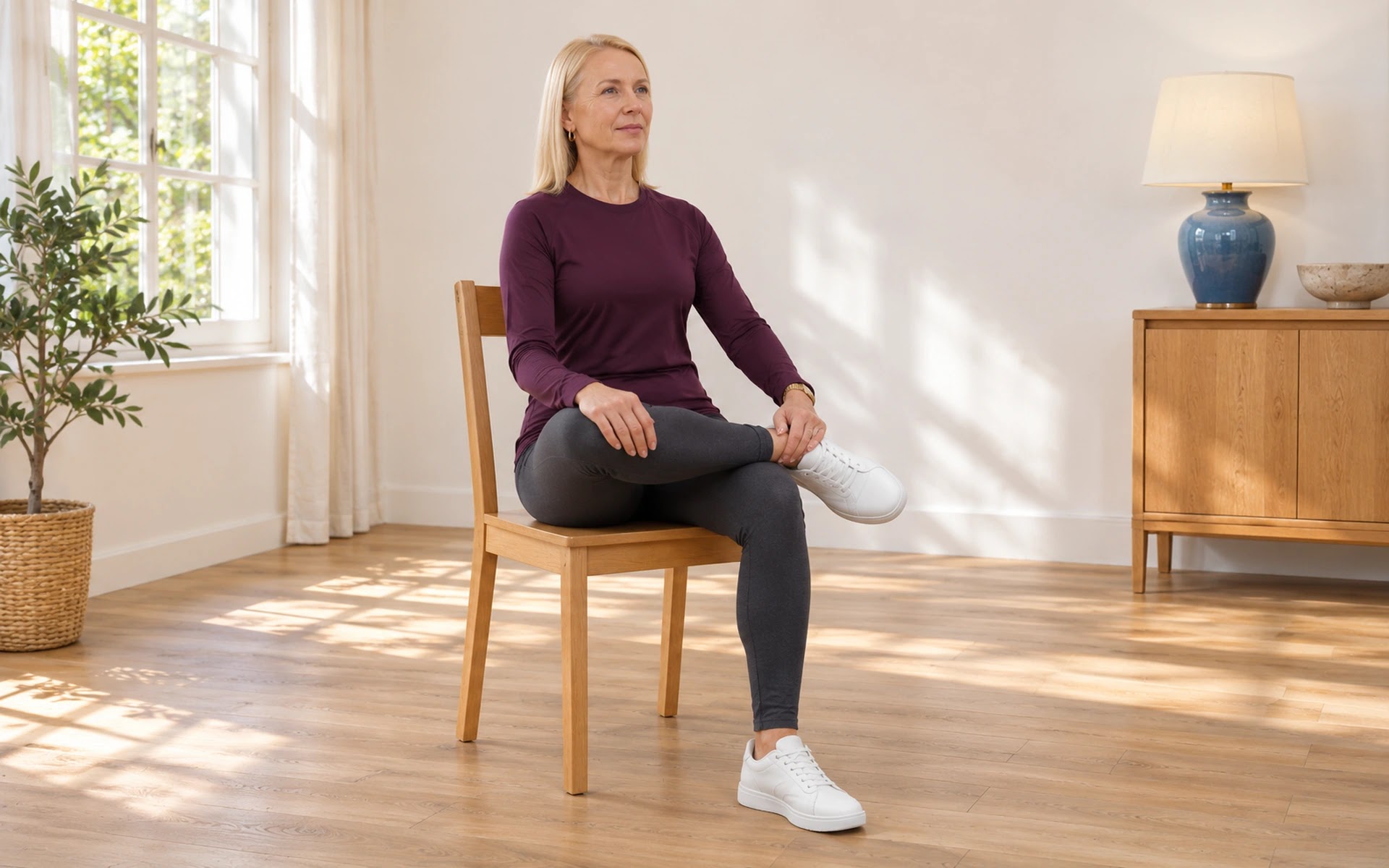
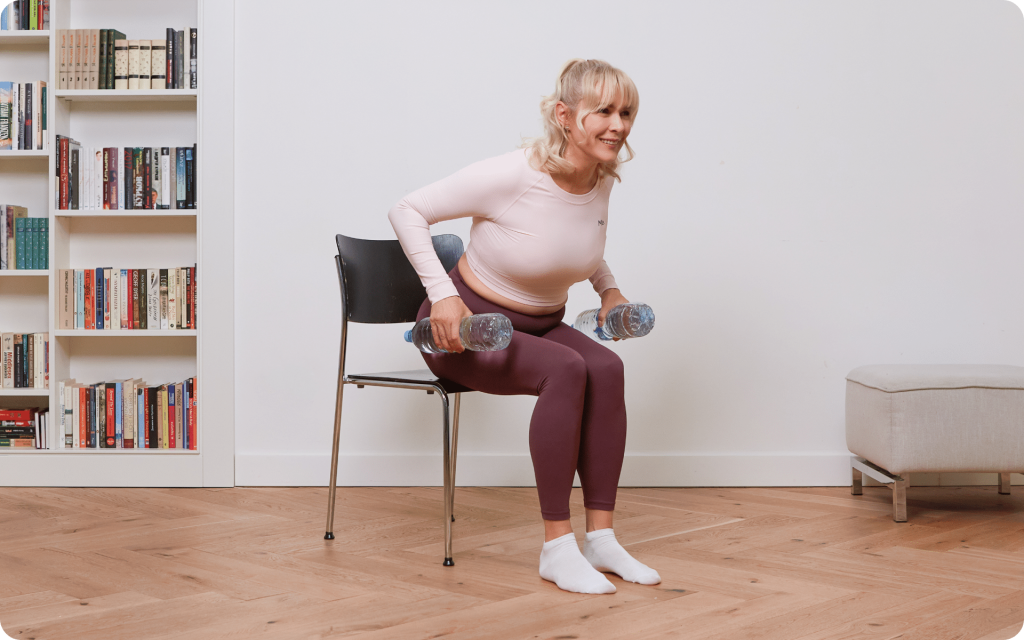
8. Seated pigeon (Eka Pada Rajakapotasana)
Seated pigeon stretches the outer hip.
- Sit tall and place one ankle on the opposite knee.
- Keep the lifted foot flexed.
- Lean forward a little with a long back.
- Hold for three breaths and change sides.
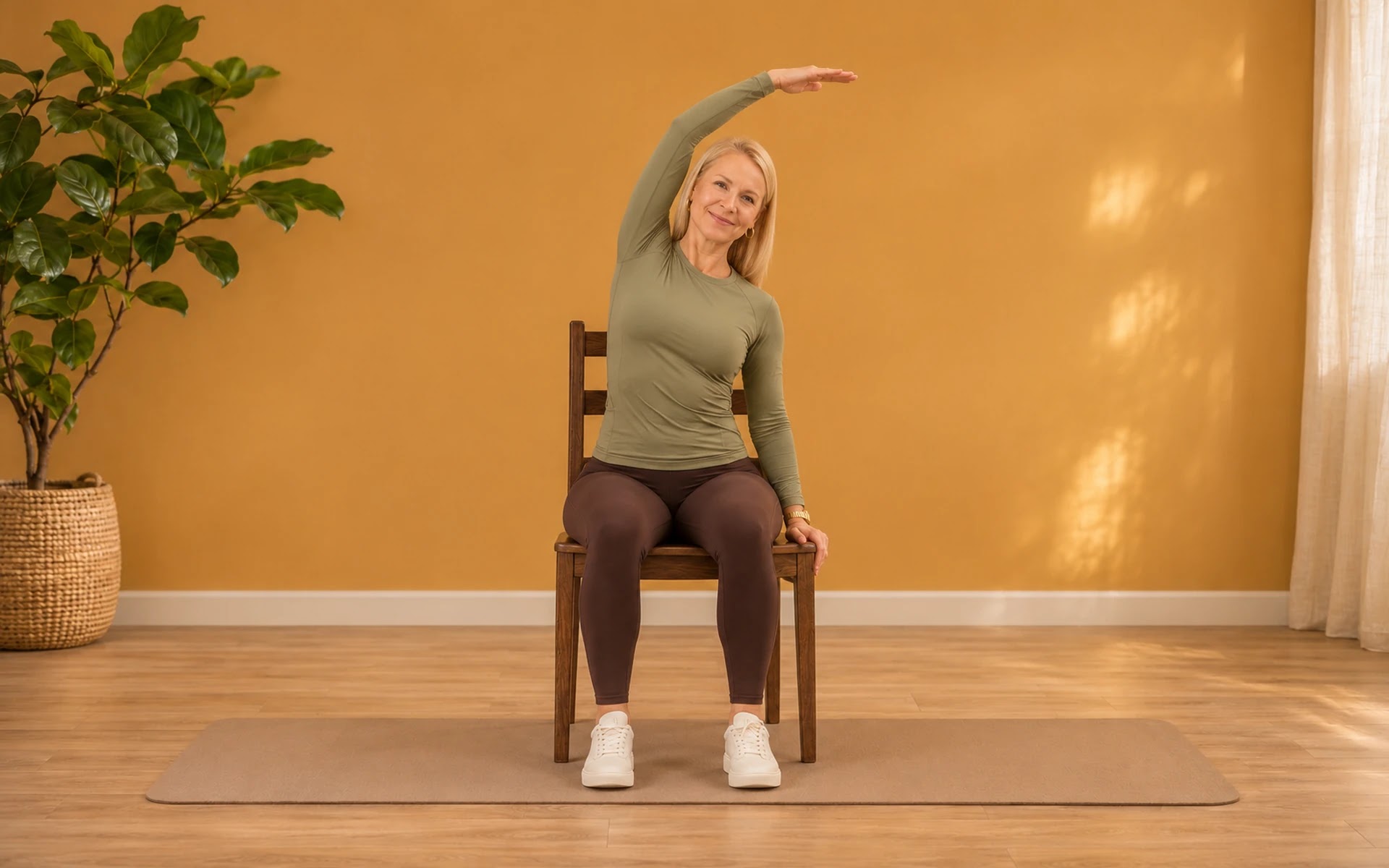
9. Seated side stretch (Parsva Sukhasana)
The seated side stretch lengthens one side of the body at a time.
- Sit tall and hold the seat with your left hand.
- Reach your right arm up and over to the left.
- Keep both hips on the chair.
- Hold for three breaths and change sides.
10. Seated spinal twist (Ardha Matsyendrasana)
The seated spinal twist rotates the upper back.
- Sit sideways on the chair with your right side to the chair back.
- Hold the chair back with both hands.
- Turn your chest toward the chair back without forcing.
- Hold for three breaths and change sides.
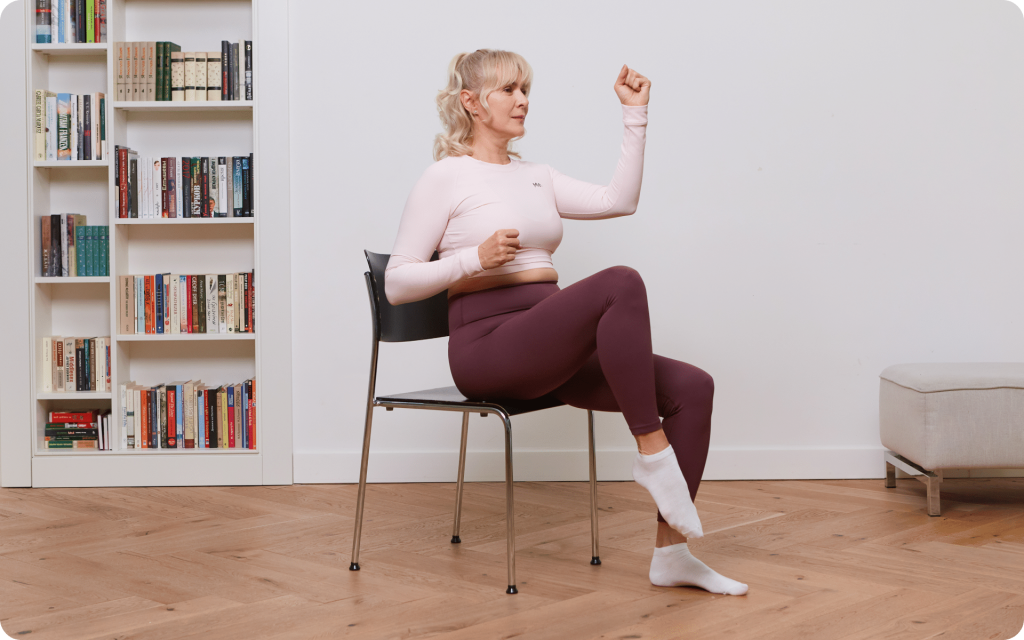
11. Seated eagle arms (Garudasana)
Seated eagle arms stretch the upper back and shoulders.
- Sit tall and cross your right arm under your left.
- Bend both elbows and bring the backs of your hands together.
- Lift your elbows slightly.
- Hold for three breaths and change sides.
Read more: Benefits of chair yoga: supported practice and what research shows
How do you put the poses into a session?
Put the poses into a session by starting seated, moving to standing, and ending seated. The sample below takes about 15 minutes.
| Part | Poses | Time |
|---|---|---|
| Warm-up | Cat-cow, seated side stretch | 3 minutes |
| Seated work | Seated twist, seated pigeon, eagle arms | 4 minutes |
| Standing work | Mountain, warrior I, warrior II | 5 minutes |
| Finish | Seated forward bend, slow breathing | 3 minutes |
Add tree pose in week 4. For a calmer finish, our restorative chair yoga guide has longer holds.
Whether you’re just starting your fitness journey or looking to add more structure to your routine, BetterMe offers tools that can support different wellness goals. Explore the app and see how its workout, nutrition, and habit-building features can fit into your lifestyle.
What can chair yoga do in four weeks?
Four weeks is enough to learn the poses and build a habit. Research on physical changes used longer programs.
In one trial, older adults with joint problems in the legs who could not do standing exercise tried chair yoga. Participants attended 45-minute sessions twice a week for 8 weeks (2). Walking speed and fatigue improved during the program. The walking-speed gains did not last after the program ended (2). Balance did not change (2).
A review pooled six trials of yoga in people aged 60 and over. Yoga produced a small improvement in balance and a medium improvement in mobility (3). Those trials used a mix of yoga styles, not only chair yoga.
These findings support modest expectations. Regular practice seems to matter, and benefits may fade when practice stops.
How does the challenge fit weekly activity guidelines?
The challenge covers part of the weekly activity that adults are advised to get. Chair yoga is light, so other movement is still needed.
Adult guidelines recommend 150 minutes of moderate activity a week, such as 30 minutes on five days. The guidelines add muscle-strengthening work on at least two days (4). Guidance for adults aged 65 and over also includes activities that improve balance (6).
A 15-minute chair session four times a week adds up to 60 minutes. Walking, swimming, or cycling can fill the rest. Our guide to chair yoga poses for balance adds more standing work.
How do you stay comfortable and steady during the challenge?
Stay comfortable by moving slowly, using the chair for support, and stopping before a stretch becomes sharp. Small ranges count.
Yoga is generally a low-impact activity. Sprains and strains are the most commonly reported problems, and serious ones are rare (5). Older adults may need to be particularly cautious and may need to modify some poses (5). For more seated options, see these yoga chair exercises for seniors.
- Keep one hand on the chair in every standing pose.
- Skip any pose that feels wrong, and try it again another week.
- Breathe steadily, and avoid holding your breath.
- Tell your instructor about any health concern before a class.
People who are pregnant, older adults, and people with health conditions should talk with a health care provider first (5).
Read more: 10 yoga chair exercises for seniors: steps, routine, and tips
Frequently Asked Questions
Can you do chair yoga every day?
Yes, short gentle sessions can be done daily if your body feels fine. This plan uses three to five sessions a week so that beginners have rest days.
How long should a chair yoga session be?
Ten to 20 minutes is enough for this challenge. The trial cited above used 45-minute classes twice a week (2).
Is the 28-day chair yoga challenge suitable for beginners?
Yes, the challenge starts with five simple poses and adds more each week. Beginners can repeat week 1 until the poses feel familiar.
Do you need a special chair for chair yoga?
No, a solid kitchen or dining chair without wheels works (1). Avoid soft armchairs and office chairs that roll.
What should you do after day 28?
After day 28, keep the sessions you liked and add variety. Longer holds, new poses, or a class with an instructor are all reasonable next steps.
The bottom line
A 28-day chair yoga challenge gives you a simple four-week structure and 11 supported poses. Start with three short sessions a week, add poses gradually, and keep a hand on the chair. Combine the challenge with walking or other activity for a fuller week.
DISCLAIMER:
This article is intended for general informational purposes only and does not serve to address individual circumstances. It is not a substitute for professional advice or help and should not be relied on for making any kind of decision-making. Any action taken as a direct or indirect result of the information in this article is entirely at your own risk and is your sole responsibility.
BetterMe, its content staff, and its medical advisors accept no responsibility for inaccuracies, errors, misstatements, inconsistencies, or omissions and specifically disclaim any liability, loss or risk, personal, professional or otherwise, which may be incurred as a consequence, directly or indirectly, of the use and/or application of any content.
You should always seek the advice of your physician or other qualified health provider with any questions you may have regarding a medical condition or your specific situation. Never disregard professional medical advice or delay seeking it because of BetterMe content. If you suspect or think you may have a medical emergency, call your doctor.
Some visuals may be AI-generated.
SOURCES:
- Sitting exercises (2024, nhs.uk)
- A Pilot Randomized Controlled Trial of the Effects of Chair Yoga on Pain and Physical Function Among Community-Dwelling Older Adults With Lower Extremity Osteoarthritis (2017, pubmed.ncbi.nlm.nih.gov)
- Yoga-based exercise improves balance and mobility in people aged 60 and over: a systematic review and meta-analysis (2016, pubmed.ncbi.nlm.nih.gov)
- Adult Activity: An Overview (2023, cdc.gov)
- Yoga: What You Need To Know (2023, nccih.nih.gov)
- Older Adult Activity: An Overview (2025, cdc.gov)
 Reviewed by
 Reviewed by