
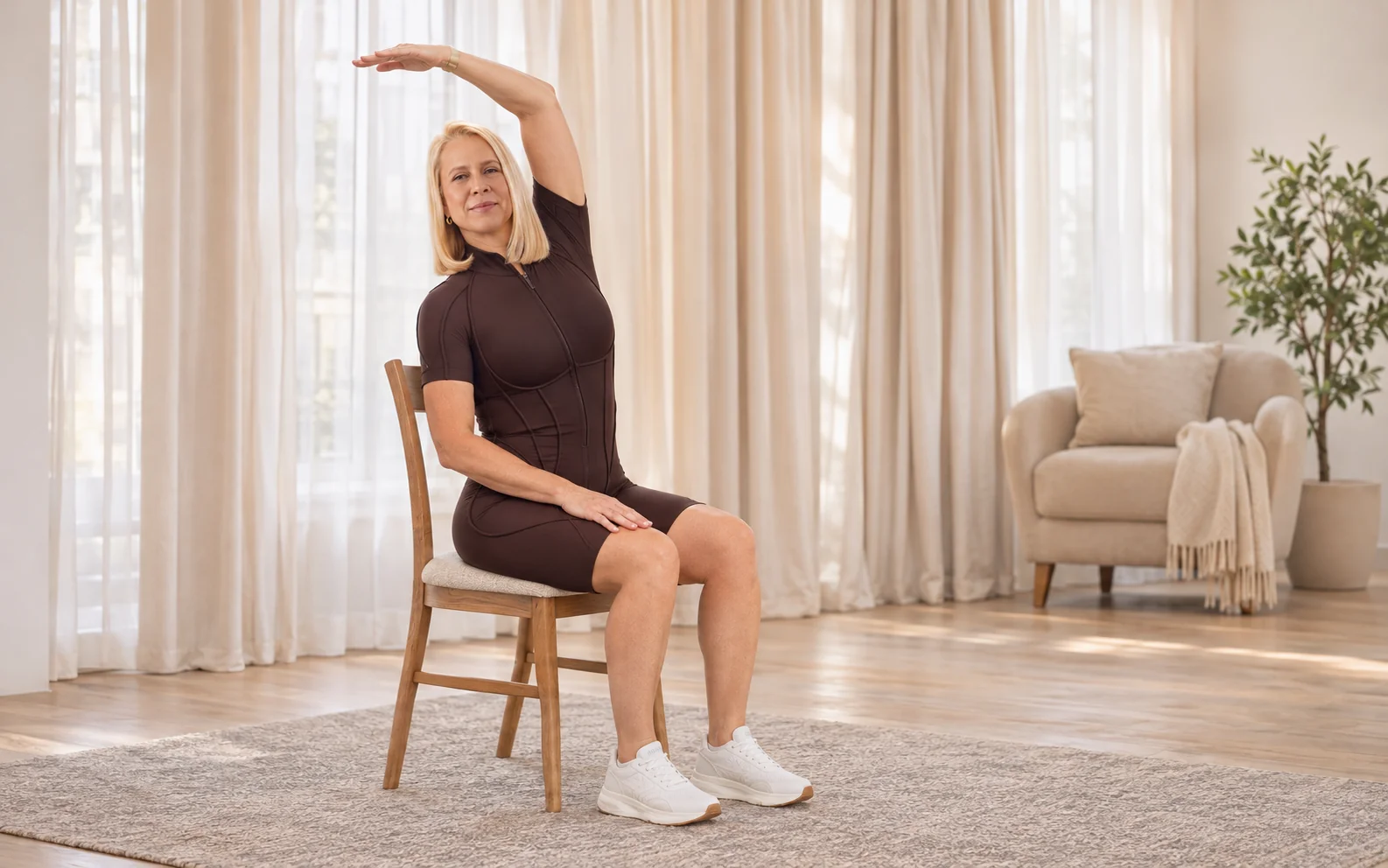
Chair yoga uses a seat or backrest for support during movement. That can make practice more accessible when floor work is difficult. Studies of older adults have pooled several types of yoga (1, 2). The findings below are identified separately from practical chair adaptations. For an introduction, see our what is chair yoga guide.
Check with a doctor before starting if you have a heart condition, balance problems, joint problems, or recent surgery.
If you have joint, muscle, or spine-related concerns, please consult your physician before starting this workout.
Following exercise and diet plans is the key in your fitness journey and greatly impacts results. In 4 weeks users can typically expect to lose not more than 1-2 lbs per week. Individual results may vary.
Key takeaways
These points distinguish the programs researchers studied from options for a supported practice.
- Across yoga trials in adults aged 60 and over, pooled results showed a small balance gain and a medium mobility gain (1).
- In older adults, varied yoga programs improved balance, flexibility, leg strength and reported sleep quality compared with inactive groups (2).
- Varied yoga programs were associated with changes in stress measures across 42 studies; this chair routine was not tested (3).
- One review found no overall weight effect, and a body mass index subgroup result was uncertain (4).
- In a separate trial, adults with overweight or obesity had lower post-drink glucose responses when they took short walking breaks during prolonged sitting (5).
- Older adults are advised to include balance and strength activities each week (6).
- Chair yoga can be adapted to many fitness levels.
What is chair yoga?
Chair yoga is a style of yoga done sitting on a chair or standing with a chair for support. It adapts classic poses so you can practice without getting down to the floor.
Sessions usually combine gentle stretches, simple strength moves, and slow breathing. Most classes last 15 to 45 minutes.
What can a chair offer, and what did broader research find?
A seat or backrest changes how a movement is supported. The research summaries below describe the populations and yoga programs studied. Most pooled findings do not isolate chair yoga or these six poses.
1. Balance in yoga research
A review of yoga trials in adults aged 60 and over found a small balance improvement (1). You can use a stationary chair as a handhold during a standing pose.
2. Mobility in yoga research
That review found a medium improvement in mobility tests in adults aged 60 and over (1). This is a result for the reviewed programs.
3. Flexibility in varied yoga programs
Across varied yoga programs, older adults showed better lower-body flexibility than inactive comparison groups (2). A seated fold is one way to practice a stretch using a chair.
4. Leg strength in varied yoga programs
The same review found better lower-limb strength than in inactive groups (2). A supported sit-to-stand is one movement that uses the legs.
5. Sleep reports in older-adult yoga studies
Older adults in the yoga groups reported better sleep quality than inactive comparison groups (2). The pooled result does not predict sleep changes from a particular chair pose.
6. Time for a quiet pause
A review of 42 studies linked varied yoga programs with changes in physiological stress measures (3). It did not establish those effects for this chair routine. You can use the seated practice as a quiet break.
7. A gentle start to activity
The chair removes the need to get up and down from the floor. That makes it easier to begin and repeat.
8. A movement option between desk tasks
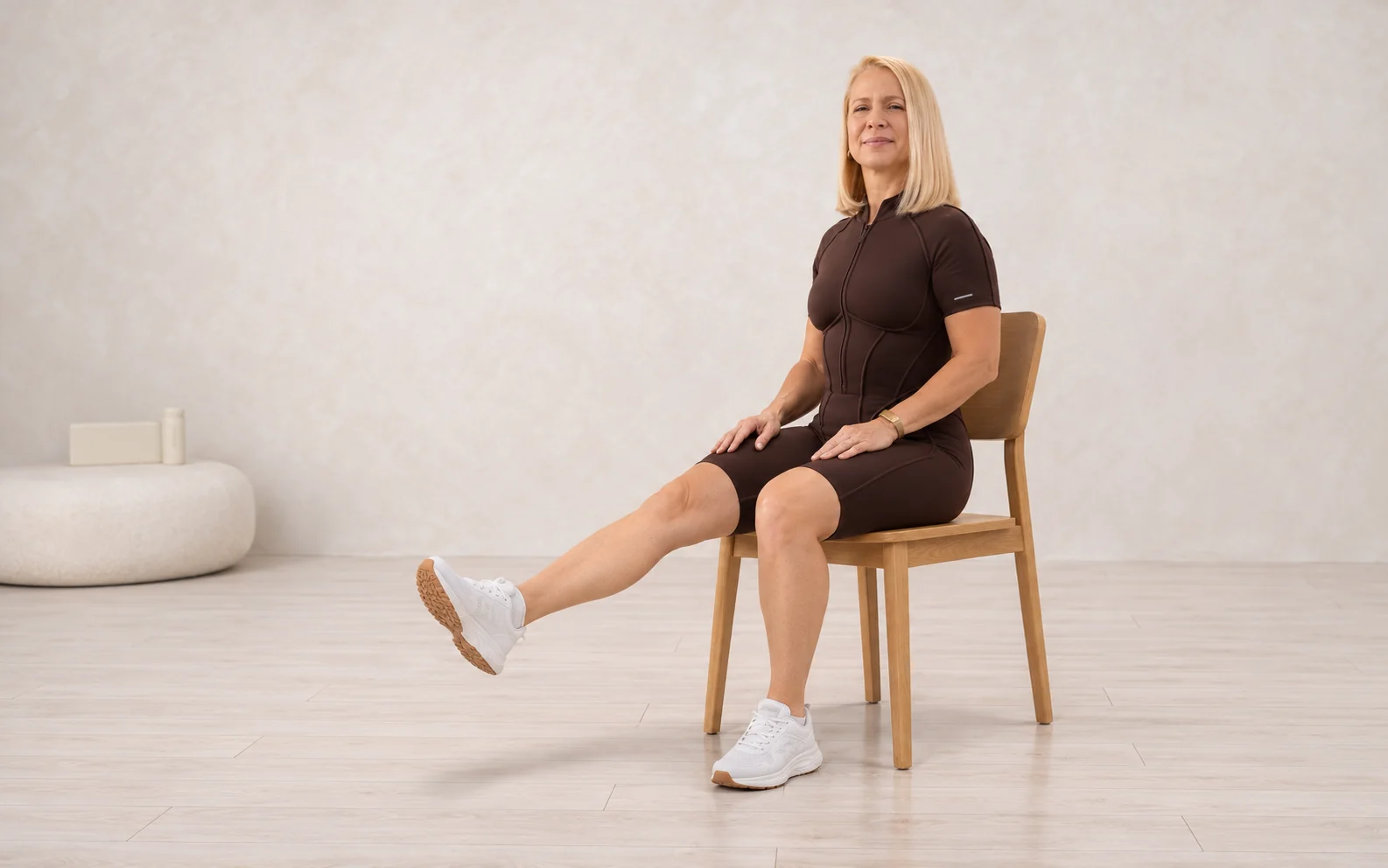
Choose a seated movement when you want a change of position at your desk. Use a firm, stationary chair and keep the range comfortable.
9. Movement within a wider activity plan
The review found no overall weight effect. A subgroup result for body mass index in people with overweight favored yoga (4). The authors noted bias risks, so the effect is uncertain.
10. Vitality ratings in older-adult yoga studies
Older adults in varied yoga programs reported higher vitality scores than inactive comparison groups (2). This was a self-reported outcome.
11. Easy to fit into a day
You can practice at home, at work, or while traveling. A sturdy chair is all you need.
Which outcomes have researchers measured in yoga studies?
The table summarizes varied yoga programs. The pooled results do not isolate chair yoga or establish outcomes from the six starter poses below.
|
Outcome studied |
What research found |
Source |
|---|---|---|
|
Balance |
Small gain with varied yoga programs in adults aged 60 and over |
(1) |
|
Mobility |
Medium gain with varied yoga programs in the same age group |
(1) |
|
Flexibility and leg strength |
Gains versus inactive groups |
(2) |
|
Sleep and vitality |
Better self-reported scores with varied yoga programs |
(2) |
|
Stress markers |
Changes in varied yoga programs; chair routine untested |
(3) |
|
Body mass index |
Subgroup finding only; no overall weight effect |
(4) |
Who can benefit from chair yoga?
Chair yoga can suit a wide range of people.
- Older adults who want support for balance
- Beginners who are new to yoga
- Office workers who sit for long hours
- People who find floor work hard
- People returning to activity after a break, with a doctor’s approval
What are 6 chair yoga poses to start with?
These poses cover breathing, stretching, and strength. Move slowly and stay in a comfortable range.
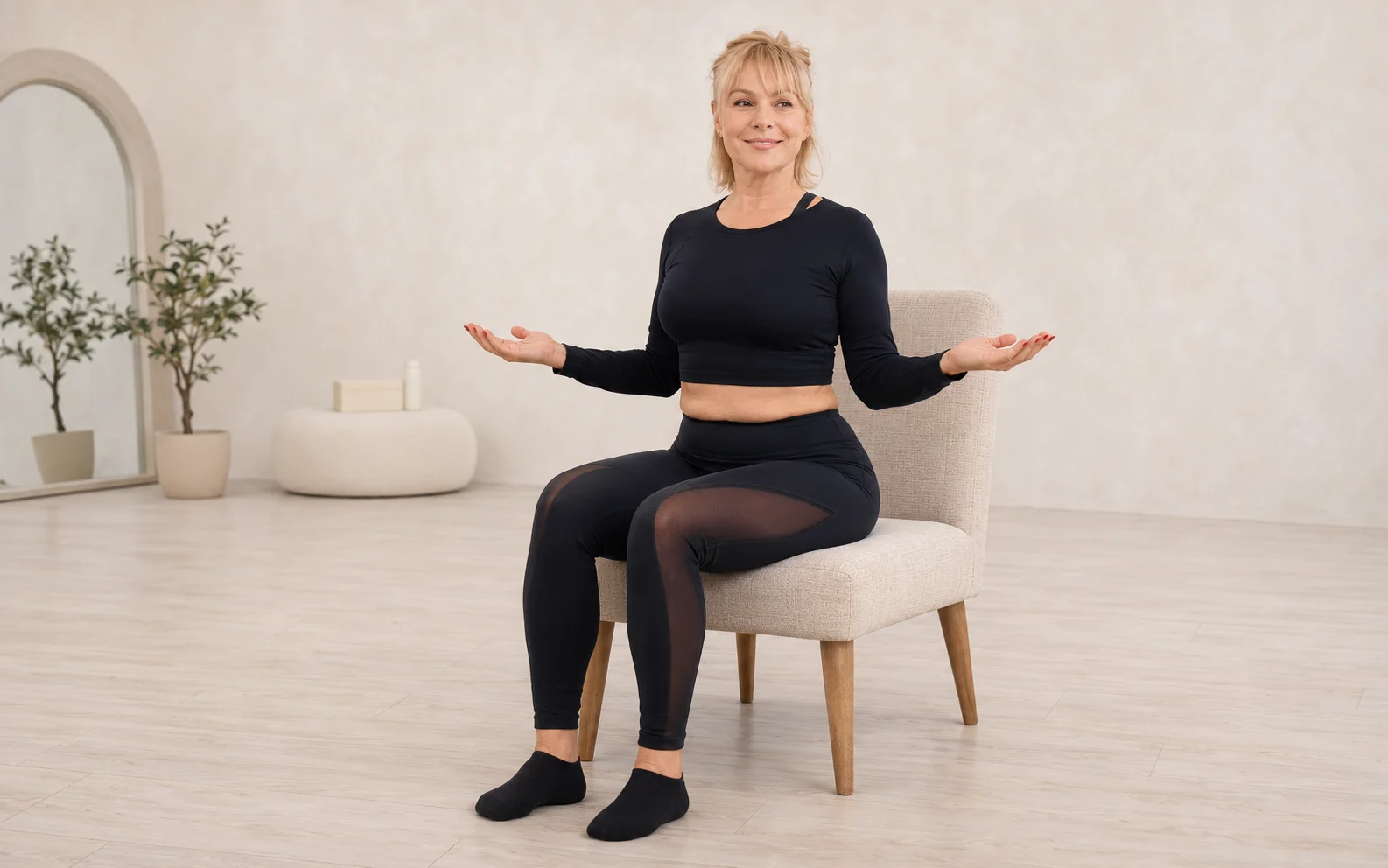
Seated mountain pose
- Sit tall with your feet flat and hip-width apart.
- Rest your hands on your thighs.
- Breathe slowly for 5 breaths.
Seated cat-cow
- Place your hands on your knees.
- Breathe in and gently arch your back, lifting your chest.
- Breathe out and round your back.
- Repeat 6 to 8 times.
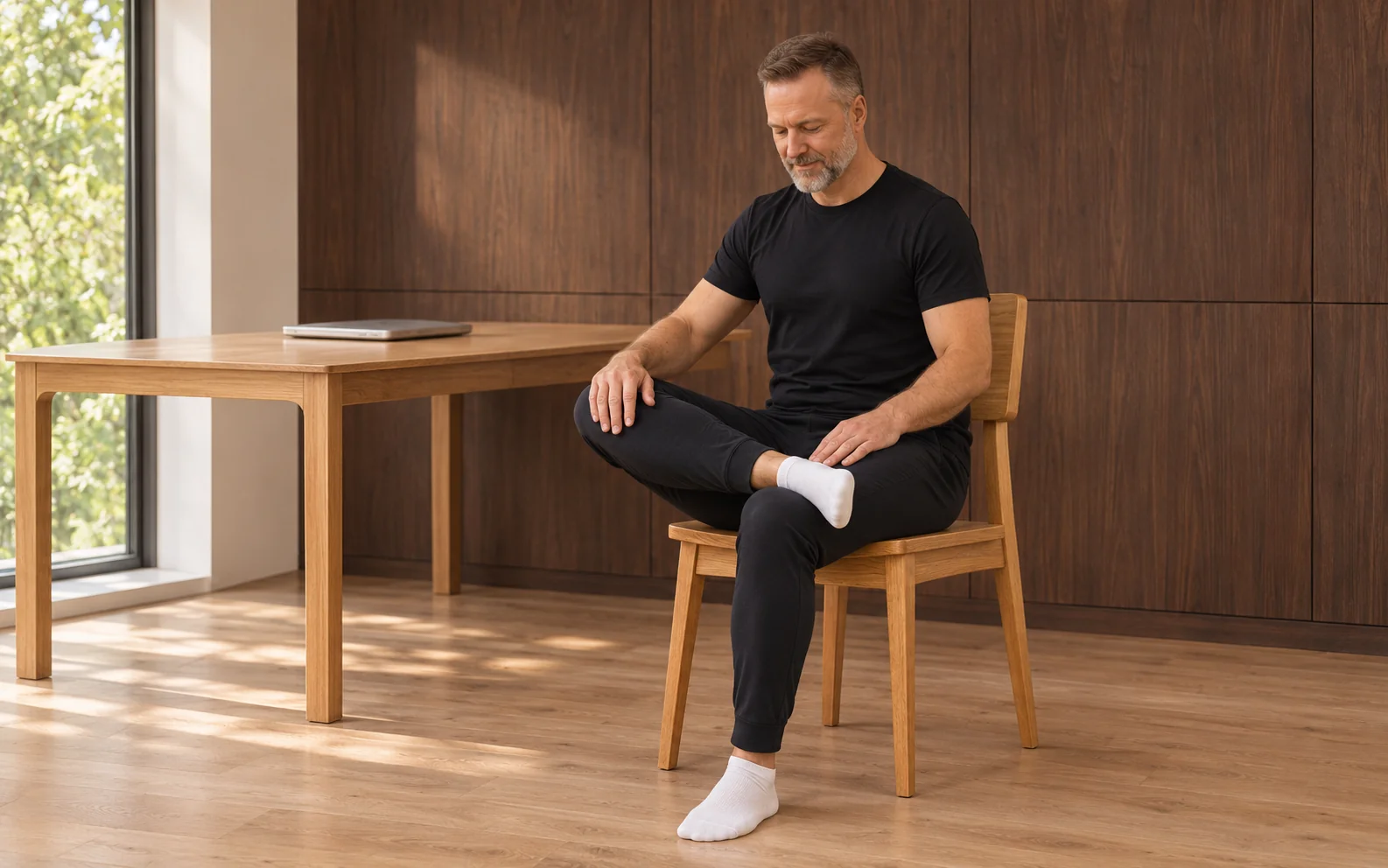
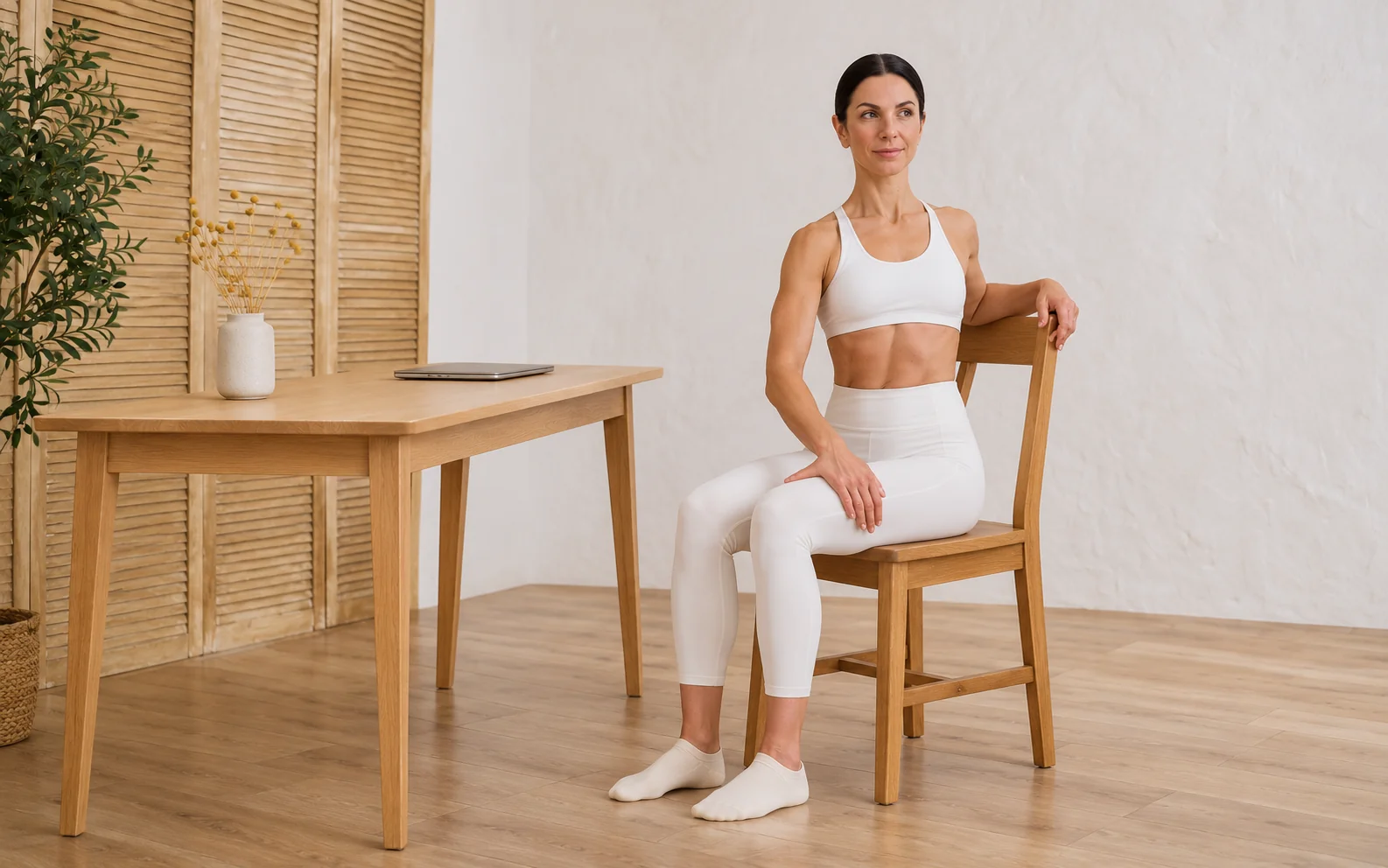
Seated twist
- Sit tall and place your right hand on your left knee.
- Turn your chest gently to the left.
- Hold for 3 breaths, then switch sides.
Seated forward fold
- Sit near the front of the chair with your feet flat.
- Hinge forward from your hips and let your arms hang.
- Hold for 3 to 5 breaths, then sit up slowly.
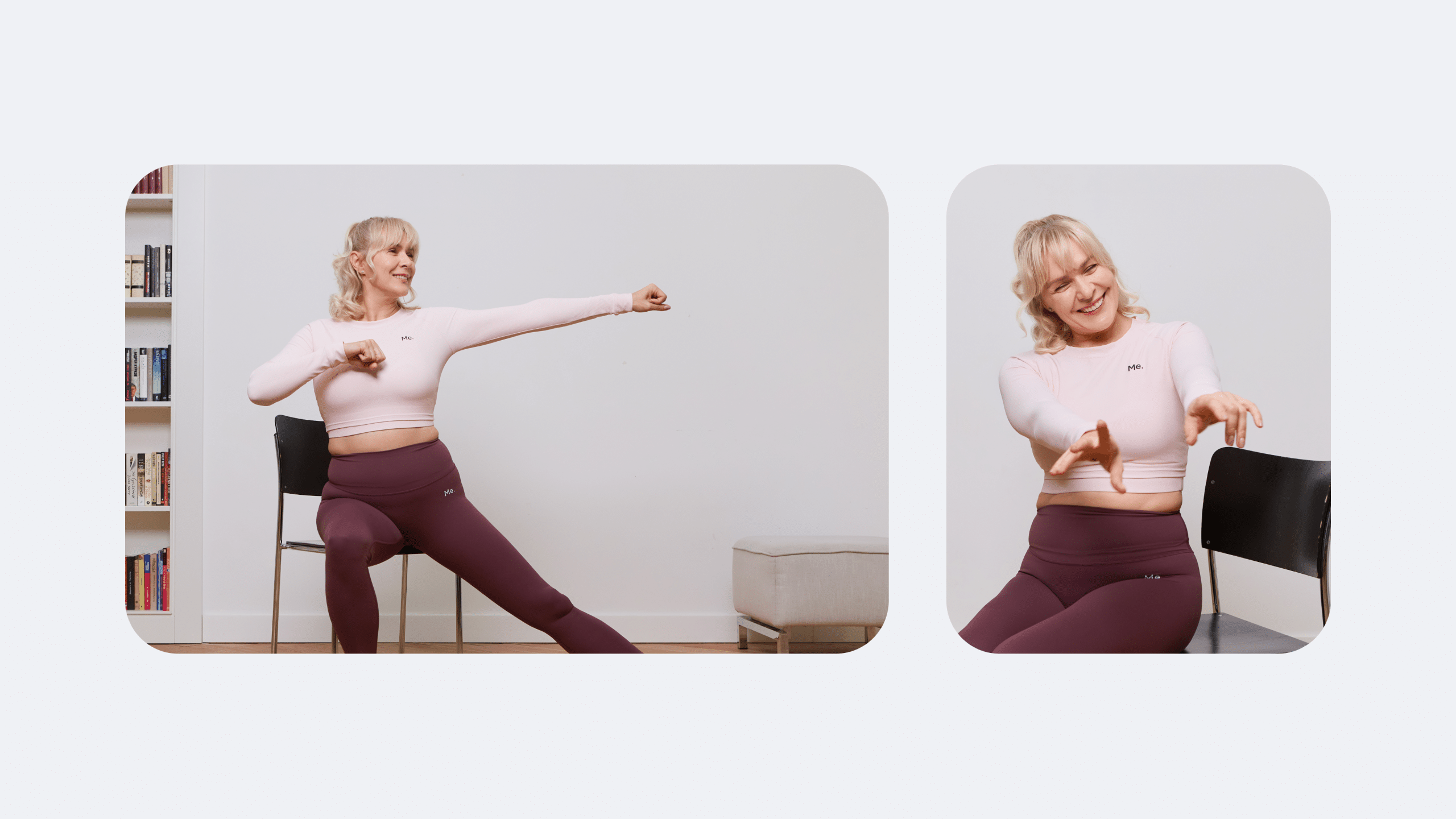
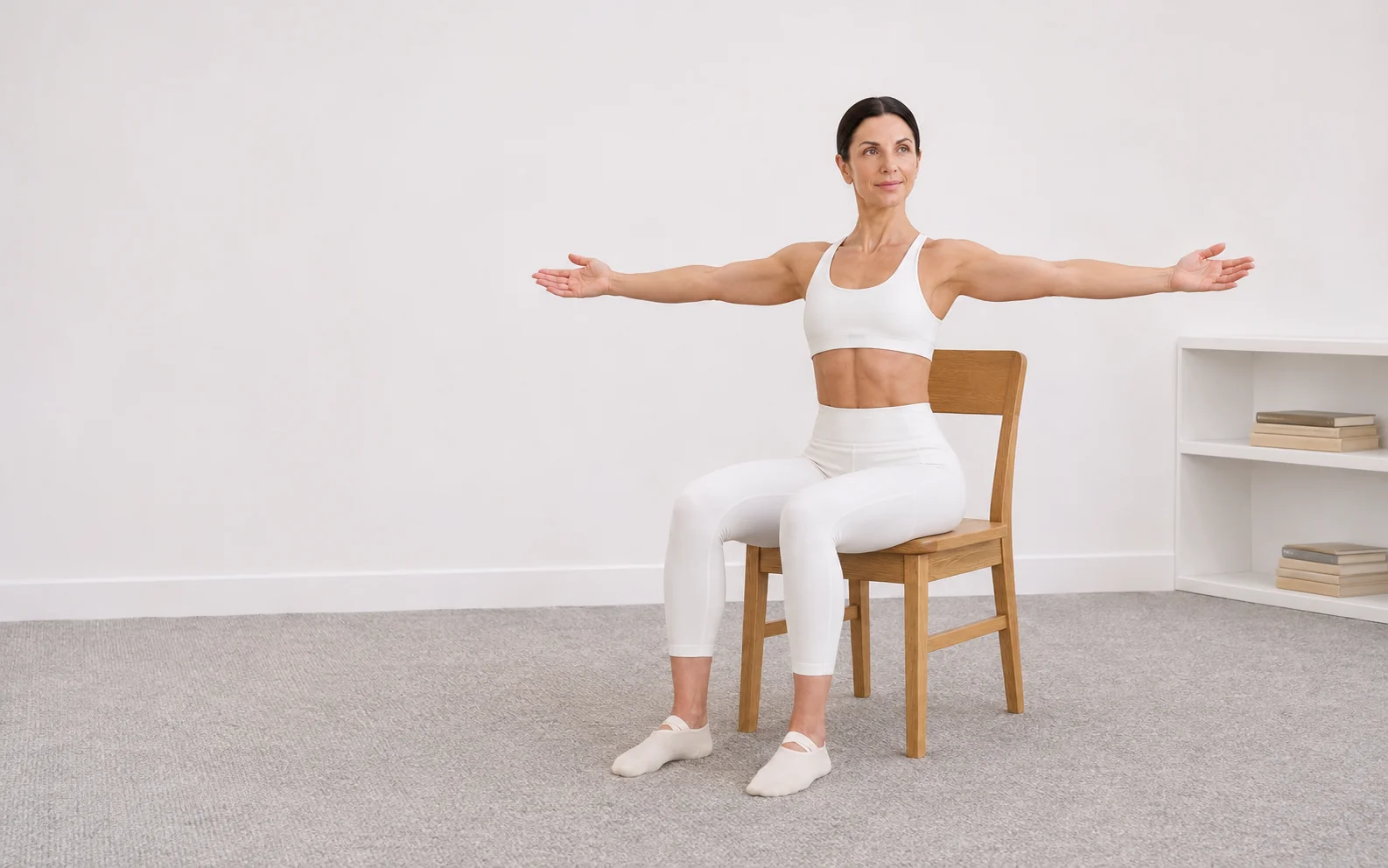
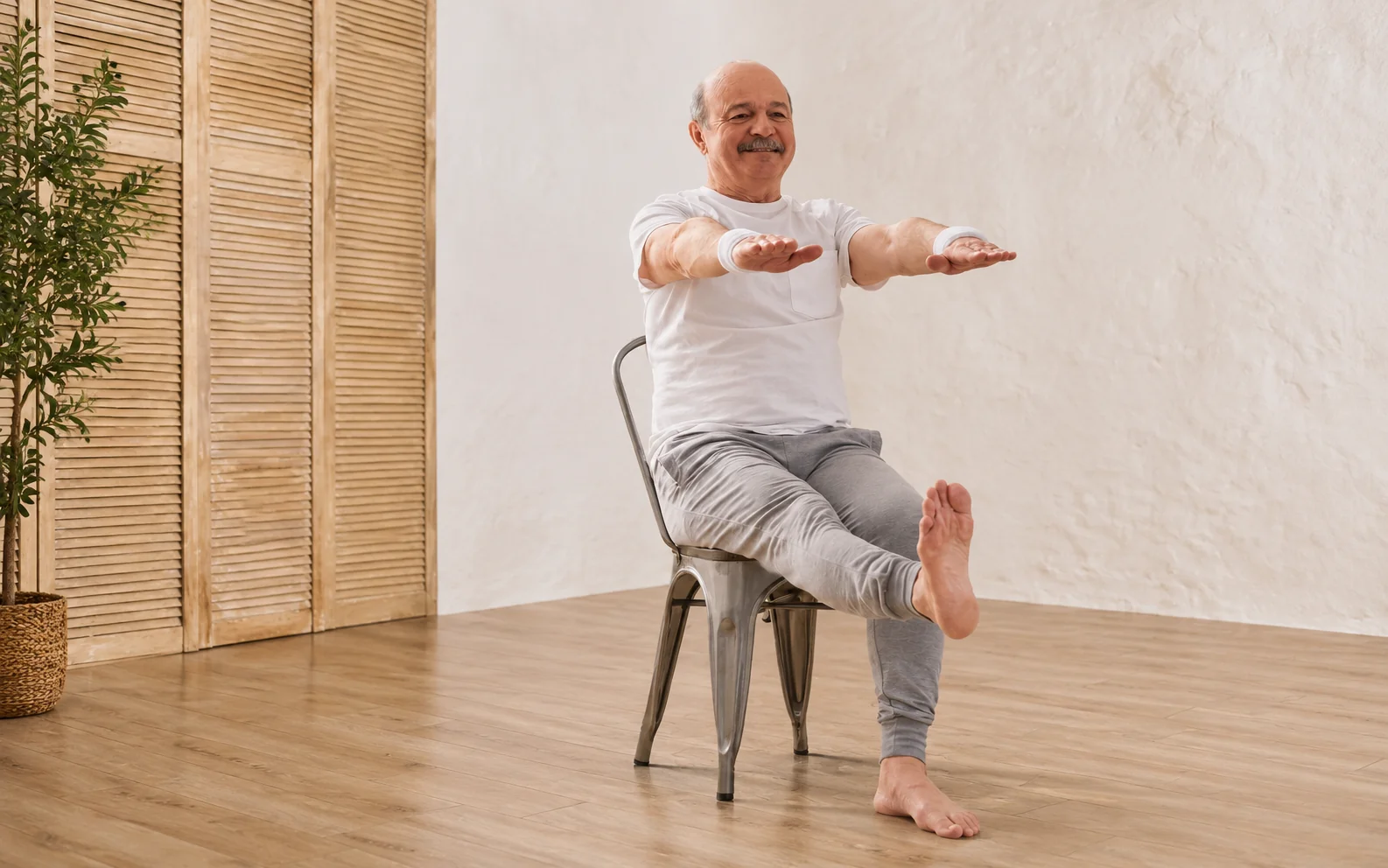
Chair warrior II
- Sit sideways with your right thigh on the seat.
- Extend your left leg behind you.
- Reach your arms out to the sides and hold for 5 breaths per side.
Chair squat
- Sit near the front edge with your feet flat.
- Stand up through your heels.
- Lower slowly back to the seat. Do 8 to 10 reps.
How can you combine the starter poses?
Try the sequence below at a comfortable pace. Breathing, repetitions, and rests determine how long the session takes. Try the seated yoga stretches guide for additional supported movements.
|
Part |
Exercise |
Time or reps |
|---|---|---|
|
Warm-up |
Neck and shoulder rolls |
2 minutes |
|
Breathing |
Seated mountain pose |
5 breaths |
|
Spine |
Seated cat-cow |
8 reps |
|
Spine |
Seated twist |
3 breaths per side |
|
Legs |
Chair squats |
2 sets of 8 to 10 |
|
Legs and hips |
Chair warrior II |
5 breaths per side |
|
Cool-down |
Seated forward fold |
5 breaths, twice |
What does a 4-week starter plan look like?
Start small and add time gradually. Adjust the sample schedule to your week.
|
Week |
Sessions |
Focus |
|---|---|---|
|
1 |
3 a week, 10 minutes |
Learn breathing and the first 3 poses |
|
2 |
3 a week, 15 minutes |
Add chair squats and warrior II |
|
3 |
4 a week, 15 minutes |
Hold poses a few breaths longer |
|
4 |
4 to 5 a week, 20 minutes |
Add a second round of the routine |
How does chair yoga compare with mat yoga?
Both styles share the same poses and breathing, but they differ in support and access. Compare the support and space each option requires.
|
Feature |
Chair yoga |
Mat yoga |
|---|---|---|
|
Floor work |
None or optional |
Most poses on the floor |
|
Balance support |
Chair always nearby |
Little support |
|
Intensity |
Gentle to moderate |
Gentle to vigorous |
|
Space needed |
A chair and a small area |
A mat-sized area |
|
Good starting point for |
Beginners, older adults, desk workers |
People comfortable on the floor |
Many people start with chair yoga and later add mat poses as their balance and strength improve.
How do you set up your chair?
A good setup keeps you stable and lets you move freely.
- Choose a sturdy chair without wheels or arms.
- Place it on a flat, non-slip surface or against a wall.
- Sit so your feet rest flat with knees over ankles.
- Choose a lower stable chair or firm foot support so both feet can rest flat.
- Clear the space around you so your arms can move freely.
What does a 5-minute desk break look like?
Short breaks help you move more during a long workday. Use this sequence as a starting point and adjust it to your ability.
|
Move |
Time or reps |
|---|---|
|
Shoulder rolls |
10 each way |
|
Seated cat-cow |
6 reps |
|
Seated twist |
3 breaths per side |
|
Seated marches |
60 seconds |
|
Chair squats |
8 reps |
You can take a separate walking break if that suits you. In a small trial of adults with overweight or obesity, two-minute walking breaks every 20 minutes lowered glucose and insulin responses after a test drink (5). The trial did not test a seated yoga break.
How often should you do chair yoga?
Choose a session frequency that fits the effort, your recovery and any individual restrictions. Older adults are advised to include balance and strength activities each week (6).
The movements and level of effort determine what a session contributes to your activity plan. Add suitable aerobic activity, such as walking, separately.
How can you get more from each session?
Small habits can make practice easier to keep up.
- Practice at the same time each day.
- Breathe slowly and evenly through each pose.
- Keep a short log of how you feel after each session.
- Add 1 or 2 breaths to each hold as poses feel easier.
- Pair practice with a short walk on most days.
Which mistakes should you avoid?
Avoid these common mistakes.
- Using a chair with wheels or a soft seat
- Forcing a stretch beyond a comfortable range
- Holding your breath
- Rushing from one pose to the next
- Expecting large changes within a week
Who should be careful?
Get advice from a doctor before starting if you have:
- Heart disease or high blood pressure
- Balance problems or frequent dizziness
- Recent surgery on your back, hips, or knees
- Pregnancy
Frequently Asked Questions
How do you choose between chair yoga and mat yoga?
Consider whether you want a backrest or a handhold and whether you can comfortably get to and from the floor. Research that pooled several yoga styles does not establish equal outcomes for the two formats (1, 2).
What should I record after a chair yoga session?
Note which poses you tried, the support you used, and which movements felt comfortable. Compare those notes when choosing your next session.
Can chair yoga help with stress?
Some people find slow breathing and gentle movement help them feel calmer. Research on stress measures covered varied yoga programs, not this chair routine (3). Talk to a doctor if stress affects your daily life.
How can older adults choose a starting movement?
Choose a movement you can enter and leave steadily. Ask your clinician or a qualified instructor about individual restrictions or balance concerns. The results from older-adult yoga trials do not establish that a particular pose suits every reader (1).
Do you need special equipment?
No. A sturdy chair without wheels is enough.
Can chair yoga help with weight loss?
The cited review found no overall weight effect, and a body mass index subgroup finding was uncertain. It does not establish weight loss from chair yoga (4).
Can you do chair yoga every day?
Frequency depends on the movements, effort and how you recover. Take a break or shorten the next session if needed.
What should you wear?
Wear comfortable clothes that let you bend and twist. Bare feet or grippy socks help your feet stay steady.
The bottom line
A chair can support a seated movement or provide a handhold while standing. The studies described here used varied yoga programs in older adults, so they cannot establish the effects of this sample routine. Choose a manageable starting movement. For further reading, see our does chair yoga work guide.
DISCLAIMER:
This article is intended for general informational purposes only and does not serve to address individual circumstances. It is not a substitute for professional advice or help and should not be relied on for making any kind of decision-making. Any action taken as a direct or indirect result of the information in this article is entirely at your own risk and is your sole responsibility.
BetterMe, its content staff, and its medical advisors accept no responsibility for inaccuracies, errors, misstatements, inconsistencies, or omissions and specifically disclaim any liability, loss or risk, personal, professional or otherwise, which may be incurred as a consequence, directly or indirectly, of the use and/or application of any content.
You should always seek the advice of your physician or other qualified health provider with any questions you may have regarding a medical condition or your specific situation. Never disregard professional medical advice or delay seeking it because of BetterMe content. If you suspect or think you may have a medical emergency, call your doctor.
SOURCES:
- Yoga-based exercise improves balance and mobility in people aged 60 and over: a systematic review and meta-analysis (2016, doi.org)
- The effects of yoga compared to active and inactive controls on physical function and health related quality of life in older adults: systematic review and meta-analysis of randomised controlled trials (2019, doi.org)
- Yoga, mindfulness-based stress reduction and stress-related physiological measures: a meta-analysis (2017, doi.org)
- A systematic review and meta-analysis on the effects of yoga on weight-related outcomes (2016, doi.org)
- Breaking up prolonged sitting reduces postprandial glucose and insulin responses (2012, doi.org)
- Older adult activity: an overview (2025, cdc.gov)
 Reviewed by
 Reviewed by