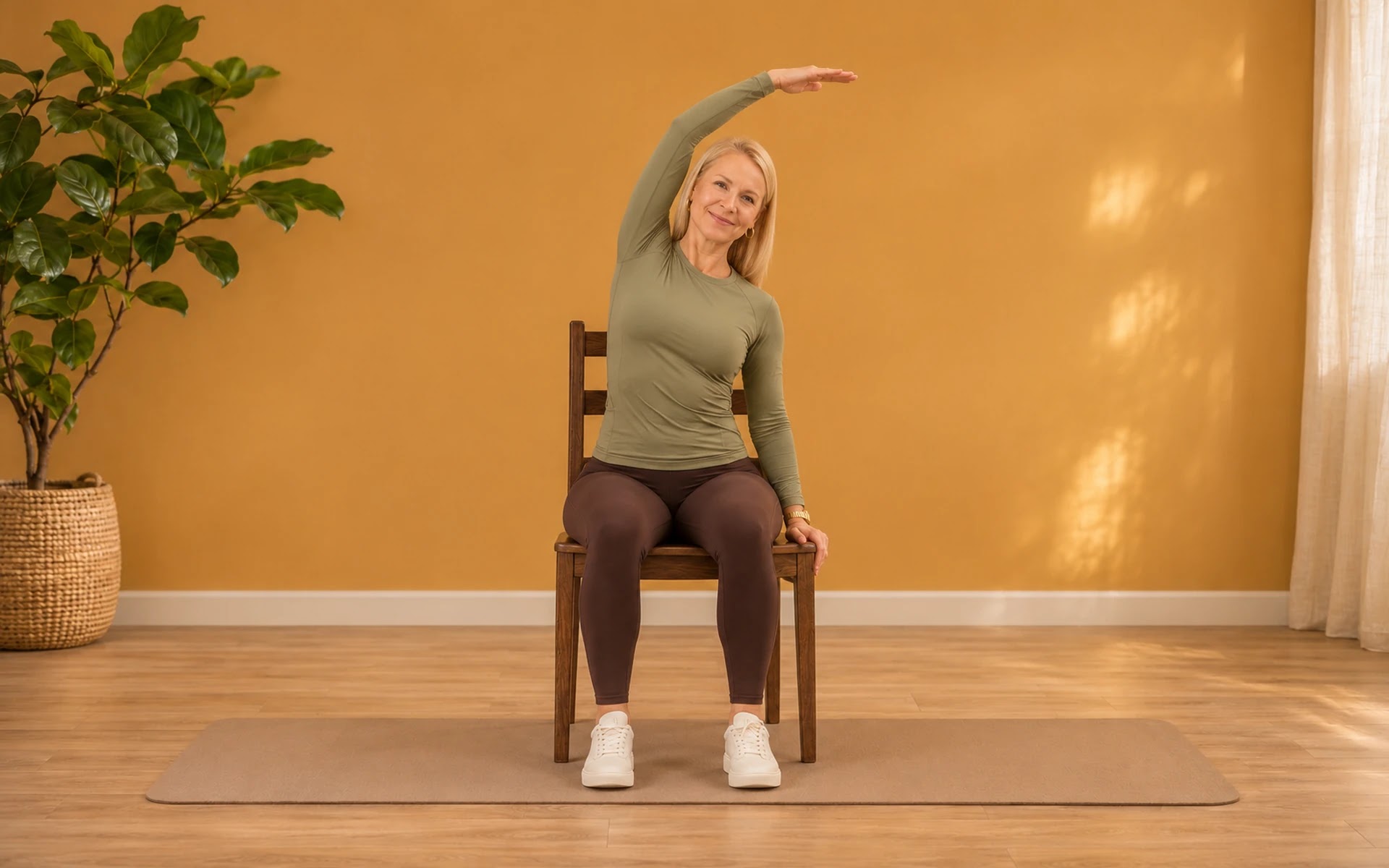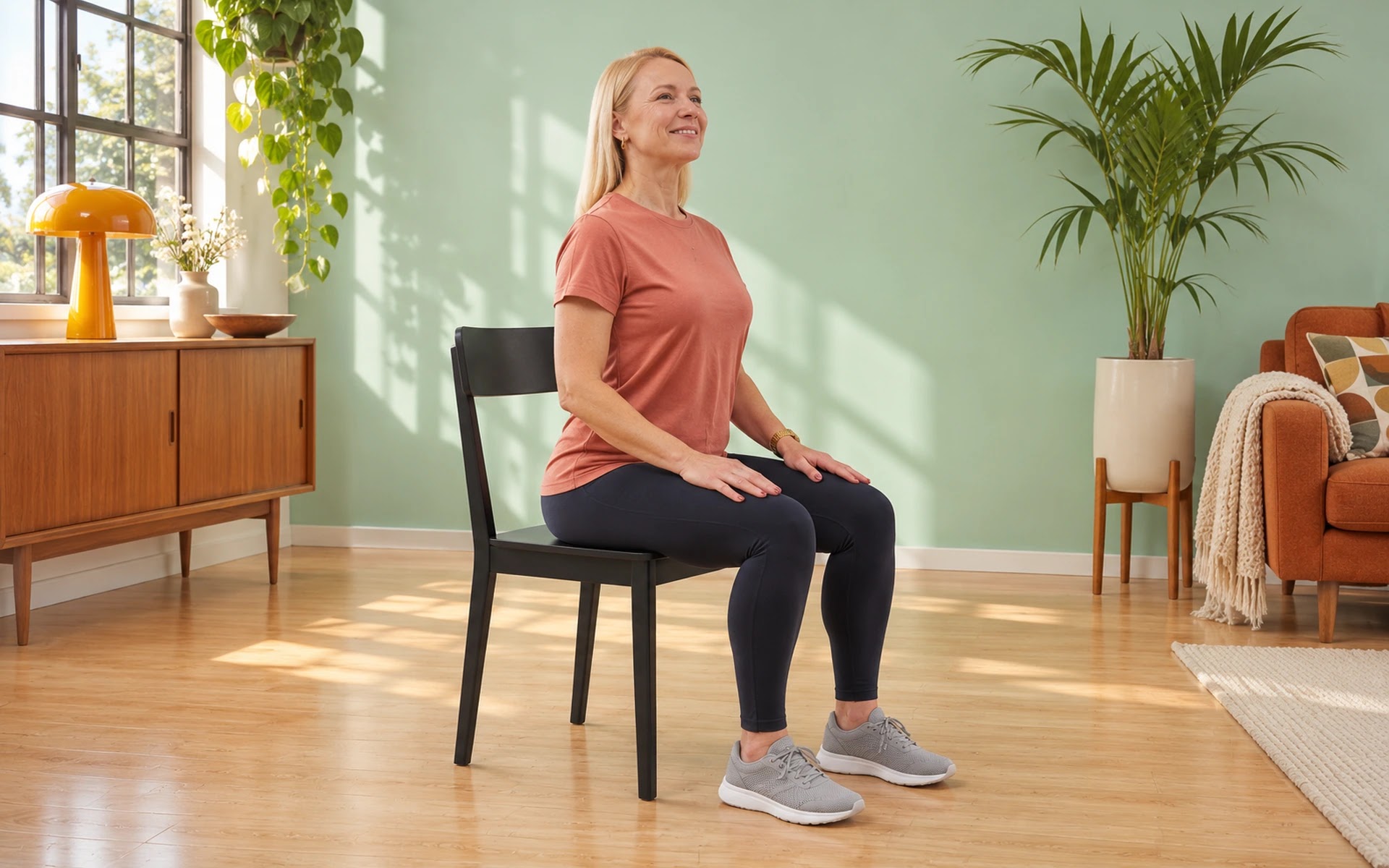

A 30-day chair workout is a month of short seated and chair-supported sessions that grow a little each week. Beginners start with three sessions of about 10 minutes. This guide gives the calendar, the moves, and the repetitions. To see why seated training is useful, read about chair workout benefits.
If you have joint, muscle, or spine-related concerns, please consult your physician before starting this workout.
Key takeaways
A 30-day chair workout builds a routine first, and small weekly steps keep it manageable.
- Use a solid, stable chair without wheels, with feet flat and knees at right angles (1).
- Seated moves in public guidance use 3 to 5 repetitions on each side (1).
- Strength moves such as sit-to-stands start at 5 repetitions (2).
- Adults are advised to do muscle-strengthening activity on at least two days a week (3).
- The same guidelines recommend 150 minutes of moderate aerobic activity each week (3).
- At moderate effort, you can talk but not sing (4).
- In one 8-week trial in older adults with lower-limb osteoarthritis, twice-weekly chair yoga improved walking speed (5).
What is a 30-day chair workout?
A 30-day chair workout is a four-week plan, plus two review days, built around one sturdy chair. Sessions mix seated mobility with supported strength moves.
The month has a clear shape. Week 1 teaches the setup. Weeks 2 and 3 add strength work. Week 4 joins the moves into one sequence. Days 29 and 30 are for review.
Thirty days is a useful start for a new habit. The plan does not promise a specific physical result.
What do you need before day 1?
You need a sturdy chair, a clear floor, and a calendar. Preparation takes a few minutes.
Seated exercise guidance describes the chair. Pick a solid, stable chair without wheels. Sit with your feet flat and your knees bent at right angles (1). Chairs without arms give you more room (1).
- Place the chair against a wall or on a non-slip floor.
- Clear the space in front of and beside the chair.
- Print or draw a 30-day calendar.
- Mark three session days for week 1.
- Put water within reach.
What does the 30-day calendar look like?
The calendar starts with three sessions a week and builds to five. The table shows the whole month.
| Days | Sessions | Minutes | Focus |
|---|---|---|---|
| 1 to 7 | 3 | 10 | Seated mobility and breathing |
| 8 to 14 | 4 | 12 to 15 | Add supported strength moves |
| 15 to 21 | 4 | 15 | More repetitions and a second round |
| 22 to 28 | 5 | 15 to 20 | One full sequence |
| 29 to 30 | 1 | 15 | Repeat day 1 and compare |
Rest days sit between sessions in the first two weeks. A short walk on a rest day is welcome.
Week 1: seated mobility
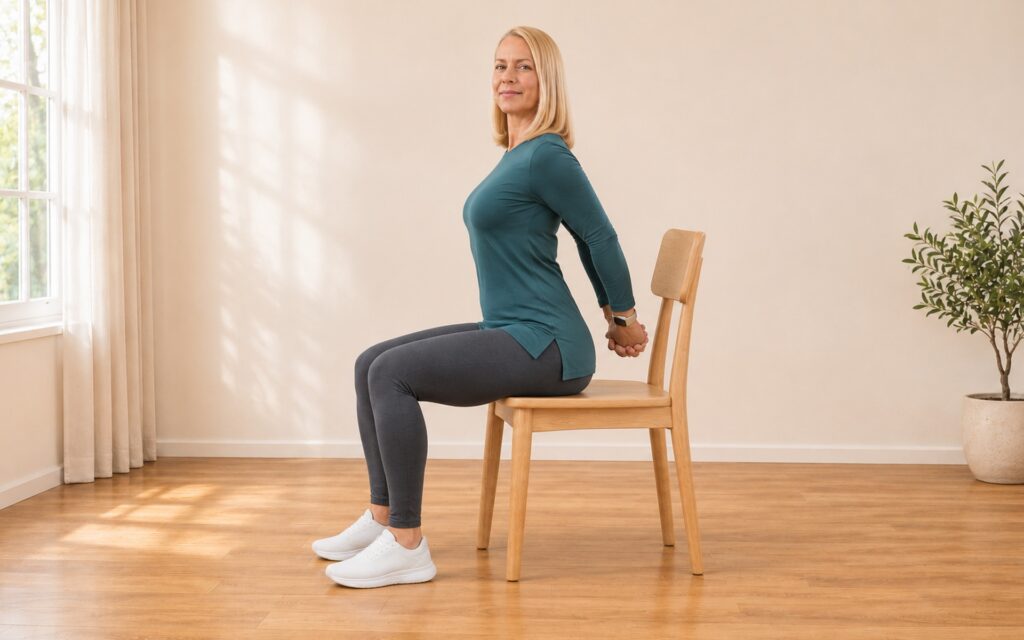
Week 1 uses five seated moves from public guidance. The repetitions come from that guidance (1).
| Move | Repetitions |
|---|---|
| Chest stretch | 5 times, holding 5 to 10 seconds |
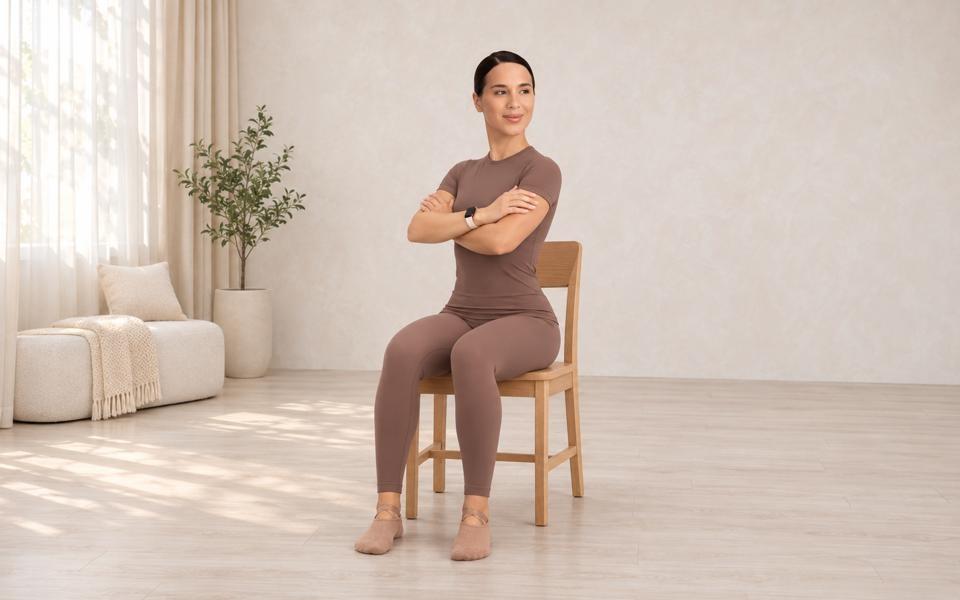
| Upper-body twist | 5 times on each side |
| Hip marching | 5 lifts with each leg |
| Ankle stretch | 2 sets of 5 with each foot |
| Neck rotation | 3 rotations on each side |
Do the five moves in order on three days. Finish with one minute of slow breathing.
Week 2: supported strength
Week 2 keeps the seated moves as a warm-up and adds three strength moves. Starting amounts follow public strength guidance (2).
| Move | How to do it | Starting amount |
|---|---|---|
| Sit-to-stand | Stand up from the chair and sit down slowly | 5 repetitions |
| Calf raise | Hold the chair back and lift both heels | 5 repetitions |
| Wall press-up | Hands on a wall, bend and straighten the elbows | 3 sets of 5 to 10 |
Use your hands on the seat during sit-to-stands if you need them.
Read more: 10-minute chair yoga for seniors: a seated routine
Week 3: more repetitions
Week 3 adds two moves and a second round of the week 2 moves. Rest for a minute between rounds.
| Move | How to do it | Starting amount |
|---|---|---|
| Mini-squat | Hold the chair back and bend your knees a little | 5 repetitions |
| Sideways leg lift | Hold the chair back and lift one leg to the side | 5 with each leg |
Add one or two repetitions to sit-to-stands and calf raises when they feel steady (2).
Week 4: one full sequence
Week 4 joins everything into one session of 15 to 20 minutes. Follow this order on five days.
- Warm up with the five seated moves.
- Do sit-to-stands and mini-squats.
- Do calf raises and sideways leg lifts.
- Do wall press-ups.
- Sit down and repeat the chest stretch.
- Finish with one minute of slow breathing.
Days 29 and 30: review
The last two days are for looking back. Repeat the day 1 session and notice what has changed.
Write down three things: the moves that feel easier, the moves that still feel hard, and the sessions you enjoyed. Use those notes to plan the next month.
How do you do the main strength moves?
The five strength moves use the chair or a wall for support. Move slowly, and keep breathing through each repetition.
Sit-to-stand
The sit-to-stand trains the thighs and hips.
- Sit near the front of the chair with your feet hip-width apart.
- Lean forward slightly and stand up slowly.
- Pause when you are fully upright.
- Sit back down with control.
BetterMe offers a variety of workouts, recipes, challenges, and support tools to help you stay more consistent with your wellness routine. Explore the app to find features that fit your goals, preferences, and schedule.
Calf raise
The calf raise trains the lower legs.
- Stand behind the chair and hold its back.
- Lift both heels as high as is comfortable.
- Pause for one second.
- Lower your heels slowly.
Wall press-up
The wall press-up trains the chest, shoulders, and arms.
- Stand at arm’s length from a wall with your hands at chest height.
- Bend your elbows and bring your chest toward the wall.
- Keep your body in a straight line.
- Push back until your arms are straight.
Mini-squat
The mini-squat is a small knee bend with support.
- Stand behind the chair and hold its back.
- Place your feet hip-width apart.
- Bend your knees a little, keeping your heels down.
- Stand tall again.
Sideways leg lift
The sideways leg lift trains the outer hip.
- Hold the chair back and stand upright.
- Lift one leg to the side with your toes facing forward.
- Lower the leg slowly.
- Repeat with the other leg.
Who should ask a doctor before starting?
Some people need individual advice before a new exercise plan. A short conversation can make the month smoother.
- People who have had a recent fall or surgery
- People who feel dizzy when they stand up
- People with a heart, joint, or bone concern managed by a doctor
- Anyone who has not exercised for a long time and feels unsure
Stop a session if you feel unwell, and rest. Return to the plan on another day with a shorter session.
Read more: What is chair yoga? A guide to getting started
Do chair workouts really work?
Chair workouts can improve everyday movement when they are done regularly. The evidence comes mainly from small studies in older adults.
In one trial, older adults with lower-limb osteoarthritis who could not do standing exercise attended chair yoga classes. The sessions lasted 45 minutes and ran twice a week for 8 weeks (5). Walking speed and fatigue improved during the program, and balance did not change (5).
General guidance supports regular strength work. Adults are advised to train all major muscle groups on at least two days a week (3). Sit-to-stands, calf raises, and wall press-ups count toward that goal.
Our article does chair yoga work looks at the research in more detail.
How hard should a 30-day chair workout feel?
The workout should feel light in week 1 and moderate by week 4. You can usually still talk while you move.
A talk test is a simple guide. At moderate intensity, a person can talk but not sing. At vigorous intensity, only a few words are possible without pausing for breath (4).
Slow down when talking becomes difficult. Rest longer between moves on tired days.
How does the plan fit weekly activity guidelines?
The plan covers strength work and leaves room for aerobic activity. Chair sessions are short, so other movement still matters.
Adult guidelines recommend 150 minutes of moderate aerobic activity a week, such as 30 minutes on five days (3). Walking, cycling, or swimming on non-session days fills that gap.
In week 4, five sessions of 15 to 20 minutes add up to 75 to 100 minutes. Count only the parts that feel moderate toward the aerobic total.
How do you stay on track for 30 days?
Stay on track by making sessions easy to start. Small habits matter more than motivation.
- Keep the chair in the same place all month.
- Tie each session to a fixed event, such as morning coffee.
- Tick the calendar after every session.
- Repeat a week instead of quitting when a week feels too hard.
- Ask a friend or family member to join you.
A missed day is not a failure. Pick up with the next planned session.
For a core-focused variation after this month, see our chair yoga for core strength guide.
What should you do after day 30?
After day 30, keep the week 4 sequence and add one new challenge. A gradual next step protects the habit.
- Add a second round of the strength moves.
- Add light hand weights to arm moves.
- Join a class led by an instructor.
- Try a new program, such as our 21-day chair yoga challenge.
Review your calendar notes first. Choose the option that matches the moves you enjoyed.
Frequently Asked Questions
Can you do a chair workout every day for 30 days?
Yes, the seated mobility moves can be done daily. The plan spaces out the strength moves so your muscles can rest.
How long does a 30-day chair workout take each day?
Sessions take 10 minutes in week 1 and 15 to 20 minutes in week 4. Rest days need no time at all.
Do 30-day workout challenges work?
A 30-day challenge works as a way to start a routine. Lasting change depends on what you keep doing after the month ends.
What if you miss a few days?
Continue from the last session you completed. Repeat the week if you missed more than three days.
Do you need equipment for a 30-day chair workout?
No, a sturdy chair and a wall are enough (1). Light hand weights are optional after day 30.
The bottom line
A 30-day chair workout starts with five seated moves and adds supported strength work each week. Keep sessions short, tick the calendar, and repeat a week when needed. After day 30, keep the sequence and add one small challenge.
DISCLAIMER:
This article is intended for general informational purposes only and does not serve to address individual circumstances. It is not a substitute for professional advice or help and should not be relied on for making any kind of decision-making. Any action taken as a direct or indirect result of the information in this article is entirely at your own risk and is your sole responsibility.
BetterMe, its content staff, and its medical advisors accept no responsibility for inaccuracies, errors, misstatements, inconsistencies, or omissions and specifically disclaim any liability, loss or risk, personal, professional or otherwise, which may be incurred as a consequence, directly or indirectly, of the use and/or application of any content.
You should always seek the advice of your physician or other qualified health provider with any questions you may have regarding a medical condition or your specific situation. Never disregard professional medical advice or delay seeking it because of BetterMe content. If you suspect or think you may have a medical emergency, call your doctor.
Some visuals may be AI-generated.
SOURCES:
- Sitting exercises (2024, nhs.uk)
- Strength exercises (2024, nhs.uk)
- Adult Activity: An Overview (2023, cdc.gov)
- How to Measure Physical Activity Intensity (2025, cdc.gov)
- A Pilot Randomized Controlled Trial of the Effects of Chair Yoga on Pain and Physical Function Among Community-Dwelling Older Adults With Lower Extremity Osteoarthritis (2017, pubmed.ncbi.nlm.nih.gov)

 Reviewed by