Returning to exercise after childbirth is a journey that requires patience, knowledge, and a deep respect for your body’s recovery process. Many new mothers feel pressured to “snap back,” but a lower-risk and effective return to fitness is gradual. This guide provides a research-informed framework to help you navigate your postpartum fitness journey with confidence.
Let’s explore how you can gradually get moving again.
Always consult your physician before you start any recovery fitness program to make sure that it’s suitable for your specific needs.
When Can You Go Back to the Gym Postpartum?
The timeline for returning to the gym after giving birth is highly individual and depends on several factors, including the type of delivery, your recovery, and any complications. The traditional “six-week clearance” from a healthcare provider is often seen as a universal green light, but it’s more of a general checkpoint than a definitive starting line for all types of exercise.
Typically, after a vaginal delivery without complications, many women receive clearance for light to moderate exercise at their six-week postpartum check-up. For those who have had a cesarean section, which is major abdominal surgery, longer to allow the body more time to recover, including the incision area (1).
However, medical clearance doesn’t mean you can immediately jump back into your old routine. It can be a sign that you may be ready to start reintroducing physical activity gradually. It is commonly recommended to listen to your body and start slowly (2).
Gentle activities can often begin sooner. For instance, you can start with pelvic floor exercises (Kegels) and deep breathing within the first few days postpartum, provided you feel no pain. Short walks, starting with 5-10 minutes and gradually increasing duration, are also excellent for promoting circulation and well-being in the initial weeks.
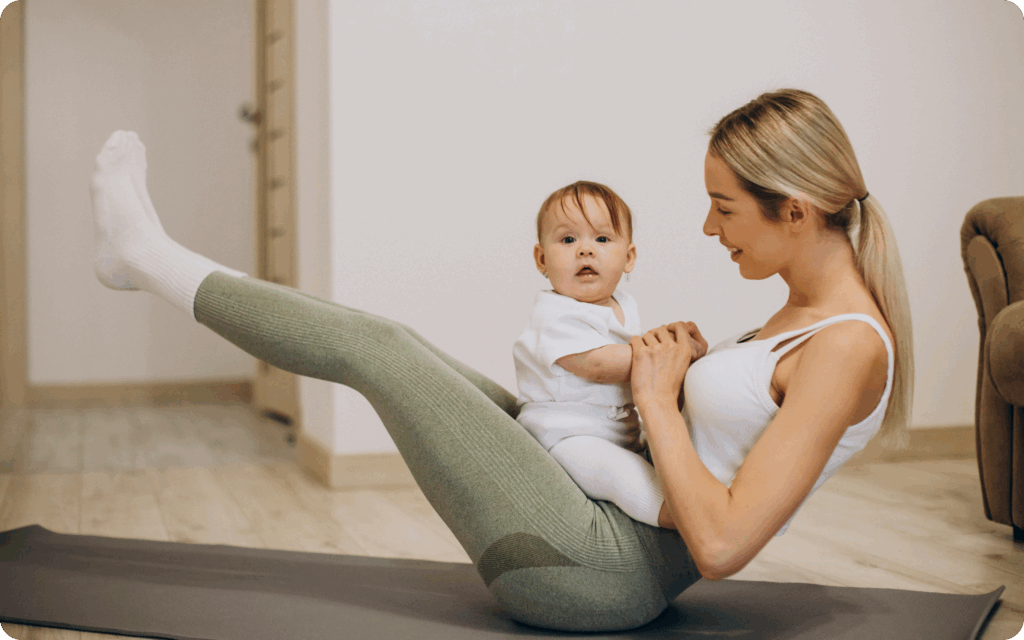
What Is the Best Workout for Postpartum?
The “best” workout postpartum is one that prioritizes recovery, rebuilds foundational strength, and respects your body’s current state. It’s not about high intensity or immediate weight loss. Instead, it focuses on restoring function to the muscles most affected by pregnancy and childbirth: the pelvic floor and the deep core.
Here are the essential qualities of an ideal postpartum gym workout plan.
- Focus on Pelvic Floor and Core Restoration
Pregnancy and delivery stretch and weaken the pelvic floor and abdominal muscles (3).
A quality postpartum program begins by reconnecting with and strengthening these areas. This involves more than just Kegels; it includes coordinating your breath with pelvic floor contractions and relaxations.
Exercises that stabilize the pelvis and strengthen the transverse abdominis (TA), the deepest layer of your abdominal muscles, are crucial. This foundational work helps prevent issues like urinary incontinence and pelvic organ prolapse (4).
- Low-Impact Movements
High-impact activities like running, jumping, and heavy lifting can be demanding, especially early on, so many people start with lower-impact options first (5). Your initial workouts should be low-impact to protect these structures.
Examples of effective low-impact exercises include walking, swimming, stationary cycling, and bodyweight strength exercises. These activities allow you to build cardiovascular fitness and muscular endurance without jarring your body (5). A good postpartum gym workout plan for beginners will always emphasize low-impact options.
Whether you’re a workout beast or just a beginner making your first foray into the world of fitness and dieting – BetterMe has a lot to offer to both newbies and experts! Install the app and experience the versatility first-hand!
- Gradual and Progressive Overload
Progress is key, but it must be gradual. A well-structured postpartum workout plan week by week will methodically increase in difficulty. This could mean adding a few more repetitions, slightly increasing the duration of a hold, or adding light resistance (5).
A helpful tool for measuring intensity is the Borg Rating of Perceived Exertion (RPE) scale, which runs from 0 (no exertion) to 10 (maximal exertion). When starting, your workouts should feel like a 2-3 out of 10. You should not increase your RPE by more than one point per week to allow your body to adapt.
- Full-Body Strength and Flexibility
While core and pelvic floor work is the priority, a balanced plan incorporates exercises for the entire body. Upper body exercises help counteract the “mom posture” that often develops from holding and feeding a baby. Lower body exercises rebuild strength in your glutes and legs, which support your pelvis.
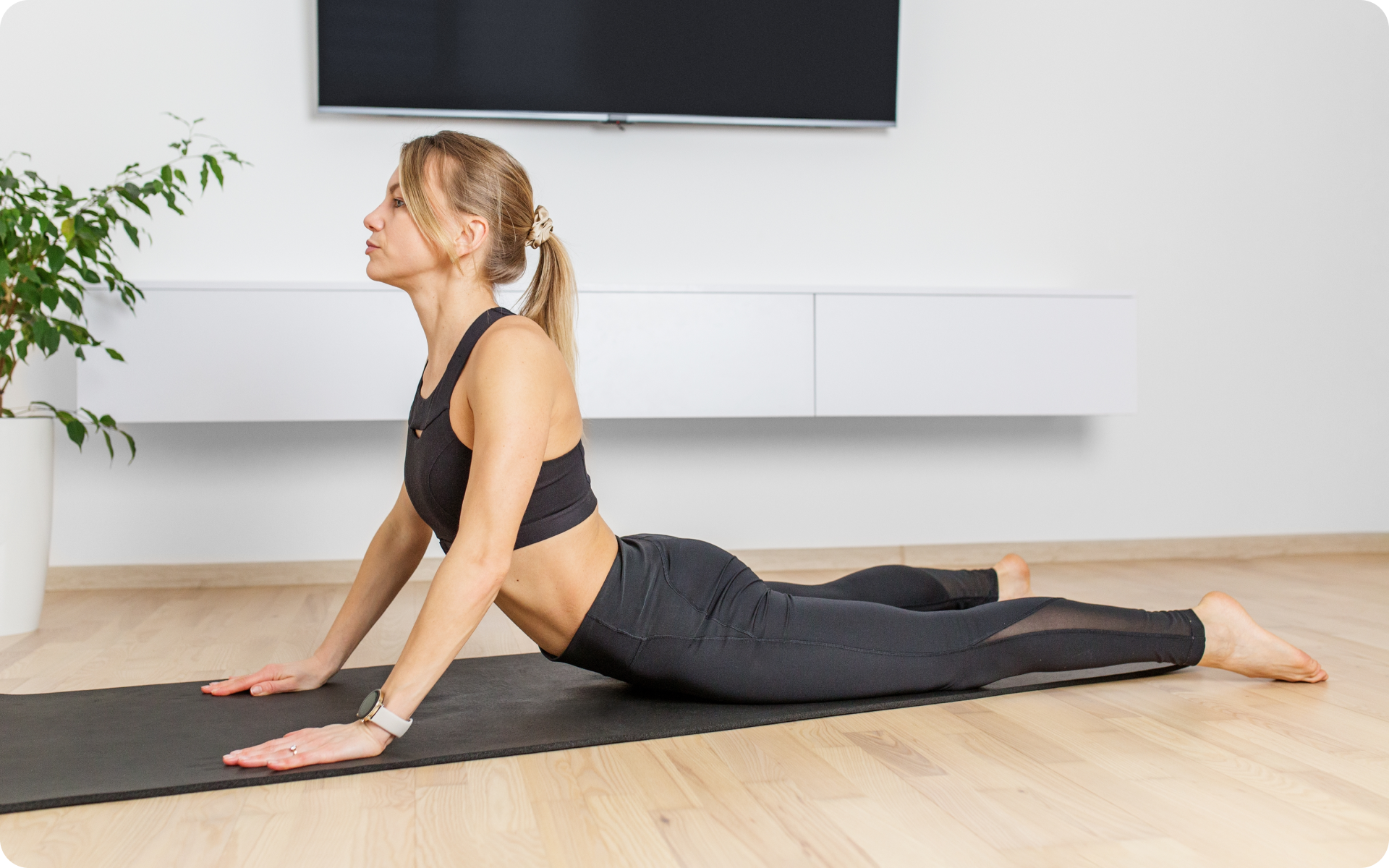
Flexibility work is also important. Stretches that open the chest and hips can relieve tension and improve posture. Gentle movements help restore mobility and reduce the aches and pains common in the postpartum period (6).
If you’re looking to build a routine that supports recovery, a great place to start is with exercises that specifically target the deep core muscles. Learn more about how to incorporate core exercise postpartum into your routine.
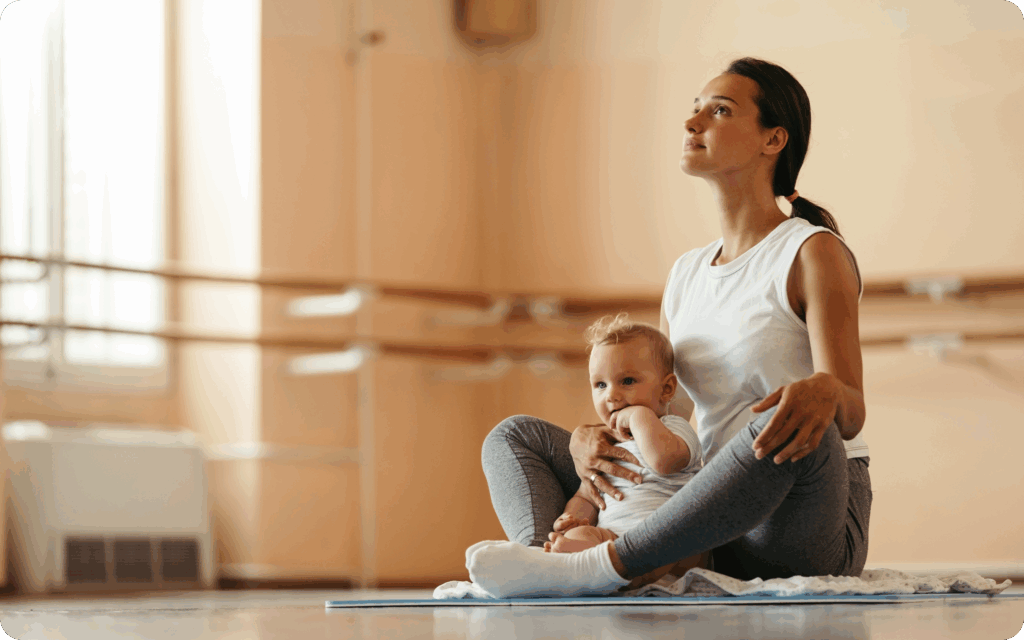
What Is a Balanced Postpartum Gym Workout Plan?
A balanced plan integrates the principles discussed above into a cohesive routine. This sample full-body workout is designed to be gentle yet effective for mothers who have received medical clearance to exercise. It focuses on breathwork, core activation, and building foundational strength across the entire body.
Remember to use the “talk test”—if you can’t hold a conversation while exercising, you’re working too hard. Your RPE should remain in the 2-4/10 range.
Program Notes
- Glossary:
- Reps: Repetitions, the number of times you perform an exercise.
- PF: Pelvic Floor.
- TA: Transverse Abdominis, your deep core muscles.
- Equipment Needed: An exercise ball and a firm surface. A yoga mat is optional.
- Structure: This is a full-body workout. Perform the exercises in the order listed.
- Sets and Reps: Aim for the rep counts listed. Focus on quality of movement over quantity.
- Rest: Rest for 60-90 seconds between exercises.
Gentle Full-Body Workout Program
| Exercise | Reps | Notes |
|---|---|---|
| Warm-Up | ||
| 3-Dimensional Breath | 10 reps | Focus on deep, expansive breaths |
| Pelvic Tilts | 10-15 reps | Coordinate with breath and PF activation |
| Workout | ||
| Transverse Abdominis (TA) Strengthening | 10 reps | Hold each contraction for 3-5 seconds |
| Exercise Ball March | 10 reps per side | Keep your core braced and pelvis stable |
| Doorway Pec Stretch | 10 reps | Hold each stretch for 5 seconds |
| Squat with Ball | 10 reps | Go to a comfortable depth |
| Side-lying Hip Strengthening | 5 reps per direction, per side | Move slowly and with control |
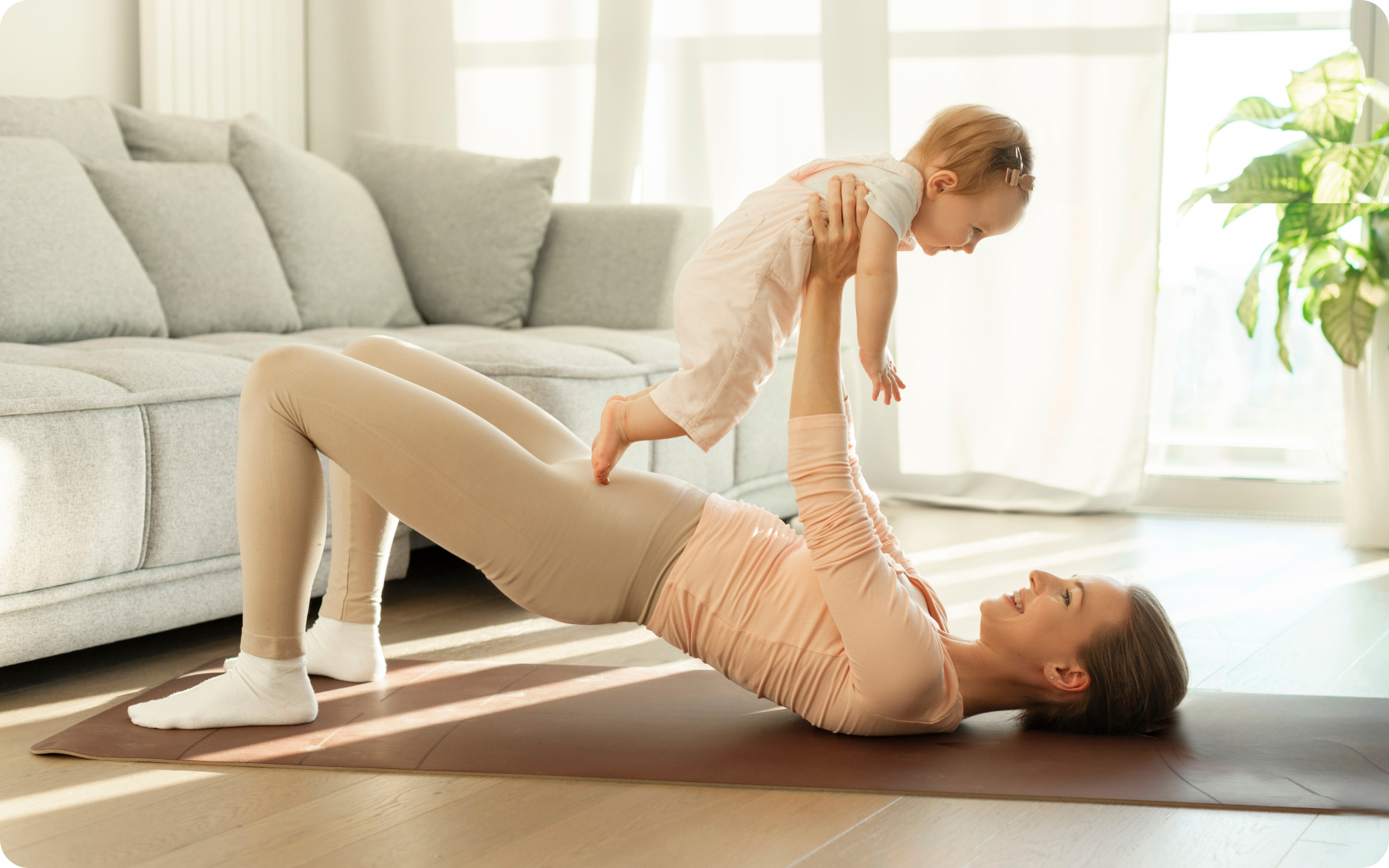
| Bridge (no baby) | 10 reps | Squeeze glutes at the top |
| Cool-Down | ||
| Child’s Pose with Side Bend | 3-5 deep breaths per side | |
| Butterfly Groin Stretch | Hold for 30 seconds |
Exercise Instructions
3-Dimensional Breath
- Sit comfortably with your spine straight. Place your hands on your lower ribcage.
- Inhale deeply through your nose, feeling your ribs expand outward and upward into your hands.
- Exhale slowly through your mouth, feeling your ribs return to their starting position.
Pelvic Tilts
- Start on all fours with your hands under your shoulders and knees under your hips.
- Inhale as you allow your tailbone to untuck and your lower back to arch slightly (forward tilt).
- Exhale as you gently tuck your tailbone under and round your lower back (backward tilt).
Transverse Abdominis (TA) Strengthening
- Sit on a firm surface or an exercise ball with your feet flat on the floor. Place your hands on your lower belly.
- Take a deep breath in, letting your belly relax.
- As you exhale, draw your abdominal muscles upward and inward toward your spine.
- Hold the contraction for 3-5 seconds while continuing to breathe, then relax.
Exercise Ball March
- Sit upright on an exercise ball with your feet flat on the floor.
- Brace your core by engaging your TA.
- Slowly lift one knee toward your chest without letting your pelvis tilt.
- Lower the foot back to the floor with control and repeat on the other side.
Doorway Pec Stretch
- Stand in a doorway. Place your forearms on the doorframe with your elbows bent at a 90-degree angle.
- Take a small step forward with one foot until you feel a gentle stretch across the front of your chest and shoulders.
- Hold the stretch for 5 seconds, then step back. Alternate which foot steps forward for each rep.
Squat with Ball
- Stand with your feet slightly wider than shoulder-width apart, toes pointing slightly outward. Hold an exercise ball in front of you.
- Inhale as you bend your knees and lower into a squat, keeping your spine straight. Lower only as far as is comfortable.
- Exhale as you press through your heels to stand back up, raising the ball overhead as you rise.
Reasons why BetterMe is a safe bet: a wide range of calorie-blasting workouts, finger-licking recipes, 24/7 support, challenges that’ll keep you on your best game, and that just scratches the surface! Start using our app and watch the magic happen.
Side-lying Hip Strengthening
- Lie on your side with your bottom leg bent for stability and your top leg straight. Engage your core to keep your hips stacked.
- Slowly lift your top leg to hip height.
- From this position, move your leg forward, then back to neutral.
- Lift it slightly up toward the ceiling, then back to neutral.
- Extend it slightly backward, then back to neutral. This completes one rep. Perform all movements before lowering the leg.
Bridge
- Lie on your back with your knees bent and feet flat on the floor, hip-width apart.
- Engage your core. Exhale as you squeeze your glutes and lift your hips off the floor until your body forms a straight line from your shoulders to your knees.
- Hold for a moment at the top, then inhale as you slowly lower your hips back down.
Child’s Pose with Side Bend
- Start on your hands and knees. Sit back on your heels and lower your torso toward the floor into Child’s Pose.
- Walk your hands over to the right side until you feel a stretch along your left side.
- Hold and take 3-5 deep breaths, then walk your hands to the left side and repeat.
Butterfly Groin Stretch
- Sit on the floor with your spine straight. Bring the soles of your feet together.
- Gently pull your heels toward your body until you feel a comfortable stretch in your inner thighs.
- Hold the position, breathing deeply.
How Many Times a Week Should I Workout Postpartum?
When you’re first starting, consistency is more important than duration or intensity. Aim to complete a gentle workout like the one above 2-3 times per week on non-consecutive days. This frequency provides enough stimulus for your muscles to adapt while allowing ample time for recovery, which is crucial postpartum.
On the days you don’t do a structured workout, stay active with light activities like walking. A 15-20 minute walk each day can do wonders for your physical and mental well-being (7). As you get stronger and your energy levels increase (usually around 12-16 weeks postpartum), you can consider increasing your workout frequency to 3-4 times per week.
Always listen to your body. If you feel overly fatigued, notice an increase in lochia (postpartum bleeding), or experience pain, it’s a sign to scale back. A postpartum workout plan week by week should be flexible enough to accommodate the unpredictable nature of life with a newborn.
Read more: Postpartum Workout Plan at Home: What You Need to Know and Exercises to Try
What Workouts Not to Do Postpartum?
Just as important as knowing what to do is knowing what to avoid. Certain exercises can hinder recovery or even cause injury in the early postpartum period.
Here are workouts to avoid until you have rebuilt your foundational core and pelvic floor strength, typically at least 12-16 weeks postpartum and with guidance from a professional:
- High-Impact Exercises: This includes running, jumping, burpees, and other plyometrics. These activities create higher ground-reaction forces, which can feel like a lot when you’re returning to impact. Prematurely returning to high-impact activities can increase the risk of pelvic organ prolapse and stress urinary incontinence (8).
- Traditional Abdominal Exercises: Crunches, sit-ups, and double leg lifts increase intra-abdominal pressure. This can put excessive strain on the linea alba (the connective tissue between your rectus abdominis muscles) and potentially worsen diastasis recti (8).
- Heavy Lifting: Lifting heavy weights with improper form or breath-holding (the Valsalva maneuver) also dramatically increases intra-abdominal pressure (9). Wait to reintroduce heavy lifting until your core and pelvic floor can effectively manage this pressure.
- Any Exercise That Causes Coning or Doming: “Coning” is when the middle of your abdomen bulges outward into a cone shape common in diastasis recti (10). This is a sign that your deep core cannot manage the intra-abdominal pressure, and you should stop or modify the movement.
For those eager to get back to more intense cardio, it’s essential to build a solid foundation first. If you are a runner, understanding the specific considerations for running postpartum can help you return to the sport.

When Can I Lift Weights Postpartum?
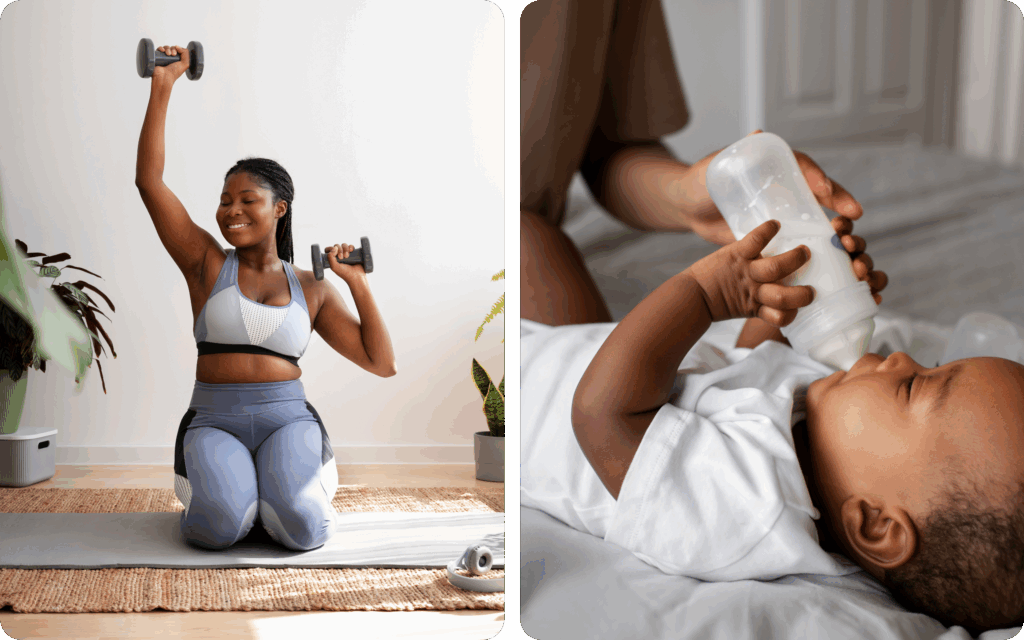
You can start lifting weights postpartum, but the approach must be strategic. In the initial phase (the first 6-12 weeks after clearance), “lifting weights” should focus on light resistance and bodyweight exercises. The postpartum gym workout plan detailed earlier is a perfect example of this phase.
You can begin incorporating light dumbbells (5-10 lbs) or resistance bands for exercises like rows, bicep curls, and squats once you’ve mastered the bodyweight versions and can perform them with good form and proper core engagement. This is a key component of a postpartum gym workout plan for weight loss, as building muscle tends to boost metabolism.
The transition to heavier lifting should be slow and deliberate, usually starting no earlier than 3-4 months postpartum. Before lifting heavier, you should be able to:
- Maintain core and pelvic floor engagement throughout the movement.
- Breathe correctly without holding your breath.
- Perform the exercise without any pain, pressure, or pelvic floor symptoms.
When you do start lifting heavier, reduce the weight to around 50-60% of your pre-pregnancy max and gradually increase it over several weeks.
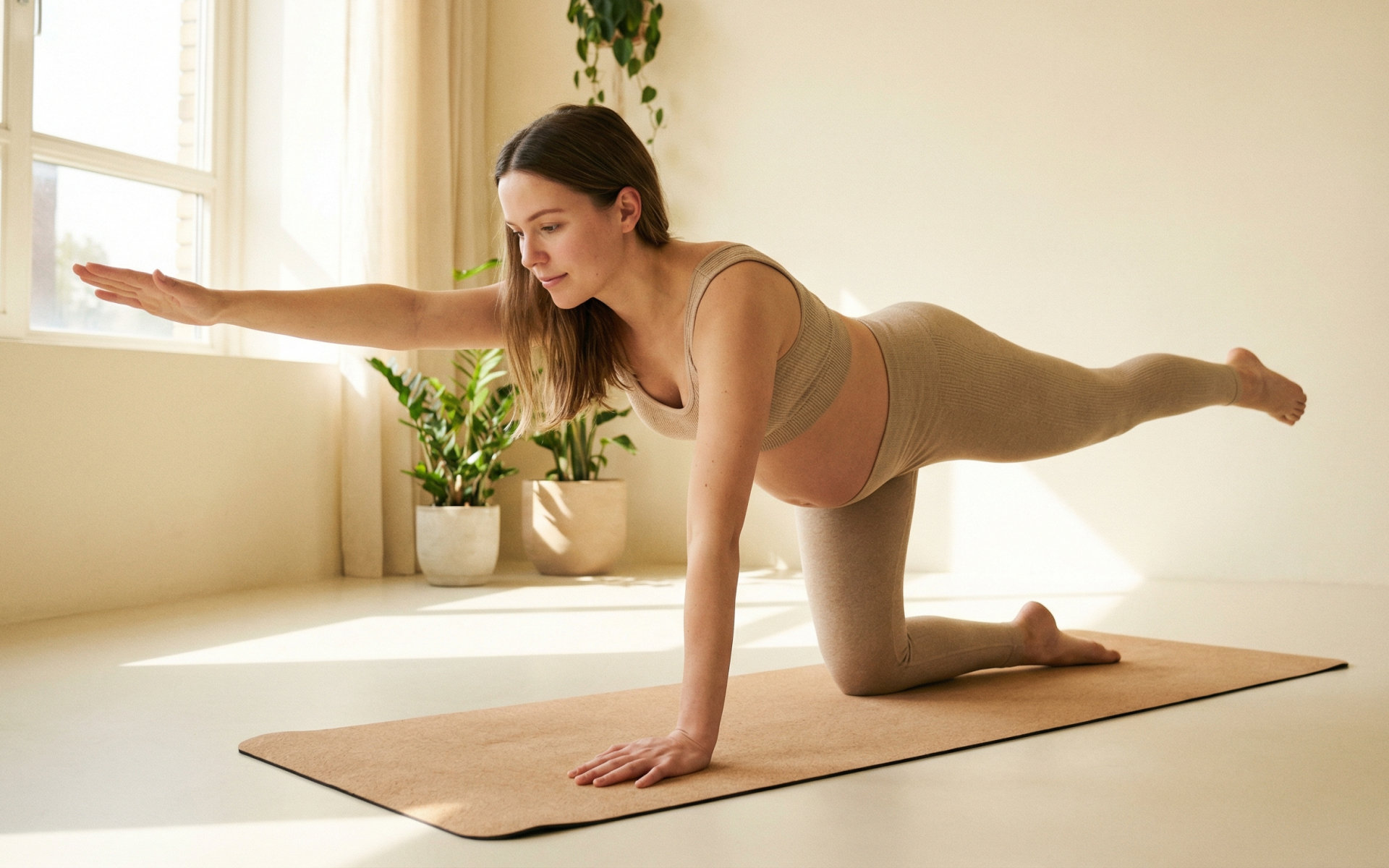
It is not recommended to do High-Intensity Interval Training (HIIT) in the early postpartum period (the first 3-4 months). HIIT often includes high-impact, explosive movements that can place a lot of demand on the pelvic floor and core, especially when you’re returning to exercise. You should build a solid foundation with low-impact strength training before gradually reintroducing HIIT. Yes, but you must choose the right kind of ab workouts. Avoid traditional exercises like crunches and sit-ups. Instead, focus on deep core exercises that strengthen the transverse abdominis and pelvic floor, such as TA breathing, heel slides, and bird-dog. These movements can help manage diastasis recti and restore core function gradually (11). Jumping jacks are a high-impact exercise and should be avoided in the early postpartum phase. The repetitive jumping motion can be too much for a recovering pelvic floor (5). Wait until you are at least 12-16 weeks postpartum and have no symptoms of pelvic floor dysfunction before attempting to reintroduce them.Frequently Asked Questions
Can I do HIIT workouts postpartum?
Can I do Ab workouts postpartum?
Can you do jumping jacks postpartum?
The Bottom Line
Returning to the gym after having a baby is a marathon, not a sprint. The most effective postpartum gym workout plan is one that honors your body’s need for recovery while systematically rebuilding your strength from the inside out. By focusing on foundational movements, listening to your body, and progressing gradually, you can build a strong, resilient body that is ready for the demands of motherhood and beyond.
DISCLAIMER:
This article is intended for general informational purposes only and does not serve to address individual circumstances. It is not a substitute for professional advice or help and should not be relied on for making any kind of decision-making. Any action taken as a direct or indirect result of the information in this article is entirely at your own risk and is your sole responsibility.
BetterMe, its content staff, and its medical advisors accept no responsibility for inaccuracies, errors, misstatements, inconsistencies, or omissions and specifically disclaim any liability, loss or risk, personal, professional or otherwise, which may be incurred as a consequence, directly or indirectly, of the use and/or application of any content.
You should always seek the advice of your physician or other qualified health provider with any questions you may have regarding a medical condition or your specific situation. Never disregard professional medical advice or delay seeking it because of BetterMe content. If you suspect or think you may have a medical emergency, call your doctor.
SOURCES:
- Exercise after pregnancy (2022, racgp.org.au)
- Physical Activity and Exercise During Pregnancy and the Postpartum Period (2020, acog.org)
- The pelvic floor during pregnancy and delivery: Can pelvic floor trauma and disorders be prevented? (2024, obgyn.onlinelibrary.wiley.com)
- Impact of postpartum exercise on pelvic floor disorders and diastasis recti abdominis: a systematic review and meta-analysis (2024, bjsm.bmj.com)
- Maximizing Recovery in the Postpartum Period: A Timeline for Rehabilitation from Pregnancy through Return to Sport (2022, pmc.ncbi.nlm.nih.gov)
- Physical Activity, Yoga, and Exercise Prescription for Postpartum and Midlife Weight Management: A Practical Review for Clinicians (2022, pmc.ncbi.nlm.nih.gov)
- Benefits of Physical Activity during Pregnancy and Postpartum: An Umbrella Review (2019, journals.lww.com)
- Guidelines for Prenatal and Postpartum Resistance Training (2022, intechopen.com)
- The Valsalva Maneuver: Its Effect on Intra-abdominal Pressure and Safety Issues During Resistance Exercise (2013, journals.lww.com)
- Clinical significance of diastasis recti: Literature review and awareness amongst health care professionals (2023, sciencedirect.com)
- Efficacy of deep core stability exercise program in postpartum women with diastasis recti abdominis: a randomised controlled trial (2019, pmc.ncbi.nlm.nih.gov)
 Reviewed by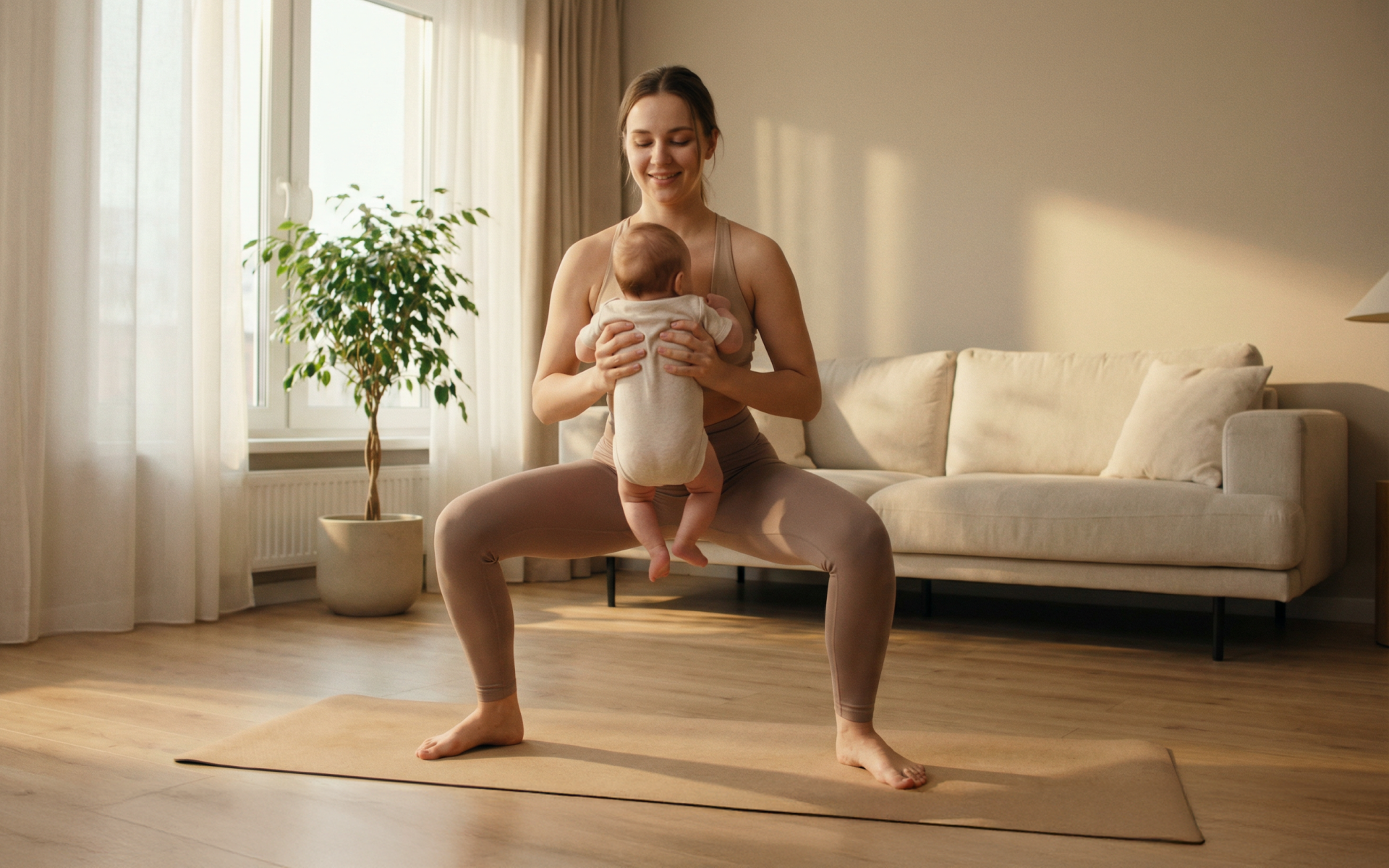
 Reviewed by