Pilates ball core exercises use an inflatable ball during movements that ask you to control your trunk. This guide includes five options, with floor-supported variations and a sample session. Start with a movement you can control, keep the ball within reach, and reduce the range when your position changes.
This guide uses a large stability ball. Small soft Pilates balls serve different purposes and are not interchangeable with a ball intended to support body weight. For equipment context, see our Pilates ball exercise guide.
Check the ball manufacturer’s sizing, inflation, and load instructions. Clear the floor around it and use a nonslip surface.
Ask a qualified exercise professional to check unfamiliar movements. If you have a medical condition, current pain, or concerns about balance, consult a healthcare professional before starting. Stop a movement that causes pain or makes you feel unsteady.
Key takeaways
- These exercises use a large stability ball; small soft Pilates balls are different props.
- The five options include a ball roll-out, kneeling plank, ball press, seated balance, and knee-supported side plank.
- Keep floor or stable support available and reduce the range when you lose control of the ball.
- A ten-week stability-ball trial in 20 sedentary adults found improvements in selected trunk-endurance tests (1).
- A 12-week mat Pilates study found endurance and hamstring-flexibility improvements, with no significant balance or posture difference from controls (2).
- The practice amounts in this guide are sample instructions, not a universal training prescription.
- Check the manufacturer’s sizing, inflation, load, and storage guidance for your ball.
How does a Pilates ball change core exercise?
A ball changes the surface you press against or balance on. You need to control its movement as well as your own position. One study in recreational athletes measured transverse-abdominis-related core activation during ball and mat exercise; it did not measure activation of every core muscle or prove that instability always produces a greater benefit (3).
The transverse abdominis is one of the muscles around the trunk. A separate four-week trial in 42 participants measured changes in its activation and timing after core-stability training (4). Those muscle-function findings do not establish injury prevention or validate every movement in this guide.
During practice, use a range that lets you keep the ball under control and breathe normally.
For example:
- In a forearm plank, keep the ball from rolling away as you hold your position.
- When seated on the ball, leave both feet on the floor until you can sit steadily.
In a small trial of 20 sedentary adults, twice-weekly stability-ball training for ten weeks improved performance on back-endurance and side-bridge tests. The findings apply to that program and population (1).
Workouts, weight management tools, and recipe ideas come together in the BetterMe: Health Coaching app, giving you practical support for building a more consistent wellness routine.
Which Pilates ball core exercises can you try?
Start with the supported version of an exercise and stop before your position becomes difficult to control. The repetitions and hold times below are sample practice amounts, not a tested prescription for every beginner.
Ball roll-out
- Start by kneeling on a yoga mat with the stability ball in front of you.
- Place your forearms on the ball.
- Gently brace your abdomen while keeping your back in a comfortable position.
- Roll the ball forward a short distance with your forearms.
- Stop before your lower back arches or the ball moves beyond your control.
- Bring the ball back toward your knees.
- Repeat for up to 5 controlled repetitions.
Adjustment: shorten the roll or practice the starting position without moving the ball.
Kneeling plank on the ball
- Place the stability ball on the ground and kneel behind it.
- Rest your forearms on the ball and clasp your hands if needed.
- Move your knees back a short distance while keeping them on the mat.
- Hold your trunk in a line from your head toward your knees.
- Try a hold of up to 10 seconds while breathing normally.
Adjustment: keep the knees closer to the ball or place your forearms on a stable raised surface instead.
End the hold if your shoulders shrug or your back starts to arch.
Read more: 28-day wall Pilates challenge: a calendar with rest
Bent-knee ball press
- Lie on your back with your knees bent and your feet on the mat.
- Place the ball against the front of your thighs.
- Press both palms gently into the ball while keeping your feet down.
- Maintain the light pressure for one normal breath.
- Release the pressure.
- Repeat up to 5 times.
Adjustment: use less pressure and keep your head resting on the mat.
Seated ball balance
- Sit on the stability ball with your feet flat on the floor, hip-width apart.
- Sit upright with your hands resting on a stable support nearby.
- Keep both feet on the floor as you practice sitting steadily.
- If you remain steady, briefly lighten one heel while keeping the toes down.
- Return the heel to the floor before changing sides.
- Keep at least one foot fully planted throughout. Skip the movement if the ball rolls or you need to grip the support to stay upright.
Adjustment: practice sitting on a stable chair if the ball makes you unsteady.
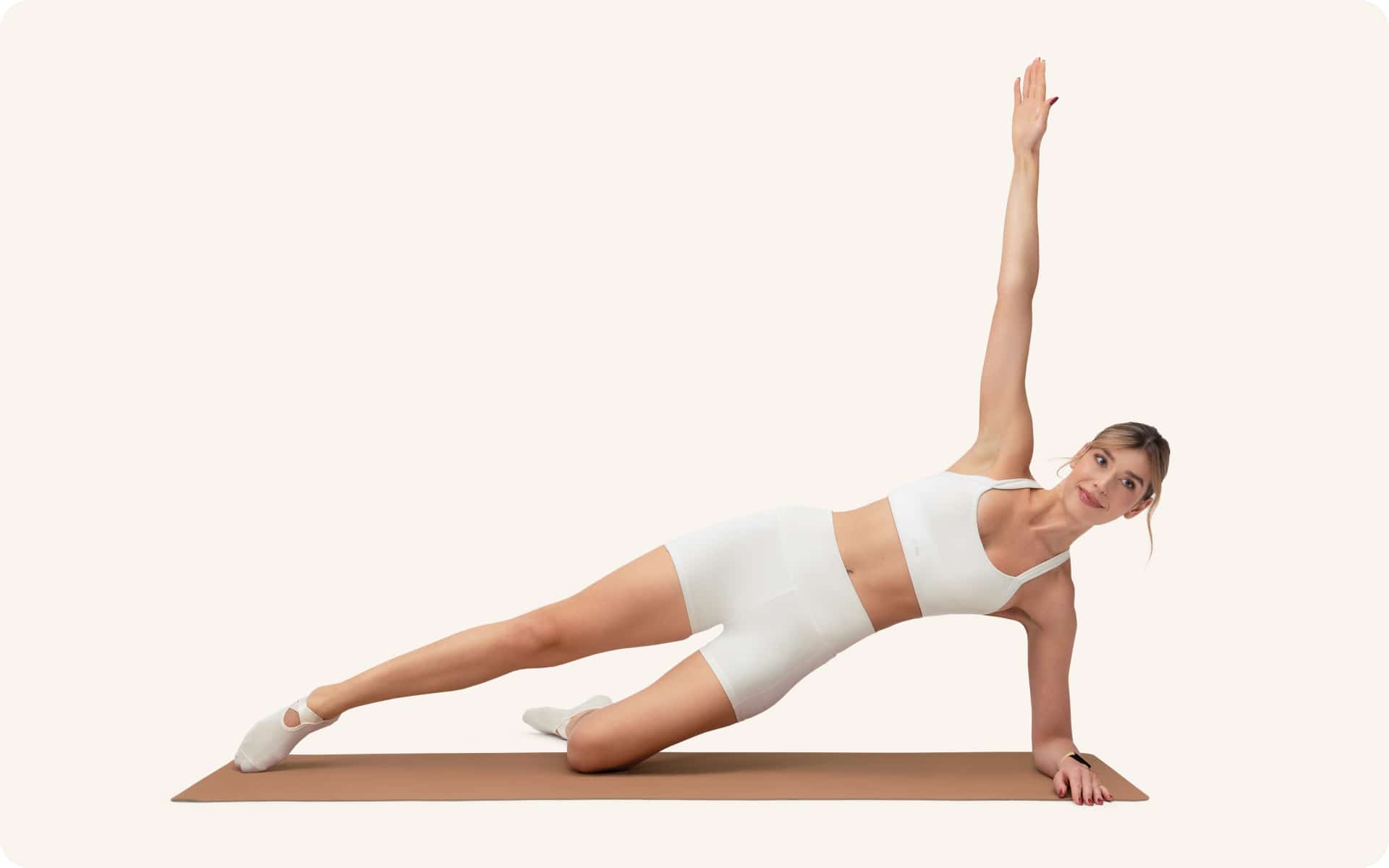
Knee-supported side plank
- Lie on your side on a mat with your knees bent and your elbow beneath your shoulder.
- Lift your hips a short distance using your forearm and knees for support.
- Keep your top hand on your hip; an optional ball can rest in front of you without supporting your weight.
- Hold for up to 5 seconds while breathing normally.
- Lower your hips before changing sides.
Adjustment: keep your hips on the mat and practice the setup. Leave the ball out if it distracts from your position.
How can you put the exercises into a session?
Choose two exercises you can perform with control for an initial practice session. The example below is a sample session, so change or skip any movement that does not suit you.
For more exercise variations, see our Pilates ball workout.
Preparation
Place the ball and mat on a clear, nonslip surface before starting.
Rehearse the starting positions without adding the full movement.
- Use a stable support for seated practice.
- Breathe normally as you settle into each position.
Sample practice session
Try one set of up to 5 bent-knee ball presses.
- After resting until you feel ready, practice the seated ball balance with both feet planted.
- End the set when the ball rolls away, your position changes, or you cannot breathe comfortably.
- On another day, consider a short roll-out or kneeling plank if you can control the setup. Increase one element at a time, such as range or repetitions.
Finishing the session
Return the ball to a stable position and stand up at a pace that feels comfortable.
- Keep both feet on the floor when getting up from seated ball practice.
- Record which movements you used and whether you needed an adjustment.
What does research show about Pilates and core training?
Research has measured endurance, muscle activation, flexibility, and attention in specific Pilates or core-training programs. The results should be read in the context of each program and participant group.
Trunk muscle function
Core muscles contribute to everyday actions such as reaching, bending, and turning (5). Studies of exercise can measure selected aspects of that function: the four-week core-stability trial assessed transverse abdominis activation and timing, with no injury-prevention endpoint (4).
Read more: Is Pilates Active Recovery? Here’s What the Science Says
Endurance and flexibility
In a 12-week mat Pilates study involving 50 active middle-aged adults, the Pilates group improved abdominal and upper-body endurance and hamstring flexibility. Balance and posture did not differ significantly from the control group (2).
The findings do not establish that a ball will correct posture or make every joint more mobile.
Daily movement
The muscles around the trunk help you maintain position while your arms and legs move (5). During exercise, pay attention to the movement you can repeat with control.
Breathing during practice
Breathe steadily as you move.
Shorten the hold or pause if you find yourself holding your breath.
Attention to movement
A 15-week study comparing mat Pilates classes with recreational exercise classes found increases in self-reported mindfulness in the Pilates group (6).
That study examined attention and wellbeing measures. It did not test whether these ball exercises prevent falls.
How can you adjust core exercises over time?
Adjust one element at a time, such as range, repetitions, or support. Keep the movement small enough to repeat without losing your position.
Practice controlled repetitions
Use the ball roll-out, ball press, or supported side plank only through a range you can control.
Pause between repetitions when you need to reset your position.
Keep mobility work manageable
Use a small movement during seated practice before trying a larger range.
The goal for the session is to repeat the movement comfortably.
Choose stable support
Keep a sturdy support within reach during seated ball practice.
Move to a stable chair if sitting on the ball feels uncertain.
Breathe through the movement
Count a normal breath during a short hold.
Release the position if you need to hold your breath to maintain it.
Review your setup
Check the mat, ball position, and available space before another set.
A smaller range or floor-supported option can make it easier to control the exercise.
What equipment do these exercises need?
Use a large stability ball, a nonslip mat, and a stable support for seated practice. Check the ball’s instructions before putting weight on it. The exercise ball workout guide shows other ways this equipment is used.
- A mat provides a surface for kneeling and floor exercises.
- A stable chair or fixed support can be kept within reach during seated practice.
- A small soft Pilates ball is a different prop. It should not replace the large support ball unless the exercise has been adapted for it.
BetterMe offers a variety of workouts, recipes, challenges, and support tools to help you stay more consistent with your wellness routine. Explore the app to find features that fit your goals, preferences, and schedule.
FAQs
How do you choose a stability ball size?
Use the sizing and load guidance for the specific ball you plan to buy. Height charts vary by product, so check the manufacturer’s instructions and ask an instructor to review the fit if you are unsure.
For seated practice, choose a setup that lets both feet rest on the floor without sliding forward.
Where should you store a stability ball?
Follow the manufacturer’s storage instructions and keep the ball away from sharp objects and heat. Inspect the surface before using it and replace damaged equipment.
The bottom line
Begin with a floor-supported movement or seated practice with both feet planted. Use a short range, stop when control changes, and note which adjustments you need. Add difficulty only when the current version remains manageable.
A ball is optional equipment. A qualified instructor can help you choose floor-based movements when ball exercises do not fit your circumstances.
DISCLAIMER:
This article is intended for general informational purposes only and does not serve to address individual circumstances. It is not a substitute for professional advice or help and should not be relied on for making any kind of decision-making. Any action taken as a direct or indirect result of the information in this article is entirely at your own risk and is your sole responsibility.
BetterMe, its content staff, and its medical advisors accept no responsibility for inaccuracies, errors, misstatements, inconsistencies, or omissions and specifically disclaim any liability, loss or risk, personal, professional or otherwise, which may be incurred as a consequence, directly or indirectly, of the use and/or application of any content.
You should always seek the advice of your physician or other qualified health provider with any questions you may have regarding a medical condition or your specific situation. Never disregard professional medical advice or delay seeking it because of BetterMe content. If you suspect or think you may have a medical emergency, call your doctor.
SOURCES:
- The effects of stability ball training on spinal stability in sedentary individuals (2006, pubmed.ncbi.nlm.nih.gov)
- Pilates for improvement of muscle endurance, flexibility, balance, and posture (2010, pubmed.ncbi.nlm.nih.gov)
- Swiss Ball Versus Mat Exercises For Core Activation of Transverse Abdominis in Recreational Athletes (2016, pmc.ncbi.nlm.nih.gov)
- TRANSVERSUS ABDOMINIS ACTIVATION AND TIMING IMPROVES FOLLOWING CORE STABILITY TRAINING: A RANDOMIZED TRIAL (2017, pmc.ncbi.nlm.nih.gov)
- The real-world benefits of strengthening your core (2012, health.harvard.edu)
- Pilates, Mindfulness and Somatic Education (2013, pmc.ncbi.nlm.nih.gov)
 By
By 
 Reviewed by
 By
By