
A beginner Pilates ball workout can use a small soft ball for gentle pressure and movement feedback. Start with supported positions, comfortable ranges, and time to learn each setup. This session does not use a large stability ball. Our Pilates equipment guide explains the differences before you choose equipment.
Following exercise and diet plans is the key in your fitness journey and greatly impacts results. In 4 weeks users can typically expect to lose not more than 1-2 lbs per week. Individual results may vary.
Key takeaways
These points summarize how to start a beginner Pilates ball workout and what to expect.
- This sample uses a small soft ball; large stability-ball exercises require different instructions.
- The eight movements and repetition ranges are editorial starting examples, not a tested clinical program.
- Core exercises involve coordinated muscles around the trunk and pelvis (1).
- Use controlled movement and keep breathing during resistance work (2).
- Pause the session if you feel discomfort or become unwell (3).
- Gentle ball practice should not automatically be counted as moderate aerobic activity (4).
What kind of ball does this workout use?
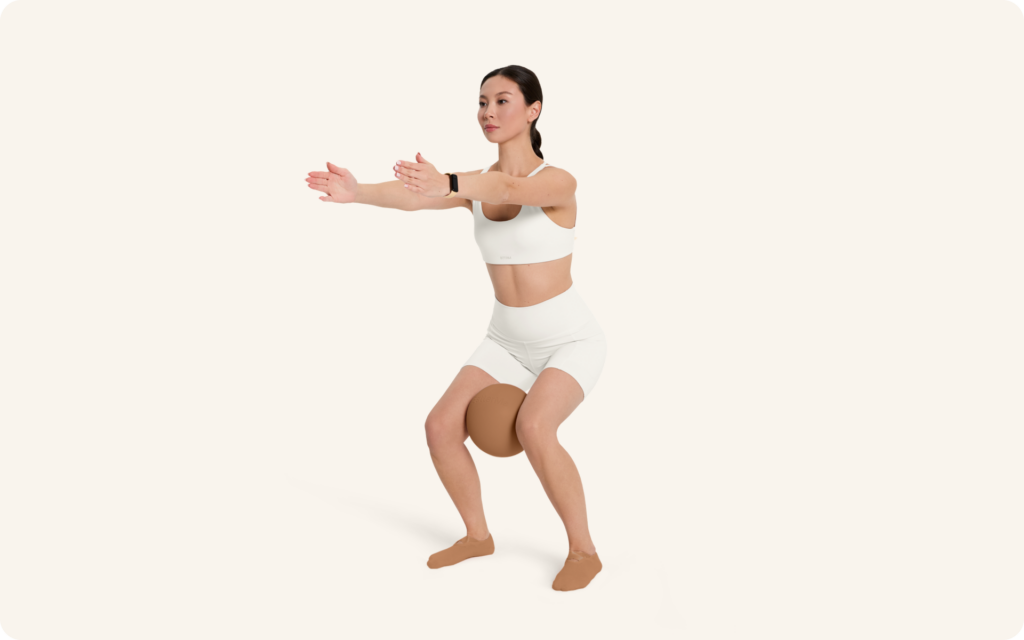
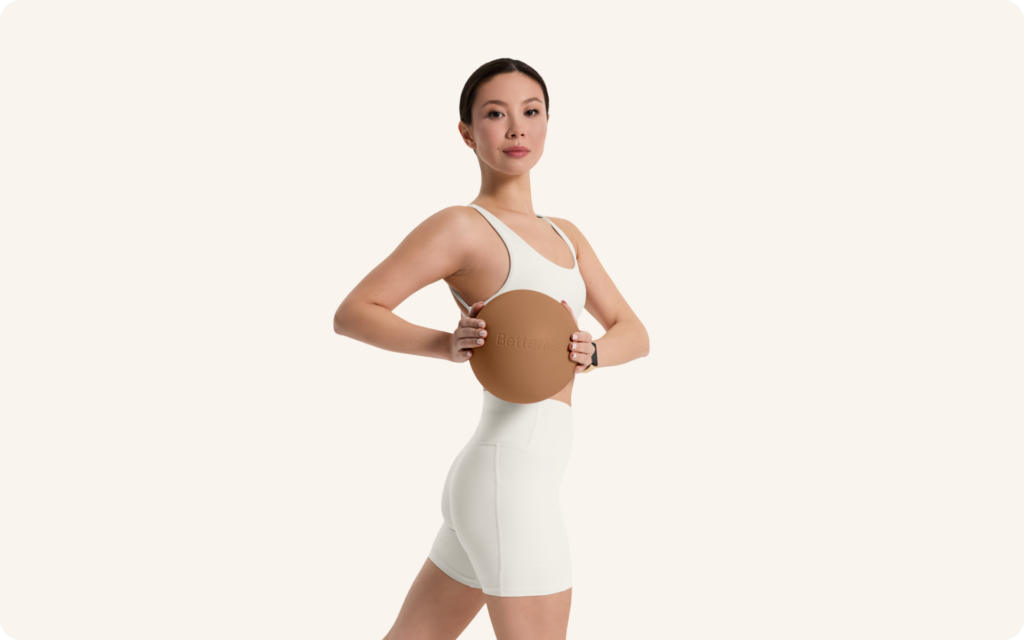
This workout uses a small soft exercise ball that fits comfortably between your hands or thighs. The ball acts as a light compression prop or a cue to keep your arms steady.
A large stability ball is designed for different positions, such as supported sitting. It changes the balance demands and contact surface. Do not substitute it for the small ball in this session.
Follow the manufacturer’s inflation and usage instructions. Check that the plug is secure and the surface is undamaged. Keep the ball away from sharp objects.
You do not need to inflate the ball until it feels rigid. Choose the permitted inflation level that feels comfortable for the intended position. If the ball slips repeatedly, pause and reconsider the setup.
The ball is optional in several movements below. Remove it when holding it distracts from the exercise. Learning a clear movement pattern is a useful first goal.
Read more: Pilates without equipment: a full-body workout at home
How can a ball help a beginner practice?
A ball can provide a visible or tactile reference during a familiar movement. Holding it between the hands gives both arms a shared object. Gentle thigh pressure creates a clear inward pressing task.
Ball feedback does not make every ball exercise more useful than a floor version. Instability can also make a task harder to control. This routine therefore keeps the feet grounded for most movements.
Core exercises can be practiced without special equipment (1). The ball adds variety rather than creating an entirely separate fitness requirement. Choose the variation you can perform comfortably.
Avoid chasing wobbling as a sign of progress. If the ball rolls away or your position changes unexpectedly, reduce the difficulty. A steadier repetition can be a more useful learning outcome.
How should you prepare for the session?
Prepare a clear floor area, a stable mat, and a solid chair for the seated exercises. The chair should not have wheels or slide during use. Keep the ball within reach before sitting or lying down.
Ask for exercise advice when a health condition, a strain, or recent surgery affects your movement (3). Pregnancy or recent childbirth may also require individual adjustments. A beginner label does not establish suitability for every circumstance.
Warm up with 5 to 10 minutes of easy walking or similar movement (2). Check that you can get down to the floor and back up comfortably. Ask about a seated alternative if floor access is difficult.
The session has no fixed completion time. Read each setup before starting. Allow additional time for changing positions and learning how to handle the ball.
BetterMe offers a variety of workouts, recipes, challenges, and support tools to help you stay more consistent with your wellness routine. Explore the app to find features that fit your goals, preferences, and schedule.
What does the first-session plan look like?
Begin with one set of each selected movement. You can try only the first few exercises during your first session. The full menu remains available when you want to extend the practice.
|
Movement |
Starting example |
Ball position |
|---|---|---|
|
Seated hand press |
6 gentle repetitions |
Between the palms |
|
Seated forward reach |
6 repetitions |
Held near the chest, then forward |
|
Supine thigh squeeze |
6 repetitions |
Between the lower thighs |
|
Bridge |
6 repetitions |
Lightly held between the thighs |
|
Heel slide |
5 per side |
Held above the chest |
|
Bent-knee opening |
5 per side |
Held above the chest |
|
Supported marching |
5 per side |
Held above the chest |
|
Seated small rotation |
4 per side |
Held near the chest |
These numbers are examples rather than minimum requirements. Rest between movements until you feel ready to continue. Stop the session when fatigue changes your control.
How do you perform the eight movements?
Perform the movements slowly enough to notice the starting position and return. Keep breathing normally. You do not need to flatten the ball or hold a maximal squeeze.
1. Seated hand press
The hand press introduces gentle ball compression from a stable position. Sit on a solid chair with both feet supported.
- Hold the ball between your palms near your chest.
- Keep your elbows comfortably bent.
- Press inward gently while breathing out.
- Release the pressure without dropping the ball.
Try 6 repetitions. Keep your shoulders relaxed rather than lifting them toward your ears. Use less pressure if your hands or wrists feel uncomfortable. The ball should remain easy to hold.
2. Seated forward reach
The forward reach adds arm movement while your body remains supported. Keep the ball pressure light.
- Sit tall with both feet flat.
- Hold the ball near your chest.
- Reach the ball forward through a comfortable range.
- Bring the ball back toward your chest.
Try 6 repetitions. Avoid leaning backward to reach farther. Shorten the movement if your shoulders tense. Rest your arms between repetitions when needed.
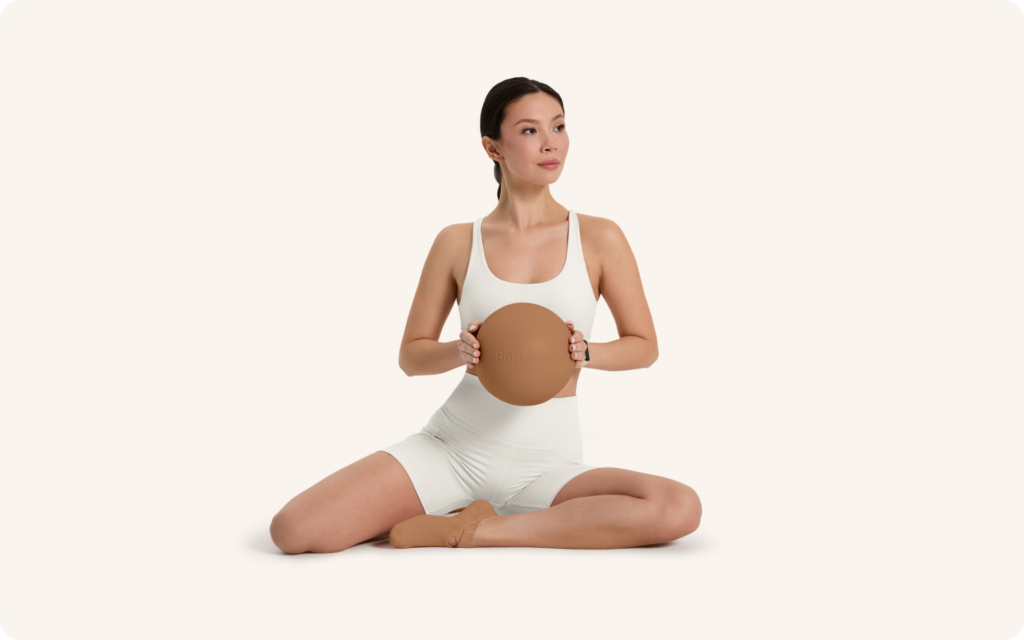
3. Supine thigh squeeze
The thigh squeeze keeps the head and feet supported. It gives you a simple way to practice ball placement on the mat.
- Lie on your back with bent knees and feet flat.
- Place the ball between your lower thighs, above the knees.
- Press inward gently.
- Release the pressure while keeping the ball in place.
Try 6 repetitions. Keep breathing throughout. Avoid clenching the whole body or pressing directly into an uncomfortable knee position. Remove the ball if the contact does not feel suitable.
4. Bridge with a light ball hold
The bridge adds hip movement to the supported starting position. A basic bridge can also be performed without equipment (1).
- Lie with bent knees, feet flat, and the ball between your lower thighs.
- Rest your arms beside your body.
- Lift your hips through a comfortable range.
- Lower your hips slowly to the mat.
Try 6 repetitions. Keep the ball squeeze gentle. Stop lifting before your lower back arches excessively. Remove the ball when the bridge feels easier to coordinate without it.
5. Heel slide
The heel slide practices leg movement while the head and trunk remain supported.
- Lie with knees bent and feet flat.
- Hold the ball above your chest with softly bent elbows.
- Slide one heel forward along the floor.
- Return the heel to its starting position.
- Change legs.
Try 5 repetitions per side. Use a short slide before extending farther. Keep the pelvis steady. Rest the ball beside you if holding it makes the movement harder to follow.
6. Bent-knee opening
The knee opening uses a small sideward movement. The foot stays on the mat throughout.
- Lie with bent knees and feet flat.
- Hold the ball above your chest.
- Open one knee a short distance outward.
- Bring the knee back over its foot.
- Repeat with the other leg.
Try 5 repetitions per side. Keep the opposite leg still. Reduce the opening when your pelvis rolls. The goal is a controlled return rather than reaching the floor.
7. Supported marching
Supported marching introduces a brief foot lift. Keep the head resting on the mat and lift only one foot at a time.
- Lie with bent knees and feet flat.
- Hold the ball comfortably above your chest.
- Lift one foot slightly from the floor.
- Set the foot down quietly.
- Alternate sides.
Try 5 lifts per side. Keep the lift low enough to maintain your starting position. Return to heel slides if your back position changes. Avoid turning the exercise into a fast march.
8. Seated small rotation
The final movement uses a stable chair and a modest turning range. Omit twisting if it conflicts with your individual movement guidance.
- Sit with both feet flat.
- Hold the ball close to your chest.
- Turn your chest slightly toward one side.
- Return to center.
- Repeat toward the other side.
Try 4 turns per side. Keep your pelvis facing forward. Move the ball with your chest rather than swinging your arms. Stop before the turn becomes forced.
Read more: Home Pilates workout: 9 no-equipment moves for your core
How should you finish and assess the session?
Finish by resting the ball and returning to a comfortable position. Take time to stand up without rushing. You do not need an aggressive stretch to complete the session.
Note which setups felt clear and which needed repeated adjustments. Record the movements you completed and any discomfort. That record helps you choose the next session’s starting point.
Repeat the same selection before adding more repetitions. When the movement becomes consistent, increase one feature at a time. You might add a few repetitions or a slightly larger comfortable range.
Avoid progressing by putting your feet on a loose ball during a bridge. That creates a different balance task. Learn such variations separately with appropriate instruction.
For a wider selection, see our 10 Pilates ball exercises. A longer menu gives you options without requiring every movement in one session.
How often should you practice?
Choose a frequency that fits your rest days and other exercise. A manageable introductory schedule might repeat this sample on two nonconsecutive days. That is an editorial example rather than a universal prescription.
Adults generally need strengthening on at least 2 days weekly and regular aerobic activity (5). This gentle session may not provide enough challenge for every major muscle group. Keep broader activity needs in view.
Moderate aerobic effort generally allows talking but makes singing difficult (4). Gentle ball practice should not automatically count toward that target. Suitable walking or other aerobic movement can complement the session.
If you are choosing between formats, read mat Pilates vs reformer Pilates. Small-ball practice is a mat-based option, not a replacement for apparatus instruction.
Frequently Asked Questions
Can you replace your office chair with a ball all day?
This workout does not establish that a ball is suitable for all-day desk seating. Choose seating that supports your work needs. Seek appropriate ergonomic advice if sitting causes discomfort.
Do you need to count every breath?
This sample does not require a fixed breathing count. Keep breathing comfortably while you move. Pause if concentrating on the ball makes you hold your breath.
Can bouncing on a ball reduce belly fat?
This small-ball routine does not include bouncing or establish targeted abdominal fat loss. Activity contributes to weight management alongside eating patterns and other factors (6). Choose the session for movement practice rather than a promised appearance change.
The bottom line
Begin with a few supported movements and light ball pressure. Repeat clear setups before increasing the session’s length. Keep the small ball optional when using it makes the movement less comfortable or harder to control.
DISCLAIMER:
This article is intended for general informational purposes only and does not serve to address individual circumstances. It is not a substitute for professional advice or help and should not be relied on for making any kind of decision-making. Any action taken as a direct or indirect result of the information in this article is entirely at your own risk and is your sole responsibility.
BetterMe, its content staff, and its medical advisors accept no responsibility for inaccuracies, errors, misstatements, inconsistencies, or omissions and specifically disclaim any liability, loss or risk, personal, professional or otherwise, which may be incurred as a consequence, directly or indirectly, of the use and/or application of any content.
You should always seek the advice of your physician or other qualified health provider with any questions you may have regarding a medical condition or your specific situation. Never disregard professional medical advice or delay seeking it because of BetterMe content. If you suspect or think you may have a medical emergency, call your doctor.
SOURCES:
- Core exercises: Why you should strengthen your core muscles (2025, mayoclinic.org).
- Weight training: Do’s and don’ts of proper technique (2025, mayoclinic.org).
- Pilates video for beginners (2025, nhs.uk).
- How to Measure Physical Activity Intensity (2025, cdc.gov).
- Adult Activity: An Overview (2023, cdc.gov).
- Physical Activity and Your Weight and Health (2026, cdc.gov).
 Reviewed by
 Reviewed by