

A calisthenics workout plan for men can start with two or three weekly sessions that combine pushing, pulling, squatting, and core work. Choose exercise variations you can control, leave rest days between demanding full-body sessions, and progress gradually. This guide offers a sample schedule, beginner alternatives, and ways to adjust the workload.
Calisthenics uses body weight as resistance. A step-by-step calisthenics starter guide can help you choose your first movements before you follow the weekly plan. Changes in strength, muscle size, and appearance vary between individuals; the schedule does not promise a particular physique.
Following exercise and diet plans is the key in your fitness journey and greatly impacts results. In 4 weeks users can typically expect to lose not more than 1-2 lbs per week. Individual results may vary.
Key takeaways
- The sample beginner schedule uses two or three full-body sessions on nonconsecutive days.
- Adults are advised to include muscle-strengthening activity on at least two days each week, alongside aerobic activity. (1)
- Incline push-ups, assisted pulls, supported squats, and knee planks can reduce the starting difficulty.
- Pull-ups and rows require equipment designed to support your body weight.
- A small four-week study found improved upper-body strength with progressive push-up training, without a significant muscle-thickness increase. (2)
- Add repetitions or change one exercise variation only when you can maintain control.
- Weight and appearance changes depend on multiple factors, and individual results may vary.

Can you build muscle with only calisthenics?
Bodyweight resistance training can support strength and muscle development when exercises provide an appropriate challenge and progress over time. A small push-up trial supports strength gains, but it should not be used as a promise of rapid muscle growth. (2)
How muscle adaptation works
Training provides a stimulus for adaptation; muscle damage is not a goal. In a study of ten young men, muscle growth was associated with repeated protein-synthesis responses after initial muscle damage had diminished. The finding does not mean that soreness or more damage produces more growth. (4)
Using your body as resistance
When you do calisthenics, you’re lifting your own body weight. Exercises such as push-ups, pull-ups, and squats use gravity to create resistance. Adjusting support, body position, and the exercise variation changes how demanding a movement feels.
Read more: This Is How A Toned Body For Men Looks Like, According To Science
Progressive overload in calisthenics
Progressive overload means increasing the challenge as your ability develops. A ten-week study of leg-extension training found gains with either added load or added repetitions; it was not a trial of this bodyweight plan. (3)
- Adding more reps or sets.
- Slowing down the movement for extra time under tension.
- Using harder variations of the same exercise (e.g. progressing from a regular push-up to an archer push-up).
Treat these as options, rather than changes to apply together. Keep the same variation until all sets are controlled, then add a repetition or use a slightly harder version. Slower movement can help you practice control, but longer time under tension does not automatically mean greater growth.
Activating multiple muscle groups
Calisthenics exercises are often compound movements. This means they target multiple muscles at once. For example:
- Push-ups work your chest, shoulders, triceps, and core.
- Pull-ups hit your back, biceps, and forearms.
- Squats engage your legs, hips, and even core.
These patterns let you organize a balanced session without needing a separate exercise for every muscle. For exercise instructions, use the eight-exercise men’s routine.
Is calisthenics good for men?
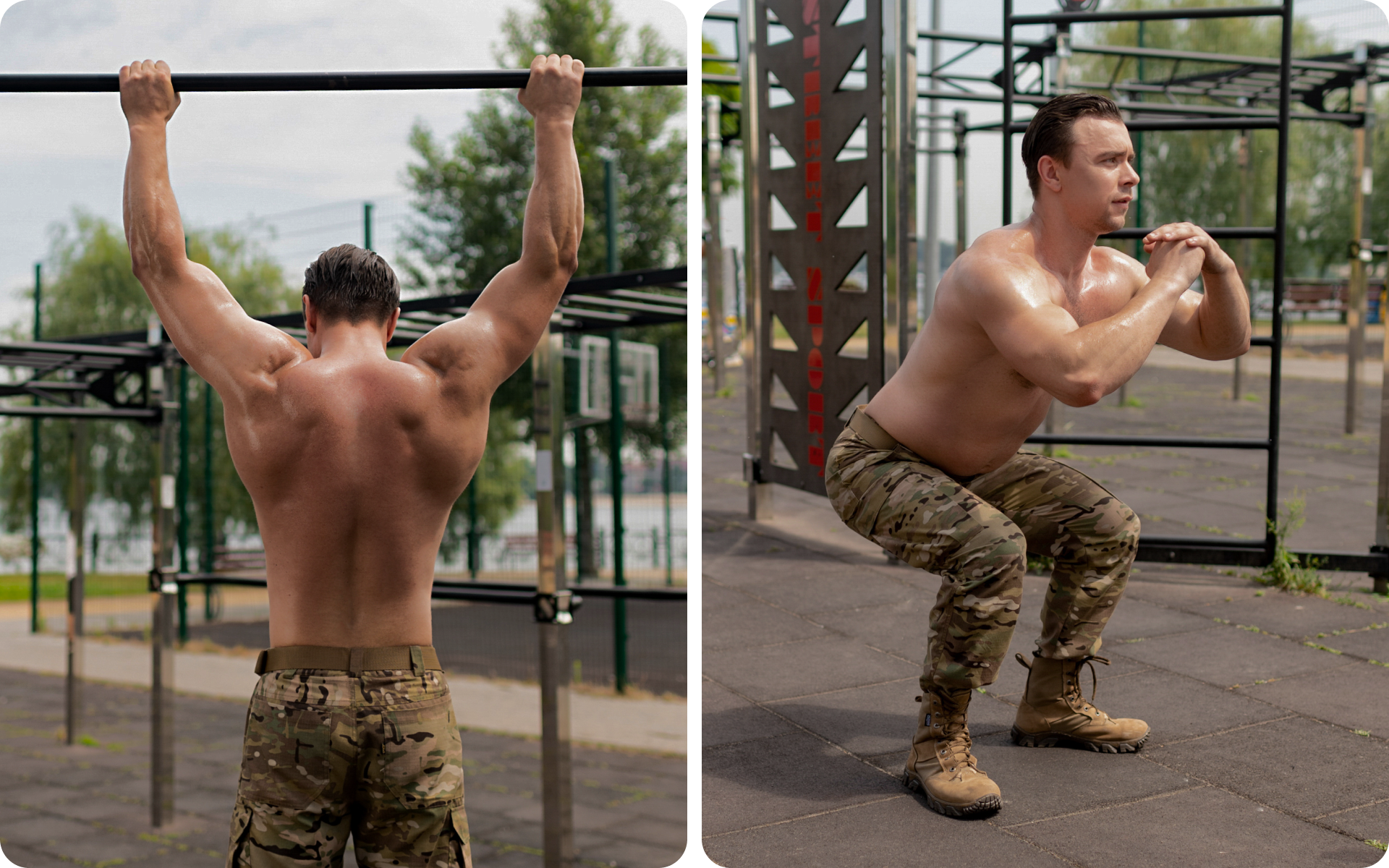
Calisthenics can be a practical resistance-training option for men whose goals include strength, movement control, and muscular endurance. Starting ability, equipment, and training preferences matter more than a single ideal body shape.
Everyday movement patterns
- Push-ups strengthen your chest, shoulders, and triceps for pushing tasks.
- Pull-ups improve back and arm strength for pulling or climbing.
- Squats keep your legs and hips strong for lifting and walking.
Practicing these movements develops strength in the trained patterns. Carryover to a particular sport or task also depends on how closely the training matches it.
Range of motion and equipment
Use a range of motion you can control. A review favored full-range training for strength and lower-limb muscle growth, but this does not justify forcing deeper positions or applying the result to every exercise. (5)
Floor exercises need a firm, nonslip surface. Pulling exercises need a properly installed bar, rated rails, or an anchored suspension trainer. Do not substitute tree branches or household furniture for equipment that supports your full body weight.
Reasons why BetterMe is a safe bet: a wide range of calorie-blasting workouts, finger-licking recipes, 24/7 support, challenges that’ll keep you on your best game, and that just scratches the surface! Start using our app and watch the magic happen.
What is a beginner calisthenics workout plan for men?
A beginner plan can use the same manageable full-body session two or three times per week, with rest or easy movement between sessions. The schedule below is an illustrative starting point, not a prescription for every reader.
Weekly schedule
| Day | Two-session option | Three-session option |
|---|---|---|
| Monday | Full-body session | Full-body session |
| Tuesday | Rest or easy walking | Rest or easy walking |
| Wednesday | Rest or mobility | Full-body session |
| Thursday | Full-body session | Rest or mobility |
| Friday | Rest or easy walking | Full-body session |
| Saturday | Optional easy activity | Optional easy activity |
| Sunday | Rest | Rest |
Start with the two-session option if you are new to resistance training. The adult activity guideline includes at least two muscle-strengthening days and either 150 minutes of moderate aerobic activity, 75 minutes of vigorous activity, or an equivalent mixture per week. Strength sessions do not automatically meet the aerobic recommendation. (1)
Full-body session
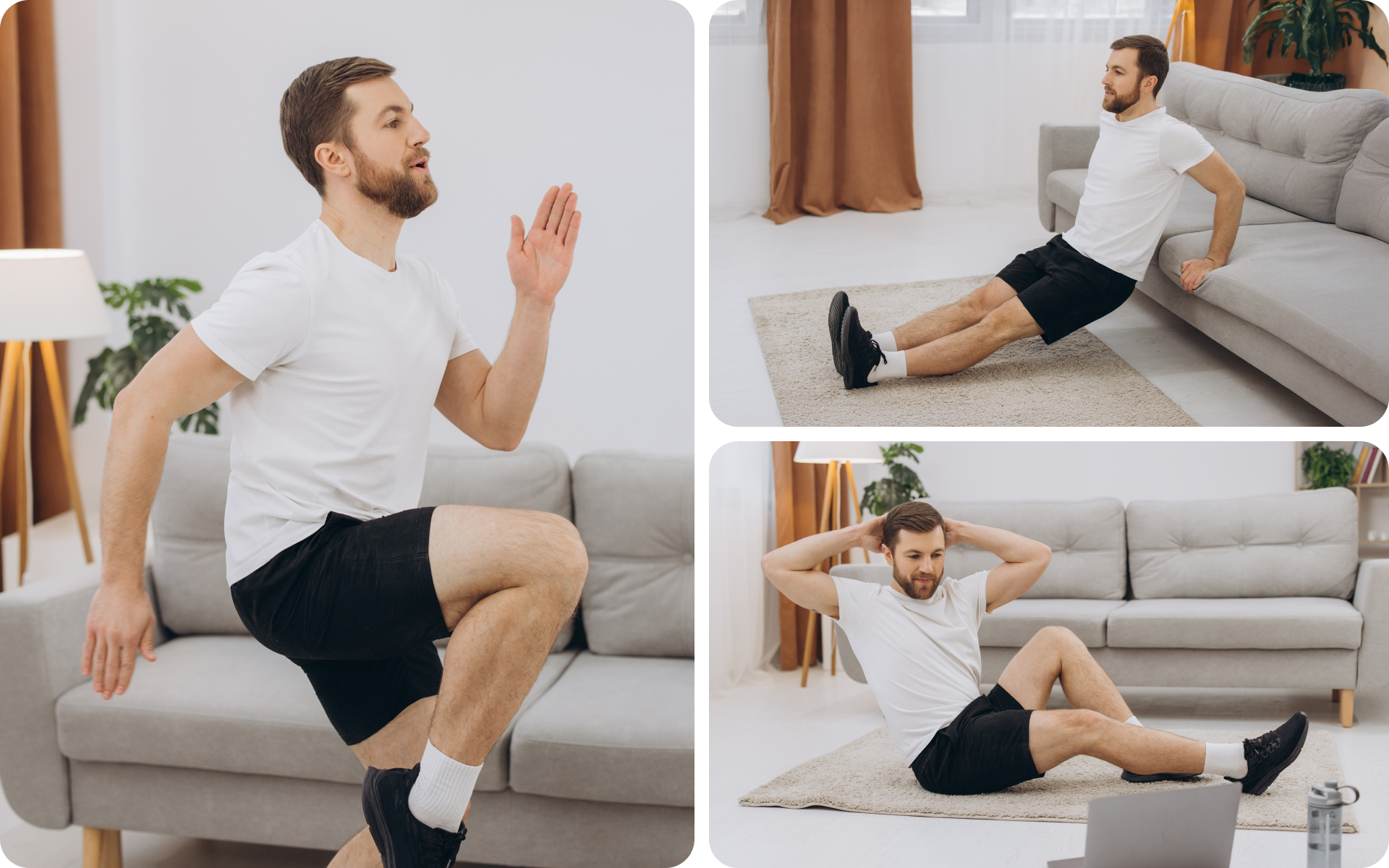
Warm up for five to eight minutes with easy marching, arm circles, supported squats, and practice repetitions. Perform one exercise at a time, completing its sets before moving on. Choose the lower end of each range at first.
| Exercise | Starting dose | Rest between sets | Easier option |
|---|---|---|---|
| Push-up | 2 sets of 6 to 10 reps | 90 to 120 secs | Wall or high-incline push-up |
| Assisted pull-up or row | 2 sets of 5 to 8 reps | 90 to 120 secs | More assistance or a more upright row |
| Bodyweight squat | 2 sets of 8 to 12 reps | 60 to 90 secs | Supported squat |
| Glute bridge | 2 sets of 8 to 12 reps | 60 to 90 secs | Shorter comfortable range |
| Plank | 2 holds of 15 to 30 secs | 60 to 90 secs | Knee-supported plank |
Allow roughly 30 to 45 minutes including the warm-up, transitions, and rest. Take longer rests when needed. Finish each set while you could still perform about two or three controlled repetitions; end a hold before your position changes.
If no suitable pulling equipment is available, leave the pull out temporarily and arrange access to rated equipment. A floor-only session is an option, but it does not provide the same pulling stimulus.
Read more: Fitness Tips For Men: What To Do When You Need To Lose Weight Or Gain Muscle
Four-week progression
| Week | Main task | When to adjust |
|---|---|---|
| 1 | Learn variations and record repetitions | Keep the starting dose manageable |
| 2 | Repeat the same schedule | Add one rep to a set if control is consistent |
| 3 | Build toward the top of a range | Keep the same number of sets |
| 4 | Review the training log | Repeat the week or try one slightly harder variation |
Weeks are checkpoints, not deadlines. If the next variation is too difficult, continue the current one. Reduce a set, choose an easier version, or take another rest day if fatigue changes your technique.
What is the 80/20 rule in calisthenics?
The 80/20 rule is an informal reminder to prioritize a few useful movements, not a measured guarantee that 20 percent of training creates 80 percent of results. A simple program can emphasize pushing, pulling, lower-body work, and core control without attaching an exact percentage to their effects.
Keep a training log of your variation, sets, repetitions, and rest. The bodyweight strength guide explains how to change leverage and assistance as you progress.
Can I train calisthenics every day?
You can move every day, but beginners do not need demanding resistance sessions every day. Use nonconsecutive full-body sessions and keep other days for rest, easy walking, or comfortable mobility.
A light day should feel different from a strength session. Repeated push-ups, hard planks, and intense skill attempts can still load the same muscles even when labeled as active rest. Stop exercise that causes sharp discomfort, and seek qualified guidance if you are unsure how to adapt a movement.
What should support your training outside the workout?
Regular meals, sufficient rest, and a workable schedule support your training routine. Include protein-containing foods that suit your dietary preferences. A review found that additional protein could support resistance-training gains, but more was not always associated with further benefit. Supplements are not automatically necessary. (6)
If you prefer brief early sessions, the morning calisthenics routine offers a different format. You can also explore BetterMe’s calisthenics quiz to see the available options.

Calisthenics can provide resistance training without free weights or machines. Some goals and movements still require additional equipment or external loads, so the choice depends on what you want to train. Many calisthenics exercises such as planks, hollow body holds, and leg raises target the core muscles directly. Even compound movements, such as pull-ups and push-ups, engage your core for stabilization. Visible abdominal definition is not guaranteed by a routine. No, age 30 alone does not prevent you from starting bodyweight training. Choose a manageable variation and adjust the workload to your experience and individual circumstances. The sample plan does not require failure on every set. Finish while you can still maintain control, and use your training log to judge whether the workload is progressing.Frequently asked questions
Can calisthenics replace the gym?
Can calisthenics build abs?
Is 30 too old for calisthenics?
Do I need to train to failure?
The bottom line
A calisthenics plan gives you a repeatable way to practice pushing, pulling, lower-body movement, and core control. Start with a schedule you can maintain, use rated equipment where required, and change one training variable at a time. Strength and appearance changes vary, and rest is part of the plan.
Disclaimer
This article is intended for general informational purposes only and does not serve to address individual circumstances. It is not a substitute for professional advice or help and should not be relied on for making any kind of decision-making. Any action taken as a direct or indirect result of the information in this article is entirely at your own risk and is your sole responsibility.
BetterMe, its content staff, and its medical advisors accept no responsibility for inaccuracies, errors, misstatements, inconsistencies, or omissions and specifically disclaim any liability, loss or risk, personal, professional or otherwise, which may be incurred as a consequence, directly or indirectly, of the use and/or application of any content.
You should always seek the advice of your physician or other qualified health provider with any questions you may have regarding a medical condition or your specific situation. Never disregard professional medical advice or delay seeking it because of BetterMe content. If you suspect or think you may have a medical emergency, call your doctor.
Sources
- Adult Activity: An Overview (2023, cdc.gov)
- Effect of Progressive Calisthenic Push-up Training on Muscle Strength and Thickness (2018, pubmed.ncbi.nlm.nih.gov)
- Effects of Resistance Training Overload Progression Protocols on Strength and Muscle Mass (2024, pubmed.ncbi.nlm.nih.gov)
- Resistance training-induced changes in integrated myofibrillar protein synthesis are related to hypertrophy only after attenuation of muscle damage (2016, pmc.ncbi.nlm.nih.gov)
- Effects of range of motion on resistance training adaptations: A systematic review and meta-analysis (2021, pubmed.ncbi.nlm.nih.gov)
- A systematic review, meta-analysis and meta-regression of the effect of protein supplementation on resistance training-induced gains in muscle mass and strength in healthy adults (2018, pmc.ncbi.nlm.nih.gov)
 By
 Reviewed by
 Reviewed by