
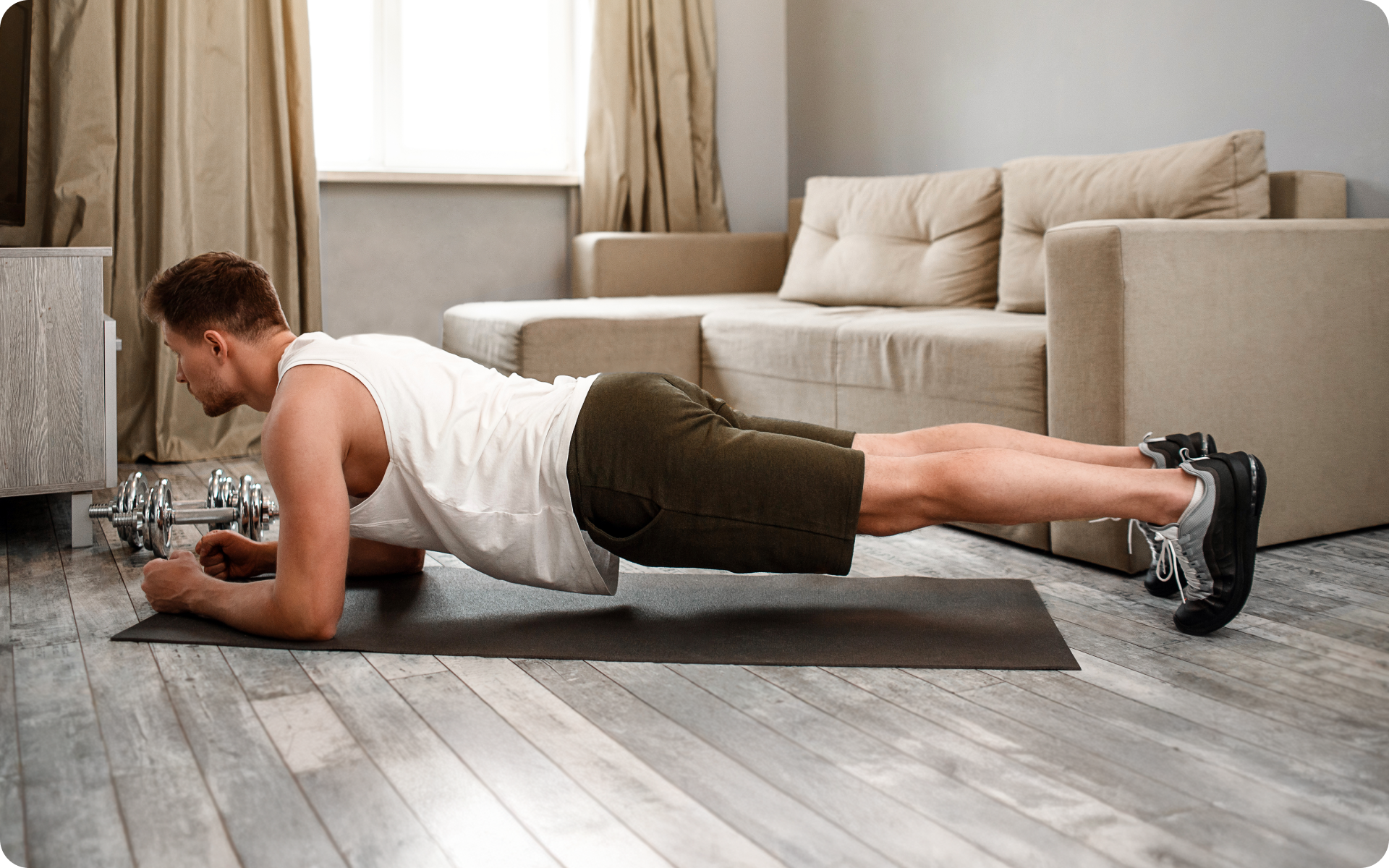
A morning calisthenics routine for men can begin with easy movement, continue with controlled bodyweight exercises, and finish with a gradual reduction in effort. This guide provides a timed 25-minute sample and a shorter 10-minute option. Choose manageable variations and a schedule that lets you train without cutting short your sleep.
Morning training is a scheduling option, not a hormonal shortcut. Use the step-by-step calisthenics starter guide to select starting variations. Strength sessions need rest and appropriate progression regardless of the time of day.
Key takeaways
- The sample morning session totals 25 minutes, including five minutes of warm-up and two minutes of easy finishing movement.
- A 10-minute option provides shorter practice when time is limited.
- Exercise time should fit your sleep and schedule, rather than promise a special morning hormonal effect.
- One study of 56 participants found attention improvements without a difference between morning and afternoon exercise groups. (5)
- Adult activity guidance includes muscle-strengthening activity on at least two days each week. (1)
- Pull-ups and rows require rated equipment; the floor-only option does not duplicate pulling work.
- Increase repetitions, rounds, or difficulty gradually, and allow rest between demanding sessions.
Is it good to do calisthenics in the morning?
Morning calisthenics can be practical if it suits your schedule and you can exercise with control. Research does not justify a universal claim that a morning routine produces superior strength gains or a favorable hormonal advantage for men.
A study comparing morning and afternoon exercise found attention improvements in both groups without a time-of-day difference. It used an intermittent running test, not this calisthenics routine, so it does not establish productivity benefits from the plan. (5)
Give yourself time to wake up and begin with an easier warm-up. If an early session means sacrificing sleep or rushing movements, choose another time. A review discussing athletic performance identifies sleep as a relevant factor, but its findings do not determine one schedule for every beginner. (6)
What makes calisthenics practical for an early session?
Calisthenics offers scalable bodyweight movements with a relatively small setup for floor exercises. You can rehearse a push-up, squat, bridge, or plank at a manageable level before the day becomes busy.
Pulling exercises still need equipment. A correctly installed bar, rated rails, or an anchored suspension trainer can provide pulling options; household tables and chairs should not be used as bodyweight suspension equipment.
A short routine is a practical way to schedule movement. It does not promise an all-day metabolic increase, guaranteed changes in focus or a specific physical outcome.
Whether you’re a workout beast or just a beginner making your first foray into the world of fitness and dieting – BetterMe has a lot to offer to both newbies and experts! Install the app and experience the versatility first-hand!
Can morning workouts help you organize your day?
A planned workout can help you reserve time for exercise before other commitments. This is a scheduling benefit, rather than proof that the routine increases job performance or produces hours of enhanced focus.
Set out the equipment you intend to use, choose a realistic start time, and decide in advance whether you will use the full or short option. Use the weekly calisthenics plan for men to place morning sessions among rest days.
Which five exercises can you use in a morning routine?
Push-ups, pull-ups, squats, planks, and rows provide several basic movement patterns. Choose easier variations where needed, and use pulling equipment only when it is designed and installed for bodyweight exercise.
A small four-week push-up study found improved upper-body strength without a significant muscle-thickness increase. It does not establish the effects of this full morning session. (2)
Push-ups
Execution:
- Begin in a plank position with your hands placed slightly wider than shoulder-width apart.
- Maintain a neutral back position by engaging your core muscles and creating a straight line from your head to your heels.
- Lower your body through a comfortable range.
- Press back to the starting position.
- Use controlled movement throughout the repetition.
Pull-ups
Execution:
- Grip a pull-up bar with your hands slightly wider than shoulder-width apart using a pronated grip.
- Begin from a full hang with your arms extended and your shoulders engaged.
- Pull your body upward with control.
- Continue until your chin clears the bar without straining your neck.
- Lower with control to the starting position.
Squats
Execution:
- Stand with your feet hip-width apart and your toes slightly turned out.
- Initiate the movement by pushing your hips back and bending your knees while maintaining an upright torso.
- Descend until your thighs are parallel to the ground or as deep as your mobility allows.
- Press through your feet to return to standing.
Planks
Execution:
- Begin in a push-up position with your forearms on the ground and your elbows directly under your shoulders.
- Create a straight line from your head to your heels by engaging your core muscles and maintaining a neutral pelvis position.
- Hold this alignment while breathing normally and avoiding hip sagging or elevation.
Use knee-supported variations if necessary to maintain proper alignment throughout the hold.
Rows
Execution:
- Position yourself at rated rails or a properly anchored suspension trainer.
- Grip the bar or handles with your arms extended and your body aligned.
- Pull your chest toward the bar or handles with control.
- Lower with control to the starting position while maintaining body alignment.
Use an incline or wall push-up if floor repetitions are too demanding. For a squat, use support and a comfortable depth. For planks, knee support is an option; for rows, a more upright body position can reduce difficulty. Assisted pull-ups are optional when you have appropriate equipment and can control the movement.
Read more: Calisthenics Workout for the Back: The Complete Exercise Guide
What is a balanced morning calisthenics routine for men?
A balanced morning session can combine a brief warm-up with a small number of controlled exercise rounds and a gradual finish. The timed table is a sample for planning, not a required pace or an individually prescribed workout.
The 25-minute option
| Time | Activity | How to use the interval |
|---|---|---|
| 0 to 5 minutes | Warm-up | Easy marching, arm circles, comfortable squats, and rehearsal reps |
| 5 to 23 minutes | Strength practice | Three six-minute rounds using the station table |
| 23 to 25 minutes | Easy finish | Gentle walking and normal breathing |
Each round has six one-minute stations. Complete the suggested repetitions or hold, then rest for the remainder of the minute. Begin the next station only when you can maintain control. If you need longer rests, extend the session or use fewer rounds; do not rush to stay within 25 minutes.
| Station | Movement | Sample dose | Easier alternative |
|---|---|---|---|
| 1 | Push-up | 5 to 8 reps | Wall or incline push-up |
| 2 | Squat | 8 to 12 reps | Supported squat |
| 3 | Row | 5 to 8 reps | More upright row |
| 4 | Glute bridge | 8 to 12 reps | Shorter comfortable range |
| 5 | Plank | 15 to 25-sec hold | Knee-supported plank |
| 6 | Rest | Full minute | Add more rest if needed |
Use an assisted pull-up in place of the row when appropriate; do not add it as extra work within the same minute. Leave several controlled repetitions available rather than making the session a maximum-effort test.

The 10-minute option
| Time | Activity | Dose |
|---|---|---|
| 0 to 3 minutes | Warm-up | Easy marching and rehearsal movements |
| 3 to 9 minutes | One six-minute round | Use the station table once |
| 9 to 10 minutes | Easy finish | Gentle walking and normal breathing |
The shorter option offers practice, but it is not equivalent to the full routine’s workload. For a floor-only session, replace the row station with an easy mobility minute; this removes the pulling stimulus rather than replacing it with an equivalent exercise. Arrange rated pulling equipment for a more balanced program.
Progressing the routine
Start with one round if three are too demanding. Add a second or third round only when the current dose is repeatable with control. After that, add a repetition or choose one slightly harder variation without also increasing every other variable.
A leg-extension study found gains with added repetitions or load, but it did not test this timed circuit or establish a weekly progression rate. (3) Use the bodyweight strength progression guide for movement ladders, and the eight-exercise routine for a separate upper/lower format.
Two or three nonconsecutive strength sessions can be a practical starting arrangement. Adult guidance includes at least two muscle-strengthening days plus weekly aerobic activity. This brief routine does not automatically satisfy the full aerobic recommendation. (1)
When should you adjust a morning calisthenics session?
Adjust a session when your starting variation, fatigue level, or available time makes controlled practice difficult. Choose the short option, reduce the rounds, use more assistance, or take a rest day.
Do not cut short sleep to meet the plan. If you have individual exercise restrictions or are unsure about a movement, consult an appropriate professional. Stop exercise that causes sharp discomfort rather than using the timed format to push through it.
This general routine does not set exercise advice for a diagnosis or medication. Individual guidance takes precedence over the sample schedule.
Read more: Lean Calisthenics Body Weight Workout for Beginners
Should you eat before or after morning calisthenics?
Meal timing can follow your preferences and individual needs; this guide does not require fasted training or a supplement. Choose a meal or snack that you tolerate and allow the time you need before movement.
Protein-containing foods across the day can support resistance training. A review found benefits from additional protein, but more was not always linked with further benefit. It does not establish a universal two-hour window or a requirement for a post-workout shake. (4)
You can explore BetterMe’s calisthenics quiz to view the available options.

Give yourself time to wake up, prepare the equipment, and complete an easy warm-up. Choose a start time that lets you keep adequate sleep rather than relying on exercise to compensate for a short night. Choose movements and intensity you can control at that time. Wall or incline push-ups, supported squats, and short plank holds are options; there is no universally superior morning exercise. Use a meal or snack schedule that fits your preferences and individual needs. If you are unsure how food timing affects your exercise, seek individual guidance rather than following a rigid rule. No, this routine does not require a shake. Protein-containing foods can fit into regular meals, and the overall dietary pattern matters more than treating one drink as mandatory. (4)Frequently asked questions
How can I prepare for an early morning workout?
What type of exercise can I do in the morning?
Should I eat before or after calisthenics?
Do I need a protein shake after the workout?
The bottom line
A morning routine can make exercise easier to schedule when its timing fits your life. Use the 25-minute or 10-minute format, choose controllable variations, and allow rest between demanding sessions. Morning training does not guarantee changes in focus or a particular physique.
Disclaimer
This article is intended for general informational purposes only and does not serve to address individual circumstances. It is not a substitute for professional advice or help and should not be relied on for making any kind of decision-making. Any action taken as a direct or indirect result of the information in this article is entirely at your own risk and is your sole responsibility.
BetterMe, its content staff, and its medical advisors accept no responsibility for inaccuracies, errors, misstatements, inconsistencies, or omissions and specifically disclaim any liability, loss or risk, personal, professional or otherwise, which may be incurred as a consequence, directly or indirectly, of the use and/or application of any content.
You should always seek the advice of your physician or other qualified health provider with any questions you may have regarding a medical condition or your specific situation. Never disregard professional medical advice or delay seeking it because of BetterMe content. If you suspect or think you may have a medical emergency, call your doctor.
Sources
- Adult Activity: An Overview (2023, cdc.gov)
- Effect of Progressive Calisthenic Push-up Training on Muscle Strength and Thickness (2018, pubmed.ncbi.nlm.nih.gov)
- Effects of Resistance Training Overload Progression Protocols on Strength and Muscle Mass (2024, pubmed.ncbi.nlm.nih.gov)
- A systematic review, meta-analysis and meta-regression of the effect of protein supplementation on resistance training-induced gains in muscle mass and strength in healthy adults (2018, pmc.ncbi.nlm.nih.gov)
- Cognitive Benefits of Exercise: Is There a Time-of-Day Effect? (2022, mdpi.com)
- Sleep and Athletic Performance: Impacts on Physical Performance, Mental Performance, Injury Risk and Recovery, and Mental Health (2020, pmc.ncbi.nlm.nih.gov)

 By

 Reviewed by
 Reviewed by