
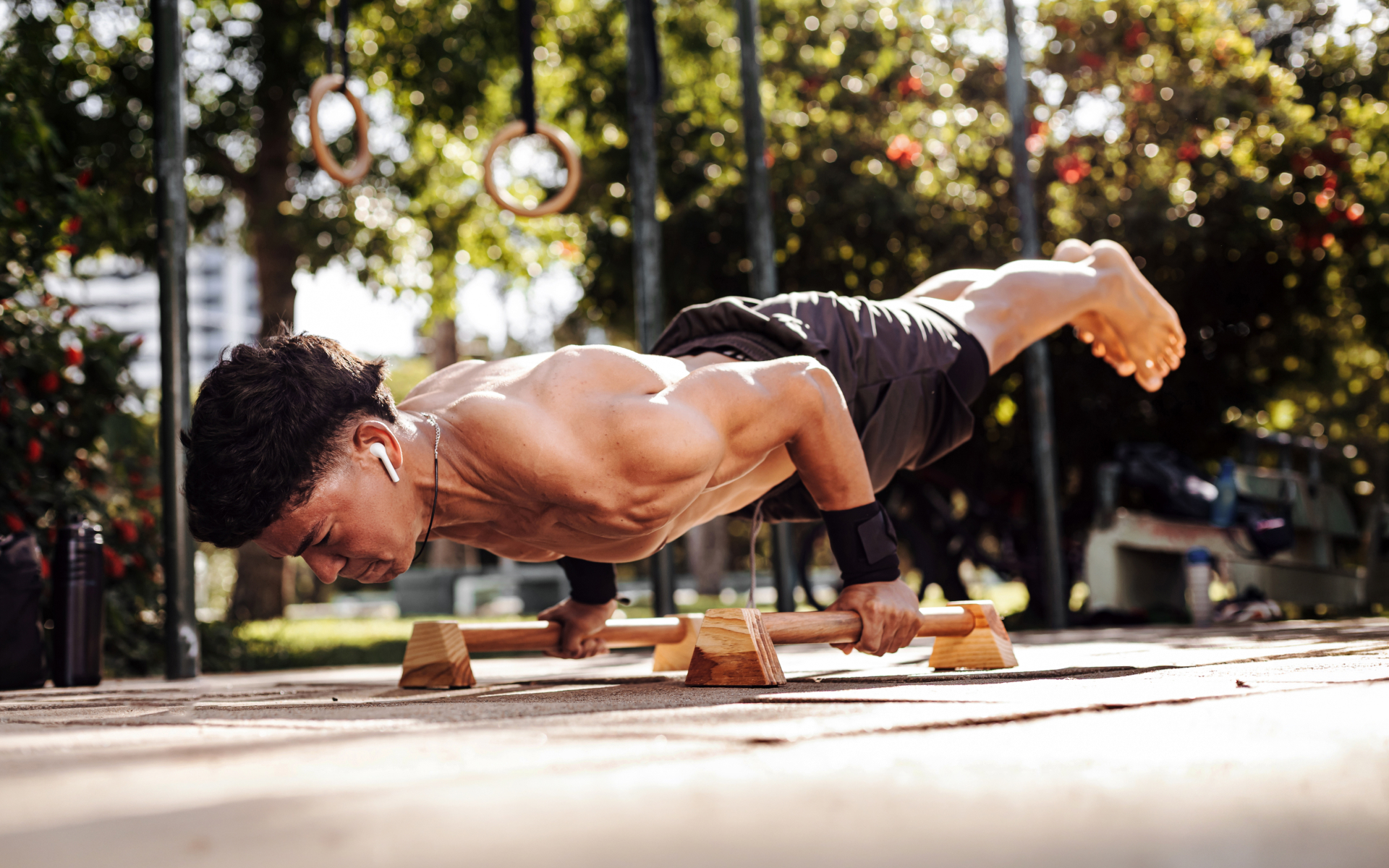
Calisthenics progression is the systematic process of increasing exercise difficulty by manipulating leverage, range of motion, and body weight. It doesn’t just revolve around adding extra plates. When you shift your center of mass or change your grip, you force your muscles to adapt to greater resistance. This can easily transform a basic push-up into a gravity-defying handstand push-up.
The fitness world is now busting the myth that bodyweight workouts have a ceiling. Calisthenics come with infinite scalability. Your body can act as an adjustable barbell. So, you may aim for your first strict pull-up or try mastering the human flag. At the end of the day, it’s about how well you perform at your own mechanics.
Are you ready to stop chasing heavier weights and start commanding your own physics? This article decodes the progressions and tells you how to build strength from the ground up.
Key Takeaways
- Calisthenics progression means making bodyweight moves harder without external weights by changing mechanical variables such as leverage, angle, and range of motion (1).
- A common sign you are ready for a harder variation is completing 3 to 4 sets of 8 to 12 clean reps, or a 30-second hold, with a 2-second lowering phase and a 1-second pause (5, 6, 7).
- Five ways to add overload without weights are changing the leverage, changing the angle, slowing the tempo, training one side at a time, and shortening rest, for example from 90 seconds to 60 seconds.
- A weekly structure can place the most demanding skill positions at most 2 times a week with 2 to 3 minutes of rest, and fill the rest of the week with mostly mastered variations and mobility work.
- Working at about 9 out of 10 effort on those top-tier skills is a general guideline for experienced trainees only, while the rest of the week stays at a lower effort, around 5 to 7 out of 10.
- When progress stalls, check your form and slow the lowering phase, for example to 5 seconds.
- A common approach is a deload every 6 to 8 weeks that cuts volume by about half, since connective tissue recovers more slowly than muscle (8, 9), and it makes sense to scale back if your elbows or wrists ache.
What Does Progression Mean in Calisthenics?
We now know that calisthenics exercise progression means systematically changing mechanical variables. For instance, you can change the leverage, angle, and range of motion to continuously challenge your muscles without adding external weight (1)(2). Because you can’t simply pop a heavier plate onto a barbell, you progress by altering how your body interacts with gravity.
This concept is fundamentally rooted in the principle of progressive overload. A recent study published confirmed that structured progressive overload yields significantly greater muscle thickness and hypertrophy than training with stagnant, non-progressive variables (3).
Although the science is modern, the practice is ancient:
- The Origins: The word stems from the Greek words kallos (beauty) and sthenos (strength) (4).
- The Warriors: Historian Herodotus documented Spartan armies using bodyweight progressions to prepare for the Battle of Thermopylae in 480 BCE.
- The Evolution: It shifted from military preparation to 19th-century European educational systems, eventually evolving into today’s global workout culture.
Ultimately, progression turns your body into an adjustable machine, in which minor structural shifts trigger major strength gains.
How Do You Know When to Try a Harder Variation?
Knowing exactly when to level up is the secret to avoiding frustrating plateaus or, worse, a nagging shoulder injury. In bodyweight training, you don’t wait until a weight feels light. You wait until your nervous system and connective tissues have fully mastered the physics of your current tier.
A reliable calisthenics progression roadmap relies on hitting specific performance benchmarks rather than guessing.
The Calisthenics Skill Progression Checklist
Before moving to a harder variation on your calisthenics progression chart, you should comfortably tick every box in this baseline criteria:
| Metric | Target Benchmark | Why It Matters |
|---|---|---|
| Repetition Volume | 3 to 4 sets of 8–12 clean reps (or a 30s static hold) | Ensures enough muscular endurance and volume capacity before increasing intensity (5). |
| Form Integrity | Zero cheating, momentum, or sagging hips | Shifting your body to sneak out a rep alters the leverage. It defeats the purpose of the calisthenics skill progression. |
| Tempo Control | 2-second negative (eccentric) and 1-second pause | Proves you own the movement through the entire range of motion, not just the easy parts (6)(7). |
| Joint Readiness | Completely pain-free joints and tendons | Connective tissues heal slower than muscle. If your elbows or wrists ache, your body isn’t ready for a higher load (8)(9). |
The Golden Rule: If you can perform 3 sets of 10 perfect, controlled repetitions of an exercise with a brief pause at the peak contraction, your body has earned the right to try the next progression on your roadmap.
What Is the Calisthenics Progression Roadmap?
If you want to visualize how a bodyweight exercise progression roadmap works in practice, try tracking how a single movement pattern evolves across different tiers. By applying the principles of progressive overload in calisthenics, you can break down complex skills into manageable phases.
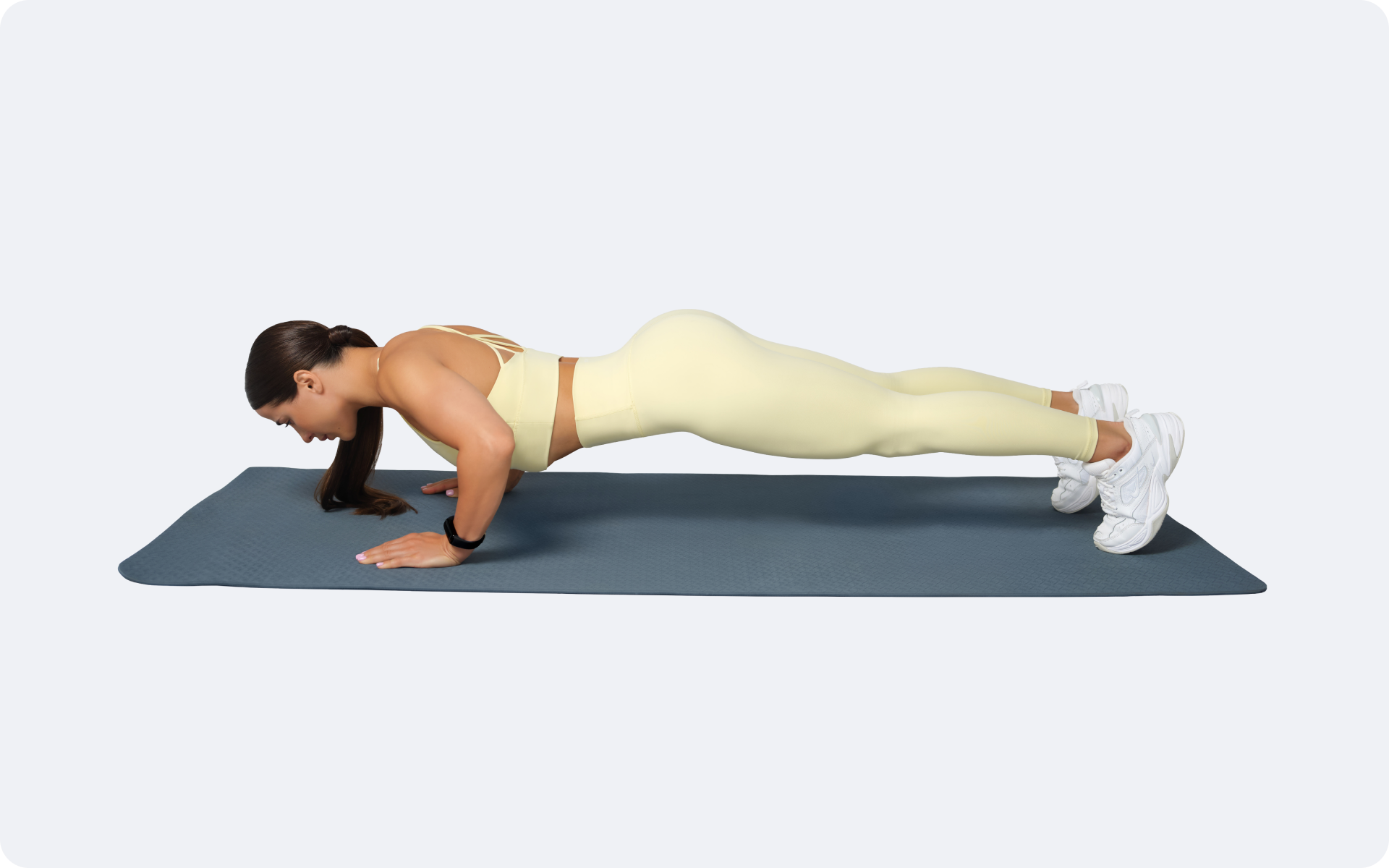
The chart below outlines the progression roadmap for two foundational movement patterns:
- The vertical pull (targeting the lats and biceps)
- The horizontal push (targeting the chest and triceps).
Whether you’re a workout beast or just a beginner making your first foray into the world of fitness and dieting – BetterMe has a lot to offer to both newbies and experts! Install the app and experience the versatility first-hand!
Calisthenics Progression Roadmap Chart
| Tier/Phase | Focus Variable | Vertical Pull Progression | Horizontal Push Progression |
|---|---|---|---|
| Foundation | Bilateral stability and volume | Australian Pull-ups (Inverted Rows) | Knee Push-ups or Wall Push-ups |
| Leverage Shifts | Changing angles to increase load | Negative Pull-ups (Focus on the eccentric phase) | Standard Push-ups with perfect form |
| Advanced Mechanics | Increasing mechanical disadvantage | Strict Pull-ups (Full range of motion) | Diamond Push-ups or Decline Push-ups |
| Unilateral Transitions | Shifting load to one side | Archer Pull-ups or Weighted Pull-ups | Archer Push-ups or Pseudo-Planche Push-ups |
| Elite Mastery | High-tension static/dynamic | One-Arm Pull-up progressions | Handstand Push-ups or One-Arm Push-ups |
How to Read This Roadmap?
- Do not skip tiers: Each phase builds the specific tendon strength required for the next. Skipping from Tier 1 to Tier 3 often results in elbow tendonitis (10).
- The 20-30% rule: Your goal should be to continually seek a 20-30% increase in neurological demand. If a movement becomes comfortable, look at the chart and shift to the next variation in that column.
- Form is the gatekeeper: You should only advance to the next box on the chart after completing 3 sets of 10 controlled repetitions with a 2-second negative phase.
How Can You Apply Progressive Overload Without Weights?
Clearly, learning how to progress in calisthenics requires forcing muscle adaptation by manipulating the physics of your own body weight.
A 2025 review found that when sets are taken to volitional fatigue (true muscular failure), lighter weights elicit the same muscle hypertrophy and thickness as heavier weights (11). Your muscles respond to the total fatigue and mechanical tension generated, not the physical weight on the bar.
A few ways to apply progressive overload without external weights by adjusting five distinct variables are:
- Reduce Leverage: Make your body position less stable so your muscles work harder. For example, progressing from a tucked front lever to a straight-body front lever places much more demand on your back muscles without adding any weight.
- Change the Angle: Adjust your position to place more of your body weight on the working muscles. For instance, decline push-ups shift more weight onto your upper chest and shoulders than standard push-ups.
- Slow Down the Movement: Perform each repetition with control instead of relying on momentum. A 4-second lowering phase followed by a 2-second pause at the bottom makes the exercise much more challenging.
- Train One Side at a Time: Move from two-limb exercises to single-limb variations. If bodyweight squats become too easy, progress to lunges, archer squats, and eventually pistol squats to increase the load on each leg.
- Reduce Rest Time: Keep the same number of sets and reps but shorten your rest periods, such as reducing them from 90 seconds to 60 seconds. This increases workout intensity and challenges your muscles to perform under greater fatigue.
When you make these structural changes, you can consistently force new muscle and strength gains using nothing but the floor and a pull-up bar.
Read more: Mobility Calisthenics: Simple Exercises for Everyday Practice
How Should You Add Progressions to Your Weekly Routine?
Adding progressions to a weekly routine is where most people get stuck. They treat calisthenics like weightlifting, assuming the only way to get stronger is to add more reps. But with bodyweight exercise progression, the real magic happens when you master more difficult calisthenics positions.
If you want to keep making gains without hitting a plateau, you need a structured strategy to integrate these harder variations into your home calisthenics workout plan.
The First Rule of Exercise
Your nervous system is freshest at the very start of your workout. If you try to practice a difficult new progression at the end of a session when your muscles are burning, your form will break down. Your brain may not map the movement pattern efficiently.
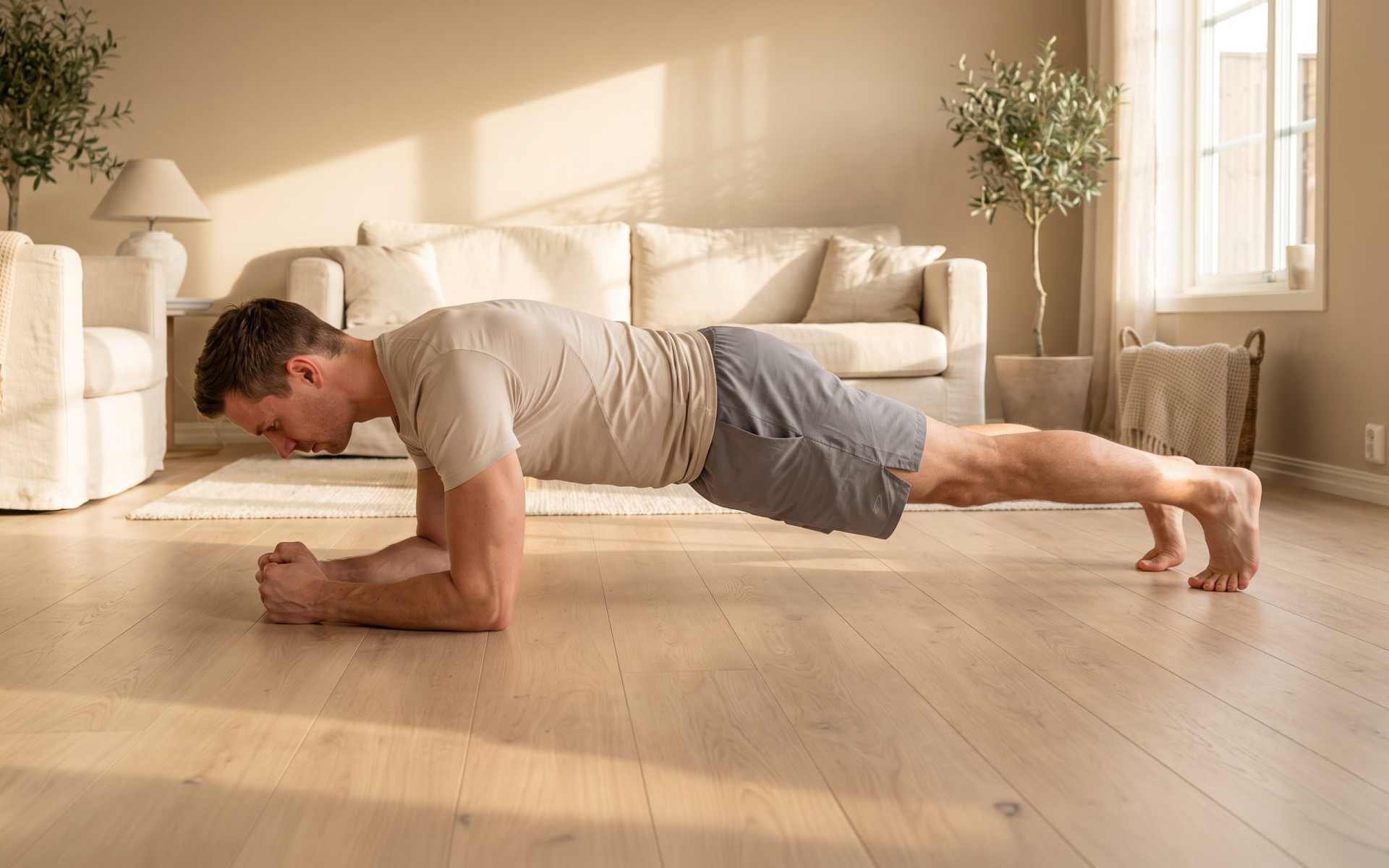
How to apply it: Place your primary skill or high-intensity progression immediately after your warm-up. If you are moving from a regular plank to a Leaned Plank (to build up to a planche), or from a regular push-up to an Archer Push-up, do it as your absolute first working set.
Leverage the Volume
Instead of constantly trying to squeeze out 15 to 20 reps of an easier exercise, use a “wave” method that forces your body to adapt to higher neurological demands.
When you can cleanly hit 3 sets of 8 to 10 reps of a current variation, do not try to go for 12. Try dropping the reps and increasing the mechanical disadvantage.
| Current Mastery (High Reps) | Next Progression Step (Low Reps) | The Mechanical Shift |
|---|---|---|
| Regular Dips (3 x 10) | Bar Straight-Bar Dips with a Lean (3 x 4) | Shifts weight forward, increasing anterior deltoid load. |
| Diamond Push-ups (3 x 12) | Decline Archer Push-ups (3 x 5) | Elevates feet to shift more of the total body weight onto a single arm. |
| Tuck L-Sit (3 x 20 sec hold) | One-Leg Extended L-Sit (3 x 8 sec hold per side) | Extends the center of mass further from your hands, stressing the hip flexors and core. |
Intense sweat sessions, working weight loss tips, lip-smacking recipes come in one package with the BetterMe Well-Being Coach app—all at your fingertips, start transforming your life now!
The 3-Tier Weekly Split Strategy
To avoid overloading your joints and connective tissues, which adapt more slowly than muscles, vary the intensity of your workouts throughout the week. Organize your training into three different intensity levels to promote steady progress while allowing adequate recovery.
- Tier 1: The Progression Project (Intensity: 9/10). Pick just two high-skill positions per training block (e.g., Wall-Supported Handstand Push-ups or Advanced Tuck Front Levers). Train these 2 times a week max, aiming for low reps, high focus, and long rest periods (2-3 minutes).
- Tier 2: The Volume Drivers (Intensity: 7/10). These are variations you have mastered by 80%. If your project is a Pistol Squat, your volume driver might be Airborne Squats. Use these to build the actual muscle tissue that supports the skill.
- Tier 3: The Accessory/Mobility Finishers (Intensity: 5/10). Focus on the antagonist muscles and joint health. Think scapular pulls, wrist conditioning, and deep core work.
A Note on Connective Tissue: Muscles adapt to new calisthenics positions in a few weeks, whereas tendons and ligaments take months. If your joints start aching, back off the advanced leverage steps and use tempo variations (like 4-second negatives) on a lower tier to build joint density first.

What Should You Do When Your Progress Stalls?
Hitting a plateau in calisthenics doesn’t mean you’ve stopped getting stronger. More often than not, it means your body needs a different approach. Don’t try to push harder. Focus on improving your technique and mobility to keep making progress.
Check Your Form
Small technique mistakes can hold you back, particularly in advanced skills like the calisthenics handstand.
You should record yourself during your workout and look for issues such as an arched back or shrugged shoulders. If your form isn’t solid, go back to an easier variation and master it before progressing.
Slow Down Your Reps
If you can’t perform a harder variation yet, make your current exercise more challenging by increasing time under tension.
Lower yourself slowly for about 5 seconds or pause at the hardest part of the movement. This can build strength and control without changing the exercise.
Take a Deload Week
Training hard every week can leave your muscles and joints feeling worn out, making it harder to make progress.
What to do: Every 6 to 8 weeks, reduce your training volume by about half and stick to easier exercises. The extra recovery often helps you come back stronger.
Remember, sometimes the fastest way to move forward is to take one step back. Returning to an easier variation to perfect your form often leads to faster, safer progress in the long run.
Read more: Calisthenics Handstand Progressions: 10 Steps to Master the Handstand
How Can You Track Calisthenics Progress?
Tracking your progress helps you see what’s working and identify when to progress an exercise. Rather than focusing only on your appearance, monitor measurable performance improvements.
A few effective ways to track your calisthenics skill progression are:
- Record your workouts: Log your sets, reps, hold times, and rest periods to see steady improvements over time.
- Track harder exercise variations: Note when you progress from beginner to more advanced movements, such as standard push-ups to archer push-ups.
- Measure skill development: Record milestones like your longest handstand hold or first unassisted pull-up.
- Take progress photos: Monthly photos can reveal changes in muscle definition that the scale may not show.
- Monitor recovery: Keep track of how you feel after workouts. Better recovery and lower perceived effort during the same exercises are signs that your fitness is improving.
Review your training log every few weeks. If you’re consistently completing your workouts with good form and less effort, it’s likely time to progress to a more challenging exercise.
Frequently Asked Questions
How long should you stay with one exercise variation?
Stay with an exercise variation until you can perform all your prescribed sets and reps with proper form and control. When the movement feels consistent and you can complete it without struggling, it’s the signal to progress an exercise.
Can you practice several calisthenics skills at once?
Yes, but keep the number of skills manageable. Focusing on two or three skills at a time allows you to practice them consistently without spreading your recovery and training volume too thin.
Should you master push-ups before starting pull-ups?
No. Push-ups and pull-ups train different muscle groups, so you can work on both simultaneously. If you can’t perform a full pull-up yet, start with assisted pull-ups, negative reps, or inverted rows while you continue improving your push-ups.
Do you need equipment to progress in calisthenics?
Not always. Many progressions rely on changing leverage, tempo, range of motion, or single-limb variations. However, basic equipment like a pull-up bar, resistance bands, or gymnastic rings can expand your exercise options and support long-term progress.
Should you train to failure before moving up?
No. Reaching failure on every set isn’t necessary and can make recovery more difficult. A better approach is to progress when you can complete your target sets and reps with good form while still having one or two repetitions left in reserve.
Can you skip steps in a progression?
It’s best not to. Each progression builds the strength, stability, and coordination needed for the next one. Skipping steps can increase your risk of poor technique and injury while slowing long-term progress.
Can added weight be part of calisthenics progression?
Yes. Once advanced bodyweight variations become too easy, adding weight with a dip belt, weighted vest, or backpack is an effective way to continue building strength while performing the same movements.
The Bottom Line
It’s pretty clear that we should not chase numbers or feel bad when we can’t hit the same numbers as others. Calisthenics teach you to master gravity and own those movements. Therefore, we must stop focusing purely on the rep count and start focusing on mechanical control. Every centimeter of extra leverage gained and every rep performed with textbook tempo is proof of a stronger nervous system.
It’s high time we stop obsessing over weights and let our consistency do the heavy lifting!
DISCLAIMER:
This article is intended for general informational purposes only and does not serve to address individual circumstances. It is not a substitute for professional advice or help and should not be relied on for making any kind of decision-making. Any action taken as a direct or indirect result of the information in this article is entirely at your own risk and is your sole responsibility.
BetterMe, its content staff, and its medical advisors accept no responsibility for inaccuracies, errors, misstatements, inconsistencies, or omissions and specifically disclaim any liability, loss or risk, personal, professional or otherwise, which may be incurred as a consequence, directly or indirectly, of the use and/or application of any content.
You should always seek the advice of your physician or other qualified health provider with any questions you may have regarding a medical condition or your specific situation. Never disregard professional medical advice or delay seeking it because of BetterMe content. If you suspect or think you may have a medical emergency, call your doctor.
SOURCES:
- CALISTHENICS…YOU MEAN BODYWEIGHT (2020, recwell.umd.edu)
- Effect of 6-Weeks Calisthenic Training on Physical Fitness: A Case Study Report (2024, researchgate.net)
- Progressive Overload Affects the Magnitude of Muscle Hypertrophy (2026, journals.lww.com)
- Calisthenics (n.d., assets.w3.tue.nl)
- Could calisthenic exercises improve maximal exercise capacity, peripheral muscle strength and quality of life in dyslipidemia? (2025, journals.plos.org)
- The Influence of Movement Tempo on Acute Neuromuscular, Hormonal, and Mechanical Responses to Resistance Exercise—A Mini Review (2020, journals.lww.com)
- The Influence of Movement Tempo During Resistance Training on Muscular Strength and Hypertrophy Responses: A Review (2021, link.springer.com)
- How Our Muscles, Tendons and Ligaments Respond to Exercise and Recover from Injury (2025, biology.ucdavis.edu)
- Mechanisms Regulating Muscle Regeneration: Insights into the Interrelated and Time-Dependent Phases of Tissue Healing (2020, mdpi.com)
- Adherence to exercise in lateral elbow tendinopathy, a scoping review. (2024, sciencedirect.com)
- Resistance training load does not determine resistance training‐induced hypertrophy across upper and lower limbs in healthy young males (2025, researchgate.net)
 By
By 

 Reviewed by