Military workouts at home can use bodyweight exercises and a clear space to practice strength and endurance.
Choose a few of the seven movements, start with one set, and reduce repetitions or hold times when needed.
This routine is for general fitness, not official military preparation or a guarantee of readiness.
Learn starting versions with our beginner military calisthenics guide.
Key takeaways
- Military-style workouts at home can use bodyweight and a small open space; pulling work needs suitable equipment.
- A small eight-week study in young men found strength and muscle-size gains from adjusted push-up training (1).
- This sample plan can use 2-3 nonconsecutive sessions a week, with one set first and more only when manageable.
- This sample circuit uses seven movements, 60-90 seconds of rest, and an adjustable effort target of 5-7 out of 10.
- Larger later targets, such as 2-3 sets, are optional and not required in a first session.
- Moderate aerobic activity generally allows talking but not singing (2).
- A review found that volume and working to exhaustion can increase rest demands (3).
Can you do military-style training without equipment?
Yes, you can do a military-style workout at home using only your body weight. Many classic moves need no gear at all. Bodyweight training uses your own weight as resistance. Think push-ups, squats, and lunges. Appropriately challenging push-up training can support strength improvements (1).
An official military fitness page combines bodyweight movements with loaded tasks and running (4). This home routine is not complete official preparation.
Here’s what bodyweight training offers:
- No cost: You don’t need to buy weights or machines.
- Flexibility: You can train in a bedroom, living room, or backyard.
- Scalability: You can make moves easier or harder as you progress.
If a standard push-up feels tough, you can drop to your knees. This small change lets you practice the movement with more control. Over time, you may work your way up to the standard push-up.
You have the option of adding weighted vests, dumbbells, and even resistance bands to your routine to increase the challenge.
What fitness components do at-home military workouts target?
An at-home military workout targets several fitness areas at once, including strength, endurance, and core stability. This mix is part of what makes the style appealing.
Many bodyweight exercises work more than one muscle group. For example, a squat involves lower-body muscles and trunk stabilization (5).
For a broader movement explanation, read our military calisthenics overview.
Here are the main components these workouts tend to support:
- Muscular strength: Push-ups and squats challenge major muscle groups.
- Muscular endurance: Higher-rep sets can train how long a muscle keeps working.
- Cardiovascular fitness: Faster circuits can raise your heart rate.
- Core stability: Planks and mountain climbers engage your midsection.
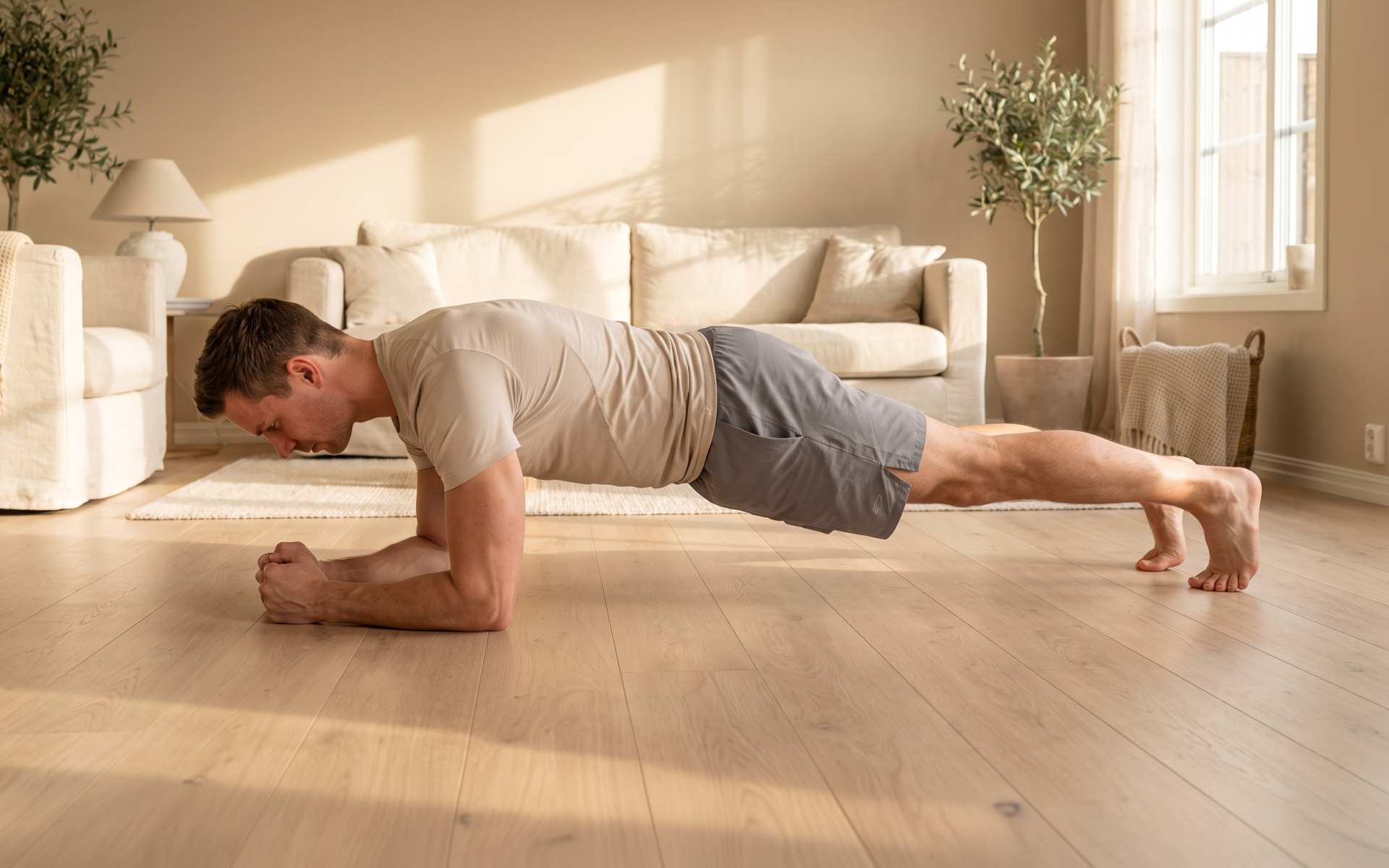
A plank holds your trunk steady while also working your shoulders.

Which exercises can you use for military workouts at home?
Military workouts at home can use simple, compound bodyweight moves that train large muscle groups.
While programming your military exercise routine at home, it helps to know some key terms:
- Reps are single complete movements, such as one full squat.
- Sets are groups of reps done before you rest.
- A rest interval is the short pause between sets.
This table compares movement options. Use it to pick exercises that fit your level, starting with one set and smaller targets if needed. The larger targets are optional later workloads.
|
Exercise |
Muscles targeted |
Optional later target |
Make it easier |
Make it harder |
|---|---|---|---|---|
|
Push-up |
Chest, shoulders, triceps, core |
2-3 sets of 8-12 reps |
Drop to knees or use a wall |
Add a pause at the bottom |
|
Bodyweight squat |
Quads, glutes, core |
2-3 sets of 12-15 reps |
Sit back to a chair |
Lower slowly for 3 seconds or use dumbbells |
|
Plank |
Core, shoulders, back |
2-3 holds of 15-30 seconds |
Rest on your knees |
Lift one foot off the floor |
|
Reverse lunge |
Quads, glutes, hamstrings |
2-3 sets of 8-12 per leg |
Hold a wall for balance |
Hold a pair of dumbbells |
|
Mountain climber |
Core, shoulders, legs (cardio) |
2-3 sets of 20-30 seconds |
Slow the pace down |
Speed up the drive |
|
Jumping jack |
Full body, heart and lungs (cardio) |
2-3 sets of 30-45 seconds |
Step out instead of jumping |
Add a faster pace |
|
High knees |
Legs, core, heart and lungs (cardio) |
2-3 sets of 20-30 seconds |
March in place |
Drive knees up faster |
|
Optional outdoor running |
Legs, core, heart and lungs (cardio) |
100-200 meters |
Jog |
Increase pace or distance |
You might practice push-ups on your knees, then try a few on your toes once the current version feels controlled. There is no required week for that change.
If you’d like a structured starting point, you may enjoy reading about the military calisthenics workout plan for beginners.
What is a full-body military circuit you can do at home?
This sample circuit offers seven bodyweight movements. Choose a smaller selection first and complete one set of each. Rest for 60-90 seconds between sets, or longer when needed.
RPE stands for rating of perceived exertion. For this sample, rate effort from 1 (very easy) to 10 (maximum effort). The 5-7 target is an adjustable planning choice. Use less effort while learning a movement.
Begin with one set and fewer exercises. Consider an additional set only when the current workload remains manageable.
|
Exercise |
Sets |
Reps or time |
Rest |
Target effort |
|---|---|---|---|---|
|
Bodyweight squat |
1-3 |
12-15 reps |
60-90 secs |
RPE 5-7 |
|
Push-up |
1-3 |
8-12 reps |
60-90 secs |
RPE 5-7 |
|
Reverse lunge |
1-3 |
8-12 per leg |
60-90 secs |
RPE 5-7 |
|
Mountain climber |
1-3 |
20-30 secs |
60-90 secs |
RPE 5-7 |
|
High knees |
1-3 |
20-30 secs |
60-90 secs |
RPE 5-7 |
|
Jumping jack |
1-3 |
30-45 secs |
60-90 secs |
RPE 5-7 |
|
Plank |
1-3 |
15-30 secs hold |
60-90 secs |
RPE 5-7 |
Use 2-3 nonconsecutive practice days only when the workload is manageable. Prepare with 5-10 minutes of gradually increasing easy movement, and finish with 5-10 minutes of slower movement (6). Stop a movement if it causes discomfort, and seek qualified guidance when needed.
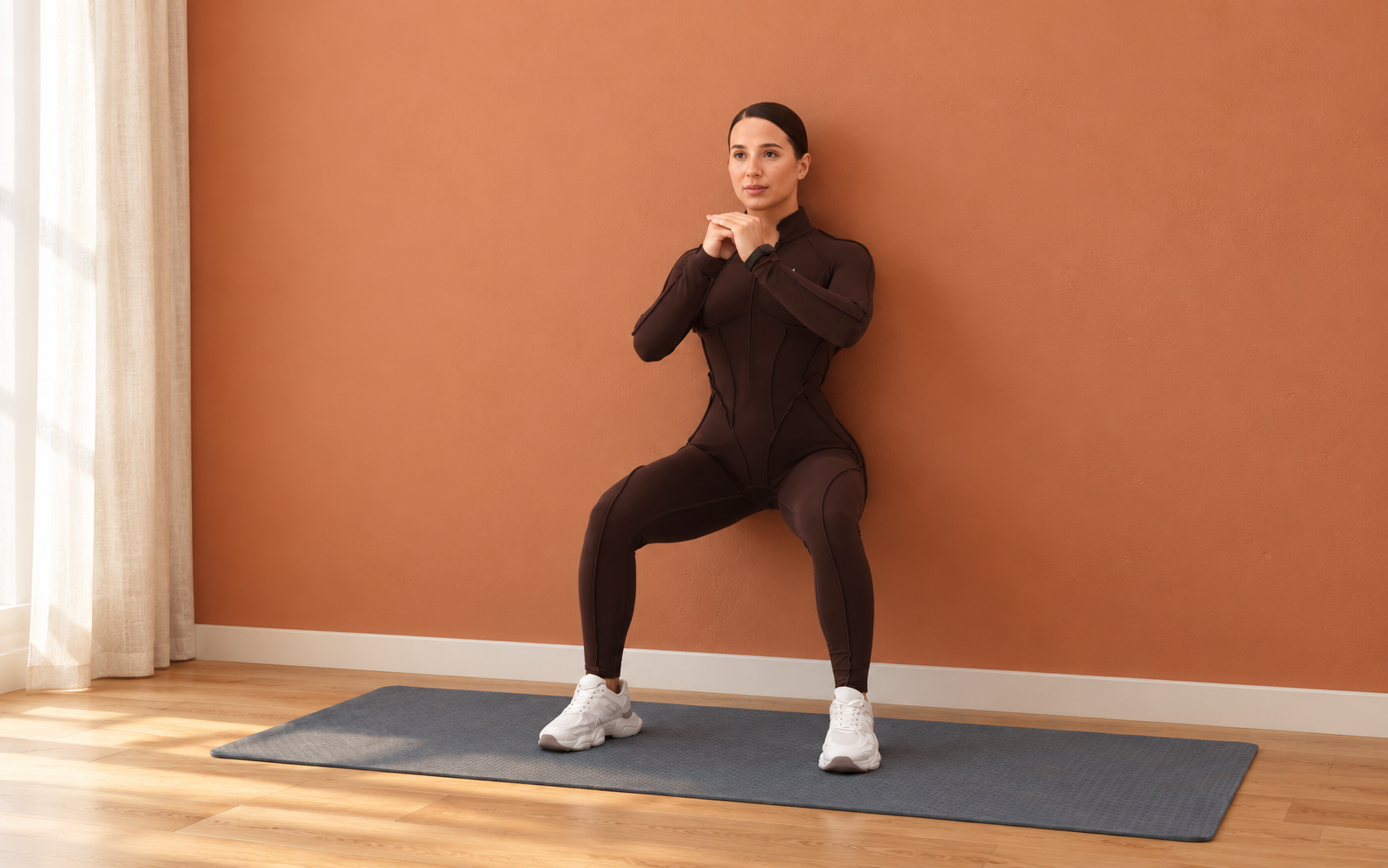
Bodyweight squat
- Stand with your feet about shoulder-width apart.
- Push your hips back as if sitting into a chair.
- Lower through a comfortable range while keeping your movement controlled.
- Press through your feet to stand tall again.
Push-up
- Place your hands a little wider than shoulder-width apart.
- Keep your body in a straight line from your head to your heels.
- Lower your chest toward the floor with control.
- Press back up to the starting position.
Reverse lunge
- Stand tall with your feet hip-width apart.
- Step one foot back and lower your back knee toward the floor.
- Keep your front knee tracking in the direction of your toes.
- Push through your front foot to return to standing.
High knees
- Stand tall with your feet hip-width apart.
- Drive one knee up toward your chest.
- Switch legs quickly, like running in place.
- Pump your arms while keeping your trunk steady. For an easier version, march slowly instead of running in place.
Jumping jacks
- Stand tall with your feet together and your arms at your sides.
- Jump your feet out wide while raising your arms overhead.
- Jump back to the starting position, lowering your arms.
- Keep a steady rhythm and breathe evenly throughout.
Plank
- Rest on your forearms and toes.
- Keep your body in one straight line.
- Squeeze your core and avoid letting your hips sag.
- Hold steady for your chosen time, breathing calmly.
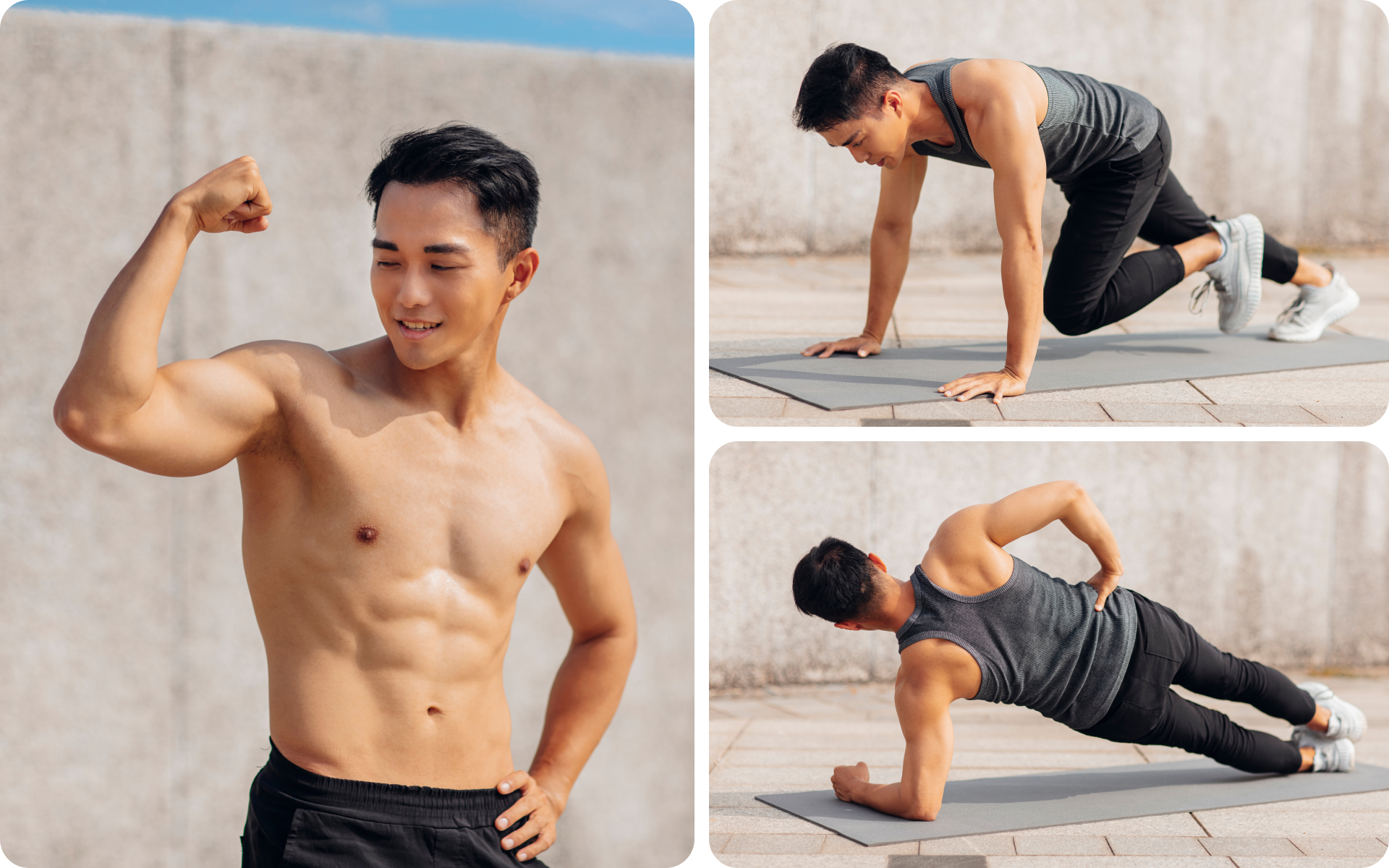
Mountain climber
- Start in a high plank with your arms straight.
- Drive one knee toward your chest.
- Switch legs in a steady rhythm.
- Keep your trunk steady and avoid letting your lower back sag.
BetterMe offers a variety of workouts, recipes, challenges, and support tools to help you stay more consistent with your wellness routine. Explore the app to find features that fit your goals, preferences, and schedule.
How can you add cardio without running outdoors?
You can add cardio at home using moves that raise your heart rate in a small space. Running outside isn’t your only option.
The talk test is a simple intensity check. Moderate effort means you can talk but not sing. Vigorous effort allows only a few words before a breath (2).
General adult guidance includes at least 150 minutes of moderate aerobic activity weekly, or 75 minutes of vigorous activity, plus strengthening on at least two days (7). Build gradually and break activity into manageable chunks.
|
Indoor cardio option |
Time |
Talk test cue |
Space needed |
|---|---|---|---|
|
Marching in place |
10-20 mins |
Moderate only if you can talk but not sing |
Very small |
|
Jumping jacks |
5-10 mins |
Intensity varies; use the talk test |
Small |
|
High knees |
30-60-sec bursts |
Intensity varies; use the talk test |
Very small |
|
Stair stepping |
10-15 mins |
Moderate if you can talk but not sing |
One step |
You could do 10 minutes of marching three times a week. These short sessions add up over time, although 30 minutes does not meet the full weekly aerobic target.
How can you modify military exercises for a small space?
You can modify military training exercises at home by choosing low-impact moves and shrinking your range. Check that your room has enough clear space for the movements you choose.
For these standing alternatives, replace jumps with steps and keep at least one foot on the floor.
Here’s how to adapt your home military training to small spaces:
- Swap jumps for steps: Replace jumping jacks with step-out jacks.
- Use in-place moves: Try high knees or marching instead of running.
- Check floor space: A plank needs room for your full body. Choose standing movements if that space is unavailable.
If you can’t sprint, march fast in place instead. You still raise your heart rate without needing room to move forward.

How often should you do military workouts at home?
Beginners can do a military fitness workout at home 2-3 times each week. This frequency leaves room for rest between sessions.
Choose a schedule you can repeat while allowing rest between demanding sessions. Reduce the workload when needed.
Here’s a simple weekly rhythm to consider:
- Strength circuit: 2-3 days, with a rest day in between.
- Cardio: Spread short sessions across 3-5 days.
- Rest: Take at least 1-2 lighter days each week.
You might train Monday, Wednesday, and Friday. The gaps leave time between demanding sessions. A review found that volume and working to exhaustion can increase rest demands (3).
You may also like military calisthenics workouts for men for added variety.
What mistakes should you avoid during at-home military training?
Doing too much too soon can make a home workout overwhelming or make technique harder to maintain.
Form tends to matter more than speed or numbers. Quality reps can help you practice the movement more consistently over time.
Watch out for these slip-ups:
- Skipping the warm-up: Gradual easy movement prepares you for more demanding activity (6).
- Ignoring rest: Allow rest between demanding sessions; needs vary with workload (3).
- Chasing big jumps: Add small increases in weight or repetition instead of attempting too heavy a weight or doubling your reps.
Instead of adding 10 reps overnight, consider 1-2 additional reps in one movement only after your current targets feel controlled. There is no required weekly increase.
Workouts, weight management tools, and recipe ideas come together in the BetterMe Well-Being Coach app, giving you practical support for building a more consistent wellness routine.
What should you consider before starting?
Before starting any military fitness routine at home, consider your current activity level and how your body feels. A thoughtful start sets you up well.
Everyone begins from a different place. There’s no single “right” level of fitness to have first.
Keep these points in mind:
- Listen to your body: Mild effort is fine, but stop if something feels off.
- Start light: Begin with one set and fewer movements before considering more.
- Check in with a professional: If you have any concerns, talk with a qualified expert.
You might begin with one round of a few selected movements. When that feels manageable, consider one additional round.
Nutrition can accompany your routine without a restrictive military diet. A meta-analysis found that protein supplementation modestly increased strength and muscle gains during resistance training lasting at least six weeks (8). It did not establish a required supplement or meal plan for this circuit. Seek individual guidance if needed.

FAQs
Can you build strength with military workouts at home?
Yes, many beginners can build strength with bodyweight exercises at home, although results vary. Moves such as push-ups and squats challenge your muscles using your own weight. A small eight-week push-up study in young men found strength and muscle-size improvements (1).
Do you need a pull-up bar for an at-home military workout?
No, you don’t need a pull-up bar for an at-home military workout. Plenty of equipment-free moves include push-ups, squats, lunges, and planks. A pull-up bar can add pulling exercises if you want them later, but for now, bodyweight pushing and lower-body moves can build a solid base.
What can you use instead of pull-ups at home?
For pulling exercises at home, use equipment that’s designed for exercise, such as a resistance band anchored according to the manufacturer’s instructions. These options target similar pulling patterns without a bar. Start with a light, manageable set and adjust with suitable instruction.
Can you combine home military workouts with weight training?
Yes, you can combine a military-style workout at home with weight training. Adding dumbbells or resistance bands can increase the challenge over time. You might do bodyweight circuits on some days and weighted moves on others.
How do you track progress?
You can track progress by logging your reps, sets, hold times, and how each session feels. Note small wins, such as the same target feeling more controlled or adding a repetition when ready. Tracking your RPE, or effort level, also helps you see improvement.
The bottom line
Military workouts at home can provide a flexible way to practice strength and endurance with bodyweight exercises. Start with a small selection and one set, allowing rest between demanding sessions. Add a small challenge only when the current workload feels manageable.
DISCLAIMER:
This article is intended for general informational purposes only and does not serve to address individual circumstances. It is not a substitute for professional advice or help and should not be relied on for making any kind of decision-making. Any action taken as a direct or indirect result of the information in this article is entirely at your own risk and is your sole responsibility.
BetterMe, its content staff, and its medical advisors accept no responsibility for inaccuracies, errors, misstatements, inconsistencies, or omissions and specifically disclaim any liability, loss or risk, personal, professional or otherwise, which may be incurred as a consequence, directly or indirectly, of the use and/or application of any content.
You should always seek the advice of your physician or other qualified health provider with any questions you may have regarding a medical condition or your specific situation. Never disregard professional medical advice or delay seeking it because of BetterMe content. If you suspect or think you may have a medical emergency, call your doctor.
SOURCES:
- Low-load bench press and push-up induce similar muscle hypertrophy and strength gain (2017, pmc.ncbi.nlm.nih.gov)
- How to Measure Physical Activity Intensity (2025, cdc.gov)
- The Importance of Recovery in Resistance Training Microcycle Construction (2024, pmc.ncbi.nlm.nih.gov)
- Army Fitness Test (2025, army.mil)
- A Biomechanical Review of the Squat Exercise: Implications for Clinical Practice (2024, pmc.ncbi.nlm.nih.gov)
- Warm Up, Cool Down (2024, heart.org)
- Adult Activity: An Overview (2023, cdc.gov)
- A systematic review, meta-analysis and meta-regression of the effect of protein supplementation on resistance training-induced gains in muscle mass and strength in healthy adults (2018, pmc.ncbi.nlm.nih.gov)
 Reviewed by
 Reviewed by