
A home calisthenics workout plan organizes bodyweight exercises into sessions you can repeat and adjust. It should cover the major muscle groups, account for equipment, and leave room for rest. Start with a realistic weekly schedule, then choose exercise versions that challenge you without making technique difficult to maintain.
If you are learning the movements, begin with our beginner calisthenics plan at home.
Key takeaways
These points summarize how to build a home calisthenics workout plan and keep it adjustable.
- Home and bodyweight resistance training can improve strength when the exercises provide an appropriate challenge (1).
- A useful plan specifies exercise versions, repetitions, sets, and rest.
- General adult guidance includes strengthening all major muscle groups on at least two weekly days (2).
- Floor exercises alone do not provide a straightforward substitute for pulling against resistance.
- Progress one exercise at a time and record what changed.
- The sample schedule is an adjustable example, not a personal prescription.
Can you build muscle with calisthenics at home?
You can build muscle with resistance training at home when the exercises provide sufficient challenge. Your bodyweight can supply resistance, although different exercises offer different progression options. Equipment may eventually help you keep some movements challenging (1).
Research comparing resistance-training prescriptions found that multiple approaches improved strength and muscle size. Higher loads tended to favor strength, while multiple sets supported muscle growth (3). These findings cover resistance training broadly, rather than this exact home routine.
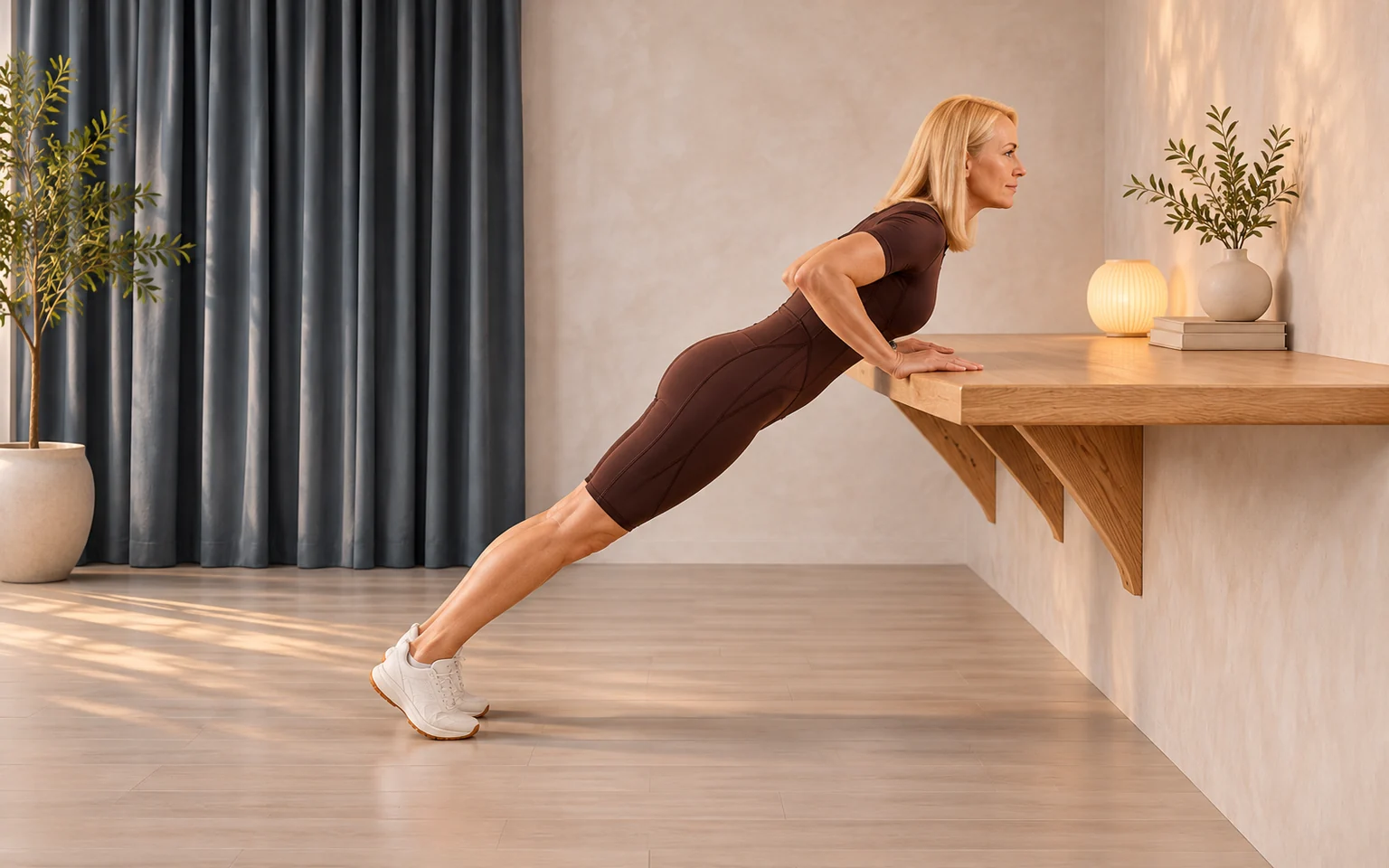
A push-up becomes more demanding when you move from a wall to a lower stable support. Lower-body progression may require different choices. You might need additional resistance or instruction before a more complicated exercise becomes appropriate.
Avoid judging the plan by soreness or how exhausted you feel afterward. Those experiences do not establish whether you gained muscle. Track comparable performances across several sessions before deciding how to progress.
A review involving women also found strength and muscle-size improvements following resistance training (4). Individual outcomes still vary. A home plan cannot promise a particular appearance or a fixed result date.
Which exercises belong in a home plan?
Choose exercises according to the movements you need to cover, your available equipment, and your current ability. The menu below provides options rather than a requirement to perform every variation. Select one manageable version from each relevant category.
| Movement | Home option | What to check |
| Squat | Chair squat or controlled bodyweight squat | Stable support and comfortable depth |
| Push | Wall, incline, knee, or floor push-up | Secure hand support and trunk control |
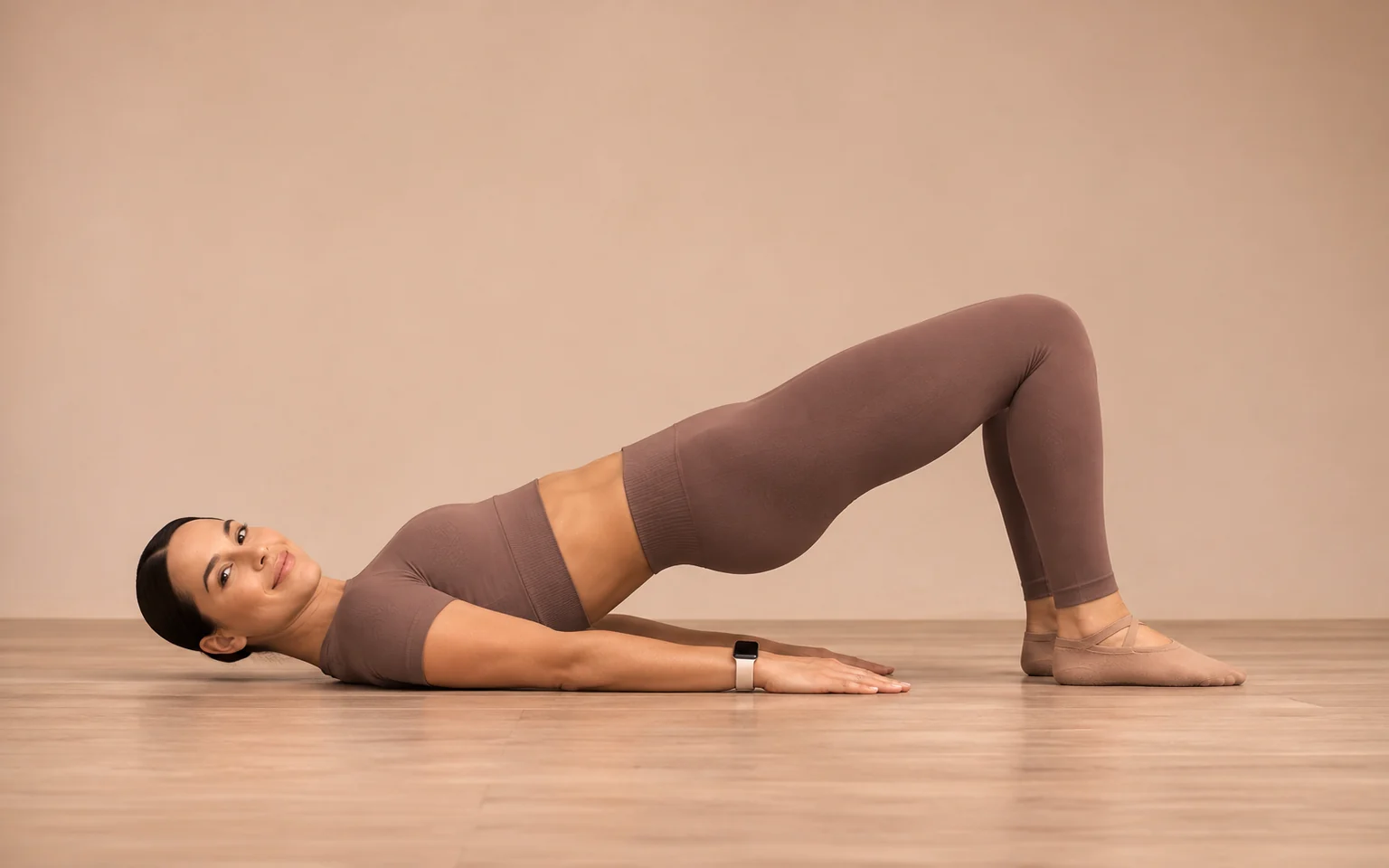
| Hip extension | Glute bridge | Comfortable floor access and controlled lifting |
| Pull | Instructed row with appropriate resistance equipment | Equipment installation and usable resistance |
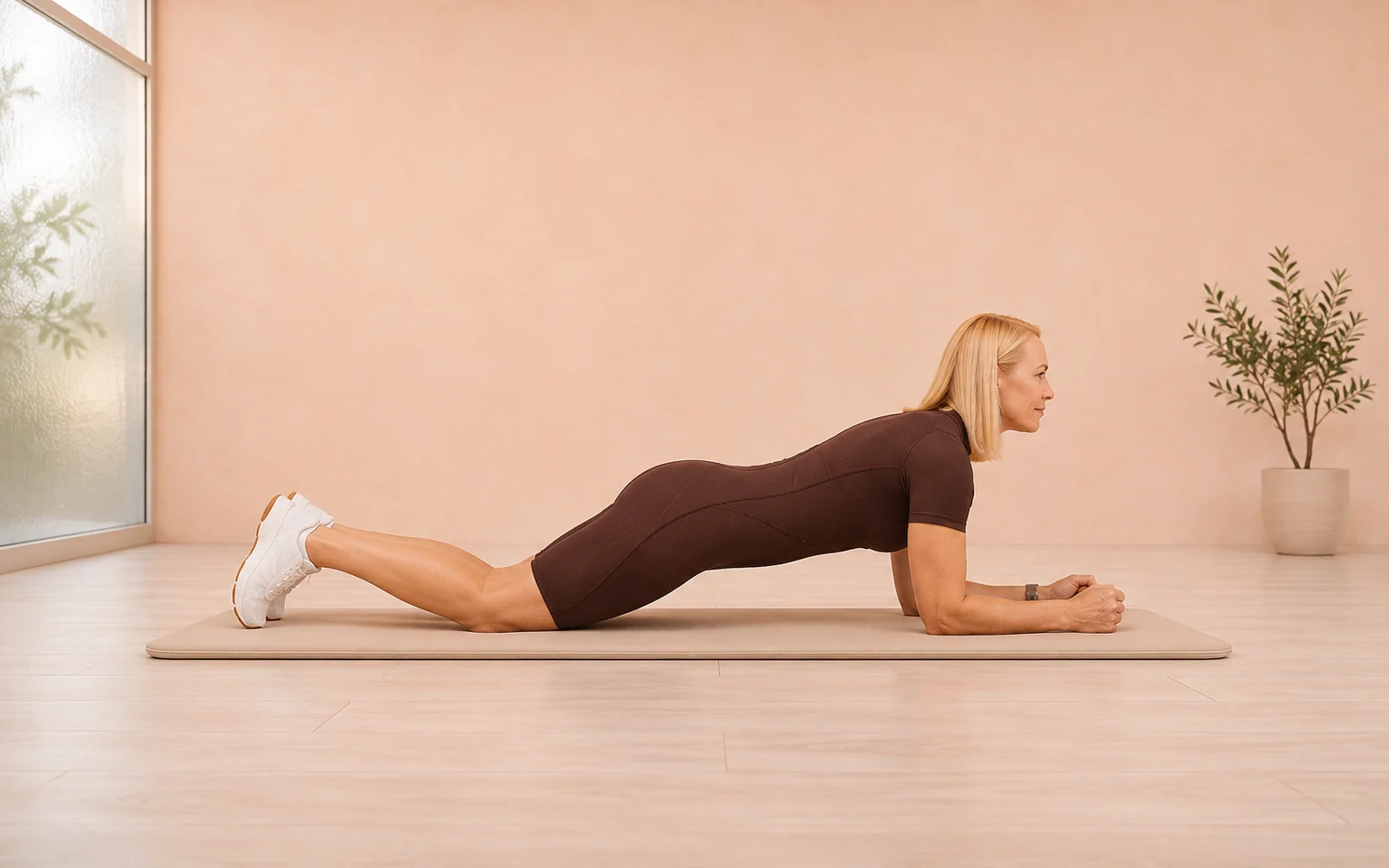
| Trunk control | Heel slide or short plank variation | Normal breathing and steady position |
| Calf raise | Supported standing calf raise | Balance support and controlled lowering |
The table is an exercise-selection aid. It does not assign a training dose or imply that every choice suits every reader. Medical restrictions or persistent discomfort may require a different selection.
Public home-exercise guidance includes chair rises, wall press-ups, and supported calf raises (5). These can provide accessible starting options. Adjust the amount to your current ability rather than copying someone else’s repetition count.
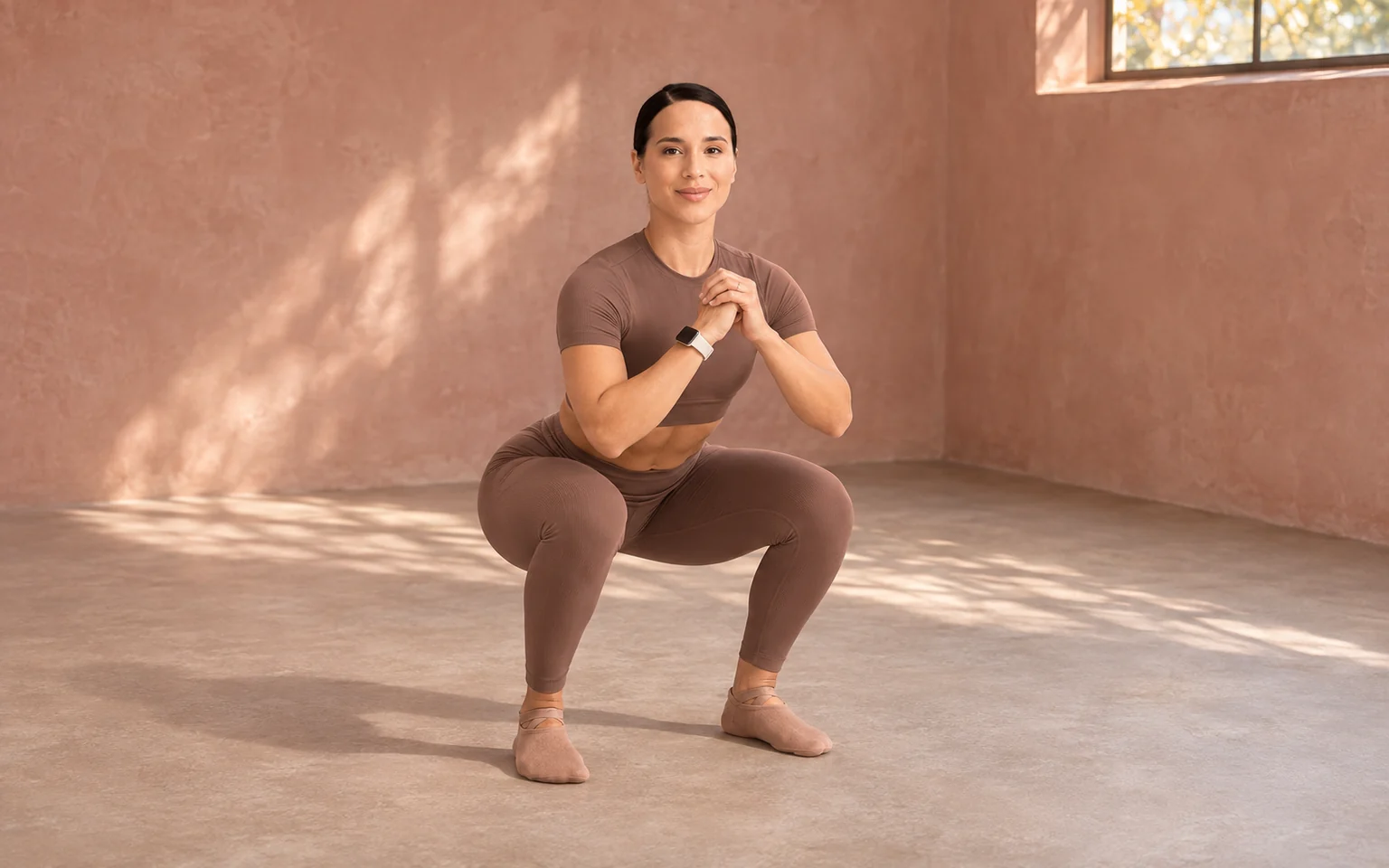
Practice a controlled squat
- Stand with your feet comfortably apart.
- Bend your hips and knees to lower under control.
- Stop at a depth you can manage steadily.
- Press through your feet to return to standing.
Use a stable chair behind you when learning the movement. Keep the setup consistent between sessions. Changing chair height changes the task, so record that detail in your log.
Set up a push-up
- Place your hands against a stable wall or suitable support.
- Position your feet so your trunk stays aligned.
- Bend your elbows to lower your chest toward the support.
- Press away without letting your middle sag.
Choose a higher support when you need less resistance. Our push-up guide for women explains common variations. A floor version is an option, not a prerequisite for useful practice.
Perform a glute bridge
- Lie on your back with your knees bent.
- Position your feet flat on the floor.
- Lift your hips while keeping the movement controlled.
- Lower your hips gently to the starting position.
Avoid forcing the top position through your lower back. Use a smaller lift if that helps you maintain control. Our calisthenics glute exercise guide covers additional choices.
Make a separate pulling decision
Pulling is the main equipment question in many home plans. A suitable resistance band setup, installed bar, or other appropriate equipment can create options. Follow the manufacturer’s installation instructions and learn the exercise before loading it heavily.
Do not assume a dining table or door handle can support your weight. If you cannot arrange a pulling exercise, acknowledge the gap. You can practice the other movements while seeking an appropriate setup or supervised setting.
What could a weekly home plan look like?
A workable starting schedule might contain two full-body sessions with nonconsecutive training days. The example below places them on Monday and Thursday. Move the days to fit your schedule while preserving rest time.
| Day | Example plan | Planning note |
| Monday | Full-body session | Use your selected exercise versions |
| Tuesday | Comfortable walking or rest | Adjust to your energy and circumstances |
| Wednesday | Rest or easy movement | Prepare for the next session |
| Thursday | Repeat the full-body session | Compare similar exercises and rest |
| Friday | Rest | Review your training notes |
| Saturday | Optional aerobic activity | Choose an appropriate activity and duration |
| Sunday | Rest or light movement | Plan the coming week |
This example is not a complete individual exercise prescription. General adult guidance also includes aerobic activity, alongside strengthening (2). Two short strength sessions do not automatically meet the aerobic recommendation.
For an initial session, consider one manageable set of each selected exercise. A practice range such as 5 to 10 controlled repetitions can help organize the session. Stop earlier when needed, and adapt the range to the exercise.
For alternating movements, record repetitions per side. For holds, record the actual time you maintained the position comfortably. Do not convert a timed hold into an assumed number of repetitions.
Add another set only after the initial workload feels manageable. Rest long enough to regain control before the next set. General technique guidance suggests allowing rest between strength sessions that train the same muscle groups (6).
How do you make the plan your own?
Begin with the time, equipment, and movements you can realistically repeat. A detailed plan is useful only when it fits those constraints. Write down the session before you start so you can distinguish planned work from extra work.
Reserve time for preparation, exercise setup, sets, rest, and finishing. Avoid labeling a session as 20 minutes if the listed exercises already fill that time. Learning a new setup can make the first session longer.
If time is limited, reduce the number of exercises or sets rather than rushing every transition. You can also use a separate short routine. Our 10-minute calisthenics workout shows one way to organize a brief appointment.
Keep the exercise order consistent when comparing performance. A push-up performed first may feel different after several other exercises. Changing the order is reasonable, but note the change before interpreting your results.
Your plan can also include an equipment-free version for travel. Label any missing movement category rather than claiming both versions are identical. This makes the limits clear when you return to the full routine.
Should you perform repetitions fast or slowly?
Use a pace that lets you control the movement and maintain your chosen range. There is no need to race through a beginner set. Deliberately slow repetitions also should not become a reason to hold your breath.
Start by making the lowering and lifting phases steady. If you lose position as the set continues, stop or use an easier version. General technique guidance prioritizes controlled movement and appropriate exercise demands (6).
Faster or explosive exercises serve different purposes and require suitable preparation. A jump squat is not simply a mandatory upgrade from a squat. It adds impact and coordination demands that may not match your goals.
How do you progress without changing everything?
Progress when you can repeat the current task with steady technique and manageable rest. Choose one variable for one exercise. Possible changes include another repetition, a slightly lower push-up support, or an additional set.
Keep other details similar for the next session. That makes the effect of your adjustment easier to assess. If the change disrupts control, return to the previous version and practice there longer.
Use a log with the exercise version, repetitions, sets, and rest. Add a brief note about discomfort or unusual fatigue. A record such as "wall push-up, two sets of six" is more useful than "hard workout."
Do not interpret a missed session as a need to double the next one. Resume with an amount you can manage. An adaptable schedule helps you continue without turning every interruption into a larger workload.
When should you train?
Choose a time when you can exercise attentively and repeat the appointment. Morning and evening can both be practical choices. Household noise, available space, and your work schedule may determine what is realistic.
How long should you continue the plan?
Review the plan after several sessions rather than attaching a promised result to a specific week. Ask whether the exercises remain suitable and whether you can repeat them consistently. Continue useful movements while adjusting those that no longer fit.
Stop exercising for sharp pain, dizziness, chest discomfort, or unusual breathlessness. Seek appropriate medical advice when these signs persist or concern you. A general home plan cannot determine the cause of these signs.
Frequently Asked Questions
These answers cover combining weights, exercise order, hybrid programs, and training on an empty stomach.
Can you combine calisthenics with weights?
Yes, a routine can include both bodyweight exercises and external resistance. Count both toward your overall workload. Avoid adding a complete second program without considering rest and exercise overlap.
Should you lift weights or do calisthenics first?
Start with the task that needs the most attention for your current goal. Avoid practicing a difficult new movement after fatigue has reduced your control. Keep the order consistent when comparing sessions.
What is a hybrid training program?
A hybrid program combines training approaches, such as calisthenics and weight training. The label does not specify exercise quality or a suitable workload. The actual movements, schedule, and progression still need to be clear.
Can you exercise on an empty stomach?
You do not need to train on an empty stomach for this routine. Choose a meal schedule that feels comfortable, considering any medical guidance. Stop if you feel faint or unwell.
The bottom line
Build your home plan around repeatable sessions, suitable exercise versions, and a realistic equipment setup. Record the workload before adding more. Use those notes to make the next adjustment specific and manageable.
DISCLAIMER:
This article is intended for general informational purposes only and does not serve to address individual circumstances. It is not a substitute for professional advice or help and should not be relied on for making any kind of decision-making. Any action taken as a direct or indirect result of the information in this article is entirely at your own risk and is your sole responsibility.
BetterMe, its content staff, and its medical advisors accept no responsibility for inaccuracies, errors, misstatements, inconsistencies, or omissions and specifically disclaim any liability, loss or risk, personal, professional or otherwise, which may be incurred as a consequence, directly or indirectly, of the use and/or application of any content.
You should always seek the advice of your physician or other qualified health provider with any questions you may have regarding a medical condition or your specific situation. Never disregard professional medical advice or delay seeking it because of BetterMe content. If you suspect or think you may have a medical emergency, call your doctor.
SOURCES:
- ACSM Unveils Landmark 2026 Resistance Training Guidelines: First Update in 17 Years (2026, acsm.org).
- Adult Activity: An Overview (2023, cdc.gov).
- Resistance training prescription for muscle strength and hypertrophy in healthy adults: a systematic review and Bayesian network meta-analysis (2023, pubmed.ncbi.nlm.nih.gov).
- The Effect of Resistance Training in Women on Dynamic Strength and Muscular Hypertrophy: A Systematic Review with Meta-analysis (2020, pubmed.ncbi.nlm.nih.gov).
- Strength exercises (2024, nhs.uk).
- Weight training: Do’s and don’ts of proper technique (2025, mayoclinic.org).
 By
 Reviewed by
 Reviewed by