Ab workouts for men at home can use crunches, planks, bird dogs, and bridges to challenge different trunk muscles (1). A manageable routine combines different movements and allows time between demanding sessions. Use the sample sets and repetitions flexibly, adjusting them to your starting level.
You do not need specialized equipment to begin practicing these exercises. Our guide to how to start calisthenics offers a broader introduction to bodyweight training. This article explains core anatomy, sample routines, and ways to adjust difficulty; visible definition is not guaranteed.
Key takeaways
- Core training: Floor-based exercises can challenge muscles at the front, sides, and back of your trunk (1).
- Exercise choice: Crunches, planks, bird dogs, and bridges emphasize different trunk muscles and movement demands (1).
- Starting workload: The sample sets and repetitions are adjustable examples rather than targets everyone must meet.
- Technique: Use a pace that lets you control each movement and continue breathing comfortably.
- Progression: Repetition and load increases supported gains in one trial of previously untrained young adults (2). Home-routine adjustments are examples.
- Visible abs: One six-week trial found improved abdominal endurance without reduced abdominal fat (3). Exercise performance and visible definition differ.
How can men train abs at home effectively?
The core includes muscles around the trunk and pelvis that help control movement and maintain posture. These muscles surround and support the trunk, rather than surrounding the spinal cord. Different exercises challenge different core muscles (1).
The core is more than the visible abdominal muscles. It includes muscles at the front, back, and sides of the trunk. A varied routine can use both movement-based exercises and holds (1).
Let’s break it down into a few simple steps:
- Choose a few exercises
- Choose your sets and reps
- Decide rest time
- Perform movements with a focus on proper execution
Core muscles can contribute to both stability and movement. Local and global labels are broad descriptions, and their roles overlap. The following groups offer an anatomical overview rather than rigid divisions.
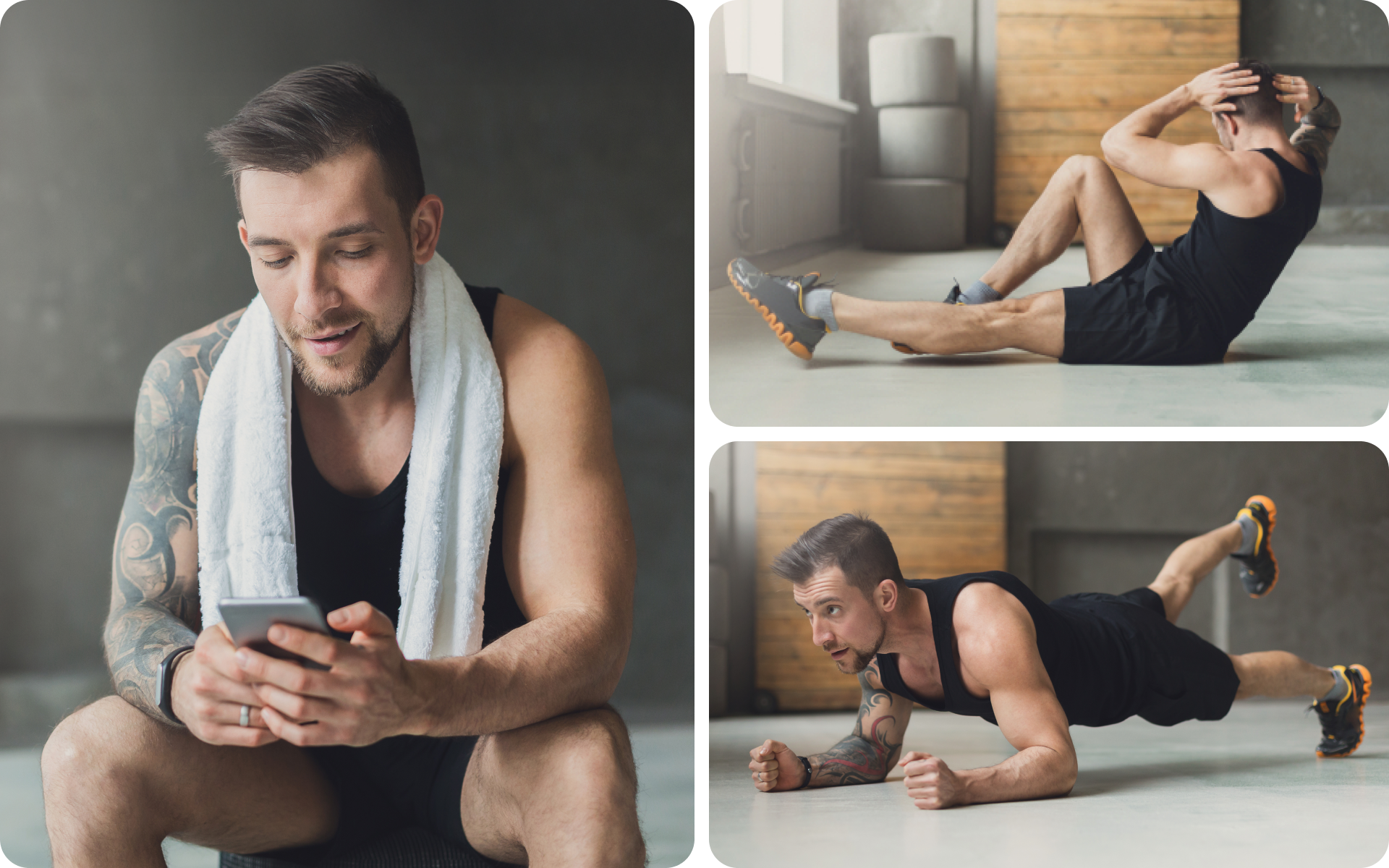
Inner core muscles
- Pelvic floor muscles: Work with the abdominal muscles to regulate intra-abdominal pressure and support spinal stability during movement.
- Transversus abdominis: The deepest abdominal muscle, providing continuous support for spinal stability during movement.
- Internal obliques: Help rotate and side-bend the trunk while also contributing to trunk control.
- Multifidus: Deep back muscles that help control movement between individual vertebrae.
- Diaphragm: In addition to its role in breathing, the diaphragm helps regulate intra-abdominal pressure, supporting core stability.
BetterMe can help you add more structure to your daily wellness routine with workouts, meal planning tools, and habit-building features. Explore the app and take a practical step toward a routine that feels more manageable for you.
Outer core muscles (global muscles)
The outer core muscles are the body’s primary movement-producing muscles (“movers”). They include:
- Rectus abdominis: Produces trunk flexion and supports movement.
- External obliques: Assist with trunk rotation and side bending while contributing to overall core function.
- Erector spinae: Extends the spine and supports lifting and upright posture.
- Quadratus lumborum: Assists with side bending and helps support the lower back.
- Hip musculature: Works with the core to control movement and maintain lumbopelvic stability.
The table below introduces exercise options for an at-home core routine. It includes alternatives beyond the exercises used in the sample circuits.
| Exercise | Simple description |
|---|---|
| Curl-up/crunch | Lie on your back with your knees bent and lift your shoulders off the floor. |
| Side crunch | Lie on your side and lift your upper body toward your hip. |
| Sit-up | Lie on your back and sit all the way up until you're upright. |
| Roll-up | Slowly roll your spine off the floor into a seated position. |
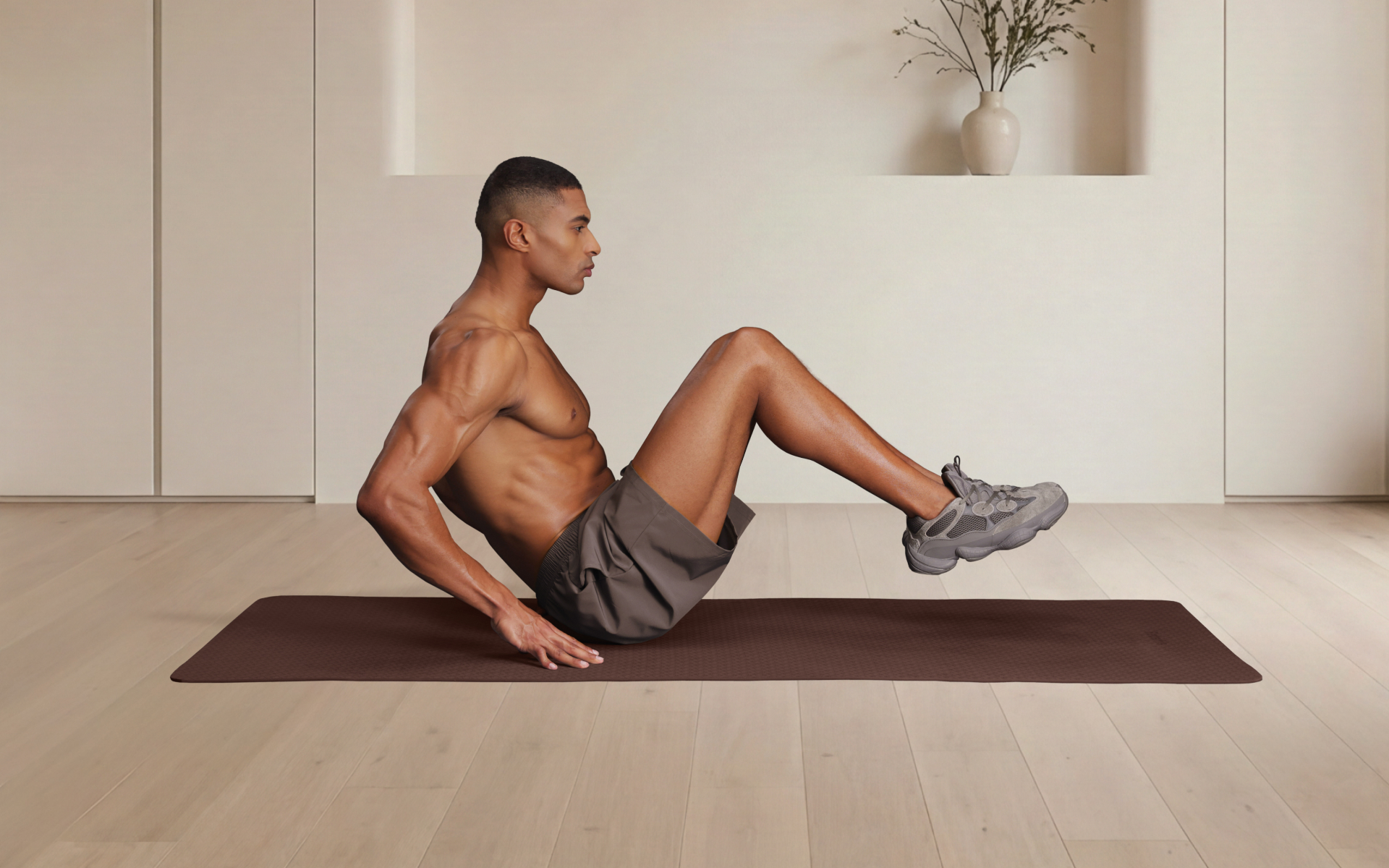
| V-sits | Lift your legs and upper body at the same time to form a "V" shape. |
| Bilateral leg raise | Lie on your back and lift both straight legs together. |
| Straight one-leg hold | Lie on your back and hold one straight leg raised while the other stays bent. |
| Double leg stretch | Extend your arms and legs away from your body, then bring them back in. |
| Back extension | Lie face down and lift your chest off the floor. |
| Prone leg extension | Lie face down and lift your legs by squeezing your glutes. |
| Bird dog | On your hands and knees, extend the opposite arm and leg while staying balanced. |
| Bridge | Lie on your back and lift your hips until your body forms a straight line. |
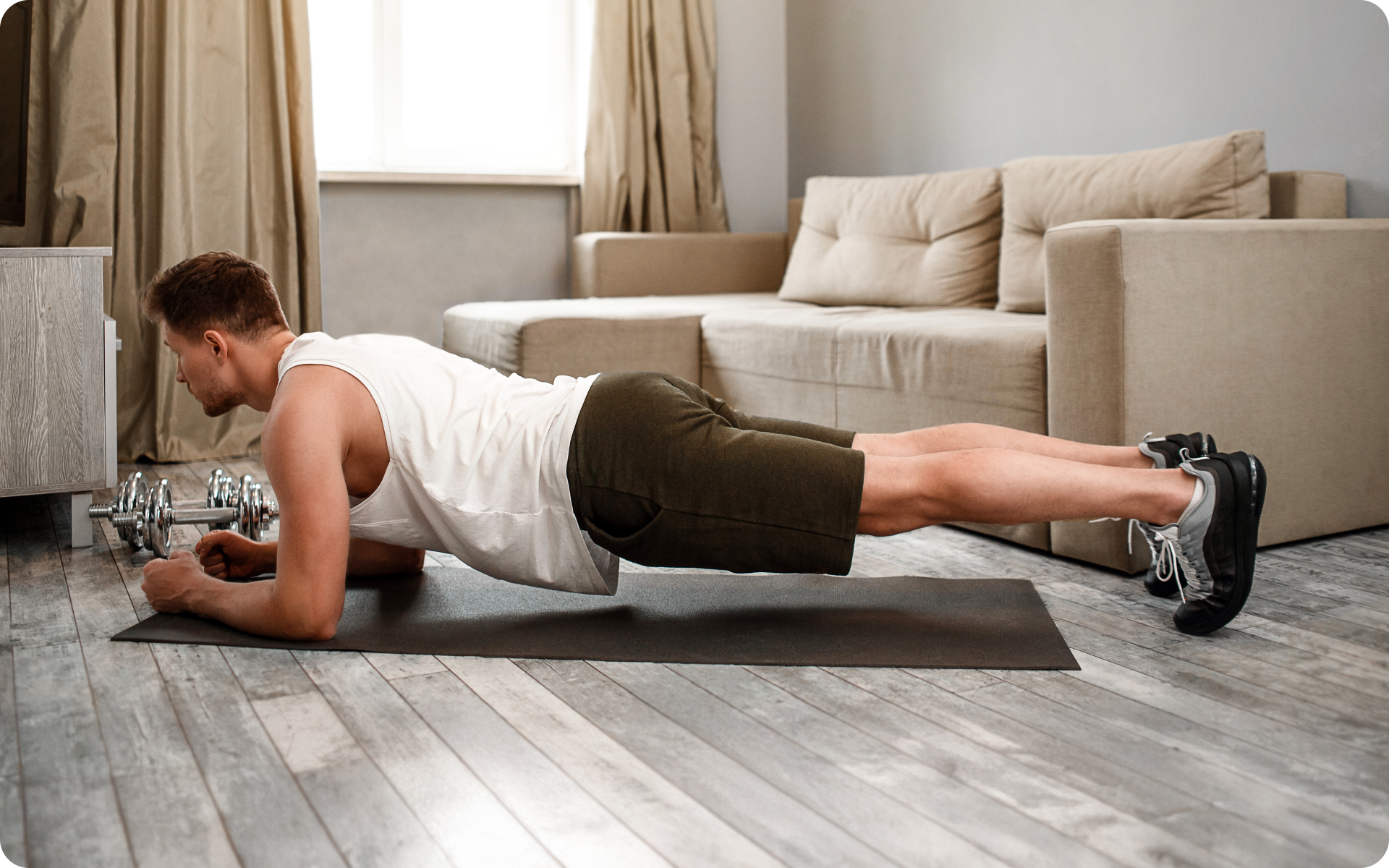
| Front plank | Hold your body straight while resting on your forearms and toes. |
| Side plank | Support yourself on one forearm and the side of your foot while keeping your body straight. |
| Abdominal drawing-in | Gently pull your belly button toward your spine while breathing normally. |
| Bracing | Tighten your abdominal muscles as if bracing for a punch, then hold. |
| Hollowing | Draw your lower stomach inward toward your spine. |
| Side-lying hip adduction | Lie on your side and lift your bottom leg upwards. |
| Supine hip adduction | Lie on your back and squeeze your legs together. |
For additional movement ideas, explore our calisthenics ab workout guide.
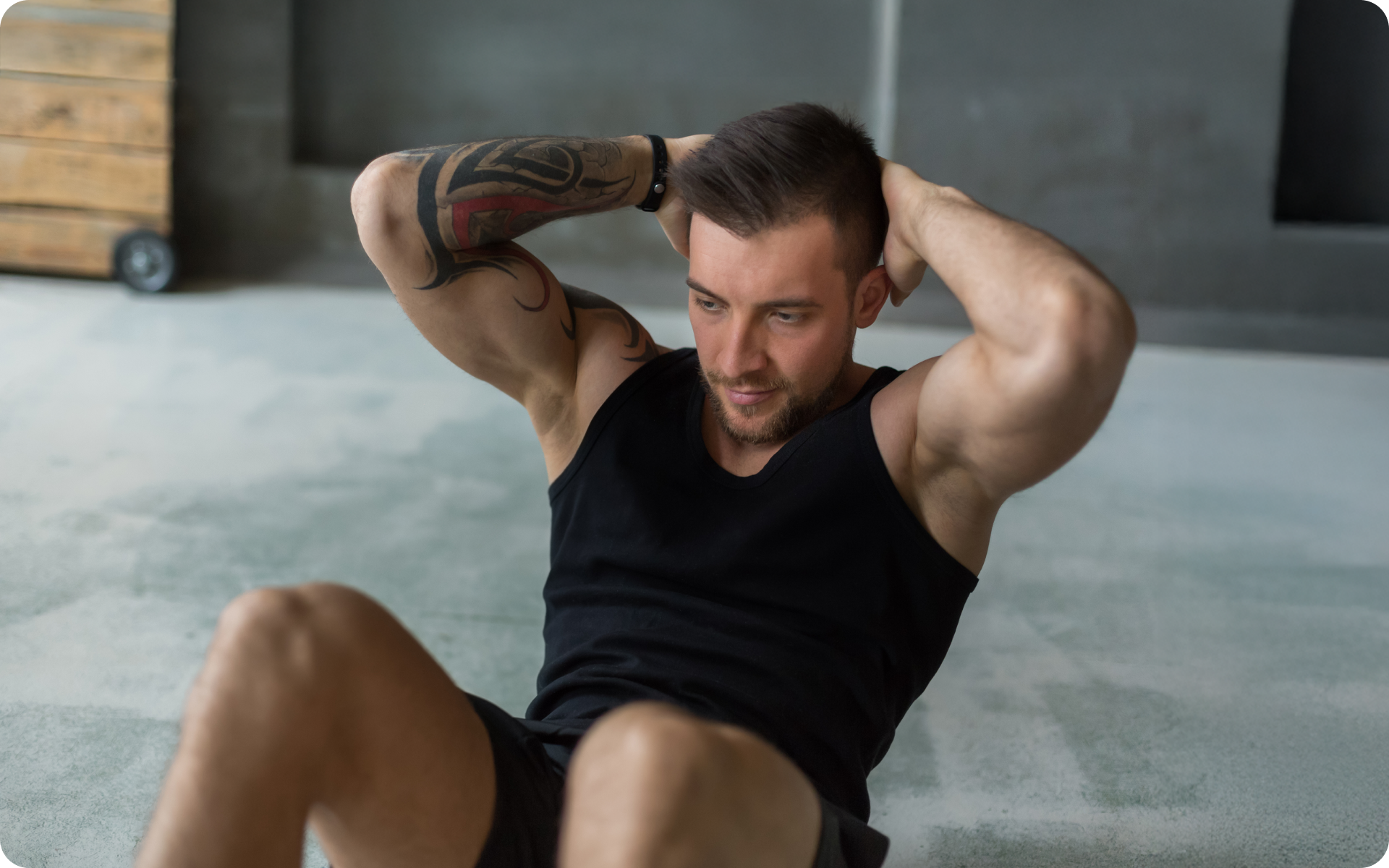
No-equipment ab workout routine for men at home
This sample bodyweight routine combines trunk movement, holds, and hip exercises. The sets and repetitions are examples you can reduce or adjust. Start with the shorter beginner circuit if the full table feels excessive.
Bodyweight core and trunk strength workout
Frequency: 2-3x/week
Level: Beginner-intermediate
Rest: 30-45 seconds between exercises, 1-2 minutes between rounds
| Exercise | Sets | Reps/time |
|---|---|---|
| Bird dog | 2-3 | 8-10 each side |
| Bridge | 2-3 | 12-15 |
| Front plank | 2-3 | 20-45 secs |
| Side plank | 2-3 | 15-30 secs each side |
| Curl-up/crunch | 2-3 | 12-15 |
| Bilateral leg raise | 2 | 8-12 |
| Side-lying hip adduction | 2 | 12 each side |
| Back extension | 2 | 10-15 |
| V-sits or double leg stretch | 2 | 8-12 |
| Bracing | 2 | 5 × 10-second holds |
Read more: Military Workout Guide for Beginners: Exercises, Tips, and FAQs
Beginner version
Sample target: 1-2 rounds
- Bird dog × 8/side
- Bridge × 10
- Front plank × 20 secs
- Curl-up × 10
- Side plank × 15 secs/side
- Back extension × 10
Intermediate version
Sample target: up to 3 rounds
- Bird dog × 10/side
- Bridge × 15
- Front plank × 45 secs
- Side plank × 30 secs/side
- Curl-up × 15
- Bilateral leg raise × 12
- Back extension × 15
- V-sits × 12
- Bracing × 10 secs × 5
Ab workouts do not need to include hundreds of repetitions or a constant burning sensation. Choose a manageable workload and focus on controlled technique. Reduce the repetitions if you cannot maintain the movement.
For a shorter session, explore our 30-minute calisthenics workout guide.
How to make an at-home ab workout easier or harder
You can adjust the difficulty of your workout in several ways:
- Slow the tempo: Use a pace that allows control. Slower repetitions increase duration, but do not automatically produce greater muscle growth (4).
- Add pauses: Hold the most challenging part of the movement for 2-5 seconds before returning to the starting position.
- Increase repetitions: Complete more repetitions in each set.
- Increase sets: Add an extra working set compared to your previous workout.
- Adjust rest time: Allow enough rest to repeat the next set with controlled technique. Shortening rest is optional.
- Progress gradually: Add repetitions or try a more challenging version when your current workload feels manageable. Research supports both repetition and load progression in specific resistance-training programs (2).
How do core exercises emphasize different movements?
Trunk flexion and leg-control options
- Bilateral leg raise
- Straight one-leg hold
- Double leg stretch
- V-sits
- Controlled curl-up
- Roll-up
Side-bending and lateral-control options
- Side crunch
- Side plank
- Standing side bend without weights
- Side plank with bent knees
Trunk stability and hip-support options
- Front plank
- Bird dog
- Bridge
- Bracing
- Abdominal drawing-in maneuver
These groups organize movements rather than isolate separate sections of the abdominal muscles. Different exercises recruit overlapping trunk muscles (1). Hip adduction is included as a hip exercise, rather than an oblique exercise.
For broader workout planning, see our daily calisthenics routine for beginners.
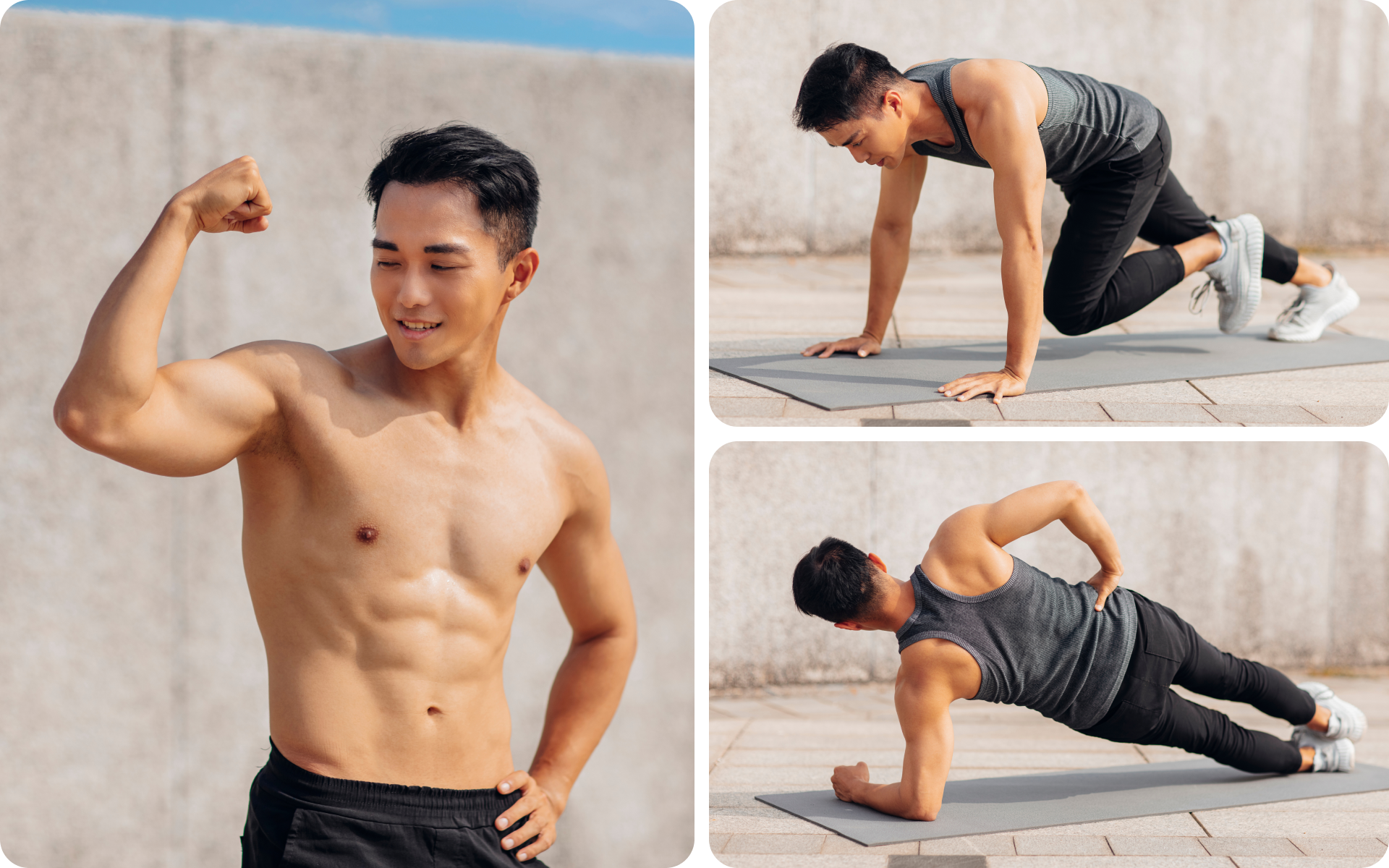
Should you do ab exercises fast or slow?
Time under tension describes how long muscles work during a set. A narrative review does not establish one universally superior repetition speed for muscle growth (4). For home ab exercises, choose a pace that lets you control the movement and continue breathing.
Read more: Military Calisthenics Workout Plan for Beginners: A Complete Guide
How often should men train abs?
Two or three sessions on nonconsecutive days are a practical starting example, rather than a requirement for all men. General activity guidance includes muscle-strengthening exercise on at least two days weekly (5). Adjust your ab workload alongside other training, fatigue, and experience.
How long does it take to get visible abs?
There is no reliable timeline for visible abs. In one six-week trial, abdominal training improved endurance without significantly reducing abdominal fat (3). Use performance and movement control as progress measures instead of expecting visible definition by a deadline.
Workouts, weight management tools, and recipe ideas come together in the BetterMe: Health Coaching app, giving you practical support for building a more consistent wellness routine.
FAQs
Will 100 crunches a day give you abs?
No specific crunch count guarantees visible abs. A six-week abdominal exercise trial improved endurance without significantly reducing abdominal fat (3). Choose a manageable routine rather than treating 100 daily repetitions as a requirement.
Is 20 minutes of abs a day enough?
A 20-minute session can be a practical option, but duration alone does not establish whether a routine suits your goal. Choose exercises and a workload you can control, and allow time between demanding sessions. Daily ab training is optional.
Are planks better than crunches?
Neither exercise is inherently superior. Planks hold the trunk steady, while crunches involve trunk flexion. A review found different core exercises produced different muscle-activation patterns (1). Choose movements that suit your current ability.
Should I train abs on an empty stomach?
Training before or after eating is a personal preference. Some people feel comfortable exercising before eating, while others perform better after consuming a light meal or snack.
Should you do ab exercises fast or slow?
Use a pace that lets you control each repetition and breathe normally. Rushing may make technique harder to maintain. Slower repetitions are an option, but they do not automatically produce superior muscle growth (4).
Is a 2-minute plank every day good?
A plank challenges trunk muscles, as documented in a review of core exercise activity (1). A two-minute daily hold is not a requirement. Try shorter holds and adjust the duration to maintain control.
The bottom line
Ab workouts for men at home can combine movements and holds without specialized equipment. Use the sample routines flexibly and increase the challenge gradually. Different resistance-training approaches can improve strength (6). Visible definition is not a guaranteed result of this sample routine.
If an exercise causes discomfort, stop and adjust it. Consider a qualified professional for ongoing concerns or help choosing a suitable starting level.
DISCLAIMER:
This article is intended for general informational purposes only and does not serve to address individual circumstances. It is not a substitute for professional advice or help and should not be relied on for making any kind of decision-making. Any action taken as a direct or indirect result of the information in this article is entirely at your own risk and is your sole responsibility.
BetterMe, its content staff, and its medical advisors accept no responsibility for inaccuracies, errors, misstatements, inconsistencies, or omissions and specifically disclaim any liability, loss or risk, personal, professional or otherwise, which may be incurred as a consequence, directly or indirectly, of the use and/or application of any content.
You should always seek the advice of your physician or other qualified health provider with any questions you may have regarding a medical condition or your specific situation. Never disregard professional medical advice or delay seeking it because of BetterMe content. If you suspect or think you may have a medical emergency, call your doctor.
SOURCES:
- Core Muscle Activity During Physical Fitness Exercises: A Systematic Review (2020, pubmed.ncbi.nlm.nih.gov)
- Effects of Resistance Training Overload Progression Protocols on Strength and Muscle Mass (2024, pubmed.ncbi.nlm.nih.gov)
- The effect of abdominal exercise on abdominal fat (2011, pubmed.ncbi.nlm.nih.gov)
- Optimizing Resistance Training Technique to Maximize Muscle Hypertrophy: A Narrative Review (2024, pubmed.ncbi.nlm.nih.gov)
- Physical Activity Guidelines for Americans, 2nd edition (2018, odphp.health.gov)
- Resistance training prescription for muscle strength and hypertrophy in healthy adults: a systematic review and Bayesian network meta-analysis (2023, pmc.ncbi.nlm.nih.gov)
 Reviewed by
 Reviewed by