
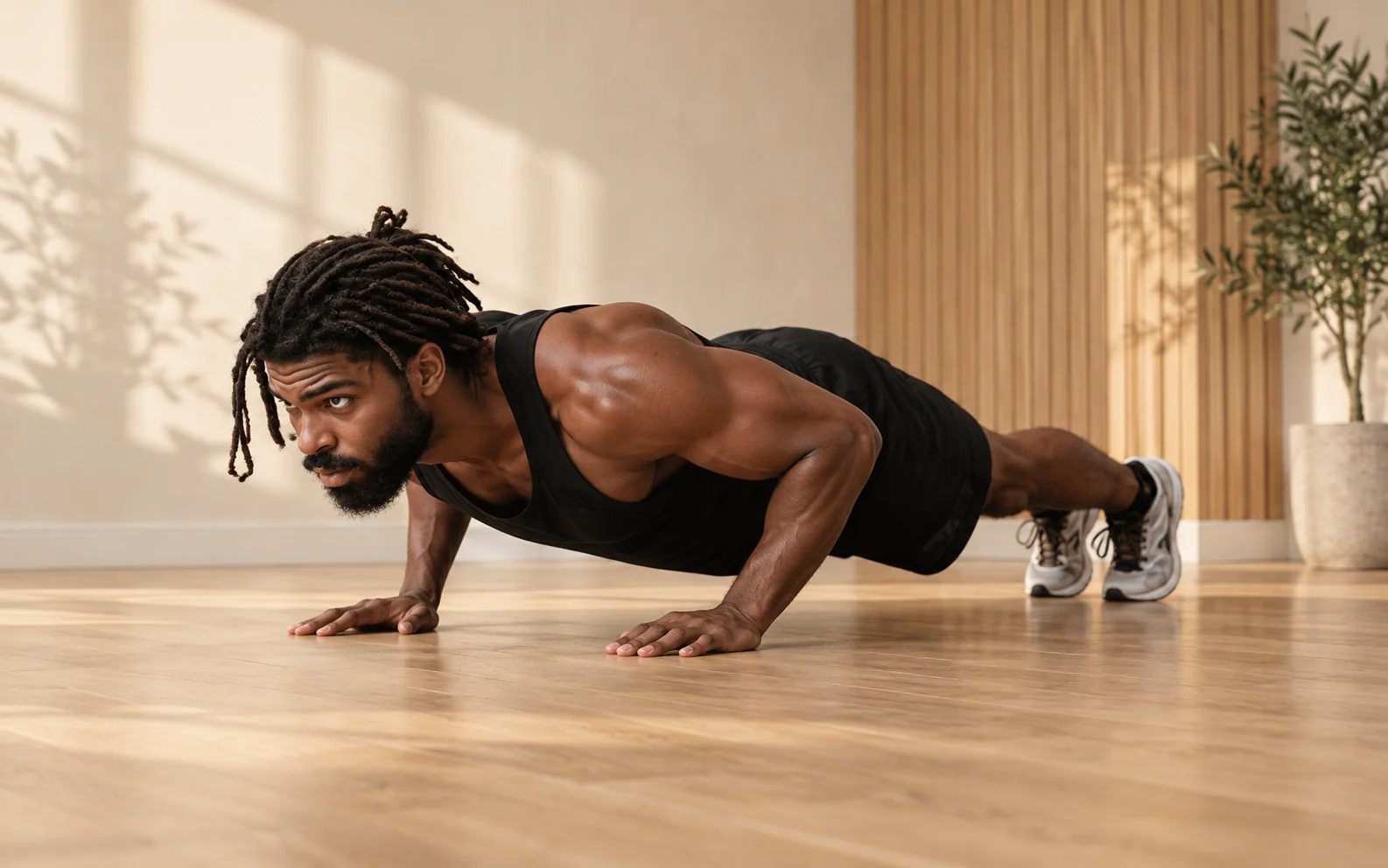
A calisthenics workout plan for mass uses progressively challenging presses, pulls and leg exercises. Start with a weekly workload you can recover from and adjust one part of the plan as you gain experience. For an example of exercise selection, see this men’s calisthenics workout with sets and rest.
Bodyweight exercises can provide resistance for muscle training. Pulling and dipping movements require purpose-built equipment installed and rated for the intended load. A securely fitted weighted vest is one optional progression.
Key takeaways
These points summarize how a calisthenics workout plan for mass works and what to expect.
> * Across resistance-training studies, higher weekly set volume was associated with greater average muscle growth (1). The finding does not predict a fixed gain from each added set.
> * Muscle growth was similar with light and heavy loads when sets went to failure (2).
> * A later review found no meaningful difference in hypertrophy between training frequencies when weekly volume was matched (3).
> * Training to momentary failure showed no clear growth advantage over stopping a little short (4).
> * Push-ups matched to 40% of bench press 1RM built chest and triceps thickness like bench pressing over 8 weeks (5).
> * A sports nutrition position stand suggests 1.4 to 2.0 g of protein per kg daily for exercising people (6).
> * Use the four-day split as one way to distribute a manageable number of sets, and adjust it to your experience and recovery.
Can you increase muscle mass with calisthenics?
Yes, you can increase muscle mass with calisthenics. Resistance training can increase muscle mass if the program is well-designed and you consider other lifestyle factors. Bodyweight moves qualify when they are hard enough and get harder over time.
One 8-week trial had young men do push-ups adjusted to about 40% of their bench press 1RM. Their chest and triceps thickness grew similarly to a matched bench press group (5). Muscle growth also appears similar across light and heavy loads when sets are taken to failure (2).
Training volume, effort and recovery all matter. Use a training log to see whether you can repeat the work with control and recover before the next demanding session.

How many sets and reps build muscle with calisthenics?
There is no single required starting set count for every trainee. Choose a workload you can perform with control and recover from, then adjust as your experience grows.
A meta-analysis found that greater weekly set volume was associated with more muscle growth across study groups. Its separate comparison of fewer than five, five to nine, and ten or more sets showed a statistical trend (1). Current guidance also reports a benefit from higher weekly volume for hypertrophy in healthy adults (7). These findings do not set a personal starting minimum.
|
Variable |
What studies or training guidance indicate |
Optional programming example |
|---|---|---|
|
Weekly sets per muscle |
Higher volume was associated with larger average gains across study groups (1) |
Start with a manageable workload and add sets only when that fits training and recovery |
|
Reps per set |
Growth similar across loads taken to failure (2) |
Pick variations you can do for about 6 to 20 reps |
|
Effort |
Momentary failure showed no clear advantage over nonfailure training in the reviewed subgroup (4) |
End sets while you can maintain controlled form and recover for the next session |
|
Frequency |
No meaningful frequency difference when weekly training volume was matched (3) |
Distribute the planned work across one or more manageable sessions; twice weekly is one example |
|
Rest between sets |
Rest needs vary with load, exercise and the work you intend to repeat |
Allow sufficient time to repeat the next set with controlled technique |
If a set becomes very long, you can try a harder version or external resistance suited to the movement. Choose according to control, available equipment and personal goals.
How do you apply progressive overload for muscle growth?
Progressive overload means gradually increasing the demand on your muscles over weeks. In calisthenics, you add reps, sets, range of motion, or difficulty.
You can do this by:
> * Adding more reps and sets.
> * Moving to more challenging variations (for example, from push-ups to archer or one-arm push-ups).
> * Slowing the lowering phase to 3 seconds to make a familiar variation harder.
> * Using weighted vests or other external resistance as you get stronger.
In an eight-week lower-body resistance-training trial, trained adults made broadly similar muscle gains when progressing repetitions or load (8). The trial did not test this calisthenics split. Record repetitions and exercise difficulty as separate training choices.
Eccentric training focuses on the lengthening phase of a muscle contraction. In a standard push-up, the eccentric phase is when you lower your body back towards the ground. A slower descent adds time under load and helps you keep control at the bottom.
What does a calisthenics workout plan for mass look like?
This sample week alternates upper- and lower-body sessions across four days. Use fewer sessions or exercises when that better fits your experience and recovery.
|
Day |
Focus |
Exercises (sets x reps) |
|---|---|---|
|
Monday |
Upper A |
Pull-ups 4 x 6 to 10; decline push-ups 4 x 8 to 15; inverted rows 3 x 8 to 12; bar dips 3 x 6 to 12; pike push-ups 3 x 6 to 10 |
|
Tuesday |
Lower A |
Bulgarian split squats 4 x 8 to 12 per leg; single-leg glute bridges 3 x 10 to 15 per leg; calf raises 3 x 12 to 20; hanging knee raises 3 x 8 to 15 |
|
Wednesday |
Rest |
Walking or light mobility |
|
Thursday |
Upper B |
Chin-ups 4 x 6 to 10; archer push-ups 3 x 5 to 8 per side; feet-elevated inverted rows 3 x 8 to 12; dips 3 x 8 to 12; pike push-ups 3 x 6 to 10 |
|
Friday |
Lower B |
Box pistol squats 4 x 5 to 8 per leg; reverse lunges 3 x 10 to 12 per leg; single-leg hip thrusts 3 x 10 to 15 per leg; calf raises 3 x 12 to 20; hollow holds 3 x 20 to 40 seconds |
|
Saturday and Sunday |
Rest |
Easy activity |
Counting the listed pulling and pressing sets gives about 14 back sets and 13 chest sets in this example. Exercise overlap and effort affect the actual demand. Session length varies with setup and rest. Newer trainees can begin with fewer exercises and sets.
For pulling variations, see the calisthenics pull workout for back and biceps.
What should you consider when planning meals around training?
Nutrition needs depend on activity, appetite, health and personal circumstances. A registered dietitian can help you plan meals around your training and individual requirements.
Start with foods you can eat regularly and that fit your preferences. Bring questions about appetite, recovery or meeting nutrition needs to a registered dietitian.
A sports nutrition position stand describes about 1.4 to 2.0 g of protein per kg of body weight per day as sufficient for most exercising people (6). It also discusses protein across meals. These ranges describe a training population and do not establish an individual requirement.
Focus on whole foods such as whole grains, potatoes, lentils, beans, fruits, vegetables, meat, fish, eggs, and dairy. Protein powder can also help you meet your daily protein goals. If you have a medical condition, check your plan with a doctor or registered dietitian.

Is calisthenics strength or hypertrophy?
Calisthenics can be strength or hypertrophy training, depending on how you set it up. The same exercises serve both goals with different reps, effort, and rest.
In studies where sets reached momentary muscular failure, heavier loads favored maximal strength while muscle growth was similar across lighter and heavier loads (2). Adjust the plan to the goal and exercise. Our calisthenics workout for strength describes a strength-focused format.
Is calisthenics better than the gym for bulking?
Both bodyweight and gym-based resistance training can provide a progressive challenge. The practical choice depends on your equipment, exercise skill and ability to adjust the load.
Weights make it easy to add small, precise increments of resistance. Calisthenics needs more planning as you get stronger, such as harder body positions or added load. A weighted calisthenics setup with a vest or belt bridges that gap for many people.
Combining both approaches can also work well. You might use calisthenics for pulling and pressing and add weights for legs and hips.

How do you know if your calisthenics mass plan is working?
Look for a pattern across comparable sessions: a controlled repetition, a manageable change in resistance or an exercise you can now perform through the intended range. Training records can guide your next choice but do not measure muscle growth directly.
Track a few simple markers:
> 1. Log every set with the variation, reps, and how many reps you had left.
> 2. Record which variation and resistance you used so that you can compare similar sessions.
> 3. Note comfort, technique and recovery before deciding whether to add more work.
> 4. Compare each 4-week block with the previous one.
Review the training log and choose one change that fits your next session. Discuss individual nutrition questions with a qualified professional.
If an exercise repeatedly feels harder than expected, review technique, recovery and the total workload before making a change. Adjust one variable at a time so you can compare the next session.
What mistakes slow muscle growth with calisthenics?
Common obstacles include an unsuitable variation, too much work to recover from, or a setup that makes the exercises hard to repeat consistently.
> * Staying on easy variations for months without adding reps or difficulty.
> * Repeating a very long set when a manageable change in exercise difficulty would better fit the training goal.
> * Training the same muscle hard every day with no easier days.
> * Skipping pulling work, which leaves the back and biceps behind the chest.
> * Choosing a weekly workload that is difficult to repeat with controlled technique.
Choose one manageable change and compare similar sessions in your log. Progress can vary across exercises and over time.
Frequently Asked Questions
Is 30 too late for calisthenics?
Adults can start calisthenics at 30. General adult guidance recommends strengthening the major muscle groups on at least two days a week (9). Start with movements you can control and progress according to recovery.
What is a good calisthenics workout plan for beginners who can do it at home?
A beginner can start with a few manageable pushing, pulling and leg exercises, using suitable equipment. Two shorter full-body sessions are one scheduling option. A current position stand supports progressive resistance training adapted to the person and goal (7).
How many reps is too much calisthenics?
A repetition count alone does not determine whether a set fits your goal. Use a movement you can control, record the work and adjust difficulty when the current version no longer fits your plan.
The bottom line
Choose movements you can perform with steady technique and a weekly workload that allows recovery. Record repetitions, exercise variations and resistance, then make a small adjustment when it fits your training. A registered dietitian can help with individual nutrition needs. BetterMe offers a calisthenics workout program.
DISCLAIMER:
This article is intended for general informational purposes only and does not serve to address individual circumstances. It is not a substitute for professional advice or help and should not be relied on for making any kind of decision-making. Any action taken as a direct or indirect result of the information in this article is entirely at your own risk and is your sole responsibility.
BetterMe, its content staff, and its medical advisors accept no responsibility for inaccuracies, errors, misstatements, inconsistencies, or omissions and specifically disclaim any liability, loss or risk, personal, professional or otherwise, which may be incurred as a consequence, directly or indirectly, of the use and/or application of any content.
You should always seek the advice of your physician or other qualified health provider with any questions you may have regarding a medical condition or your specific situation. Never disregard professional medical advice or delay seeking it because of BetterMe content. If you suspect or think you may have a medical emergency, call your doctor.
SOURCES:
- Dose-response relationship between weekly resistance training volume and increases in muscle mass: A systematic review and meta-analysis (2016, nih.gov)
- Strength and Hypertrophy Adaptations Between Low- vs. High-Load Resistance Training: A Systematic Review and Meta-analysis (2017, nih.gov)
- How many times per week should a muscle be trained to maximize muscle hypertrophy? A systematic review and meta-analysis (2019, nih.gov)
- Influence of Resistance Training Proximity-to-Failure on Skeletal Muscle Hypertrophy: A Systematic Review with Meta-analysis (2022, nih.gov)
- Low-load bench press and push-up induce similar muscle hypertrophy and strength gain (2017, nih.gov)
- International Society of Sports Nutrition Position Stand: protein and exercise (2017, nih.gov)
- Resistance Training Prescription for Muscle Function, Hypertrophy, and Physical Performance in Healthy Adults: An Overview of Reviews (2026, nih.gov)
- Progressive overload without progressing load? The effects of load or repetition progression on muscular adaptations (2022, nih.gov)
- World Health Organization 2020 guidelines on physical activity and sedentary behaviour (2020, nih.gov)

 Reviewed by

 Reviewed by
 Reviewed by