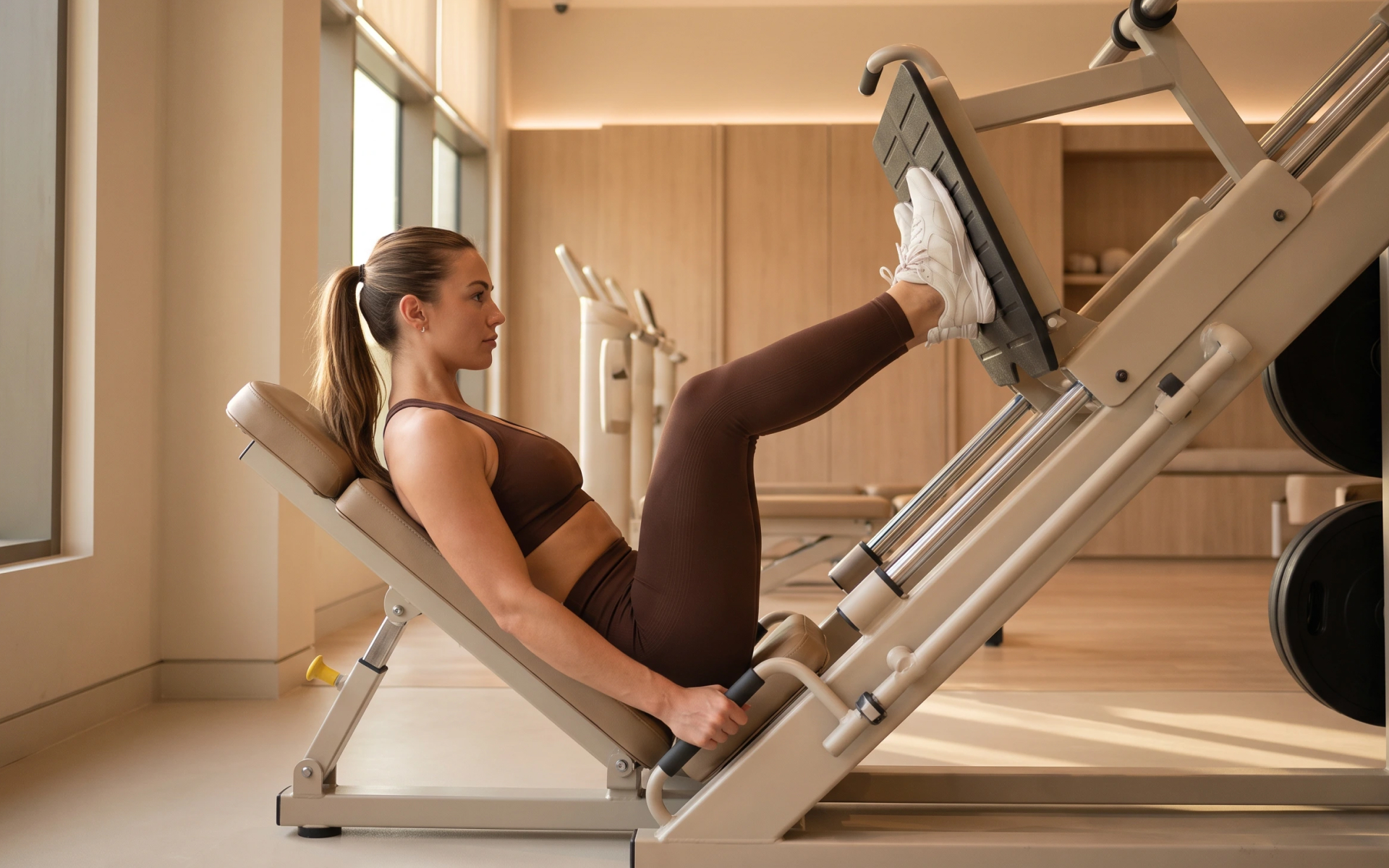
A good leg workout at the gym pairs a squat, a hip hinge, and a one-leg move, done for 2 to 4 sets about twice a week. That simple structure suits beginners and regular lifters alike, and you can build it with machines, free weights, or both.
Building strong legs supports everyday movement, from climbing stairs to carrying groceries. As long as your leg gym workout covers the right movement patterns, you can build a complete session without touching every piece of equipment in the room.
Below you will find sample routines, step-by-step exercise cues, sets, reps, rest, session length, and frequency, plus ways to adjust each part to your level.
Key Takeaways
A balanced leg session covers a few movement patterns, uses moderate volume, and leaves time to recover. These points sum up the plan:
- The exercise sections cover knee-dominant, hip-dominant, and one-leg movements; the machine routine uses a smaller selection.
- Start with 5 minutes of light cardio, then a few dynamic moves like leg swings and walking knee hugs (1).
- Knee-bending lifts lean on the quads and glutes, while hip-bending lifts lean on the back of the legs (2, 3).
- Heavier loads for around 1 to 5 reps suit a strength focus, while moderate loads for around 8 to 12 reps suit a strength-and-size blend (4).
- A common target for muscle growth is around 10 or more sets per muscle group per week (5).
- One study in trained adults found that training once or three times per week brought similar results when weekly volume matched (6).
- Leave at least one day between leg sessions so your muscles can reset (7).
How Should You Structure a Leg Day Workout?
Structure a leg day workout around three movement patterns: a knee-dominant lift, a hip-dominant lift, and a one-leg move. Together they train the major muscle groups of your lower body in one session.
Each pattern has a job:
- Squat: bending at the hips and knees, like a back squat
- Hip-dominant lift: folding at the hips with soft knees, like Romanian deadlifts
- Single-leg move: working one leg at a time, like a step-up or reverse lunge
A session built on these three patterns tends to be balanced and time-friendly.
A helpful order many people follow:
- Start with a knee-dominant movement
- Move to a hip-dominant movement
- Finish with one-leg and isolation moves for smaller muscle groups
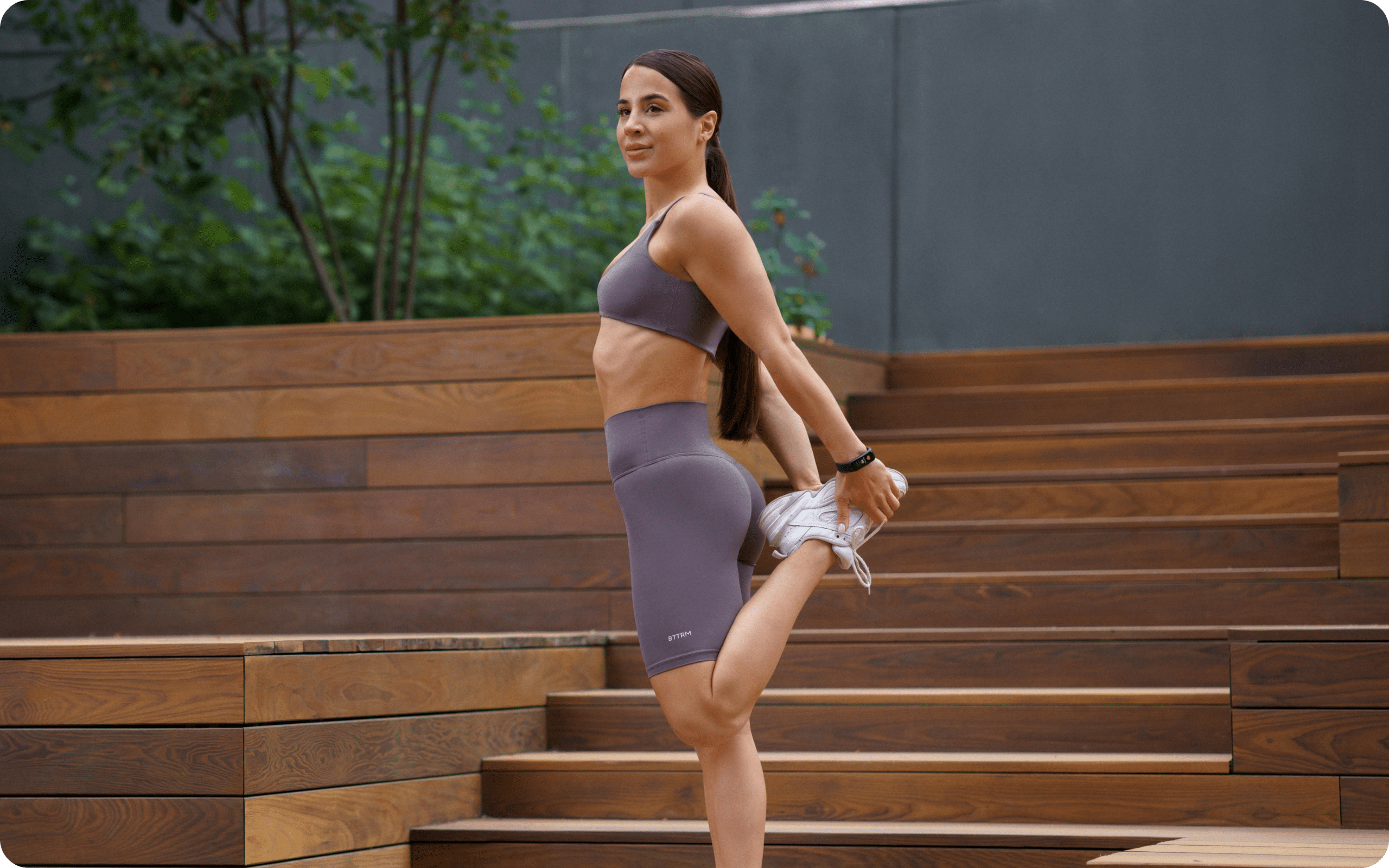
Add a short warm-up first. Try 5 minutes of light cardio, then a few dynamic mobility moves like leg swings and walking knee hugs. This gets blood flowing and helps your muscles feel ready (1).
Keep things simple, especially for beginners. A focused session of 3 to 5 exercises often works better than a long, scattered one.
Read more: Knee-friendly leg exercises for home and gym workouts
Which Muscles Should You Train During a Leg Workout?
A leg workout should train the main leg muscles: the glutes, quads, hamstrings, calves, and adductors. Together, they power nearly every step you take.
Here’s a plain-language look at each group:
- Glutes: your buttock muscles; the gluteus maximus is the largest muscle of the hip and helps with hip extension and stability (8).
- Quads: the front of your upper leg; straighten the knee (9).
- Hamstrings: the back of your upper leg; bend the knee and extend the hip (10).
- Adductors: your inner thigh; pull the leg toward the body’s midline (11).
- Abductors: your outer hip; move the leg away from the body.
- Calves: your lower leg; help you push off the ground (12).
Many leg moves also bring in the smaller hip muscles that support balance and control.
A well-rounded routine hits these groups through varied movements. Knee-dominant lifts lean on the quads and glutes (2). Hip-dominant lifts lean on the hamstrings and glutes (3). Unilateral work challenges balance and the smaller stabilizers (13).
You don’t need to memorize anatomy to train well. Still, knowing what each move targets can help you pick exercises with purpose.
If you’d like to focus more on your backside, you can explore bodyweight options in this guide to Calisthenics for Glutes.
What Is a Good Leg Day Workout for Beginners?
A good beginner session uses simple, low-impact moves with light loads and clear form cues. It focuses on control first, then gradually adds challenge over time.
If you’re new, start with machines and body-weight moves. They tend to feel more approachable and let you learn each pattern with support. Gym training doesn’t need to feel intimidating.
Here is a sample beginner program. Complete two sets per movement using the number of reps in the table. Rest for 60 to 90 seconds, or longer if needed.
| Exercise | Sets | Reps | Rest |
|---|---|---|---|
| Leg press | 2 | 10 to 12 | 60 to 90 sec |
| Goblet squat | 2 | 10 to 12 | 60 to 90 sec |
| Lying leg curl | 2 | 10 to 12 | 60 to 90 sec |
| Glute bridge | 2 | 12 to 15 | 60 sec |
| Standing calf raise | 2 | 12 to 15 | 60 sec |
Move slowly and stop before your form breaks down, especially if you feel yourself rushing or losing balance. Individual results vary, so progress at a pace that feels manageable for you.
Leg press machine
This machine lets you push a load with your back supported.
- Sit with your back and head flat on the pad.
- Place your feet hip-width apart on the plate.
- Extend your legs without locking your knees.
- Lower the plate slowly by bending your knees, then press back up.
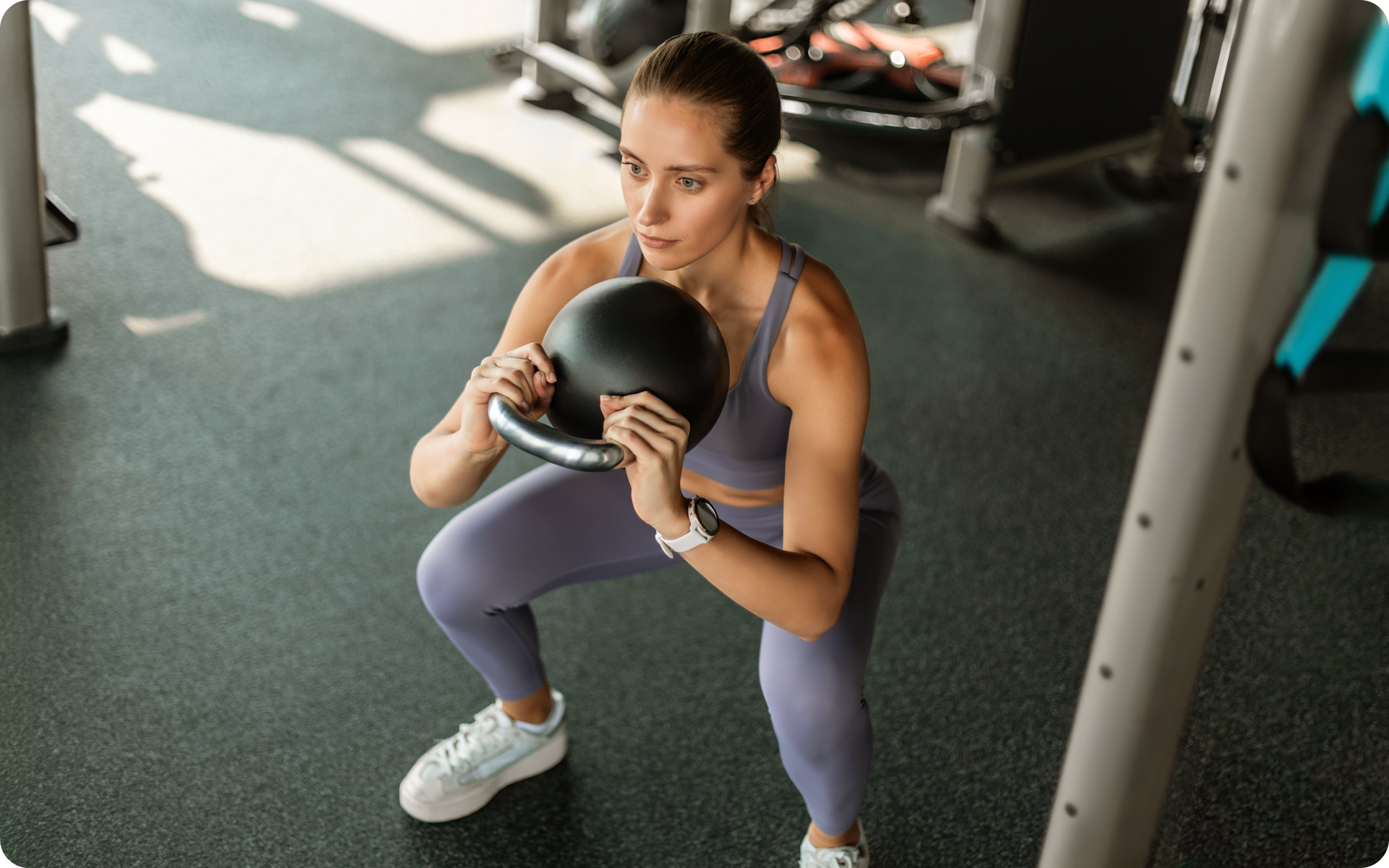
Goblet squat
This move teaches an upright stance with one weight held at your chest.
- Hold a dumbbell vertically against your chest with both hands.
- Stand with your feet shoulder-width apart.
- Lower your body by sitting back into your hips and bending your knees.
- Go as low as feels comfortable, then push up through your heels and stand up tall.
Lying leg curl
The leg curl machine isolates the hamstrings with little balance demand.
- Lie face down on the machine with the pad above your heels.
- Grab the handles for support.
- Bring your heels toward your backside slowly.
- Lower back down with control to the starting position.
Glute bridge
This floor move trains the back of the hips.
- Lie on your back with knees bent and feet flat.
- Push through your feet to lift your hips toward the ceiling.
- Squeeze your glutes at the top.
- Lower slowly and return to the starting position.
Standing calf raise
This move trains the lower leg with a simple up-and-down motion.
- Stand with the balls of your feet on a step or flat floor.
- Rise onto your toes over about 2 seconds.
- Pause briefly at the top.
- Lower your heels slowly to the start.
This kind of beginner leg workout at the gym builds a foundation you can grow from. For a low-pressure option away from the weight rack, you might also enjoy these Lower-Body Pilates Exercises.
What Free-Weight Leg Exercises Can You Do at the Gym?
Free-weight moves use dumbbells, barbells, or kettlebells to load your lower body through a full range of motion. They challenge your muscles and your balance at the same time.
“Free weights” simply means loads you hold or move freely, rather than a fixed machine path (14). Common options include:
- Back squat
- Romanian deadlift (RDL)
- Walking lunges
- Bulgarian split squat
- Dumbbell step-up
These moves tend to recruit more stabilizing muscles than machines. That can help with real-world strength, like carrying bags or climbing stairs.
Here’s a sample free-weight program. Do 3 sets of 6 to 12 reps per move, resting 90 seconds to 2 minutes between sets.
| Exercise | Sets | Reps | Rest |
|---|---|---|---|
| Back squat | 3 | 6 to 8 | 2 min |
| RDL | 3 | 8 to 10 | 90 sec to 2 min |
| Walking lunges | 3 | 10 each leg | 90 sec |
| Bulgarian split squat | 3 | 8 to 12 each leg | 90 sec |
These are flexible starting points, not fixed rules. Adjust the load so the last 2 reps feel challenging but controlled.
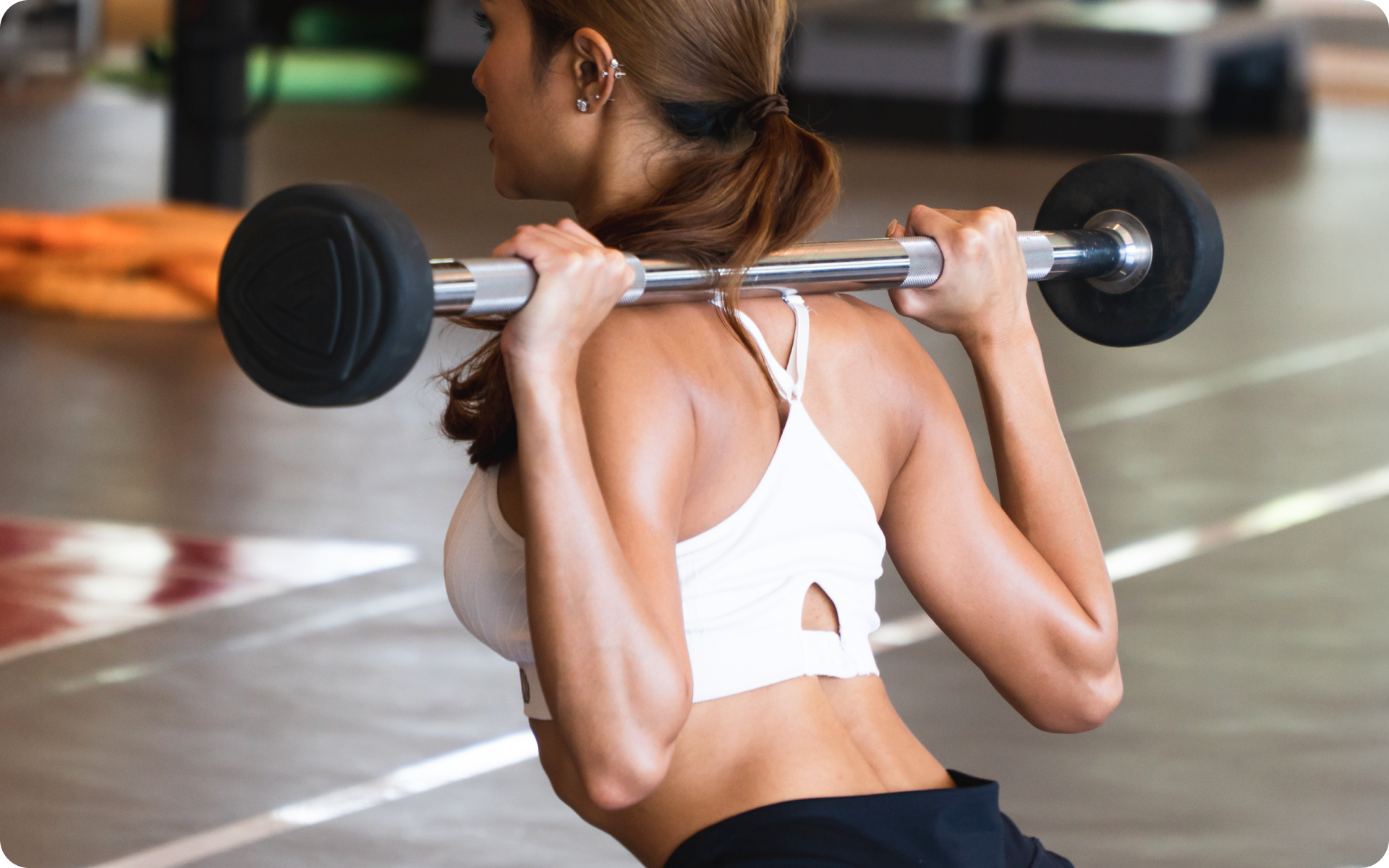
Back squat
This lift loads the whole lower body.
- Set the barbell at mid-chest height in a rack.
- Place it on your upper back and step under it.
- Take a shoulder-width stance with toes slightly out.
- Sit back into your hips, lower until your upper legs are near parallel, then stand up.
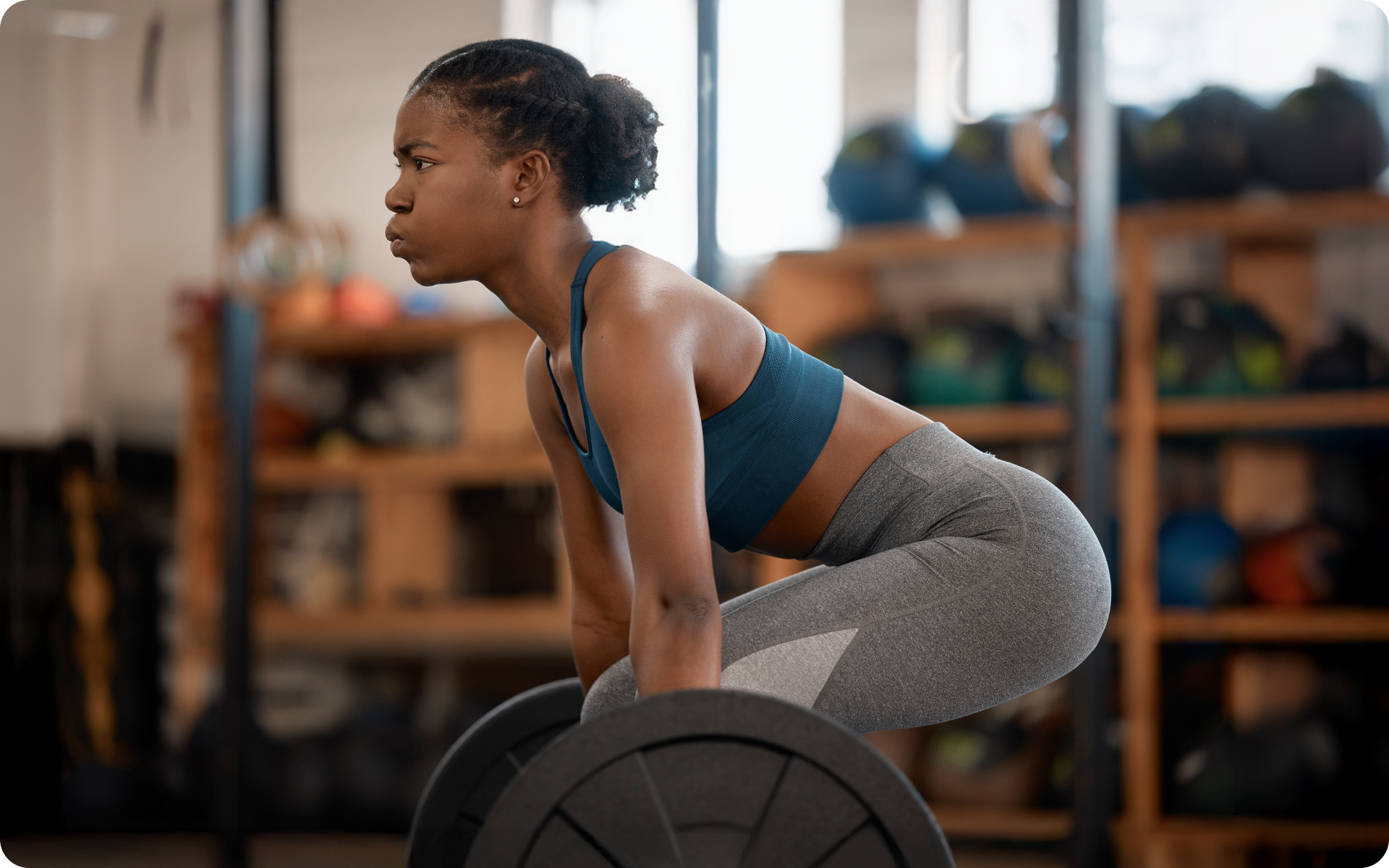
RDL
This move targets the hamstrings while you keep your back straight.
- Hold a barbell in front of your legs.
- Keep a slight bend in your knees.
- Hinge at your hips, sliding the bar down your legs while keeping your back straight.
- Stop when you feel a stretch in your hamstrings, then drive your hips forward to stand.
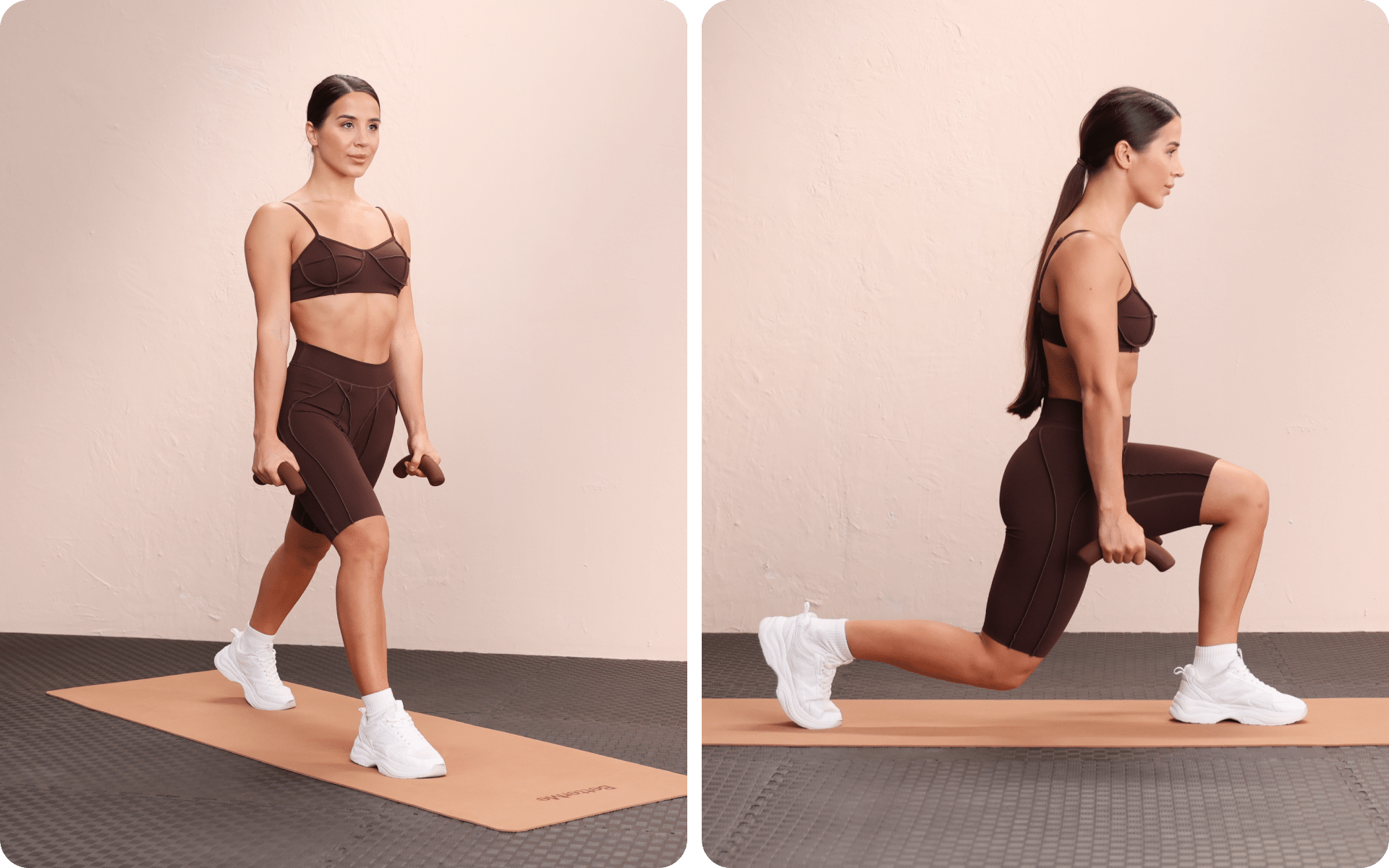
Walking lunges
Walking lunges train each leg in turn while you move forward.
- Hold a dumbbell in each hand at your sides.
- Step forward with your right foot and lower your left knee towards the floor.
- Push up through your front heel.
- Bring your left foot forward and repeat on the left leg.
Bulgarian split squat
This one-leg move puts most of the work on the front leg.
- Stand a couple of feet in front of a bench, facing away.
- Rest the top of your left foot on the bench behind you.
- Lower straight down by bending your right leg.
- Push up through your right foot to return, then switch sides.
These weighted moves reward good form, so keep control over speed. If a move feels shaky, hold a rail with one hand or reduce the load.
Workouts, weight management tools, and recipe ideas come together in the BetterMe: Health Coaching app, giving you practical support for building a more consistent wellness routine.
Which Three Leg Exercises Cover the Basics?
A squat, a hip-dominant lift such as RDLs, and a lunge cover the basics, because together they load the front, back, and sides of your legs. No single trio suits everyone, so pick the versions that fit your gym equipment and comfort.
- Knee-dominant lift: mainly the quads (2)
- RDLs: mainly glutes and hamstrings (3)
- Lunge: one side at a time, with a balance challenge (13)
Squats and deadlifts both use heavy loads, so many people place them on separate days or keep one of them light.
What Are Five Leg Workouts You Can Try?
Five practical options are a machine circuit, a free-weight strength day, a mixed session, a dumbbell-only day, and a no-equipment routine. Each sample below uses 3 to 5 exercises.
| Workout | Sample exercises | Good for |
|---|---|---|
| Machine circuit | Leg press, leg extension, lying leg curl, seated calf raise | New lifters |
| Free-weight strength day | Back squat, RDLs, walking lunges | Experienced lifters |
| Mixed session | Back squat, RDLs, leg extension | Most gym-goers |
| Dumbbell-only day | Step-up, RDLs, single-leg hip bridge | A busy gym or a home gym |
| No-equipment routine | Air squat, reverse lunge, hip bridge, wall sit | Days you can't get to the gym |
These dumbbell leg workouts and machine workouts are samples, not fixed prescriptions. Rotate them to keep training interesting.
How Can You Combine Machines and Free Weights?
You can combine machines and free weights by starting with free-weight compound moves, then finishing with machines for targeted, lower-fatigue work. This mix combines balance work with targeted muscle work.
Free weights build overall strength and balance. Machines let you isolate a muscle with steady support (14). A machine session paired with barbell moves can feel both demanding and manageable.
Here’s a simple way to structure it:
- Begin with 1 to 2 free-weight compound moves while you’re fresh
- Add 1 to 2 machine moves to target specific muscles
- Finish with a light isolation move
A sample blended session might look like this:
- Back squat (free weight)
- RDLs (free weight)
- Leg extension (machine)
- Lying leg curl (machine)
- Seated calf raise (machine)
Machines can be great near the end, when balance and grip start to tire. Using gym machines at that point lets you keep pushing with control.
There’s no single “right” split. For most healthy adults, the equipment you choose matters less than showing up and training with real effort. Pick what you enjoy and can repeat.
How Many Sets and Reps Should I Do in a Leg Workout?
Most people do 2 to 4 sets of 6 to 12 reps per exercise as a flexible starting point (14). Your exact numbers depend on your goal and experience.
Two terms first:
- Set: a group of reps done back-to-back before you rest
- Rep: one full movement, like lowering and rising once
Here’s a simple way to match reps to goals (4):
- Strength focus: heavier load, around 1 to 5 reps
- Strength-and-size blend: moderate load, around 8 to 12 reps
- Endurance focus: lighter load, around 15 to 20 reps
Beginners can progress well with less volume. Starting with 2 sets per exercise is plenty. As you build confidence, you might add a third set.
Total weekly volume tends to matter more than any single session. A common target for muscle growth is around 10 or more sets per muscle group per week (5). You can spread that across 2 sessions.
A tip for effort: aim for a load that leaves you 1 to 2 reps “in the tank.” That challenge tends to matter more than hitting an exact number. Individual outcomes vary, so treat these ranges as adjustable, not strict.
Read more: Squat workout plan for controlled lower-body training
How Long Should You Rest Between Leg Exercises?
Rest time depends on how heavy the work is, ranging from about 30 seconds to 3 minutes. Heavier sets need more rest; lighter sets need less.
Here’s a simple guide:
| Type of work | Reps | Suggested rest |
|---|---|---|
| Heavy, strength-focused | 1 to 5 | 2 to 3 min |
| Moderate, strength-and-size | 6 to 12 | 60 to 90 sec |
| Light, endurance-focused | 12 to 20+ | 30 to 60 sec |
| Circuit or time-saving format | Varies | About 30 sec |
Longer rests help you recover enough to lift well on your next set. Shorter rests keep your muscles working under fatigue, which suits lighter, higher-rep work.
Think of rest as a dial you can adjust. If your form feels shaky, take a little more time. If you’re pressed for time, a leg workout routine with shorter rests can still be productive.
How Long Should a Leg Workout Take?
Most leg sessions take about 30 to 60 minutes, including a 5 to 10 minute warm-up. The length depends mostly on how many sets you do and how long you rest.
For example, 4 exercises of 3 sets with 90 seconds of rest come to about 12 sets and roughly 25 to 35 minutes of lifting time. Heavier work with 2 to 3 minute rests stretches the same plan toward an hour. If time is short, supersets of non-competing moves and shorter rests are time-efficient options (14).
How Often Should I Train My Legs?
You can train your legs 2 to 4 days a week, though 2 sessions a week works for many people. Working each muscle group at least twice a week is a common, flexible target.
Some research suggests that total weekly volume matters more than how often you train. One study in trained adults found that training once or three times a week brought similar results when weekly volume matched (6).
Here’s how frequency might look for different goals:
| Goal | Sessions per week | Notes |
|---|---|---|
| General fitness | 2 | Balanced, easy to maintain |
| Muscle growth | 2 to 3 | Spread weekly volume across sessions |
| Higher volume | 3 to 4 | Better suited to experienced trainees |
Recovery matters just as much as the work itself. Leave at least one day between leg sessions so your muscles can reset (7).
A leg day routine twice a week fits neatly into a busy schedule. If you’d rather avoid heavy barbell work, you can explore this No-Squat Leg Workout for a gentler approach.
How Can You Adjust Leg Training to Your Fitness Level?
You can adjust a leg session to your fitness level by changing the load, reps, sets, range of motion, or rest. Small tweaks keep training suitable for you as you grow.
Here are simple ways to make a session easier:
- Use lighter loads or body weight only
- Reduce the range of motion
- Do fewer sets, like 2 instead of 3
- Rest a little longer between sets
- Choose machine versions for extra support
And here are ways to make it more challenging over time, a concept called progressive overload (gradually increasing the demand) (15):
- Add a small amount of load
- Add 1 rep or 1 set
- Slow down your tempo
- Shorten your rest slightly
- Progress to a harder variation
A lower-body workout at the gym can flex with your needs. Beginners might lean on machines, while more experienced trainees add free-weight volume.
For older adults or those returning after a break, start with gentle, controlled moves. Build gradually, and stop before your form breaks down.
A leg gym workout for women can follow these exact same principles. There’s no separate rulebook. The right plan is one that fits your goals, feels doable, and keeps you coming back.
BetterMe offers a variety of workouts, recipes, challenges, and support tools to help you stay more consistent with your wellness routine. Explore the app to find features that fit your goals, preferences, and schedule.
Frequently Asked Questions
Are 4 exercises enough for leg day?
Yes, 4 exercises are enough for most sessions if they cover a knee-dominant lift, a hip-dominant lift, a one-leg move, and an isolation move. The appropriate volume depends on sets, effort, experience, and recovery, not exercise count alone.
What is the 3-3-3 rule for working out?
The 3-3-3 rule is an informal gym saying with no official definition. It usually means 3 exercises, 3 sets each, about 3 times a week, or 3 rounds of 3 moves. For legs, that could be three of the moves above for 3 sets each, which fits the weekly volume ranges above (5).
Can beginners use leg machines at the gym?
Yes, beginners can use leg machines at the gym, and they can be a helpful starting point. Machines offer steady support and a guided path, which helps you learn each movement with control. A gym workout for legs built on machines such as the leg extension feels approachable. As you gain confidence, you can gradually add free-weight moves.
Can you do a leg workout at home without weights or machines?
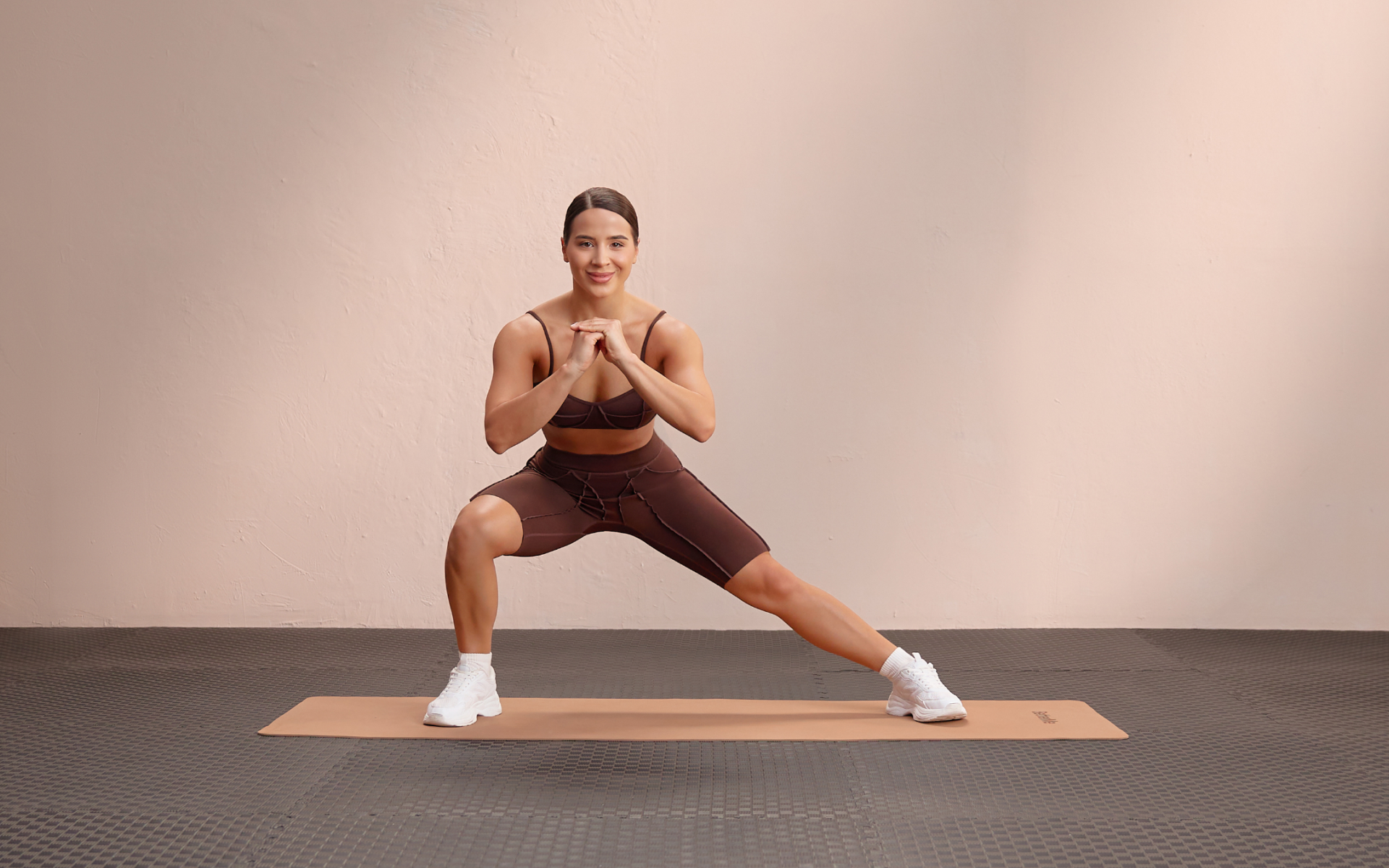
Yes, you can do a full leg session at home with body weight alone. If you’re working out at home, keep the moves slow and controlled. Air squats, reverse lunges, lateral lunges, hip bridges, step-ups on a sturdy stair, and wall sits cover the main patterns. To add challenge, slow the tempo or switch to one-leg versions, for example a step-up where you lift your left foot onto the stair and then the right.
How can you make leg sessions more challenging over time?
Use progressive overload, which means gradually adding demand as you get stronger (15). Try adding a little load, one extra rep, or one more set. You can also slow your tempo or progress to a harder variation. Individual results vary, so adjust at a pace that feels right for you.
The Bottom Line
A well-built leg gym workout comes down to a few simple pieces: cover the core movement patterns, train with real effort, and adjust the plan to your level. You don’t need every machine or a perfect routine. Pick 3 to 5 moves, focus on control, and repeat the session consistently.
DISCLAIMER:
This article is intended for general informational purposes only and does not serve to address individual circumstances. It is not a substitute for professional advice or help and should not be relied on for making any kind of decision-making. Any action taken as a direct or indirect result of the information in this article is entirely at your own risk and is your sole responsibility.
BetterMe, its content staff, and its medical advisors accept no responsibility for inaccuracies, errors, misstatements, inconsistencies, or omissions and specifically disclaim any liability, loss or risk, personal, professional or otherwise, which may be incurred as a consequence, directly or indirectly, of the use and/or application of any content.
You should always seek the advice of your physician or other qualified health provider with any questions you may have regarding a medical condition or your specific situation. Never disregard professional medical advice or delay seeking it because of BetterMe content. If you suspect or think you may have a medical emergency, call your doctor.
SOURCES:
The list covers warm-up and lifting-pattern research, repetition and volume reviews, a training-frequency trial, recovery guidance, anatomy references, and a balance-training review. Each number in the text links to the matching source below.
-
- Dynamic Warm-ups Play Pivotal Role in Athletic Performance and Injury Prevention (2024, pmc.ncbi.nlm.nih.gov)
- A Biomechanical Review of the Squat Exercise: Implications for Clinical Practice (2024, pmc.ncbi.nlm.nih.gov)
- A Comparison of Muscle Recruitment Across Three Straight-Legged, Hinge-Pattern Resistance Training Exercises (2023, pmc.ncbi.nlm.nih.gov)
- Loading Recommendations for Muscle Strength, Hypertrophy, and Local Endurance: A Re-Examination of the Repetition Continuum (2021, mdpi.com)
- Resistance Training Variables for Optimization of Muscle Hypertrophy: An Umbrella Review (2022, frontiersin.org)
- Equal-Volume Strength Training With Different Training Frequencies Induces Similar Muscle Hypertrophy and Strength Improvement in Trained Participants (2022, frontiersin.org)
- The Importance of Recovery in Resistance Training Microcycle Construction (2024, pmc.ncbi.nlm.nih.gov)
- Training the Glutes (2020, researchgate.net)
- Anatomy, Bony Pelvis and Lower Limb: Thigh Quadriceps Muscle (2023, ncbi.nlm.nih.gov)
- Anatomy, Bony Pelvis and Lower Limb, Hamstring Muscle (2026, ncbi.nlm.nih.gov)
- Muscles in the Medial Compartment of the Thigh (2024, teachmeanatomy.info)
- Anatomy, Bony Pelvis and Lower Limb: Calf (2026, ncbi.nlm.nih.gov)
- Single Leg Balance Training: A Systematic Review (2022, pubmed.ncbi.nlm.nih.gov)
- No Time to Lift? Designing Time-Efficient Training Programs for Strength and Hypertrophy: A Narrative Review (2021, link.springer.com)
- Attention to Progression Principles and Variables of Exercise Prescription in Workplace-Related Resistance Training Interventions: A Systematic Review of Controlled Trials (2022, frontiersin.org)
 Reviewed by