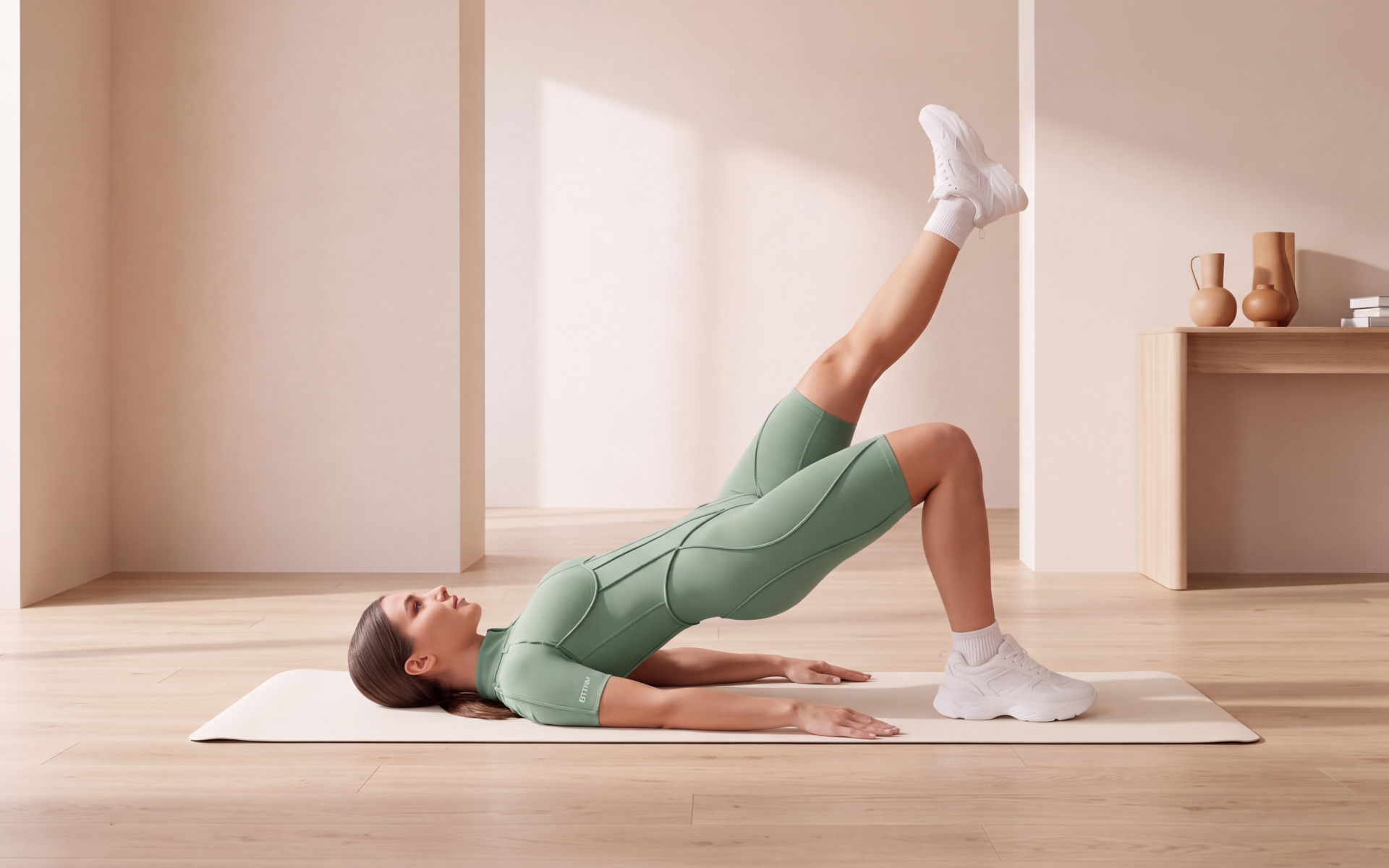
A Pilates butt routine works the glutes and hips with controlled, low-impact movements such as bridges, side-lying leg lifts, and clamshells. This guide explains the exercises and provides a sample home session. Start with movements you can control and adjust the workload to your experience.
You can use body weight or add resistance once the movements feel manageable. If you are comparing exercise options, our guide to walking and glute training explains how walking fits into lower-body activity.
Key takeaways
- The sample Pilates butt routine uses bridges, clamshells, leg lifts, donkey kicks, and fire hydrants.
- Begin with one main round and adjust the repetitions to your movement control.
- The sample schedule starts with 2 sessions on nonconsecutive days each week.
- General exercise guidance recommends 5 to 10 minutes for both warming up and cooling down (1).
- Increase resistance gradually when the current repetition target becomes manageable (2).
- Muscle-activation measurements do not establish long-term glute growth from Pilates (3).
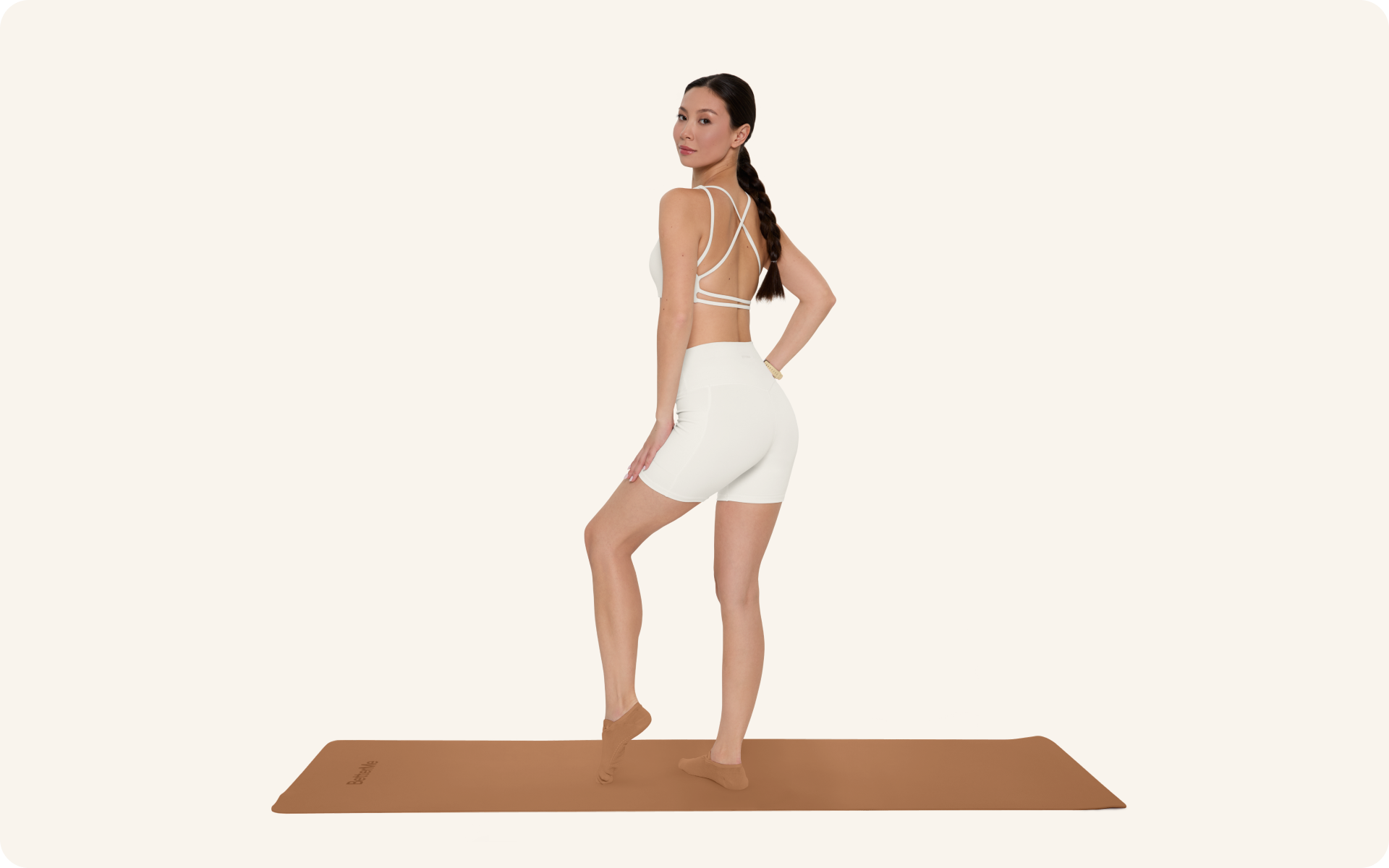
Can Pilates help build stronger glutes?
Pilates can challenge your glutes when a routine includes hip extension, hip abduction, and one-sided work. The gluteus maximus is the large buttock muscle that helps extend the hip (4).
During a bridge, you extend your hips against your body weight. Clamshells and side-lying leg lifts use different hip movements, so they provide variety within a glute-focused session.
A review of 16 studies in healthy people found support for flexibility, dynamic balance, and muscular endurance benefits from Pilates. Study quality was limited, and the findings do not establish glute growth from the routine in this article (5).
Choose the challenge according to your training experience:
- If you are new to these movements, begin with body weight and learn the setup.
- If the repetitions already feel easy, consider a small increase in resistance.
Track movement control and the resistance you use without expecting a particular appearance change.
A review of muscle-activation studies found high gluteus maximus activity during several strength exercises, including step-up and hip-thrust variations. These short-term measurements do not prove muscle growth from Pilates (3).
Results depend on your starting point and training consistency. Individual results vary.
Read more: Static Glute Bridge Abduction: Benefits You Can Expect
How does Pilates work the butt and lower body?
Pilates works the butt and lower body through hip movements such as extension and abduction. The gluteus medius and minimus work together to move the thigh outward and help control the pelvis during movement (6).
Your glutes include three main muscles (4, 6):
- Gluteus maximus: the largest gluteal muscle, which helps extend the hip.
- Gluteus medius: a side-hip muscle that helps with hip abduction and pelvic control.
- Gluteus minimus: a smaller muscle that works with the medius during hip abduction.
Pilates challenges these muscles through four key movements:
- Hip extension: moving your leg behind you, such as in a bridge.
- Hip abduction: moving your leg out to the side, such as in a leg lift.
- External rotation: turning your thigh outward, such as in a clamshell.
- Single-leg stability: holding your pelvis steady while one leg moves.
Use a controlled tempo. For example, take about 2 seconds to lift and 2 seconds to lower a bridge, with a brief pause if comfortable.
Keep the range small enough to avoid shifting the movement into your lower back.
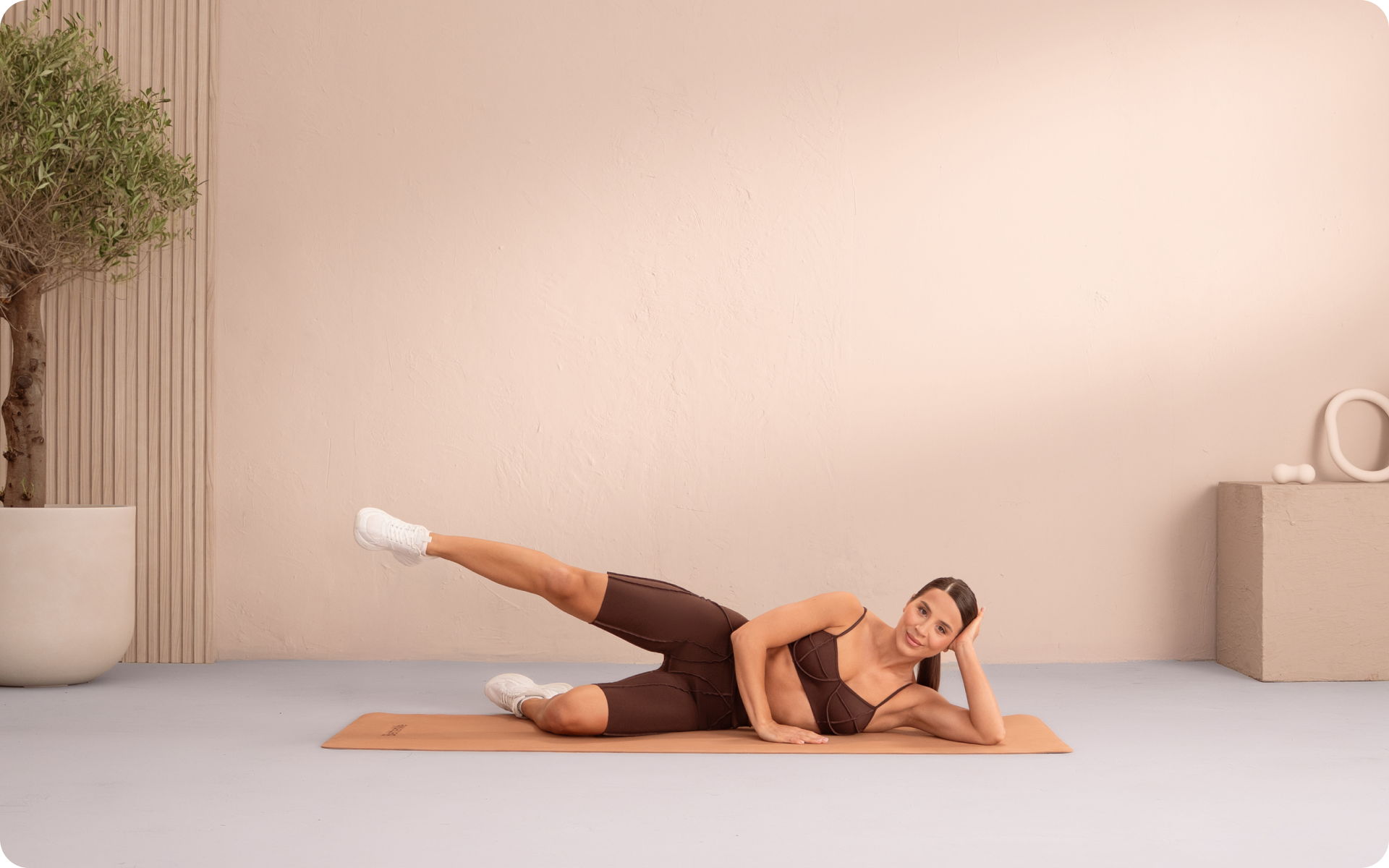
Which Pilates exercises work the glutes?
Bridges, clamshells, and side-lying leg lifts are Pilates moves for glutes that use different hip movements. Choose exercises you can perform with control.
The table gives sample repetition targets for a glute-focused session. These are practical starting points, not research-tested prescriptions for a particular result.
| Exercise | Area emphasized | Typical reps/time | Use it for |
|---|---|---|---|
| Glute bridge | Gluteus maximus | 12-15 reps | Practicing hip extension |
| Single-leg bridge | Gluteus maximus | 8-10 per side | Adding one-sided challenge |
| Clamshell | Gluteus medius | 15-20 per side | Side-glute activation |
| Side-lying leg lift | Gluteus medius | 15 per side | Hip and outer-thigh focus |
| Donkey kick | Gluteus maximus | 15 per side | Hip extension practice |
| Fire hydrant | Gluteus medius | 12-15 per side | Rotation and stability |
A few tips to get more from each move:
- Add a mini band above your knees for extra challenge.
- Pause for 1-2 seconds at the top of each rep.
- Slow your tempo to a 3-second lower.
To progress a Pilates butt workout, gradually increase the challenge as the current workload becomes manageable. General resistance-training guidance supports increasing resistance when you can exceed a repetition target with control (2).
For example, build from 12 to 15 controlled repetitions before trying a light resistance band. Keep the other variables steady while you assess the change.
Pilates includes both mat exercises and work with specialist apparatus (7). If you want to practice Pilates glute exercises on a reformer, ask an instructor to explain the equipment and setup.
Prefer a wall-based approach? A Pilates wall workout chart can help you map out moves that use a wall for support and feedback.
Workouts, weight management tools, and recipe ideas come together in the BetterMe: Health Coaching app, giving you practical support for building a more consistent wellness routine.
How often should you do Pilates for your glutes?
For the sample routine here, start with 2 sessions on nonconsecutive days each week. General resistance-training guidance recommends 2 to 3 weekly sessions for beginners, but this is not a tested dose for Pilates glute growth (2).
Allow more rest when soreness or fatigue affects your movement.
Here are two sample schedules:
- 2 sessions: Monday and Thursday, with rest from hard glute work between them.
- 3 sessions: Monday, Wednesday, and Friday, if you are comfortable with the workload.
On other days, choose rest, walking, or gentle mobility according to how you feel. You do not need extra glute sets on rest days.
Pilates for glutes and hips can fit alongside other everyday movement. Leave time to rest between demanding lower-body sessions.
For a seated movement option, see our chair Pilates workout. Adjust the session to your comfort and experience.
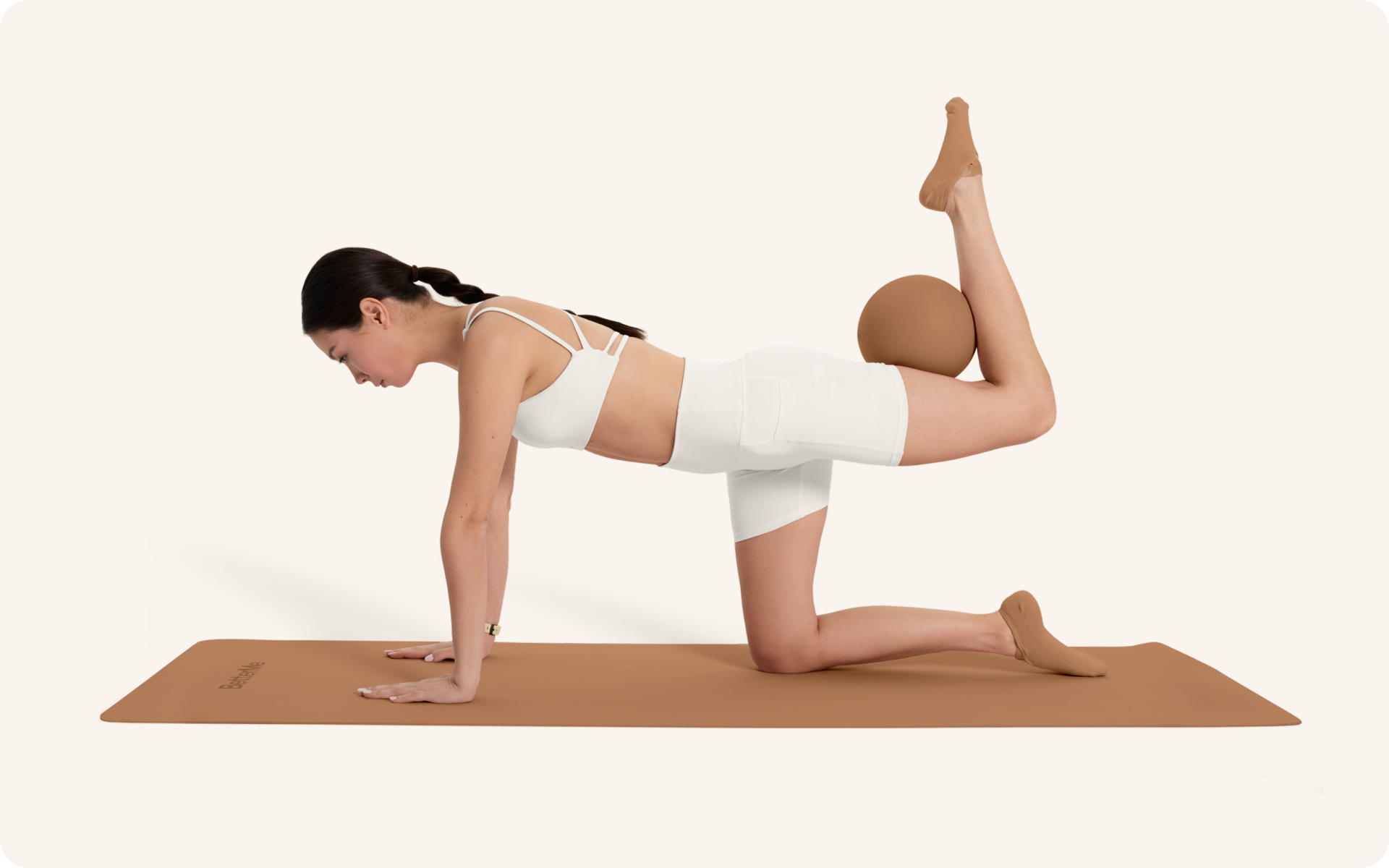
Can you do a Pilates butt workout at home?
Yes, you can do a Pilates butt workout at home with little to no equipment. Bodyweight moves such as bridges and clamshells work well on a simple mat.
A Pilates booty workout can fit into a home session with a mat and room to move.
A few affordable tools can raise the challenge:
- Mini resistance bands: great for clamshells and lateral work.
- Ankle weights: add load to kicks and leg lifts.
- Sliders: increase control during bridges and lunges.
For Pilates resistance band exercises, begin with a light band. Place it above your knees for a bridge only when you can keep the movement controlled.
Wall Pilates for bum and legs is another home-friendly option. You press your feet or back against a wall for support and feedback, which can help with alignment.
Set up a small space with a mat and enough room to lie down and move your legs freely. Good lighting and a non-slip surface help you stay steady.
Home training gives you a way to repeat the movements consistently. Track the repetitions and resistance you use without setting a deadline for visible changes.
Read more: Workout For Lower Butt: Exercises For A Firmer, Perkier Bum
How long should a Pilates butt workout be?
Allow about 25 to 40 minutes for the sample routine below, including a warm-up, one main round, and a cool-down. The actual time depends on your pace and rest breaks.
Adjust the session to the time available:
- For a shorter session, choose fewer main exercises and keep the warm-up and cool-down.
- For the full session, complete one controlled round of all six main movements.
Do not rush to fit more rounds into a time limit. Take longer rests or stop early if your form changes.
Begin with 5 to 10 minutes of easy movement, such as walking, followed by comfortable pelvic tilts and cat-cow. General exercise guidance recommends a gradual warm-up lasting 5 to 10 minutes (1).
Finish with 5 to 10 minutes of easy movement to cool down gradually (1). Keep any stretching comfortable.
Stop or reduce the range when you cannot maintain control. Consistent technique helps you compare sessions.
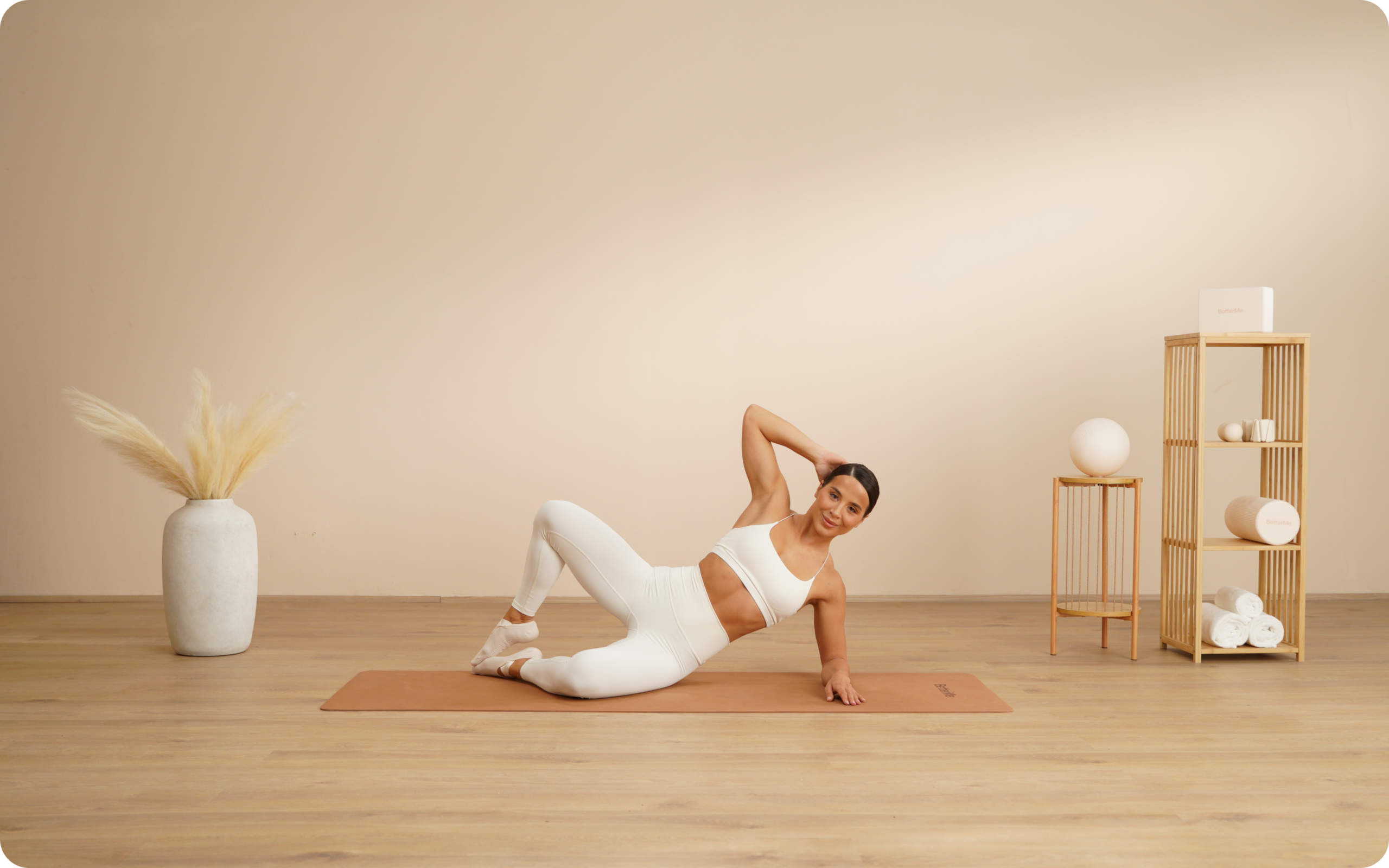
What does a simple Pilates butt routine look like?
This sample Pilates butt routine combines a warm-up, six main exercises, an optional bridge hold, and a cool-down. Allow about 25 to 40 minutes in total. You need a mat and enough floor space to move your legs.
Complete one main round. Rest about 30 to 60 seconds between exercises, or longer if needed. Use a controlled pace, roughly 2 seconds up and 2 seconds down, without forcing the timing.
| Phase | Exercise | Reps/time |
|---|---|---|
| Warm-up | Easy walking, then pelvic tilts | 5-10 minutes total warm-up; 10 pelvic tilts |
| Warm-up | Cat-cow | 6 reps within the warm-up |
| Main set | Glute bridge | 12-15 reps |
| Main set | Single-leg bridge | 8-10 per side |
| Main set | Clamshell | 15-20 per side |
| Main set | Side-lying leg lift | 15 per side |
| Main set | Donkey kick | 15 per side |
| Main set | Fire hydrant | 12-15 per side |
| Optional finisher | Bridge hold | 30-45 seconds |
| Cool-down | Easy walking | 5-10 minutes |
To progress this routine, first complete the repetitions with control. Change one variable at a time: add a light band to one exercise or increase its repetitions.
Pelvic tilts
- Lie on your back with your knees bent and your feet flat.
- Gently flatten your lower back into the mat.
- Tilt your pelvis up slightly.
- Release the tilt.
- Repeat for 10 slow reps.
Cat-cow
- Start on all fours with your hands under your shoulders.
- Round your back.
- Tuck your chin.
- Arch your back gently.
- Lift your gaze.
- Flow between both for 6 reps.
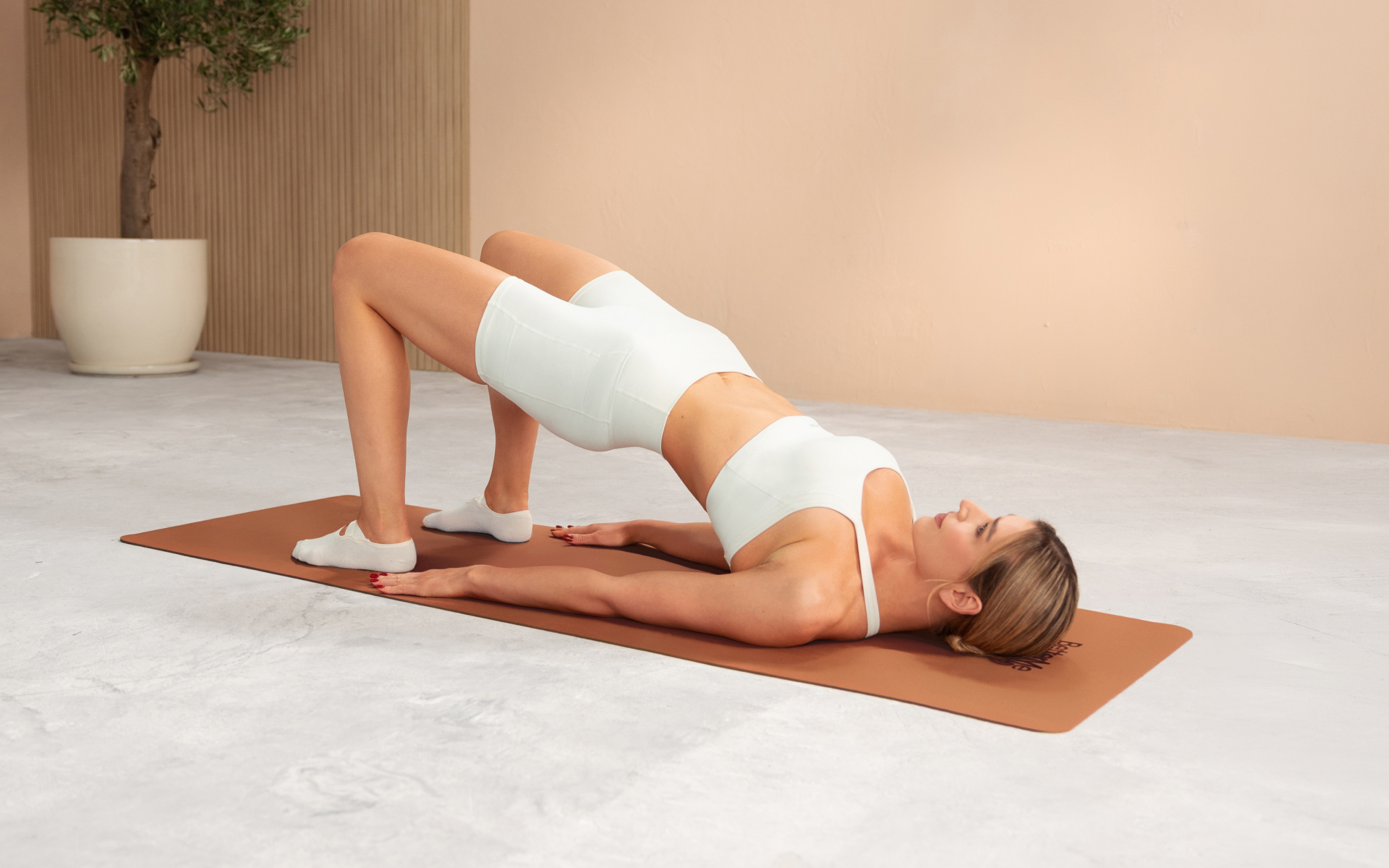
Glute bridge
- Lie on your back with your knees bent and your feet hip-width apart.
- Lift your hips by pressing through your heels.
- Squeeze your glutes at the top for 1-2 seconds.
- Lower your hips slowly.
- Repeat for 12-15 reps.
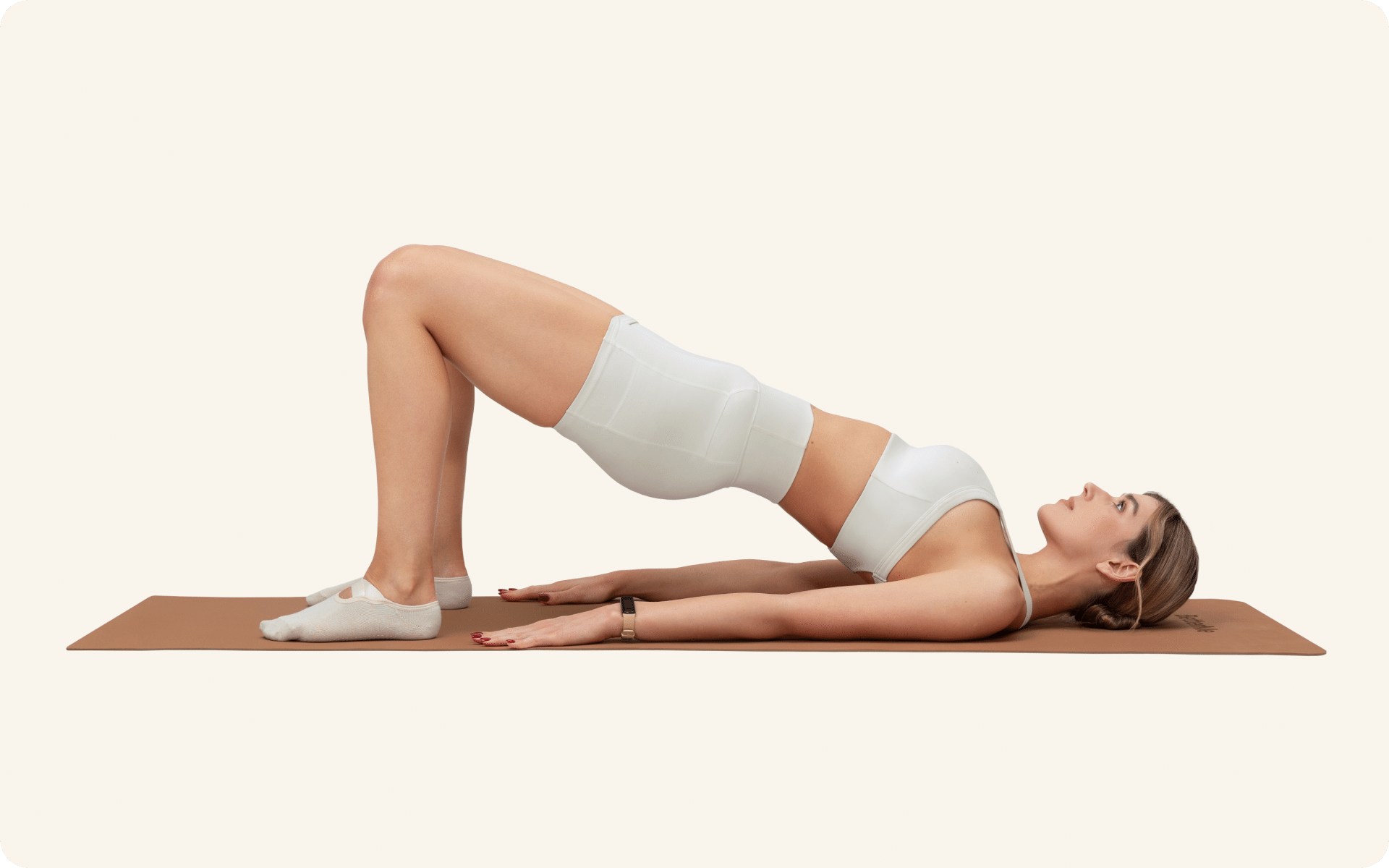
Single-leg bridge
- Lie on your back with your knees bent and feet flat.
- Extend one leg straight.
- Press through the grounded heel and lift your hips.
- Keep your pelvis level as you rise.
- Perform 8-10 reps.
- Switch sides.
Clamshell
- Lie on your side with your knees bent and stacked.
- Keep your feet together throughout.
- Lift your top knee while keeping your hips still.
- Lower with control for 15-20 reps per side.
Side-lying leg lift
- Lie on your side with your legs straight and stacked.
- Lift your top leg slowly toward the ceiling.
- Pause briefly at the top.
- Lower with control for 15 reps per side.
Donkey kick
- Start on all fours with a flat back.
- Press one foot upward with that knee bent.
- Squeeze your glute at the top.
- Lower without touching down for 15 reps per side.
Fire hydrant
- Start on all fours with your hands under your shoulders.
- Lift one bent knee out to the side.
- Keep your torso steady and level.
- Lower with control for 12-15 reps per side.
Bridge hold
- Lie on your back with your knees bent and your feet flat.
- Lift your hips into a bridge.
- Hold the bridge with your glutes engaged.
- Breathe evenly for 30-45 seconds.
Whether you want to refresh your fitness routine, explore lower-calorie recipe ideas, or bring more structure to your wellness habits, BetterMe: Health Coaching app offers tools that can support your next step. Explore the app and find an approach that works for your lifestyle.
FAQs
Can exercise change how your glutes look?
Resistance training can build muscle, but this routine cannot promise a particular shape or appearance. Track controlled repetitions and resistance as practical measures of progress.
Does Pilates make your glutes look more toned?
“Toned” describes appearance, rather than a single training outcome. Research on Pilates supports some fitness benefits, but it cannot predict a particular look for your glutes (5).
Can you do Pilates for your glutes every day?
Keep demanding glute sessions on nonconsecutive days in this sample. On the days between them, choose rest or comfortable light activity according to how you feel.
How do you choose a Pilates exercise for your glutes?
Choose an exercise whose setup and range you can control. A two-leg bridge is one starting option; try a single-leg version only when you can keep your pelvis steady.
Can you build glute strength with Pilates at home?
Home practice lets you adjust repetitions and resistance as movements become manageable (2). If your goal is a bigger bum or a “butt lift workout,” avoid treating those labels as promises of a particular appearance.
The bottom line
A Pilates butt routine gives you a low-impact way to practice glute and hip movements at home. Begin with one controlled round, leave rest days between demanding sessions, and increase the challenge gradually. Use your training log to guide changes without expecting a fixed appearance timeline.
DISCLAIMER:
This article is intended for general informational purposes only and does not serve to address individual circumstances. It is not a substitute for professional advice or help and should not be relied on for making any kind of decision-making. Any action taken as a direct or indirect result of the information in this article is entirely at your own risk and is your sole responsibility.
BetterMe, its content staff, and its medical advisors accept no responsibility for inaccuracies, errors, misstatements, inconsistencies, or omissions and specifically disclaim any liability, loss or risk, personal, professional or otherwise, which may be incurred as a consequence, directly or indirectly, of the use and/or application of any content.
You should always seek the advice of your physician or other qualified health provider with any questions you may have regarding a medical condition or your specific situation. Never disregard professional medical advice or delay seeking it because of BetterMe content. If you suspect or think you may have a medical emergency, call your doctor.
SOURCES:
- Warm Up, Cool Down (2024, heart.org)
- American College of Sports Medicine position stand. Progression models in resistance training for healthy adults (2002, pubmed.ncbi.nlm.nih.gov)
- Gluteus Maximus Activation during Common Strength and Hypertrophy Exercises: A Systematic Review (2020, pmc.ncbi.nlm.nih.gov)
- Anatomy, Bony Pelvis and Lower Limb, Gluteus Maximus Muscle (2023, ncbi.nlm.nih.gov)
- A systematic review of the effects of pilates method of exercise in healthy people (2011, pubmed.ncbi.nlm.nih.gov)
- Anatomy, Bony Pelvis and Lower Limb, Gluteus Medius Muscle (2023, ncbi.nlm.nih.gov)
- About Pilates (n.d., pilatesfoundation.com)
 By
 Reviewed by
 Reviewed by