A Pilates wall workout chart lists wall moves with reps, holds, and rest. This chart groups 15 beginner-friendly moves by body area: core, glutes and legs, and upper body. Use it 2 to 4 times a week and progress through 3 levels. For setup tips, see our how to do wall Pilates guide.
Following exercise and diet plans is the key in your fitness journey and greatly impacts results. In 4 weeks users can typically expect to lose not more than 1-2 lbs per week. Individual results may vary.
Key takeaways
A simple chart helps you train regularly and progress step by step.
- In a 12-week trial, twice-weekly Pilates improved abdominal endurance and hamstring flexibility (1).
- One review of 11 Pilates trials in adults with higher body weight found modest decreases in weight and body fat (2).
- In resistance training trials, training a muscle group at least twice a week gave more growth than once a week (3).
- Adults are advised to do muscle-strengthening activities on 2 or more days a week (4).
- Resistance-training guidance recommends increasing difficulty gradually as you adapt (5).
- The chart below uses 3 levels so you can move up as moves get easier.
- Each session takes 15 to 30 minutes.
What is a Pilates wall workout chart?
A Pilates wall workout chart is a table of wall-based Pilates moves with reps, holds, or time. The chart lets you follow a session without stopping to plan.
Charts can help beginners because they show exactly what to do and how to progress.
Who is this chart for?
This chart can suit beginners and people returning to exercise who want a simple home routine. Level 1 needs no prior Pilates experience. Fitter readers can start at level 2.
What does the Pilates wall workout chart include?
The chart below lists 15 moves grouped by body area. Each row shows the level 1 dose.
Core moves
The five core moves below keep your back supported by the floor or the wall.
| Move | How to do it | Level 1 dose |
|---|---|---|
| Wall dead bug | Feet on the wall, knees at 90 degrees, reach one arm back | 8 per side |
| Wall toe taps | Feet on the wall, tap one foot to the floor | 10 per side |
| Wall crunch | Feet on the wall, lift shoulders slightly | 10 reps |
| Wall roll-down | Back on the wall, roll down slowly | 5 reps |
| Wall plank | Hands on the wall, body straight | 20 seconds |
Glute and leg moves
The five glute and leg moves below use the wall for support or balance.
| Move | How to do it | Level 1 dose |
|---|---|---|
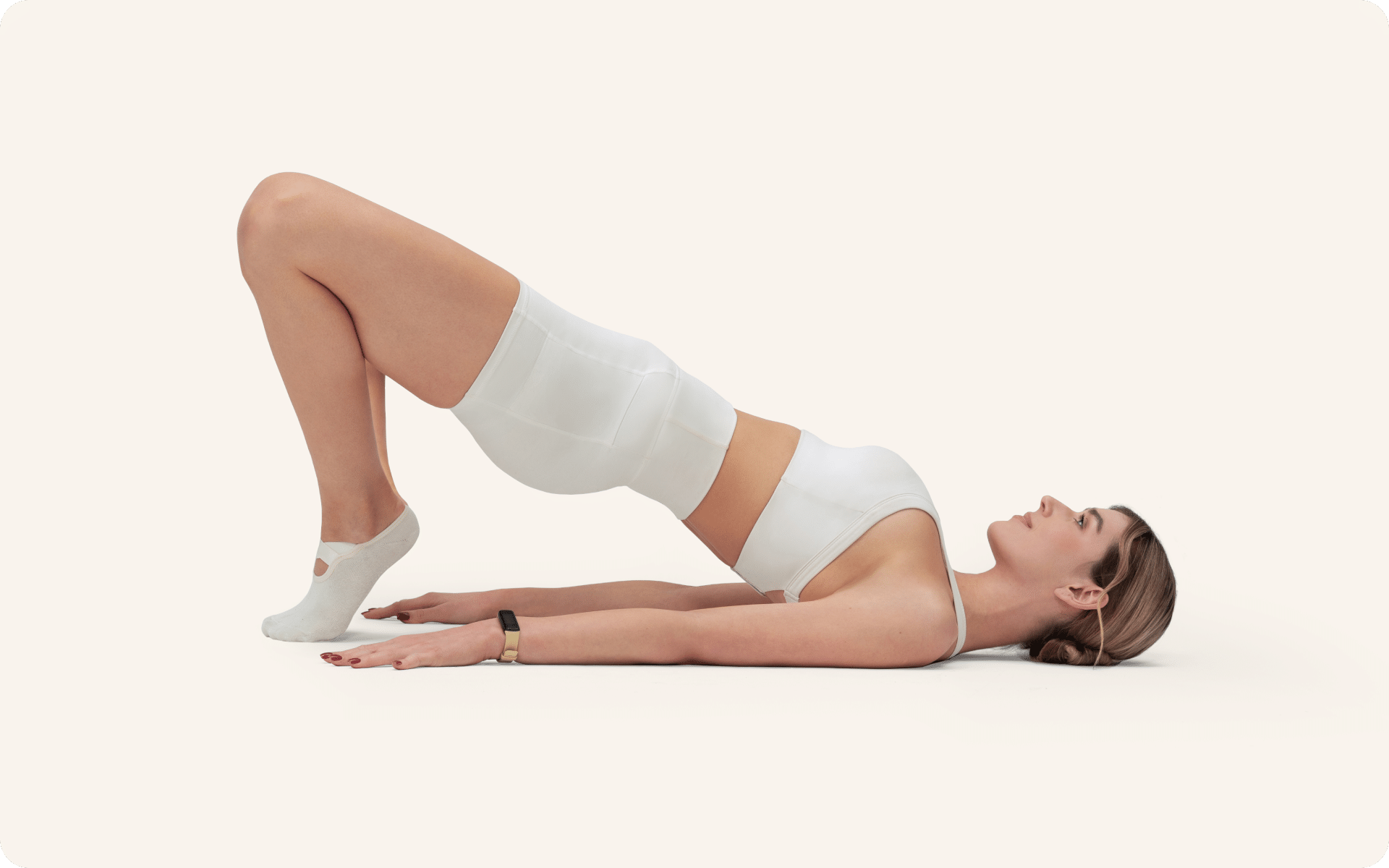
| Wall glute bridge | Feet on the wall, lift hips | 12 reps |
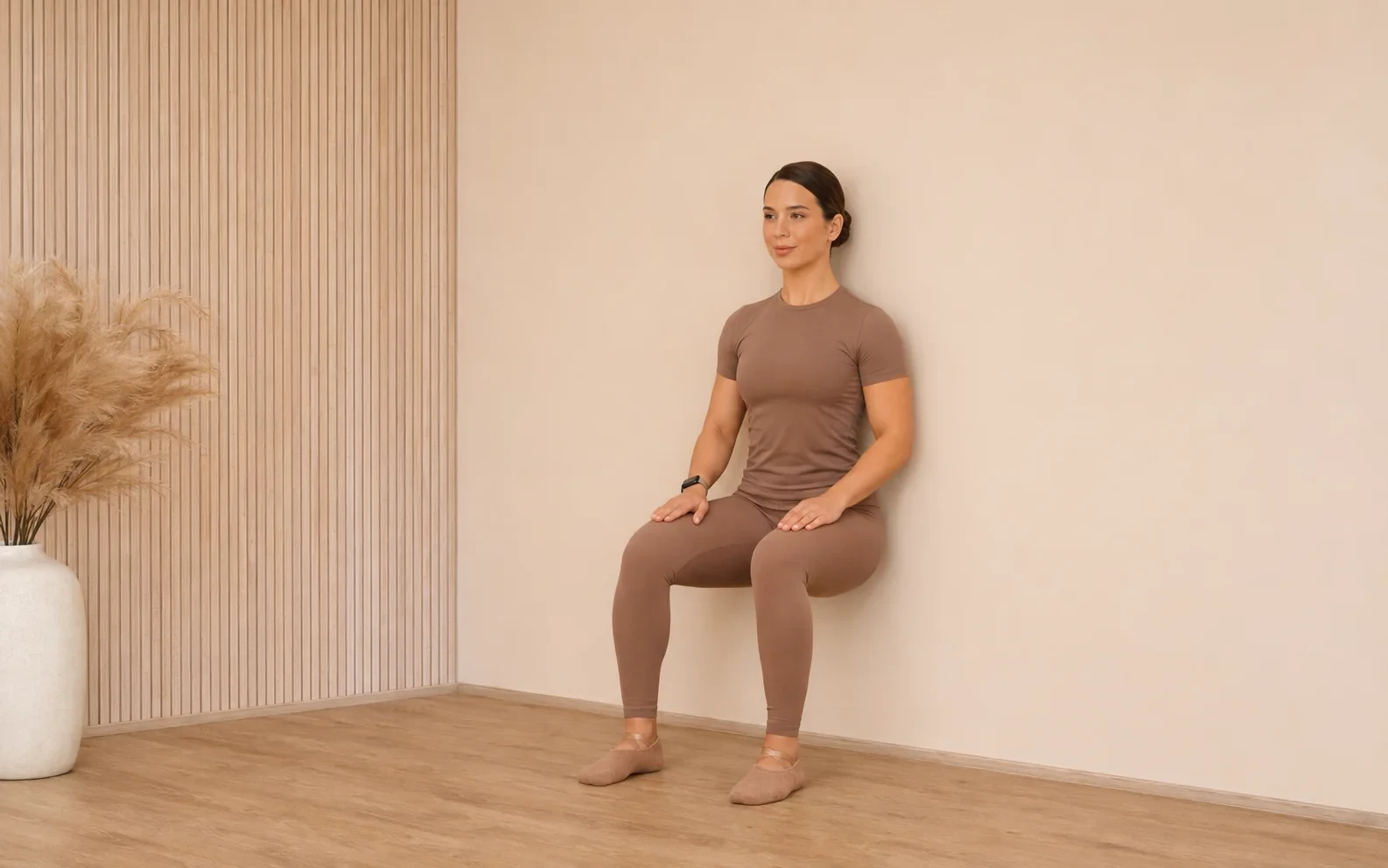
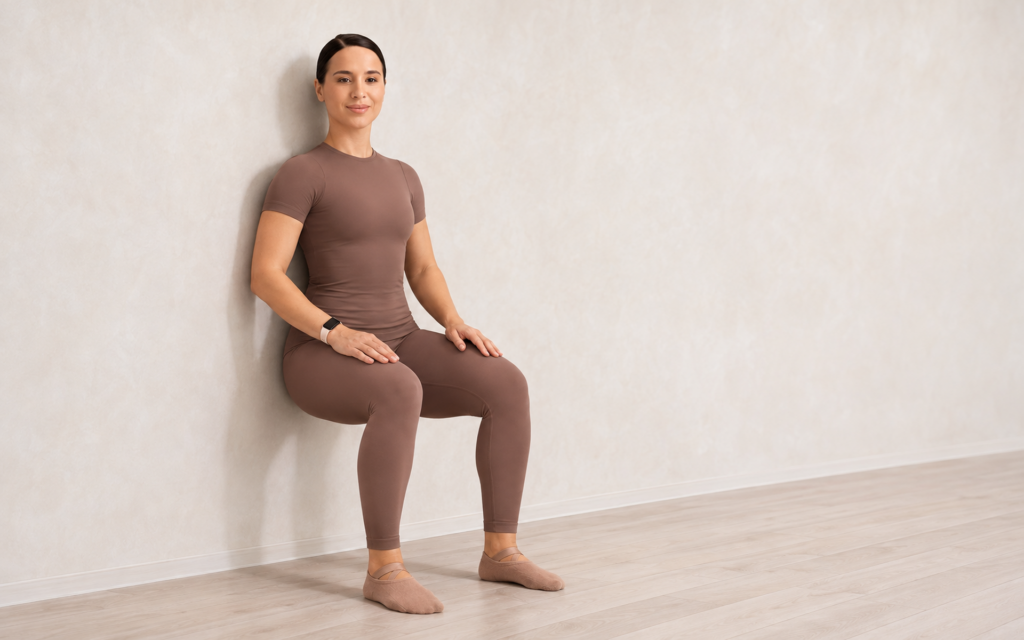
| Wall sit | Back on the wall, knees bent | 20 seconds |
| Side-lying wall leg lift | Back near the wall, lift top leg | 10 per side |
| Wall calf raise | Hands on the wall, rise onto toes | 15 reps |
| Wall split squat | Hand on the wall for balance, lower back knee | 8 per side |
Upper-body moves
The five upper-body moves below use the wall in place of the floor.
| Move | How to do it | Level 1 dose |
|---|---|---|
| Wall push-up | Hands on the wall, lower chest | 10 reps |
| Wall angels | Back on the wall, slide arms up and down | 10 reps |
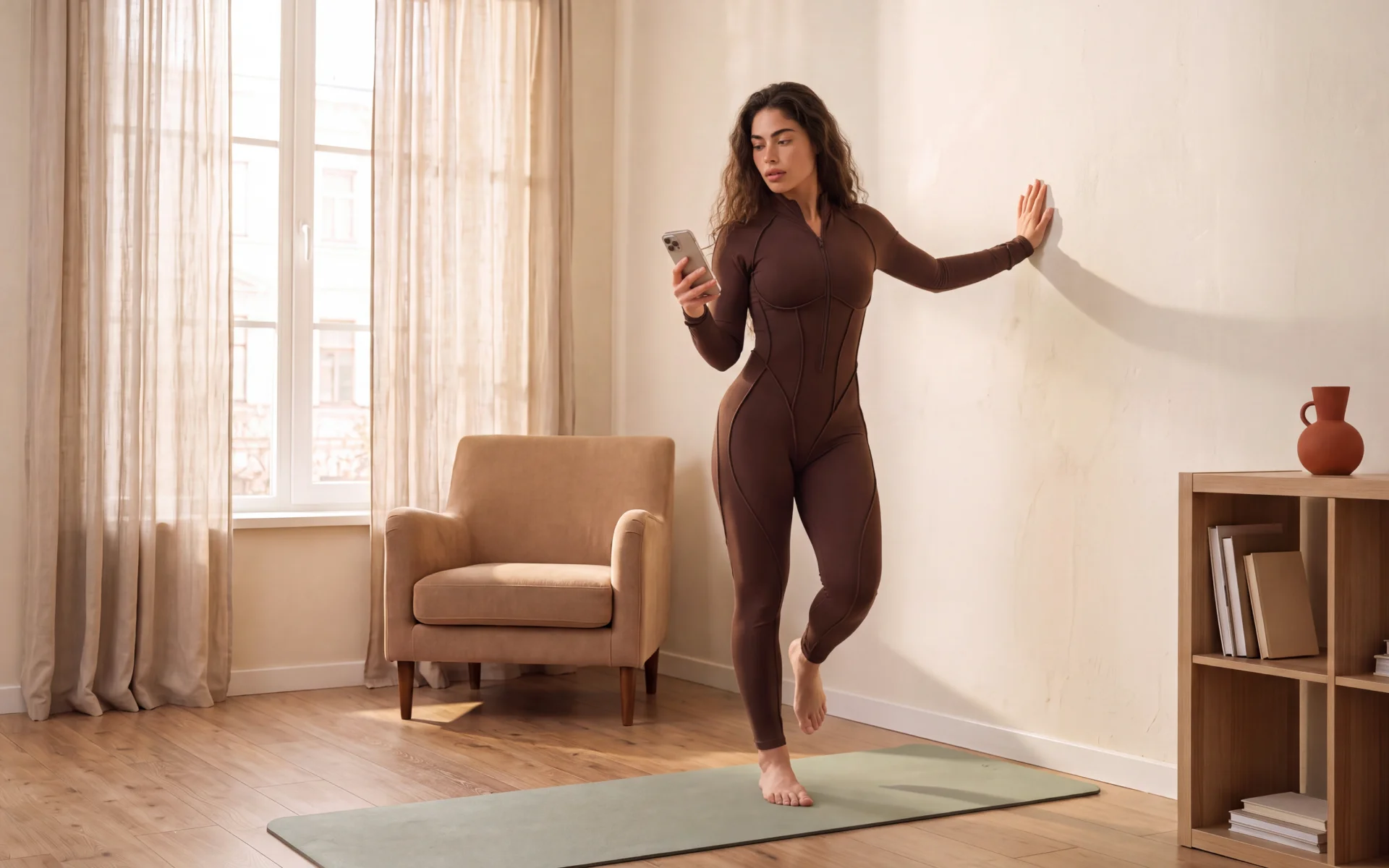
| Standing wall press | Face the wall, place both palms against it and press gently while keeping your body steady | 10-second hold |
| Wall shoulder taps | Wall plank, tap opposite shoulder | 8 per side |
| Wall arm circles | Stand by the wall, small circles | 30 seconds each way |
How do you read and use the chart?
Pick 2 moves from each body area for a 6-move session. Do 2 rounds, resting 30 to 60 seconds between moves.
- Warm up for 3 to 5 minutes.
- Choose 2 core, 2 leg, and 2 upper-body moves.
- Do each move at your current level.
- Complete 2 rounds.
- Cool down for 3 minutes.
Rotate the moves you choose each session to cover all 15 over a week.
Read more: How to choose a Wall Pilates workout app: a beginner’s guide
What do sample sessions from the chart look like?
The 3 sample sessions below each use 6 moves. Rotate them through the week.
Session A
Session A pairs steady holds with basic strength moves.
| Area | Moves |
|---|---|
| Core | Wall dead bug, wall plank |
| Legs | Wall glute bridge, wall sit |
| Upper body | Wall push-up, wall angels |
Session B
Session B uses smaller, lighter moves for an easier day.
| Area | Moves |
|---|---|
| Core | Wall toe taps, wall crunch |
| Legs | Side-lying wall leg lift, wall calf raise |
| Upper body | Standing wall press, wall arm circles |
Session C
Session C adds single-leg and shoulder-tap work.
| Area | Moves |
|---|---|
| Core | Wall roll-down, wall plank |
| Legs | Wall split squat, wall glute bridge |
| Upper body | Wall shoulder taps, wall push-up |
What are the 3 levels?
Use the listed repetitions and holds as starting examples. Move up only when you can keep your form and recover between sessions.
| Level | Reps | Holds | Rounds |
|---|---|---|---|
| 1 | 8 to 12 | 20 seconds | 2 |
| 2 | 12 to 15 | 30 seconds | 2 to 3 |
| 3 | 15 to 20 or a harder version | 45 seconds | 3 |
Adjust one variable at a time as your strength changes (5). The levels give general ranges. Follow each move’s listed starting dose.
What does a 28-day wall Pilates schedule look like?
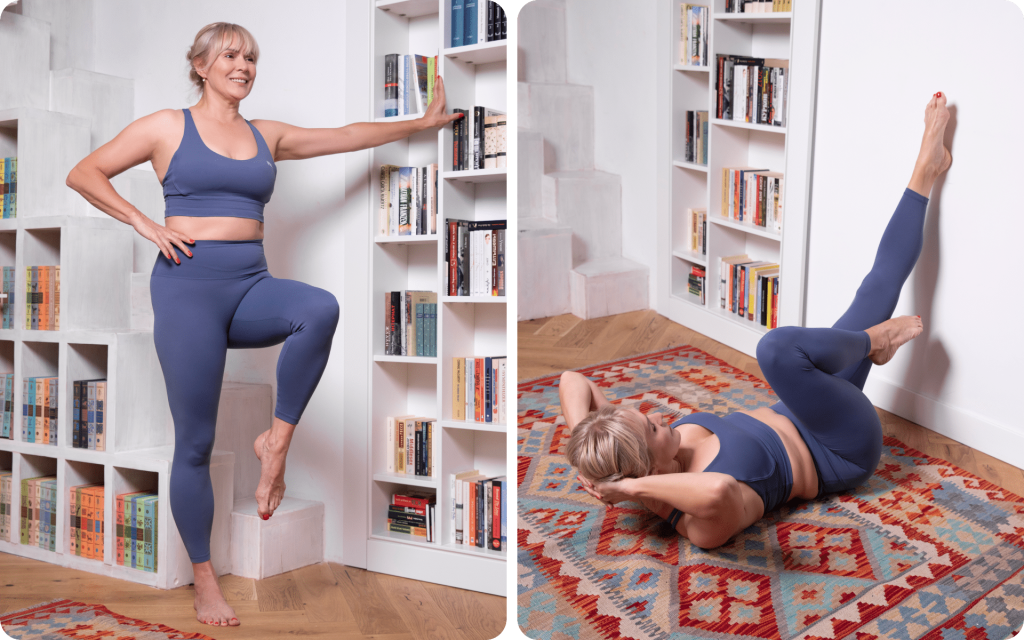
This sample schedule allows 2 to 4 sessions a week. Stay at the current level for another week whenever you need more practice or rest.
| Week | Sessions | Level | Focus |
|---|---|---|---|
| 1 | 3 | 1 | Learn all 15 moves |
| 2 | 3 | 1 to 2 | Add a third round to 1 session |
| 3 | 4 | 2 | Longer holds |
| 4 | 4 | 2 to 3 | Try harder versions such as single-leg bridges |
A mat Pilates trial used two 60-minute sessions weekly for 12 weeks and found improved abdominal endurance and hamstring flexibility (1). In resistance-training trials with comparable weekly volume, twice-weekly training produced more muscle growth than once weekly (3). Our wall Pilates 21-day challenge guide has a shorter sample plan. For more ideas, see our guides on Wall Pilates workout app and home Pilates workout guide.
BetterMe offers a variety of workouts, recipes, challenges, and support tools to help you stay more consistent with your wellness routine. Explore the app to find features that fit your goals, preferences, and schedule.
What are the benefits of using a Pilates wall chart?
A chart makes your sessions simple and consistent.
Clear structure
You know exactly which moves, reps, and holds to do.
Steady progress
Levels show you when to make moves harder (5).
Balanced training
Grouping by body area helps you train your core, legs, and upper body each week.
Core endurance and flexibility
Pilates improved abdominal endurance and hamstring flexibility in a 12-week trial (1).
Low impact
Wall support and slow moves suit many beginners.
Which moves suit your goal?
Choose moves from the chart based on what you want most.
| Goal | Moves to include |
|---|---|
| Core control | Wall dead bug, wall toe taps, wall plank |
| Glute and leg strength | Wall glute bridge, wall sit, wall split squat |
| Upper-body strength | Wall push-up, standing wall press, wall shoulder taps |
| Posture and mobility | Wall angels, wall roll-down, wall arm circles |
Read more: Home Pilates workout guide: a beginner routine with no equipment
How long does a session from the chart take?
A six-move session takes about 15 to 30 minutes, including the warm-up and cool-down. Two rounds at level 1 sit at the short end of that range. Three rounds at level 3 take longer because holds and rests add up. Time one full session in week 1 to plan your schedule.
How do you breathe during wall Pilates?
Breathe out as you lift, press, or brace, and breathe in as you return. Keep your breath slow and steady, and avoid holding it during holds.
How do you warm up before the chart?
Warm up for 3 to 5 minutes.
- March in place for 1 minute.
- Do 10 shoulder rolls and 10 arm circles.
- Do 8 cat-cow stretches.
- Do 10 pelvic tilts lying on your back.
- Take 5 deep breaths.
How do you cool down after the chart?
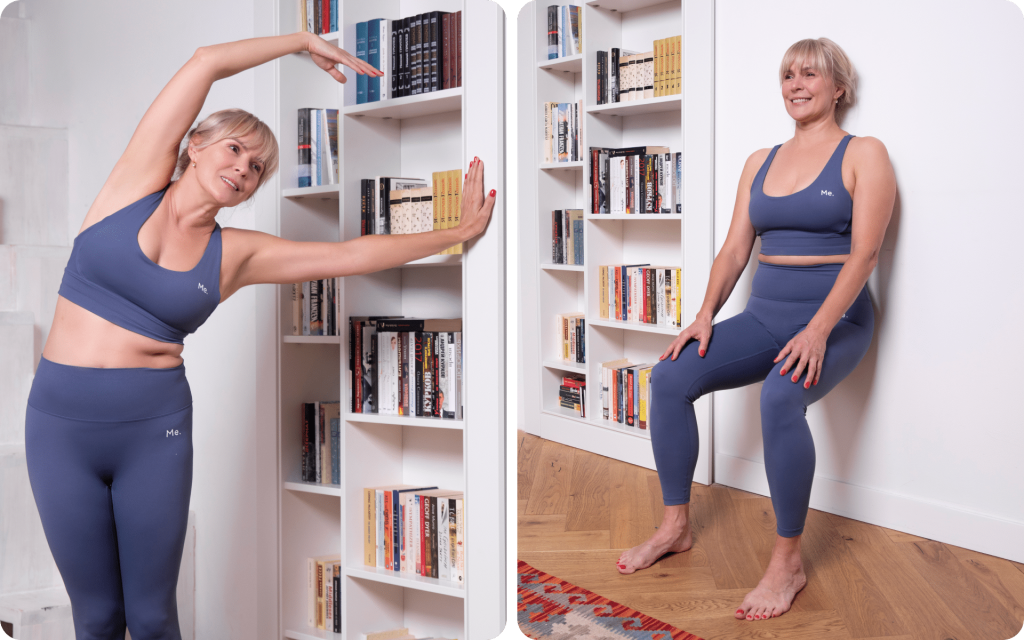
Cool down for 3 minutes.
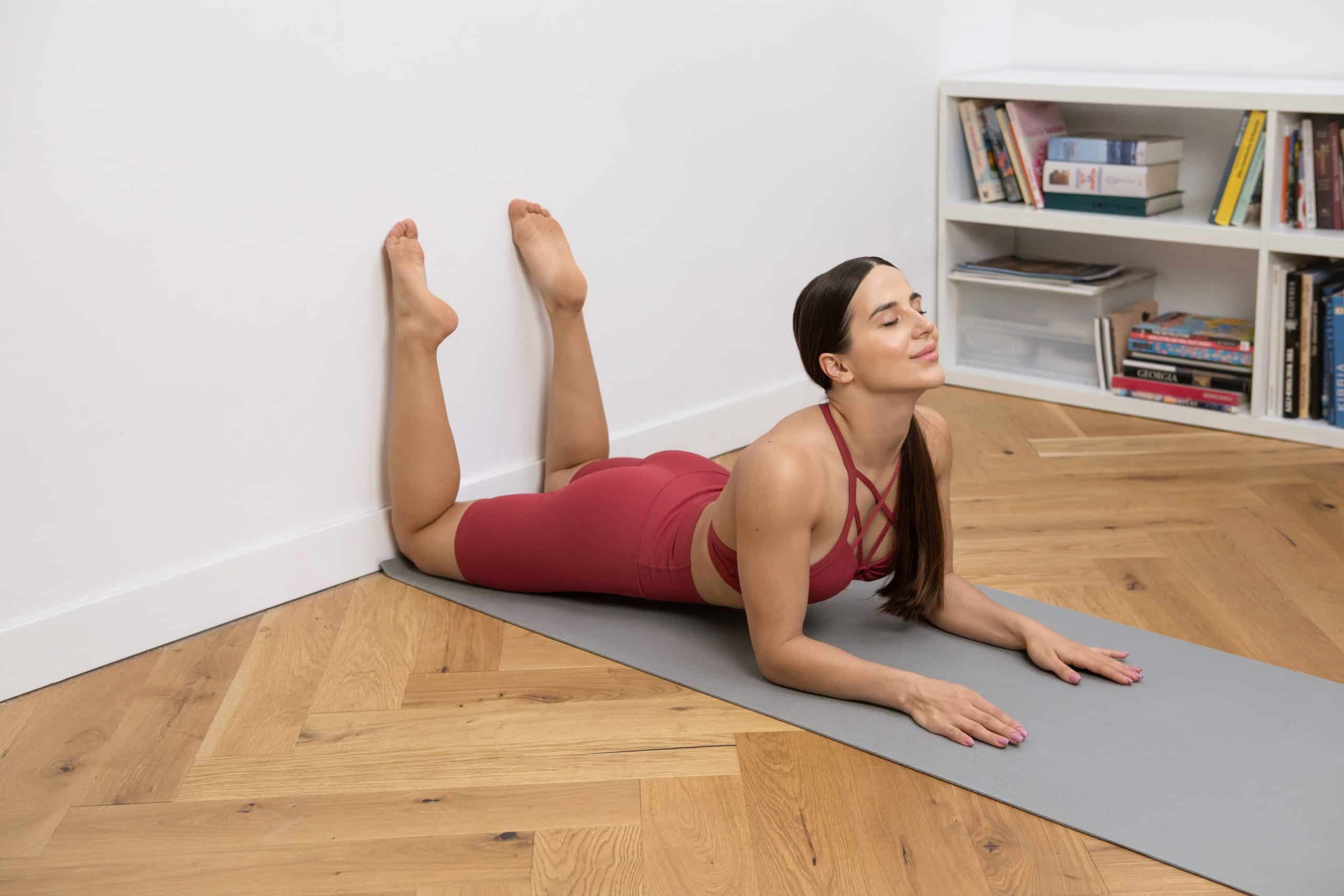
- Lie with your legs up the wall for 1 minute.
- Hug your knees to your chest for 20 seconds.
- Rest in child’s pose for 30 seconds.
- Take 5 slow breaths.
How do you progress each move?
Use these swaps when a move feels easy.
| Move | Harder version |
|---|---|
| Wall glute bridge | Single-leg wall bridge |
| Wall sit | Lower sit or 1 heel lifted |
| Wall push-up | Feet farther from the wall |
| Wall plank | Hands lower on the wall |
| Wall dead bug | Straighten the moving leg |
| Wall split squat | Slower lowering over 3 seconds |

How do you track progress with the chart?
Write down your level, reps, and holds after each session. Check every week whether you can move up a level.
- Note which moves feel easy and which feel hard.
- Time your wall sit and wall plank holds.
- Count your single-leg bridge reps once you reach level 3.
- Retest all 15 moves at the end of each 4-week block.
Can a Pilates wall chart help with weight loss?
A wall chart alone is not a weight-loss plan. One review pooled Pilates trials in adults with higher body weight. The trials showed modest average decreases in weight and body fat (2). The review did not test this wall chart, and results differ between people.
Which mistakes should you avoid?
Avoid rushing through the chart and skipping levels.
- Moving too fast to finish sooner
- Jumping to level 3 in week 1
- Arching your lower back in bridges and planks
- Doing only core moves
- Skipping the warm-up
Who should be careful with wall Pilates?
Some people should get advice before starting.
- People with back, neck, or shoulder concerns
- People who have been advised to avoid legs-up positions
- Pregnant people or those who recently gave birth
- People returning to exercise after surgery or a recent strain
Frequently Asked Questions
Can you print the chart?
Yes, the tables are easy to print or save on your phone.
How often should you use the chart?
Two to four sessions is one sample schedule. General public guidance recommends strengthening all major muscle groups at least twice weekly (4).
Do you need equipment?
You need a mat and a clear wall. Grippy socks help.
Can men use this chart?
Men can use the same chart. Choose a level that fits your current strength and movement restrictions.
Can you do the chart in the morning?
Yes, any time of day works. Warm up a little longer if you feel stiff after sleep.
What if a move feels uncomfortable?
Stop that move and choose another from the same group. Ask a health professional if discomfort continues. Our wall Pilates moves guide has more options.
The bottom line
Select two moves from each group and record the repetitions or hold times you complete. Repeat the same level until the movements feel controlled and you feel rested between sessions.
DISCLAIMER:
This article is intended for general informational purposes only and does not serve to address individual circumstances. It is not a substitute for professional advice or help and should not be relied on for making any kind of decision-making. Any action taken as a direct or indirect result of the information in this article is entirely at your own risk and is your sole responsibility.
BetterMe, its content staff, and its medical advisors accept no responsibility for inaccuracies, errors, misstatements, inconsistencies, or omissions and specifically disclaim any liability, loss or risk, personal, professional or otherwise, which may be incurred as a consequence, directly or indirectly, of the use and/or application of any content.
You should always seek the advice of your physician or other qualified health provider with any questions you may have regarding a medical condition or your specific situation. Never disregard professional medical advice or delay seeking it because of BetterMe content. If you suspect or think you may have a medical emergency, call your doctor.
Some visuals may be AI-generated.
SOURCES:
- Pilates for improvement of muscle endurance, flexibility, balance, and posture (2010, doi.org)
- Pilates for overweight or obesity: a meta-analysis (2021, doi.org)
- Effects of resistance training frequency on measures of muscle hypertrophy: a systematic review and meta-analysis (2016, doi.org)
- Physical activity factsheet (2021, who.int)
- American College of Sports Medicine position stand: progression models in resistance training for healthy adults (2009, doi.org)
 Reviewed by
 Reviewed by