Partner workout challenges let two people share a session while choosing their own exercise versions and pace. Try alternating sets, coordinated squats, or simple movement games with planned breaks. Our workout planning guide can help you fit these sessions around your other activity and recovery.
Key takeaways
Use these points to choose a shared exercise and a separate workload for each partner.
- Partners can share a session without matching loads, repetitions, or exercise difficulty.
- Push-ups require a controlled torso position while the arms move (1).
- Bridges and supported core exercises offer alternatives to repeated sit-ups (2).
- Resistance training can use bodyweight or equipment; a gym is not essential for strength training (3).
- Adult activity guidance includes aerobic movement and strengthening all major muscle groups (4).
- One partner can rest while the other completes a set.
What makes a partner workout practical?
A practical partner workout gives both people a clear role, an appropriate movement, and permission to rest. Agree on those details before starting.
One person might count repetitions while the other exercises. You can also move together at separate stations.
Choose a shared goal such as practicing the session or arriving at the agreed time. Avoid making exhaustion the measure of success.
Different fitness levels are expected. Someone can use a wall push-up while their partner uses a floor version.
You do not need to use each other’s bodyweight or provide resistance by pulling on one another. Independent support is easier to control.
If one person dislikes competition, choose a cooperative format. A workout partner should respect that preference throughout the session.
What should you prepare before starting?
Prepare a clear space, stable equipment, and exercise alternatives that both people understand. Walk through the session before starting a timer.
The sample challenges use bodyweight, a mat if wanted, and an optional lightweight ball. A soft unweighted ball can replace a medicine ball.
Keep the floor free of loose bands, bags, and cables. Leave enough space for both people to step or lie down.
Use fixed supports for elevated push-ups or balance assistance. Lightweight chairs can slide when someone leans against them.
Bring drinking water and take breaks as needed. Fluid needs vary with activity, weather, and individual circumstances (5).
If either person has an injury, health condition, or movement restriction, choose activities consistent with their professional advice.
Agree on a simple stop signal. Either person can finish a set without explaining or asking permission.
Which five partner workout challenges can you try?
The five options below emphasize clear roles and controlled movement. Choose a few, rather than treating the entire list as compulsory.
All repetition counts and hold times are sample starting points. Change them according to each person’s ability.
|
Challenge |
Shared task |
Easier option |
|---|---|---|
|
Alternating push-up sets |
Take turns moving and resting |
Wall or raised-surface push-up |
|
Seated ball hand-off |
Pass an object with control |
Use an unweighted soft ball |
|
Coordinated squat |
Start together at a comfortable pace |
Sit-to-stand from separate stable seats |
|
Alternating reverse lunge |
Take turns while the other rests |
Supported split stance |
|
Supported plank reach |
Briefly lift one hand |
Keep knees down or use a raised surface |
Alternating push-up sets
Alternating sets give one person time to rest while the other practices. Each partner chooses a suitable push-up version.
A push-up involves lowering and raising the body while keeping the trunk controlled. Avoid letting the lower back sag (1).
- Choose separate stable surfaces or floor spaces.
- Agree on a manageable repetition count for each person.
- Partner A completes their set.
- Partner B rests or observes without touching.
- Partner B completes their set.
- Rest together before deciding whether to repeat.
For example, one person could do four wall push-ups while the other does six floor push-ups. Matching numbers is unnecessary.
The resting partner does not need to hold a plank. Rest is part of the session.
End the set when the movement becomes difficult to control. Do not add repetitions because the other person is still watching.
Seated ball hand-off
A seated ball hand-off adds a shared coordination task without requiring fast sit-ups or throws. Keep the object light and the distance comfortable.
- Sit facing each other with both feet supported.
- Choose enough space for a comfortable hand-to-hand pass.
- Hold a lightweight ball or soft object near your torso.
- Pass it gently into your partner’s hands.
- Wait until your partner has a secure grip.
- Receive the object in the same controlled way.
A sample round could use six exchanges. Stop sooner if your back, shoulders, or wrists become uncomfortable.
Keep your torso within a comfortable range. Avoid leaning far backward to make the movement harder.
If floor sitting is difficult, use separate stable chairs. Keep both chairs still and avoid reaching beyond your balance.
For a separate strength task, each partner can practice bridges during their own turn. General core guidance describes the supported bridge position (2).
Coordinated bodyweight squats
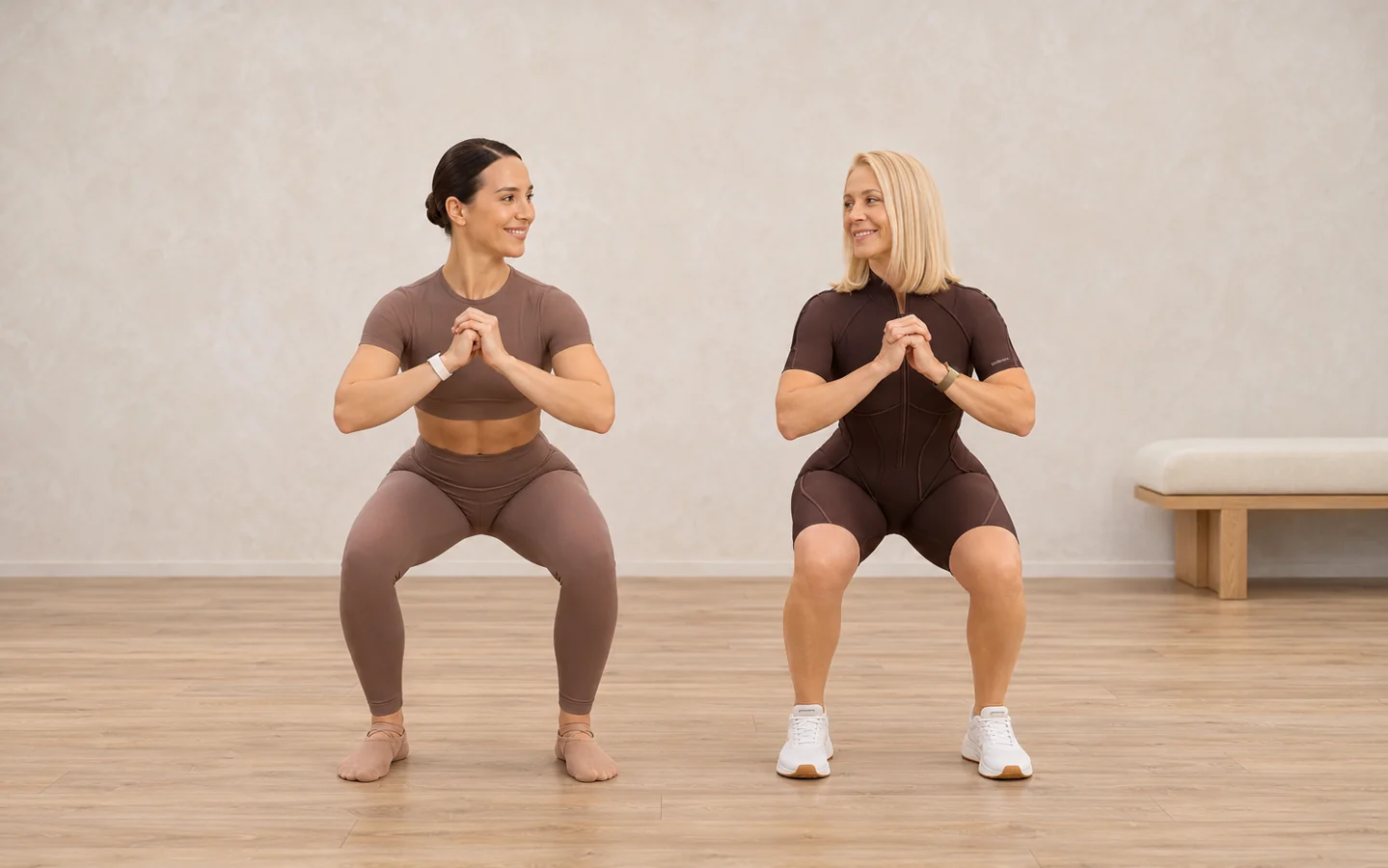
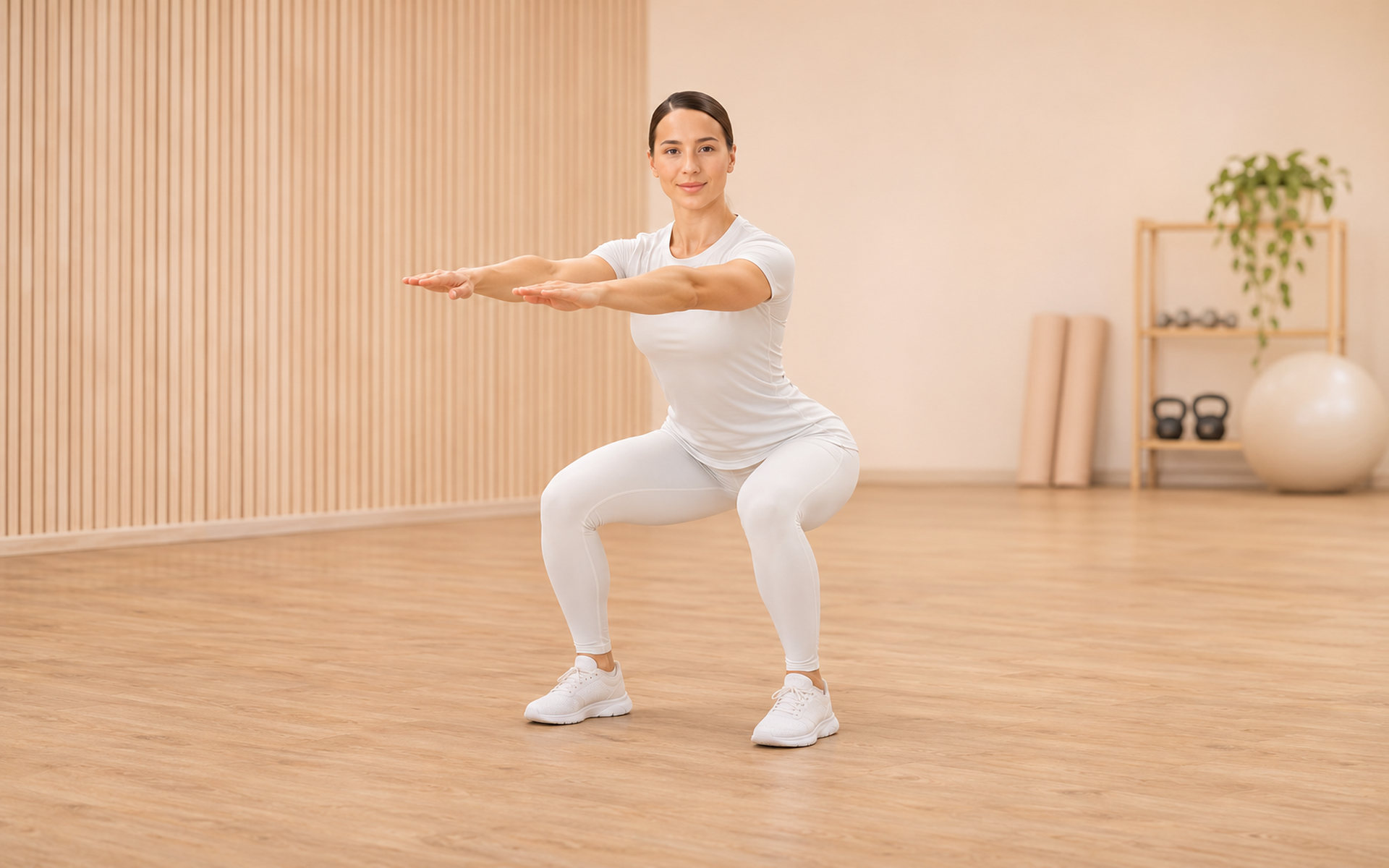
Coordinated squats let partners share a rhythm while choosing different depths. Jumping is optional and unnecessary for this version.
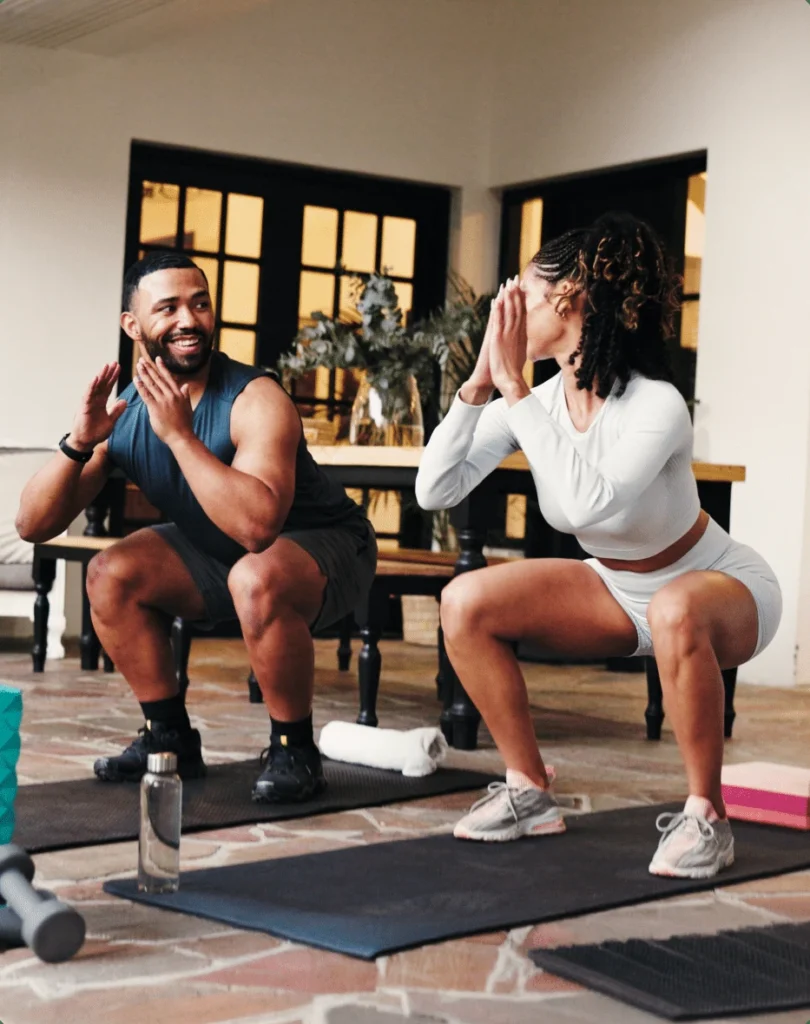
- Stand beside each other with enough room to move.
- Place your feet at a comfortable width.
- Bend your hips and knees into a manageable squat.
- Return to standing with control.
- Pause before the next repetition.
Start with a sample set of five repetitions. Either person can stop or use a shallower range.
Separate stable chairs can provide a sit-to-stand alternative. Choose a chair height that each person can manage.
Avoid pulling on each other’s arms for support. A fixed support is more predictable.
Experienced participants who want jumping should learn and assess that movement separately. Adding jumps changes the landing and fatigue demands.
Alternating reverse lunges
Alternating reverse lunges give each person a turn while the other rests. Both partners use their own space and support.
- Stand near a fixed support if needed.
- Step one foot backward.
- Bend both knees through a comfortable range.
- Return to standing.
- Repeat on the other side.
- Let your partner take their turn.
A sample set could include three repetitions per side. Reduce the range or use a stationary split stance when balance is difficult.
Keep the front foot planted and avoid rushing the return. A smaller step may be easier to control.
Do not pull against a band held by your partner during the lunge. Unexpected changes in tension add another task.
If lunges remain uncomfortable, use the coordinated sit-to-stand option instead. Repeating an appropriate movement is acceptable.
Supported plank reach
A supported plank reach briefly removes one hand while the trunk stays controlled. It can be more demanding than holding both hands down.
- Choose separate stable supports or a kneeling floor position.
- Place your hands beneath your shoulders.
- Establish a comfortable trunk position.
- Lift one hand slightly.
- Return it before changing sides.
- Rest when your position becomes difficult to maintain.
You can face each other for a light hand touch only when both people remain stable. Reaching farther is unnecessary.
Begin with a sample of two reaches per side. Keep both hands down if lifting one causes twisting.
For another controlled limb movement, use a single-arm reach from hands and knees. The bird-dog progression emphasizes limiting unwanted trunk movement (6).
Our quadruped exercise guide explains supported versions in more detail.
Looking for a plan to follow? Take the BetterMe quiz for a customized workout plan.
How can you combine the challenges into one session?
Choose a few challenges and leave room for instruction and rest. A shorter session can be easier to repeat than a crowded circuit.
The example below uses three movements from the list. It is a scheduling illustration, not a researched program.
|
Part |
Activity |
Example approach |
|---|---|---|
|
Preparation |
Easy walking and practice movements |
Continue until ready for the exercises |
|
First challenge |
Alternating push-up sets |
One manageable set each |
|
Second challenge |
Coordinated squats |
Five controlled repetitions |
|
Third challenge |
Seated ball hand-off |
Six gentle exchanges |
|
Rest |
Sit or stand comfortably |
Pause between challenges |
|
Optional repeat |
Same sequence |
Only if both want another round |
Avoid turning the rest period into another challenge. Let each person recover enough to move comfortably.
You can replace one movement with a lunge or supported reach. Keep the total amount manageable when making that change.
Afterward, note which movements you enjoyed and which setups felt awkward. Use that information to plan the next meeting.
Our fun workouts guide offers alternatives if a circuit format does not appeal to you.
How do you accommodate different fitness levels?
Give each person a separate exercise version and workload. Sharing the same start time is enough to make the session collaborative.
For example, one person can practice a raised push-up while the other uses the floor. Both can stop before losing control.
A partner who finishes early can rest. They do not need extra repetitions to fill the time.
Ask before offering feedback. A useful observation describes something visible, such as a support sliding or a movement becoming rushed.
Avoid diagnosing movement problems or promising that a correction will prevent injury. A qualified professional can assess persistent difficulties.
If your goals differ substantially, share the warm-up or an easy walk instead. You can complete separate training afterward.
Can partner challenges build strength?
Partner challenges can include strength exercises, but the benefit depends on the actual training. The social format alone does not determine results.
Current resistance-training evidence supports bodyweight, bands, and other forms of resistance for healthy adults. Progression should match the person’s goals (3).
A light coordination game may provide little strength challenge. Treat the seated hand-off as practice and shared movement.
To progress a strength exercise, change one feature after the current version becomes manageable. That might mean repetitions, resistance, or less support.
Both partners can progress at different rates. Avoid increasing difficulty simply to preserve identical versions.
For a broader lower-body session, see our ab and glute workout. Account for overlapping work before adding it.
How often should you do partner workouts?
Choose a frequency that fits your existing training and recovery. The session should add a useful appointment without crowding every day.
Adult guidance includes at least 150 minutes of moderate aerobic activity weekly and muscle strengthening on two days. Smaller amounts still count (4).
These short challenges may cover only part of that activity. They do not automatically train every major muscle group.
A sample arrangement could place one partner session within a broader strength week. You might share a walk on another day.
Avoid repeating hard sessions for sore muscles merely to maintain a streak. Adjust the activity when recovery or normal movement is affected.
Prefer a ready structure for your week? The BetterMe quiz can help you set up a workout routine that fits your schedule.
What mistakes should partners avoid?
Avoid competition that overrides technique, consent, or recovery. The workout should remain manageable for both people.
Before you start, agree to avoid:
- Pulling on a partner to force a deeper position.
- Adding punishment exercises for missed repetitions.
- Ignoring a partner’s request to stop.
Stop for sharp pain, dizziness, or feeling faint. Seek prompt medical attention for chest pain or severe breathing difficulty.
Review the setup before increasing difficulty at the next session. Familiarity with a partner does not replace clear instructions.
Frequently Asked Questions
Can you do these workouts over a video call?
Yes. Choose movements that each person can perform independently in their own clear space. Replace the ball hand-off with a separate comfortable exercise. Do not depend on a remote partner for spotting or equipment checks.
What if one partner cancels?
Use an independent version or reschedule the shared session. Alternating sets can become regular sets with rest between them. A canceled meeting does not require extra exercise later. Keep the remaining weekly plan manageable.
How can I practice the hand-off if floor sitting is uncomfortable?
Face each other on separate stable chairs with both feet supported. Keep the object light and close enough to pass without leaning.
Should you keep score?
Scoring is optional. If both people enjoy it, record attendance or completed practice rather than forcing equal physical performance. Stop scoring if it encourages rushed repetitions or skipped rest. Both partners should agree on the rules.
The bottom line
Choose a few shared movements, agree on rest, and let each person select an appropriate version. Start with controlled practice and predictable equipment. Keep the partnership supportive by respecting different workloads, preferences, and the right to stop.
DISCLAIMER:
This article is intended for general informational purposes only and does not serve to address individual circumstances. It is not a substitute for professional advice or help and should not be relied on for making any kind of decision-making. Any action taken as a direct or indirect result of the information in this article is entirely at your own risk and is your sole responsibility.
BetterMe, its content staff, and its medical advisors accept no responsibility for inaccuracies, errors, misstatements, inconsistencies, or omissions and specifically disclaim any liability, loss or risk, personal, professional or otherwise, which may be incurred as a consequence, directly or indirectly, of the use and/or application of any content.
You should always seek the advice of your physician or other qualified health provider with any questions you may have regarding a medical condition or your specific situation. Never disregard professional medical advice or delay seeking it because of BetterMe content. If you suspect or think you may have a medical emergency, call your doctor.
SOURCES:
- Push-up (n.d., www.acefitness.org)
- How to strengthen your core (2023, www.mayoclinichealthsystem.org)
- American College of Sports Medicine Position Stand. Resistance Training Prescription for Muscle Function, Hypertrophy, and Physical Performance in Healthy Adults: An Overview of Reviews (2026, pubmed.ncbi.nlm.nih.gov)
- Adult Activity: An Overview (2023, www.cdc.gov)
- About Water and Healthier Drinks (2026, www.cdc.gov)
- Bird-dog (n.d., www.acefitness.org)


 Reviewed by
 Reviewed by
 Reviewed by