An ab and glute workout combines trunk-control exercises with movements that train your hips and legs. Choose a few exercises you can perform comfortably, then adjust the load and repetitions. Our easy core exercises guide explains useful starting movements before you build a longer session.
Following exercise and diet plans is the key in your fitness journey and greatly impacts results. In 4 weeks users can typically expect to lose not more than 1-2 lbs per week. Individual results may vary.
Key takeaways
These points summarize the main exercise and planning guidance below.
- A combined session can include a hip movement, a squat or lunge, and controlled trunk work.
- Bridges involve the gluteal muscles and hamstrings alongside trunk control (1).
- Resistance training can improve strength using bodyweight, bands, free weights, or machines (2).
- One small abdominal-exercise trial improved endurance without reducing measured abdominal fat (3).
- General adult guidance includes strengthening all major muscle groups on at least two days weekly (4).
- A stable chair can provide a depth target for a sit-to-stand or squat.
Can you train abs and glutes together?
Yes. You can combine abdominal and glute exercises within the same session, provided the total workload suits your ability and rest needs.
The core includes muscles around your abdomen, back, pelvis, and hips. Bridges and other movements can involve several of these areas together (1).
Training them together does not require every exercise to challenge both areas equally. A session can alternate different tasks.
For example, a squat involves your legs and hips while you control your torso. A heel-slide dead bug emphasizes trunk control.
Avoid treating this combination as a complete training program by itself. Your broader week should also include other muscle groups and aerobic activity (4).
If you already follow a full-body routine, replace overlapping exercises rather than automatically adding more. More total work is not always useful.
What should an ab and glute workout include?
Include movements that suit your equipment, current skills, and goals. A small number of well-practiced exercises can make the session easier to follow.
The table compares possible roles within the workout. The examples are exercise choices, rather than a ranking of results.
|
Role in the session |
Home option |
Gym option |
|---|---|---|
|
Squat pattern |
Sit-to-stand from a stable chair |
Goblet squat or coached machine exercise |
|
Hip extension |
Glute bridge |
Loaded bridge or coached hip thrust |
|
Single-leg movement |
Supported reverse lunge |
Reverse lunge with suitable weights |
|
Trunk control |
Heel-slide dead bug |
Dead bug or cable exercise with instruction |
|
Side support |
Bent-knee side plank |
The same movement with suitable progression |
You do not need every option from both columns. Choose one movement for each role you want to train.
Current resistance-training evidence supports several equipment types. The choice can fit your goal and ability to practice consistently (2).
How do you perform the main exercises?
Learn the unloaded or supported version before adding difficulty. The instructions below describe general exercise practice for healthy adults.
Use a clear floor area and stable equipment. Stop if a movement causes discomfort that feels unusual.
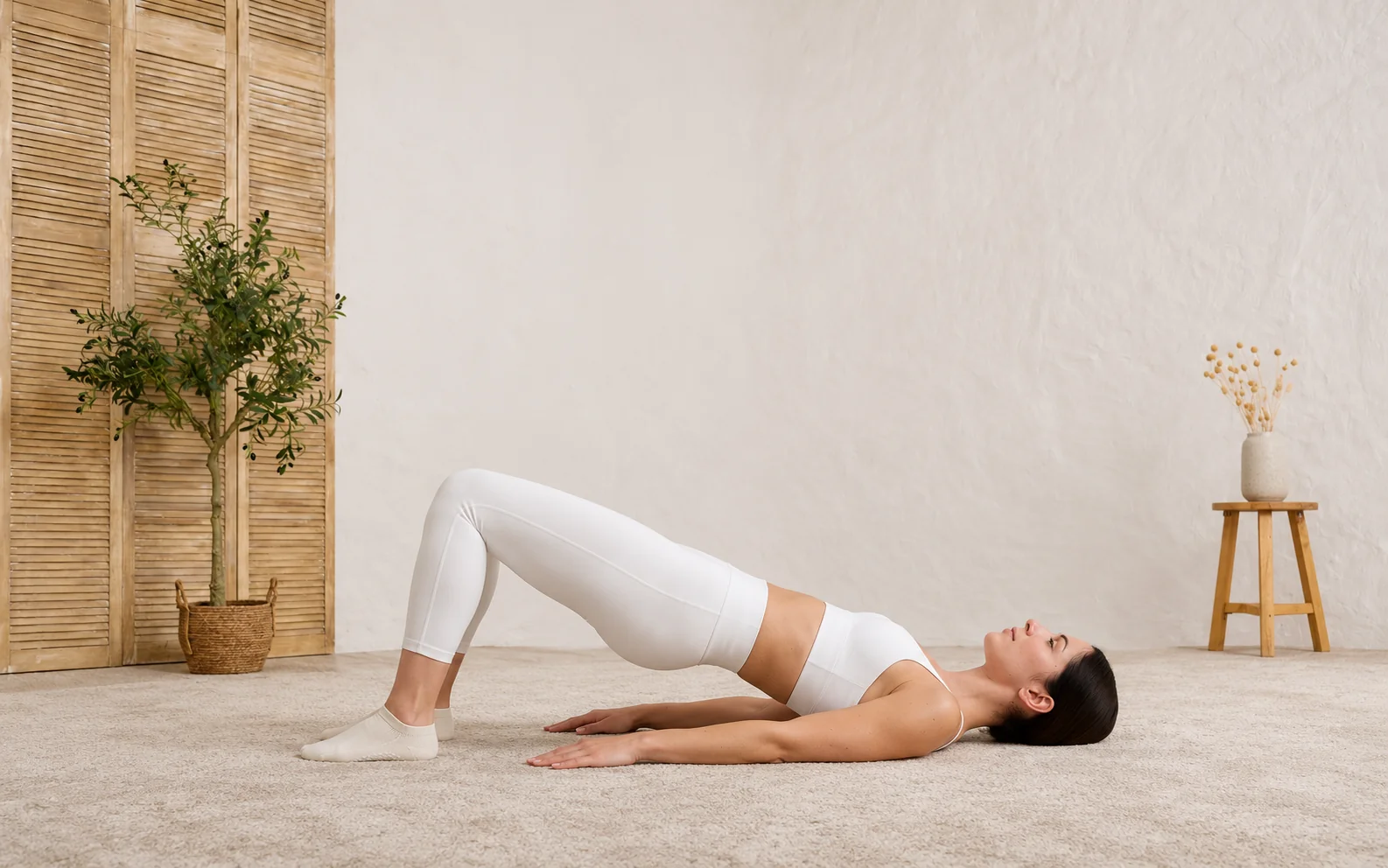
Glute bridge
A bridge lifts your hips while the shoulders and feet remain supported. Keep the top position aligned through shoulders, hips, and knees (1).
- Lie on your back with your knees bent.
- Place your feet comfortably apart.
- Breathe out while lifting your hips.
- Pause before your lower back arches.
- Lower your hips with control.
Keep your neck relaxed and avoid pushing weight through your head. Reduce the lift if you cannot keep a comfortable position.
Start with bodyweight. A trainer can help you place and control external resistance if you later add a load.
Sit-to-stand or bodyweight squat
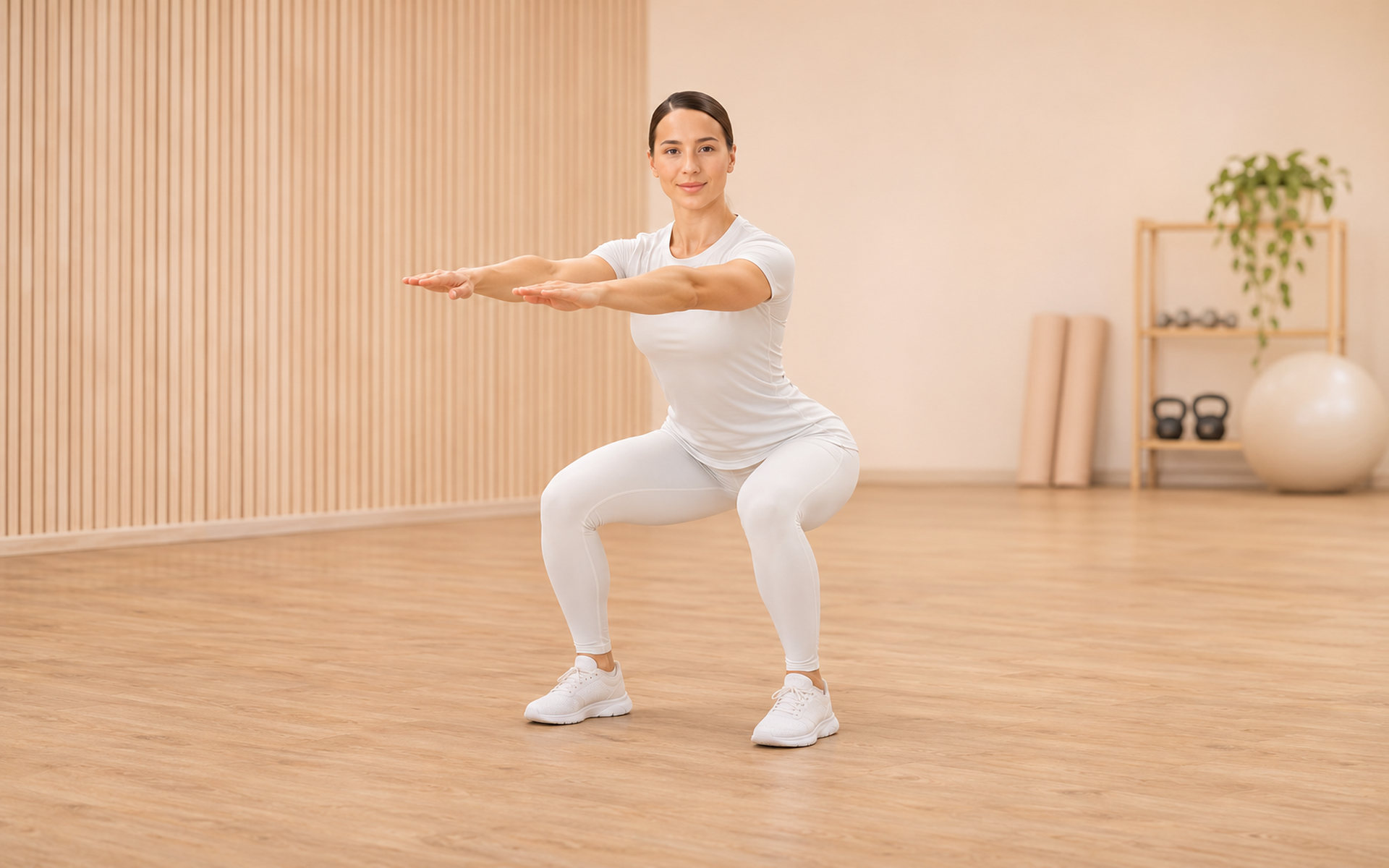
A sit-to-stand provides a clear depth target for learning a squat pattern. Use a chair that cannot slide or tip.
- Stand in front of the chair.
- Place your feet at a comfortable width.
- Bend your hips and knees to sit back.
- Touch down with control.
- Stand without bouncing or rushing.
Use hand support if needed. Avoid dropping onto the chair or choosing a height that makes standing difficult.
For a free squat, remove the chair only when you can control the same comfortable range. Depth can differ between people.
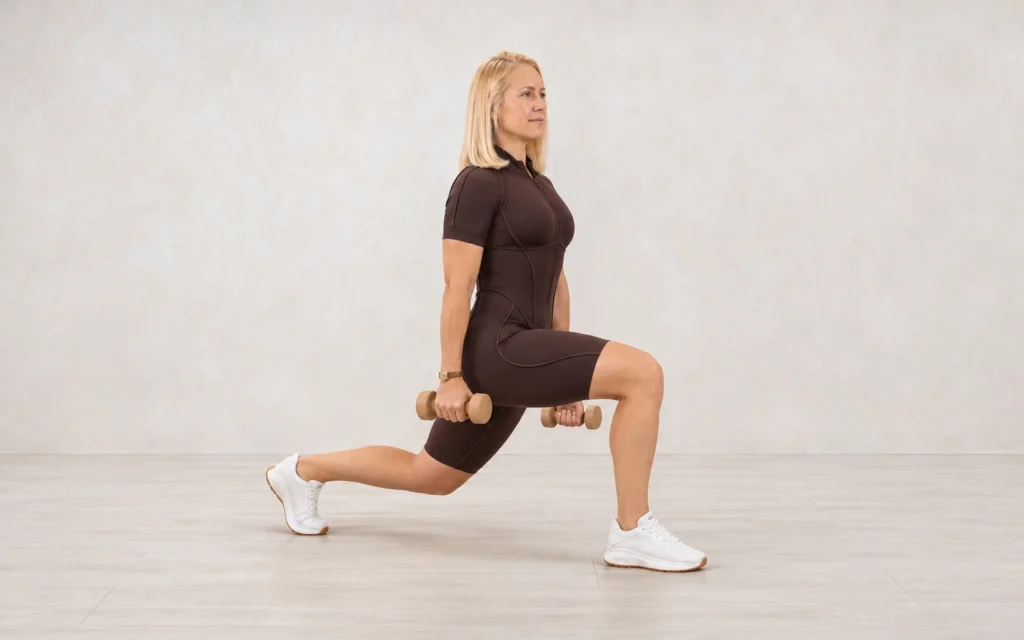
Supported reverse lunge
A reverse lunge trains one leg at a time while requiring balance and trunk control. A fixed support can reduce the balance demand.
- Stand beside a stable support.
- Step one foot backward.
- Bend both knees through a comfortable range.
- Keep your front foot planted.
- Return to standing.
- Change sides.
Take a shorter range if you feel unsteady. You can also use a supported split stance without repeatedly stepping.
Choose a sit-to-stand instead if lunges remain uncomfortable. There is no requirement to include a single-leg movement in every session.
Heel-slide dead bug
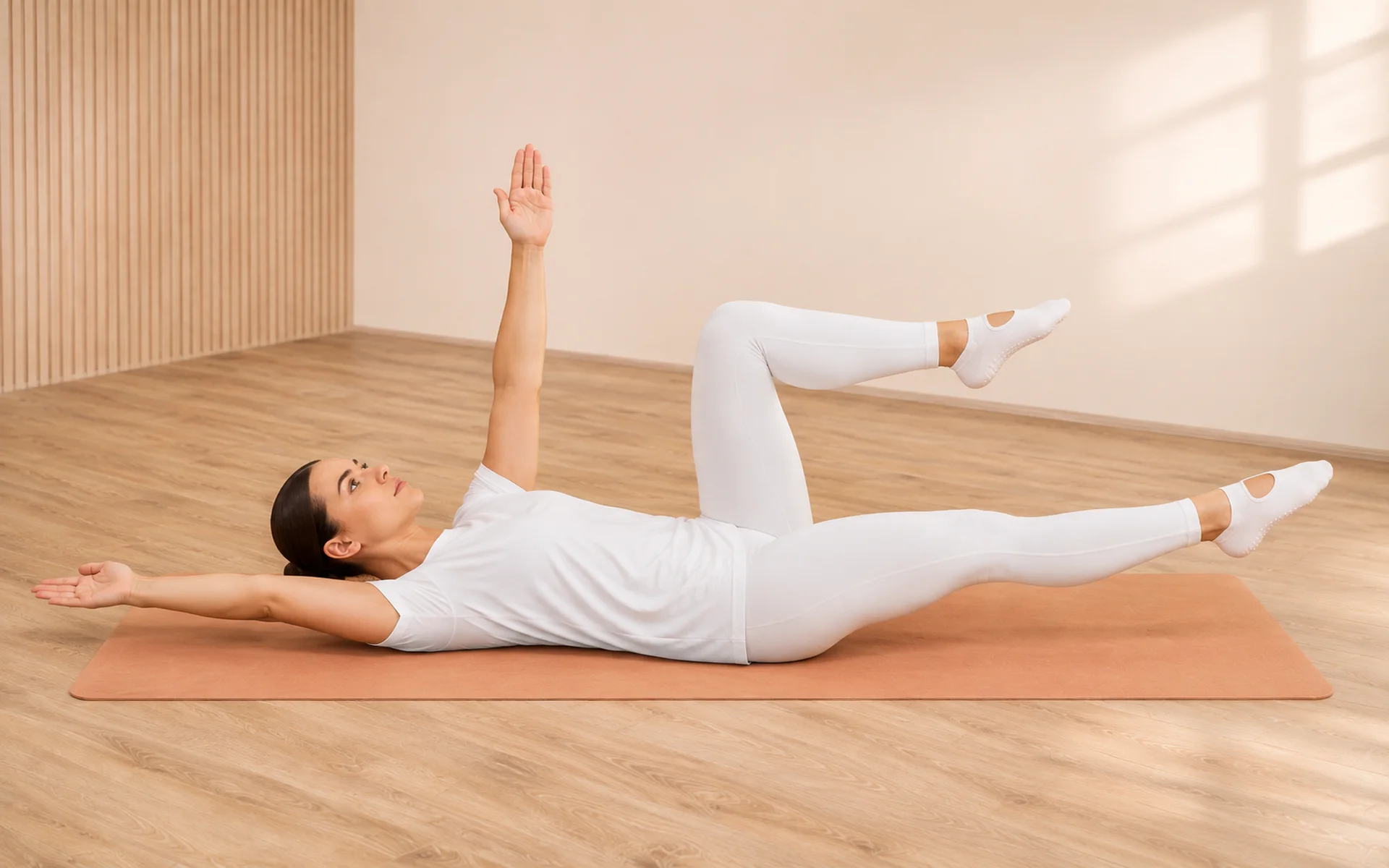
A heel-slide dead bug practices trunk control while one leg moves. The supported version can be simpler than holding both legs in the air.
- Lie on your back with knees bent and feet down.
- Keep your arms in a comfortable position.
- Gently tighten your abdomen while breathing.
- Slide one heel away from you.
- Return before your back arches.
- Repeat with the other leg.
Use a small sliding range first. Keep your head supported instead of lifting it to watch your feet.
Once comfortable, a different dead-bug variation can increase the demand. Change one feature at a time.
Bent-knee side plank
A bent-knee side plank uses your forearm and knees for support. It can be less demanding than a full-length side plank.
- Lie on your side with your knees bent.
- Place your elbow beneath your shoulder.
- Lift your hips slightly from the mat.
- Keep your head in line with your trunk.
- Breathe during a brief hold.
- Lower and change sides.
Avoid collapsing into the supporting shoulder. Stop if the position causes shoulder discomfort.
Choose another trunk exercise if you cannot find a comfortable setup. A shorter hold is a valid modification.
Bird dog as an alternative
Bird dog offers another way to practice trunk control from hands and knees. Reach opposite limbs only as far as your back remains steady (5).
A single-arm or single-leg reach can come first. The quadruped exercise guide explains these progressions.
Looking for a plan to follow? Take the BetterMe quiz for a customized workout plan.
What does a beginner session look like?
Choose a few movements with enough rest to practice each one with control.
Adjust the sample session to your current ability.
|
Exercise |
Example amount |
Adjustment |
|---|---|---|
|
Sit-to-stand |
6 repetitions |
Use a higher stable seat |
|
Glute bridge |
6 repetitions |
Lift through a smaller range |
|
Heel-slide dead bug |
4 repetitions per side |
Shorten the slide |
|
Supported reverse lunge |
4 repetitions per side |
Use a supported split stance |
|
Bent-knee side plank |
5 to 10 seconds per side |
Use another comfortable trunk exercise |
Rest between movements until you can repeat them with control. One round may be enough initially.
Begin with easy movement and a few practice repetitions. Keep the first session comfortable enough to learn each setup.
If you already train, this sample may be too light for your goals. A qualified trainer can help adjust the workload.
General resistance training can progress over time when appropriate. The progression can involve load, repetitions, or other training variables (2).
How can you adapt the workout for different equipment?
Keep the purpose of each movement clear when changing equipment. A dumbbell, band, machine, or wall can serve a practical need.
Dumbbells and gym weights
Dumbbells can add resistance to a squat or lunge once you control the unloaded movement. Start with a load you can manage.
Ask for instruction before using unfamiliar machines or performing a loaded hip thrust. Bench height and equipment setup matter.
Avoid balancing a loose weight plate on your back during a plank. Choose a progression you can enter and exit independently.
A gym routine does not need several demanding exercises for the same muscles in one session. Select a manageable total workload.
Resistance bands
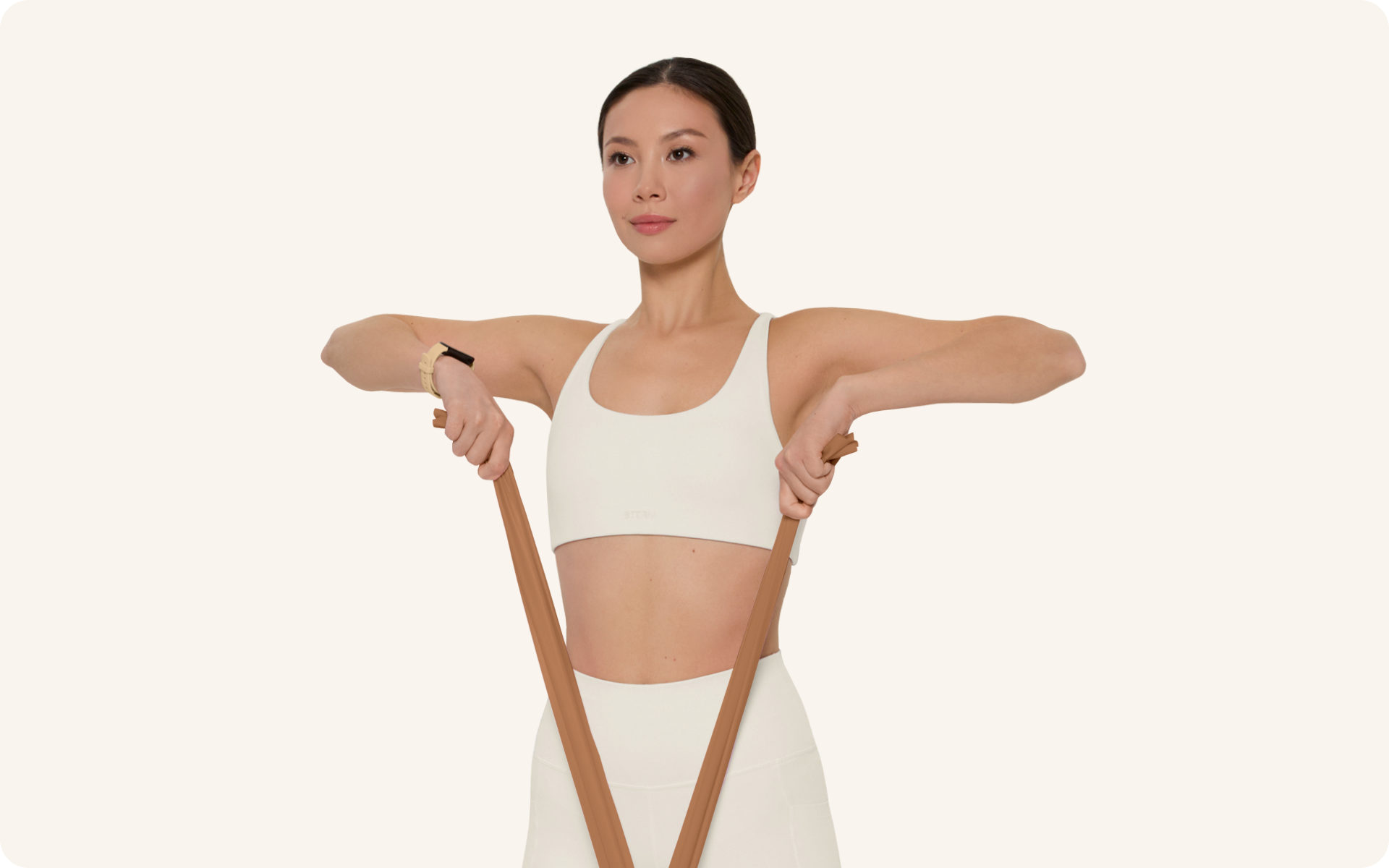
Bands offer resistance without a large weight stack. They can be useful when space or equipment access is limited (2).
Inspect the band for damage and follow its instructions. Use only an anchor designed for the intended exercise.
A loop band around the thighs changes a bridge’s demands. It does not automatically improve the exercise for every person.
Avoid attaching a band to unstable furniture or asking a partner to provide unpredictable resistance. Learn the setup before increasing tension.
Wall-supported options
A wall can provide support during selected standing movements. It can also offer a stable surface for an inclined push-up.
Wall-supported exercise does not establish a unique fat-loss or muscle-shaping effect. Choose it for the support or position it provides.
If you want a wall-based Pilates session, seek instruction appropriate to the exercises. Not every floor movement transfers directly.
Our fun workouts guide offers other ways to vary your routine without adding more equipment.
Should abs or glutes come first?
Begin with the movement that matters most to your training goal, while you can perform it with control. Exercise order can influence strength training (2).
If learning a squat is your priority, practice it before tiring your trunk with difficult holds. Keep warm-up movements gentle.
If trunk practice is the main purpose, start with a comfortable core movement. Avoid exhausting yourself before a demanding loaded exercise.
No exercise order promises a particular body shape. Your technique, total workload, and rest all need consideration.
How often should you repeat the workout?
Repeat the session according to your broader training schedule and rest days. Two nonconsecutive days can be an introductory scheduling example.
General adult guidance calls for strengthening all major muscle groups on at least two days weekly. It also includes aerobic activity (4).
An ab and glute session covers only part of those needs. Include pushing and pulling movements elsewhere when appropriate.
For example, a push-up trains the chest, shoulders, and arms while you keep the torso steady. Use a manageable variation (6).
The workout planning guide can help you distribute those sessions. Avoid counting every short core practice as a full-body strength day.
If soreness affects your usual movement, reduce the next session. Ongoing discomfort or worsening signs call for a check with a health professional.
Prefer a ready structure for your week? The BetterMe quiz can help you set up a workout routine that fits your schedule.
How do you track progress?
Track the exercise version, repetitions, load, and how well you controlled the movement. Compare sessions using the same setup.
A practical note might read: “Six chair squats, no hand support, comfortable afterward.” That gives you a clear reference.
When the same version becomes manageable, change one training variable. You could add a repetition or use slightly more resistance.
Appearance does not change on a fixed schedule of workouts. Individual responses and goals differ.
A small abdominal-exercise trial found improved endurance without reduced abdominal fat. Training a muscle and reducing nearby fat are different outcomes (3).
Frequently Asked Questions
Can you train without lying on the floor?
Yes. Standing squats, supported lunges, and suitable standing trunk exercises can form an alternative session. Those movements are not identical replacements for every floor exercise. Ask for guidance if discomfort or difficult floor transfers limit your choices.
Do you need to feel sore afterward?
No. Soreness is not a required target or a complete measure of progress. Record repeatable performance and comfort instead. If soreness is severe or changes your normal movement, reduce the workload. Seek advice for ongoing or unusual discomfort.
How can I make room for a walk on strength days?
Choose a duration and pace that fit your energy and the rest of the week. You can also schedule the walk on a separate day (4).
The bottom line
Choose a few ab and glute exercises you can control, with support where needed. Practice the setup before adding resistance, and record manageable progress. Include other muscle groups and aerobic activity in your week, without expecting a set body shape or fixed timeline.
DISCLAIMER:
This article is intended for general informational purposes only and does not serve to address individual circumstances. It is not a substitute for professional advice or help and should not be relied on for making any kind of decision-making. Any action taken as a direct or indirect result of the information in this article is entirely at your own risk and is your sole responsibility.
BetterMe, its content staff, and its medical advisors accept no responsibility for inaccuracies, errors, misstatements, inconsistencies, or omissions and specifically disclaim any liability, loss or risk, personal, professional or otherwise, which may be incurred as a consequence, directly or indirectly, of the use and/or application of any content.
You should always seek the advice of your physician or other qualified health provider with any questions you may have regarding a medical condition or your specific situation. Never disregard professional medical advice or delay seeking it because of BetterMe content. If you suspect or think you may have a medical emergency, call your doctor.
SOURCES:
- How to strengthen your core (2023, www.mayoclinichealthsystem.org)
- American College of Sports Medicine Position Stand. Resistance Training Prescription for Muscle Function, Hypertrophy, and Physical Performance in Healthy Adults: An Overview of Reviews (2026, pubmed.ncbi.nlm.nih.gov)
- The effect of abdominal exercise on abdominal fat (2011, pubmed.ncbi.nlm.nih.gov)
- Adult Activity: An Overview (2023, www.cdc.gov)
- Bird-dog (n.d., www.acefitness.org)
- Push-up (n.d., www.acefitness.org)
 Reviewed by
 Reviewed by
 Reviewed by
 Reviewed by