
Starting your day with intentional movement can set a positive tone for everything that follows. A morning Pilates routine is an excellent way to awaken your body, improve core strength, and enhance mental focus.
This structured guide will walk you through everything you need to know to establish a fulfilling and effective at-home practice, even if you’re a complete beginner.
We’ll break down what a gentle and energizing routine looks like, provide a step-by-step beginner’s program, and answer common questions to help you get started with confidence. This isn’t just about going through the motions – it’s about learning the principles of control, precision, and flow that make Pilates a transformative practice.
What Is a Gentle Morning Pilates Routine?
A gentle morning Pilates routine is a low-impact workout that’s designed to wake up the body through a series of controlled movements. The focus is on core engagement, spinal alignment, and breathwork. This type of routine emphasizes precision and control over speed and repetition.
The goal is to gradually increase circulation, activate the “powerhouse” – the muscles of your core, lower back, hips, and glutes – and stretch your muscles. It prepares your body and mind for the day ahead.
This approach makes it an ideal easy morning workout for people of all fitness levels.
Is It Good to Do Pilates in the Morning?
Yes, practicing Pilates in the morning can be highly beneficial. Joseph Pilates, the creator of the method, advocated for his exercises as a way to “return to life” with renewed vigor (1).
A morning session helps to shake off stiffness from sleep and stimulates circulation (2), which can lead to increased energy levels throughout the day (3). Its emphasis on deep, controlled breathing increases oxygen intake, which helps to improve mental clarity and focus (4).
By starting your day with mindful movement, you create a mind-body connection that can reduce stress and improve your overall sense of well-being (5). It’s a proactive way to invest in your physical and mental health before the demands of the day begin.
Read more: Does Pilates Require Equipment? What to Know as a Beginner
What Is an Energizing Morning Pilates Routine?
An energizing morning Pilates routine combines foundational exercises that build heat and increase blood flow in a deliberate sequence. It differs from a purely gentle routine by incorporating dynamic movements that challenge your endurance and strength, all while adhering to the core principles of Pilates.
The routine below is designed to be both accessible for beginners and effective at building energy. It systematically works through the major muscle groups, with a strong focus on core stability. You’ll move from warming up your entire system with the hundred to articulating your spine and challenging your powerhouse with a series of stretches and holds.
Beginner’s Morning Pilates Program
Before you begin, here are a few notes to guide your practice.
- Glossary:
- Powerhouse: This refers to the center of your body, including the abdominals, lower back muscles, pelvic floor, hips, and glutes. All movement in Pilates originates from the powerhouse.
- Pilates Stance: Heels are together and toes are slightly apart, forming a small ‘V’ shape with your feet. This engages the inner thighs and glutes.
- C-Curve: This is the shape your spine makes when you round it forward, with your navel pulled in deeply toward your spine.
- Equipment Needed: A yoga or Pilates mat.
- Sets and Reps: Follow the repetitions specified for each exercise. The focus is on the quality of movement, not the quantity.
- –Rest: Rest is minimal between exercises. The goal is to create a “flow” from one movement to the next.
| Exercise | Repetitions |
|---|---|
| The hundred | 10 sets of 10 breaths (100 pumps total) |
| Roll up | 3-5 times |
| Single leg circles | 5 circles in each direction, with each leg |
| Rolling like a ball | 6-10 times |
| Single leg stretch | 5-10 sets of alternating legs |
| Double leg stretch | 5-10 times |
| Spine stretch forward | 3-5 times |
| The wall sequence | Standing (hold), arm circles (3 each way), roll down (1-2), the chair (2-3) |
Exercise Instructions
Here’s a breakdown of how to perform each exercise in the program. Pay close attention to the instructions to ensure you maintain proper form and get the most out of each movement.
The Hundred
This classic warm-up exercise builds endurance, stimulates circulation, and strengthens the powerhouse.
- Lie flat on your back with your knees drawn into your chest.
- Inhale, then as you exhale, lift your head and shoulders off the mat, curling your chin toward your chest.
- Stretch your arms long by your hips, your palms facing down, hovering about 6 inches above the mat.
- Extend both legs up toward the ceiling. For the beginner version, you can keep your knees bent in a tabletop position (shins parallel to the floor) or lower the legs to a 45-degree angle if you can do so without your lower back arching.
- Start to pump your arms vigorously up and down. Inhale through your nose for 5 pumps and exhale through your mouth for 5 pumps.
- Complete 10 full breath cycles for a total of 100 pumps. To finish, hug your knees into your chest and lower your head to the mat.
Roll Up
The roll up is excellent for spinal articulation, strengthening the abdominals, and stretching the hamstrings.
- Lie flat on your back with your legs straight and together, and your feet flexed. Reach your arms overhead toward the wall behind you, keeping your shoulders down.
- Inhale and bring your arms forward over your chest, followed by your head, as you start to curl your upper spine off the mat.
- Exhale and continue to roll up, peeling your spine off the mat one vertebra at a time. Maintain a C-curve in your spine as you reach toward your toes. Keep your abdominals pulled in deeply.
- Inhale to begin rolling back down, initiating the movement from your lower abs and pelvis.
- Exhale as you slowly lower your spine back onto the mat, vertebra by vertebra, with control. Your arms return overhead to the starting position.

Single Leg Circles
This exercise strengthens the hips and powerhouse while improving hip mobility.
- Lie flat on your back with your arms by your sides, your palms down. Extend your right leg up to the ceiling and keep your left leg extended long on the mat.
- Anchor your hips and torso. Inhale as you cross your right leg over your body toward the left shoulder.
- Circle the leg down toward the center line of your body and out to the right side.
- Exhale as you bring the leg back up to the starting position, completing the circle.
- Perform 5 circles in this direction, then reverse for 5 more circles. Repeat the entire sequence with your left leg.
Rolling Like a Ball
This movement massages the spine and challenges your balance and core control.
- Sit at the front of your mat and hug your knees into your chest, grasping your ankles.
- Lift your feet off the floor and find your balance on your sit-bones. Keep your spine in a rounded C-curve and tuck your head between your knees.
- Inhale and roll back smoothly to the base of your shoulder blades. Don’t roll onto your neck.
- Exhale and use your abdominal muscles to roll back up to the starting position, finding your balance without letting your feet touch the floor.
Single Leg Stretch
This is the first exercise in the “Stomach Series” and builds coordination and abdominal strength.
- Lie on your back and draw both knees into your chest. Lift your head and shoulders off the mat into a curl.
- Extend your right leg out to a 45-degree angle while hugging your left knee in. Place your left hand on your left ankle and your right hand on your left knee.
- Inhale as you switch legs, extending the left leg and drawing the right knee in. Your right hand moves to your right ankle and your left hand to your right knee.
- Continue switching legs with a steady rhythm, exhaling as you complete the pair. Keep your torso stable and your powerhouse engaged.
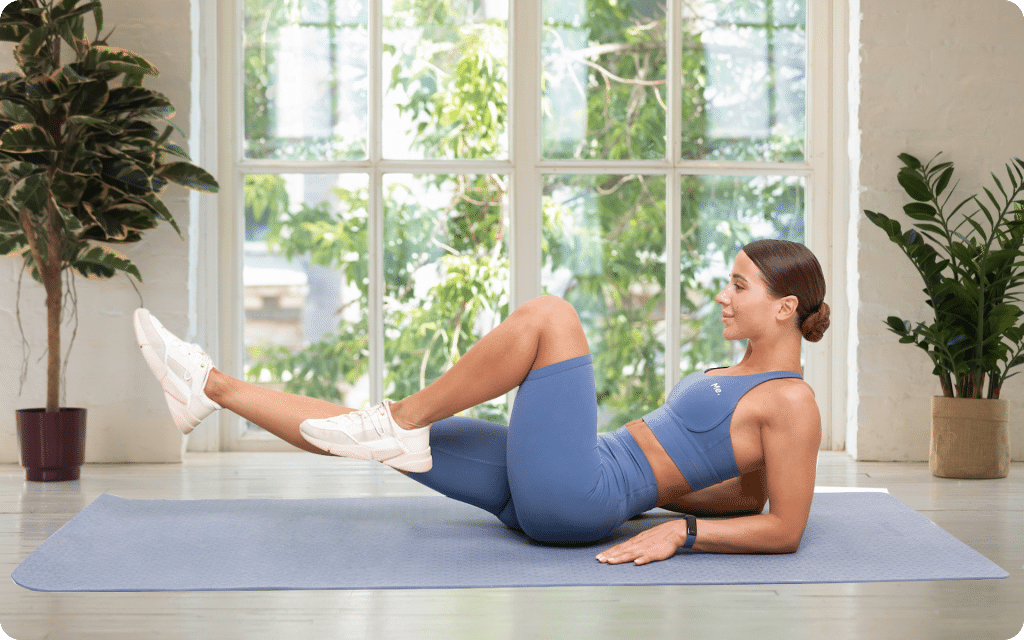
Double Leg Stretch
This exercise challenges the powerhouse by moving your arms and legs simultaneously.
- From the end of the single leg stretch, hug both knees into your chest, with one hand on each ankle. Your head and shoulders are still lifted.
- Inhale and simultaneously extend your arms back by your ears and your legs out to a 45-degree angle. Keep your lower back pressed into the mat.
- Exhale as you circle your arms around to the sides and hug your knees back into your chest, returning to the starting position.
Spine Stretch Forward
This movement stretches the spine and hamstrings while reinforcing deep abdominal scooping.
- Sit up tall with your legs extended in front of you, approximately shoulder-width apart, and your feet flexed.
- Extend your arms straight out in front of you at shoulder height. Inhale and sit even taller.
- Exhale as you drop your chin to your chest and round your spine forward, vertebra by vertebra. Imagine you’re rounding up and over a large ball.
- Reach forward, deepening the scoop in your abdominals. Your lower back should press back behind you.
- Inhale as you stack your spine back up to a tall, seated position, one vertebra at a time.
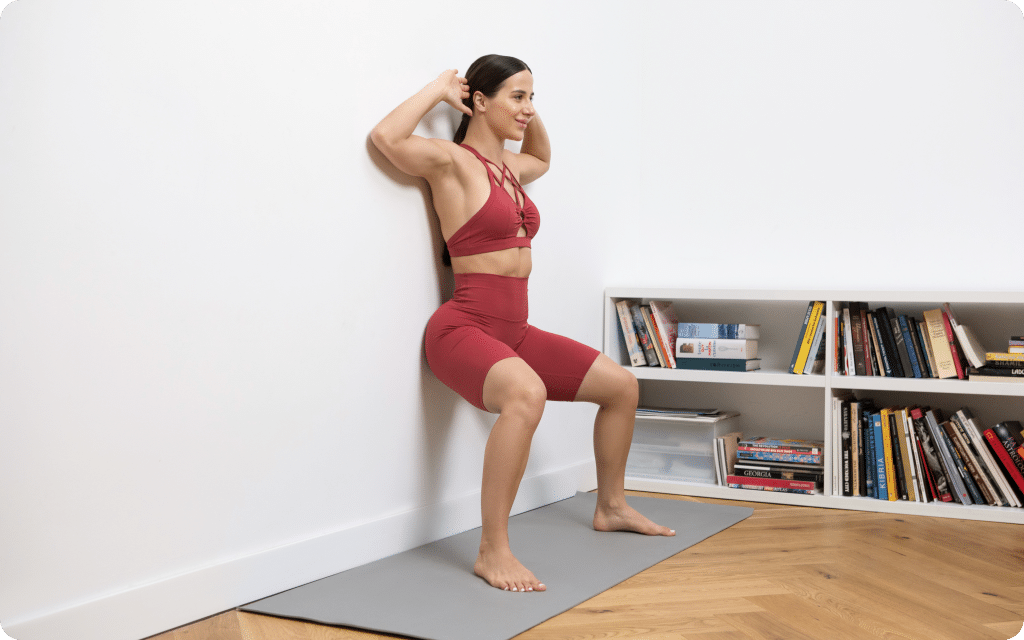
The Wall Sequence
This series uses a wall to help you find and maintain correct posture, translating your mat work into an upright, functional position.
- Standing:
- Stand with your back against a wall, your feet about a step’s distance away.
- Press your tailbone, mid-back, shoulders, and the back of your head into the wall. You may need to soften your knees to get your lower back to touch.
- Draw your navel in and up. Hold this position for several deep breaths to feel correct alignment.
- Arm Circles:
- Maintain the standing wall position. Inhale and raise both arms in front of you to shoulder height.
- Keep your back connected to the wall as you open your arms out to the sides.
- Exhale and lower your arms down to your sides to complete the circle. Repeat 3 times, then reverse the direction.
- Roll Down:
- From the starting wall position, exhale and drop your chin to your chest.
- Slowly peel your spine off the wall, one vertebra at a time, allowing your arms to hang heavy.
- Roll down as far as you can while keeping your hips against the wall. Inhale at the bottom.
- Exhale and roll back up, pressing each vertebra into the wall until you’re standing tall again.
- The Chair:
- Stand with your back against the wall, your feet a large step away and hip-width apart.
- Inhale as you bend your knees and slide down the wall until your thighs are parallel to the floor, as if sitting in a chair. Simultaneously raise your arms in front of you.
- Hold for 3-5 breaths, keeping your abdominals engaged.
- Exhale and press through your heels to slide back up the wall to the starting position.
This entire sequence is one of many exercises to wake you up and prepare you for the day.
Can You Do Pilates as Soon as You Wake Up?
Yes, you can do Pilates shortly after waking up. A gentle routine can be an excellent way to ease your body into the day. However, your muscles and joints may be stiffer in the morning (6).
It’s important to move slowly and mindfully, paying close attention to how your body feels. Avoid pushing into any sharp pain and focus on gentle, controlled movements to warm up gradually.
Should You Eat Before Early Morning Pilates?
This is a matter of personal preference and how your body responds. Some people feel best when they exercise on an empty stomach, while others need a small snack to have enough energy.
A full, heavy meal is not recommended, as it can make you feel sluggish and uncomfortable, particularly during exercises that involve core work and bending.
If you choose to eat, you should opt for something light and easily digestible. Listen to your body’s signals – if you feel weak or dizzy exercising on an empty stomach, a small snack beforehand is a good idea.
For a more detailed look at fueling your body, you can explore guides on creating a balanced morning exercise routine.
Whether you’re a workout beast or just a beginner making your first foray into the world of fitness and dieting – BetterMe has a lot to offer to both newbies and experts! Install the app and experience the versatility first-hand!
What to Eat Before Pilates in the Morning
If you feel you a need to eat, choose a light snack about 30-60 minutes before your session. The goal is to provide a small amount of energy without weighing you down. Good options include:
- A banana
- A handful of almonds
- A piece of toast with a layer of almond butter
- A cup of yogurt
Read more: At-Home Chair Pilates Workout Routines for Beginners
What Not to Do Before Pilates
It may not be advisable to perform a strenuous workout, such as heavy weightlifting or a long run, immediately before your Pilates session. Pilates requires immense focus, control, and precision – all principles that are difficult to uphold when your body is already fatigued.
Pre-fatiguing your muscles may compromise your form, reduce the effectiveness of the Pilates exercises, and increase the risk of injury.
What Happens if I Follow a Morning Pilates Routine for a Month?
Committing to a daily Pilates routine, even a short 20-minute Pilates workout for beginners, can lead to noticeable changes in just one month. The benefits are both physical and mental, aligning with the outcomes Joseph Pilates promised in his work, “Return to Life Through Contrology.”
- Improved Posture and Alignment
Pilates places a strong emphasis on spinal alignment and strengthening the postural muscles. Consistent practice teaches your body to hold itself in a more optimal position, which can reduce back pain and create a taller, more confident appearance (7). To learn more about the Pilates posture exercises, check out our in-depth article on the topic.
- Increased Core Strength
Every Pilates exercise originates from the powerhouse. After a month, you’ll likely notice an increase in the strength and endurance of your abdominal and back muscles. This creates a strong, stable center for all your daily activities (8).
- Enhanced Flexibility
While it’s not focused on static stretching, Pilates improves flexibility through dynamic, controlled movements. Exercises such as the spine stretch forward and single leg circles lengthen muscles while strengthening them, which leads to an increased range of motion in your joints (9).
- Better Body Awareness
The deep focus required in Pilates enhances your mind-body connection. You’ll become more attuned to how your body moves and what it needs. This heightened proprioception (your sense of where your body is in space) can improve coordination and reduce the risk of injury (10).
- Increased Energy Levels
The combination of controlled movement and deep breathing boosts circulation and oxygenates your blood (2, 11). Many people find that a morning Pilates routine at home leaves them feeling energized and focused.
Yes, 20 minutes of Pilates a day can be very effective, particularly if you’re consistent. A focused 20-minute session is enough to engage your core, improve flexibility, and build strength. Quality and consistency are more important than duration. Pilates helps build lean muscle mass (12), and muscle tissue burns more calories at rest than fat tissue (13). While it’s not a high-intensity cardio workout that dramatically spikes your metabolism during the session, consistent practice contributes to a higher resting metabolic rate over time. Pilates strengthens the deep abdominal muscles (8), which can create a flatter, more toned appearance in the midsection. However, spot reduction of fat isn’t possible (14). Losing belly fat requires a combination of consistent exercise, such as a morning Pilates for weight loss routine, a balanced diet, and an overall calorie deficit. Pilates promotes a toned physique by strengthening the entire body, with a particular focus on the core. While regular practice improves muscular tone and overall posture, your body shape is determined by factors such as genetics and body fat percentage, and this practice can only enhance it. Both walking and Pilates can support weight loss, but they serve different functions. Walking is a low-impact cardiovascular exercise that burns calories (15). Pilates is primarily a strength and flexibility workout that builds metabolism-boosting muscle (12, 13). For optimal results, a combination of both is ideal. No, it isn’t inherently bad. Many people prefer to do Pilates on an empty stomach, particularly in the morning. It ultimately depends on your personal energy levels and comfort. If you feel lightheaded or weak, a small, easily digestible snack is recommended.Frequently Asked Questions
Is 20 minutes of Pilates a day enough?
Can Pilates speed up your metabolism?
Can I lose belly fat by doing Pilates?
What body shape does Pilates give you?
Is walking or Pilates better for weight loss?
Is it bad to do Pilates on an empty stomach?
The Bottom Line
Integrating a morning Pilates routine into your life is a powerful way to enhance your physical strength and mental clarity. By focusing on the principles of control, breath, and precision, you can build a sustainable practice that serves you well beyond the mat. Start with this beginner’s guide, listen to your body, and embrace the process of building a stronger, more connected version of yourself, one session at a time.
DISCLAIMER:
This article is intended for general informational purposes only and does not serve to address individual circumstances. It is not a substitute for professional advice or help and should not be relied on for making any kind of decision-making. Any action taken as a direct or indirect result of the information in this article is entirely at your own risk and is your sole responsibility.
BetterMe, its content staff, and its medical advisors accept no responsibility for inaccuracies, errors, misstatements, inconsistencies, or omissions and specifically disclaim any liability, loss or risk, personal, professional or otherwise, which may be incurred as a consequence, directly or indirectly, of the use and/or application of any content.
You should always seek the advice of your physician or other qualified health provider with any questions you may have regarding a medical condition or your specific situation. Never disregard professional medical advice or delay seeking it because of BetterMe content. If you suspect or think you may have a medical emergency, call your doctor.
SOURCES:
- PILATES’ Return to Life Through Contrology (n.d., books.out.csli.me)
- Effects of an Acute Pilates Program under Hypoxic Conditions on Vascular Endothelial Function in Pilates Participants: A Randomized Crossover Trial (2020, mdpi.com)
- Does exercise really boost energy levels? (2021, harvard.edu)
- A New Perspective of Focused Inhalation on Cognitive Functions (2025, jscimedcentral.com)
- The role of a mindful movement-based program (Movimento Biologico) in health promotion: results of a pre-post intervention study (2024, frontiersin.org)
- Why You Wake Up With Stiff Joints (2023, health.clevelandclinic.org)
- Effects of Pilates on Body Posture: A Systematic Review (2024, sciencedirect.com)
- The Relationship of Trunk Muscle Activation and Core Stability: A Biomechanical Analysis of Pilates-Based Stabilization Exercise (2021, mdpi.com)
- Acute effects of a pilates method session on flexibility and performance in practitioners of an extreme conditioning program: A preliminary study (2024, sciencedirect.com)
- The effect of pilates on body awareness, activity level, aerobic capacity, and balance in healthy young adults (2021, researchgate.net)
- IMMEDIATE EFFECT OF DEEP BREATHING EXERCISE ON HEALTHY SUBJECTS (2017, semanticscholar.org)
- Increasing muscle mass to improve metabolism (2013, pmc.ncbi.nlm.nih.gov)
- Efficacy of Pilates in Functional Body Composition: A Systematic Review (2022, mdp.com)
- Spot reduction: why targeting weight loss to a specific area is a myth (2023, sydney.edu.au)
- Walking for Exercise (2023, nutritionsource.hsph.harvard.edu)
 Reviewed by
 Reviewed by