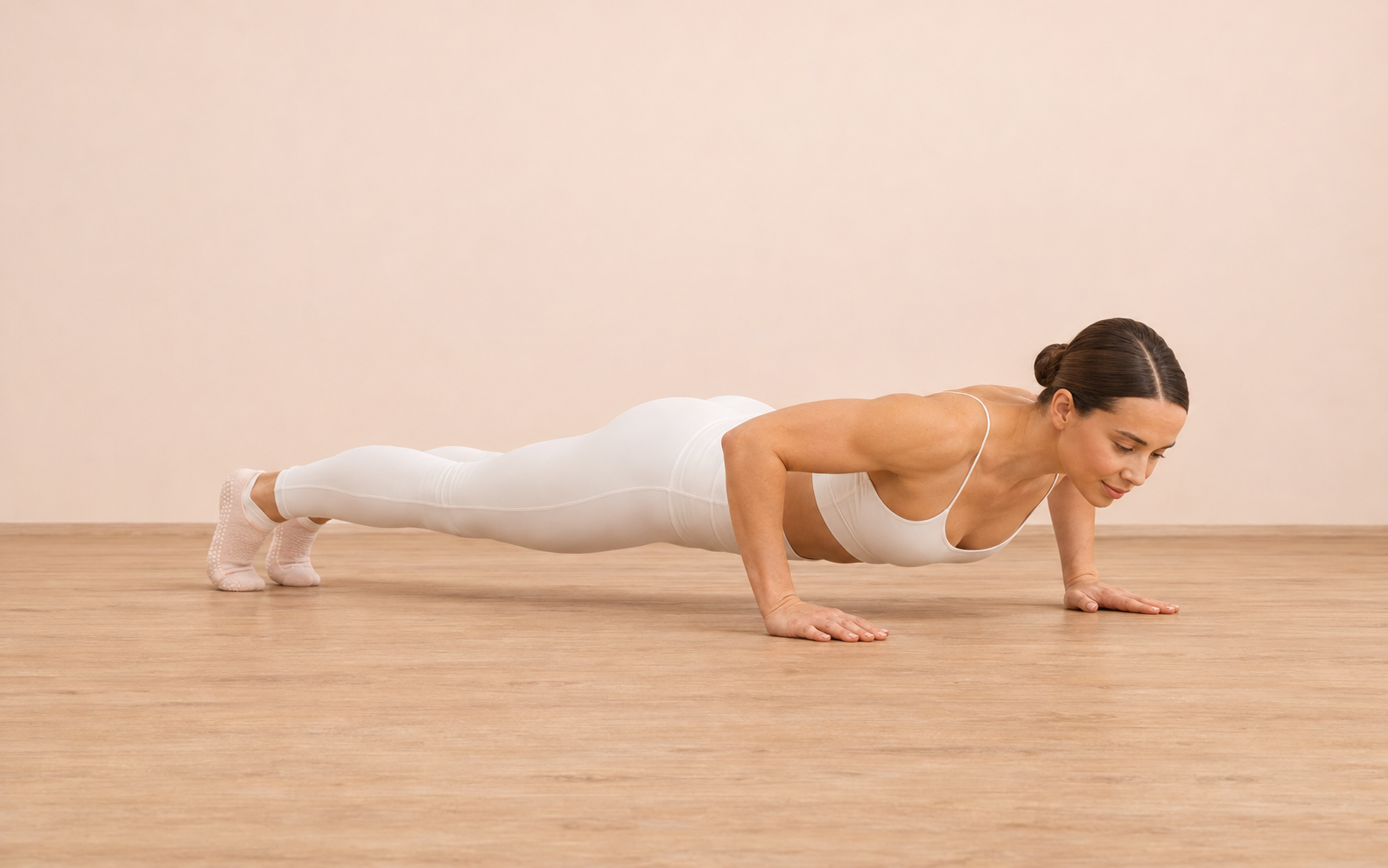
Benefits of push-ups for females include upper-body strength practice, adjustable resistance, and convenient training with little equipment. The movement also requires trunk control. Choose a wall, incline, knee, or floor version that suits your ability. Push-ups belong within a varied routine and cannot promise weight loss or changes in breast appearance.
For the wider activity context, read our calisthenics benefits for women.
Key takeaways
These points summarize the benefits of push-ups for females and how to progress.
- Push-ups train the chest and arms while requiring control of your trunk (1).
- Wall and raised-support variations offer alternatives to starting on the floor.
- Resistance training can improve women’s strength; no universal push-up total applies to every woman (2).
- A push-up does not replace pulling exercises or substantial lower-body training.
- Record the variation and range alongside your repetition count.
- Stop the set when you lose control or feel discomfort (3).
Why include push-ups in a routine?
Push-ups provide a practical pushing exercise with several possible starting positions. The chest and arms produce movement while the trunk helps maintain alignment (1). You can practice without buying a weight set.
Convenience is a practical advantage, although it does not make the movement suitable for everyone. Wrist, shoulder, or other limitations may require a different exercise. A qualified instructor can help when adjustments are unclear.
Push-ups also provide a repeatable skill to track. You can record the height of your support and the depth reached. That record is more useful than comparing your total with an unrelated online challenge.
Women can develop strength through resistance training (2). Starting with a wall variation does not indicate a permanent limit. Your current exercise version is simply the version you can practice now.
What does research say about push-up training?
Push-up training can improve strength when its resistance and workload provide an appropriate challenge. One small study of young men compared push-ups with a matched low-load bench press. Both groups increased chest and triceps thickness over eight weeks (4).
That study did not test every push-up variation or establish a result for all women. It supports a narrower point: bodyweight pushing can provide meaningful resistance. The study’s population and short duration limit broader predictions.
Push-up capacity research does not show that a set number improves health outcomes. Being able to perform many repetitions can reflect existing fitness and other characteristics. A performance test and a health claim are different kinds of evidence.
A push-up on its own is not complete full-body strength training. The legs and trunk help maintain position, but that does not replace separate pulling and leg work. Our home calisthenics workout plan explains how to include other patterns.
Which push-up variation should you start with?
Start with a version that permits several controlled repetitions without discomfort. A wall or high fixed support often makes the movement easier to learn. A floor version is optional until its demands suit you.
| Variation | Main setup | Useful adjustment |
| Wall push-up | Hands on a clear wall | Move feet closer or farther away |
| Incline push-up | Hands on a fixed raised surface | Use a higher support when needed |
| Knee push-up | Knees and hands on the floor | Shorten the lowering range |
| Standard push-up | Hands and toes on the floor | Return to an incline if control changes |
The table is a practical comparison, not a ranking. Knee and incline variations change the movement differently. You can use whichever version matches your current needs and available space.
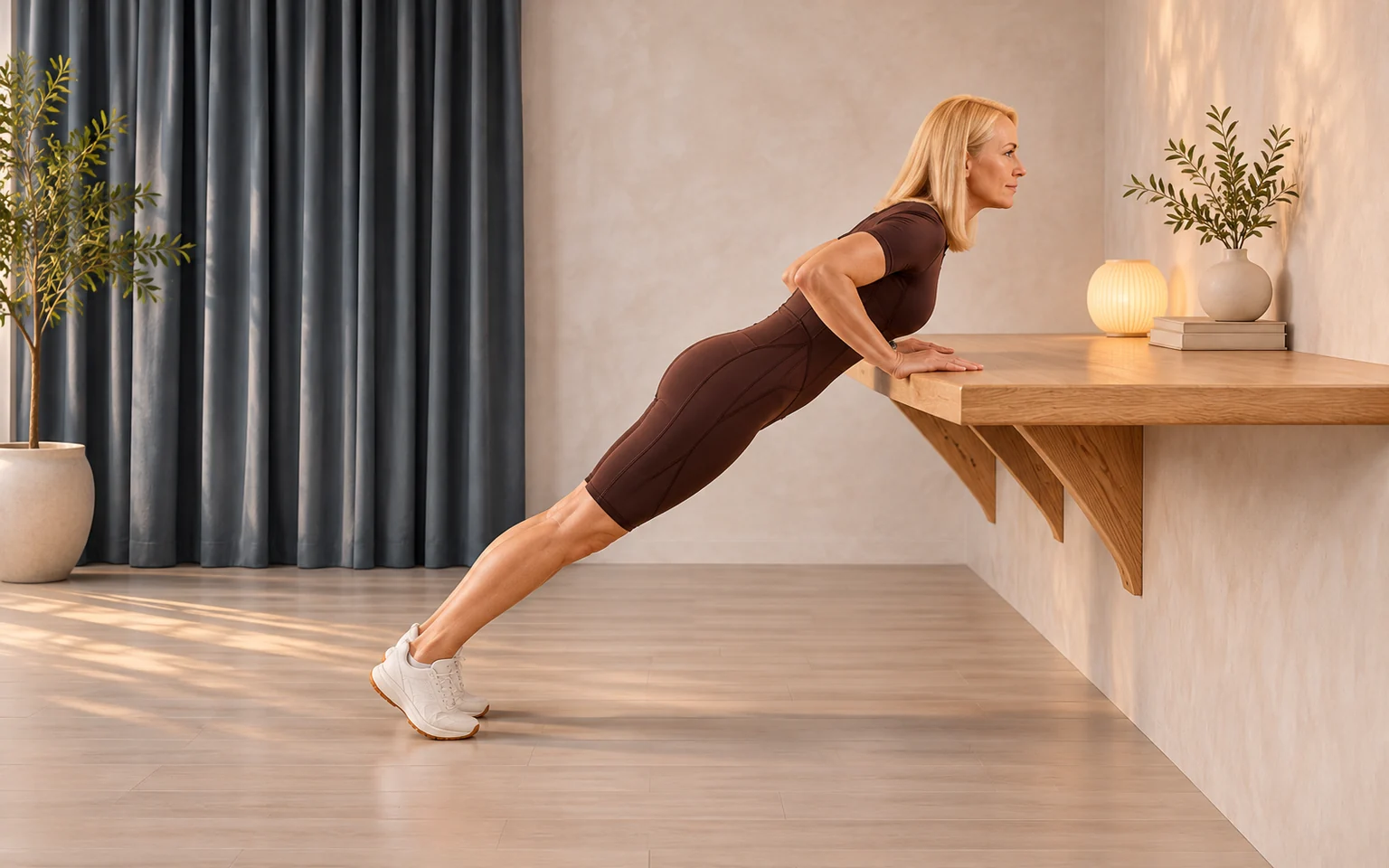
Public home-exercise guidance includes wall press-ups (5). Test your surface before starting. A rolling chair, lightweight table, or slippery support can make an otherwise manageable exercise unstable.
How do you perform a wall push-up?
- Face the wall for the wall push-up.
- Place your palms around chest height.
- Step backward to a comfortable starting distance.
- Bend your elbows to move toward the wall.
- Press away to return.
Keep your body moving as a unit. Avoid leaving your hips behind while only your head approaches the wall. Move closer if the current angle is difficult to control.
Start with a comfortable hand spacing. Your elbows do not need to flare directly sideways. Stop and adjust if the position feels uncomfortable rather than forcing the same setup repeatedly.
How do you perform an incline push-up?
- Place both hands on a fixed counter for the incline push-up.
- Step your feet back into a long body position.
- Bend your elbows to lower your chest toward the support.
- Press through your hands to return.
Choose a support that cannot move under your weight. Keep the surface dry and your hands secure. Avoid lowering your chest farther than you can control comfortably.
Your head should follow the line of your trunk. Reaching forward with your chin can make the repetition look deeper without changing chest movement. Record a repeatable range rather than chasing contact with the counter.
How do you perform a knee push-up?
- Place your hands and knees on the floor for the knee push-up.
- Move your knees back until your trunk forms a long line.
- Bend your elbows to lower your chest.
- Press back up without leading with your hips.
Use padding under your knees if needed. Keep breathing rather than bracing through a long breath hold. A modified push-up still requires trunk control (1).
Choose an incline version instead if kneeling is uncomfortable. You do not need to master every intermediate variation in a fixed order. The movement should fit the person practicing it.
How do you perform a standard push-up?
- Begin on your hands and toes for the standard push-up.
- Set your hands at a comfortable width near shoulder level.
- Lower your body by bending your elbows.
- Press back up while keeping your trunk aligned.
Use the depth you can control without discomfort. If your hips sag or your shoulders lose position, end the set. Return to a raised support for later practice if needed.
A standard repetition is not worth more because it looks harder. The useful choice is the version that provides an appropriate challenge. Keep your practice consistent enough to compare sessions.
How many push-ups should you do?
Choose your push-up amount around the variation, your technique, and the rest of your routine. There is no universal daily total for women. An easier version may allow more repetitions without being a better exercise choice.
This editorial practice example uses small sets. Adjust it freely and rest longer whenever needed. The example is not a test or a research-validated program.
| Stage | Practice example | Decision afterward |
| Learn the setup | Try 3 to 5 controlled repetitions | Adjust the support or range |
| Repeat the movement | Rest, then try another short set | Stop if technique deteriorates |
| Record the session | Note variation, repetitions, and comfort | Repeat before increasing difficulty |
You can stop below the example range. You can also choose a different pushing exercise after qualified instruction. Completing a set number does not need to take priority over discomfort or control.
A broad resistance-training review found benefits across different prescriptions (6). That finding does not produce a single push-up target. Your total workload includes other pressing exercises, classes, and demanding upper-body activity.
If you use an incline, measure or describe the support height in your notes. Keep your feet in a similar position for the next comparison. Record whether each repetition reached the same comfortable depth. If those details change, label the session as a different variation. This prevents a larger repetition total from hiding an easier setup or shorter movement.
How should you progress?
Progress by changing one feature while keeping a clear record. You might add one controlled repetition or use a slightly lower incline. Test the new setup with a small set before committing to more work.
Keep the earlier version available. A lower support may be a larger change than expected. Returning to the higher support allows further practice without turning the session into repeated failed attempts.
Avoid making speed the first progression. Faster movement can hide a shortened range or loss of alignment. Controlled repetitions give you more time to notice those changes.
Plan rest between demanding pushing sessions. General strength guidance recommends avoiding hard work for the same muscles on consecutive days (3). Your schedule may need additional adjustment after unfamiliar or unusually demanding exercise.
Our women’s calisthenics guide shows how pushing can fit into a varied week. Count the whole routine before adding a separate daily push-up challenge.
Do push-ups increase or lift breast tissue?
Push-ups train chest muscles; they do not directly train breast tissue. Breast anatomy includes fatty, glandular, and connective tissues over the chest muscles (7). Muscle development may not change breast size or position.
No exercise can promise a particular cup size or breast position. Appearance can change for reasons unrelated to push-up training. If a breast change concerns you, seek appropriate medical advice rather than attempting to correct it with exercise.
You also do not need an appearance goal to practice push-ups. A useful goal might be completing the same variation with steadier control. The female calisthenics body guide separates training outcomes from physique promises.
What mistakes make progress difficult to judge?
Changing the exercise standard makes repetition totals hard to compare. A shallower range, higher support, or longer rest can change performance. Record those differences rather than interpreting every larger number as increased strength.
Rushing through the setup can also make practice inconsistent. Check hand position and support stability before the first repetition. A brief pause between sets gives you time to notice whether anything has shifted.
Finally, avoid training through discomfort because a movement is called beginner-friendly. General technique guidance advises stopping painful exercise (3). Persistent discomfort deserves individual assessment, not a harder variation.
Frequently Asked Questions
These answers cover single push-ups, push-up handles, and practicing after another workout.
Is doing one controlled push-up worthwhile?
Yes, one repetition can provide useful practice and information about the current variation. A higher incline may let you practice several controlled repetitions. Choose the version around your learning goal.
Do you need push-up handles?
No, handles are optional equipment. They change the hand and wrist position and should be stable on the chosen surface. Seek advice if wrist discomfort persists rather than assuming handles solve the cause.
Can you practice push-ups after another workout?
Yes, if the earlier workout leaves you able to perform the movement with control. Count any earlier pressing toward your total workload. Move practice to another day when fatigue disrupts technique.
The bottom line
Choose a push-up variation you can control and record its exact setup. Build gradually, leave room for rest, and include other movement patterns. Use the exercise to practice strength without attaching promised weight or breast changes to the result.
DISCLAIMER:
This article is intended for general informational purposes only and does not serve to address individual circumstances. It is not a substitute for professional advice or help and should not be relied on for making any kind of decision-making. Any action taken as a direct or indirect result of the information in this article is entirely at your own risk and is your sole responsibility.
BetterMe, its content staff, and its medical advisors accept no responsibility for inaccuracies, errors, misstatements, inconsistencies, or omissions and specifically disclaim any liability, loss or risk, personal, professional or otherwise, which may be incurred as a consequence, directly or indirectly, of the use and/or application of any content.
You should always seek the advice of your physician or other qualified health provider with any questions you may have regarding a medical condition or your specific situation. Never disregard professional medical advice or delay seeking it because of BetterMe content. If you suspect or think you may have a medical emergency, call your doctor.
SOURCES:
- Video: Modified pushup (2025, mayoclinic.org).
- The Effect of Resistance Training in Women on Dynamic Strength and Muscular Hypertrophy: A Systematic Review with Meta-analysis (2020, pubmed.ncbi.nlm.nih.gov).
- Weight training: Do’s and don’ts of proper technique (2025, mayoclinic.org).
- Low-load bench press and push-up induce similar muscle hypertrophy and strength gain (2017, pubmed.ncbi.nlm.nih.gov).
- Strength exercises (2024, nhs.uk).
- Resistance training prescription for muscle strength and hypertrophy in healthy adults: a systematic review and Bayesian network meta-analysis (2023, pubmed.ncbi.nlm.nih.gov).
- Anatomy (2025, training.seer.cancer.gov).
 Reviewed by
 By
 By