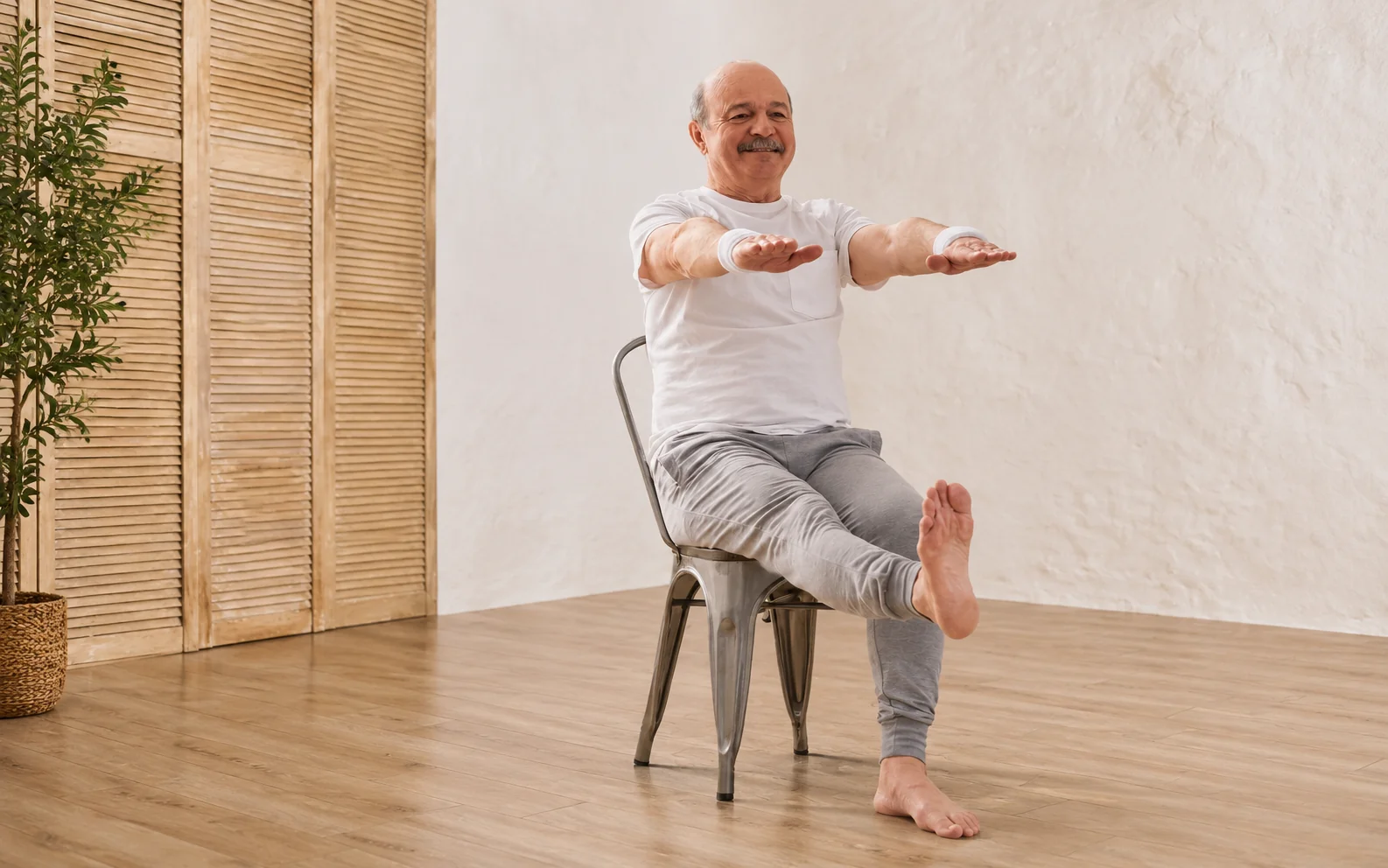
Chair yoga for men over 60 uses a sturdy chair for support during stretching, strengthening, and balance practice. In studies of older adults, yoga improved balance and mobility (1). Compared with inactive groups, participants also improved leg strength and flexibility (2). These eight poses can be adapted for practice at home. For more seated options, see our chair yoga for men guide.
If you have joint, muscle, or spine-related concerns, please consult your physician before starting this workout.
Key takeaways
These points sum up research on yoga, falls, activity advice, and muscle loss in older adults.
- In adults aged 60 and over, yoga gave a small gain in balance and a medium gain in mobility (1).
- Compared with inactive groups, yoga improved balance, flexibility, leg strength, and sleep quality in older adults (2).
- Exercise programs cut the rate of falls by 23% in older adults living in the community (3).
- For adults aged 65 and over, weekly activity guidance includes aerobic activity, muscle strengthening and balance practice (4).
- Inactive adults lose 3% to 8% of muscle per decade, and strength training helps counter this (5).
- Chair yoga can be adapted to many fitness levels.
- A stable chair provides support for both seated and standing poses.
Is yoga good for 60-year-old men?
Research in older adults covers varied yoga programs rather than this specific chair routine for men. A review in adults aged 60 and over found a small balance effect across 6 trials and a medium mobility effect across 3 trials (1).
A larger review compared yoga with inactive groups in older adults. Yoga improved balance, lower body flexibility, leg strength, and sleep quality (2). Compared with other active groups, it also improved leg strength and flexibility (2).
Why is chair yoga a good fit for older men?
The chair gives support, so you can focus on form and breathing. You do not need to get up and down from the floor.
- It lowers the balance demand while you learn poses.
- It can suit men with stiff hips or tight hamstrings.
- It can be done at home with no special equipment.
- Moves can be made smaller or larger as needed.
- It pairs well with walking and strength training.
What do you need to get started?
A sturdy chair and a little floor space are enough.
- A stable chair without wheels or arms
- A non-slip floor, or the chair placed against a wall
- Comfortable clothes that let you move
- Shoes with grip, or bare feet on a non-slip surface
- A counter or table close by for standing poses
What are 8 chair yoga poses for men over 60?
These poses cover breathing, flexibility, strength, and balance. Move slowly and stay in a range that feels comfortable.
1. Seated mountain pose
- Sit tall near the front of the chair with your feet flat.
- Rest your hands on your thighs.
- Lengthen your spine and breathe slowly for 5 breaths.
2. Seated cat-cow
- Place your hands on your knees.
- Breathe in, lift your chest, and gently arch your back.
- Breathe out and round your back, tucking your chin.
- Repeat 6 to 8 times.
3. Seated side stretch
- Raise your right arm overhead.
- Lean gently to the left and hold for 3 breaths.
- Return to center and switch sides.
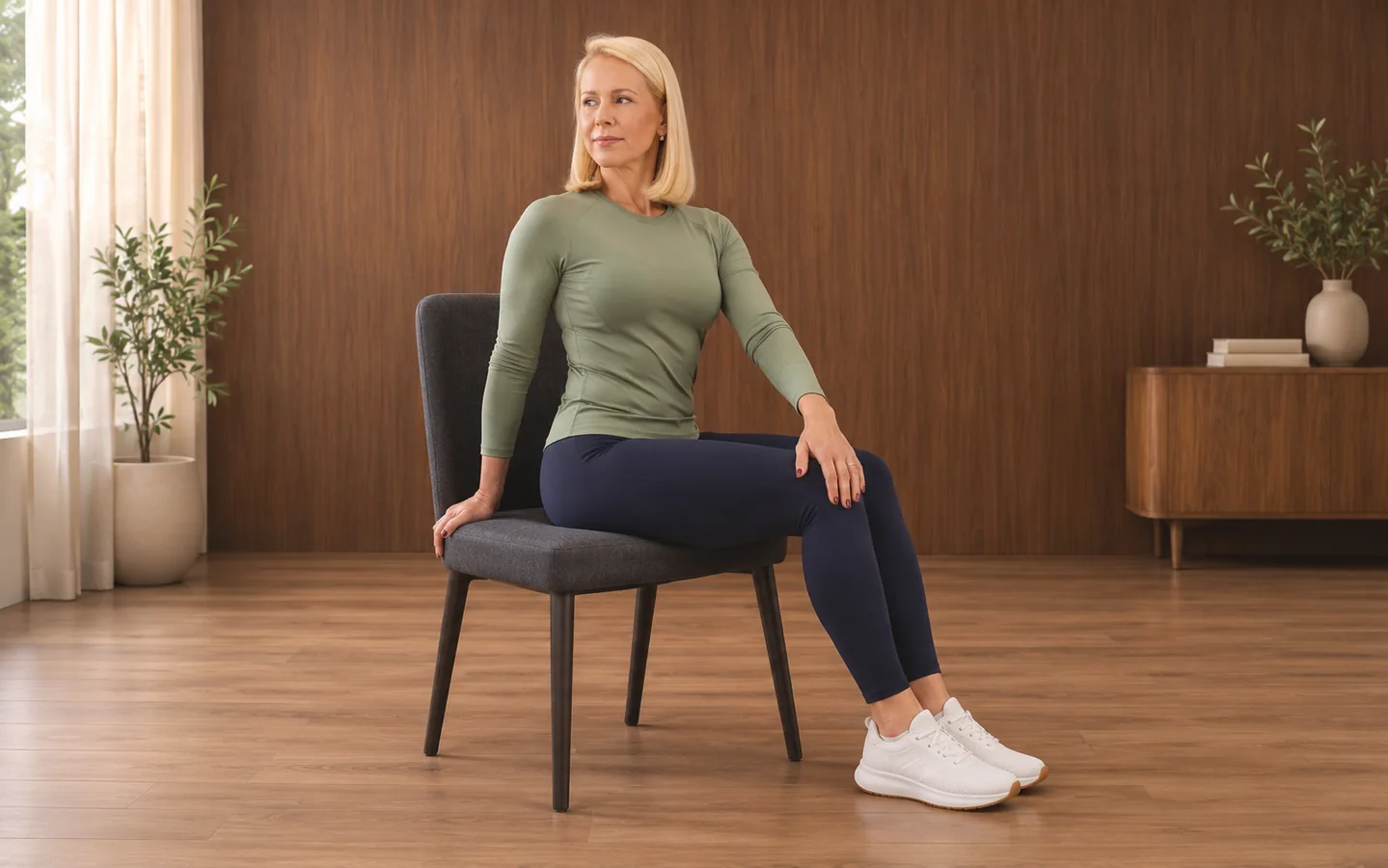
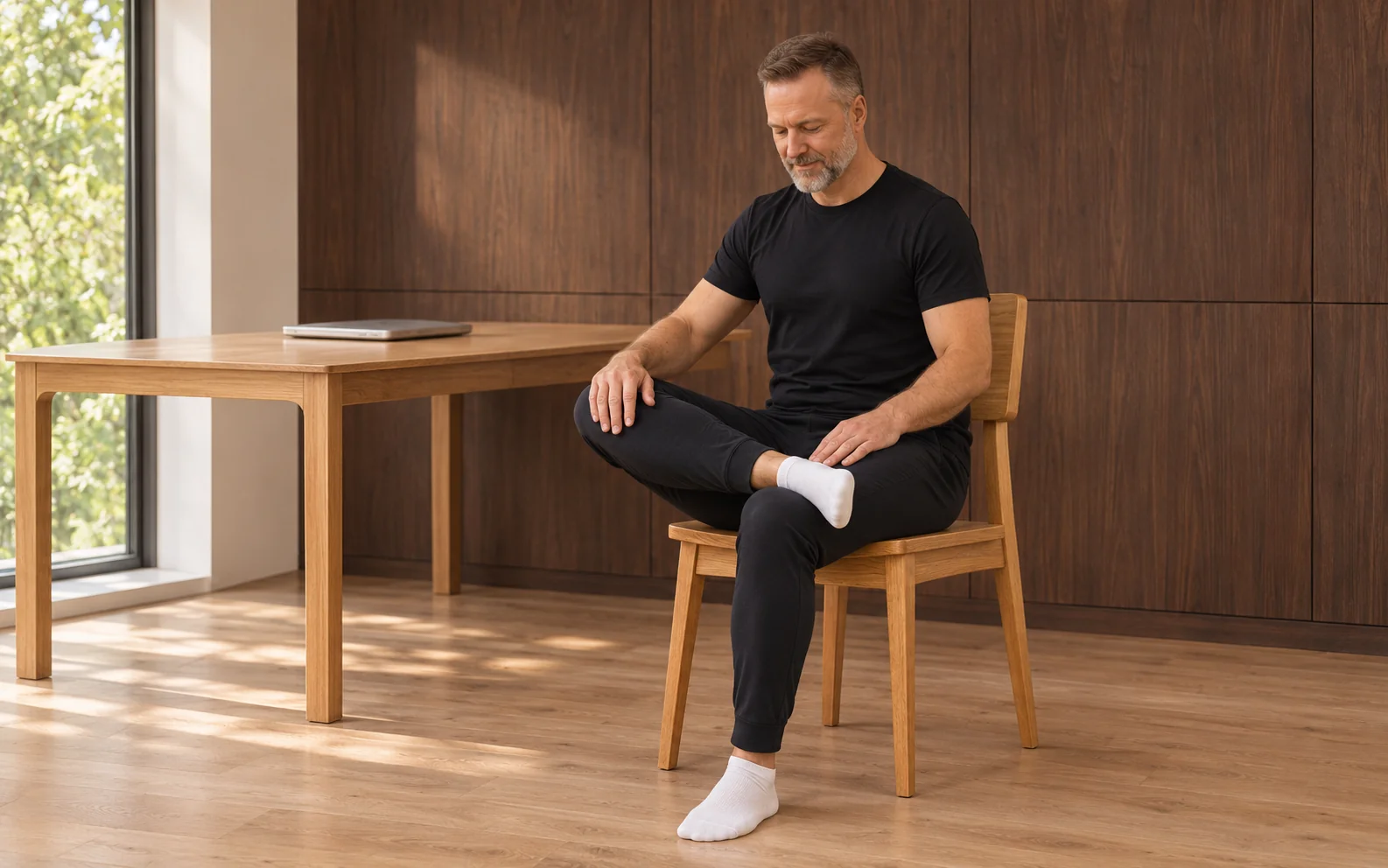
4. Seated twist
- Sit tall and place your right hand on the outside of your left knee.
- Turn your chest gently to the left.
- Hold for 3 breaths, then switch sides.
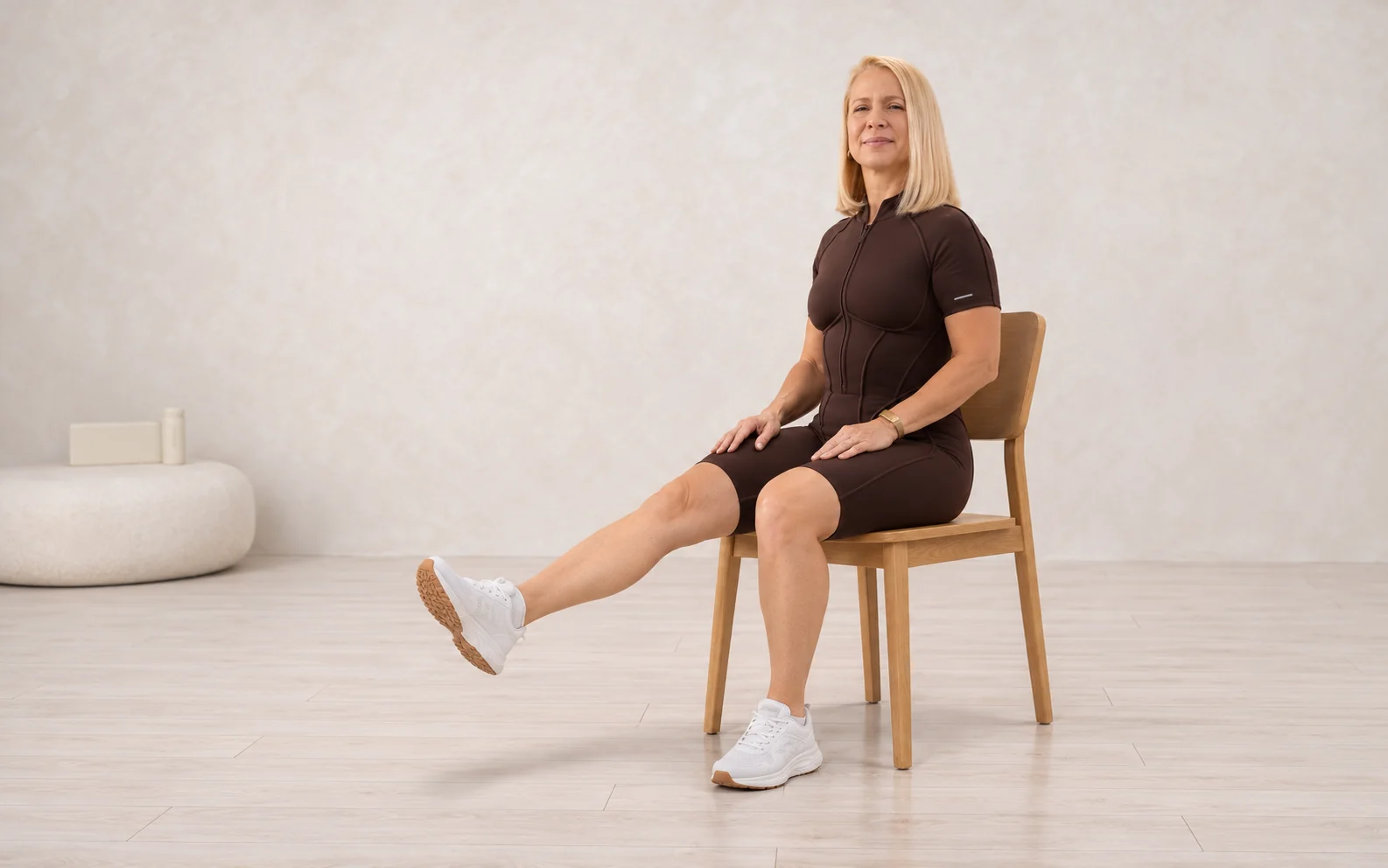
5. Seated hamstring stretch
- Sit near the front edge and straighten your right leg with your heel on the floor.
- Hinge forward from your hips with a straight back.
- Hold for 20 to 30 seconds, then switch legs.
6. Chair squat
- Sit near the front edge with your feet hip-width apart.
- Lean forward slightly and stand up through your heels.
- Lower slowly back to the seat.
- Do 8 to 12 reps.
7. Supported tree pose
- Stand beside the chair and hold its back with one hand.
- Rest the sole of your other foot on your ankle or calf.
- Hold for 15 to 30 seconds, then switch sides.
8. Chair warrior II
- Sit sideways with your right thigh on the seat.
- Extend your left leg behind you with your toes on the floor.
- Reach your arms out to the sides and hold for 5 breaths.
- Switch sides.
Which areas does each pose work?
Compare the movements and choose a version you can control.
|
Pose |
Main focus |
|---|---|
|
Seated mountain |
Posture, breathing |
|
Seated cat-cow |
Spine mobility |
|
Seated side stretch |
Side body, shoulders |
|
Seated twist |
Upper back, core |
|
Seated hamstring stretch |
Back of thighs |
|
Chair squat |
Thighs, glutes |
|
Supported tree |
Balance, hips |
|
Chair warrior II |
Legs, hips, shoulders |
How can you put the poses together?
Try this sequence at a comfortable pace. The repetitions, breaths, and rest breaks determine how long your session lasts. The seated yoga stretches guide offers shorter options.
|
Part |
Exercise |
Time or reps |
|---|---|---|
|
Warm-up |
Neck rolls, shoulder rolls, ankle circles |
3 minutes |
|
Breathing |
Seated mountain pose |
5 breaths |
|
Spine |
Cat-cow, side stretch, twist |
5 minutes |
|
Strength |
Chair squats |
2 sets of 8 to 12 |
|
Balance |
Supported tree pose |
2 holds per side |
|
Legs and hips |
Chair warrior II |
5 breaths per side |
|
Cool-down |
Seated hamstring stretch, slow breathing |
4 minutes |
What does a 6-week plan look like?
Increase time and difficulty slowly. Adjust the sample schedule to your week.
|
Weeks |
Sessions |
Focus |
|---|---|---|
|
1 to 2 |
3 a week, 15 minutes |
Learn the poses and breathing |
|
3 to 4 |
3 to 4 a week, 20 minutes |
Add a second set of chair squats |
|
5 to 6 |
4 a week, 20 to 25 minutes |
Hold balance poses longer, lighter grip on the chair |
How should you warm up and cool down?
A short warm-up prepares your joints, and a cool-down helps you relax.
- Roll your shoulders 10 times each way.
- Turn your head slowly side to side 5 times.
- Circle each ankle 10 times.
- March in place while seated for 1 minute.
- After the session, breathe slowly for 1 to 2 minutes.
Why do balance and strength matter after 60?
Muscle mass declines with age, especially without regular activity. Inactive adults lose 3% to 8% of muscle per decade (5).
Falls also become more common with age. Exercise programs cut the rate of falls by 23% in older adults living in the community (3). Programs that included balance and functional exercise had the clearest effect (3).
How does chair yoga fit with other exercise?
For adults aged 65 and over, guidance recommends at least 150 minutes of moderate aerobic activity per week or an equivalent amount of vigorous activity, muscle strengthening on at least two days, and balance practice (4).
|
Day |
Plan |
|---|---|
|
Monday |
Chair yoga, 20 minutes |
|
Tuesday |
Brisk walk, 30 minutes |
|
Wednesday |
Strength work, such as chair squats and wall push-ups |
|
Thursday |
Chair yoga, 20 minutes |
|
Friday |
Brisk walk, 30 minutes |
|
Saturday |
Chair yoga or light gardening |
|
Sunday |
Rest |
How should you breathe during chair yoga?
Slow, steady breathing keeps you relaxed and helps you hold good form.
- Breathe in through your nose as you sit tall or lift your arms.
- Breathe out slowly as you twist, fold, or lower.
- Keep breathing during holds rather than pausing your breath.
- Rest if you feel light-headed, and sit up slowly after folds.
Should you practice at home or in a class?
You can combine class practice with short sessions at home.
|
Option |
Pros |
Points to consider |
|---|---|---|
|
Home practice |
Flexible timing, no travel, low cost |
Harder to check your form |
|
Group class |
Teacher feedback, social contact |
Fixed times, may cost more |
|
Online video |
Guidance at home |
Choose classes made for older adults |
A class can help you learn the poses before you practice alone.
How can you make poses easier or harder?
Change one thing at a time as your body adapts.
|
Pose |
Easier |
Harder |
|---|---|---|
|
Chair squat |
Use your hands on your thighs |
Lower more slowly, pause above the seat |
|
Supported tree |
Keep your toes on the floor |
Lighten your grip on the chair |
|
Seated twist |
Turn only your head and shoulders |
Hold for 5 breaths |
|
Hamstring stretch |
Bend the front knee slightly |
Reach a little further forward |
How do you know you are progressing?
Track a few simple markers every 2 weeks.
- Chair squats you can do with good form
- How long you hold supported tree pose
- How far you reach in the hamstring stretch
- How easily you get up from a chair or car seat
Which mistakes should you avoid?
Avoid these common mistakes.
- Using a chair with wheels or one that slides
- Holding your breath during poses
- Forcing stretches past a comfortable range
- Letting go of the chair too soon in balance poses
- Skipping the warm-up
Who should be careful?
Get advice from a doctor before starting if you have:
- Heart disease or high blood pressure
- Balance problems, dizziness, or a recent fall
- A hip or knee replacement
- Recent surgery or a back condition
Frequently Asked Questions
How often should a 60-year-old do yoga?
At age 60, two to four short chair yoga sessions is one possible schedule. Adjust the number to your comfort, other activities and recovery. The specific balance guidance for older adults applies from age 65 (4).
Has this chair sequence been studied in men over 60?
The reviews included adults aged 60 and over doing several styles of yoga. They found improvements in balance and mobility (1) and in leg strength and lower-body flexibility versus inactive groups (2). They did not separately test this sequence in men over 60.
How long until you notice changes?
Track how steadily you can stand or how comfortably you can rise from a chair. The studies measured changes over structured programs and did not establish when a particular person would notice a difference.
Can chair yoga replace strength training?
Chair squats work the legs. Adults aged 65 and over are also advised to strengthen all major muscle groups on at least two days a week (4). Add exercises for areas your chair routine does not challenge.
What if I cannot stand up from the chair without my hands?
Use your hands on your thighs or the chair at first. Practice with a higher seat, then lower it over time.
The bottom line
Choose a few supported poses you can repeat comfortably. Add walking and strength work to suit your ability and schedule. For a standing-and-seated mix, see our chair exercises for seniors guide.
DISCLAIMER:
This article is intended for general informational purposes only and does not serve to address individual circumstances. It is not a substitute for professional advice or help and should not be relied on for making any kind of decision-making. Any action taken as a direct or indirect result of the information in this article is entirely at your own risk and is your sole responsibility.
BetterMe, its content staff, and its medical advisors accept no responsibility for inaccuracies, errors, misstatements, inconsistencies, or omissions and specifically disclaim any liability, loss or risk, personal, professional or otherwise, which may be incurred as a consequence, directly or indirectly, of the use and/or application of any content.
You should always seek the advice of your physician or other qualified health provider with any questions you may have regarding a medical condition or your specific situation. Never disregard professional medical advice or delay seeking it because of BetterMe content. If you suspect or think you may have a medical emergency, call your doctor.
SOURCES:
- Yoga-based exercise improves balance and mobility in people aged 60 and over: a systematic review and meta-analysis (2016, doi.org)
- The effects of yoga compared to active and inactive controls on physical function and health related quality of life in older adults: systematic review and meta-analysis of randomised controlled trials (2019, doi.org)
- Exercise for preventing falls in older people living in the community (2019, doi.org)
- Older adult activity: an overview (2025, cdc.gov)
- Resistance training is medicine: effects of strength training on health (2012, doi.org)
 Reviewed by

 Reviewed by