
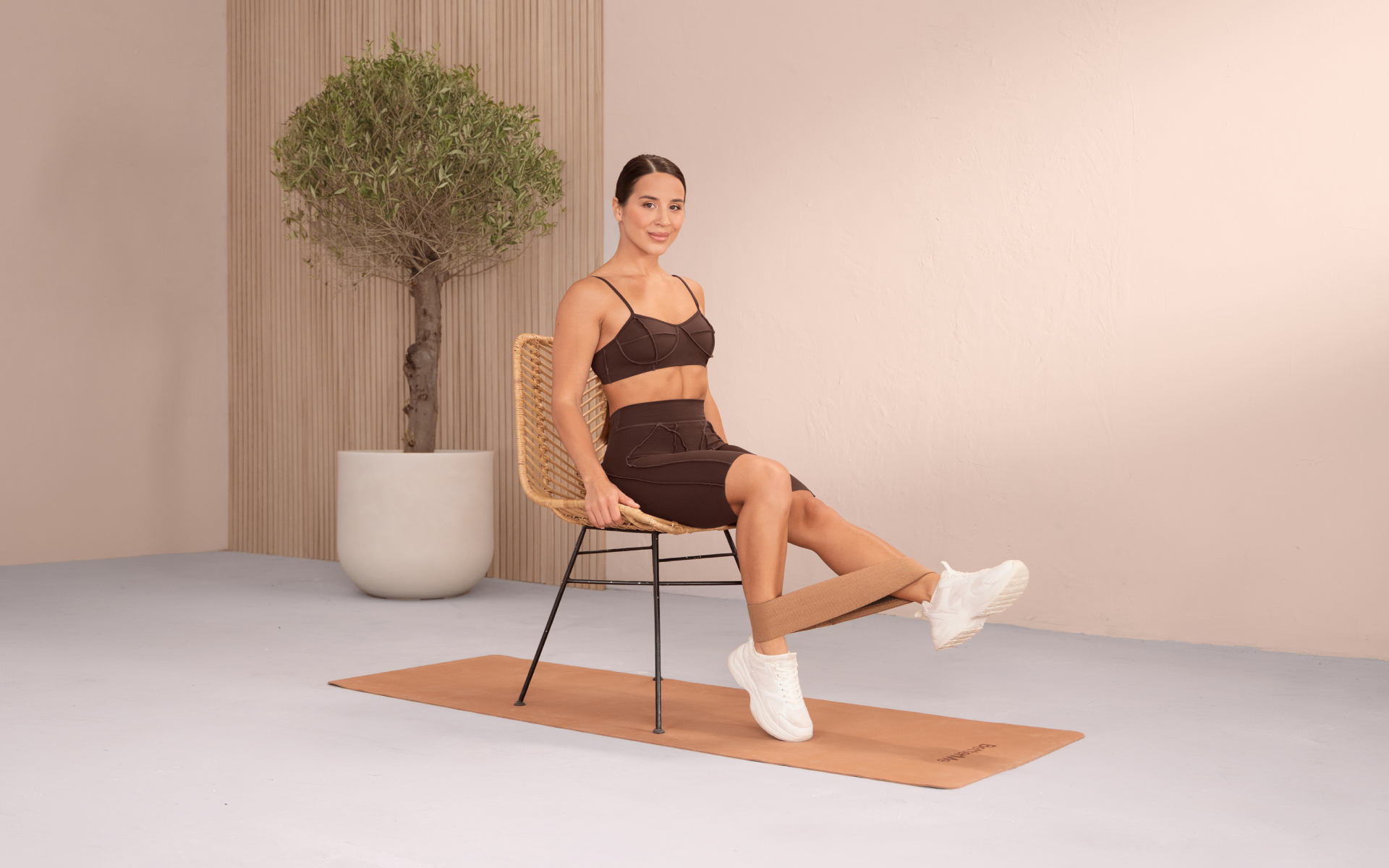
Ankle resistance band exercises use a stretchy elastic band to add gentle, adjustable resistance to ankle movements. They can help you target the small muscles that support ankle control. For many people, such exercises work best when done a few times each week, and progressed slowly over several weeks.
Weak or wobbly ankles can make everyday movement feel less steady. The good news is that you don’t need a gym or fancy equipment to work on it. A single resistance band—an inexpensive elastic strip that adds controllable tension—can go a long way at home.
This guide is for anyone who wants simple, practical ankle work they can do on the couch or the floor. We’ll cover what bands add, how to pick one, five moves to try, a short routine, and how to build over time.
Are you ready to give your ankles a little attention? Grab a band, find a comfy spot, and let’s walk through it together, step by step.
What Do Resistance Bands Add to Ankle Exercises?
Resistance bands add adjustable, direction-specific tension to ankle movements, making otherwise easy motions more challenging. This extra load helps you target the muscles that support ankle control.
Simple ankle motions without resistance tend to get too easy, too fast. A band fixes this by letting you scale the effort up or down.
Here’s what banded ankle exercises can offer:
- Progressive load through the full movement
- Direction-specific training for each ankle motion
- Repeatable resistance you can do at home
- Focus on the smaller muscles around the ankle
Bands let you train four key movements:
- Plantar flexion: pointing your toes away, such as pressing a gas pedal
- Dorsiflexion: pulling the top of your foot toward your shin, such as letting your foot off the gas
- Inversion: turning the sole of your foot inward
- Eversion: turning the sole of your foot outward
Some research on ankle programs has suggested that combining ankle resistance exercises with balance practice tends to support better results than strength alone (1, 2). So bands are a useful piece, not the whole puzzle. When you’re training your ankles (and the rest of your body), it is important to focus on movements that you perform daily.
For many people, resistance band ankle exercises are particularly handy for the outer-ankle muscles (the evertors), which often need attention after a history of the ankle turning inward.
That being said, bands aren’t a full replacement for standing work. You’ll still benefit from single-leg balance, calf raises, and later, more dynamic movement.
Think of bands as your entry point. They build controllable strength before you progress to harder, weight-bearing tasks.
If you enjoy adding light load to movement, you might also like exploring Walking With Ankle Weights for a different take on lower-leg training.

How Do You Choose the Right Resistance Band for Ankle Exercises?
You choose the right resistance band by picking one that challenges your ankle without distorting the movement. The goal is meaningful effort with smooth, full-range control.
Band color is not standardized across brands. One brand’s “red” may feel very different from another’s. So choose by feel, not by color.
A good band lets you:
- Complete about 8-15 controlled reps
- Feel the target muscles working by the last 2-3 reps
- Move through full range without jerking
- Avoid twisting your hip or curling your toes to cheat
Use this quick guide to find your fit:
| Sign | What it means | What to do |
|---|---|---|
| You breeze past 20 reps with no fatigue | The band is likely too light | Move to a firmer band |
| You can't reach full range, or you twist your leg | The band is likely too heavy | Switch to a lighter band |
| The last 2-3 reps feel challenging but controlled | The band is a good match | Stay here and progress slowly |
A practical starting target is moderate effort—around 5-7 out of 10—with about 2-4 reps left in reserve. This means that you could do a few more reps, but not many.
This approach keeps things beginner-friendly. You’re building control first, not chasing fatigue.
If you’re brand new to bands, start on the lighter side. You can always add tension as the moves feel easier. Individual experience varies, so let your own comfort guide the pace.
Once you’ve found a band you like, you’ll be set for a wide range of resistance band ankle exercises, and many other lower-body moves too.
Read more: Resistance Band Chest Workout For A Muscular And Bigger Chest

What Are Some Ankle Resistance Band Exercises to Try?
Some of the most useful ankle band exercises target the four main foot movements: dorsiflexion, plantar flexion, inversion, and eversion (3). Together, they cover the muscles that support ankle control from every angle.
Below is a quick overview. Detailed steps follow in the instruction section.
| Exercise | Main focus | Suggested sets and reps | Best for |
|---|---|---|---|
| Banded dorsiflexion | Front of the shin | 2-3 sets × 10-15 | Foot control during walking |
| Banded plantar flexion | Calf and push-off | 2-3 sets × 10-15 | Ankle push strength |
| Banded eversion | Outer-ankle muscles | 2-3 sets × 10-15 | Side-to-side stability |
| Banded inversion | Inner-ankle muscles | 2-3 sets × 10-15 | Balanced ankle control |
| Banded diagonal pattern | Combined motions | 2 sets × 10 | Functional movement |
These moves are simple to set up. Most of them can be done seated on the floor, which makes them easy to fit into a relaxed evening.
A few pointers to keep in mind:
- Move slowly, particularly on the return phase
- Keep the movement at your ankle, not your whole leg
- Breathe steadily and stay relaxed
Banded ankle dorsiflexion and its partner motions form the backbone of most ankle band workouts. You don’t need all five on day one—starting with two or three is perfectly fine.
If any move causes sharp discomfort, ease off and reduce the tension. Mild muscle fatigue is expected—anything sharper is your cue to pause.
Seated ankle band exercises are gentle on the body and beginner-friendly, which makes them a comfortable place to start. If you enjoy floor-based band work, you might also explore Pilates Resistance Bands Exercises for a full-body option that pairs nicely with ankle training.
Exercise Instructions
Here’s how to perform each move with good form.
1. Banded Dorsiflexion
This move targets the front of your lower leg for foot control.
- Sit with your leg straight in front of you.
- Anchor the band to a table leg or the opposite foot.
- Loop the band around the top of your foot.
- Slowly pull your foot up toward your shin.
- Lower with control. Repeat for 10-15 reps.
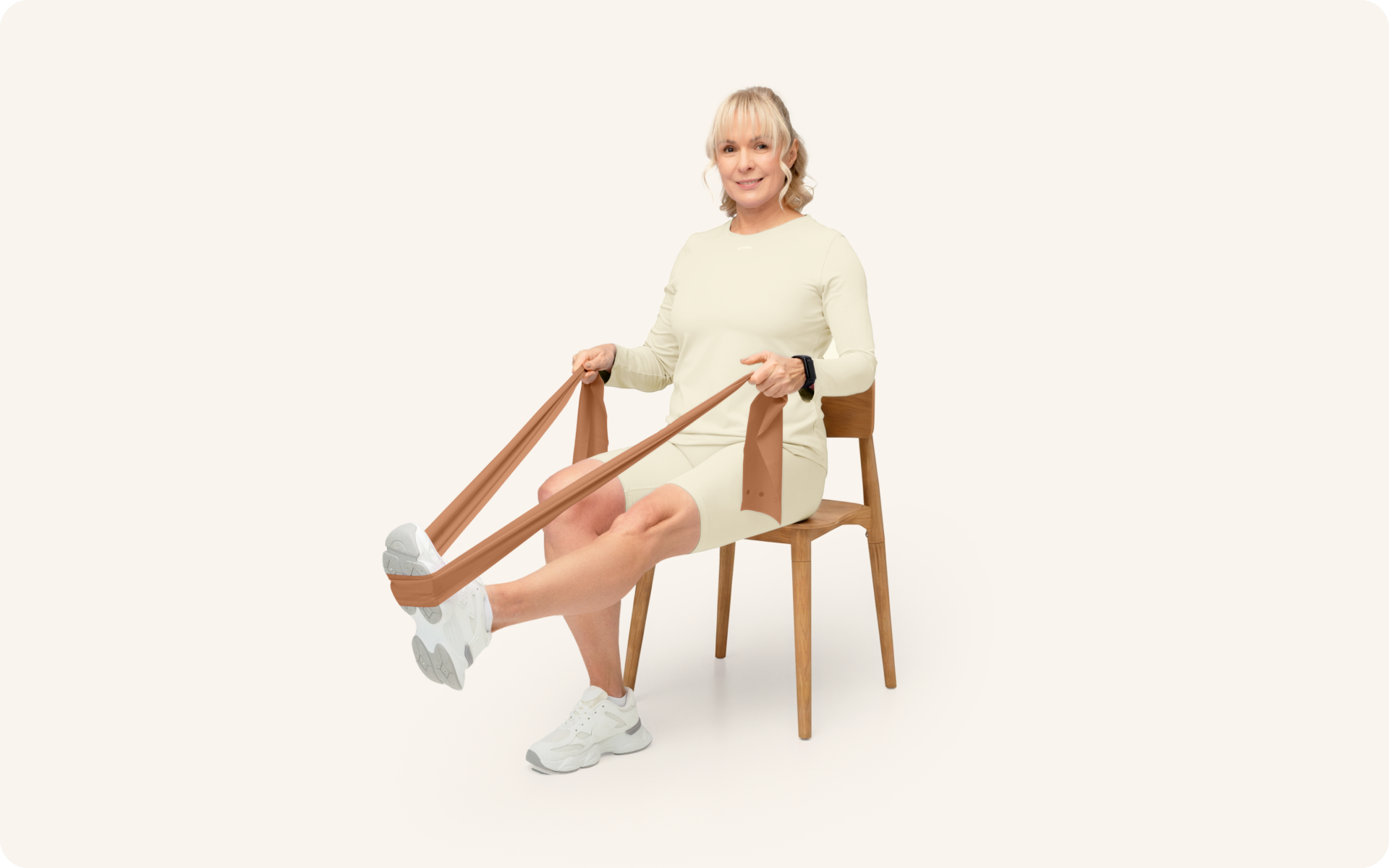
2. Banded Plantar Flexion
This banded ankle plantar flexion move works the calf and push-off pattern.
- Sit with your leg extended.
- Loop the band around the ball of your foot.
- Hold both ends in your hands.
- Press your foot away, as if pushing a gas pedal.
- Return slowly. Repeat for 10-15 reps.
3. Banded Eversion
This banded ankle eversion move targets the outer-ankle muscles.
- Sit with your legs extended.
- Anchor the band on the inner side of your foot.
- Start with your foot turned slightly inward.
- Turn the sole of your foot outward against the band.
- Return slowly. Repeat for 10-15 reps.
4. Banded Inversion
This banded ankle inversion move works the inner-ankle muscles.
- Sit with your legs extended.
- Anchor the band on the outer side of your foot.
- Start in a neutral position.
- Turn the sole of your foot inward against the band.
- Return slowly. Repeat for 10-15 reps.
5. Banded Diagonal Pattern
This move blends motions for more functional control.
- Sit comfortably with the band looped around your forefoot.
- Combine a gentle point with a slight inward turn.
- Or try a lift with a slight outward turn.
- Move slowly through the pattern.
- Repeat for 10 controlled reps per direction.
BetterMe can help you add more structure to your daily wellness routine with workouts, meal planning tools, and habit-building features. Explore the app and take a practical step toward a routine that feels more manageable for you.

How Can You Combine Ankle Band Exercises into a Short Routine?
You can combine ankle band exercises into a short routine by pairing a few strengthening moves with a little balance practice. A 10-15-minute session covers the basics without eating into your day.
The idea is balance, literally and figuratively. You’re mixing strength work with steadiness work, which tends to support better ankle control for many people.
Here’s a simple ankle band workout you can follow:
| Order | Move | Sets and reps | Rest |
|---|---|---|---|
| 1 | Banded dorsiflexion | 2 sets × 10-15 | 30 secs |
| 2 | Banded eversion | 2 sets × 10-15 | 30 secs |
| 3 | Banded inversion | 2 sets × 10-15 | 30 secs |
| 4 | Banded plantar flexion or calf raises | 2 sets × 10-15 | 30 secs |
| 5 | Single-leg balance | 2-3 rounds × 20-45 secs | 30 secs |
If you’re short on time, a 5-8-minute version still helps. Prioritize these four:
- Eversion
- Dorsiflexion
- Single-leg balance
- Calf raises
That shorter mix covers lateral stability, front-of-shin control, and functional balance. It’s a solid resistance band ankle routine when your schedule is tight.
A few tips to keep it smooth:
- Warm up with 1-2 minutes of easy ankle circles
- Keep rest short—about 30 seconds between sets
- Finish with gentle calf and foot stretches
Aim for this routine 2-3 times per week on non-consecutive days. This spacing gives your muscles time to recover between sessions.
You can adjust the order to suit your energy. Some people prefer balance work first, while others save it for last. There’s no single right way, so experiment and see what feels best.
If you want a broader full-body plan to build around this, you may enjoy browsing Resistance Band Workouts for Women for more banded ideas.

How Can You Progress Ankle Resistance Band Exercises Over Time?
You progress ankle resistance band exercises over time by increasing difficulty in small, steady steps—starting with control, then volume, then resistance. This gradual build tends to feel manageable and sustainable.
Progression matters more than novelty. You don’t need new exercises every week. You need to slowly raise the challenge of the ones you have.
Here’s a simple progression ladder:
- Control first: smooth reps, full range, slow lowering
- More volume: go from 2 sets to 3 sets, or 10 reps to 15
- More resistance: move to a firmer band once the current one feels easy
- More time under tension: try a 2-second lift and a 3-second return
- More function: shift toward standing and single-leg tasks
Once seated work feels easy, try adding weight-bearing moves like these:
- Standing calf raises
- Single-leg calf raises
- Single-leg balance with a reach
- Slow step-downs
A helpful rule for when to progress: if you can complete 2-3 sessions in a row with good form, and the last reps feel only mildly challenging, it’s time to nudge things up.
You can nudge things up by:
- Adding a firmer band
- Adding reps or a set
- Slowing your tempo
- Moving toward standing tasks
Some research on ankle programs points toward building across multiple areas—strength, balance, and more functional movement—rather than staying with isolated moves forever (4). So progression isn’t just about a stiffer band—it’s about gradually adding real-world movement.
Keep expectations realistic. Changes tend to show up over several weeks of consistent practice, and individual outcomes vary. It depends on your starting point, how often you train, and how your body responds.
If you ever feel sharp discomfort, catching, or ongoing instability, it’s worth checking in with a qualified professional before you push further. General guidance such as this can’t replace a personalized assessment.
Progress at your own pace. Slow, steady steps tend to stick far better than big jumps.
Read more: How Effective Are Resistance Band Workouts?
FAQs
Can beginners do ankle resistance band exercises?
Yes, beginners can do ankle resistance band exercises, and they’re a friendly starting point for many people. Seated moves keep things gentle and low-impact. Start with a light band, 2 sets of 10-15 reps, and focus on smooth control rather than heavy tension. If a move feels sharp, ease off. Building slowly tends to feel more comfortable and sustainable.
What resistance band strength should you start with?
You should start with a light-to-moderate band that lets you complete 8-15 controlled reps with effort around 5-7 out of 10. The last 2-3 reps should feel challenging but doable, with full range of motion. As band colors vary by brand, choose by feel, not color. You can always move to a firmer band as the movement gets easier.
How many reps should you do for ankle band exercises?
You can aim for 2-3 sets of 10-15 reps per ankle band exercise, which suits most beginners. Keep each rep slow and controlled, especially the return phase. If 15 reps feels very easy, add a set or a firmer band. If you can’t reach 10 with good form, lighten the tension. Adjust to match your own comfort.
How often can you do ankle resistance band exercises?
You can do ankle resistance band exercises about 2-3 times per week on non-consecutive days for many people. This spacing gives your muscles time to recover between sessions. Each session might last for 10-15 minutes. If your ankles feel tired, take an extra rest day. Consistency over several weeks tends to matter more than doing them daily.
Can you do ankle resistance band exercises while sitting?
Yes, you can do ankle resistance band exercises while sitting, and seated versions are a common, beginner-friendly choice. Sitting on the floor with your leg extended lets you anchor the band easily and focus on control. Seated ankle band exercises are gentle on the body, which makes them handy for relaxed evenings or a quick break. Move slowly and keep the effort at your ankle.
The Bottom Line
Ankle resistance band exercises give you a simple, adjustable way to support ankle strength and balance right at home. Pair a few banded moves with single-leg balance, progress in small steps over several weeks, and let your own comfort set the pace. Grab your band today and give your ankles the steady attention they deserve—one controlled rep at a time.
DISCLAIMER:
This article is intended for general informational purposes only and does not serve to address individual circumstances. It is not a substitute for professional advice or help and should not be relied on for making any kind of decision-making. Any action taken as a direct or indirect result of the information in this article is entirely at your own risk and is your sole responsibility.
BetterMe, its content staff, and its medical advisors accept no responsibility for inaccuracies, errors, misstatements, inconsistencies, or omissions and specifically disclaim any liability, loss or risk, personal, professional or otherwise, which may be incurred as a consequence, directly or indirectly, of the use and/or application of any content.
You should always seek the advice of your physician or other qualified health provider with any questions you may have regarding a medical condition or your specific situation. Never disregard professional medical advice or delay seeking it because of BetterMe content. If you suspect or think you may have a medical emergency, call your doctor.
SOURCES:
- Effects of combination of strength and balance training on postural control and functionality in people with chronic ankle instability: a systematic review and meta analysis (2024, link.springer.com)
- What Will Deliver the Best Bang-For-Your-Treatment-Buck? Treatment Effects of Physical Therapy Approaches to Managing Chronic Ankle Instability: A Network Meta-Analysis of Randomized Controlled Trials (2025, jospt.org)
- Muscle Strengthening Exercises for the Foot and Ankle: A Scoping Review Exploring Adherence to Best Practice for Optimizing Musculoskeletal Health (2025, pmc.ncbi.nlm.nih.gov)
- Exercise Therapy for Chronic Ankle Instability: Which Modality for Which Deficit? A Systematic Review and Meta‐Analysis (2026, onlinelibrary.wiley.com)

 Reviewed by
 Reviewed by