A good beginners’ leg and glute workout is built on three pillars. Firstly, a warm-up that raises temperature and rehearses the movement patterns you’ll train. There should be a proper exercise selection with both knee-dominant and hip-dominant exercises. And finally and perhaps the most important factor, you must get enough weekly volume and effort to drive progress.
A leg and glute workout combines exercises that load your thighs and glutes in one session. It makes sense to train these muscles in the same routine as they function together in most meaningful lower-body movements.
This guide is for beginners who want to get the most out of their lower body workouts. You’ll learn how to warm up, which moves pair well, how many sets and reps to start with, and how to fit it all into your week.
What Should You Know Before a Leg and Glute Workout?
Before a leg and glute workout, you should know your starting point, your fitness goal, and the main movement patterns you need to train. Then you can pick the right lower body exercises that match your needs.
Your glutes are the muscles in your buttocks. Your leg muscles include the quads (front thigh), hamstrings (back thigh), and calves (1, 2).
Your lower body consists of four major muscle groups:
- Glutes
- Quadriceps
- Hamstrings
- Calves
1. Your Goal
Your workout should match your primary aim:
- General strength/fitness: Balanced lower-body session
- Glute growth: Include more direct hip-extension work and enough weekly glute volume, i.e. barbell hip thrust, cable kickbacks
- Athletic performance: Include forceful hip extension, unilateral work, and possibly power work
- Return from inactivity: Start conservatively and focus on form and consistency
2. The Movement Patterns Involved
Good leg and glute workout programming should cover:
- Squat pattern: Movements that involve flexion and extension in both the hips and knees (back squat, goblet squat, leg press)
- Hinge pattern: Movement that involves significant hip flexion and minimal or no knee flexion—pushing hips back with a flat back (deadlift, Romanian deadlift)
- Single-leg work: Training one leg at a time (single-leg Romanian deadlift, Bulgarian split squat)
- Direct glute work: Moves that focus on hip extension (cable kickbacks, cable hip abduction)
- Optional abduction/lateral stability work
This matters because the glutes contribute to hip extension, pelvic control, and frontal-plane stability.
A “leg day” can bias different tissues:
- Knee-dominant work: Squat, split squat, leg press, step-up
- Typically hits quads heavily, with glutes assisting
- Hip-dominant work: Hip thrust, Romanian deadlift, deadlift variations, back extension
- Typically emphasizes glutes and posterior chain more
Also, recent review data supports the use of multiple exercise types rather than assuming one exercise covers everything (3).
3. Recent Evidence Favors Consistency over Complexity
General resistance-training guidance emphasizes that the biggest gains usually come from doing resistance training consistently, not from chasing an overly complicated “perfect” routine (3). Drop sets, forced reps, or training to failure are optional, not required.
4. Soreness is Not the Goal
It’s normal to feel some soreness when you start lifting. It’s also normal for the soreness to reduce over time (4). You may get to a point where, even after a well-programmed session, your muscles feel OK. That’s normal, as muscle soreness isn’t really the best indicator or a good workout.
As a beginner, it may be useful to focus on:
- Learning the movements
- Using steady effort
- Maintaining good form
- Recovering well
- Coming back for the next session
Workouts, weight management tools, and recipe ideas come together in the BetterMe Well-Being Coach app, giving you practical support for building a more consistent wellness routine.
Why Do Legs and Glutes Work Well in the Same Routine?
Legs and glutes work well in the same routine as they share movement and support each other during most lower-body exercises. Training them together is efficient and practical.
Take a squat. It works your quads, glutes, and often your hamstrings in one move (5), so you get more done in less time.
Your gluteus maximus is your biggest buttock muscle. It drives hip extension, which means straightening your hip. This happens in squats, lunges, and step-ups (6).
That’s why glute and leg exercises fit naturally in one session—you rarely train one without the other.
Why does this matter? You don’t need a separate “glute-only” day as a beginner. A well-built lower body strength workout can grow and strengthen both at once.
Some research has suggested that both single moves and mixed lower-body programs can build glute size (7), so you have flexibility in how you train.
A quick reason this helps busy people:
- Fewer sessions to schedule
- More muscles worked per workout
For many people, two combined sessions weekly is enough to see steady progress. Individual results vary based on effort, sleep, and consistency.
Read more: Side Glutes Exercises Gym Guide for Toned Hips and a Confident You
How Should You Warm Up Before Leg and Glute Exercises?
You should warm up before leg and glute exercises with light cardio, dynamic movements, and a few lighter “ramp-up” sets. This preparation can lower strain and help you move better (8).
A 2024 study comparing glute pre-activation options used a warm-up including low-intensity jogging plus dynamic lower-body preparation. This is a sensible template before harder lower-body work (9).
Use this simple three-step warm-up. It takes about 10-15 minutes.
Step 1: General warm-up (5 minutes)
Raise your body temperature with easy movement, such as:
- A brisk walk or light jog
- Easy cycling
Step 2: Dynamic movement prep (5 minutes)
Rehearse the patterns you’ll train. You can perform 10 repetitions of each movement, without weights. Good options include:
- Bodyweight squats
- Hip hinges
- Reverse lunges
- Leg swings
- Lateral steps
Step 3: Ramp-up sets
Do lighter versions of your first lift before adding weight. For a squat, you might do:
- Empty bar or bodyweight × 8-10
- Light load × 5
- Moderate load × 3
- First working set
Some people struggle to feel their glutes working. If that’s you, a few gentle activation moves may help before heavier lifting. A 2022 paper cited in recent glute research suggests activation training can improve glute recruitment during weight-bearing strengthening tasks (10).
You might do:
- Glute bridge holds
- Banded lateral walks
- Side-lying abduction
- Bodyweight hip thrusts
Avoid long static stretches right before lifting if they leave your muscles feeling too relaxed and less able to produce force (11). Static stretches are those that you hold in place, as opposed to the dynamic movements that involve moving a joint through a range of motion (ROM). Save static stretches for after your session (12).
If you want a deeper primer, you can explore our guide to glute activation exercises for more warm-up ideas.
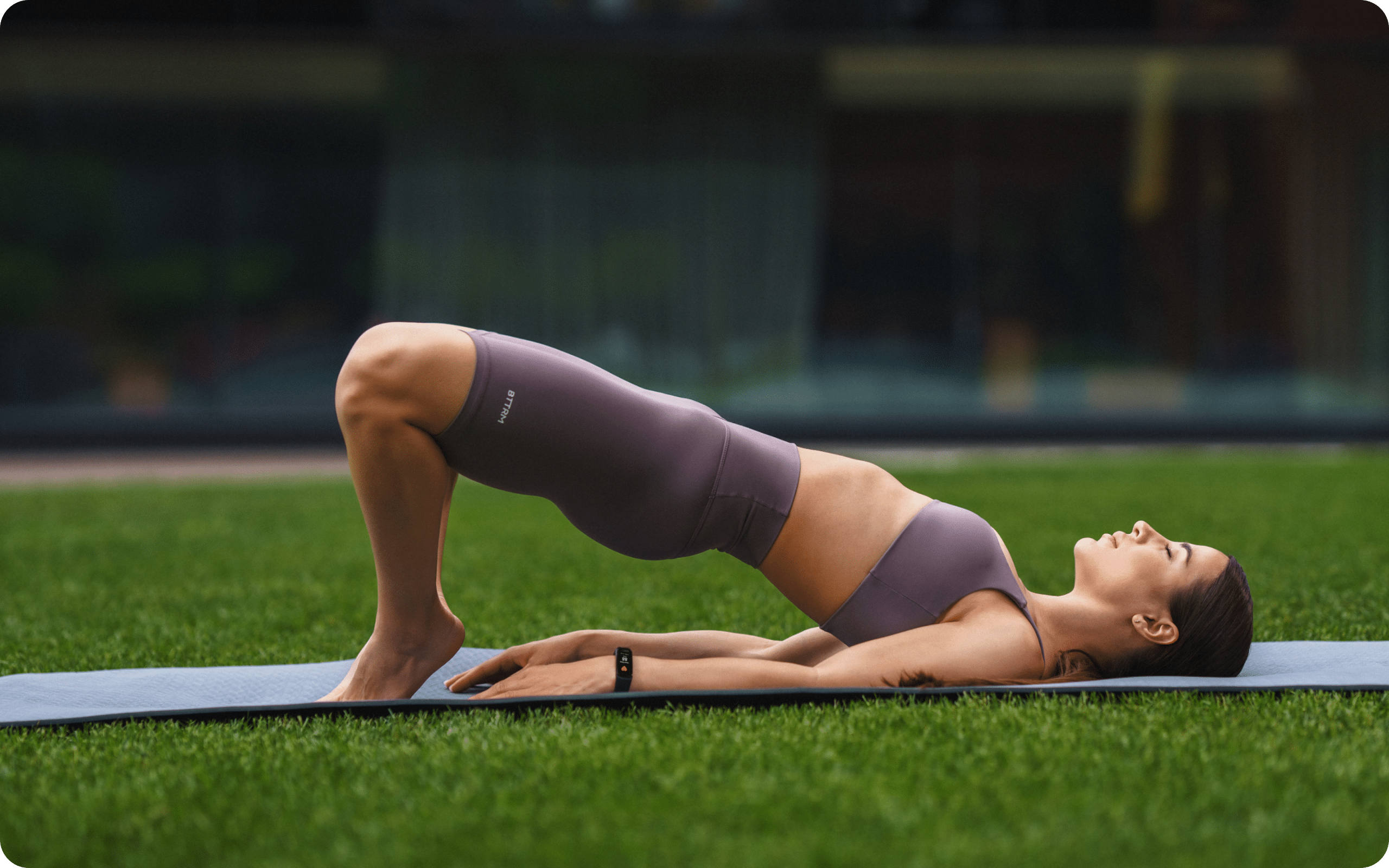
Which Leg Exercises Pair Best With Glute Work?
The leg exercises that pair best with glute work combine a knee-focused move with a hip-focused move. This balance trains your thighs and buttocks together.
A squat and lunge workout covers knee-focused patterns well. Pair it with a hip-focused move such as a hip thrust for balance.
Here’s a simple way to think about pairing. Match one move from each column.
| Knee-dominant move | Hip-dominant pair | Why it works | Best for |
|---|---|---|---|
| Back squat | Hip thrust | Broad leg stimulus plus strong glute focus | Overall lower body |
| Bulgarian split squat | Romanian deadlift | Single-leg control plus posterior chain | Balance and shape |
| Leg press | Glute bridge | Machine support plus direct glute work | New beginners |
| Step-up | Back extension | Athletic carryover plus hip extension | Everyday strength |
For hamstring and glute exercises, the Romanian deadlift is a strong choice. It loads the back of your thighs and your glutes together (13).
Do you want to focus on your outer glutes too? A dedicated side booty workout can add lateral moves like banded steps.
Below is a beginner-friendly sample program you can try twice per week.
| Exercise | Sets | Reps | Rest |
|---|---|---|---|
| Goblet squat | 3 | 8-12 | 2 mins |
| Glute bridge | 3 | 10-15 | 90 secs |
| Reverse lunge | 2 | 8-10 per leg | 90 secs |
| Romanian deadlift | 3 | 8-12 | 2 mins |
| Banded lateral walk | 2 | 12-15 per side | 60 secs |
Goblet Squat
- Hold a dumbbell close to your chest with both hands.
- Stand with your feet a little wider than hip-width apart.
- Bend your knees and hips to lower down.
- Keep your chest tall and your heels planted.
- Push through your feet to stand back up.
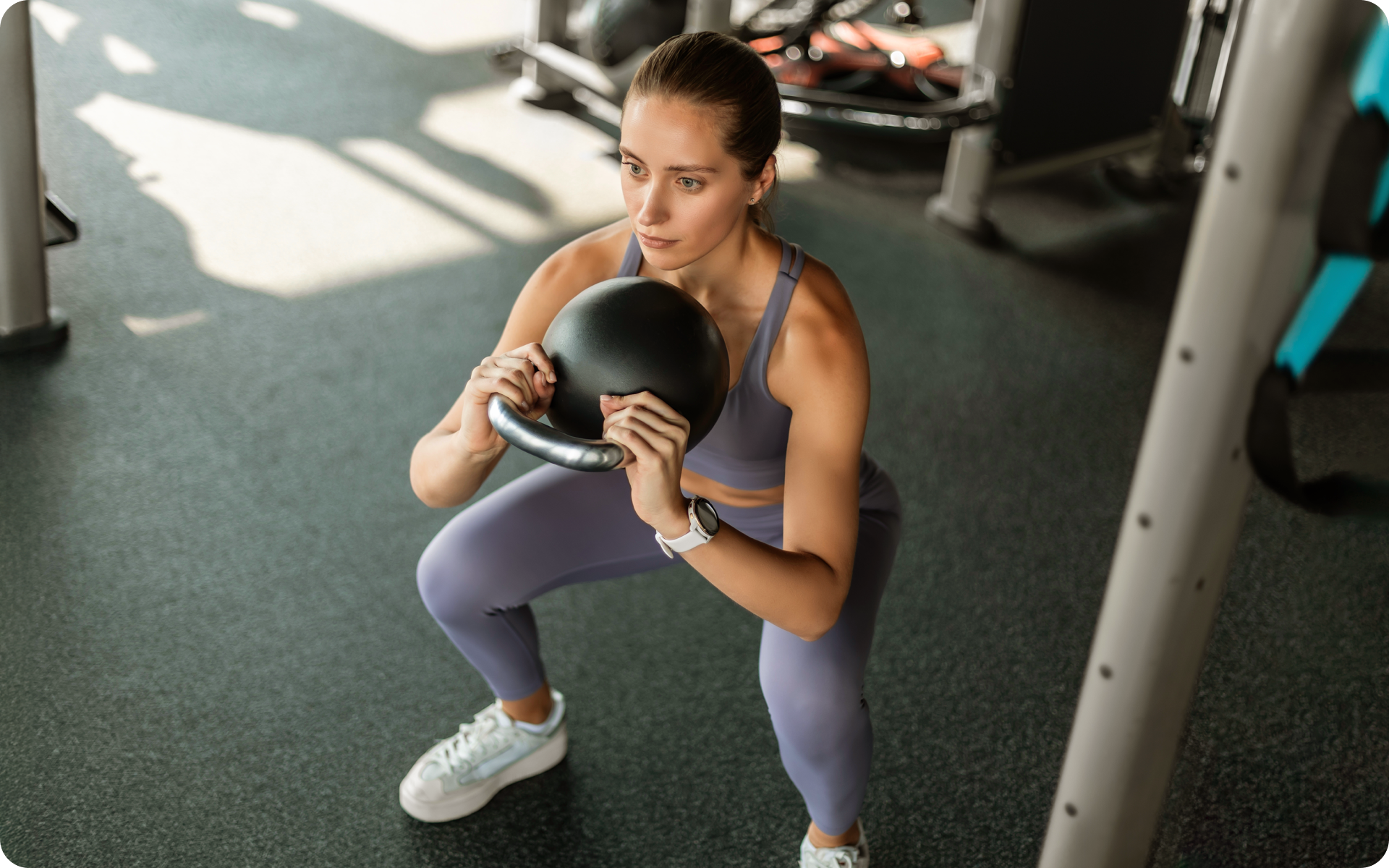
Glute Bridge
- Lie on your back with your knees bent and your feet flat.
- Keep your feet about hip-width apart.
- Push through your heels to lift your hips.
- Squeeze your glutes at the top for one second.
- Lower slowly and repeat.
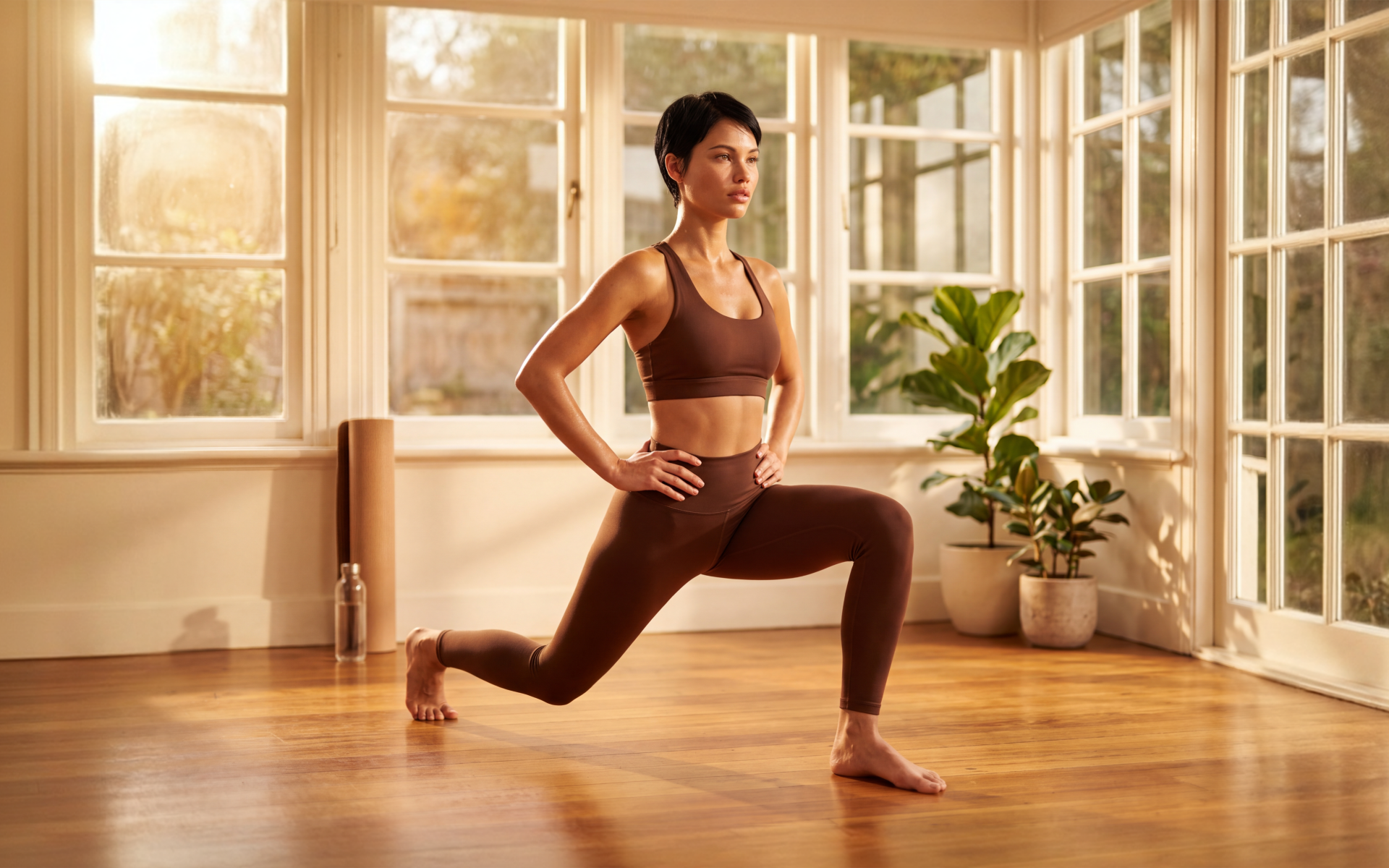
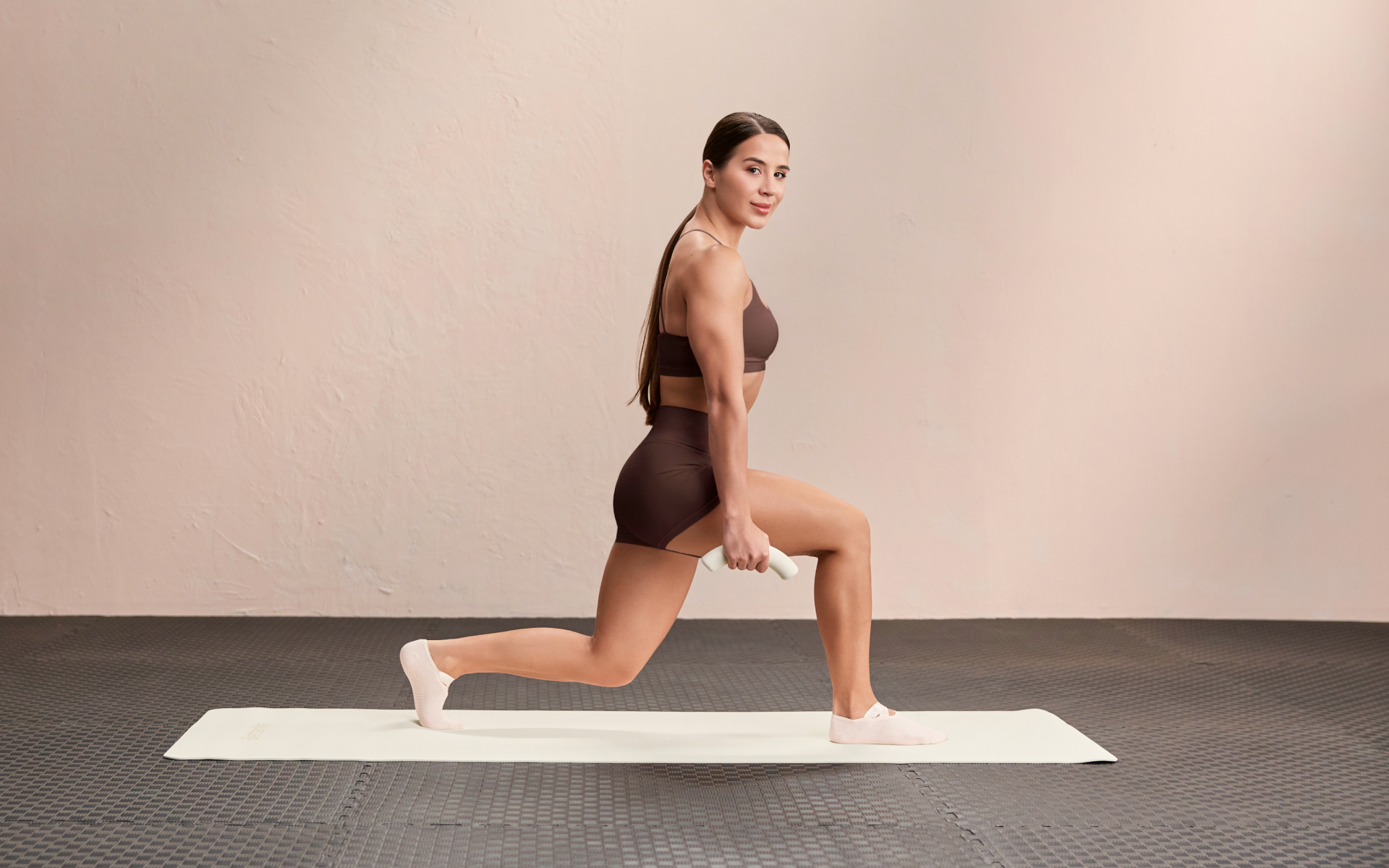
Reverse Lunge
- Stand tall with your feet under your hips.
- Step one foot back and lower your back knee.
- Keep your front knee over your ankle.
- Push through your front foot to stand up.
- Repeat, then switch legs.
Romanian Deadlift
- Hold dumbbells in front of your thighs.
- Keep a soft bend in your knees.
- Push your hips back and lower the weights.
- Keep your back flat and your shins vertical.
- Drive your hips forward to stand tall.
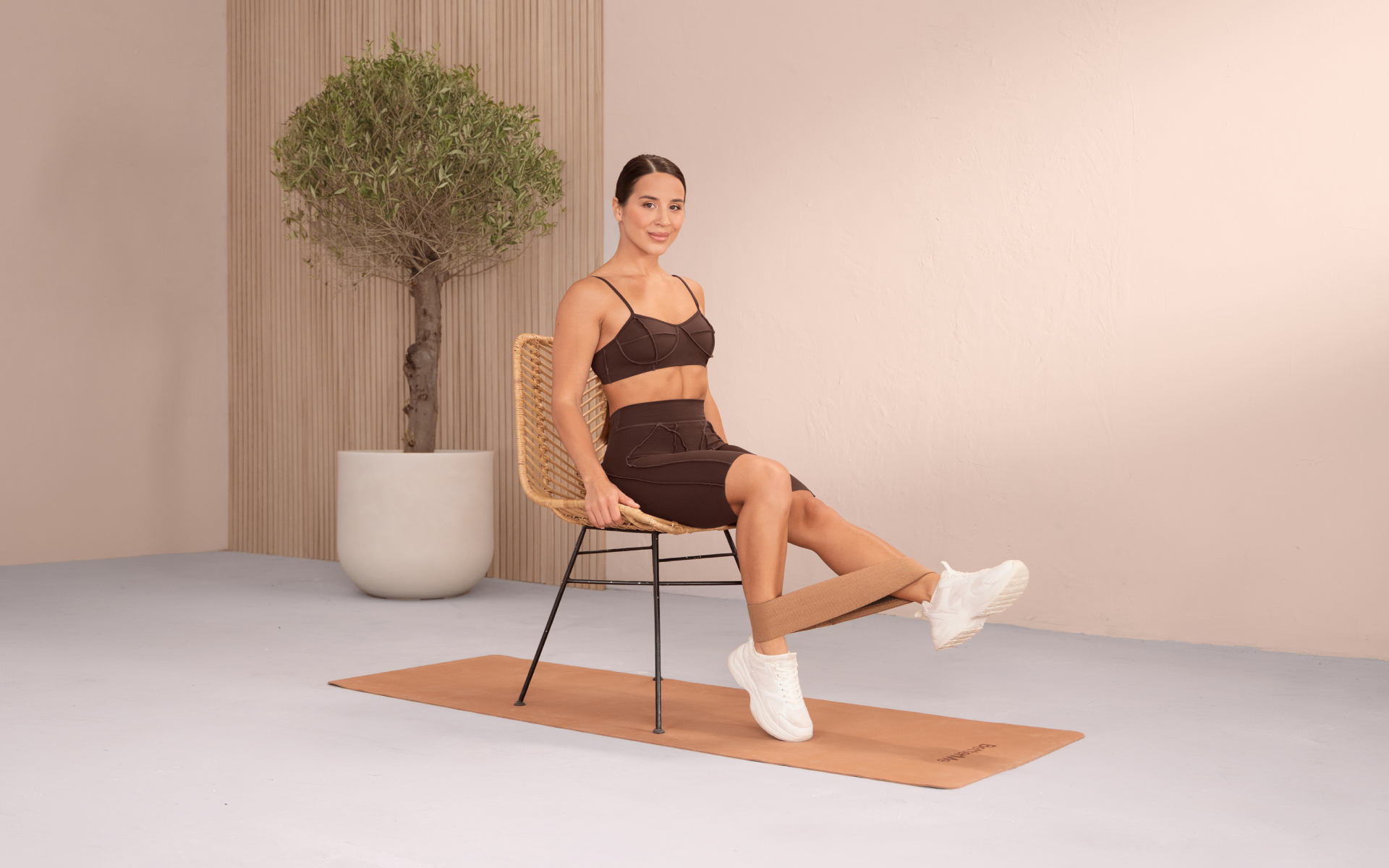
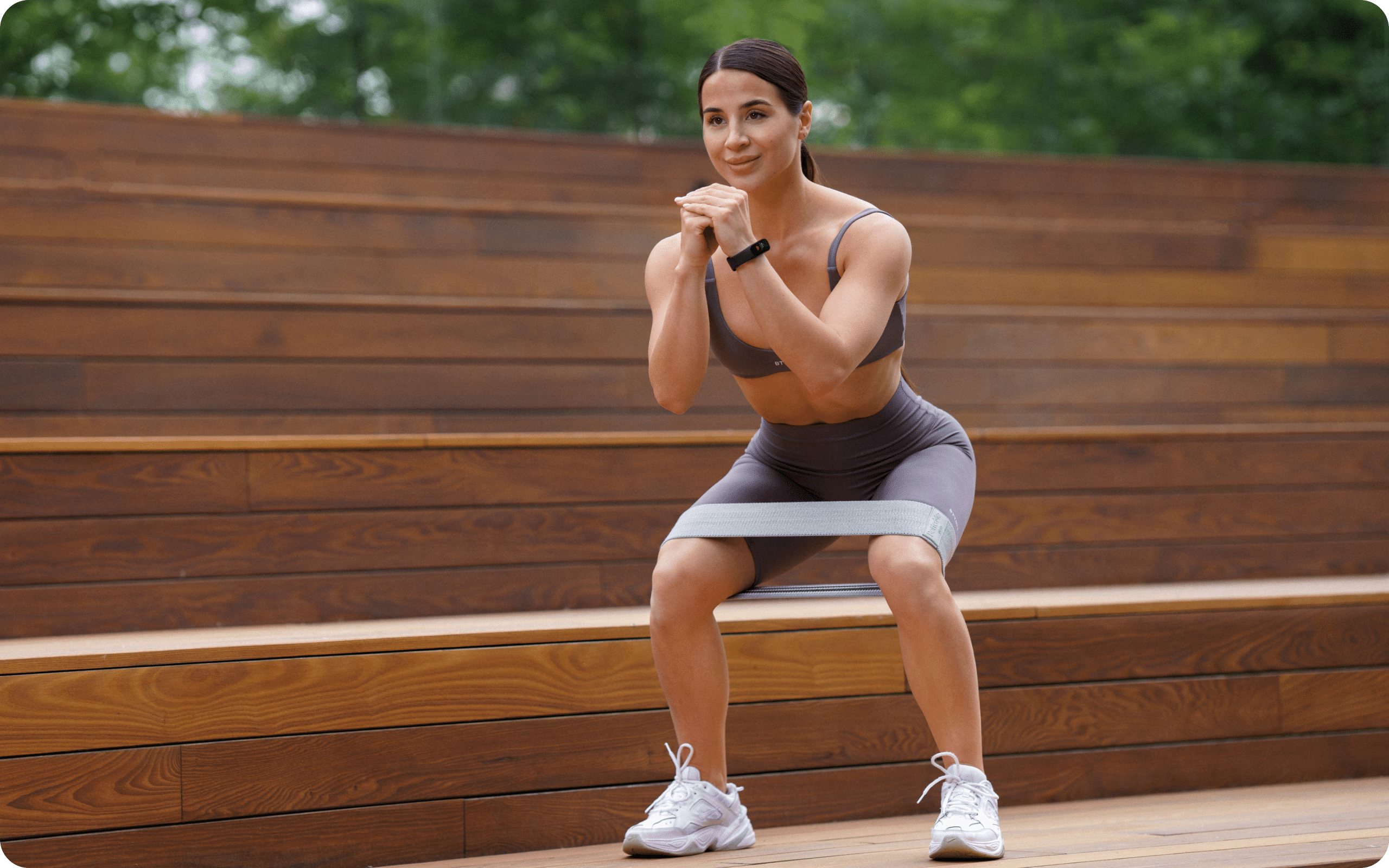
Banded Lateral Walk
- Place a resistance band around your legs, just above the knees.
- Bend into a quarter-squat stance.
- Step sideways, keeping tension on the band.
- Take 12-15 steps in one direction.
- Return the other way.
This dumbbell leg and glute workout keeps equipment simple. You only need a pair of dumbbells and one band.
How Many Sets, Reps, and Rest Breaks Should You Start With?
You should start with 2-4 sets per exercise, 6-12 reps for main moves, and 1-3 minutes of rest. These ranges suit most beginners (14).
Here’s a simple breakdown to follow.
Main lifts (squats, hinges, hip thrusts):
- 2-4 sets
- 6-12 reps
- 1.5-3 minutes rest in between sets
Accessory moves (band walks, side-lying lifts):
- 2-3 sets
- 10-20 reps
- 45-90 seconds rest in between sets
Why rest longer on big lifts? More rest helps you keep good form and force. For example, resting for 2 minutes before a heavy squat set beats rushing after 30 seconds.
How hard should each set feel? Aim to finish with 1-3 reps left in reserve. This means you could do 1-3 more reps if pushed.
A typical session lands around 8-14 total working sets. That’s enough to challenge you without wiping you out.
For example, your leg/glute session may include:
- 1 squat or press variation
- 1 hip hinge variation
- 1 direct glute exercise
- 1 unilateral exercise
- Optional: 1 accessory
For weekly volume, many people aim for about 10 sets per muscle group across the week (15). You can split that over 2 sessions.
Skip training to full failure every set. Most beginners progress well without grinding to exhaustion. Individual experience may vary, so adjust to how you feel.
BetterMe Well-Being Coach app can help you build a more structured approach to your wellness routine with meal plans, workouts, and habit-tracking tools. Start using the app to explore options that may support your personal fitness and nutrition goals.
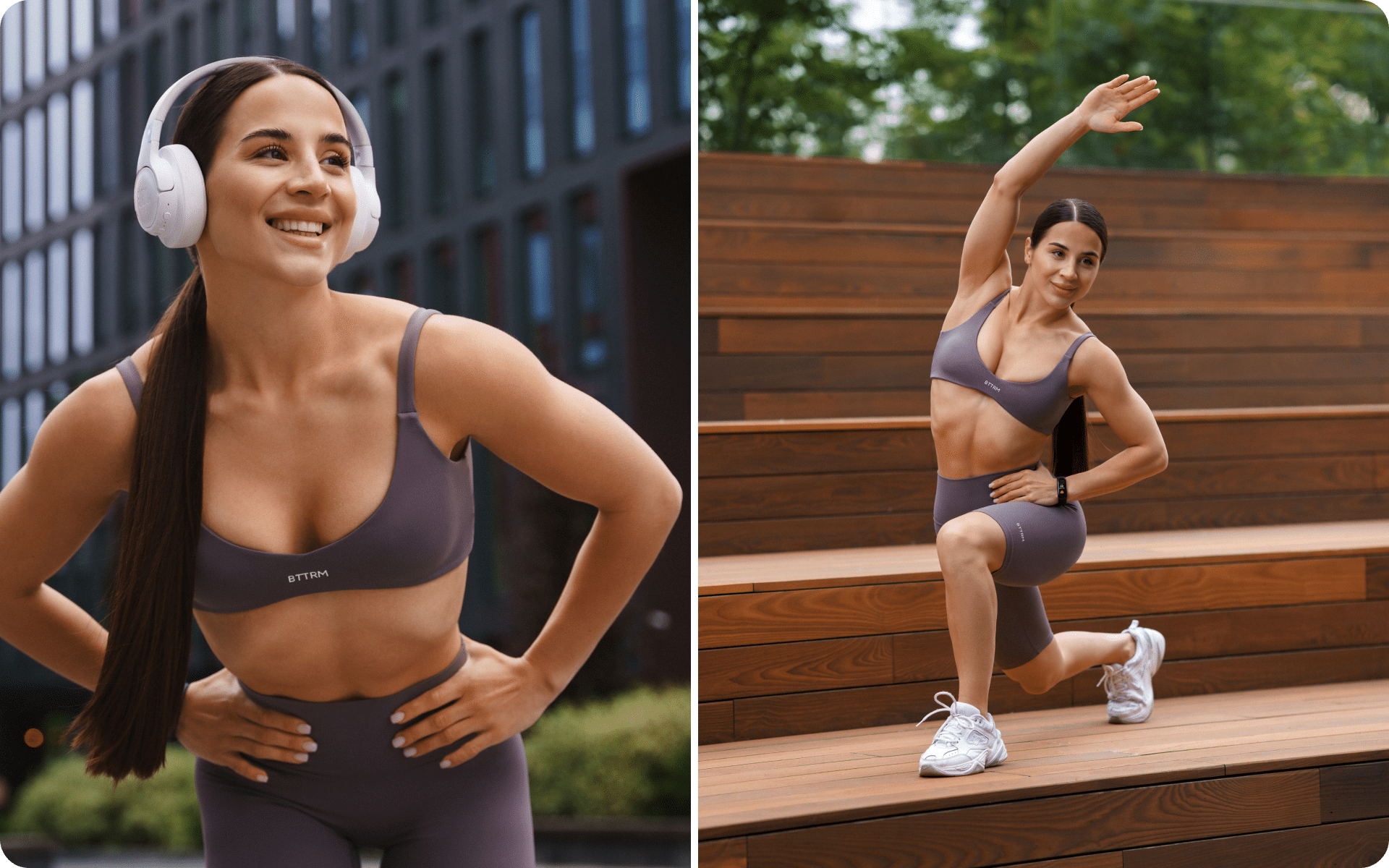
What Form Tips Help You Get More From Each Rep?
The form tips that help you get more from each rep focus on your trunk, your feet, and your movement speed. Clean reps mean better results and less strain.
1) Control the trunk
- Keep your ribcage stacked over your pelvis
- Brace before the rep
- Avoid floppy lumbar movement
2) Own the foot
- Keep pressure through your whole foot or tripod foot
- Avoid collapsing inward at the arch
3) Track the knee well
- Your knee should generally follow the line of your toes
- Don’t force exaggerated “knees out”, but avoid uncontrolled collapse inward
4) Use full, controlled range you can own
Recent glute-hypertrophy review findings suggest a range of motion matters, particularly in squat and hip-thrust variants, but it should be individualized to what you can do safely and well (7).
5) Don’t rush the lowering phase
A controlled eccentric usually improves (16):
- Position
- Tension
- Repeatability
The biggest beginner mistake is using heavier weights at the expense of your form. If you find it difficult to control your movement throughout the full range of motion, then the load may be too heavy. It may be a good idea to reduce the weight and practice the movement while increasing your strength for a few more sessions.
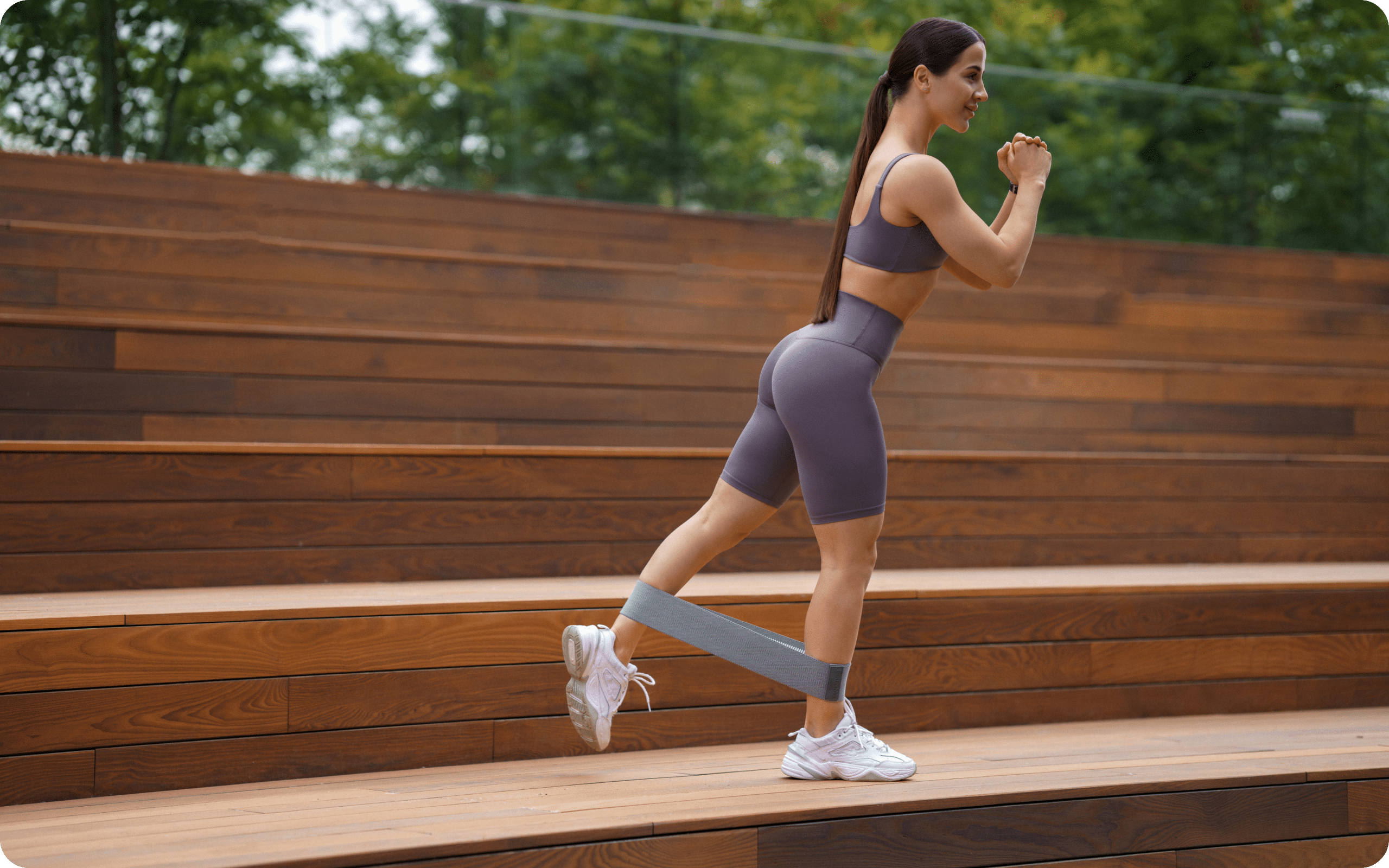
How Can You Make Leg and Glute Workouts More Challenging?
You can make leg and glute workouts more challenging by adding load, reps, sets, range, or slower tempo over time. This gradual buildup is called progressive overload (17).
Progressive overload simply means asking your muscles to do a bit more than before. Here are practical ways to do it:
- Add load: Increase a hip thrust from 95 lb to 105 lb.
- Add reps: Stay within a rep range, then increase weight once you hit the top end. For example, set your rep range at 6-12, and once you can perform 12 reps of the exercise, increase the weight and start again at 6 reps.
- Add sets: Start with 3 x 8 → 3 x 10 → 3 x 12, then progress to 4 sets.
- Add range: Squat slightly deeper if you can control it. If it’s safe and controlled, a slightly deeper or fuller ROM can raise difficulty and training stimulus.
- Slow the tempo: Use a 3-second lower, a 1-second pause and go back to starting position.
- Reduce support or increase complexity carefully: Introduce a split squat, move from a machine to a free weight version of the exercise, etc.
Read more: Your Ultimate Guide to Leg Exercises at Home
How Can You Fit Leg and Glute Training Into a Weekly Plan?
You can fit leg and glute training into a weekly plan with 2 lower-body sessions, spaced 48-72 hours apart. Such a routine balances progress with recovery.
Here are a few weekly setups to consider.
| Plan option | Weekly structure | Best for | Time needed |
|---|---|---|---|
| Two lower days | Lower A + Lower B | Focused leg and glute growth | 2 sessions |
| Upper/lower split | Upper, lower, upper, lower | Balanced full-body training | 4 sessions |
| Full body 3x | Some legs each session | Busy or brand-new beginners | 3 sessions |
Here’s a sample two-day setup you can copy.
| Day | Focus | Main moves |
|---|---|---|
| Monday | Lower A (squat focus) | Goblet squat, reverse lunge, glute bridge |
| Thursday | Lower B (hinge focus) | Romanian deadlift, step-up, banded walk |
Try to leave 48-72 hours between hard sessions—Monday and Thursday works well.
You may need to scale back if you notice:
- Soreness that lasts for more than 3 days
- Your strength dropping week to week
This flexible setup suits an at-home glute workout, too. Swap machines for dumbbells and bands as needed.
Do you want a ready-made plan to follow? Check out our full glute workout routine for more structured options.
FAQs
Is a leg and glute workout good for beginners?
A leg and glute workout is a good fit for beginners if you start with simple moves and manageable loads. Start with 4 exercises, 2-3 sets each, and 8-12 reps. Use body weight or light dumbbells first. Focus on clean form over heavy weight. Train twice weekly, and build slowly (3). Individual experience may vary, so adjust to your comfort.
How many leg exercises should I include?
You should include about 4-6 exercises in a beginners’ leg and glute session. Pick a mix of moves to cover your main patterns:
- One squat-style move
- One hinge-style move
- One direct glute move
- One single-leg move
That range gives you 8-14 total working sets. It challenges your muscles without leaving you overwhelmed or too sore to repeat the session.
Do I need weights for a leg and glute workout?
You don’t need weights to start a leg and glute workout, as a bodyweight leg workout can build a strong base. Bodyweight squats, glute bridges, and lunges work well for beginners. As you become stronger, you can add resistance. A resistance band glute workout is a simple, low-cost next step before moving on to dumbbells or barbells.
How do I make the workout harder over time?
You make the workout harder over time by gradually adding load, reps, sets, or range. This is called progressive overload. A simple approach: once you finish all sets with good form for 2 sessions, add a little weight or 1-2 reps. You can also slow your tempo, using a 3-second lower. Progress at your own pace.
What should I avoid during leg and glute workouts?
You should avoid rushing your reps, using too much weight too soon, and skipping your warm-up. These habits can lead to sloppy form and extra strain. Also avoid arching your lower back during hip thrusts or hinges. Keep 1-3 reps in reserve on most sets. Rest well between sessions, and listen to your body.
The Bottom Line
A well-planned leg and glute workout can build strength, shape, and confidence when you keep it simple and consistent. Focus on a smart mix of squat and hip moves, sensible sets and reps, and steady progress over weeks. Individual results vary, so make each number your own. Pick your two training days this week and enjoy the process of getting stronger.
DISCLAIMER:
This article is intended for general informational purposes only and does not serve to address individual circumstances. It is not a substitute for professional advice or help and should not be relied on for making any kind of decision-making. Any action taken as a direct or indirect result of the information in this article is entirely at your own risk and is your sole responsibility.
BetterMe, its content staff, and its medical advisors accept no responsibility for inaccuracies, errors, misstatements, inconsistencies, or omissions and specifically disclaim any liability, loss or risk, personal, professional or otherwise, which may be incurred as a consequence, directly or indirectly, of the use and/or application of any content.
You should always seek the advice of your physician or other qualified health provider with any questions you may have regarding a medical condition or your specific situation. Never disregard professional medical advice or delay seeking it because of BetterMe content. If you suspect or think you may have a medical emergency, call your doctor.
SOURCES:
- Anatomy, Bony Pelvis and Lower Limb: Thigh Muscles (2022, ncbi.nlm.nih.gov)
- Anatomy, Bony Pelvis and Lower Limb: Calf (2026, ncbi.nlm.nih.gov)
- American College of Sports Medicine Position Stand. Resistance Training Prescription for Muscle Function, Hypertrophy, and Physical Performance in Healthy Adults: An Overview of Reviews (2026, journals.lww.com)
- Is “Delayed Onset Muscle Soreness” a False Friend? The Potential Implication of the Fascial Connective Tissue in Post-Exercise Discomfort (2021, mdpi.com)
- A Biomechanical Review of the Squat Exercise: Implications for Clinical Practice (2024, pmc.ncbi.nlm.nih.gov)
- Gluteus Maximus Activation during Common Strength and Hypertrophy Exercises: A Systematic Review (2020, pmc.ncbi.nlm.nih.gov)
- The impact of resistance training on gluteus maximus hypertrophy: a systematic review and meta-analysis (2025, frontiersin.org)
- Dynamic Warm-ups Play Pivotal Role in Athletic Performance and Injury Prevention (2024, pmc.ncbi.nlm.nih.gov)
- How to activate the glutes best? Peak muscle activity of acceleration-specific pre-activation and traditional strength training exercises (2024, link.springer.com)
- Activation training facilitates gluteus maximus recruitment during weight-bearing strengthening exercises (2022, sciencedirect.com)
- Revisiting the stretch-induced force deficit: A systematic review with multilevel meta-analysis of acute effects (2024, sciencedirect.com)
- Practical recommendations on stretching exercise: A Delphi consensus statement of international research experts (2025, sciencedirect.com)
- An Electromyographic Analysis of Romanian, Step-Romanian, and Stiff-Leg Deadlift: Implication for Resistance Training (2022, mdpi.com)
- No Time to Lift? Designing Time-Efficient Training Programs for Strength and Hypertrophy: A Narrative Review (2021, link.springer.com)
- Resistance Training Variables for Optimization of Muscle Hypertrophy: An Umbrella Review (2022, frontiersin.org)
- Eccentric Exercise: Adaptations and Applications for Health and Performance (2021, mdpi.com)
- Attention to Progression Principles and Variables of Exercise Prescription in Workplace-Related Resistance Training Interventions: A Systematic Review of Controlled Trials (2022, fronteirsin.org)
 Reviewed by