Women’s gym workouts for beginners work well as 2 to 3 total-body sessions a week. Each session uses 6 to 7 basic exercises, 2 to 3 sets, and light weights you can control. This plan gives you a clear order of exercises for each visit.
Starting at the gym can feel confusing when you don’t know where to start. A clear plan can remove much of the guesswork. Regular physical activity may support heart health, mood, energy, and sleep (1). If you prefer training at home first, try these full-body resistance band workouts.
Following exercise and diet plans is the key in your fitness journey and greatly impacts results. In 4 weeks users can typically expect to lose not more than 1-2 lbs per week. Individual results may vary.
Key takeaways
Here is the short version of this guide.
- Adults are advised to do muscle-strengthening activity for all major muscle groups on at least 2 days a week (2).
- Adults are also advised to get 150 minutes of moderate aerobic activity, such as brisk walking, each week (2).
- Training each muscle group twice per week led to more muscle growth than once a week in a meta-analysis (3).
- Doing weights first, then cardio, gave slightly more lower-body strength gains in one review (4).
- Good form comes before heavier weights, especially in your first weeks (5).
- A full-body workout routine with compound exercises is a simple way to start lifting weights.
- Adults are advised to sleep at least 7 hours a night (6).
What should a beginner gym workout plan include?
A beginner gym workout plan should include a warm-up, a few compound exercises, light cardio, and rest days. Compound exercises train several muscle groups at once, so you cover the whole body in less time. Keep this workout program simple, so each gym session is easy to repeat.
|
Part |
What to do |
Time |
|---|---|---|
|
Warm-up |
5-10 minutes of light cardio, plus bodyweight squats and arm circles |
5-10 minutes |
|
Strength training |
6 to 7 exercises, 2 to 3 sets of 8 to 12 reps |
25 to 35 minutes |
|
Cardio |
Bike, incline walk, or rower at a moderate pace |
10 to 15 minutes |
|
Cooldown |
Easy walking and gentle stretches |
5 minutes |
This structure covers the movement patterns many new lifters need: squat, hinge, lunge, push, pull, and core. A certified personal trainer can check your technique in one or two personal training sessions, if that fits your budget.

Which exercise should beginners start with at the gym?
New lifters can start with the goblet squat because it teaches a basic movement pattern with one light dumbbell. It trains your legs, glutes, and core together. From there, add a hinge, a push, and a pull.
These 7 exercises make a simple beginner workout for women who are new to weight training.
1. Goblet squat
The goblet squat trains your quads, glutes, and core. Hold a dumbbell at your chest with your feet about shoulder-width apart. Sit your hips back with a bend in your knees, then stand up. Aim for 10 reps, 2 to 3 rounds.
2. Glute bridges
Glute bridges train your glutes and hamstrings through hip extension. Lie on your back with knees bent and feet flat. Press through your heels to raise your hips, then lower slowly. Start with bodyweight, then add a dumbbell across your hips.
3. Dumbbell row
The dumbbell row trains your upper back and arms. Place one hand and knee on a bench, with a dumbbell in the other hand. Pull the weight toward your hip, then lower it with control. Aim for 10 reps per side, 2 to 3 rounds.
4. Dumbbell bench press
The dumbbell bench press works your chest, shoulders, and triceps. Lie on a flat bench with a dumbbell in each hand above your chest. Lower the weights until your elbows are slightly below the bench, then press up. Aim for 8 to 12 reps, 2 to 3 rounds.
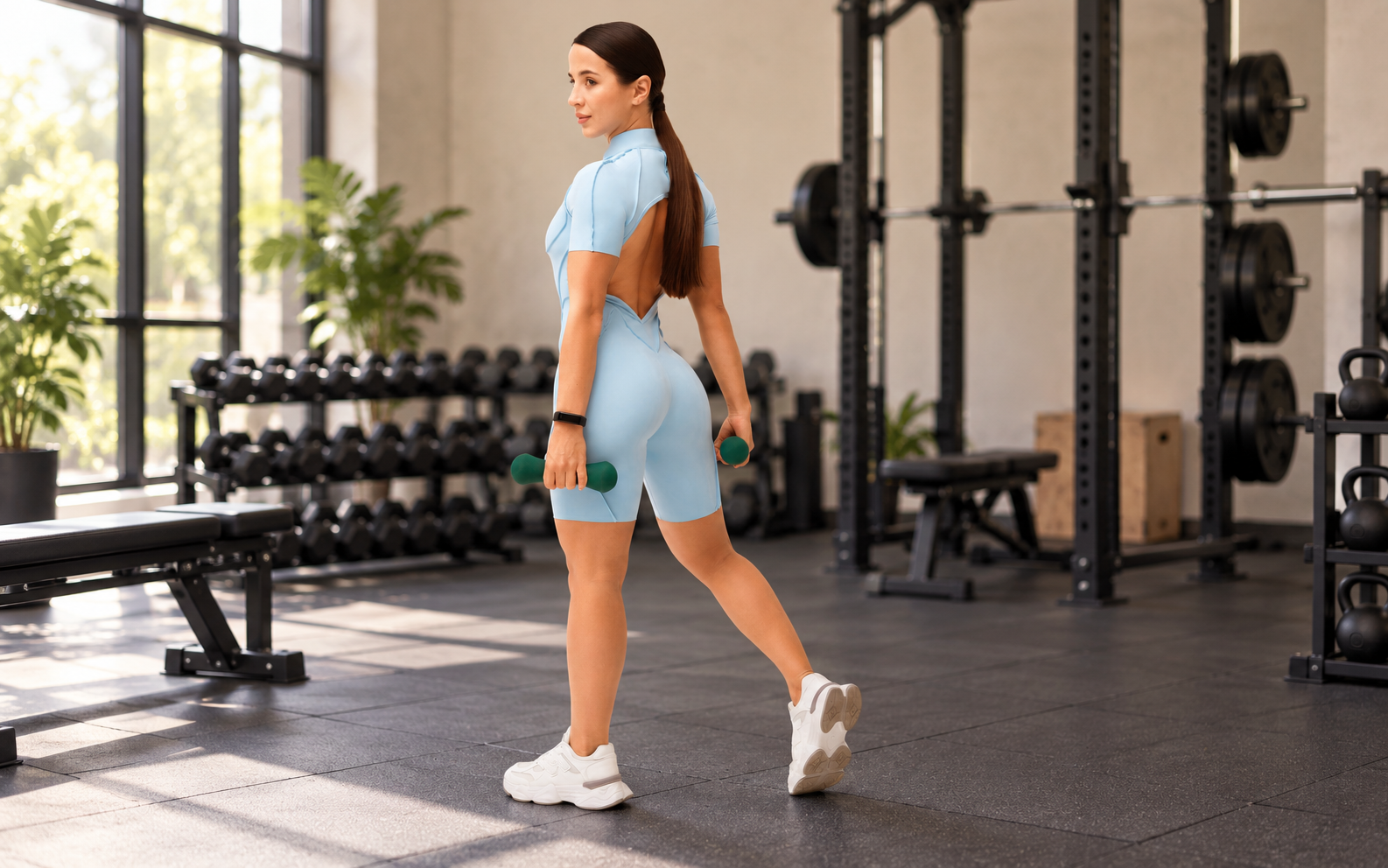
5. Reverse lunge
The reverse lunge trains each leg on its own and can help you practice balance. Step one foot back and lower until both knees bend to about 90 degrees. Push through your front foot to return. Do 2 to 3 sets of 8 reps per leg.
6. Lat pulldown
The lat pulldown builds the muscles of your upper back. Sit at the machine, grip the bar wider than your shoulders, and pull it to your upper chest. Return the bar slowly. Aim for 10 reps, 2 to 3 rounds.
7. Forearm plank
The forearm plank trains your core to stay steady. Place your elbows under your shoulders and keep a straight line from head to heels. Hold for 15 to 30 seconds, rest, and repeat 3 times.
How should you choose the right starting weight and use proper form?
Choose a weight you can lift for all your reps, with 2 to 3 reps left in reserve. If the last rep breaks your form, the weight is too heavy. Learn each move with light weights first (5).
Move slowly, breathe out as you lift, and keep your back neutral. When all 3 sets feel easy for 2 workouts in a row, lift a slightly heavier weight. This gradual process is called progressive overload. Stop any exercise that causes sharp discomfort.
How many days a week should a beginner woman work out?
A beginner woman can work out 3 days a week, with a full rest day between strength sessions. That schedule meets the advice to train all major muscle groups on at least 2 days a week (2). Training each muscle twice per week also supports muscle growth (3).
|
Day |
Plan |
|---|---|
|
Monday |
Full-body session: the 7 exercises above, with fewer sets if needed |
|
Tuesday |
Walk or light cardio |
|
Wednesday |
Repeat the same full-body session at an effort that feels manageable |
|
Thursday |
Rest day |
|
Friday |
Full-body session: the 7 exercises above, with fewer sets if needed |
|
Saturday |
Walk, cycle, or a class you enjoy |
|
Sunday |
Rest day |
This sample plan is for general guidance only. After 2 to 3 months, some women move to a 4-day split of upper body and lower body sessions.
If you’ve mustered up the courage to crush your weight loss goal, let Betterme take the sting out of this demanding process. Our app will help you restructure your habits, remold your life and crank up your fitness results!
How long should a workout last?
A typical session can last about 45 to 65 minutes, including the warm-up. The quality of each set matters more than the total time. Rest 60 to 90 seconds between sets so you can keep good form.
If you are short on time, a 30-minute workout with 4 compound exercises still covers the main muscle groups. For quick ideas, see these easy workouts.
Should beginners do cardio or weights first?
If you want to build strength, you may do better with weights first and cardio after. In one meta-analysis, this order led to greater lower-body strength gains than the reverse order (4). The order made no clear difference for aerobic fitness or body fat percentage (4).
Use 5-10 minutes of light cardio as a warm-up either way. Then lift, and finish with longer cardio if you have time.

What is the 3-3-3 rule in the gym?
The 3-3-3 rule is an informal gym guideline, and it has no single official definition. One common version is 3 exercises, 3 sets each, 3 days a week. It can suit newcomers because the plan stays short and easy to track.
To apply it, pick 3 exercises per session, such as a squat, a row, and a press. Do 3 sets of each, and rotate exercises across the week.
Reasons why BetterMe is a safe bet: a wide range of calorie-blasting workouts, finger-licking recipes, 24/7 support, challenges that’ll keep you on your best game, and that just scratches the surface! Start using our app and watch the magic happen.
Which workout helps most with weight loss?
No single workout causes weight loss on its own. A mix of strength training, cardio, and eating habits tends to matter more. Cardio uses energy during the session, while resistance training helps you keep and build muscle. Adults are advised to combine both each week (2).
Fat loss also depends on total food intake, sleep, and daily movement. Results vary widely between people. Focus on eating and training habits you can keep for months.
How long does it take to see results from working out?
There is no fixed timeline for strength or appearance changes. Progress varies with your starting point, training, sleep, and eating habits.
Track the weights you lift and how you feel. Lifting more over time is a clear sign of progress, even if the scale stays the same. Muscle soreness is common at first and usually eases as you adapt.

What should you eat and how should you rest?
Eating regular meals with protein, carbohydrates, and vegetables helps fuel your workouts. Protein foods such as fish, chicken, beans, eggs, and yogurt support muscle repair. Many beginners find it easier to keep all food groups in their meals.
Rest is part of the plan. Adults are advised to sleep at least 7 hours a night (6). Many people give each muscle about 48 hours of rest before training it hard again. If you are over 50 or returning after a long break, see these exercises for beginners over 50.
Frequently Asked Questions
Will lifting weights make women bulky?
Not necessarily. Changes in muscle mass and strength vary with training, nutrition, genetics, and individual response. Choose a workload that matches your goals, and track how your strength changes.
Should you use machines or free weights at first?
You can use both. Machines guide the movement, which helps you learn. Free weights such as dumbbells train balance and coordination.
Do you need a personal trainer to start?
No, you can start without a personal trainer by following a clear plan. A few sessions with a trainer can help you check your form.
The bottom line
Start with 3 total-body sessions a week and 6 to 7 basic exercises. Use light weights, focus on form, and add weight slowly. Pair strength training with regular cardio, good meals, and enough sleep.
DISCLAIMER:
This article is intended for general informational purposes only and does not serve to address individual circumstances. It is not a substitute for professional advice or help and should not be relied on for making any kind of decision-making. Any action taken as a direct or indirect result of the information in this article is entirely at your own risk and is your sole responsibility.
BetterMe, its content staff, and its medical advisors accept no responsibility for inaccuracies, errors, misstatements, inconsistencies, or omissions and specifically disclaim any liability, loss or risk, personal, professional or otherwise, which may be incurred as a consequence, directly or indirectly, of the use and/or application of any content.
You should always seek the advice of your physician or other qualified health provider with any questions you may have regarding a medical condition or your specific situation. Never disregard professional medical advice or delay seeking it because of BetterMe content. If you suspect or think you may have a medical emergency, call your doctor.
SOURCES:
- Real-life benefits of exercise and physical activity (2022, nia.nih.gov)
- Adult activity: an overview (2023, cdc.gov)
- Effects of resistance training frequency on measures of muscle hypertrophy: a systematic review and meta-analysis (2016, pubmed.ncbi.nlm.nih.gov)
- The role of intra-session exercise sequence in the interference effect: a systematic review with meta-analysis (2018, pubmed.ncbi.nlm.nih.gov)
- 7 tips for a safe and successful strength-training program (2023, health.harvard.edu)
- Recommended amount of sleep for a healthy adult (2015, ncbi.nlm.nih.gov)
 Reviewed by
 Reviewed by