Women’s calisthenics uses bodyweight movements to practice strength and control. A useful routine matches each exercise to your current ability and includes time to rest. Start with manageable movement patterns, then adjust the workload as you learn. You do not need advanced tricks or a particular body type to begin.
Explore the broader benefits of calisthenics for women if you are deciding whether this training suits your goals.
Key takeaways
These points summarize how to organize women’s calisthenics and what to expect.
- Adult women can improve strength through resistance training (1).
- Plan exercises around your current ability rather than assumptions about your sex or age.
- A weekly routine needs room for rest as well as practice.
- Bodyweight exercise is one recognized resistance-training option (2).
- An upper-body session needs a pulling decision; push-ups alone do not cover that movement.
- The sample schedule is an editorial example, with optional sessions and adjustable exercise choices.
What belongs in a women’s calisthenics routine?
A women’s calisthenics routine can include exercises you can perform consistently, with clear instructions for adjusting them. Begin by choosing a training purpose. You might want to practice a push-up, become more comfortable with lunges, or establish regular strength sessions. Current guidance recognizes bodyweight exercise as one resistance-training option (2).
Write that purpose in ordinary language. “Practice a lower push-up incline” gives you a clearer task than “get fit.” Keep the goal small enough to guide your next exercise choice.
Resistance-training research in women includes both upper-body and lower-body strength improvements (1). The research does not prescribe a separate movement alphabet for women. Your experience, equipment, and preferences matter when selecting a starting version.
A useful routine also identifies what it leaves out. Floor exercises can cover pushing, leg work, and trunk control. Meaningful pulling usually requires an appropriate bar, resistance band, or other equipment.
How can you organize the week?
Organize the week around sessions you can rest from and repeat. Lower-body, upper-body, rest, and circuit sessions offer several ways to divide practice. You can keep those categories without making every day demanding.
This editorial example offers two main sessions and an optional third. The movement names are choices, not a requirement to complete everything listed. Beginners can select fewer exercises while learning.
| Day | Session choice | Main purpose |
| Monday | Lower body plus pushing and pulling | Squat, bridge, supported row, and incline push-up practice |
| Tuesday | Rest or comfortable walking | Leave room for rest |
| Wednesday | Upper body plus legs | Push-up, suitable row, supported lunge, and dead bug practice |
| Thursday | Rest | Review how the earlier sessions felt |
| Friday | Optional mixed practice | Repeat familiar movements only if well rested |
| Saturday | Comfortable activity | Choose walking or another activity you enjoy |
| Sunday | Rest or light movement | Prepare the next week |
The schedule spreads the main sessions apart. It does not require you to train because a calendar names a day. If you still feel tired, move the next demanding session.
General adult guidance includes strengthening all major muscle groups at least twice weekly (3). Use that as a broader target, with gradual steps from your starting point. Two incomplete sessions do not automatically cover every muscle group.
For a more detailed schedule, use our home calisthenics workout plan. Keep one main plan in your log rather than combining several full routines.
Which exercise versions should you choose?
Choose the version that lets you control the movement through a comfortable range. The label on an exercise cannot tell you its difficulty for your body. A supported lunge may feel harder than a squat, even when both are called beginner movements.
Squat or chair rise
- Stand in front of a firm chair for the chair-rise practice.
- Bend your hips and knees to sit with control.
- Lean forward slightly from the hips.
- Press through your feet to stand again.
Use your hands for assistance if needed. A higher seat can reduce the depth required. Home exercise guidance includes chair rises and mini-squats as starting options (4).
Once standing becomes comfortable, practice a free squat near the chair. Keep the chair as a reference without collapsing onto it. Choose a depth you can repeat without losing balance.
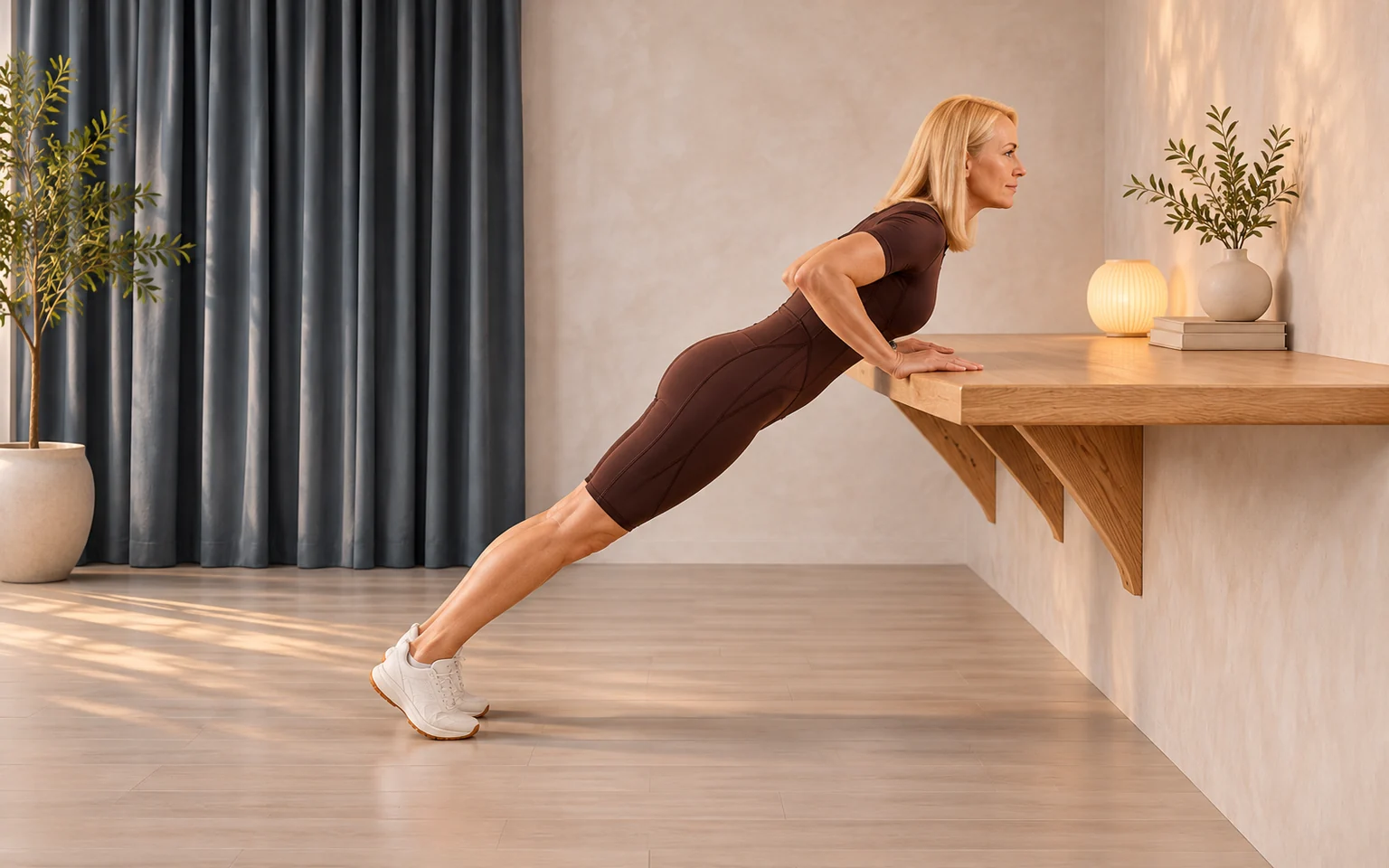
Incline push-up
- Place your hands on a stable support for the incline push-up.
- Step back until your body forms a long line.
- Bend your elbows to lower your chest toward the support.
- Press away while keeping your trunk steady.
Use a wall if a counter feels too demanding. Avoid a chair that could tip or slide. The push-up benefits guide covers different starting positions.
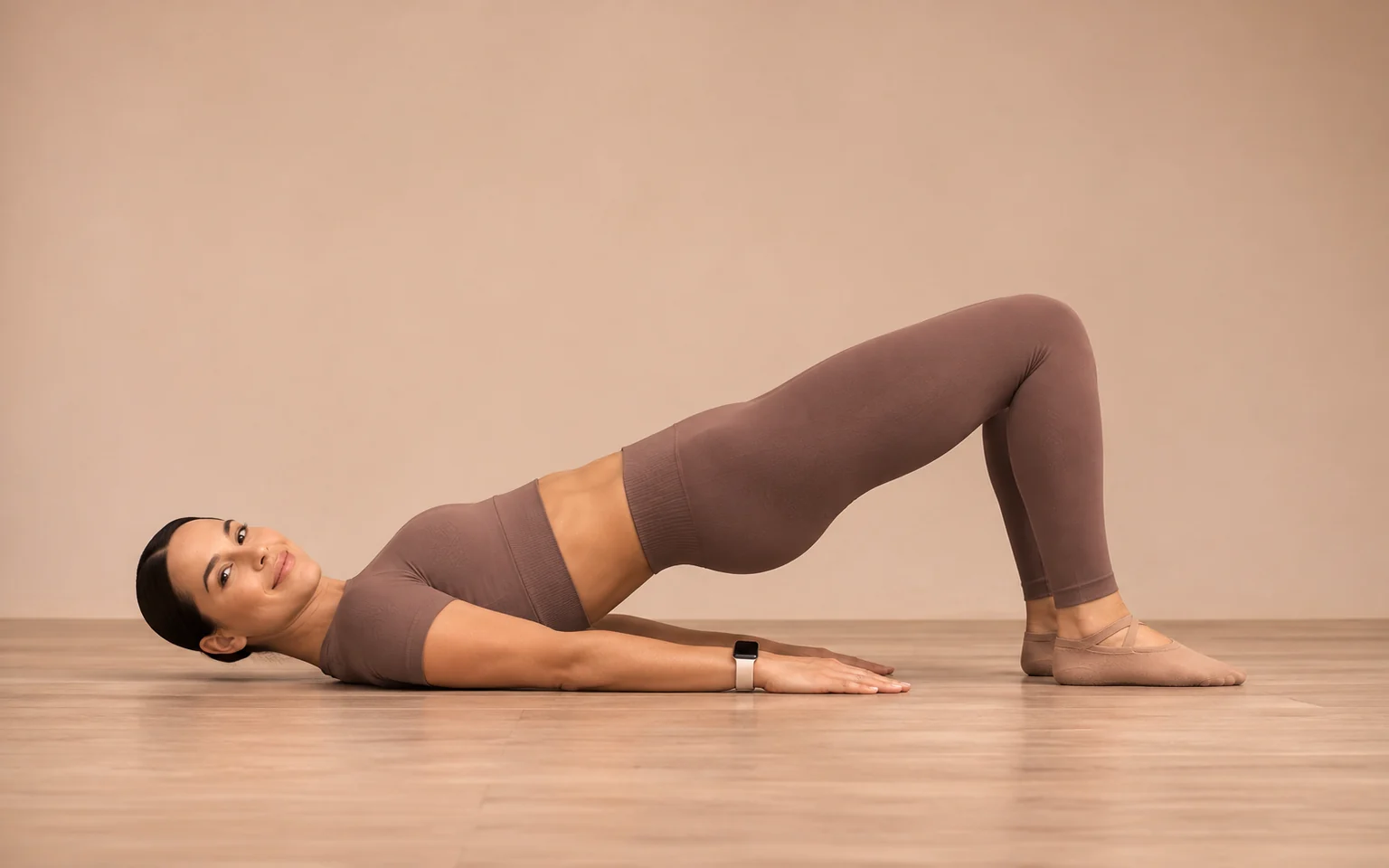
Glute bridge
- Lie on your back with bent knees for the glute bridge.
- Place your feet flat on the floor.
- Lift your hips without forcing your lower back into an arch.
- Lower your hips with control.
Keep your arms relaxed beside you. Stop the lift before your ribs flare upward. Shorten the movement if you cannot keep it comfortable.
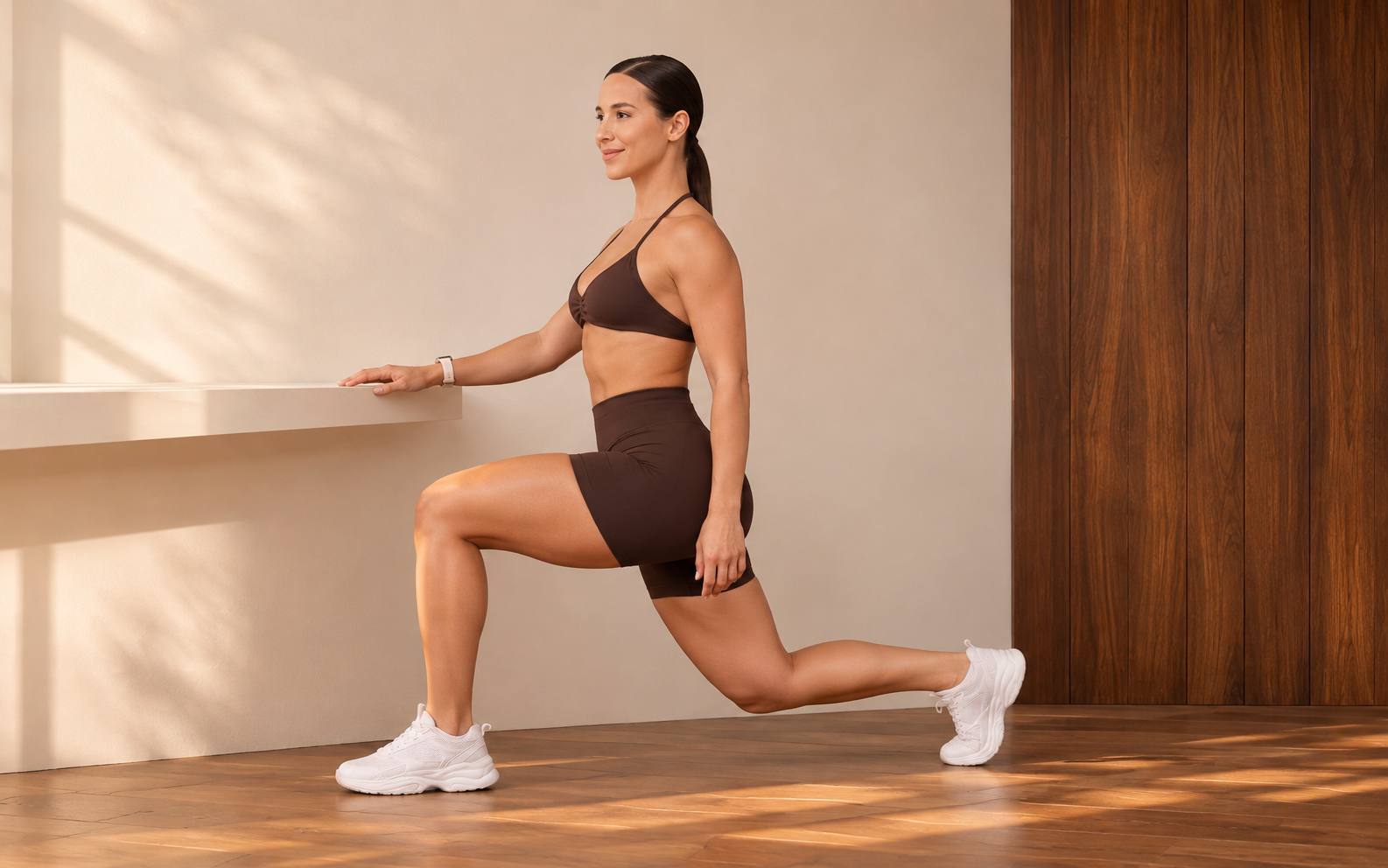
Supported reverse lunge
- Stand beside a fixed support for the reverse lunge.
- Step one foot backward.
- Bend both knees through a comfortable range.
- Return to standing through the front foot.
Practice the stance before adding depth. Keep the support within reach throughout the movement. You can use a stationary split squat if stepping makes balance difficult.
Dead bug
- Lie on your back for the dead bug with your knees bent.
- Lift your arms toward the ceiling.
- Move one heel away along the floor.
- Bring that heel back before changing sides.
Begin with a small reach and continue breathing. Keep your trunk position comfortable rather than pressing aggressively into the floor. Moving opposite arms and legs is an optional later version.
Pulling exercise
A supported row adds a movement missing from many home routines. Use purpose-built equipment with an installation you can verify. Ask an instructor to show the setup before relying on it.
Avoid pulling against a loose table, door handle, or improvised towel anchor. Without suitable equipment, acknowledge the gap and arrange another pulling option. Prone arm movements can offer practice, but they do not reproduce the resistance of a row.
How much work should a first session contain?
A first session should leave enough attention for learning and checking your setup. Use short practice sets and stop before movement control deteriorates. You can add work later after seeing how you respond.
The table is an editorial starting menu. Choose three or four movements from the table initially. Add the supported row when suitable equipment is available. The ranges are adjustable examples rather than thresholds you must reach.
| Movement | Example practice amount | Adjustment |
| Chair rise or squat | 1 to 2 sets of 5 to 8 repetitions | Raise the seat or shorten depth |
| Incline push-up | 1 to 2 sets of 4 to 8 repetitions | Use a higher support |
| Glute bridge | 1 to 2 sets of 6 to 10 repetitions | Shorten the lift |
| Supported lunge | 1 set of 4 to 6 per side | Use a stationary stance |
| Dead bug | 1 set of 4 to 6 per side | Keep the heel near your body |
Rest until you can set up and perform the next set with control. The session has no promised elapsed duration. Learning a new movement may take longer than performing it.
A broad review found benefits across varied resistance-training prescriptions (5). You do not need to identify an elaborate split before trying a manageable session. A qualified coach can help adjust the workload when your goals become more specific.
How do you progress without rushing?
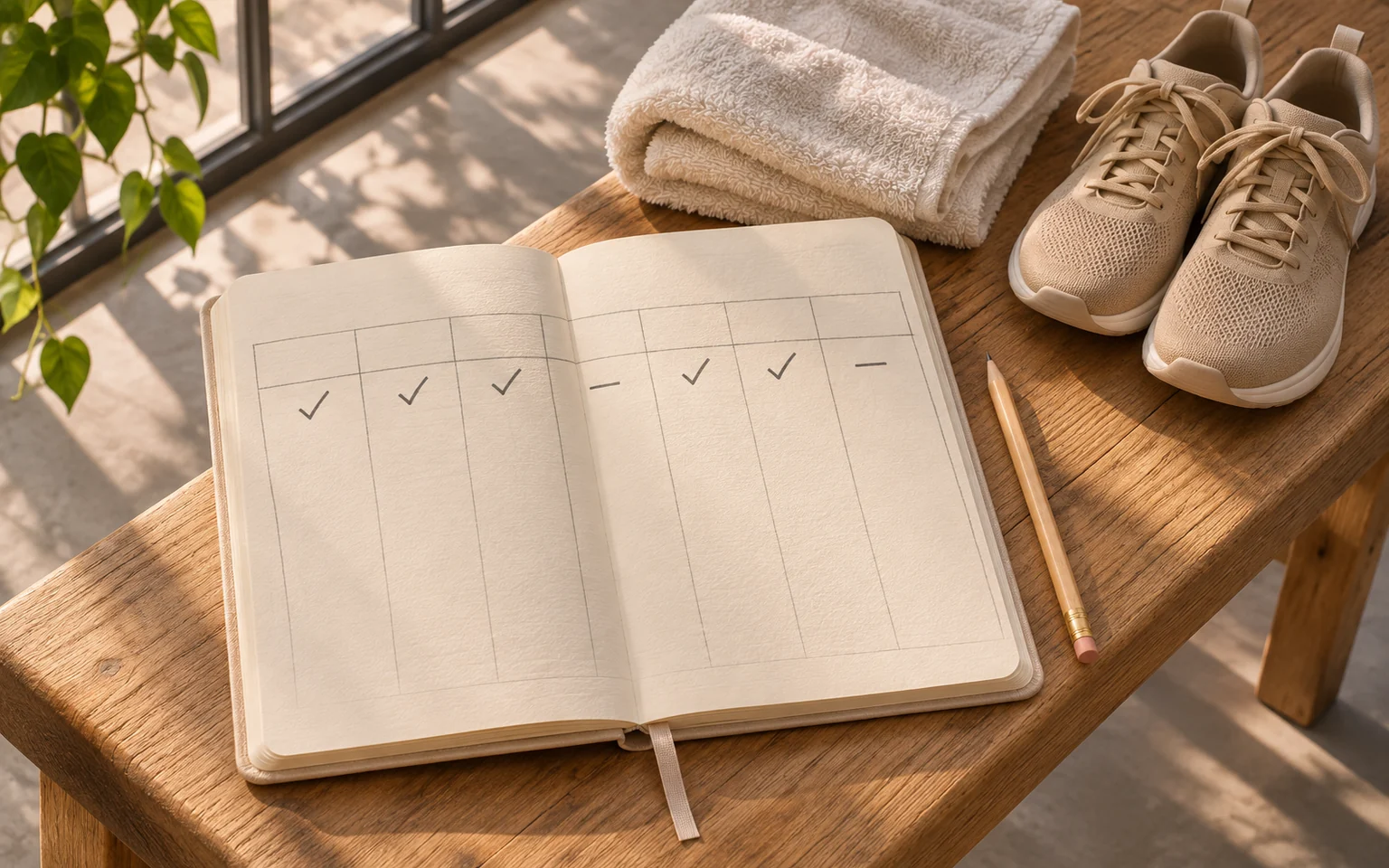
Progress by making a small, recorded change after the current exercise becomes manageable. Add a repetition, use slightly less assistance, or choose a modestly harder version. Keep the other details similar while testing the change.
For example, repeat the same incline push-up setup until the final repetition remains controlled. Then try a slightly lower support for a short set. Return to the higher support if the new position changes your technique substantially.
Avoid introducing several changes together. More sets, shorter rests, and a harder version can produce a much larger increase than intended. Your log should explain what changed between sessions.
You also do not have to progress every week. Travel, poor sleep, and unfamiliar exercises can affect what feels manageable. Repeating a session gives useful practice without creating a new target each time.
How do age and body size affect exercise choices?
Age and body size influence exercise experience, but neither gives a complete picture of ability. Choose movements based on what you can currently do. A person returning after a long break may need different support from someone training regularly.
Longer limbs can change how a position feels. Bodyweight movements also load you with a proportion of your own mass. These differences make comparisons between people less useful than comparisons with your own previous sessions.
This guide addresses adult general fitness. Pregnancy, the postpartum period, current strains, and medical restrictions usually call for individual guidance. Avoid using a general women’s routine as a substitute for that advice.
Our female calisthenics overview compares bodyweight training with equipment-based options. You can choose both rather than committing to one training identity.
What should you do when a movement feels wrong?
Stop a movement that causes discomfort or signs that concern you. General strength-training guidance advises stopping exercise that causes discomfort and reducing demands when technique breaks down (6). Avoid letting a motivational cue override that information.
Check obvious setup problems before another attempt. A slippery surface, unstable support, or awkward hand position may need changing. Seek qualified advice for persistent discomfort or uncertainty about your suitability for exercise.
Stop and seek medical advice if you feel dizzy, unusually breathless, or have chest discomfort. A shorter routine does not make those signs irrelevant. Keep stopping decisions separate from repetition goals.
Frequently Asked Questions
These answers cover first push-ups, repetition ranges, and repeating exercises over several weeks.
Why can a first push-up feel much harder than a squat?
A push-up and squat distribute load differently and use different movement skills. Previous experience also matters. Choose each exercise version separately instead of expecting matching repetition totals.
Do women need a different repetition range from men?
No, sex alone does not determine the repetition range you need. Training purpose, exercise difficulty, and individual response should guide the choice. The examples here are adjustable practice amounts.
Can you keep the same exercises for several weeks?
Yes, repeating familiar exercises makes changes easier to track. Replace an exercise when your goals, equipment, or comfort require a different option. Constant variety is optional.
The bottom line
Build a week around movements you can practice with control. Include rest, address the pulling gap, and record one clear progression at a time. A routine you understand gives you a useful basis for deciding what to change next.
DISCLAIMER:
This article is intended for general informational purposes only and does not serve to address individual circumstances. It is not a substitute for professional advice or help and should not be relied on for making any kind of decision-making. Any action taken as a direct or indirect result of the information in this article is entirely at your own risk and is your sole responsibility.
BetterMe, its content staff, and its medical advisors accept no responsibility for inaccuracies, errors, misstatements, inconsistencies, or omissions and specifically disclaim any liability, loss or risk, personal, professional or otherwise, which may be incurred as a consequence, directly or indirectly, of the use and/or application of any content.
You should always seek the advice of your physician or other qualified health provider with any questions you may have regarding a medical condition or your specific situation. Never disregard professional medical advice or delay seeking it because of BetterMe content. If you suspect or think you may have a medical emergency, call your doctor.
SOURCES:
- The Effect of Resistance Training in Women on Dynamic Strength and Muscular Hypertrophy: A Systematic Review with Meta-analysis (2020, pubmed.ncbi.nlm.nih.gov).
- ACSM Unveils Landmark 2026 Resistance Training Guidelines: First Update in 17 Years (2026, acsm.org).
- Adult Activity: An Overview (2023, cdc.gov).
- Strength exercises (2024, nhs.uk).
- Resistance training prescription for muscle strength and hypertrophy in healthy adults: a systematic review and Bayesian network meta-analysis (2023, pubmed.ncbi.nlm.nih.gov).
- Weight training: Do’s and don’ts of proper technique (2025, mayoclinic.org).
 By
 Reviewed by