Female calisthenics describes bodyweight training for women, including movements such as squats, push-ups, and supported lunges. The exercises can develop strength when their demands match your ability. This guide helps you compare training options, choose a starting point, and understand results without expecting one particular body shape.
Our women’s calisthenics routine guide provides a separate example for organizing weekly practice.
Following exercise and diet plans is the key in your fitness journey and greatly impacts results. In 4 weeks users can typically expect to lose not more than 1-2 lbs per week. Individual results may vary.
Key takeaways
These points summarize how to choose a female calisthenics approach and what to expect.
- Calisthenics uses body weight as resistance and can include equipment-assisted movements.
- Women can gain strength and muscle through resistance training (1).
- Home training, weights, and bodyweight exercises can all contribute to resistance exercise (2).
- Difficulty depends on the movement and starting ability, rather than the training label.
- Pulling exercises often need equipment even when the rest of a routine uses the floor.
- This adult exercise advice is not a program for children or teenagers.
What does female calisthenics include?
Female calisthenics includes bodyweight exercises chosen around a woman’s ability, preferences, and training goals. The term does not describe a separate biological category of exercise. A squat remains a squat regardless of who performs it.
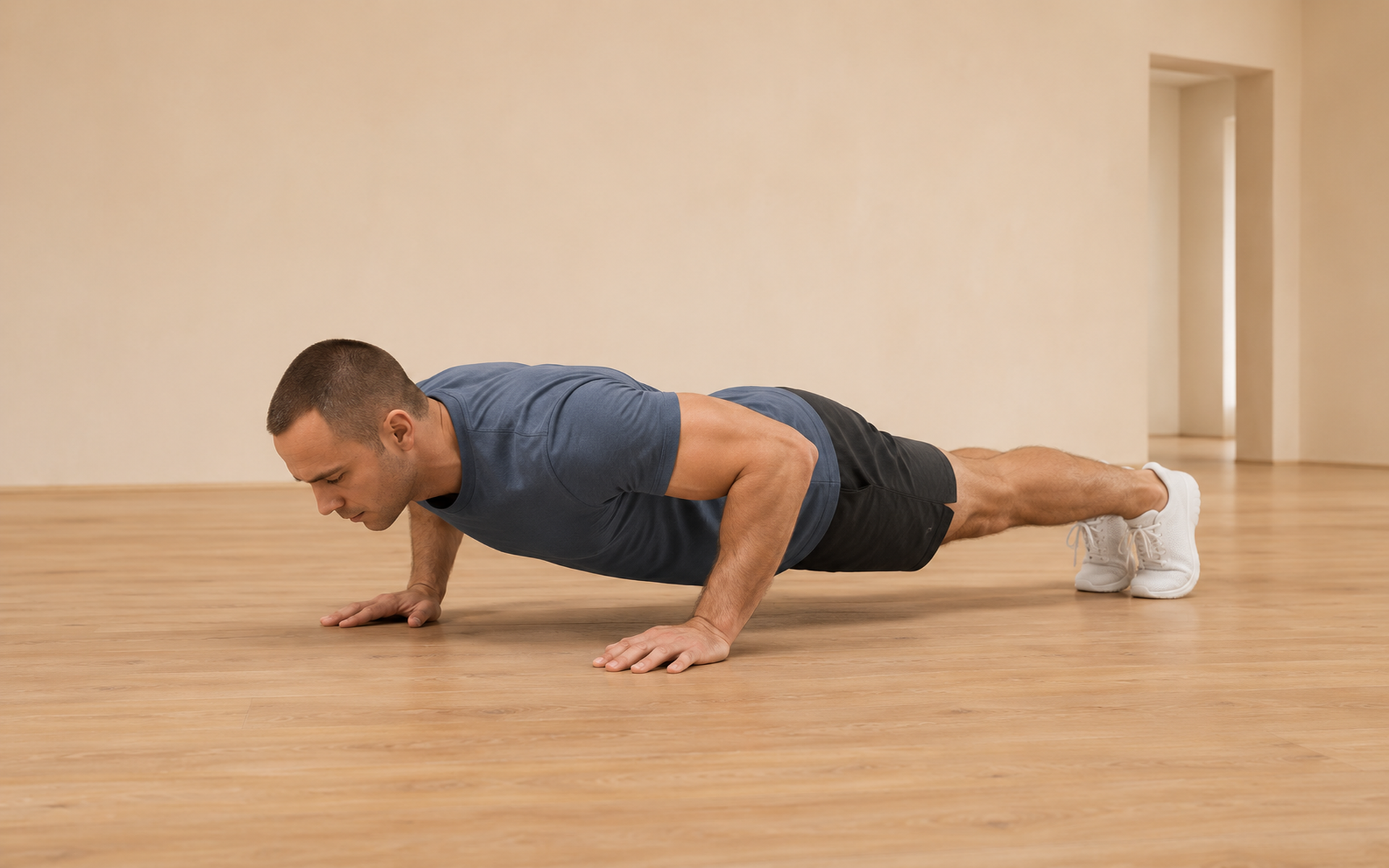
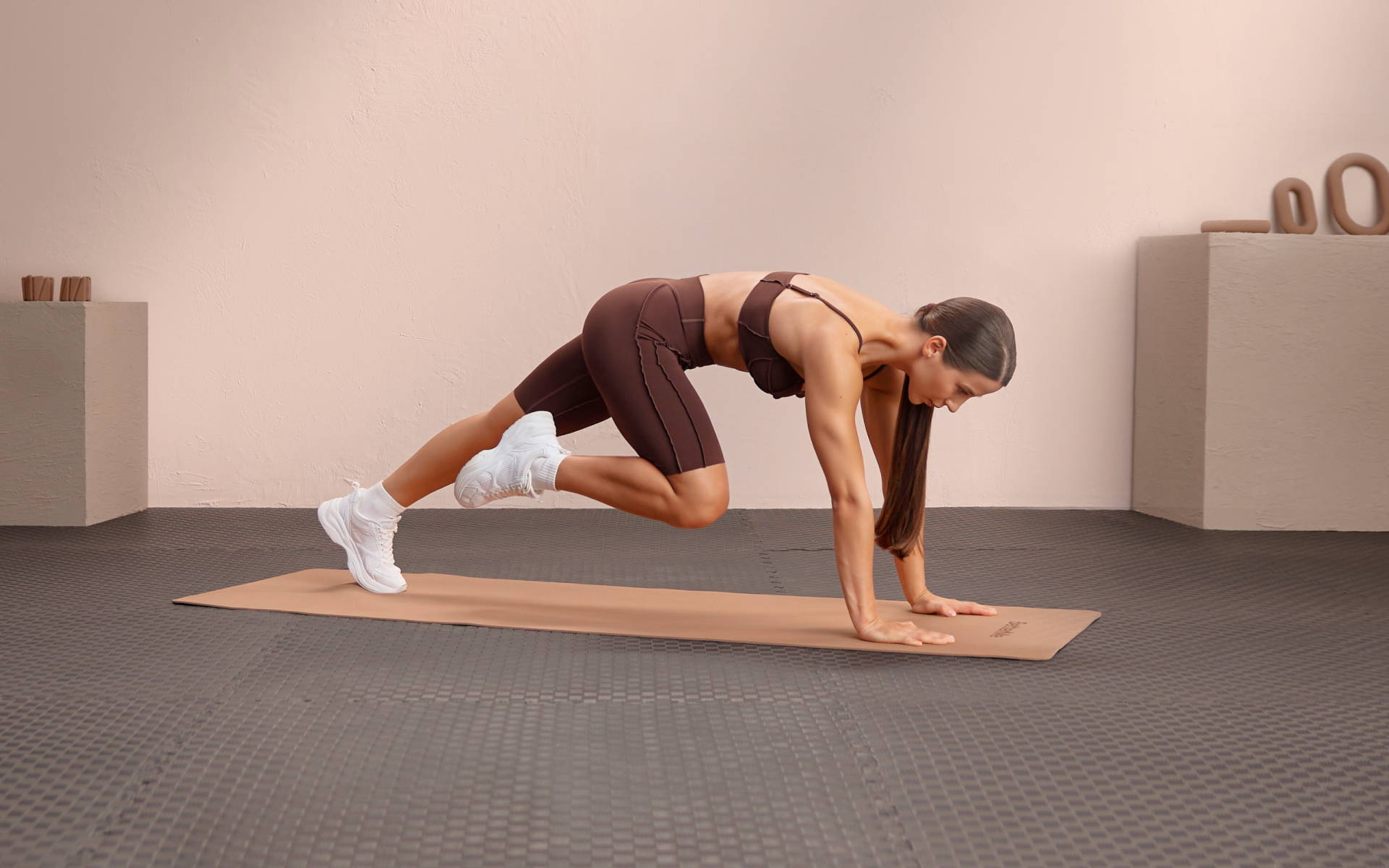
Common movements include pushing against a wall or floor, standing from a squat, and holding a plank. Some people also train pull-ups, dips, or advanced balance skills. Those harder movements are optional and require preparation.
A useful distinction is between the exercise and its setting. Calisthenics can happen in a gym, and gym training can include bodyweight work. You can practice a push-up beside someone using a chest-press machine without following conflicting approaches.
Start by identifying what attracts you to the activity. Perhaps you prefer working at home or want to learn a particular movement. That preference helps determine which parts of calisthenics belong in your routine.
What results can women reasonably expect?
Women can improve strength through resistance training, although results vary between people and programs. A review focused on healthy adult women found gains in strength and muscle size (1). Those findings support participation without promising a particular appearance.
Avoid separating “functional muscle” from “bulky muscle” as though training creates two different tissues. Muscle size and performance can change together. What someone considers a large or small appearance remains subjective.
The amount and type of training matter. A short skill practice may improve familiarity with a movement without providing much muscle-building work. A demanding resistance session serves a different purpose, even when it uses similar exercises.
Calisthenics also cannot promise changes in body weight. Physical activity and eating patterns both influence weight management (3). An exercise plan cannot predict where someone’s body will look different.
For a focused discussion of appearance expectations, read female calisthenics body changes. You can keep performance goals central even when appearance matters to you.
Is calisthenics harder than gym training?
Calisthenics can be easier or harder than a particular gym exercise, depending on the version you compare. A wall push-up and a handstand push-up belong to the same broad category. Their demands differ substantially.
Weights often make small load adjustments straightforward. With bodyweight movements, a change in angle or support can create a larger step. You may need an intermediate version between two familiar variations.
Some gym machines also provide external support. That support can help someone practice resistance exercise while reducing balance demands. Free-weight movements can also require considerable coordination, so gym training is not skill-free.
| Decision | Bodyweight option | Equipment-based option |
| Adjust resistance | Change support, angle, or variation | Change the selected load |
| Practice pulling | Use a suitable bar or anchor | Use a row or pulldown machine |
| Train at home | Clear floor space may cover several movements | Allow space for equipment and storage |
| Track progress | Record variation, range, and repetitions | Record load, range, and repetitions |
| Get instruction | Seek coaching or a suitable class | Ask for coaching and equipment orientation |
Neither column promises a better result. A broad review found strength and muscle gains across multiple resistance-training prescriptions (4). Select a method you can perform consistently and adjust when needed.
How can you choose a starting exercise?
Choose a movement you can set up, control, and stop without difficulty. Test the simplest practical version first. Your first attempt should help you learn the movement rather than establish a maximum.
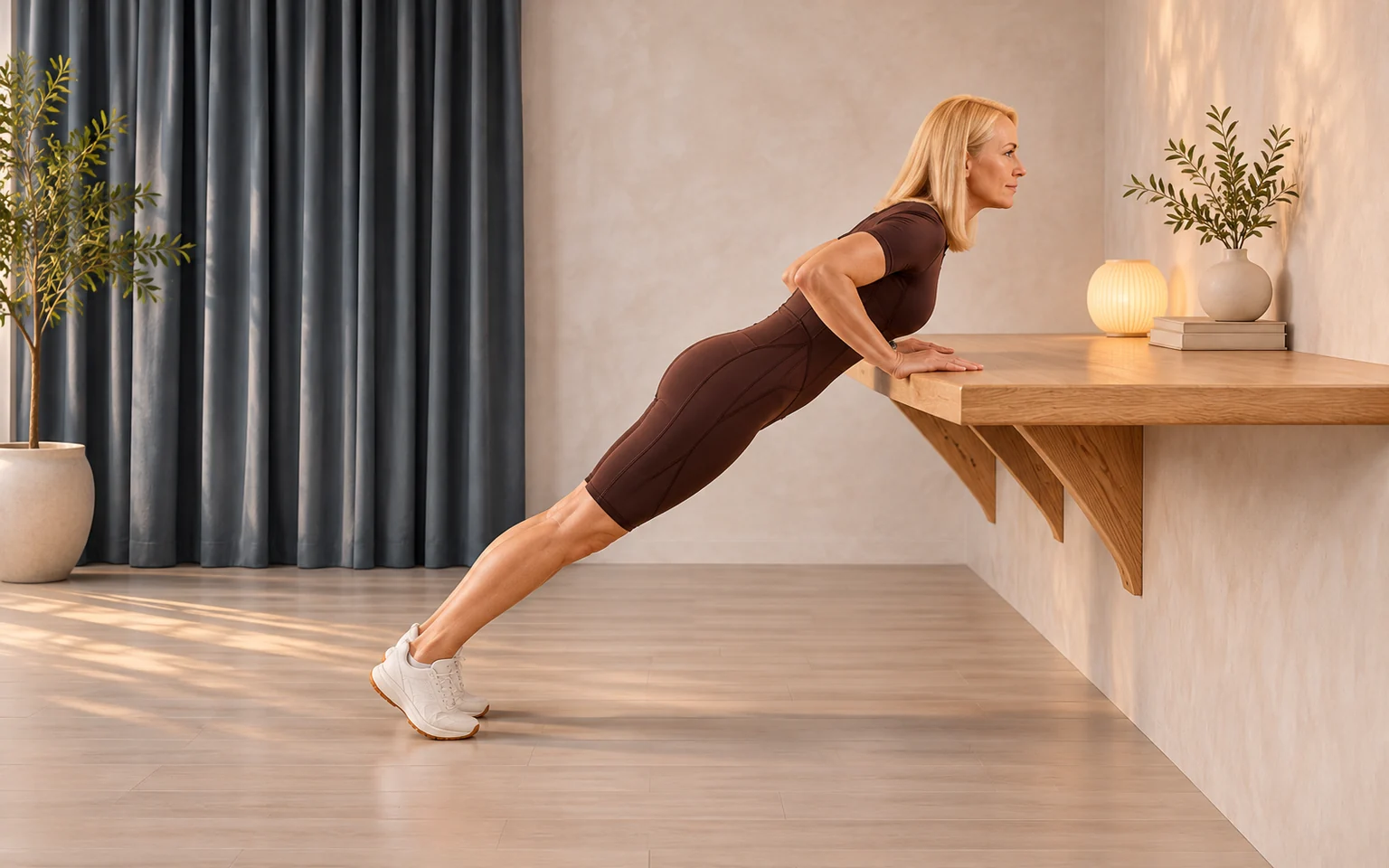
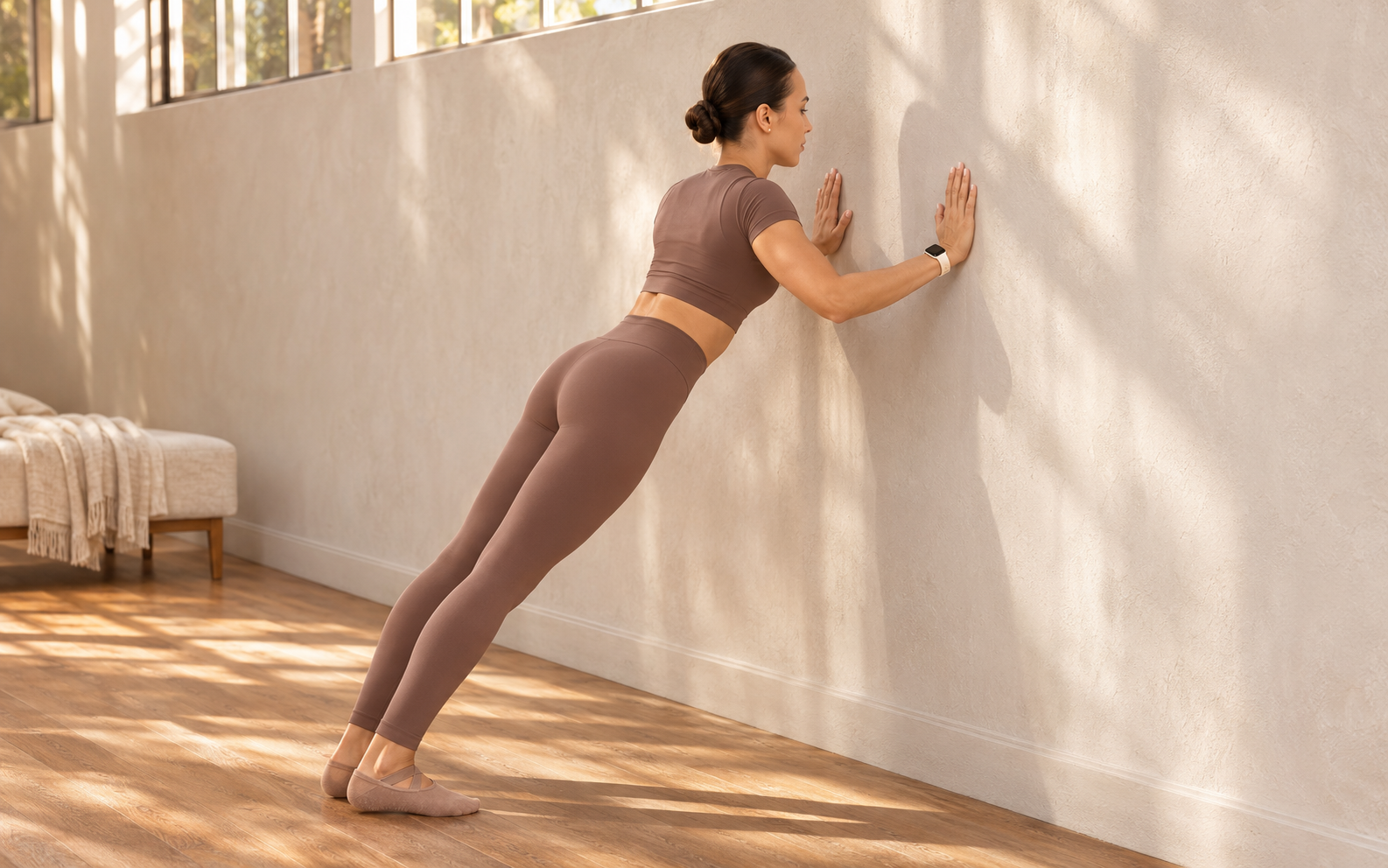
Start with a standing push
- Place your hands against a wall for a wall push-up.
- Step back a comfortable distance.
- Bend your elbows to move toward the wall.
- Press away with your body aligned.
A higher support reduces the demands compared with many floor versions. Public home-exercise guidance includes wall press-ups as an adjustable option (5). Choose a clear wall and nonslip footing.
If your shoulders or wrists feel uncomfortable, stop and reassess the movement. Discomfort does not need to be part of learning. An instructor can help you find a different setup.
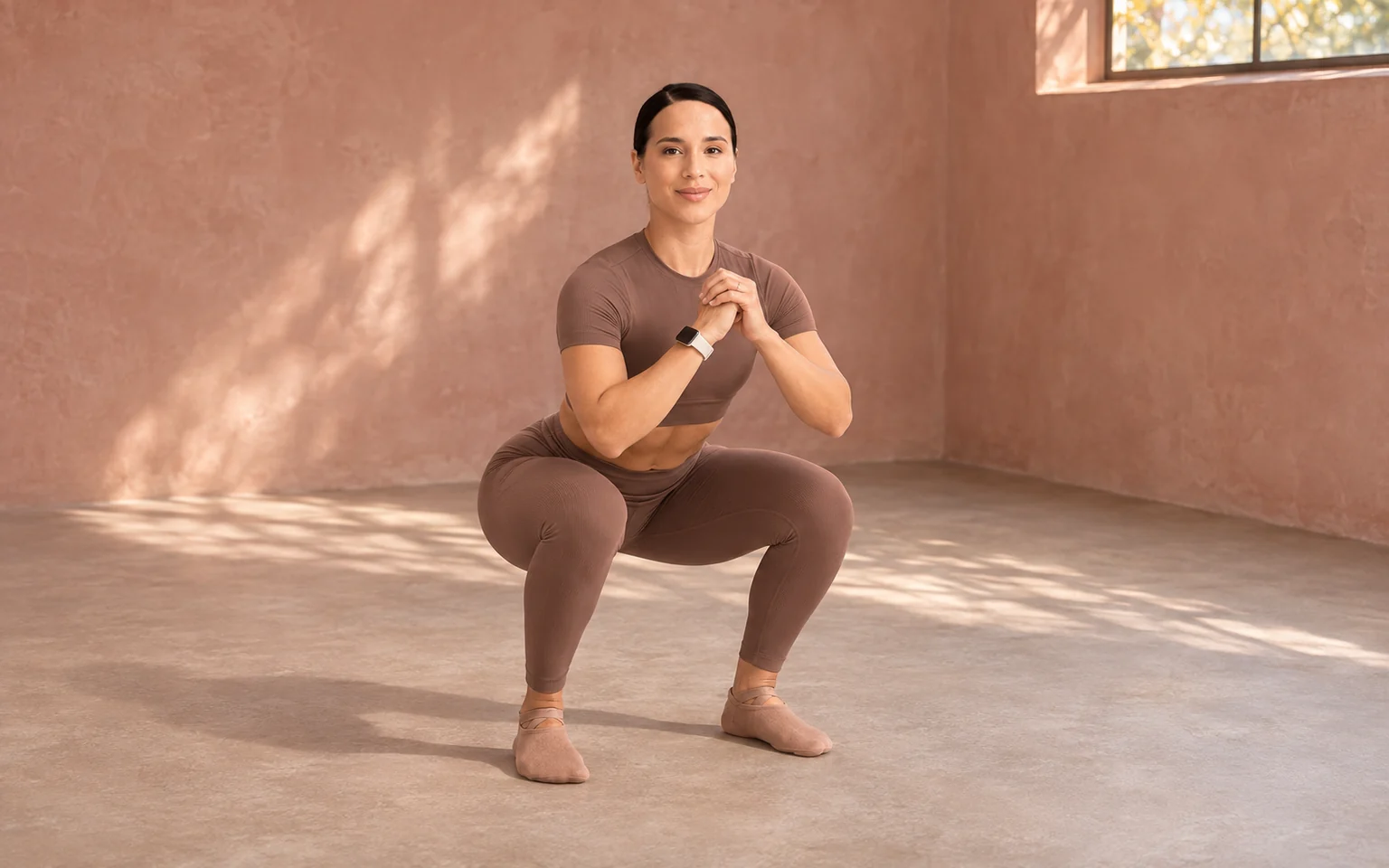
Practice a squat pattern
- Stand in front of a stable chair for the squat pattern.
- Move your hips backward as your knees bend.
- Lower toward the chair with control.
- Stand by pressing through both feet.
The chair offers a consistent depth reference. Use assistance if needed to return to standing. Remove the chair only when you can repeat the movement comfortably without relying on it.
Try a bridge
- Lie on your back for the bridge with your knees bent.
- Set your feet on the floor at a comfortable distance.
- Lift your hips while keeping your ribs relaxed.
- Lower slowly to the starting position.
The lift does not need to be high. Stop before the movement shifts into an exaggerated back arch. A bridge can be one lower-body exercise within a broader routine.
Decide how to include pulling
Pulling requires an appropriate source of resistance. A properly installed bar, suitable band setup, or gym machine can provide one. An improvised furniture anchor can fail and is not a standard home solution.
If you lack pulling equipment, start learning other movements while planning how to address the gap. Describe the routine honestly as partial. Floor arm raises do not provide the same training demand as rows or pull-ups.
What should your first practice session look like?
A first session can be a short exploration of a few exercise versions. Warm up with comfortable movement, then try brief sets. Rest between attempts so fatigue does not prevent you from checking technique.
This editorial practice menu is optional. It is designed to help you make choices, rather than prescribe an individual program. Select only movements you can perform comfortably.
| Practice task | What to observe | What to record |
| Wall push-up | Trunk position and elbow movement | Wall distance and controlled repetitions |
| Chair squat | Balance and seat contact | Chair height and use of assistance |
| Bridge | Hip movement without excessive back arch | Comfortable range and repetitions |
| Pulling orientation | Equipment setup and support | Equipment used and coaching needed |
Finish with a note about which exercise felt understandable. A confusing movement may need instruction before more repetitions. Avoid treating the first session as a test you can fail.
For a fuller introduction, see the beginner home calisthenics plan. Follow one plan at a time so the total workload stays clear.
How should you make exercises harder?
Make exercises harder through small changes you can describe and repeat. You might lower the push-up support or use less help during a squat. Additional repetitions can also increase the work when the movement remains controlled.
Current guidance recognizes multiple workable forms of resistance training (2). You do not need elaborate equipment rules to begin. Choose a method of progression that suits your available setup.
Keep the exercise standard consistent. A deeper squat and a shallow squat are different tasks, even with identical repetition counts. Write down range changes so apparent progress does not hide a change in technique.
General technique guidance recommends reducing demands when you cannot maintain form (6). Ending a set early can therefore be a useful decision. Do not add speed simply to finish an assigned number.
Progress can also mean improved setup. Learning to use a bar correctly or choosing a more stable support makes future practice easier to organize. These practical improvements deserve space in your training notes.
Can girls and teenagers start calisthenics?
Girls and teenagers can participate in age-appropriate physical activity, but this adult guide is not a youth training prescription. A parent or guardian may want suitable qualified instruction for a young person. Exercise selection needs to reflect age, supervision, and individual circumstances.
Avoid applying adult appearance goals to children. Adult articles about muscle size or body weight are not meant as guidance for a child’s diet. Skill learning and enjoyable participation require a different conversation from physique change.
The same distinction applies to advanced movements shown online. A demonstration does not establish readiness, supervision needs, or appropriate equipment. Choose an instructor who can explain suitable progressions and stopping points.
How do you decide between home practice and a class?
Choose the setting that addresses your main barrier to starting. If travel is the barrier, home practice may be convenient. If uncertainty about technique is the barrier, instruction may be more useful.
Ask a prospective instructor how they adapt exercises. You should be able to describe your current ability without pressure to perform advanced skills. Check whether the setting has appropriate supports and a clear approach to equipment use.
At home, keep the starting routine simple enough to remember. Place written instructions where you can read them without twisting during an exercise. Review a demonstration before the set rather than watching a screen throughout the movement.
Your setting can change later. You might learn a movement in a class and practice it at home. A mixed arrangement can fit your circumstances without requiring a permanent choice.
Frequently Asked Questions
These answers cover adding weights, sweating, and skipping handstands and dips.
Can you add weights to calisthenics?
Yes, weights can complement bodyweight exercise when the setup and load are appropriate. Treat the added resistance as a progression and reassess technique. You do not have to keep a routine equipment-free to call it useful.
Does sweating show that a workout is effective?
No, sweating alone does not measure strength progress or exercise quality. Temperature and individual differences affect how much you sweat. Track the actual exercise, workload, and response instead.
Can a beginner skip handstands and dips?
Yes, handstands and dips are optional movements. You can practice general strength without including either exercise. Choose skills because they serve your goals and suit your current preparation.
The bottom line
Choose female calisthenics for the movements and setting you want to practice. Test manageable versions, arrange suitable pulling equipment, and keep a record of changes. You can combine bodyweight work with other training as your needs develop.
DISCLAIMER:
This article is intended for general informational purposes only and does not serve to address individual circumstances. It is not a substitute for professional advice or help and should not be relied on for making any kind of decision-making. Any action taken as a direct or indirect result of the information in this article is entirely at your own risk and is your sole responsibility.
BetterMe, its content staff, and its medical advisors accept no responsibility for inaccuracies, errors, misstatements, inconsistencies, or omissions and specifically disclaim any liability, loss or risk, personal, professional or otherwise, which may be incurred as a consequence, directly or indirectly, of the use and/or application of any content.
You should always seek the advice of your physician or other qualified health provider with any questions you may have regarding a medical condition or your specific situation. Never disregard professional medical advice or delay seeking it because of BetterMe content. If you suspect or think you may have a medical emergency, call your doctor.
SOURCES:
- The Effect of Resistance Training in Women on Dynamic Strength and Muscular Hypertrophy: A Systematic Review with Meta-analysis (2020, pubmed.ncbi.nlm.nih.gov).
- ACSM Unveils Landmark 2026 Resistance Training Guidelines: First Update in 17 Years (2026, acsm.org).
- Benefits of Physical Activity (2025, cdc.gov).
- Resistance training prescription for muscle strength and hypertrophy in healthy adults: a systematic review and Bayesian network meta-analysis (2023, pubmed.ncbi.nlm.nih.gov).
- Strength exercises (2024, nhs.uk).
- Weight training: Do’s and don’ts of proper technique (2025, mayoclinic.org).
 Reviewed by
 Reviewed by
 By

 By