
For older adults, strengthening the core isn’t just about athletic performance, it’s a crucial component of longevity, injury prevention, and everyday independence.
In this guide, we’ll break down everything you need to know about core training, outline exactly how to execute a highly effective routine, and show you how to train to sustain long-term well-being.
What Are Gentle Standing Core Exercises for Seniors?
Gentle standing core exercises for seniors are upright movements that are designed to engage the muscles in the abdomen, lower back, pelvis, and hips without the need to get down on the floor (1). These movements rely on your body weight and gravity to create mechanical tension – the primary driver of muscle adaptation (2).
Instead of isolating one muscle group, standing exercises for seniors require the brain to coordinate multiple muscle groups simultaneously. This approach improves proprioception (your body’s ability to sense its location in space) while strengthening the midsection (3).
When you perform a standing core movement, you’re typically working at a moderate intensity – defined here as an effort level of 4 to 5 on a scale of 1 to 10 – which makes it highly accessible for those who are managing joint discomfort or limited mobility. For more details about low-impact exercises for seniors, take a look at our prior publication.
When Should a Senior Start Focusing on Core Strengthening?
The best time to start focusing on core strengthening was yesterday, and the second-best time is today. Sarcopenia, the age-related loss of muscle mass, begins as early as the age of 30, with muscle strength declining by roughly 10% to 15% per decade after 50 (4).
If you want to be good at your favorite everyday activities – whether that’s playing golf, carrying groceries, or simply walking up the stairs – there’s less room for improvisation. You should begin a targeted core routine immediately if you notice a decline in balance, experience frequent lower-back fatigue after standing for 20 minutes, or simply want to proactively prevent injuries.
Integrating a targeted core workout for seniors into your daily routine 2 to 3 times a week is sufficient to stimulate neuromuscular adaptations and counter the decline in core strength.
BetterMe: Health Coaching app helps you achieve your body goals with ease and efficiency by helping to choose proper meal plans and effective workouts. Start using our app and you will see good results in a short time.
How Do Seniors Tighten Their Stomach Muscles?
Tightening the stomach muscles requires an understanding of how to properly brace the core. Many people mistakenly suck their stomach in, which actually compromises stability. Instead, you need to create intra-abdominal pressure.
Here’s how you execute a proper core brace:
- Stand tall with your feet placed precisely 12 to 15 inches apart.
- Place your hands on your obliques (the sides of your stomach).
- Take a deep breath in through your nose, directing the air down into your belly rather than your chest.
- Exhale forcefully through pursed lips while pushing your stomach muscles out against your hands.
Imagine that you’re about to be gently punched in the stomach. The tension you feel is the coordinated contraction of the transverse abdominis, rectus abdominis, and obliques. This bracing technique should be maintained at a moderate tension (roughly 30% of your maximum effort) during all standing core exercises for seniors at home.
Read more: 6 Bodyweight Exercises for Seniors to Build Muscle and Improve Strength
Do Standing Core Exercises Actually Work?
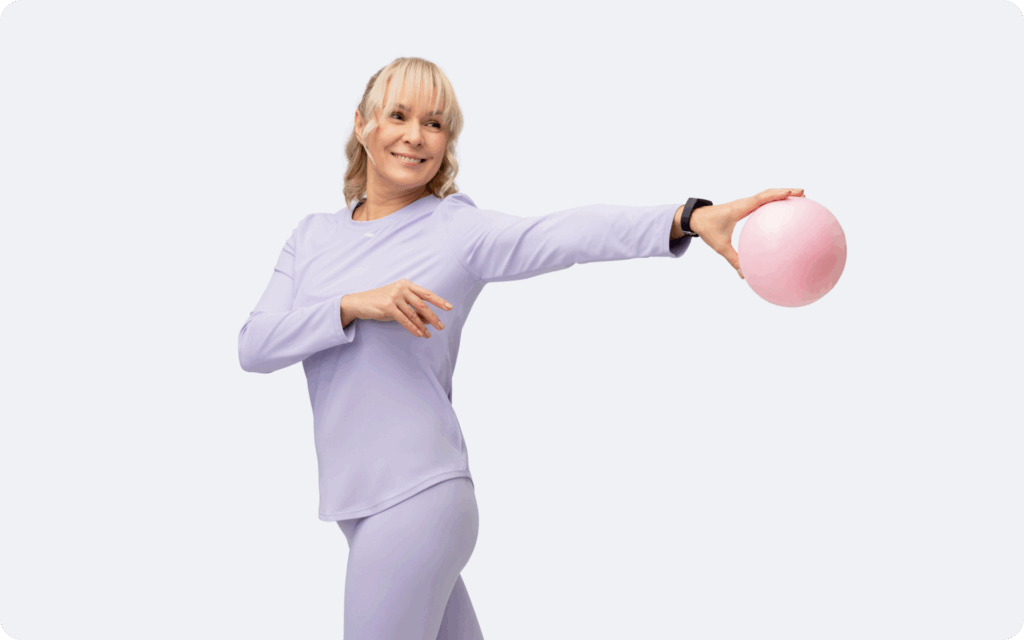
Yes, they’re highly effective. Standing core movements actually replicate the exact mechanical demands of daily life. When you walk, reach, or twist, your core muscles are firing from a standing position to stabilize your body (5).
By training in an upright position, you train your nervous system to stabilize the spine against functional, gravity-based resistance. This mind-body synergy ensures that the strength you build translates directly to injury-free training and living. For example, lifting a 5-pound dumbbell overhead while standing requires your core to actively resist back extension, providing an excellent lower abs workout for seniors without a single sit-up.
Our previous post goes into great detail about the senior exercise programs.

What Are Some Easy Standing Core Exercises for Seniors?
Here are 6 exercises to have in a highly effective, joint-friendly routine.
Program Notes:
- Equipment needed: A sturdy chair for balance, a wall, and optional light dumbbells (2 to 5 pounds).
- Split structure: Performed 3 days per week (e.g. Monday, Wednesday, Friday).
- Rest schemes: Rest precisely 45 to 60 seconds between sets.
- Progression: Once you can easily complete 12 repetitions of an exercise with perfect form, increase the duration of the hold or add a light weight.
| Exercise name | Sets | Repetitions | Rest |
|---|---|---|---|
| Standing knee lifts | 2 to 3 | 10 per leg | 45 seconds |
| Standing side bends | 2 to 3 | 10 per side | 45 seconds |
| Wall pushes | 2 to 3 | 10 reps (3-sec hold) | 45 seconds |
| Standing cross-body punches | 2 to 3 | 15 per side | 45 seconds |
| Standing woodchops | 2 to 3 | 10 per side | 60 seconds |
| Standing pelvic tilts | 2 to 3 | 12 reps | 45 seconds |
| Overhead reaches | 2 to 3 | 10 reps | 45 seconds |
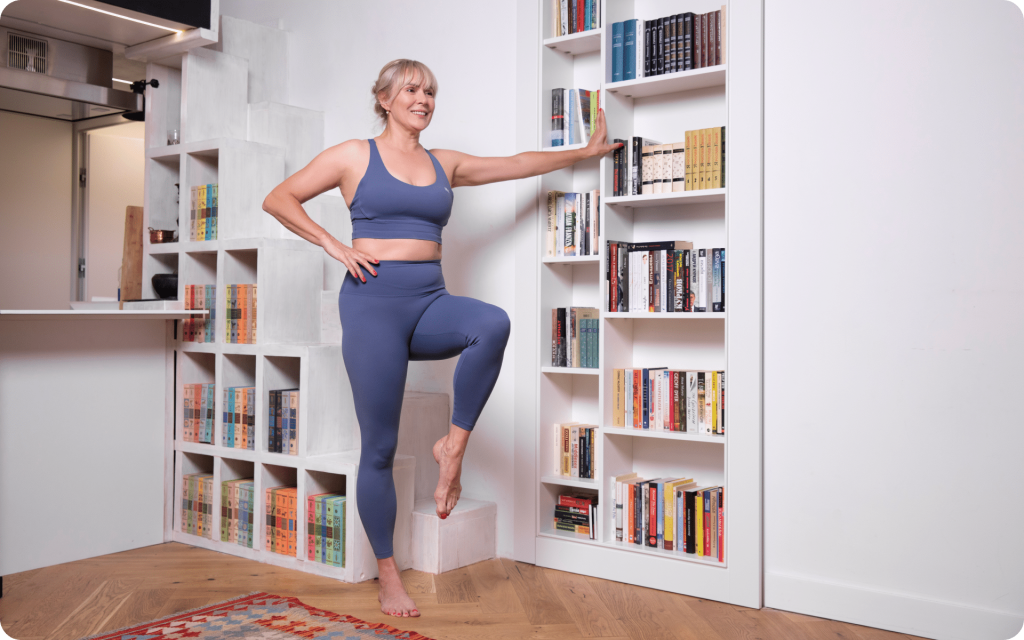
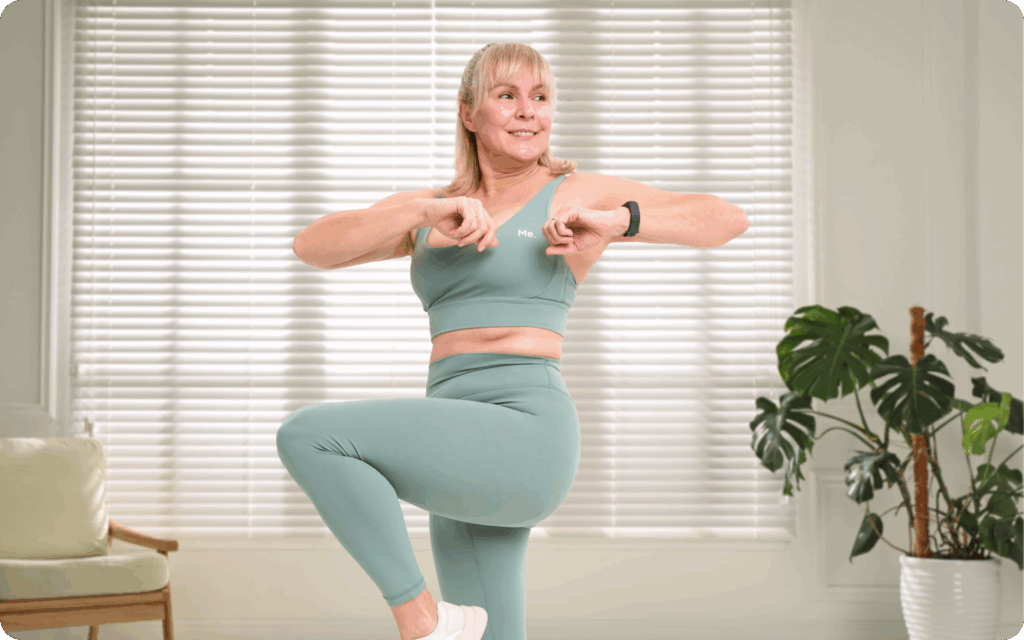
Standing Knee Lifts
- Stand tall next to a sturdy chair, resting one hand lightly on the backrest for balance.
- Brace your core using the breathing technique discussed earlier.
- Slowly lift your right knee until it’s parallel to your hip (at a 90-degree angle).
- Hold the top position for exactly 2 seconds, focusing on contracting your lower abdominal muscles.
- Lower your leg under control over a 3-second count.
- Repeat for 10 repetitions, then switch legs.
Standing Side Bends
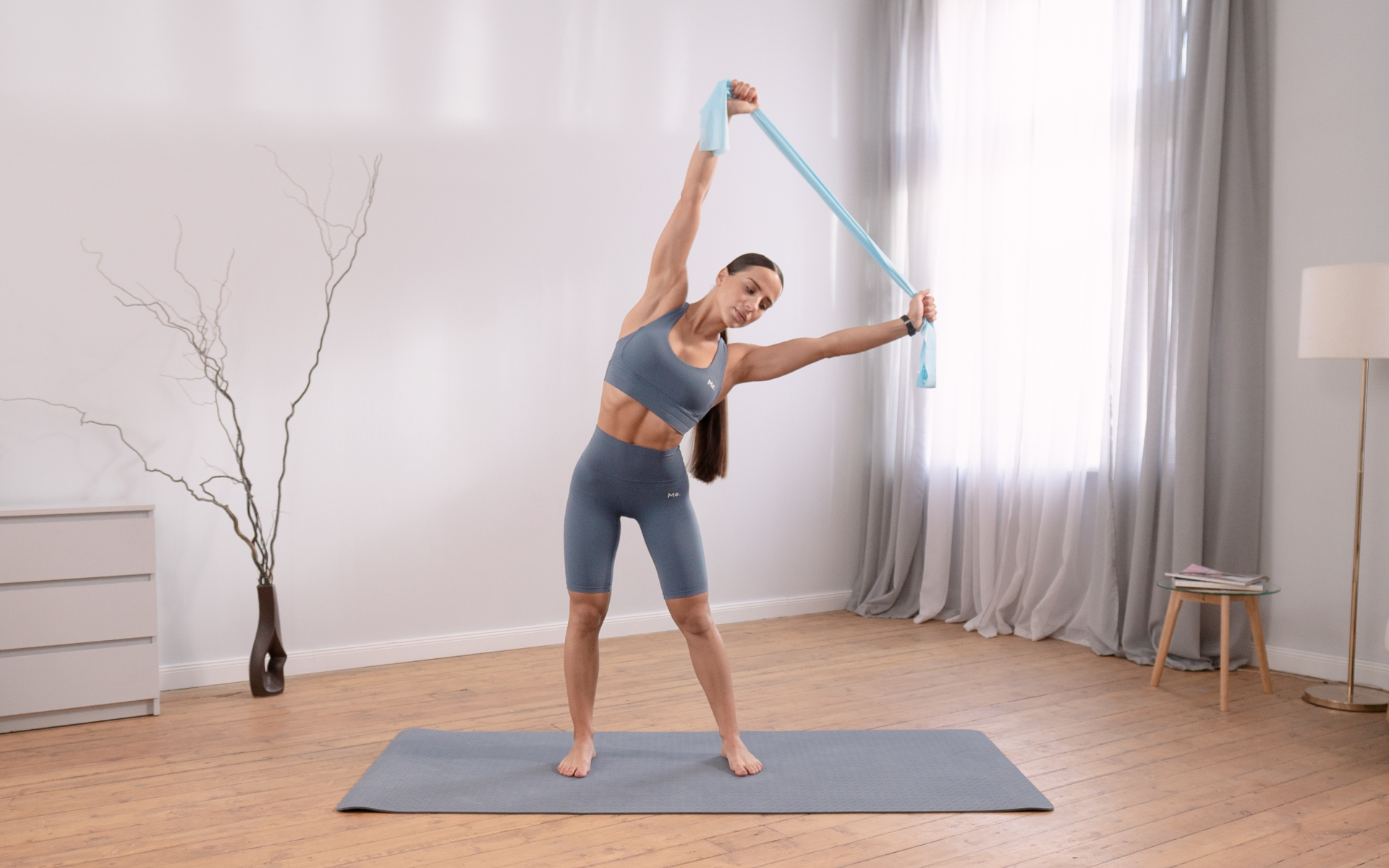
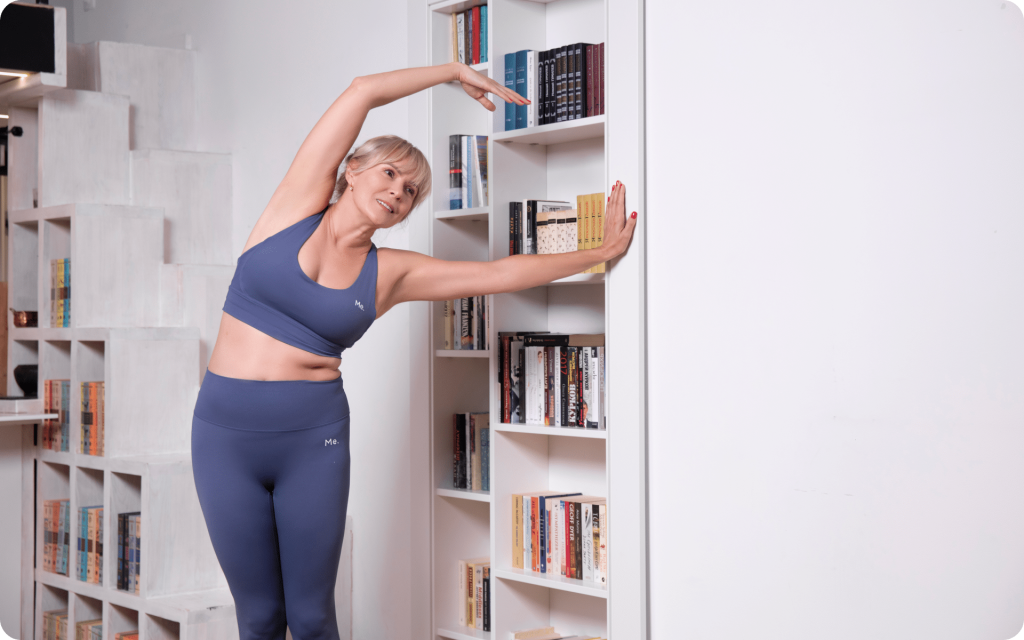
- Stand with your feet shoulder-width apart, your arms resting straight down by your sides.
- Keep your chest up and look straight ahead.
- Slowly slide your right hand down the side of your right leg, lowering your torso until you feel a gentle stretch in your left oblique.
- Pause for 1 second at the bottom of the movement.
- Contract your left oblique to pull your torso back to the starting upright position.
- Perform 10 repetitions on the right side before switching to the left.
Wall Pushes
- Stand facing a wall, approximately 18 to 24 inches away.
- Place both palms flat against the wall at chest height.
- Brace your core tightly and push against the wall with 50% to 60% of your maximum effort, as if trying to move the wall.
- Maintain a perfectly straight line from your heels to the top of your head.
- Hold this isometric contraction for exactly 3 seconds.
- Release the tension smoothly and rest for 2 seconds before the next repetition.
Standing Cross-Body Punches
- Stand with your feet slightly wider than shoulder-width apart, your knees slightly bent (a 15-degree angle).
- Bring your hands up to guard your face, keeping your elbows tucked in.
- Pivot slightly on your right foot and punch your right arm straight across your body to the left.
- As you punch, consciously rotate your torso, forcing your oblique muscles to power the movement.
- Pull your arm back quickly to the starting position.
- Alternate arms, completing 15 punches per side for a dynamic 10-minute core workout for seniors.
Reasons why BetterMe is a safe bet: a wide range of calorie-blasting workouts, finger-licking recipes, 24/7 support, challenges that’ll keep you on your best game, and that just scratches the surface! Start using our app and watch the magic happen.
Standing Woodchops
- Clasp your hands together or hold a light weight (2 to 5 pounds).
- Stand with your feet shoulder-width apart and raise your clasped hands over your right shoulder.
- In one smooth, controlled motion, bring your hands diagonally down across your body toward your left hip.
- Allow your knees to bend slightly (about 20 degrees) as you lower your hands.
- Reverse the motion, pulling your hands back up to the right shoulder over a 2-second count.
- Complete 10 repetitions on this diagonal path, then switch sides.
Standing Pelvic Tilts
- Stand with your back flat against a wall, with your heels positioned 6 inches away from the baseboard.
- Notice the natural curve in your lower back creating a gap between your back and the wall.
- Flatten your lower back against the wall by tucking your pelvis under and contracting your abdominal muscles.
- Hold this flattened position, pushing firmly against the wall, for 3 seconds.
- Slowly release back to the starting position.
- Repeat for 12 controlled repetitions.
Overhead Reaches
- Stand tall with your feet hip-width apart and your core fully braced.
- Raise both arms straight out in front of you at chest height.
- Slowly lift both arms overhead until your biceps are next to your ears.
- Actively resist the urge to arch your lower back as your arms go up – keep your ribcage pulled down.
- Hold the top position for 2 seconds, focusing entirely on core stability.
- Lower your arms back to chest height over a 3-second count and repeat.
To learn more about the wall exercises for seniors, check out our in-depth article on the topic.
What Is the Best Core Strengthening Exercise for Seniors?
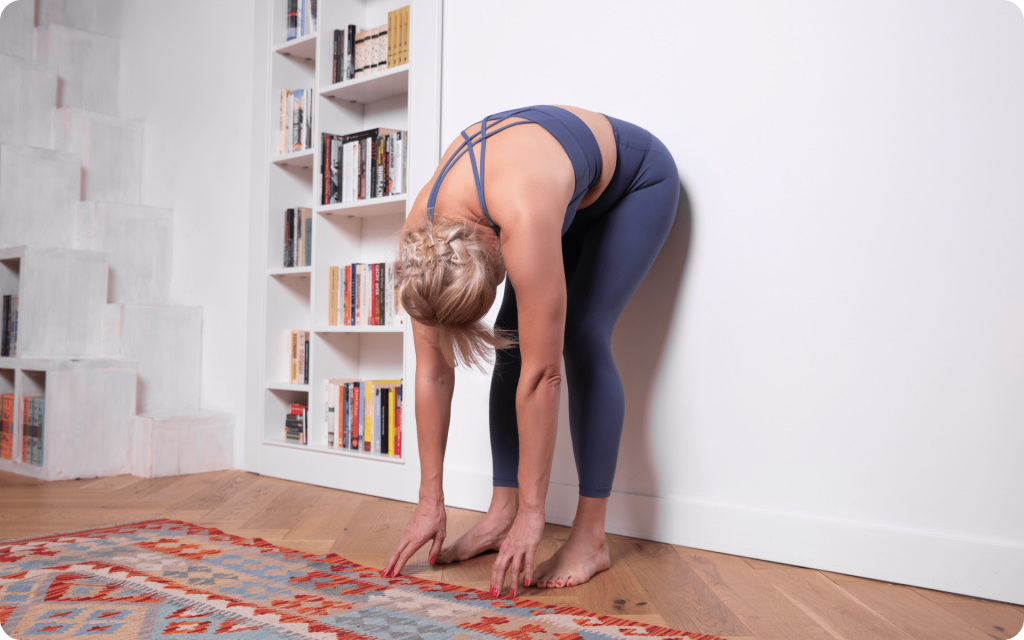
It’s tempting to look for one ultimate exercise, but physiological adaptations rely on specificity. The “best” exercise depends entirely on what mechanical function you’re trying to improve. If your goal is to improve rotational stability for activities such as swinging a golf club, the standing woodchop could be highly effective. If your goal is anti-extension (keeping your back safe when reaching up), the overhead reach could be considered superior.
Instead of searching for a single magic bullet, focus on a comprehensive routine – such as the 7 core exercises for seniors outlined above – that challenges the midsection through all planes of motion (flexion, extension, rotation, and lateral flexion).
What Are Some Common Mistakes in Standing Core Exercises?
- Holding your breath: The Valsalva maneuver (holding your breath during exertion) can cause a rapid spike in blood pressure. Always exhale during the concentric (effort) phase of the movement.
- Moving too fast: Momentum is the enemy of muscle growth. If you swing your limbs rapidly, your joints and tendons will do the work, rather than your muscles. Adhere to the strict 2-second and 3-second tempos outlined in the exercise instructions.
- Losing spinal alignment: Allowing the lower back to excessively arch or round transfers the mechanical load from the core muscles to the spinal discs. Always prioritize neutral back alignment.
Read more: How Standing Hip Exercises for Seniors Can Improve Your Health
How to Strengthen Your Core While Sitting
If fatigue sets in or standing becomes uncomfortable, you can effectively integrate core training from a seated position. Seated core exercises eliminate the balance requirement, which allows you to focus purely on the muscular contraction.
To execute seated core work, sit on the front edge of a sturdy chair with your feet flat on the floor, precisely hip-width apart. Perform seated marches (lifting one knee to the chest at a time) or seated torso twists. There are a number of seated core exercises you can try.
The key to making seated exercises effective is maintaining an upright posture – don’t hunch your back excessively or push your chest excessively upward. This requires constant activation of the erector spinae (lower back muscles) and transverse abdominis, which will keep your mind-body connection sharp and your midsection engaged.
There’s no single “ultimate” exercise, as the best choice depends on your specific goals and needs. However, movements that target multiple muscle groups and build core stability – such as standing woodchops or overhead reaches – are highly recommended. Incorporating a variety of standing core exercises for seniors will ensure that you strengthen your core from every angle. Noticeable improvements can be seen within 4 to 8 weeks of consistent practice, as long as you’re training your core 2 to 3 times per week. Progress depends on individual starting strength, adherence to exercise routines, and overall health status. Yes, a focused 10-minute core workout for seniors, when performed with correct form and regularity, is sufficient to stimulate the core muscles and improve functional strength. The key is to maintain consistent effort and gradually increase the difficulty. The best time is the time you can consistently commit to. Some people feel most energetic in the morning, while others prefer afternoon or evening sessions. Consistency matters more than the exact time you exercise each day. Walking is excellent for general fitness and can help engage the core, but it doesn’t specifically target the lower abs. For a focused lower abs workout for seniors, incorporate exercises such as standing knee lifts or controlled pelvic tilts.Frequently Asked Questions
What’s the ultimate exercise for seniors over 60?
How long does it take to strengthen your core?
Is a 10-minute core workout enough?
When is the best time of day for seniors to exercise?
Does walking tighten the lower abs?
The Bottom Line
Developing a resilient, stable midsection doesn’t require complex equipment or exhausting floor routines. By applying these foundational training principles, you can safely optimize your physical function and protect your back while doing it. Take ownership of your training, master these fundamental movements, and enjoy the lasting benefits of a truly capable body.
DISCLAIMER:
This article is intended for general informational purposes only and does not serve to address individual circumstances. It is not a substitute for professional advice or help and should not be relied on for making any kind of decision-making. Any action taken as a direct or indirect result of the information in this article is entirely at your own risk and is your sole responsibility.
BetterMe, its content staff, and its medical advisors accept no responsibility for inaccuracies, errors, misstatements, inconsistencies, or omissions and specifically disclaim any liability, loss or risk, personal, professional or otherwise, which may be incurred as a consequence, directly or indirectly, of the use and/or application of any content.
You should always seek the advice of your physician or other qualified health provider with any questions you may have regarding a medical condition or your specific situation. Never disregard professional medical advice or delay seeking it because of BetterMe content. If you suspect or think you may have a medical emergency, call your doctor.
SOURCES:
- Core Training (n.d., reference.jrank.org)
- Load-induced human skeletal muscle hypertrophy: Mechanisms, myths, and misconceptions (2026, sciencedirect.com)
- Sensorimotor and proprioceptive exercise programs to improve balance in older adults: a systematic review with meta-analysis (2024, pmc.ncbi.nlm.nih.gov)
- Sarcopenia in the Aging Process: Pathophysiological Mechanisms, Clinical Implications, and Emerging Therapeutic Approaches (2025, mdpi.com)
- Core Muscle Activity during Physical Fitness Exercises: A Systematic Review (2020, pmc.ncbi.nlm.nih.gov)


 Reviewed by
 Reviewed by
 Reviewed by