
Corporate wellness programs are no longer a “nice to have” – they’re a common strategy companies use to support employee well-being and performance. But with so many formats and vendors available, it’s fair to ask whether these programs actually deliver measurable results.
85% of large and 54% of small workplaces provide some type of wellness program, with 9 of 10 companies using some form of wellness-related efforts in hopes of improving employee well-being and workplace productivity (1).
This post explains how corporate wellness programs work, the benefits, statistics, and more to help you decide whether now is the right time to invest in wellness.
What are workplace wellness programs?
According to Gallup, the cost of poor well-being extends beyond how your employees feel at work. It can cause increased sick days, poor job performance, and high turnover and burnout (2).
Corporate wellness programs are designed to help improve employee well-being. They also help support retention, engagement, and productivity while helping reduce the likelihood of burnout.
When you take care of your employees, they are less likely to leave and more likely to perform better at work.
So, what activities and initiatives do well-being programs for employees include?

As many as 90% of companies that use corporate wellness programs include basic biometric screenings, like blood tests and surveys, and questionnaires on habits, nutrition, health history, and exercise to protect and improve health (3).
This information is then used to help determine program activities and employee well-being initiatives. For example, if smoking is identified as a risk factor for a particular workplace, a workshop on the dangers of smoking with advice on how to quit would be a good intervention.
In a workplace where a lot of workers are sedentary and do not receive quality nutrition, workshops on healthy eating and an introduction to fitness classes would be a valued addition.
While it depends on the demographic and individual workplace, example activities may include:
- Fitness classes
- Yoga and mindfulness sessions
- Healthy eating and nutrition workshops
- Burnout management tips
- Workplace challenges (e.g., steps, sleep, water intake)
It’s worth noting that your program should not only be tailored to support employees who may be managing health-related challenges (3). It should empower and provide all employees with equal opportunities to improve their well-being and productivity through wellness activities.
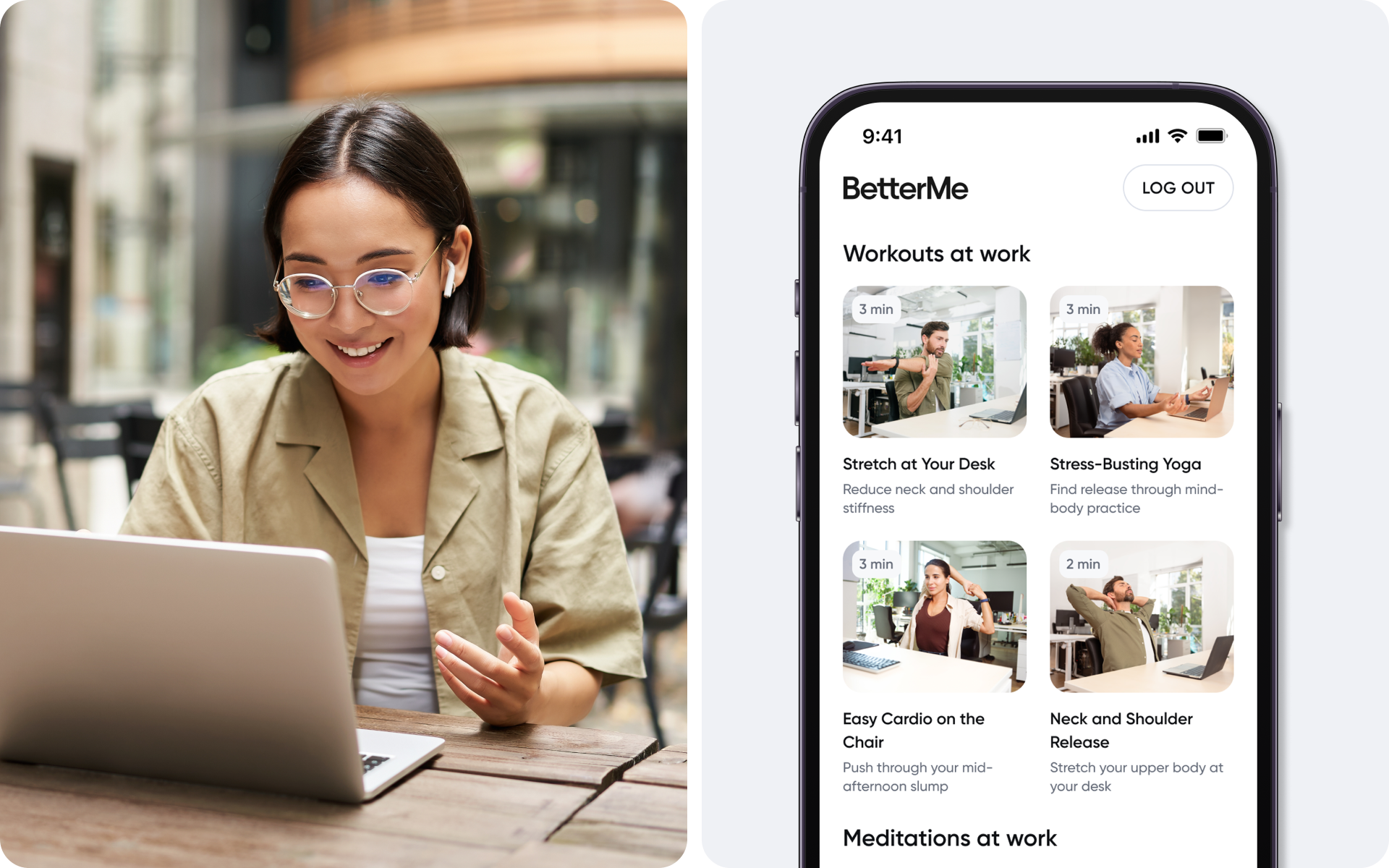
BetterMe provides members with tailored plans that are based on their unique physical, psychological, and lifestyle needs and health goals. Start using BetterMe corporate wellness solutions to transform your team and business!
How do corporate wellness programs work?
Employers frequently use vendors and B2B corporate wellness companies to build and run their programs.
Working with a corporate well-being provider removes bias and helps identify problem areas, and opportunities for improvement. The best wellness programs are tailored to your employees and aligned with your goals.
To give you a better example of how a wellness program works, here is what is included in our wellness programs:
- Two wellness apps for mental and physical health and year-long program support with continuous updates (like new sessions)
- Zoom-integrated app for team workouts and mindfulness sessions
- Ongoing guidance via additional materials to improve implementation and participation
Think of the above as the foundations of your wellness program. Our apps include things like nutrition guidance, step trackers, meditation and mindfulness sessions, and sleep stories and sounds to support employee well-being.
Some programs also include extras like corporate wellness gifts for challenge winners, 1-on-1 coaching with niche experts to help your employees achieve their goals, and team retreats.
The best programs are tailored to your employees, designed to meet your goals. Our engagement and participation dashboard helps you see program success first-hand.
Read more: What Are Employee Wellness Programs? Key Benefits and How Top Companies Use Them
Workplace wellness programs, right or wrong
How successful a workplace wellness program is largely dependent on the program’s content and how it is run.

Moreover, it’s very important to tailor a program to the workplace and the possible issues or areas of improvement required. For example, yoga and meditation classes may not prove as effective for certain industries like construction.
When creating a wellness program, tailor it to a specific business and industry for the best results.
One study found that for a wellness program to be successful, it should include the following (4):
- Effective communication strategies
- Opportunities for employees to engage (make it convenient and accessible for all)
- Leadership engaged at all levels (senior management should consider wellness an organizational priority)
- Use of existing resources and relationships
- Continuous evaluation (surveys, employee feedback, needs assessments)
Benefits of corporate wellness programs: Statistics
Workplace wellness programs have the potential to increase everything from employee happiness and mental wellness to work performance and job satisfaction.
Recent benefits of employee wellness programs statistics include:
- 93% of employers plan to maintain or expand their well-being offerings in 2025 (5)
- 84% of employees say productivity increased after implementing wellness plans (6)
- For every $1 spent on employee wellness, companies see an average of a 47% ROI (7)
Workplace wellness programs case study
A case study (3) investigated the effect of their new corporate wellness program on 111 workers across 5 laundry plants (1 plant did not run a wellness program, serving as a control group).
The laundry plants introduced various wellness interventions, including an annual biometric health screening that measured multiple common health markers. Employees were also provided with a health survey where they were asked about their health background, stress level, substance use, and other behaviors.
Before reviewing the outcomes, it’s worth noting that employees experiencing physical or mental health issues should consult a qualified healthcare professional.
After 3 weeks, the results were available, and nurses from the vendor held educational seminars at each laundry plant and provided workers with a personalized report with their results. Each report included customized suggestions for improvement and areas to consider discussing with a qualified healthcare professional to increase awareness surrounding employee health.
Additionally, the nurse called approximately 20% of employees with results that were flagged for follow-up based on the program’s screening criteria within 1 week of their first visit, explained the results, and asked permission to forward the results to their physician (referrals were given if the employee did not have one).
Results showed a 3.9% increase in productivity (while employees who did not participate saw a decrease of 5.8%). Employees who improved their measured health markers or health-related habits saw increases of up to 10%.
ROI was calculated on productivity gains – the program saw a 76% ROI. Authors note that if participation rates of the case study were higher and turnover minimal (another possible benefit of corporate wellness programs), the ROI was estimated to potentially be as high as 590%.
BetterMe corporate wellness solutions help employees fight burnout and prevent chronic health conditions. Boost your team’s performance, improve job satisfaction, and lower medical expenses with BetterMe.
Statistics on employee wellness programs
Companies that prioritize well-being see up to 20% higher productivity and reduced absenteeism. Also, employees who feel supported at work are more likely to show engagement and innovation, improving the quality of work (8).
Furthermore, research from the University of Oxford shows a direct correlation between employee well-being and the financial success of an organization. In fact, as little as a one-point increase in employee happiness scores was shown to be associated with as much as $1.39 and $2.29 billion USD increase in profits annually (9).
Organizations that make well-being a part of their company culture saw 10% higher retention rates. This helps reduce staff turnover and training costs and allows employers to confidently invest in their employees (8).
Read more: What Is Corporate Wellness Software?

Frequently Asked Questions
Why don’t workplace well-being programs work?
Workplace wellness programs are sometimes not effective because they are not implemented properly or customized for their workforce (it’s not plug and play – it needs to be customized and tailored to a specific population and workforce).
What is a drawback to wellness programs?
One drawback to wellness programs is that employees may feel activities are mandatory. To avoid this, ensure that it is clear that all events are voluntary in your messaging.
What is the value of a corporate wellness program?
A corporate wellness program, when done correctly,may support employee well-being and workplace performance – such as morale, productivity, and lower levels of burnout, absenteeism, and turnover – depending on program design and participation. By investing in your employees, you may be able to reduce certain costs over time and build a stronger, more effective workforce.
The Bottom Line
Corporate wellness programs can work, but results are not automatic. The most effective workplace wellness programs are tailored to your workforce, easy to access for all employees, supported by leadership, and continuously evaluated with clear participation and outcome metrics. When you treat wellness as an ongoing part of company culture (not a one-off initiative), align activities with real employee needs, and measure impact over time, corporate well-being programs are far more likely to improve engagement, productivity, and retention, as well as deliver a meaningful return on investment.
DISCLAIMER:
This article is intended for general informational purposes only and does not serve to address individual circumstances. It is not a substitute for professional advice or help and should not be relied on for making any kind of decision-making. Any action taken as a direct or indirect result of the information in this article is entirely at your own risk and is your sole responsibility.
BetterMe, its content staff, and its medical advisors accept no responsibility for inaccuracies, errors, misstatements, inconsistencies, or omissions and specifically disclaim any liability, loss or risk, personal, professional or otherwise, which may be incurred as a consequence, directly or indirectly, of the use and/or application of any content.
You should always seek the advice of your physician or other qualified health provider with any questions you may have regarding a medical condition or your specific situation. Never disregard professional medical advice or delay seeking it because of BetterMe content. If you suspect or think you may have a medical emergency, call your doctor.
SOURCES:
- Corporate Wellness Statistics and Trends 2024 (2024, strategicmarketresearch.com)
- Help employees improve well-being and performance (2025, gallup.com)
- Doing Well by Making Well: The Impact of Corporate Wellness Programs on Employee Productivity (2018, researchgate.net)
- Workplace Wellness Programs Study (2013, PMC)
- Most Employers To Maintain, Expand Well-being Offerings Despite Headwinds, According to Business Group on Health Survey Findings (2025, businessgrouphealth.org)
- Wellhub Study Reveals Strong Return on Investment for Corporate Wellness Programs (2025, wellhub.com)
- Return on Investment for Offering Employer-Sponsored Insurance (2022, uschamber.com)
- Workplace Wellbeing Initiative Trends for 2025 (2025, globalwellnessinstitute.org)
- Workplace Well-being and Firm Performance – Wellbeing Research Centre, University of Oxford (2023, wellbeing.hmc.ox.ac.uk)