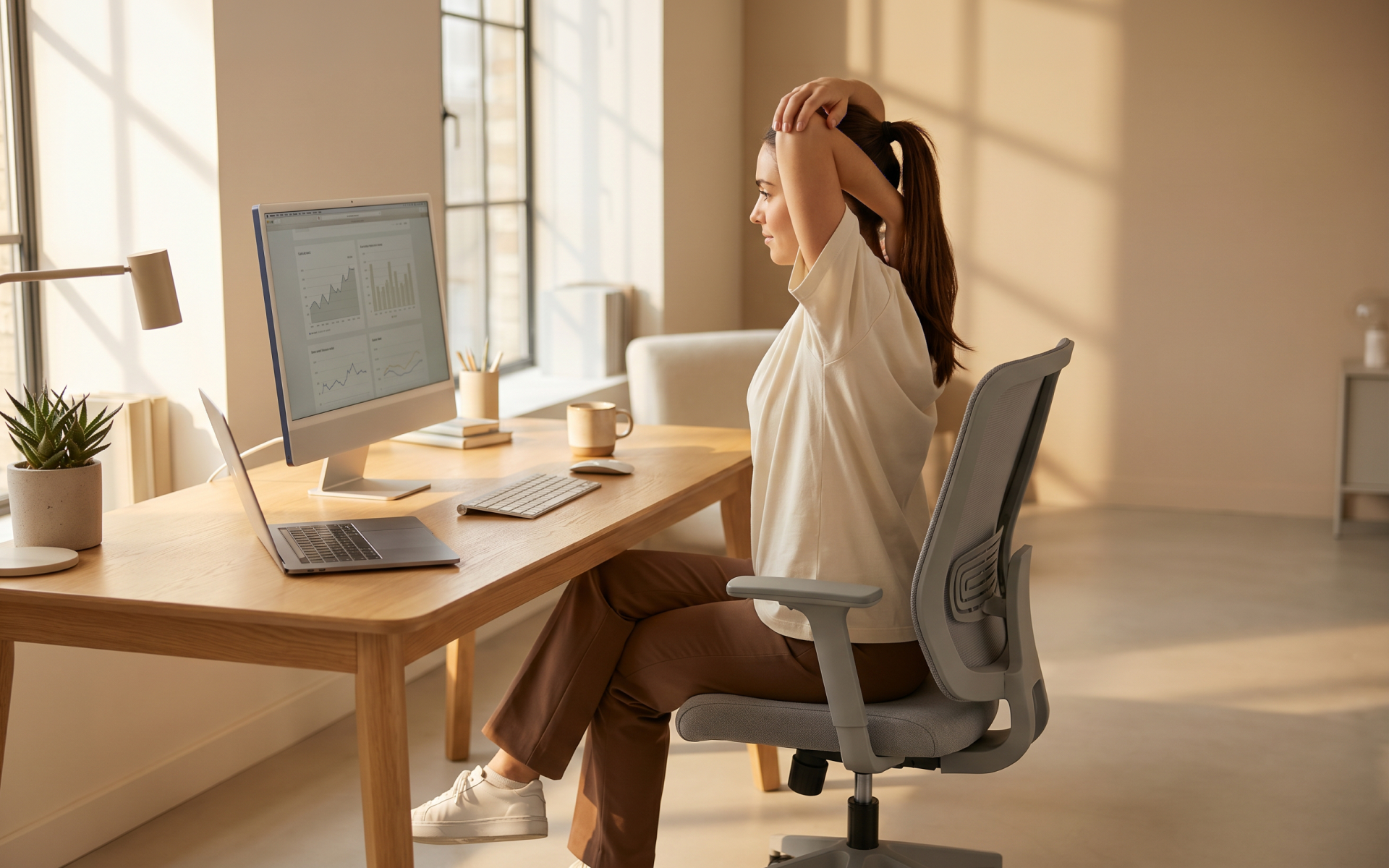
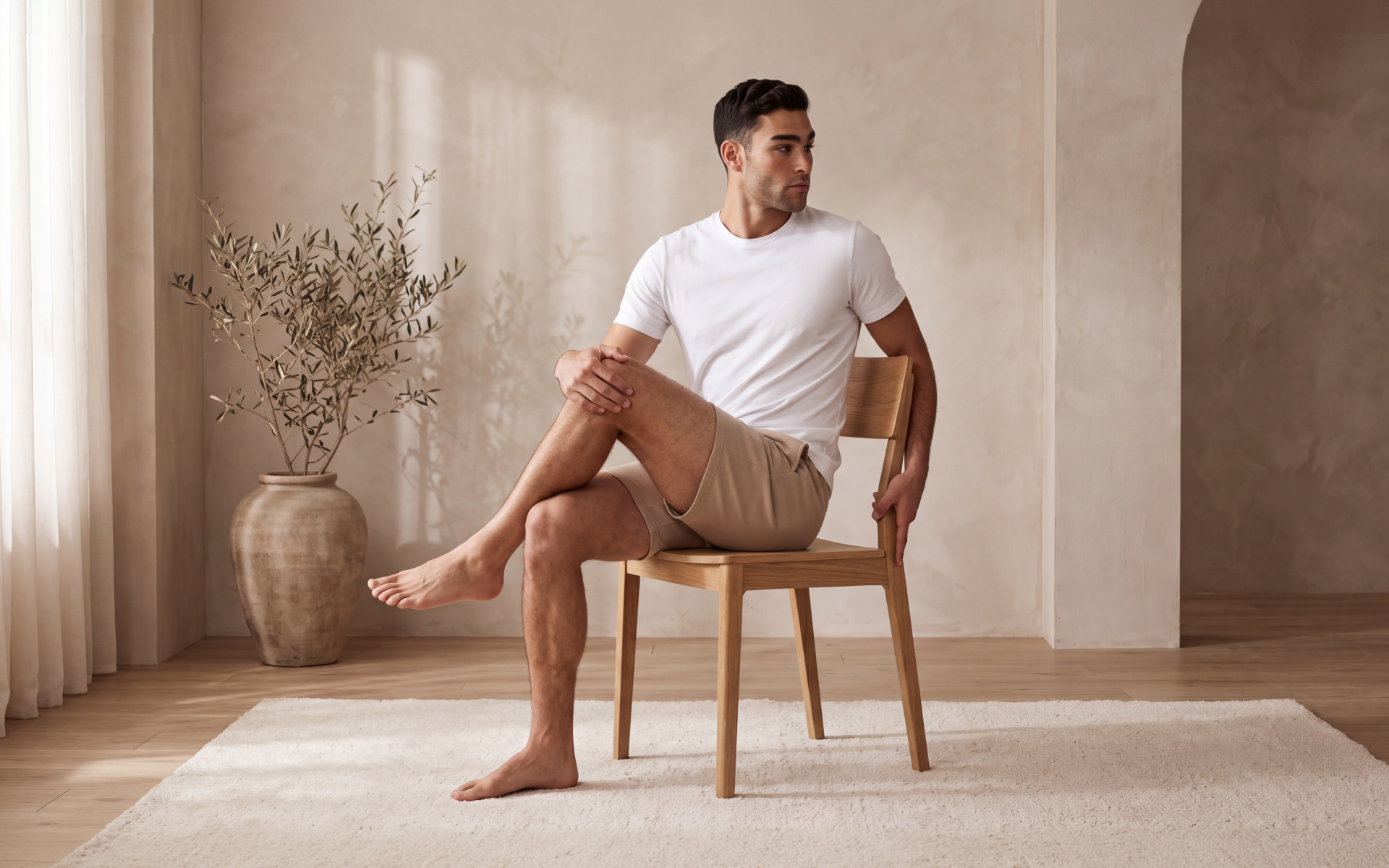
Chair yoga for men beginners uses seated poses or a chair for support during movement. This guide includes seven exercises, clear setup instructions, and ways to shorten the practice. Choose a stable chair, keep your feet supported, and use a range you can control without forcing a stretch.
Start with the setup in our guide to using a yoga chair. You can select a few of the movements here and leave out any position that does not suit you.
If you have a medical condition, current pain, or concerns about balance, ask a qualified healthcare professional about appropriate movement before starting. Stop if a pose causes pain, dizziness, or unusual symptoms.
Key takeaways
- Chair yoga uses seated positions or a chair for support during movement.
- Use a stable chair, support your feet, and keep the surrounding floor clear.
- The seven movements in this guide can be practiced in a smaller range or omitted.
- A small office study found lower perceived stress after a specific 15-minute chair-yoga session (1).
- Physiological muscle tone describes resting tension and resistance to passive movement, not visible definition (2).
- Research on isometric training cannot directly predict muscle-building effects from this seated routine (3).
- A review in adults aged 60 or older found balance and mobility improvements but did not establish fall prevention (4).
What can chair yoga offer, beginners?
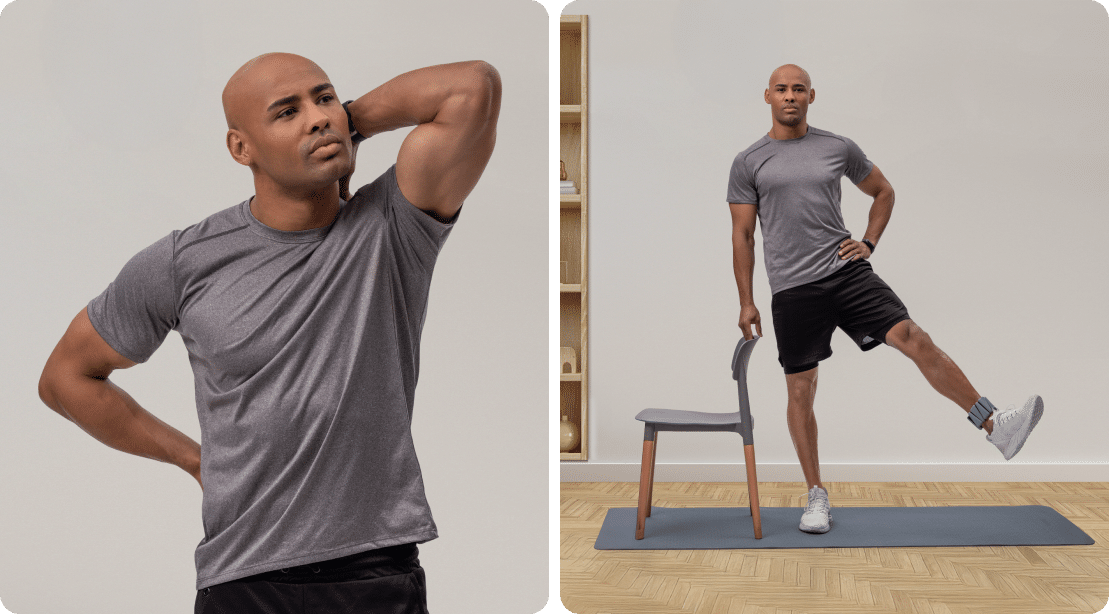
Chair yoga offers a way to practice seated movement, short holds, and attention to breathing. Its effects depend on the program and the person, and research on one routine cannot validate every chair sequence.
In a small study of 20 office participants, a 15-minute chair-yoga session was followed by lower perceived stress. The study measured an immediate response to that particular session (1).
The movements in this guide give you practice with:
A comfortable range of motion
Move a joint through the range you can currently control.
The size of that range varies between people and between movements.
Use a smaller shoulder circle or a shallower forward lean when needed.
A seated side stretch can be shortened simply by keeping the reaching arm lower.
For limitations related to a medical condition or injury, ask a qualified professional which adaptations are appropriate.
Read more: 6 Seated Core Exercises for Seniors to Do at Home
Controlled movement
During a seated shoulder roll, move slowly enough to choose where the movement starts and stops.
Keep your feet supported as you move your arms or turn your torso.
If your position changes unexpectedly, pause and reset.
Attention to breathing
Use ordinary, unforced breaths during each pose.
Pause in a seated position between poses whenever you want to rest.
A supported setup
A chair lets you practice these movements while seated.
Before starting, check that:
- The chair is stable and has no wheels.
- Your feet can rest on the floor or a firm support.
- There is room to move your arms without hitting furniture.
A chair changes the setup but does not make every movement appropriate for everyone. Skip positions that feel unsteady or cause pain.
What can make starting yoga unfamiliar?
Unfamiliar positions, class expectations, and uncertainty about adapting a pose can make yoga difficult to start.
Choose instructions that explain the setup and offer a smaller range or another position.
Your movement options depend on your own experience and circumstances.
Avoid assuming a particular level of flexibility from someone’s sex or body shape. Start with the range available to you.
In interviews with 21 men who did not practice yoga, some participants described gender-related perceptions as a barrier to joining classes (5). This records those participants’ views rather than a belief shared by all men.
A separate qualitative study involving 15 participants explored role models and other influences on men’s participation in yoga (6).
You may need time to learn the position and coordinate it with breathing. Pause to read a step before moving.
An instructor can help adapt a pose to your current range and equipment.
Workouts, weight management tools, and recipe ideas come together in the BetterMe: Health Coaching app, giving you practical support for building a more consistent wellness routine.
What does muscle tone mean?
In physiology, muscle tone refers to resting tension and resistance to passive movement (2).
Visible muscle definition describes appearance. Physiological tone describes how muscles behave at rest and during passive movement (2).
A pose can include an isometric hold, where you maintain a position while the muscles exert force.
A systematic review of isometric training found that adaptations depend on factors such as loading, muscle length, and training intent. Those protocols cannot be assumed to match a light chair-yoga hold or predict visible definition from this routine (3).
In a seated pose, focus on the movement you are doing and the support you need.
For a seated leg lift, keep your trunk still as you lift one bent knee.
If the movement becomes a rocking motion, reduce the lift or keep both feet down.
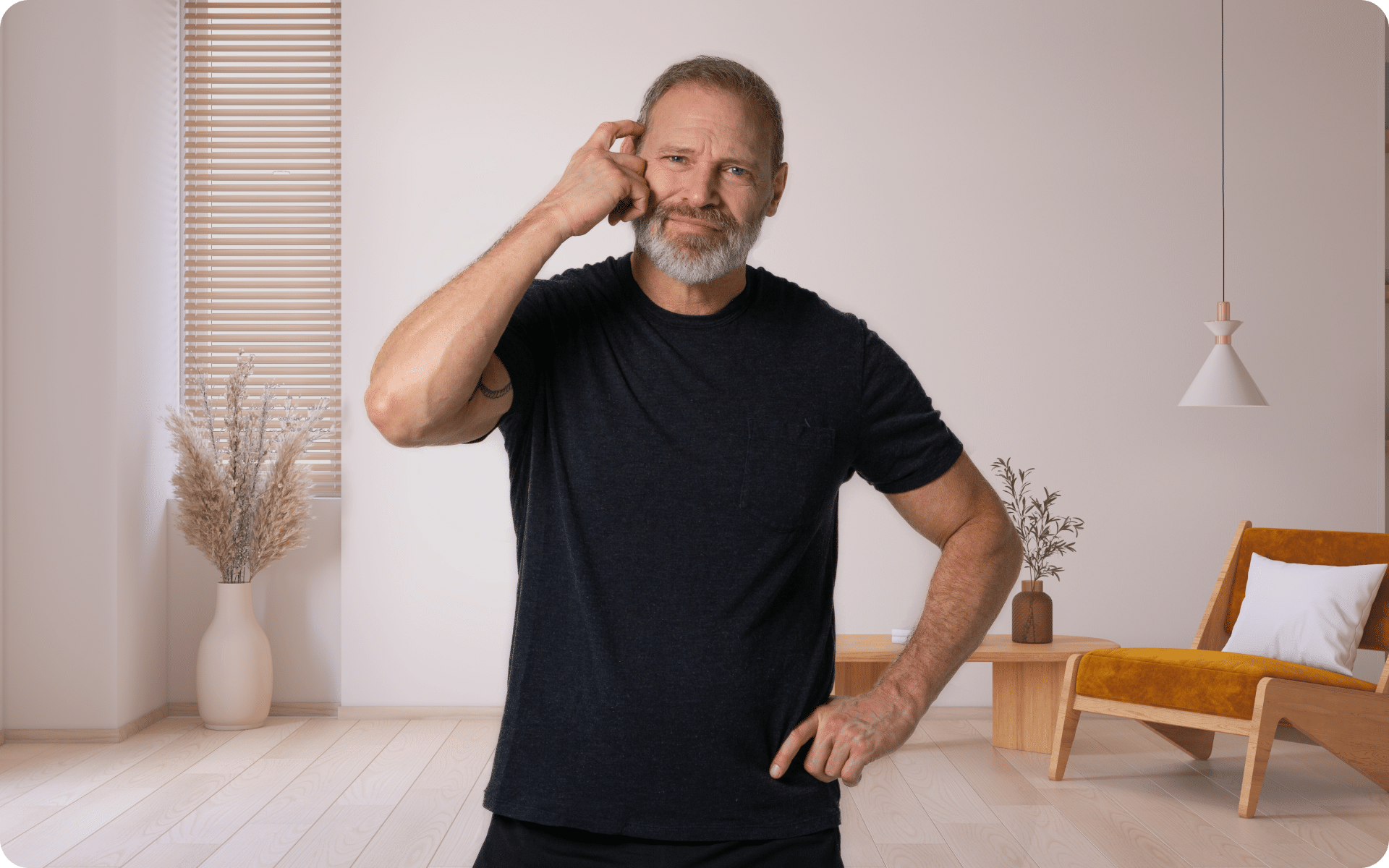
Can chair yoga be used for muscle-building goals?
The studies cited here do not establish this chair sequence as a muscle-building program. Research on isometric resistance training uses defined loads and protocols that differ from ordinary seated practice (3).
If increasing muscle size is your goal, discuss an appropriate resistance-training plan with a qualified exercise professional.
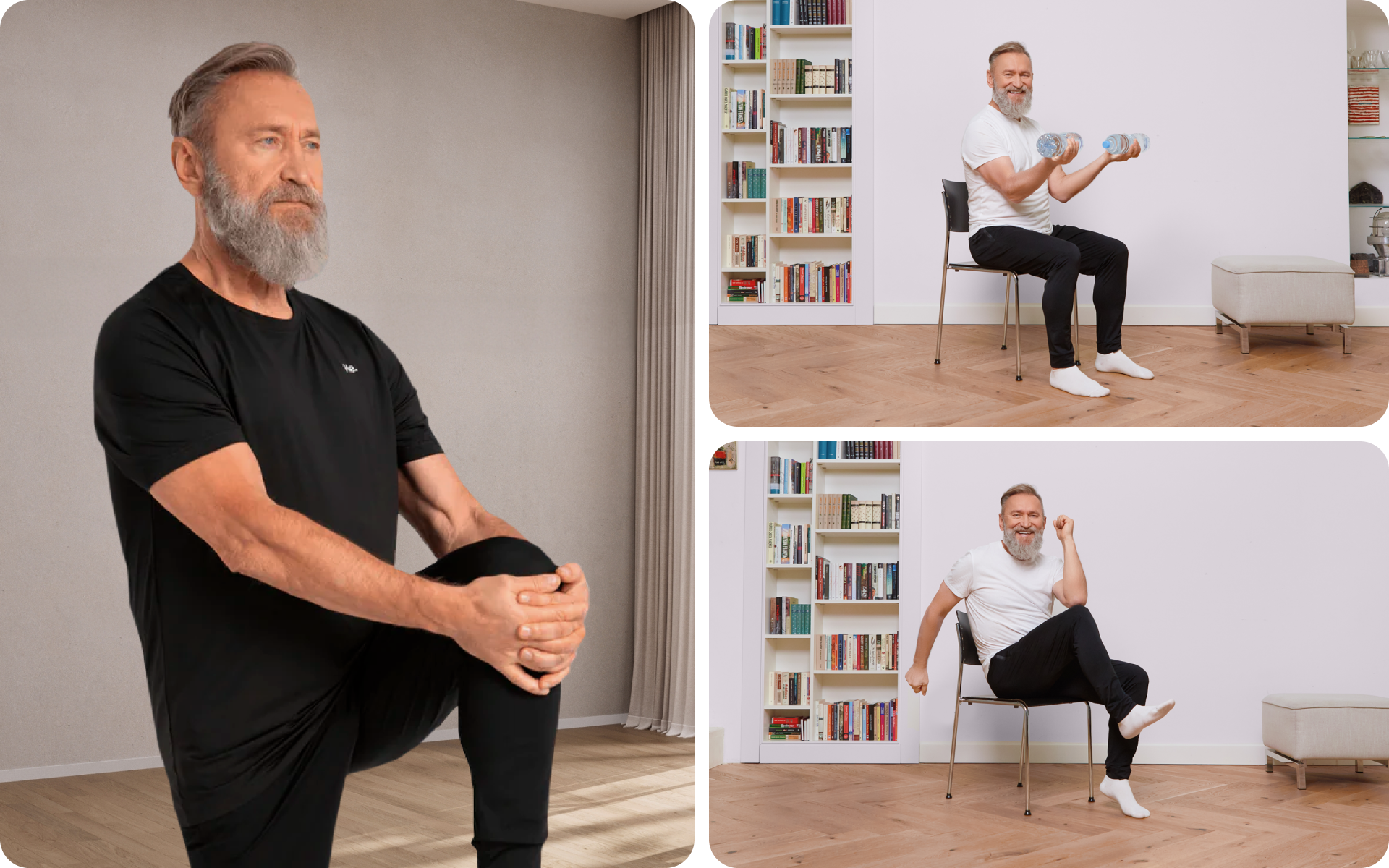
- Adding weights changes the demands of an exercise. Learn the unweighted setup before considering an adaptation with an instructor.
You can use chair yoga as one part of a wider activity routine without expecting a specific appearance outcome.
Read more: Yoga for Older Men: 7 Poses for Better Mobility
What chair yoga movements can beginners try?
Choose a few of the seven movements below for an initial practice. The repetitions and hold times are illustrative amounts; shorten them or skip a pose when needed.
Use a stable chair with both feet supported, and breathe normally throughout.
Seated cat-cow
This movement alternates a small forward and backward curve of the back.
- Sit upright in your chair with your feet flat on the floor and your hands resting on your knees.
- Inhale as you lift your chest slightly.
- Exhale as you gently round your back.
- Repeat up to 6 times within a comfortable range.
Seated side stretch
Use a small side bend while keeping your sitting position steady.
- Sit with your back straight and feet firmly planted on the ground.
- Raise your right arm only as far as comfortable, keeping your left hand on the chair.
- Lean a little to the left for up to 3 normal breaths.
- Return to center.
- Repeat on the other side.
Supported seated warrior
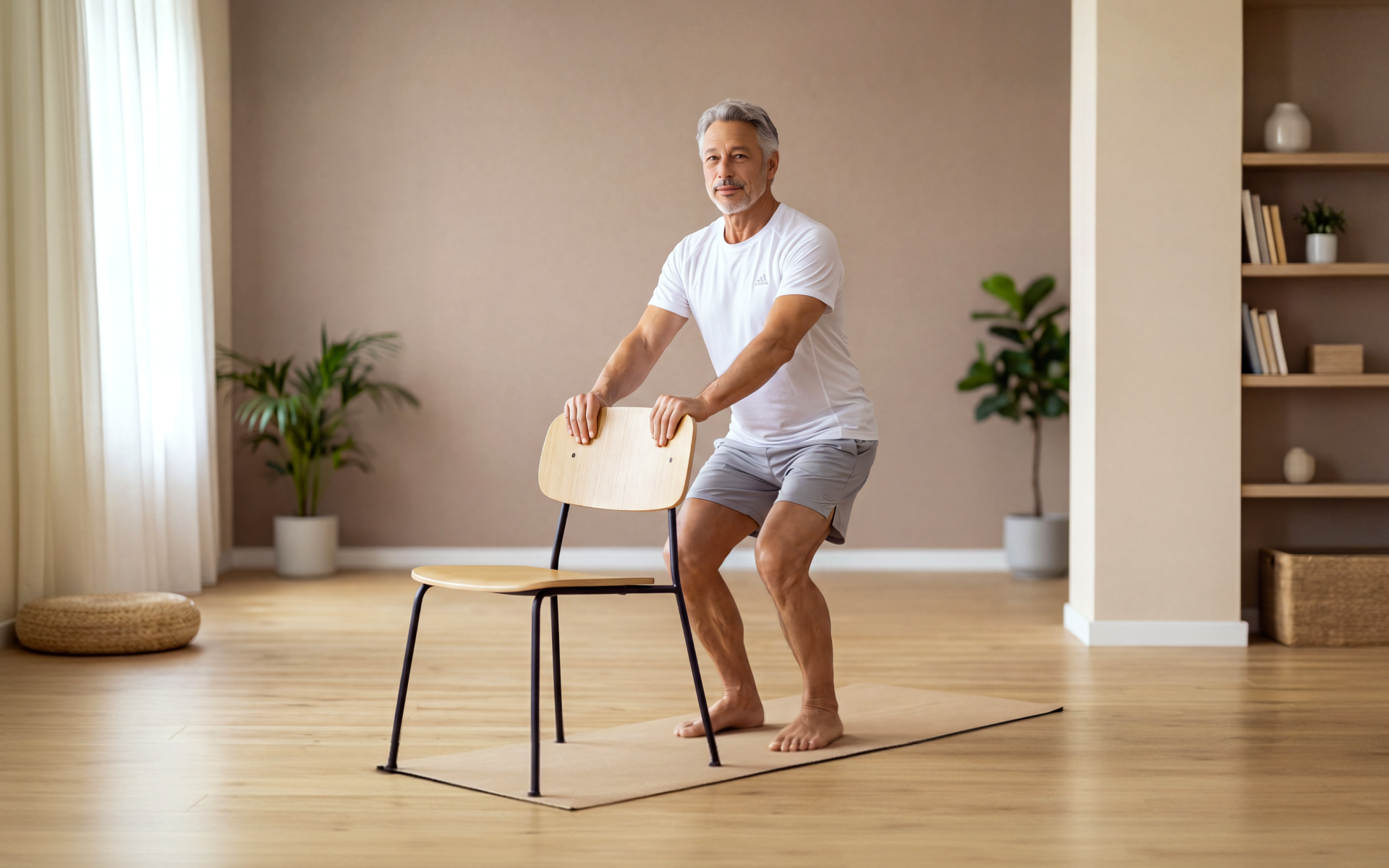
Keep the chair supporting your weight throughout this variation.
- Sit with your right foot planted and slide your left foot a short distance to the side.
- Rest your hands on your hips.
- Hold the position for up to 3 normal breaths.
- Bring your left foot back under you.
- Repeat with the other foot.
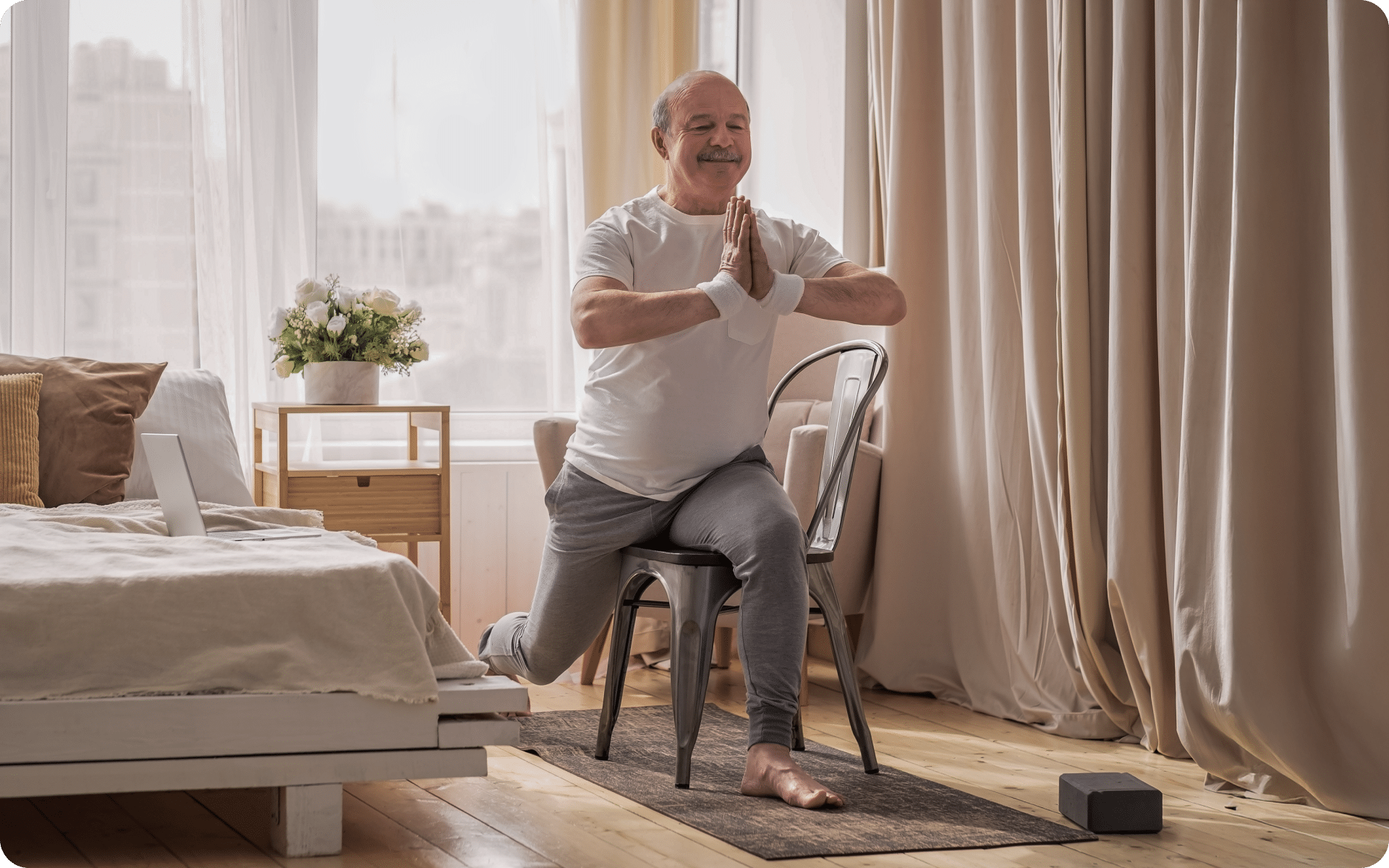
Seated turn
Turn through a small range without pulling on the chair.
- Sit upright with both feet flat on the floor.
- Rest your hands lightly on your thighs.
- Turn your chest a little to the right while keeping your hips facing forward.
- Return to center.
- Repeat to the left.
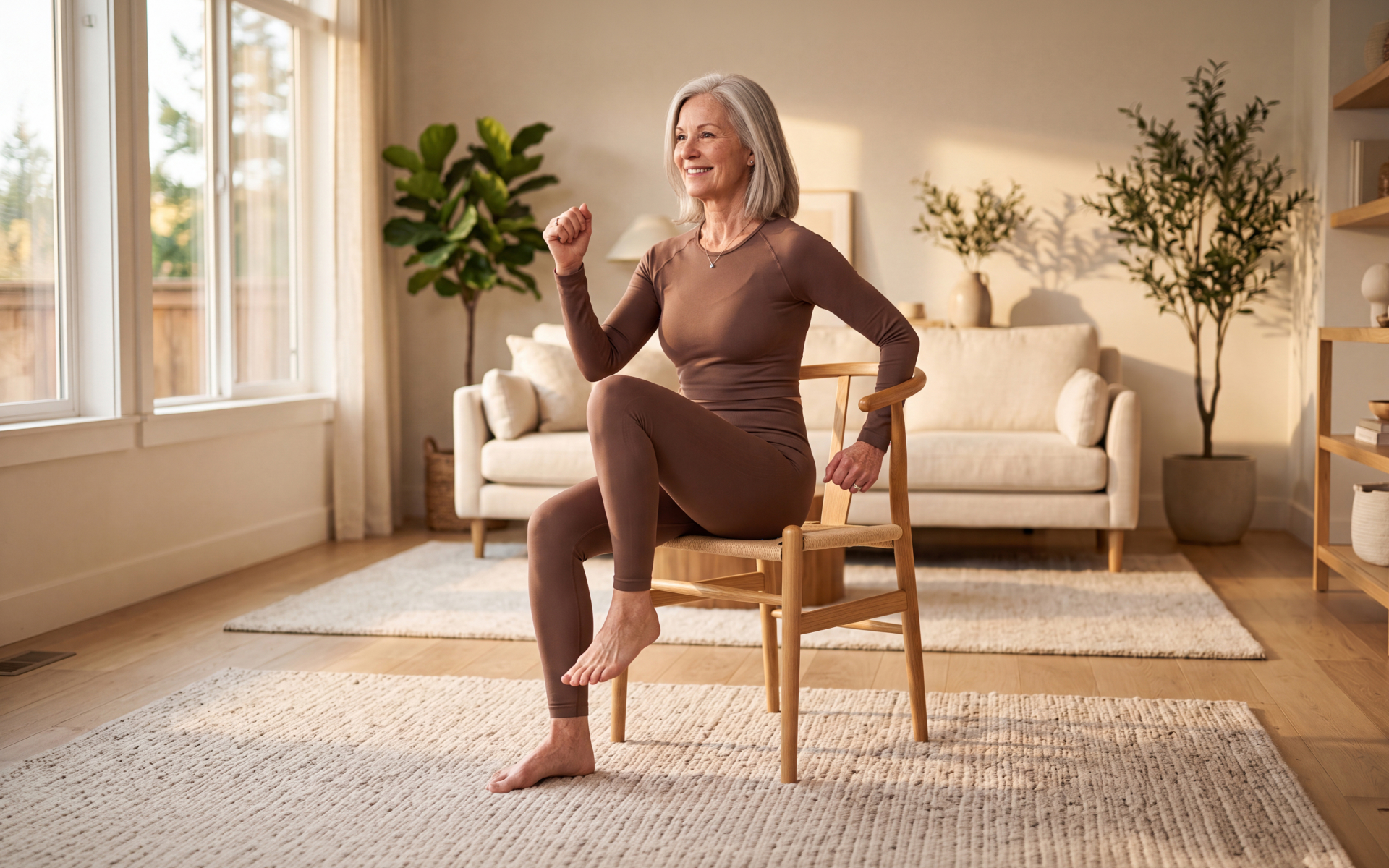
Seated leg lift
Practice lifting one bent leg while keeping the trunk steady.
- Sit tall with your knees bent and feet flat on the floor.
- Lift your right leg a few inches off the ground, keeping the knee bent and engaging your core.
- Lower the foot to the floor.
- Repeat with the left leg.
- Try up to 6 lifts on each side.
Seated forward lean
Keep the lean small and your feet planted.
- Sit near the front of the chair with your feet hip-width apart.
- Hinge a short distance forward at your hips with your hands on your thighs.
- Keep your neck in line with your back.
- Return slowly to an upright seat.
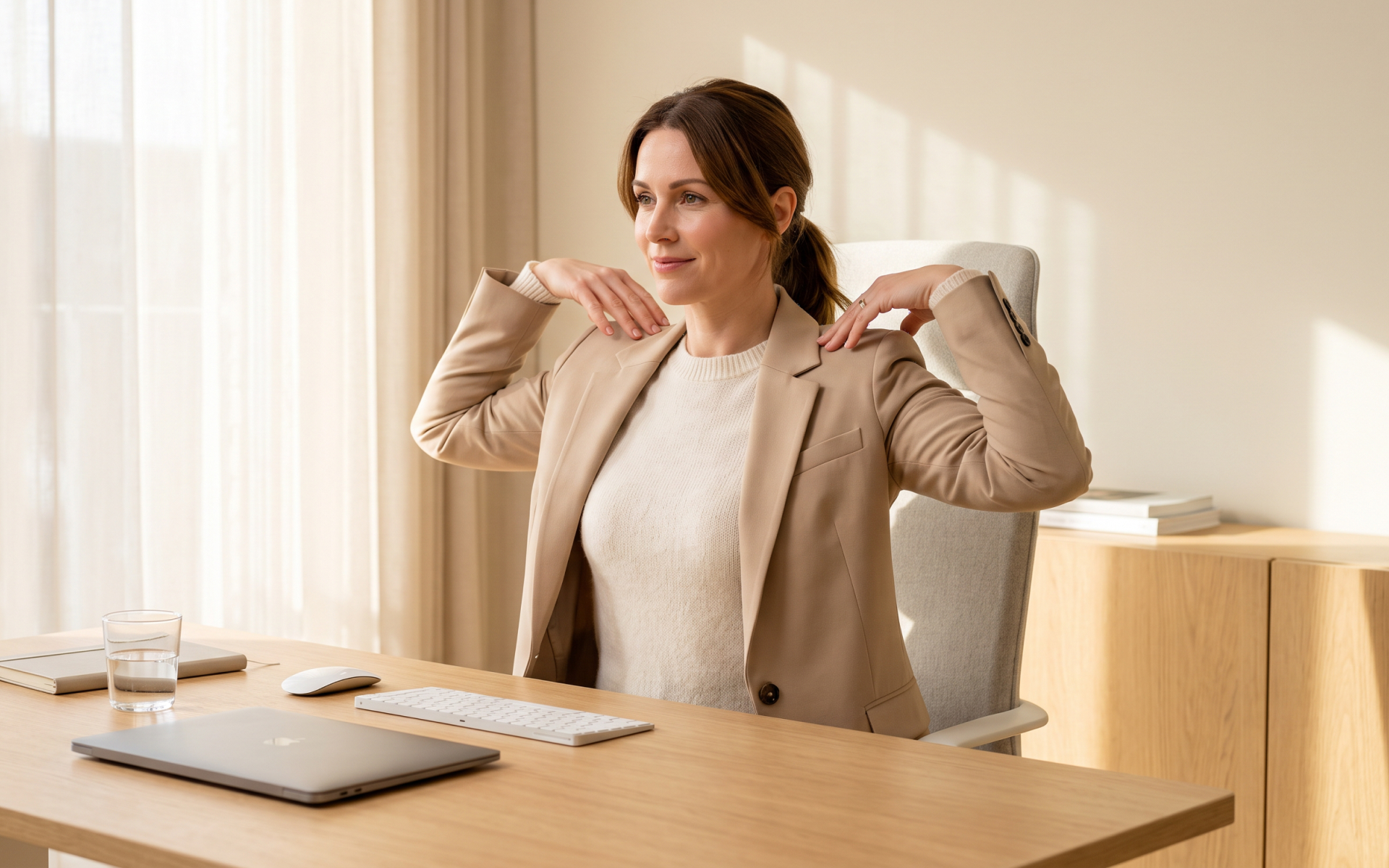
Seated shoulder roll
Make the circles small enough to control.
- Sit with your back straight and arms relaxed at your sides.
- Roll your shoulders backward slowly up to 5 times.
- Reverse direction for up to 5 circles.
Finish seated with your feet supported and allow your breathing to settle.
For another sequence, see our chair yoga pose guide.
How can you schedule chair yoga practice?
As an example, you could try a short practice on two days of the week, leaving time between sessions to see how the movements feel. This is a sample schedule, not an established dose for every beginner.
Adjust the session using a few practical checks:
- Leave time to rest when the movements feel tiring.
- Choose only as many poses as you can follow without rushing.
- Repeat a manageable version before increasing the range or number of repetitions.
If you decide to add time, change one element and check how it feels.
Stop if symptoms occur and seek professional advice when needed.
Our chair yoga for men guide includes additional movement examples.
BetterMe can help you add more structure to your daily wellness routine with workouts, meal planning tools, and habit-building features. Explore the app and take a practical step toward a routine that feels more manageable for you.
FAQs
Do you need a yoga mat for this seated sequence?
A mat is optional for the seated movements described here. Place the chair on a surface where it will not slide, and check that any floor covering lies flat.
Can you follow the instructions from a screen?
Yes, you can read a step and pause before trying it. Place the screen where you can view it without holding a strained neck position, and avoid turning toward it during a hold.
What has research found about yoga in older adults?
A review of six trials involving 307 adults aged 60 or older found improvements in balance and mobility. The authors said further research was needed to determine whether those changes prevent falls; the findings do not validate every chair-yoga routine (4).
The bottom line
Set up a stable chair, choose a few movements, and practice each through a range you can control. Keep the repetitions brief enough to follow the instructions without rushing.
If a pose does not fit your circumstances, leave it out and ask a qualified professional about an alternative.
DISCLAIMER:
This article is intended for general informational purposes only and does not serve to address individual circumstances. It is not a substitute for professional advice or help and should not be relied on for making any kind of decision-making. Any action taken as a direct or indirect result of the information in this article is entirely at your own risk and is your sole responsibility.
BetterMe, its content staff, and its medical advisors accept no responsibility for inaccuracies, errors, misstatements, inconsistencies, or omissions and specifically disclaim any liability, loss or risk, personal, professional or otherwise, which may be incurred as a consequence, directly or indirectly, of the use and/or application of any content.
You should always seek the advice of your physician or other qualified health provider with any questions you may have regarding a medical condition or your specific situation. Never disregard professional medical advice or delay seeking it because of BetterMe content. If you suspect or think you may have a medical emergency, call your doctor.
SOURCES:
- Fifteen Minutes of Chair-Based Yoga Postures or Guided Meditation Performed in the Office Can Elicit a Relaxation Response (2012, pmc.ncbi.nlm.nih.gov)
- Muscle Tone Physiology and Abnormalities (2021, pmc.ncbi.nlm.nih.gov)
- Isometric training and long-term adaptations: Effects of muscle length, intensity, and intent: A systematic review (2019, pubmed.ncbi.nlm.nih.gov)
- Yoga-based exercise improves balance and mobility in people aged 60 and over: a systematic review and meta-analysis (2016, pubmed.ncbi.nlm.nih.gov)
- Yoga not a (physical) culture for men? Understanding the barriers for yoga participation among men (2021, sciencedirect.com)
- “Men Need Role Models”: Exploring the Facilitators and Barriers for Yoga Participation Among Men (2024, pmc.ncbi.nlm.nih.gov)

 Reviewed by