
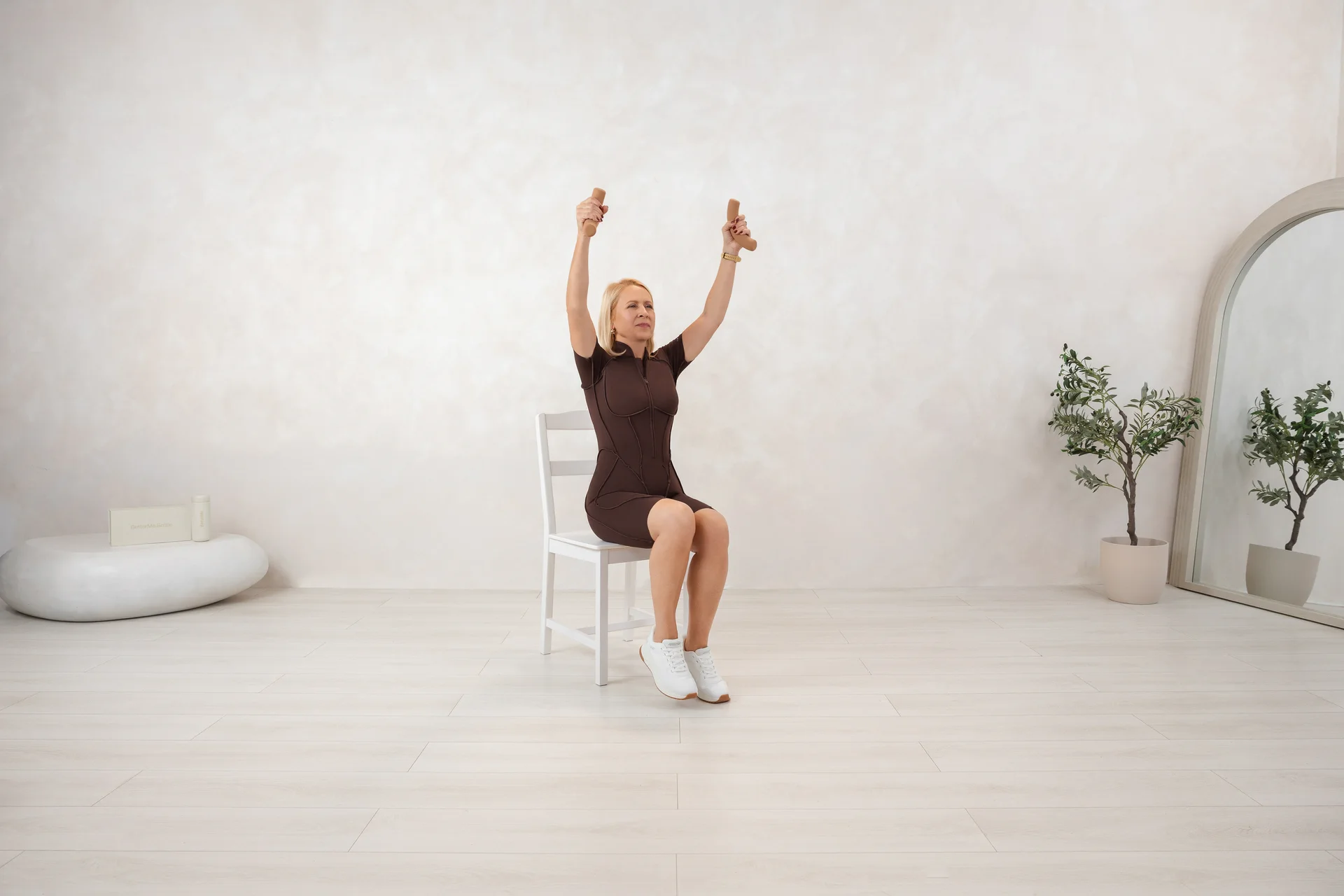
A chair arm workout trains the biceps, triceps, shoulders, and forearms while you sit on a sturdy chair. Beginners can start with light dumbbells or water bottles on two or three days a week. This guide gives eight exercises, sets, and a short routine. For forearm work alone, see our forearm workouts*.*
Key takeaways
A chair arm workout is a simple way to add strength work to a busy or low-energy day.
- Public strength guidance starts biceps curls at 3 sets of 5 with each arm, standing or seated (1).
- Adults are advised to do muscle-strengthening activity on at least two days a week (2).
- Use a solid, stable chair without wheels, with your feet flat on the floor (3).
- Resistance-training guidance includes home-based exercise with light equipment (4).
- Light loads built muscle as well as heavy loads in trials where sets were taken close to fatigue (5).
- Eight exercises cover the front and back of the upper arm, the shoulders, and the forearms.
- A full session takes about 15 minutes.
What is a chair arm workout?
A chair arm workout is a set of arm and shoulder exercises done while seated. The chair supports your body, so your arms do most of the work.
The format suits office breaks, small rooms, and days when standing exercise feels like too much. The moves use light hand weights, water bottles, or no weight at all.
Seated work has limits. Your legs and hips stay mostly at rest, so a chair arm workout is one part of a weekly routine.
Are chair arm exercises effective?
Chair arm exercises can build strength when the last repetitions of a set feel challenging. The position matters less than the effort.
Resistance-training guidance counts home-based exercise with simple equipment as a valid option (4). A review of trials compared light and heavy loads. Muscle growth was similar when sets continued until the muscles were close to fatigue (5). Heavier loads were more effective for maximal strength in the same review (5).
For beginners, the message is practical. A light weight can work when the last controlled repetitions feel hard.
Read more: Chair workout plan for seniors: a simple weekly schedule
How do you set up for a chair arm workout?
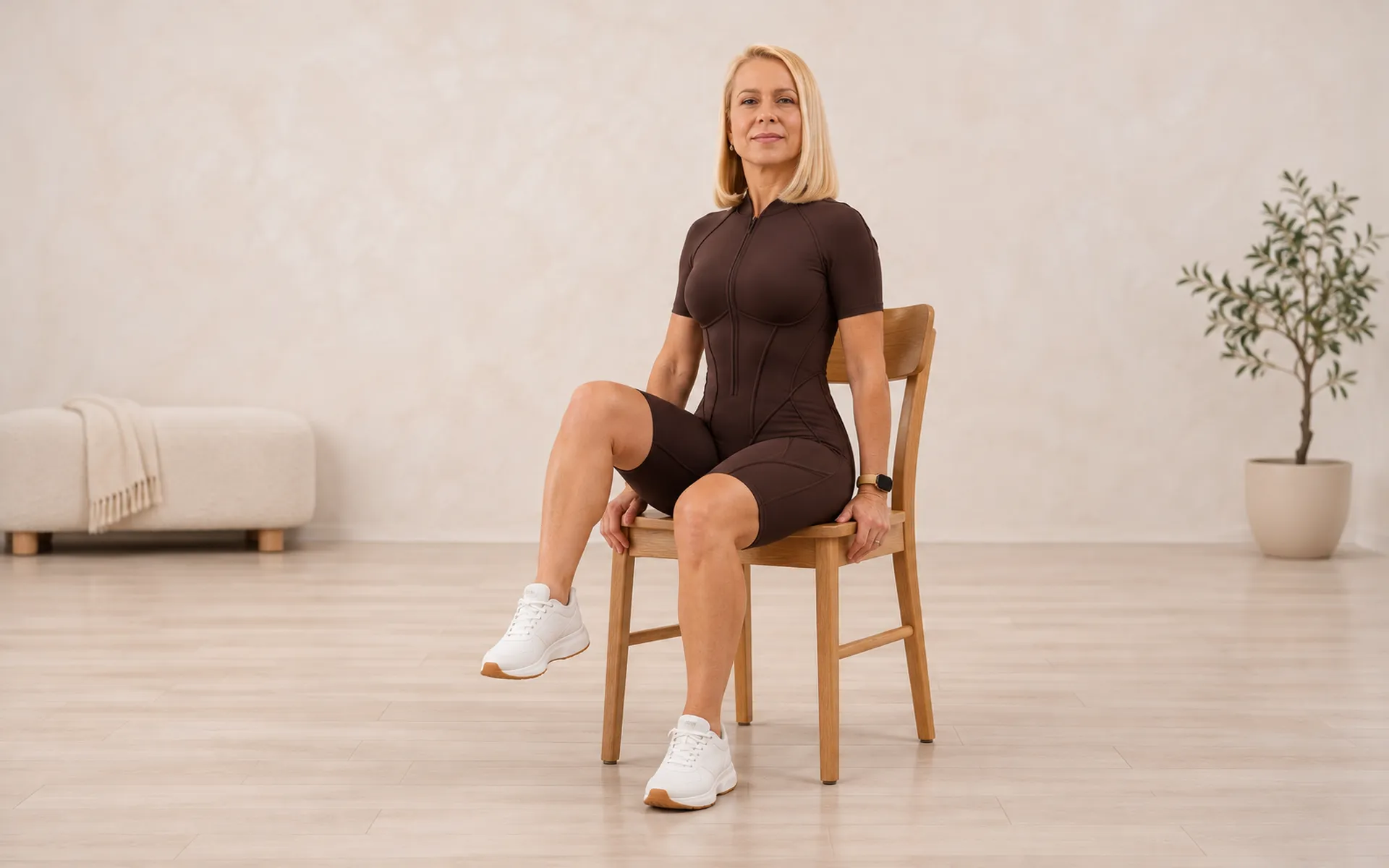
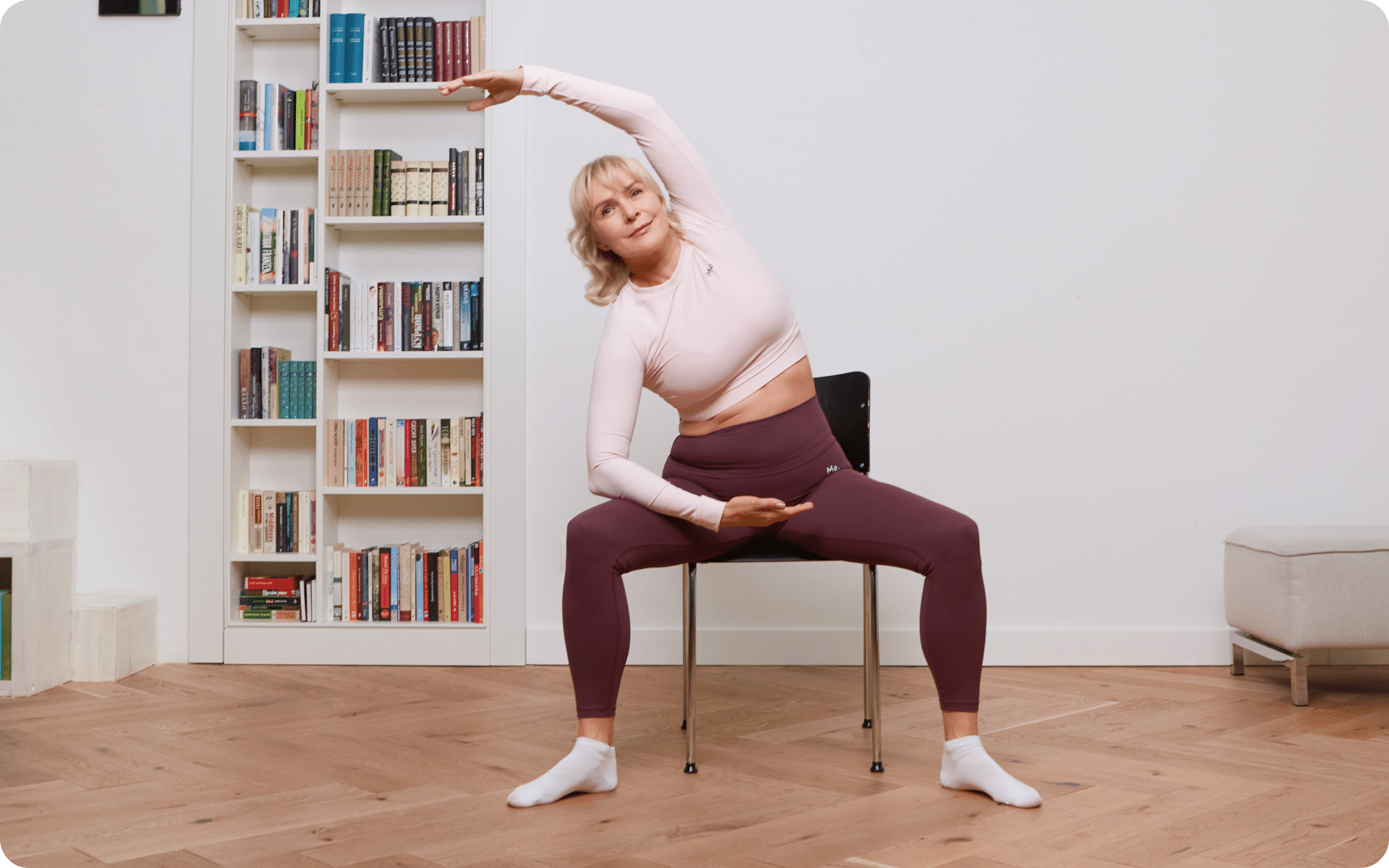
Set up with a sturdy chair, a pair of light weights, and enough space to lift your arms overhead. A good position keeps your posture steady.
Seated exercise guidance recommends a solid, stable chair without wheels. Sit with your feet flat and your knees bent at right angles (3). A chair without arms leaves room for your elbows (3).
- Sit tall with your back away from the backrest if you can.
- Keep your shoulders down and relaxed.
- Choose a weight you can lift 10 times with control.
- Water bottles of about 16 ounces work as starter weights.
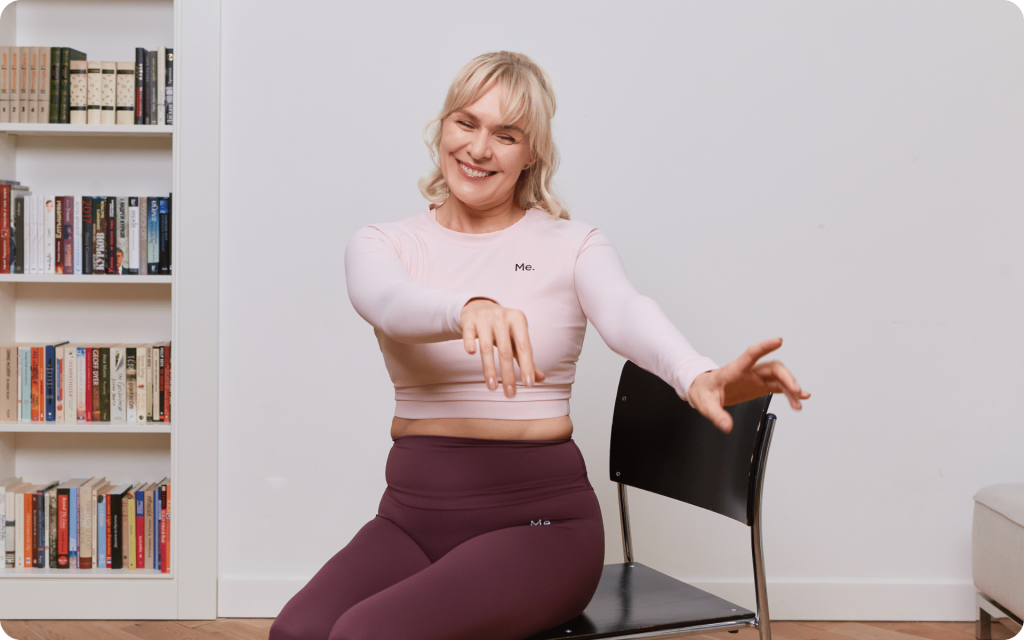
Which 8 exercises are in the chair arm workout?
The workout uses eight exercises that cover the main parts of the arm. The table shows the main area and a starting amount.
| Exercise | Main area | Sets and repetitions |
|---|---|---|
| Seated biceps curl | Front of the upper arm | 3 sets of 5 to 10 with each arm |
| Hammer curl | Front of the upper arm and forearm | 2 sets of 8 to 10 |
| Seated overhead press | Shoulders | 2 sets of 8 to 10 |
| Overhead triceps extension | Back of the upper arm | 2 sets of 8 to 10 |
| Arm circles | Shoulders | 2 sets of 10 each way |
| Wrist curl and extension | Forearms | 2 sets of 10 each |
| Shoulder shrug | Upper shoulders | 2 sets of 10 |
| Chair dip, optional | Back of the upper arm | 1 to 2 sets of 5 |
The biceps curl amount follows public strength guidance, which starts at 3 sets of 5 (1). The other amounts are editorial starting points.
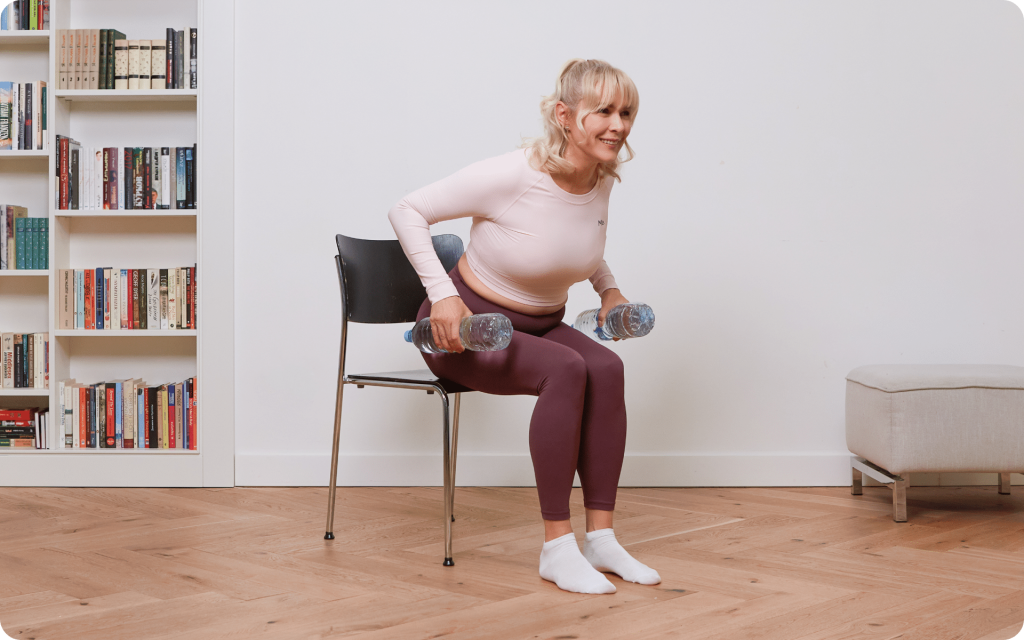
1. Seated biceps curl
The seated biceps curl trains the front of the upper arm.
- Sit tall with a weight in each hand and your arms by your sides.
- Turn your palms forward.
- Bend one elbow and lift the weight toward your shoulder.
- Lower slowly and repeat with the other arm.
2. Hammer curl
The hammer curl trains the upper arm and the forearm together.
- Hold the weights with your palms facing each other.
- Keep your elbows close to your sides.
- Lift both weights toward your shoulders.
- Lower slowly.
3. Seated overhead press
The seated overhead press trains the shoulders.
- Hold the weights at shoulder height with your elbows bent.
- Press both weights up until your arms are nearly straight.
- Pause briefly.
- Lower the weights back to shoulder height.
Press one arm at a time if lifting both feels unsteady.
4. Overhead triceps extension
The overhead triceps extension trains the back of the upper arm.
- Hold one weight with both hands above your head.
- Keep your elbows pointing forward.
- Bend your elbows and lower the weight behind your head.
- Straighten your arms again.
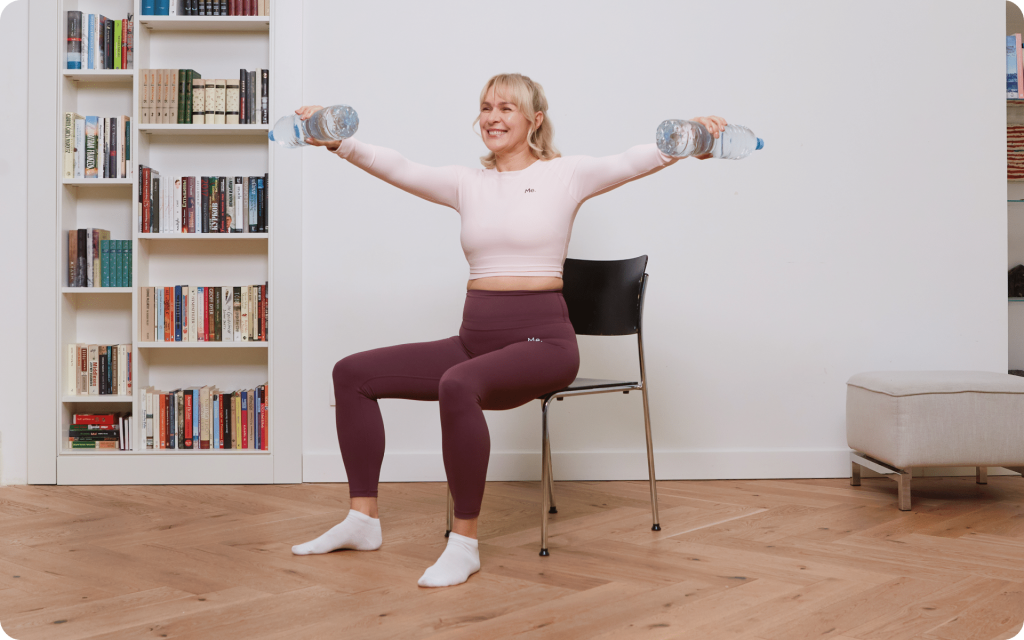
5. Arm circles
Arm circles warm and train the shoulders without weights.
- Lift your arms out to the sides at shoulder height.
- Draw small circles forward 10 times.
- Reverse the direction for 10 circles.
- Lower your arms and rest.
6. Wrist curl and extension
Wrist curls and extensions train the forearms.
- Rest your forearm on your thigh with your palm up.
- Curl the weight up by bending your wrist, then lower it.
- Turn your palm down.
- Lift the back of your hand, then lower it.
7. Shoulder shrug
The shoulder shrug trains the upper shoulders.
- Hold a weight in each hand with your arms hanging down.
- Lift your shoulders toward your ears.
- Pause for one second.
- Lower your shoulders slowly.
8. Chair dip, optional
The chair dip is a harder move for people with strong, comfortable shoulders.
- Place the chair against a wall and sit on its front edge.
- Grip the edge beside your hips and slide forward off the seat.
- Bend your elbows a little and lower your hips.
- Push back up and return to the seat.
Skip the chair dip if your shoulders or wrists feel uncomfortable. The triceps extension trains the same muscle.
Whether you’re just starting your fitness journey or looking to add more structure to your routine, BetterMe offers tools that can support different wellness goals. Explore the app and see how its workout, nutrition, and habit-building features can fit into your lifestyle.
What does a 15-minute chair arm routine look like?
A 15-minute routine runs through seven exercises with short rests and fewer sets of some moves. The table gives one order.
| Order | Exercise | Amount | Rest |
|---|---|---|---|
| 1 | Arm circles | 10 each way | 30 seconds |
| 2 | Seated biceps curl | 3 sets of 5 to 10 each arm | 45 seconds between sets |
| 3 | Seated overhead press | 2 sets of 8 | 45 seconds |
| 4 | Overhead triceps extension | 2 sets of 8 | 45 seconds |
| 5 | Hammer curl | 2 sets of 8 | 45 seconds |
| 6 | Wrist curl and extension | 1 set of 10 each | 30 seconds |
| 7 | Shoulder shrug | 2 sets of 10 | 30 seconds |
Finish with gentle stretches. Reach one arm across your chest for 15 seconds, then change sides.
How do you warm up before a chair arm workout?
Warm up for two minutes so your shoulders and elbows move freely. Stay seated for every step.
- Roll your shoulders backward 10 times and forward 10 times.
- Bend and straighten both elbows 10 times without weights.
- Open and close your hands 10 times.
- Do one easy set of arm circles.
A warm-up also tells you how your joints feel that day. Choose a lighter weight when a shoulder feels stiff. Skip the overhead moves on days when lifting your arms is uncomfortable.
Read more: 10 yoga chair exercises for seniors: steps, routine, and tips
How often should you do a chair arm workout?
Do a chair arm workout two or three times a week with a rest day between sessions. Adult guidelines recommend muscle-strengthening activity on at least two days (2).
The guidelines refer to all major muscle groups. Add leg and trunk exercises on the same days or on other days. Aim for 150 minutes of moderate aerobic activity across the week as well (2).
A wall push-up is a useful extra. Public guidance suggests 3 sets of 5 to 10 repetitions (1).
How do you progress a chair arm workout?
Progress by adding repetitions first and weight second. Change one thing at a time.
| Stage | What to change |
|---|---|
| Weeks 1 and 2 | Learn the moves with a light weight |
| Weeks 3 and 4 | Add 2 repetitions to each set |
| Weeks 5 and 6 | Add a third set to the curls and presses |
| After week 6 | Move to a slightly heavier weight and return to fewer repetitions |
Write down the weight and repetitions after each session. Our rear delt calisthenics guide adds bodyweight shoulder work for later stages.
What mistakes should you avoid?
Two common mistakes are swinging the weights and rushing. Slow, controlled movement works the muscles more evenly.
- Leaning back to lift a weight that is too heavy
- Shrugging the shoulders during curls and presses
- Holding the breath
- Locking the elbows hard at the top of a press
- Skipping the lowering phase
Stop an exercise that causes discomfort, and try a lighter weight or a smaller range. Talk to a doctor about a shoulder or elbow concern before adding weight.
Older readers may prefer a gentler start. Our arm chair yoga for seniors guide uses slower, lighter movements.
Frequently Asked Questions
Can you do a chair arm workout without weights?
Yes, arm circles, shrugs, and wall push-ups need no weights. Water bottles or food cans can replace dumbbells for the other moves.
Can you do arm exercises in a chair every day?
Light moves such as arm circles suit daily use. Leave a day between weighted sessions so the muscles can rest.
What weight should beginners use?
Choose a weight you can lift 10 times with control. Many beginners start with 2 to 4 pounds (1 to 2 kilograms) in each hand.
Can you do this workout at a desk?
Yes, if your office chair is locked or replaced by a chair without wheels (3). Short sets between tasks add up over the day.
How long does a chair arm workout take to feel easier?
The moves usually feel more familiar within a few sessions. Strength changes vary between people, so track your repetitions instead of a date. Our chair workout benefits article explains what to expect from seated training.
The bottom line
A chair arm workout needs one sturdy chair, light weights, and about 15 minutes. Start with the listed sets, move slowly, and add repetitions before weight. Pair the session with leg and aerobic exercise for a balanced week.
DISCLAIMER:
This article is intended for general informational purposes only and does not serve to address individual circumstances. It is not a substitute for professional advice or help and should not be relied on for making any kind of decision-making. Any action taken as a direct or indirect result of the information in this article is entirely at your own risk and is your sole responsibility.
BetterMe, its content staff, and its medical advisors accept no responsibility for inaccuracies, errors, misstatements, inconsistencies, or omissions and specifically disclaim any liability, loss or risk, personal, professional or otherwise, which may be incurred as a consequence, directly or indirectly, of the use and/or application of any content.
You should always seek the advice of your physician or other qualified health provider with any questions you may have regarding a medical condition or your specific situation. Never disregard professional medical advice or delay seeking it because of BetterMe content. If you suspect or think you may have a medical emergency, call your doctor.
SOURCES:
- Strength exercises (2024, nhs.uk)
- Adult Activity: An Overview (2023, cdc.gov)
- Sitting exercises (2024, nhs.uk)
- American College of Sports Medicine Position Stand. Resistance Training Prescription for Muscle Function, Hypertrophy, and Physical Performance in Healthy Adults: An Overview of Reviews (2026, pmc.ncbi.nlm.nih.gov)
- Strength and hypertrophy adaptations between low- vs. high-load resistance training: a systematic review and meta-analysis (2017, doi.org)
 Reviewed by