A chair yoga sequence puts seated and supported poses in an order you can follow. This version starts with breathing, then moves through gentle stretches before returning to a seated rest. Use only the positions that feel comfortable. For individual variations, see our advanced chair yoga poses guide.
Check with a doctor before starting if you have a heart condition, balance problems, joint problems, or recent surgery.
Our product is meant to increase well-being and not as a treatment for mental health conditions. If you have any mental health condition, please consult a mental health specialist instead
Key takeaways
A steady, ordered flow helps you relax while you stretch.
- A review of 42 studies evaluated varied yoga programs and reported lower evening cortisol and resting heart rate in some comparisons (1).
- Slow breathing was linked with greater relaxation and calmer heart rhythms (2).
- All types of stretching improved range of motion for a short time after a session (3).
- Compared with inactive groups, yoga improved balance, flexibility, and sleep quality in older adults (4).
- In adults aged 60 and over, yoga gave a small gain in balance and a medium gain in mobility (5).
- The full sequence takes about 20 minutes, and shorter versions take 5 to 10 minutes.
What is a chair yoga sequence?
A chair yoga sequence is a series of poses done in a set order on or beside a chair. Each pose flows into the next, often linked with the breath.
A good sequence warms up the body first, then stretches and strengthens, and ends with stillness. Many sequences take 10 to 20 minutes. This order helps you move with more ease as the session goes on.
How is a sequence different from single poses?
Single poses target one area at a time. A sequence links poses into a flow, so the whole body warms up, stretches, and settles in one session.
Following a set order also makes practice easier to repeat. You do not need to plan each session, so it is simpler to build a habit.
Why does the order of poses matter?
The order of poses shapes how the session feels.
- Breathing first helps you settle and focus.
- Gentle spine moves warm up the back before deeper stretches.
- Stretches come after the body is warm.
- Light strength moves raise energy in the middle.
- A calm finish helps you relax before getting up.
What do you need?
You need very little equipment, and many homes already have it.
- A sturdy chair without wheels or arms
- A quiet space with room to stretch your arms
- Comfortable clothes
- A cushion if your feet do not reach the floor
Read more: 28-day chair yoga challenge: weekly plan and 11 poses
What are the 12 poses in the sequence?
Follow the poses in order. Move slowly and breathe through your nose if you can.
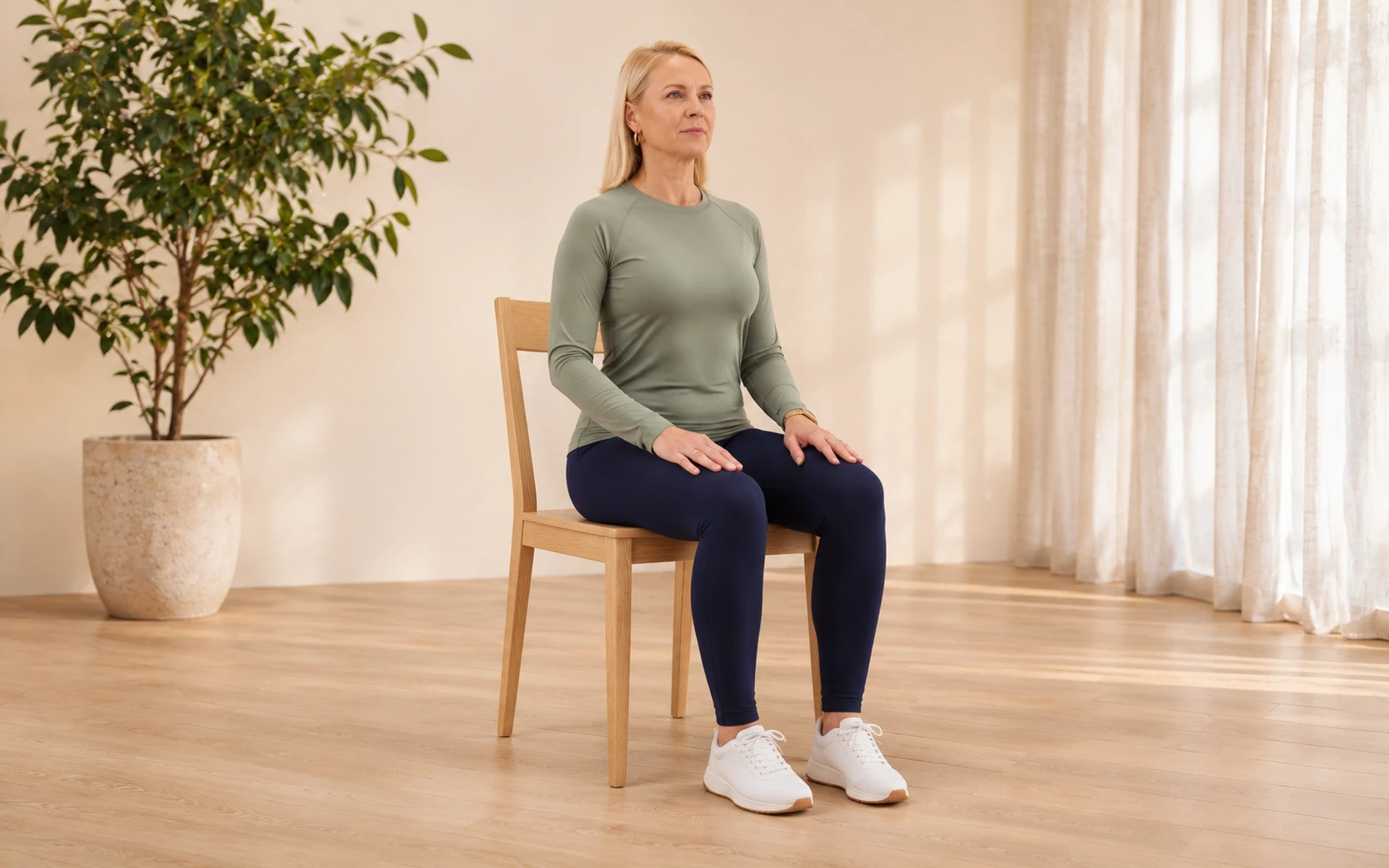
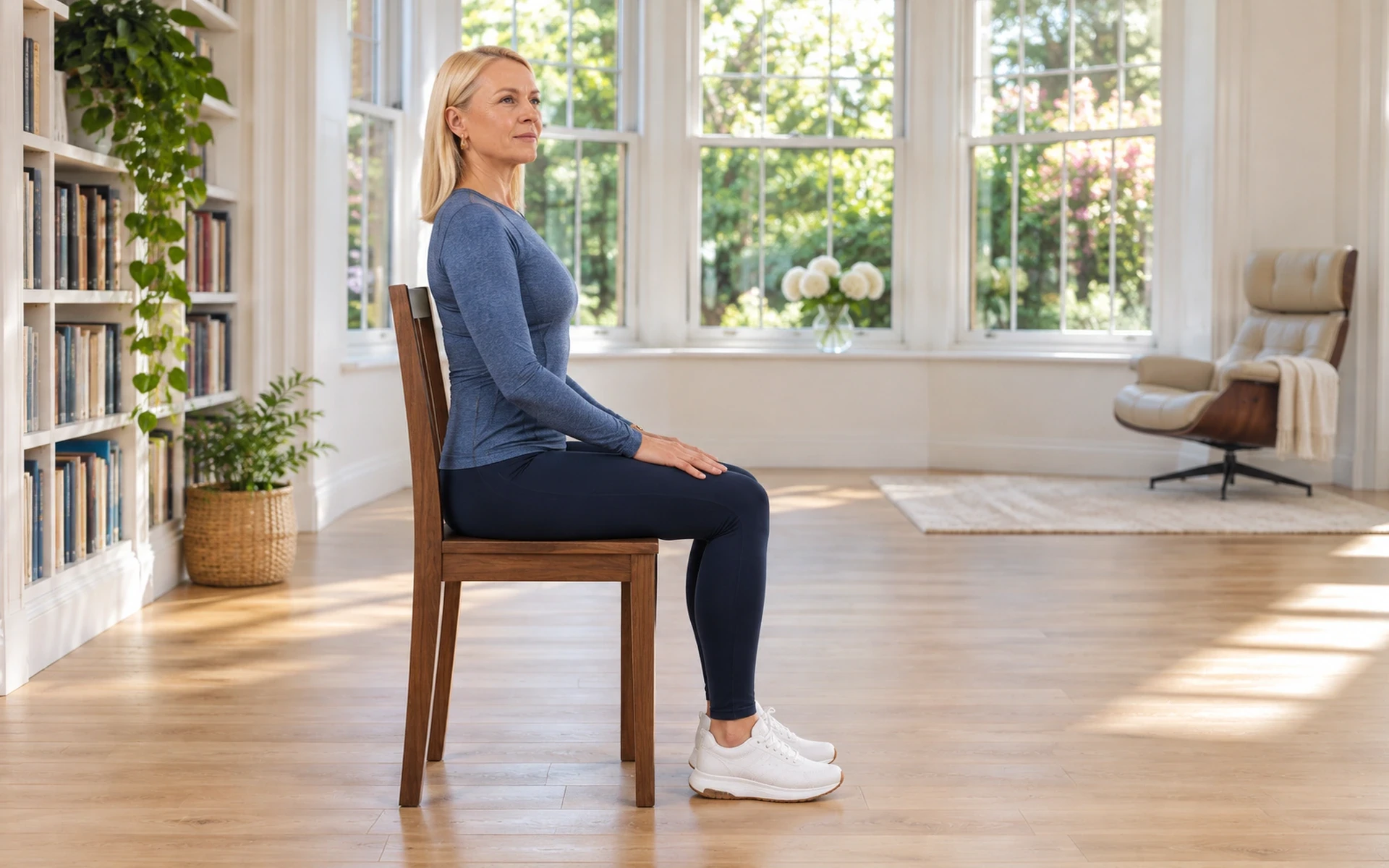
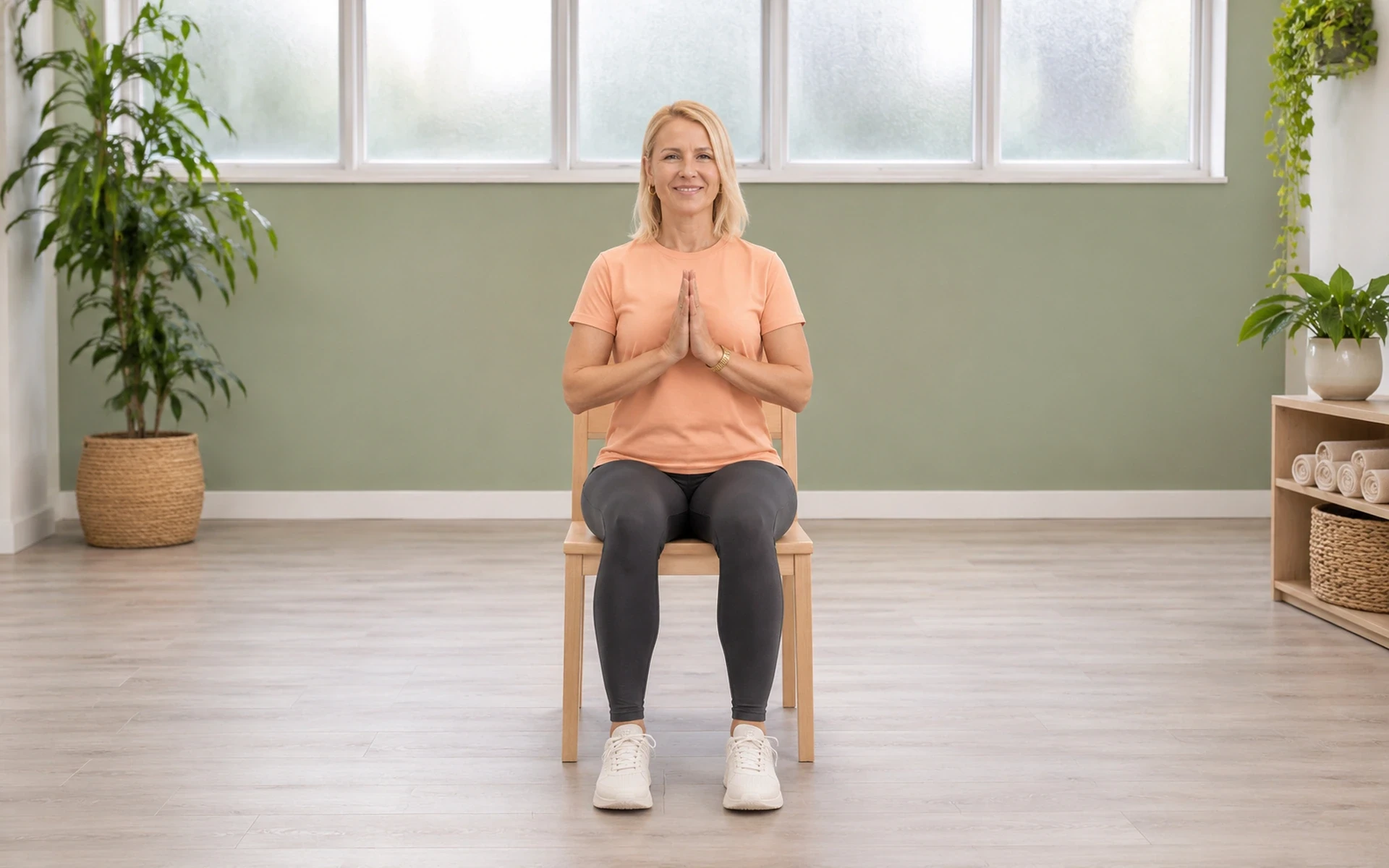
1. Seated mountain pose with breathing
- Sit tall with your feet flat and hands on your thighs.
- Breathe in for a count of 4.
- Breathe out for a count of 6.
- Repeat for 6 breaths.
2. Neck release
- Tilt your right ear toward your right shoulder.
- Hold for 3 breaths.
- Switch sides.
3. Shoulder rolls
- Roll your shoulders up, back, and down 5 times.
- Reverse the direction 5 times.
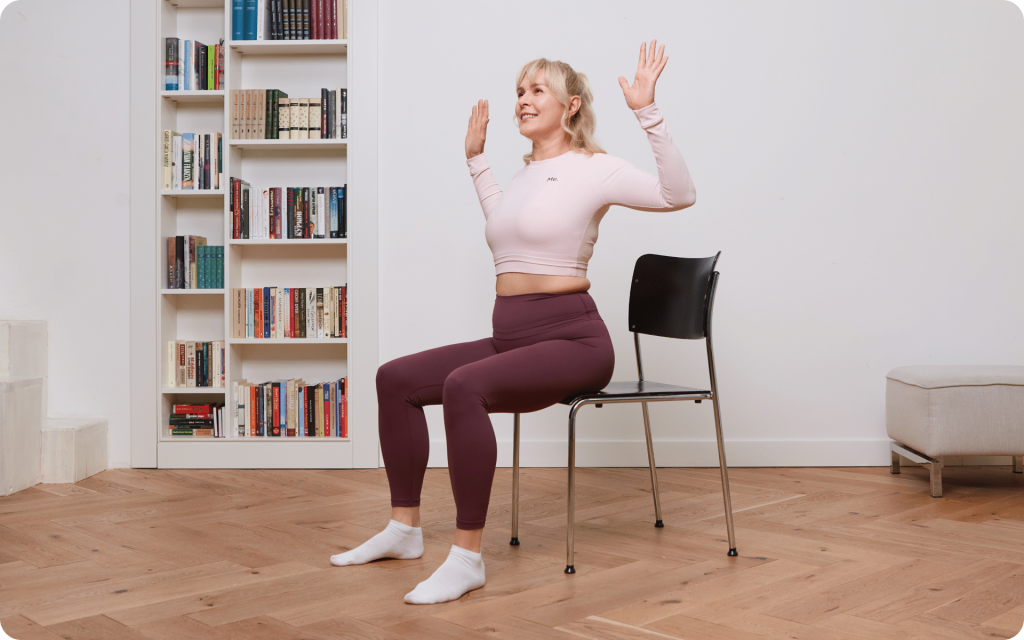
4. Seated cat-cow
- Place your hands on your knees.
- Breathe in, lift your chest, and arch your back gently.
- Breathe out and round your back.
- Repeat 6 times.
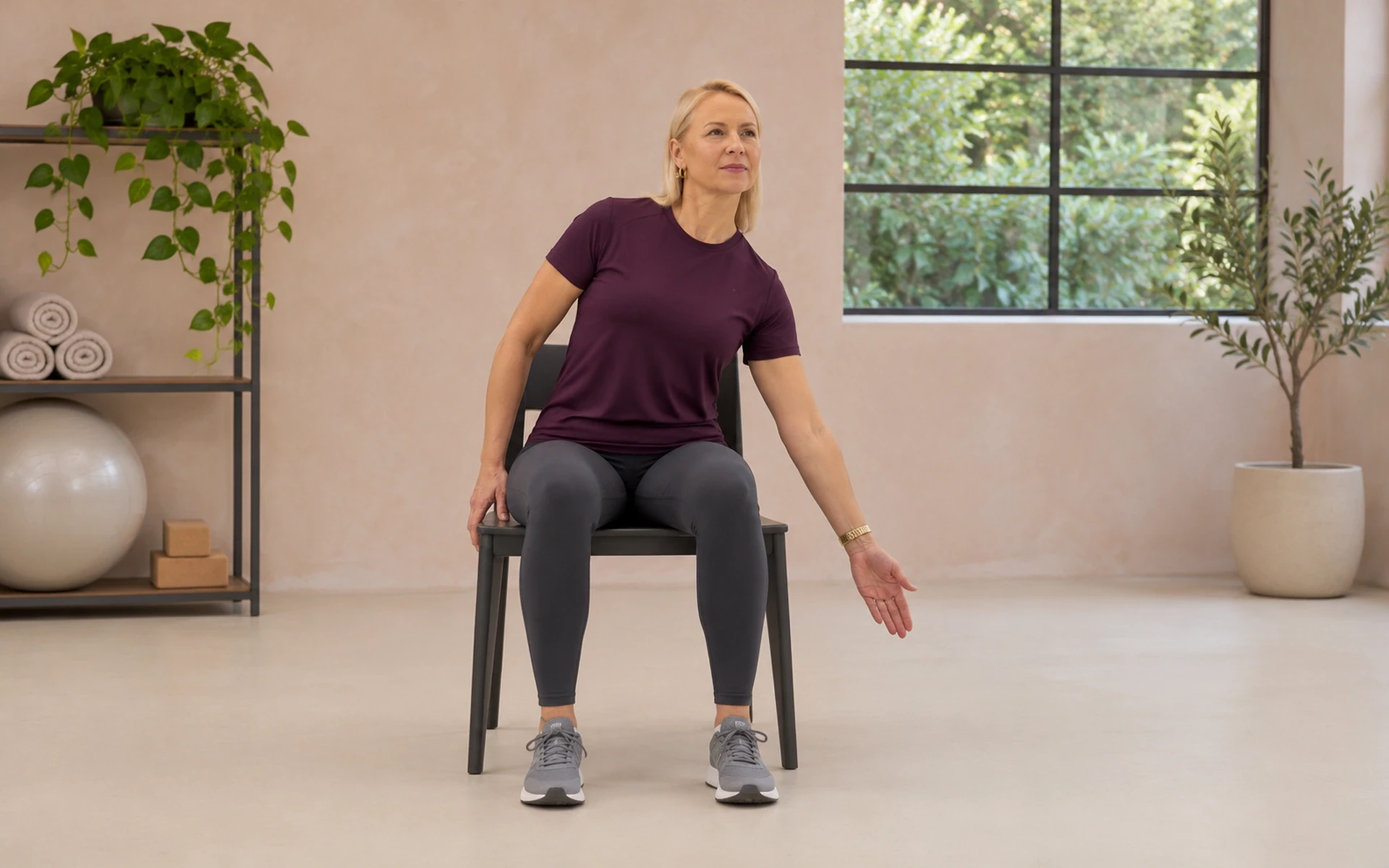
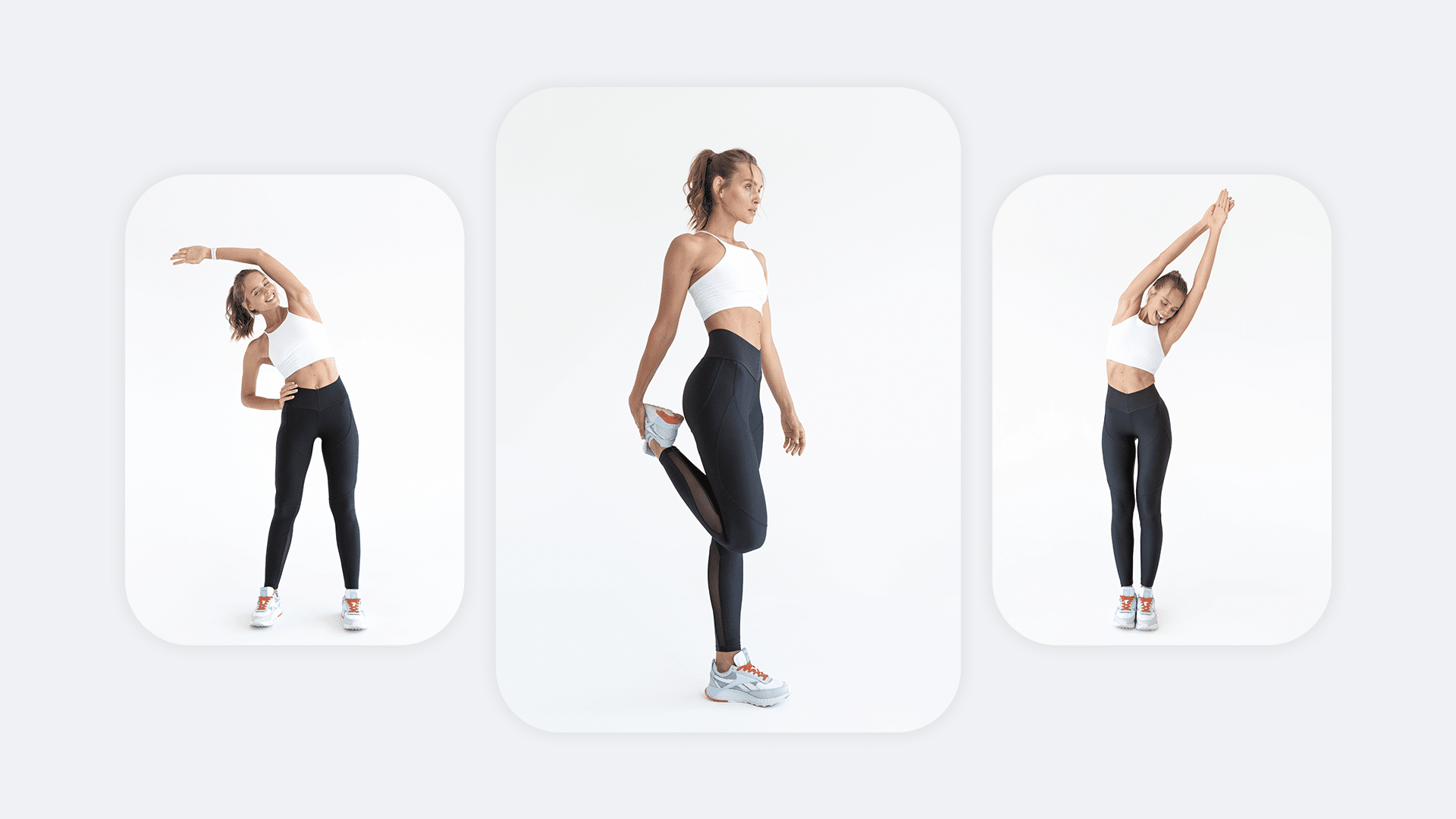
5. Seated side bend
- Raise your right arm overhead.
- Lean to the left and hold for 3 breaths.
- Switch sides.
6. Seated twist
- Place your right hand on your left knee.
- Turn your chest gently to the left and hold for 3 breaths.
- Switch sides.
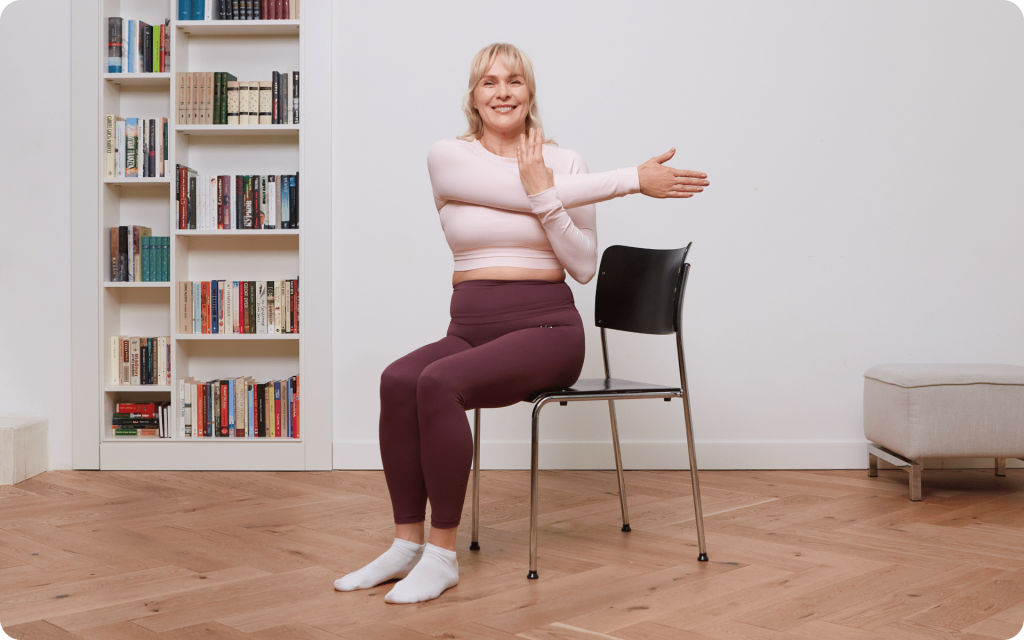
7. Seated eagle arms
- Cross your right arm under your left at the elbows.
- Bring your palms together and hold for 3 breaths.
- Switch arms.
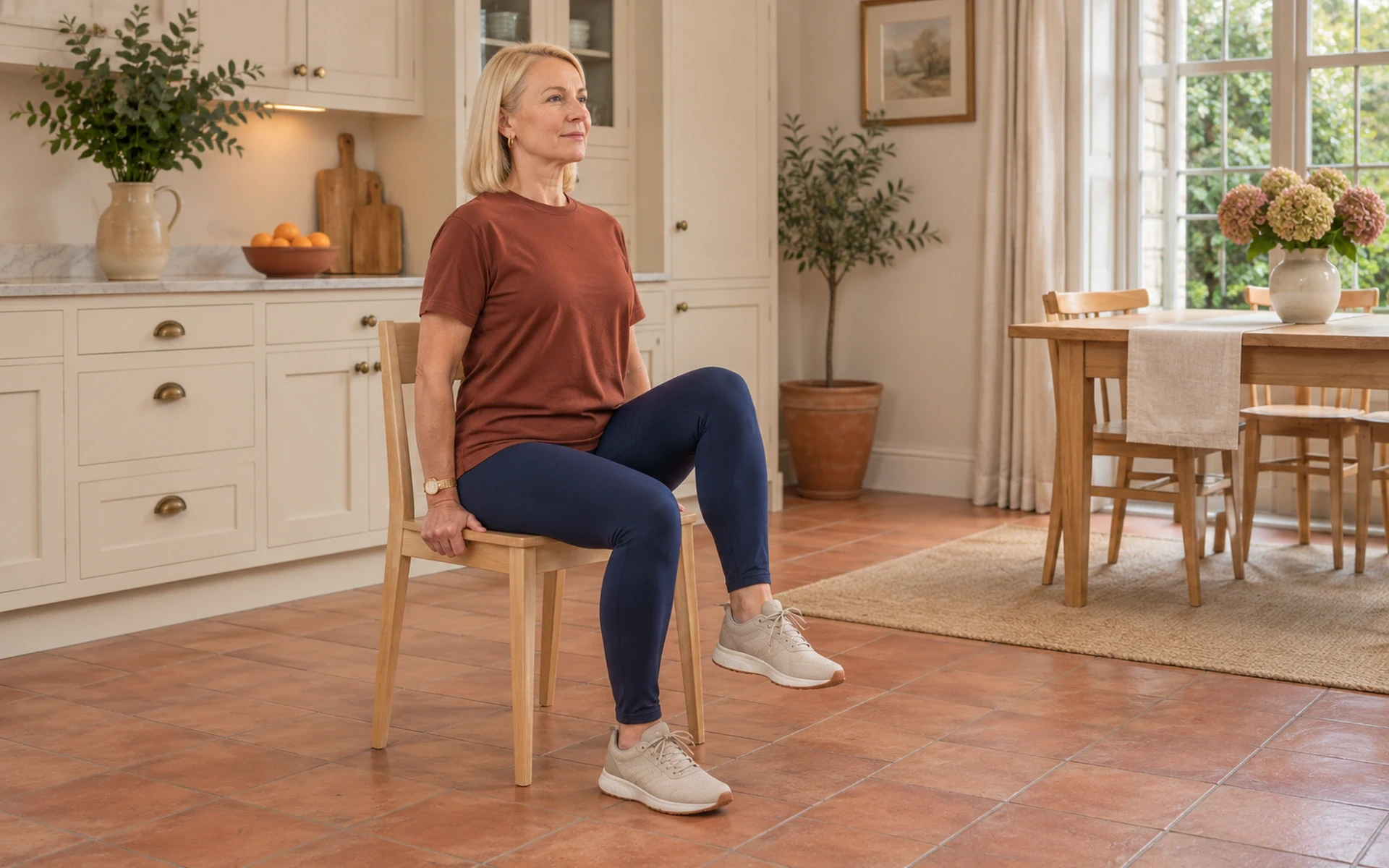
8. Seated figure four
- Cross your right ankle over your left knee.
- Lean forward slightly with a straight back.
- Hold for 5 breaths, then switch sides.
9. Chair warrior II
- Sit sideways with your right thigh on the seat.
- Extend your left leg behind you.
- Reach your arms out and hold for 5 breaths.
- Switch sides.
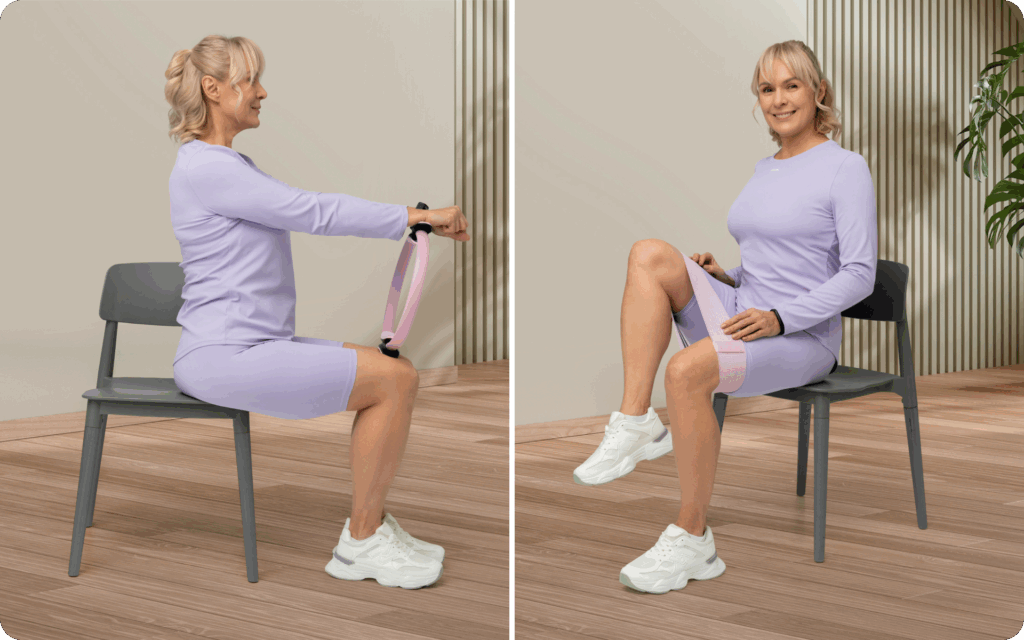
10. Chair squat
- Sit near the front edge with your feet flat.
- Stand up through your heels.
- Lower slowly back to the seat. Do 6 to 8 reps.
11. Seated forward fold
- Sit near the front of the chair.
- Hinge forward and let your arms hang.
- Hold for 5 breaths, then sit up slowly.
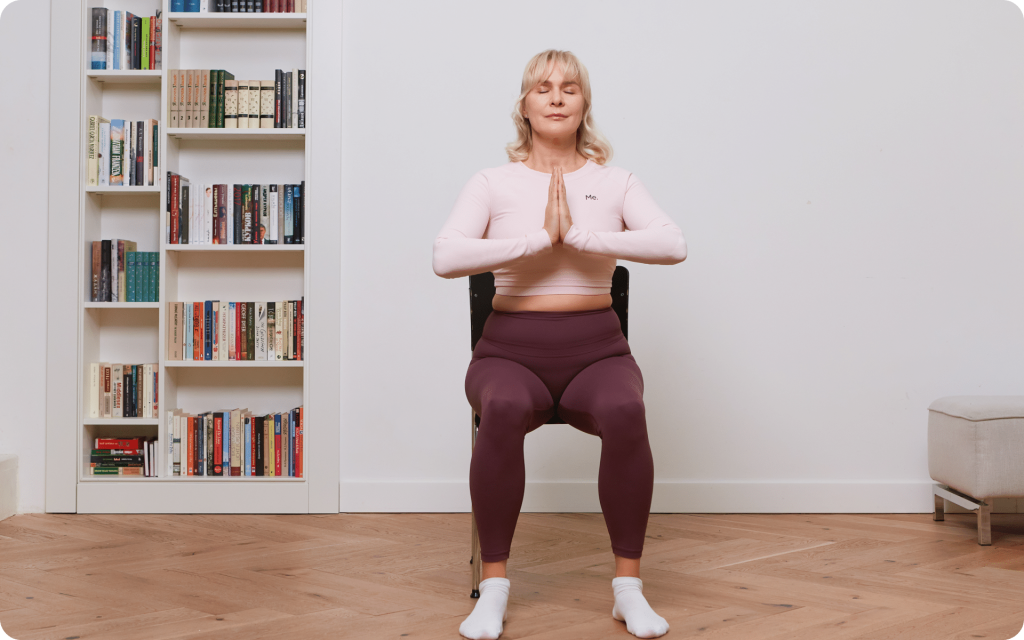
12. Seated rest
- Sit tall and close your eyes.
- Rest your hands on your thighs.
- Breathe slowly for 1 to 2 minutes.
How long should each part of the sequence take?
The timing below is an example of a 20-minute flow.
|
Part |
Poses |
Time |
|---|---|---|
|
Settle |
Mountain pose with breathing |
2 minutes |
|
Warm up |
Neck release, shoulder rolls, cat-cow |
4 minutes |
|
Stretch |
Side bend, twist, eagle arms, figure four |
6 minutes |
|
Strengthen |
Chair warrior II, chair squat |
4 minutes |
|
Wind down |
Forward fold, seated rest |
4 minutes |
How should you breathe during the sequence?
Slow breathing was linked with greater relaxation in a review (2).
- Let your breath come in comfortably.
- Let it out without forcing the pace.
- Lift or lengthen as you breathe in.
- Twist, fold, or lower as you breathe out.
- Keep your breathing smooth during holds.
What does a 10-minute morning version look like?
Use this shorter version to start your day. The routine below is one example.
|
Pose |
Time |
|---|---|
|
Mountain pose with breathing |
1 minute |
|
Shoulder rolls and cat-cow |
2 minutes |
|
Side bend and twist |
2 minutes |
|
Chair warrior II |
2 minutes |
|
Chair squats |
2 minutes |
|
Seated rest |
1 minute |
What does a 10-minute evening version look like?
Use this version to wind down. The routine below is one example.
|
Pose |
Time |
|---|---|
|
Mountain pose with slow breathing |
2 minutes |
|
Neck release |
1 minute |
|
Seated twist |
2 minutes |
|
Seated figure four |
2 minutes |
|
Seated forward fold |
1 minute |
|
Seated rest |
2 minutes |
Whether you’re just starting your fitness journey or looking to add more structure to your routine, BetterMe offers tools that can support different wellness goals. Explore the app and see how its workout, nutrition, and habit-building features can fit into your lifestyle.
What does a 5-minute desk version look like?
Use this version during a workday. The routine below is one example.
|
Pose |
Time |
|---|---|
|
Mountain pose with breathing |
1 minute |
|
Neck release and shoulder rolls |
1 minute |
|
Seated cat-cow |
1 minute |
|
Seated twist |
1 minute |
|
Seated figure four |
1 minute |
Try it once in the morning and once in the afternoon.
What have studies of yoga and stretching found?
The research below tested several yoga styles, breathing practices and stretches. The results apply to those interventions.
Relaxation
A review of 42 studies of yoga postures reported lower evening cortisol and resting heart rate in some comparisons (1). The review did not test this chair sequence.
Flexibility
Stretching improves range of motion for a short time after each session (3). Yoga improved flexibility in older adults compared with inactive groups (4).
Balance and mobility
In adults aged 60 and over, yoga gave gains in balance and mobility (5). For introductory variations, see our chair yoga for beginners guide.
Better sleep quality
Older adults who practiced yoga reported better sleep quality than inactive groups (4).
What does a 4-week plan look like?
Build the habit slowly. The plan below is one example.
|
Week |
Sessions |
Focus |
|---|---|---|
|
1 |
3 a week, 10 minutes |
Morning or evening version |
|
2 |
4 a week, 15 minutes |
Add the stretch block |
|
3 |
4 to 5 a week, 20 minutes |
Full 12-pose sequence |
|
4 |
5 a week, 20 minutes |
Longer exhales and holds |
How can you adapt the sequence?
Change poses to suit your body and energy on the day.
|
Pose |
Easier |
Harder |
|---|---|---|
|
Chair squat |
Use your hands |
Slower lowering |
|
Figure four |
Stay upright |
Lean further forward |
|
Chair warrior II |
Bend the back knee |
Straighten the back leg |
|
Forward fold |
Hands on thighs |
Reach toward the floor |
Read more: 10 yoga chair exercises for seniors: steps, routine, and tips
How do you create a calm space?
A calm setting helps you relax and focus on your breath.
- Turn off notifications on your phone.
- Use soft light and a comfortable room temperature.
- Practice at the same time each day.
- Play quiet music if it helps you focus.
What can you track during practice?
Use these prompts to record how you feel during a session.
- How did you feel before and after the session?
- Which twists or folds felt comfortable?
- Did you use your hands when standing up?
- Which position felt comfortable after sitting?
- Which movement would you choose next time?
How do you pair the sequence with other activity?
A chair yoga sequence is gentle, so pair it with walking and strength work on other days. Many people use the morning version on workdays and the full flow at weekends. A short walk after the evening version can also help you wind down.
Which mistakes should you avoid?
Avoid these common mistakes.
- Rushing through the sequence
- Holding your breath
- Forcing stretches past a comfortable range
- Using a rolling chair
- Standing up quickly after the forward fold
Who should be careful?
Get advice from a doctor before starting if you have:
- Heart disease or low blood pressure
- Balance problems or dizziness
- A recent hip, knee, or back operation
- Low bone density, which may limit folds and twists
Frequently Asked Questions
How often should you do a chair yoga sequence?
Three to 5 times a week is a common range.
Is morning or evening better?
Either works. Use the morning version to start the day and the evening version to wind down.
How can you shorten the sequence?
Select one or two seated poses and finish when you are ready. Keep the support and range adjustments for each pose you choose.
Can beginners follow this sequence?
Yes. Start with the 10-minute versions and build up.
Do you need to memorize the poses?
No. Keep a printed list nearby until the order feels familiar.
Can you practice at work?
Use the desk sequence for a short work break. Move away from the desk edge and choose a stationary chair.
What if a pose feels uncomfortable?
Make it smaller or skip it. A gentle version still gives you the benefit of moving.
The bottom line
A chair yoga sequence moves from breathing to stretching, light strength, and rest. Doing the poses in order helps you warm up, stretch with ease, and finish calm. Practice 3 to 5 times a week with the full or 10-minute versions. For the research behind the practice, see our benefits of chair yoga guide.
DISCLAIMER:
This article is intended for general informational purposes only and does not serve to address individual circumstances. It is not a substitute for professional advice or help and should not be relied on for making any kind of decision-making. Any action taken as a direct or indirect result of the information in this article is entirely at your own risk and is your sole responsibility.
BetterMe, its content staff, and its medical advisors accept no responsibility for inaccuracies, errors, misstatements, inconsistencies, or omissions and specifically disclaim any liability, loss or risk, personal, professional or otherwise, which may be incurred as a consequence, directly or indirectly, of the use and/or application of any content.
You should always seek the advice of your physician or other qualified health provider with any questions you may have regarding a medical condition or your specific situation. Never disregard professional medical advice or delay seeking it because of BetterMe content. If you suspect or think you may have a medical emergency, call your doctor.
SOURCES:
- Yoga, mindfulness-based stress reduction and stress-related physiological measures: a meta-analysis (2017, doi.org)
- How breath-control can change your life: a systematic review on psycho-physiological correlates of slow breathing (2018, doi.org)
- Acute effects of muscle stretching on physical performance, range of motion, and injury incidence in healthy active individuals: a systematic review (2016, doi.org)
- The effects of yoga compared to active and inactive controls on physical function and health related quality of life in older adults: systematic review and meta-analysis of randomised controlled trials (2019, doi.org)
- Yoga-based exercise improves balance and mobility in people aged 60 and over: a systematic review and meta-analysis (2016, doi.org)
 Reviewed by