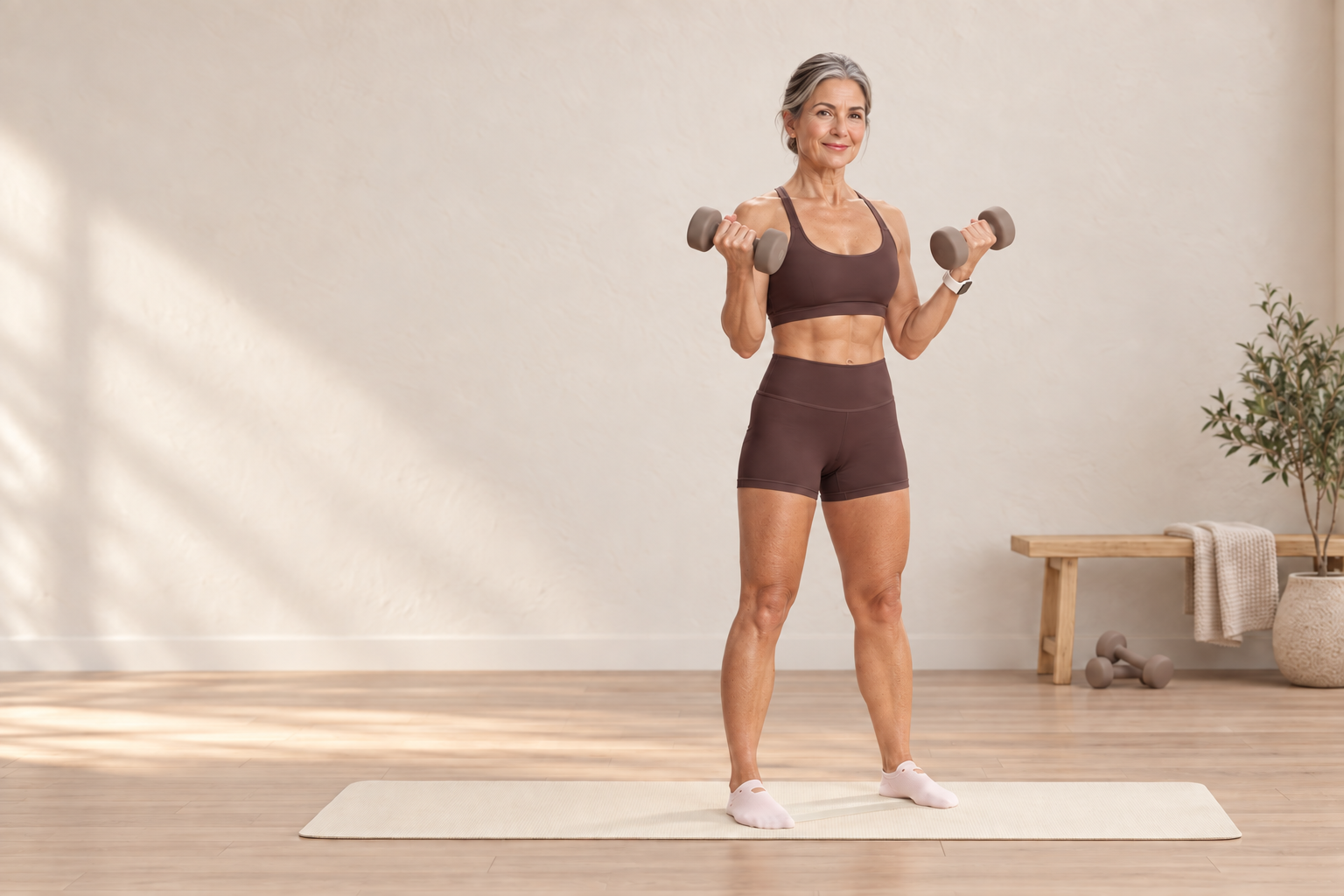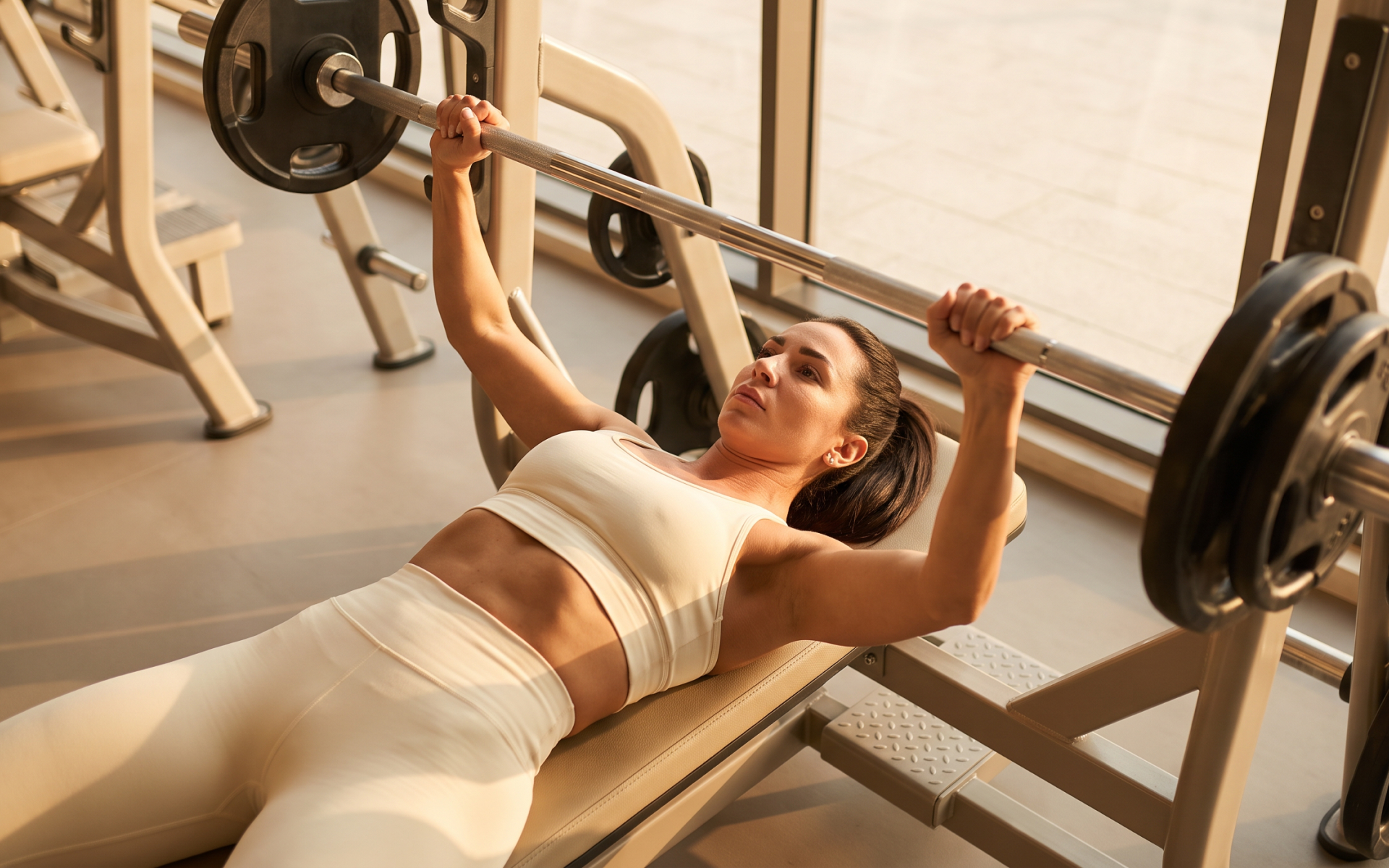
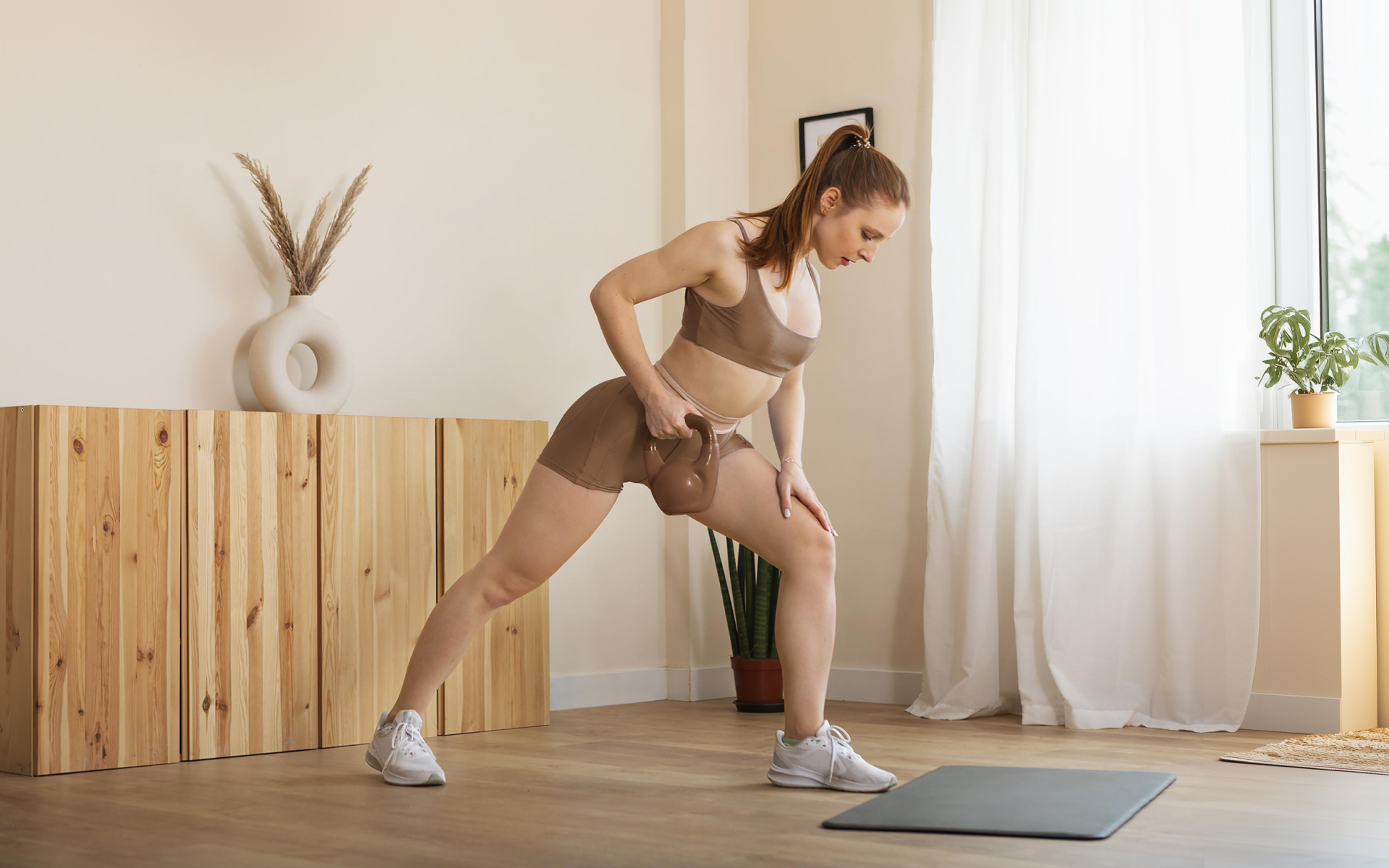
A 6-week female bodybuilder workout is a 4-day plan that trains your whole body to build muscle and strength. Over 6 weeks, you may notice better strength, cleaner technique, and modest muscle gains. Individual outcomes vary based on training history, sleep, and nutrition.
Bodybuilding-style training simply means lifting weights to grow muscle size, using controlled reps and steady progress over time. Having a female bodybuilder workout plan removes guesswork. You train two lower-body days and two upper-body days each week. You work each muscle group about twice weekly. Most sets fall in the 6-12 rep range, using controlled form and steady effort.
This guide is for beginners and early intermediates who can train 4 days per week. It matters because a simple structure helps you stay consistent, and consistency drives results. Here, you’ll find a full weekly split, sample workouts, exercise steps, and answers to common questions. For help building the habit, explore our good starter workout routine.
Are you ready to build a routine you can actually stick with? Let’s walk through it together.
Key takeaways
- This sample 6-week plan uses 4 lifting days. It includes 2 upper-body and 2 lower-body sessions.
- Start with 2 sets per exercise and 2-3 reps in reserve while learning technique.
- The sample workouts use mostly 6-12 reps, with higher rep ranges for selected accessories.
- Add reps within the target range before increasing weight. The weekly examples are illustrative.
- Keep rest days between repeated muscle-group sessions when possible, and reduce volume if fatigue builds.
- Track strength, technique, and recovery rather than expecting a fixed amount of muscle gain.
What does bodybuilding-style training involve for women?
Bodybuilding-style training for women involves lifting weights to build muscle size through controlled reps and steady progression. The goal is hypertrophy, which means an increase in muscle size (1).
This style relies on a few core ideas. Let’s define them clearly (1, 2):
- Hypertrophy: The growth of muscle size over time
- Mechanical tension: The force your muscles feel when they lift a challenging weight
- Progressive overload: Gradually making training harder by adding reps, weight, sets, or better control
Some research has suggested that mechanical tension is the main driver of muscle growth. You create it by lifting weights that feel challenging, then slowly increasing the demand (2).
The sample plan below uses these practical rep ranges. Muscle growth can occur across a wider range of loads when effort is sufficient (3):
- 6-12 reps on many exercises
- 6-10 reps for bigger compound lifts
- 10-20 reps for smaller isolation lifts
- Effort around RPE 7-9, leaving 1-3 reps in reserve
RPE means rating of perceived exertion, scored 1-10, where 10 means you could not do another rep. Reps in reserve (RIR) means how many reps you could still do at the end of a set (4).
Here’s some good news. Women don’t need special “toning” moves or lighter default weights. Some research has suggested that women gain muscle size in similar relative amounts to men (5).
A temporary pump is not a reliable measure of long-term muscle growth. Focus on challenging training, manageable volume, and consistent progression (2).
Who is this 6-week workout program designed for?
This six-week workout program is designed for women who are beginners or early intermediates and can train 4 days per week. It suits those who want muscle and strength, not peak sport performance.
This female bodybuilding workout plan works well if you:
- Are new to lifting or returning after a break
- Can recover from 4 lifting sessions weekly
- Want a clear, repeatable structure
It may be less suitable if you:
- Have ongoing discomfort or a current strain
- Cannot recover from 4 training days
- Prefer only cardio or endurance work
If you have any concerns about starting, consider checking with a qualified professional first. This guide shares general, educational information, not medical advice.
Which equipment do you need for the program?
You need access to weights and a few basic stations for this program, though the exact setup can vary a lot. Muscle growth depends more on effort than on any single machine (2).
A full gym setup might include:
- Barbell, squat rack, and bench
- Dumbbells and cable machine
- Pulldown or pull-up station
A minimum effective setup includes:
- Dumbbells
- An adjustable bench
- Some way to squat, hinge, press, and row
This gym workout plan for women stays flexible on purpose. You can swap a barbell squat for a goblet squat, or a pulldown for an assisted pull-up. Choose what your space allows.
Read more: Realistic Weight Loss Goals: A Reality Check You Need
How can you establish your starting weights?
Choose starting weights you can lift with controlled form while leaving approximately 2-3 reps in reserve. RIR is a practical effort-monitoring tool (4). Start lighter than you think, especially on compound lifts.
A compound exercise works several muscles and joints at once, such as a squat. An isolation exercise targets one muscle, such as a biceps curl (6).
Try this simple approach:
- Pick a weight for your target rep range.
- Stop with 2-3 reps still left in the tank.
- Adjust the next session based on how it felt.
Use these quick rules:
- Hit the top of the range easily? Add weight next time.
- Miss the bottom of the range? Reduce the weight.
- Form breaks down? Lower the load, even if reps were fine.
For isolation moves, you can train a little closer to failure sooner. For compounds, keep a bigger buffer early on.
What does the 4-day training split look like?
The four-day training split uses an upper/lower split for women, with two lower-body days and two upper-body days each week. A training split simply means how you divide your workouts across the week.
This 4-day workout split for women spreads upper- and lower-body work across 2 sessions each. A review suggests that frequency has little independent effect on hypertrophy when weekly volume is matched (7).
| Day | Focus | Sets per exercise | Reps | Rest | Target effort |
|---|---|---|---|---|---|
| Day 1 | Lower-Body A | 2-4 | 6-15 | 60-180 secs | RPE 7-9 (1-3 RIR) |
| Day 2 | Upper-Body A | 2-4 | 6-20 | 60-180 secs | RPE 7-9 (1-3 RIR) |
| Day 3 | Rest or light walk | N/A | N/A | N/A | Easy |
| Day 4 | Lower-Body B | 2-4 | 5-15 | 60-180 secs | RPE 7-9 (1-3 RIR) |
| Day 5 | Upper-Body B | 2-4 | 8-20 | 60-180 secs | RPE 7-9 (1-3 RIR) |
| Day 6 | Rest | N/A | N/A | N/A | Easy |
| Day 7 | Rest | N/A | N/A | N/A | Easy |
You can arrange the days to fit your week. Just keep at least one rest day between workouts with repeated muscle groups where possible.
How do weeks 1-2 establish your training baseline?
Weeks 1-2 establish your training baseline by helping you learn technique, find your working weights, and gauge recovery. Think of these weeks as calibration, not maximum effort.
During this phase, aim to:
- Learn each movement with clean form
- Keep 2-3 reps in reserve on most sets
- Track your reps, loads, and effort honestly
Beginners can start with 2 sets per exercise and adjust as technique and recovery improve. Keep compound lifts a bit further from failure. This tells you which loads feel right and whether 4 days feels manageable. The workout tables show later-block options; beginners should start with 2 sets per exercise and omit optional arm or shoulder accessories if sessions feel too demanding. Research reviews discuss how set volume relates to hypertrophy (8); adjust the sample ranges to your recovery.
How does the workload change during weeks 3-4?
The workload increases during weeks 3-4 as you push progression and train slightly closer to failure. This is your productive middle block.
Make these adjustments:
- Add weight when you reach the top of a rep range
- Move to 1-2 reps in reserve on most working sets
- Optionally add 1 set to a few exercises if recovery feels good
Keep your technique strict. The aim is more quality stimulus, not random exhaustion. This steady build reflects progressive overload for women in action.
How should you approach the final 2 weeks?
Approach the final 2 weeks by progressing only when technique and recovery remain steady. Beginners can keep the earlier effort targets rather than training closer to failure.
Try this:
- Experienced lifters may take selected isolation sets to 0-1 reps in reserve if technique remains controlled
- Keep compounds around 1-2 reps in reserve
- Avoid adding random extra volume just to finish strong
If fatigue climbs sharply, scale back. You might reduce sets by 20-30% while keeping your form clean. These weeks consolidate your gains rather than prove toughness.
Here’s a quick comparison of how the three phases progress.
| Phase | Goal | Volume | Effort | Progression focus |
|---|---|---|---|---|
| Weeks 1-2 | Learn and calibrate | 2 sets initially; adjust to technique and recovery | 2-3 RIR (RPE 7-8) | Technique and consistent loads |
| Weeks 3-4 | Build stimulus | 3-4 sets per exercise | 1-2 RIR (RPE 8-9) | More reps or weight |
| Weeks 5-6 | Consolidate gains | 3-4 sets per exercise | 0-2 RIR; beginners: 2-3 RIR | Push loads, manage fatigue |
What does the first lower-body workout include?
The first lower-body workout includes squats, hip hinges, and accessory leg work to target your quads, glutes, and hamstrings. It builds your foundational movement skills.
| Exercise | Sets | Reps | Rest | Notes |
|---|---|---|---|---|
| Back squat or goblet squat | 3-4 | 6-10 | 2-3 mins | Control the descent |
| Romanian deadlift | 3 | 6-10 | 2-3 mins | Feel the hamstrings load |
| Single leg press or split squat | 3 | 8-12 | 90-120 secs | Steady, full range |
| Leg curl | 2-3 | 10-15 | 60-90 secs | Smooth tempo |
| Calf raise | 3 | 10-15 | 60-90 secs | Pause at the top |
How does the first upper-body workout balance pushing and pulling?
The first upper-body workout balances pushing and pulling by pairing chest presses with back rows and pulldowns. This covers the main upper-body movement patterns.
Roughly equal push and pull volume helps you stay balanced. Direct shoulder and arm work adds bodybuilding-specific shape.
| Exercise | Sets | Reps | Rest | Notes |
|---|---|---|---|---|
| Lat pulldown or assisted pull-up | 3 | 8-12 | 90-120 secs | Avoid swinging |
| Bench press or dumbbell bench press | 3-4 | 6-10 | 2-3 mins | Controlled touch |
| Chest-supported row | 3 | 8-12 | 90-120 secs | Pull through elbows |
| Seated dumbbell shoulder press | 2-3 | 8-12 | 90 secs | Press steadily |
| Lateral raise | 2-3 | 12-20 | 60-90 secs | Light and controlled |
| Triceps pressdown | 2-3 | 10-15 | 60-90 secs | Full extension |
| Biceps curl | 2-3 | 10-15 | 60-90 secs | No swinging |
Which exercises make up the second lower-body session?
The second lower-body session uses different exercises to shift emphasis and avoid exact repetition of Lower-Body A. It still trains your glutes, quads, and hamstrings.
| Exercise | Sets | Reps | Rest | Notes |
|---|---|---|---|---|
| Hip thrust or deadlift variation | 3 | 6-10 | 2-3 mins | Use cues specific to the chosen exercise |
| Front squat, hack squat, or leg press | 3 | 8-12 | 2-3 mins | Use the posture appropriate to the chosen exercise |
| Walking lunge or split squat | 2-3 | 8-12 each side | 90 secs | Even, steady steps |
| Leg extension | 2-3 | 10-15 | 60-90 secs | Pause and squeeze |
| Seated leg curl | 2-3 | 10-15 | 60-90 secs | Smooth tempo |
| Calf raise | 3 | 10-15 | 60-90 secs | Full range |
Workouts, weight management tools, and recipe ideas come together in the BetterMe: Health Coaching app, giving you practical support for building a more consistent wellness routine.
How does the second upper-body session complete the weekly split?
The second upper-body session completes the weekly split by adding new angles for your chest, back, shoulders, and arms. It rounds out your weekly volume.
| Exercise | Sets | Reps | Rest | Notes |
|---|---|---|---|---|
| Pulldown or pull-up variation | 3 | 8-12 | 90-120 secs | Elbows down |
| Incline dumbbell press | 3 | 8-12 | 90-120 secs | Control each rep |
| One-arm dumbbell row | 3 | 8-12 | 90 secs | Steady torso |
| Machine chest press or push-up | 2-3 | 10-15 | 90 secs | Full range |
| Rear-delt fly | 2-3 | 12-20 | 60-90 secs | Light and controlled |
| Lateral raise | 2-3 | 12-20 | 60-90 secs | No momentum |
| Overhead triceps extension | 2-3 | 10-15 | 60-90 secs | Full stretch |
| Incline or cable curl | 2-3 | 10-15 | 60-90 secs | Slow lowering |
If you’re weighing this style against other approaches, you may enjoy reading powerlifting vs bodybuilding to see how the goals differ.
How do you perform the program’s exercises?
Here are simple steps for the main movements in this women’s weight training plan. Focus on control over speed.
How do you perform a squat?
- Set your feet shoulder-width apart.
- Brace your core and keep your chest tall.
- Lower by bending your hips and knees together.
- Descend until your thighs reach a comfortable depth.
- Drive evenly through your feet to stand.
How do you perform a Romanian deadlift?
- Hold the weight in front of your thighs.
- Keep a soft bend in your knees.
- Push your hips back and lower the weight.
- Keep your back flat and the weight close.
- Feel your hamstrings, then stand tall.
How do you perform a dumbbell bench press?
- Lie back with a dumbbell in each hand.
- Set your shoulder blades down and together.
- Lower the weights to chest level with control.
- Keep your wrists stacked over your elbows.
- Press the weights up steadily.
How do you perform a row?
- Hinge forward or use a chest-supported setup.
- Keep your back flat and your core braced.
- Pull the weight toward your lower ribs.
- Lead with your elbows, not your hands.
- Lower slowly and repeat.
How do you perform a pulldown?
- Grip the bar with your hands slightly wider than shoulder-width apart.
- Sit tall and set your shoulders down.
- Pull the bar toward your upper chest.
- Bring your elbows down and back.
- Control the bar back up fully.
How do you perform a hip thrust?
- Rest your upper back on a bench.
- Place the weight across your hips.
- Plant your feet flat, hip-width apart.
- Drive through your heels to lift your hips.
- Squeeze your glutes at the top, then lower.
How do you perform a split squat?
- Stand in a staggered stance.
- Keep your torso tall and your core braced.
- Lower your back knee toward the floor.
- Keep your front knee tracking over your foot.
- Push through your front heel to rise.
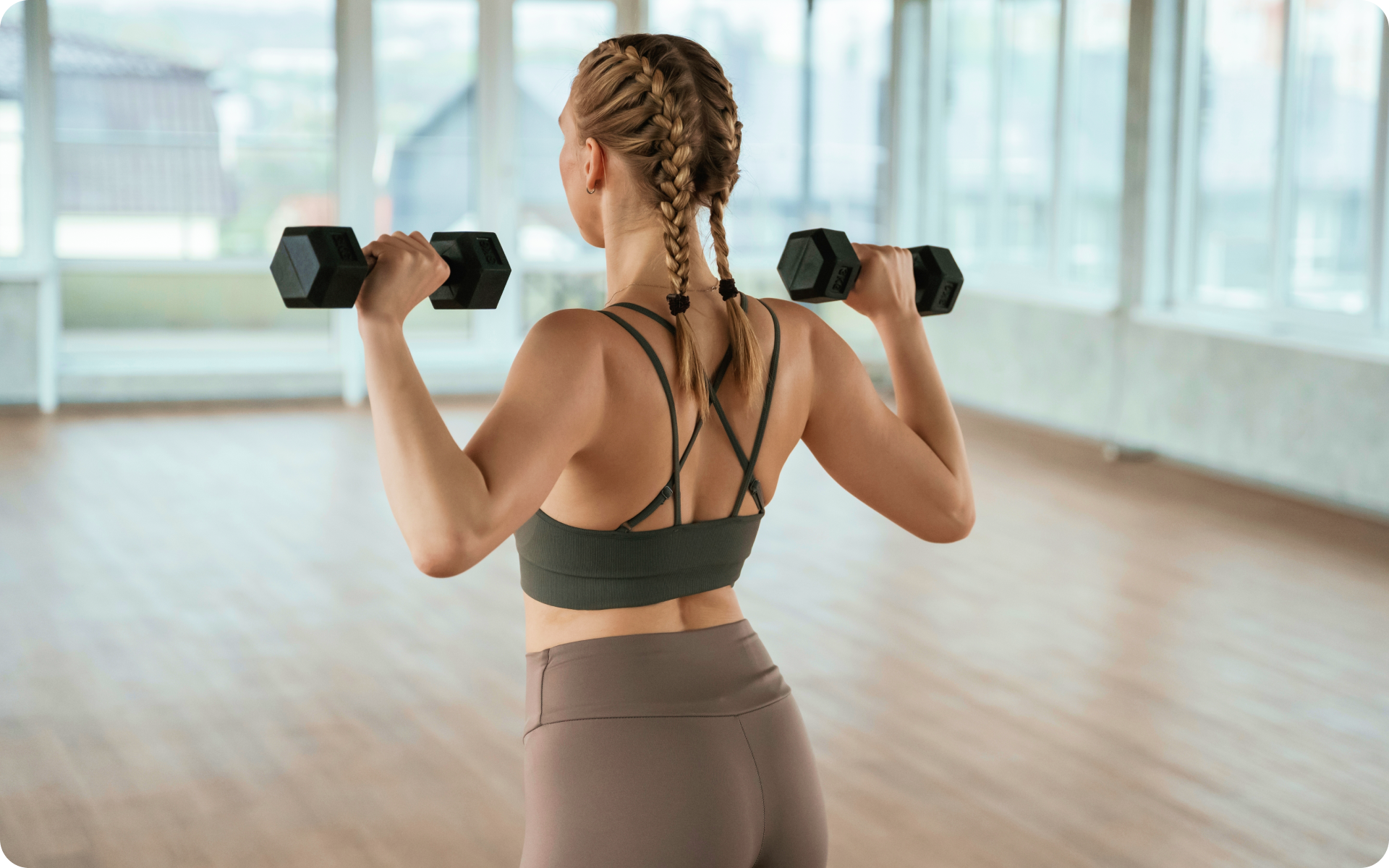
How do you perform a shoulder press?
- Sit or stand with weights at shoulder height.
- Brace your core and keep your ribs down.
- Press the weights overhead smoothly.
- Avoid arching your lower back.
- Lower with control to the start.
How should you perform the main compound exercises?
Perform the main compound exercises with a controlled lowering phase, a comfortable range of motion, and no bouncing. A survey found gaps in knowledge of target muscles and lifting form (9). The cues below are practical instructions for this sample plan, rather than outcomes tested in that survey.
Keep these cues in mind:
- Lower each rep for about 2-3 seconds
- Use a full range your joints handle comfortably
- Stop the set when form clearly breaks down
For hypertrophy, the aim isn’t just moving weight. It’s making the working muscles do the work. Consistent technique helps make your training easier to monitor.
Read more: How Much Weight Can You Lose In 100 Days: Setting Up Realistic Goals
How can you apply progressive overload across 6 weeks?
One practical way to apply progressive overload across 6 weeks is double progression: add reps within a range, then increase the load. Research has compared separate load- and repetition-progression protocols (10); the example below is an illustrative plan, not a tested week-by-week protocol.
Here is a sample for a target of 3 sets of 8-10:
| Week | Load | Reps by set |
|---|---|---|
| 1 | 60 lb | 8, 8, 8 |
| 2 | 60 lb | 9, 8, 8 |
| 3 | 60 lb | 10, 9, 8 |
| 4 | 60 lb | 10, 10, 9 |
| 5 | 60 lb | 10, 10, 10 |
| 6 | 65 lb | 8, 8, 8 |
You can also progress by adding a set or improving your control at the same load. Some research has suggested that mechanical tension from steady overload is the main growth driver (2).
Prioritize progression in this order:
- Better technique
- More reps at the same load
- More load, then more sets
If you like structure, this muscle-building workout plan makes progress easy to track. Curious how bodyweight training compares? You might explore calisthenics vs bodybuilding next.
How much rest do you need between sets and sessions?
For this sample plan, start with 2-3 minutes between heavier compound sets and 60-90 seconds between lighter accessory sets. Extend the rest if you need more time to repeat the movement with control.
Use these ranges:
- Compounds: 2-3 minutes between sets
- Isolation work: 60-90 seconds between sets
Between sessions, leave a rest day before training the same muscle group hard again when possible. Adjust spacing if fatigue affects your technique or performance.
How can you adjust the program when recovery declines?
When recovery declines, review sleep, food intake, stress, and training workload. Reduce sets or effort temporarily if the current workload feels difficult to sustain.
Watch for these signs:
- Reps dropping across several sessions
- Ongoing joint discomfort
- Unusually high fatigue or poor sleep
If recovery dips, try these steps:
- Reduce sets on the most tiring lifts
- Leave more reps in reserve
- Take an extra rest day or a lower-volume week
This women’s strength training program can flex around your life. Rest is part of the plan, not a setback.
When should you modify or stop an exercise?
You should modify or stop an exercise when it causes sharp discomfort, repeated form breakdown, or ongoing joint irritation. No single move is required for results.
Consider swapping when:
- A movement consistently bothers a joint
- Form breaks even after lowering the weight
- The exercise doesn’t suit your equipment or skill
Easy swaps include:
- Back squat to goblet squat or leg press
- Barbell bench press to dumbbell press
If discomfort feels sharp or ongoing, consider checking with a qualified professional. Listen to your body and adjust with confidence.
What should you do after completing the 6 weeks?
After completing the six weeks, review your logs and build your next block from what worked, rather than starting over. Your progress becomes your blueprint.
Try this next:
- Keep the exercises that felt good and those that you were able to progress
- Replace moves that stalled or felt awkward
- Add a little volume for muscles you want to prioritize
You might also take a lighter week if you feel worn down. Then begin another 4-8-week block. This 6-week gym program is a starting point, not a finish line. Are you interested in nutrition strategies? You may find intermittent fasting keto bodybuilding worth a look.
What can you realistically expect in 6 weeks?
In 6 weeks, beginners may improve lifting skill and strength, while visible muscle changes may be subtle. The pace of progress varies, so use your training log rather than a fixed outcome target.
For many people, 6 weeks may bring:
- Noticeable strength increases
- More confidence with free weights
- Small, gradual muscle gains
What is less realistic in 6 weeks:
- Dramatic size changes
- A “stage-ready” bodybuilder look
Early strength changes can involve improvements in neuromuscular function (11). This does not establish a specific 6-week outcome for women; training history, nutrition, sleep, and consistency all affect progress.
Whether you want to refresh your fitness routine, explore lower-calorie recipe ideas, or bring more structure to your wellness habits, BetterMe: Health Coaching app offers tools that can support your next step. Explore the app and find an approach that works for your lifestyle.
FAQs
Can beginners follow a female bodybuilding workout?
Yes, beginners can follow a female bodybuilding workout with lighter starting weights and a focus on form. Begin with 2 sets per exercise, leave 2-3 reps in reserve, and adjust the workload to your recovery. Learn each movement before adding load.
Do women need to use lighter weights than men?
No, women don’t need lighter weights by default; use loads suited to your current strength. Research suggests similar relative muscle-size gains between women and men (5). Choose weights that allow controlled reps and leave a manageable effort buffer.
Will bodybuilding-style training make women excessively bulky?
Muscle size changes gradually, and whether a look feels bulky is a matter of individual preference. A 6-week plan does not predict a specific amount of muscle gain. Adjust your training goals as your strength and preferences develop.
Can you combine the program with cardio?
Yes, you can combine the program with cardio, starting with manageable walking, cycling, or other light sessions. Place harder cardio where it least affects your lifting performance. Reduce either workload if recovery becomes difficult.
How long should each workout take?
Plan for roughly 45-75 minutes, although the full later-block workouts may take longer. Start with fewer sets and optional accessories if you have limited time. Keep enough rest to maintain technique rather than rushing to fit every exercise.
The bottom line
A structured 6-week female bodybuilder workout can help you practice lifting and build strength through steady effort and progressive overload. Focus on controlled technique, manageable volume, and recovery, then use your logs to guide your next block. Individual results vary, so adjust the plan to your experience and capacity.
DISCLAIMER:
This article is intended for general informational purposes only and does not serve to address individual circumstances. It is not a substitute for professional advice or help and should not be relied on for making any kind of decision-making. Any action taken as a direct or indirect result of the information in this article is entirely at your own risk and is your sole responsibility.
BetterMe, its content staff, and its medical advisors accept no responsibility for inaccuracies, errors, misstatements, inconsistencies, or omissions and specifically disclaim any liability, loss or risk, personal, professional or otherwise, which may be incurred as a consequence, directly or indirectly, of the use and/or application of any content.
You should always seek the advice of your physician or other qualified health provider with any questions you may have regarding a medical condition or your specific situation. Never disregard professional medical advice or delay seeking it because of BetterMe content. If you suspect or think you may have a medical emergency, call your doctor.
SOURCES:
- Anabolic signals and muscle hypertrophy – Significance for strength training in sports medicine (2025, sciencedirect.com)
- Load-induced human skeletal muscle hypertrophy: Mechanisms, myths, and misconceptions (2026, sciencedirect.com)
- Loading Recommendations for Muscle Strength, Hypertrophy, and Local Endurance: A Re-Examination of the Repetition Continuum (2021, mdpi.com)
- Modeling the repetitions-in-reserve-velocity relationship: a valid method for resistance training monitoring and prescription, and fatigue management (2024, pmc.ncbi.nlm.nih.gov)
- Sex differences in absolute and relative changes in muscle size following resistance training in healthy adults: a systematic review with Bayesian meta-analysis (2025, pmc.ncbi.nlm.nih.gov)
- Multi-joint vs. Single-joint Resistance Exercises Induce a Similar Strength Increase in Trained Men: A Randomized Longitudinal Crossover Study (2020, pmc.ncbi.nlm.nih.gov)
- Resistance Training Variables for Optimization of Muscle Hypertrophy: An Umbrella Review (2022, frontiersin.org)
- A Systematic Review of The Effects of Different Resistance Training Volumes on Muscle Hypertrophy (2022, pmc.ncbi.nlm.nih.gov)
- Knowledge of Targeted Muscles and Proper Form in Strength Training: A Cross-Sectional Survey of 1000 Adults Across Age, Sex, and Instructional Experience (2025, pmc.ncbi.nlm.nih.gov)
- Effects of Resistance Training Overload Progression Protocols on Strength and Muscle Mass (2024, pubmed.ncbi.nlm.nih.gov)
- Neuromuscular adaptations to resistance training in elite versus recreational athletes (2025, pmc.ncbi.nlm.nih.gov)