You might have seen it on social media: the “5-day broccoli diet” as a quick way to lose weight. It’s a topic we’ve covered before here on our blog, and over time new questions keep coming up—some that repeat, others that change. As we like our information to be clear, honest, and up to date, we’ve decided to update this article and answer those questions once and for all.
So what exactly is this diet, what does it promise, and what’s actually true about it? In this updated version, we’ll walk through the most common questions, section by section, with up-to-date and straightforward information.
Please note: Results from a 5-day plan are typically modest and largely reflect water weight rather than fat loss. Individual results may vary.
What Is the 5-Day Broccoli Diet Plan?
The broccoli diet is a short-term eating plan in which this green vegetable becomes the main food on your plate for five days. It doesn’t mean eating only broccoli at every meal, but rather including a good portion of broccoli as the base, paired with other foods that bring different nutrients.
The goal is usually the same across plans like this: cutting calories quickly and easily. As broccoli is low in calories and very filling thanks to its fiber and water content, it could help you feel full on less food, which makes it easier to eat less without going hungry (1).
So a 5-day broccoli diet plan isn’t a magic formula or an exact recipe—it’s more of a short, structured framework that simply puts one vegetable at the center. We’ll see in the next sections whether that’s enough and how to do it in a truly balanced way if you decide to try it.
Why Do Single-Food Diets Attract Attention?
It’s partly because there’s something very tempting about simplicity. We’re surrounded by nutritional information (and sometimes over-information) that often contradicts itself: one source tells you one thing, another the exact opposite. In the middle of all that noise, a single-food diet offers just what people long for: a clear, easy rule to follow. “Eat broccoli” is concrete. On its own, that already feels good.
Then there’s the promise of quick results, which is what tends to drive people toward a broccoli diet for weight loss in the first place. These are short plans, five days long, and they come with a very powerful idea: reset your body and see a change on the scale in under a week. And that, when you’re looking for a change right now, could be difficult to ignore.
And then there’s the novelty factor, which feeds on social media. Diets like this grow through word of mouth and catchy headlines: someone tries one, shares it, and the cycle repeats. There’s also something curious about eating something so specific for several days in a row.
Due to all of this, it’s no wonder they draw so much attention. And it’s also normal that, once people try them, many end up with more questions than answers. This is where things get interesting: in understanding what lies behind the attraction and learning to give that same need an answer that actually lasts, which is, in a way, what we’ll look at next.
Read more: Different Types Of Diets: The Lowdown On The Most Talked-About Weight Loss Strategies

Does Broccoli Burn Fat or Detox the Body?
Let’s go back to what we were saying: much of the appeal comes from that promise of “this does something for me.” And perhaps the most repeated promise around broccoli is exactly that—that it burns fat or detoxifies.
Let’s start with the first part, that no food actually burns fat on its own. What tends to help weight change, when it changes at all, is the whole picture of a different approach, another way of eating, a different pace, more attention to your plate, healthier habits overall. Broccoli doesn’t “melt” fat magically. What it does is more subtle and more real—thanks to its fiber and water, it gives greater satiety, which could help you feel full sooner and listen better to what your body is asking for (1). As we keep saying, it genuinely helps, just from that place, not from a magical effect.
And as for “detoxifying”, the truth is your body doesn’t need help cleaning itself—the liver and kidneys already handle that job (2)(3). What is true is that broccoli provides nutrients that support those organs, such as vitamins, minerals, and antioxidants (1). It’s one of those foods worth keeping close, not for any miracle, simply because it adds to a balanced diet
Can Broccoli Provide Everything You Need from a Meal?
As we’ve already said, broccoli has plenty of benefits: vitamins, minerals, antioxidants. It’s a vegetable that truly gives, the kind worth including without overthinking it.
But no matter how good it is, there are very important nutrients that don’t come with it, such as proteins or fats. If broccoli were the only star of the plate, it would fill you up in the short term, but in the long run you would be missing pieces your body also needs.
And this isn’t a flaw, not in the least. When we talk about the risks of the broccoli diet, we’re not really pointing the finger at broccoli: what fails is asking a single food to do the job of a complete meal. No food manages on its own, and it doesn’t have to. A complete meal isn’t built on a single ingredient, but on the whole plate (4). And this is where broccoli truly shines, not when we ask it to do everything, but when we combine it.
So the question really worth asking isn’t “does broccoli give me everything I need?”, but “how can broccoli be included in a balanced meal?”
BetterMe can help you add more structure to your daily wellness routine with workouts, meal planning tools, and habit-building features. Explore the app and take a practical step toward a routine that feels more manageable for you.
How Can Broccoli Fit into a Balanced Meal?
So we already made it clear: the problem isn’t broccoli, it’s asking it to do the job of a whole plate. A balanced eating pattern is built with several ingredients that complement each other, and what comes next is finding broccoli its place within that whole. The good news is that the answer is simple: nothing about rigid rules or impossible recipes.
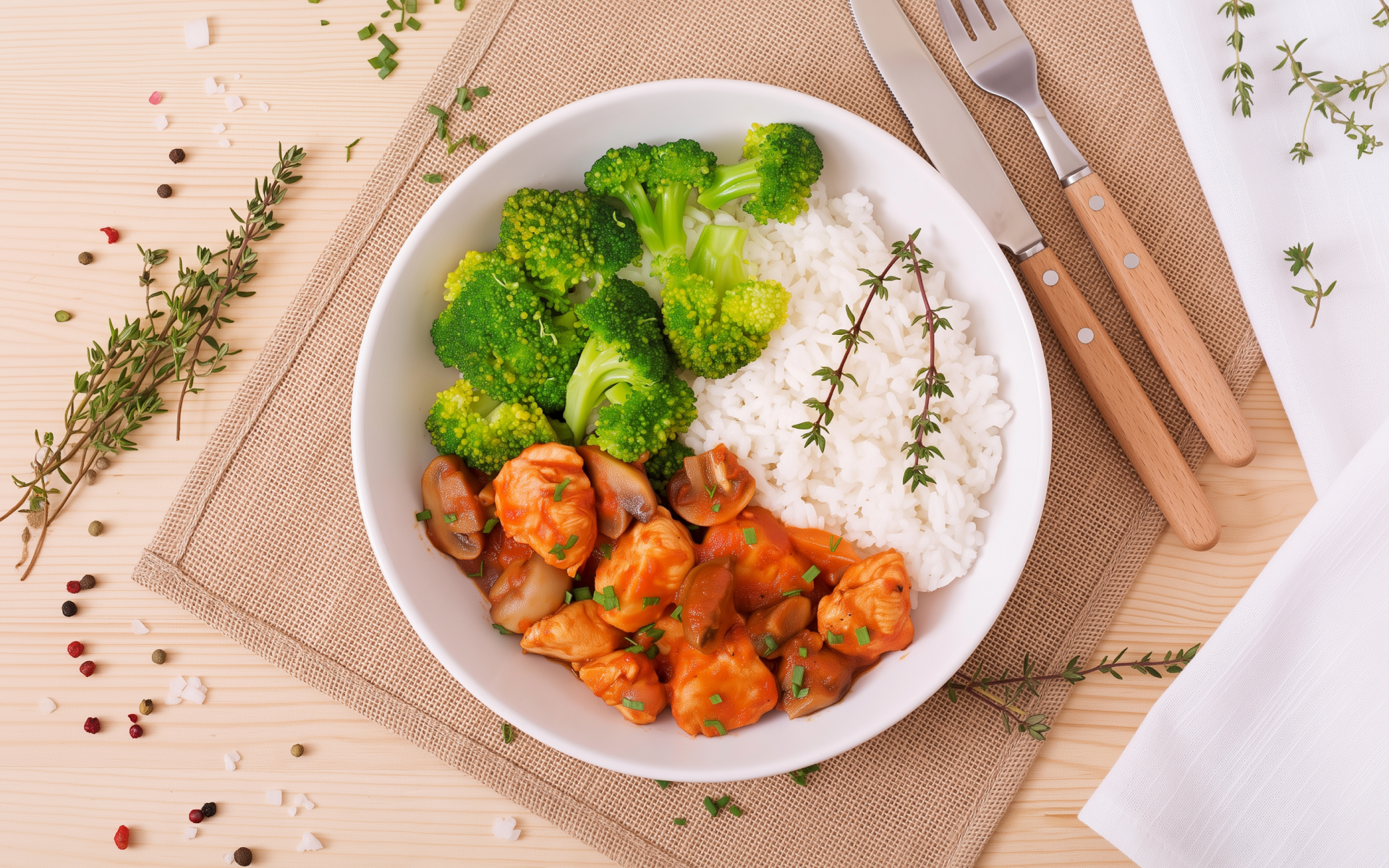
An easy way to picture it, one that works for almost any meal of the day, is to think of the plate divided into three parts (5): half for vegetables, and that’s where broccoli goes, along with whatever vegetables you like; a quarter for a protein, such as chicken, fish, eggs, or legumes (6); and the other quarter for some grain, such as rice, quinoa, potatoes, or whole-wheat pasta (7). Fats also have their role in a balanced plate: a drizzle of olive oil when sautéing, some seeds on top, a little avocado, or a handful of nuts (8). With just a little, the meal rounds out and your body thanks you for it. With this simple reference, you could put together balanced broccoli meals without overcomplicating things.
There’s no need to measure anything precisely. It’s more of a visual guide that you get at a glance, one that adapts to what’s in the kitchen, to cravings, and even to what was left over from the day before.
The key, deep down, isn’t following an exact formula, but having a reference that lets broccoli do its part without asking it to be everything. A well-thought-out broccoli meal plan leans right on this idea. If you look at the plate and there’s this variety, there’s a good chance it’s in balance. And from that place, broccoli does a great job—it’s not the one carrying everything, but it is the one that adds.
Can Five Days of Restrictive Eating Produce Meaningful Results?
We always try to be realistic. And the reality is that, in the short term, a restrictive diet plan such as the five-day broccoli one, or any similar restriction, could see weight drop fast, maybe with less bloating and a certain feeling of “reset”. However, it’s worth keeping in mind that a big part of that initial change could be water, not actual fat (9). Real transformation tends to be a slower, more sustained process.
Here’s the thing: when we measure success in five days, we’re asking a week to do the work of a lifestyle. The results that truly matter come from how you eat the rest of the time, your exercise, your hydration, how you sleep, how you manage stress. It’s the whole picture that builds the change.
Five days could serve to get started, to take the first step and feel how your body responds. However, if the plan ends on day six and everything goes back to the way it was, it’s unlikely that the effect will hold. What leaves a mark isn’t the restriction week, but what you manage to keep up afterward.
Here, just as we don’t ask broccoli to be the whole plate, we couldn’t ask five days to do it all.

Why Does Dietary Variety Matter?
We’ve said it before: no single food has it all, not even broccoli. Every food we eat brings something the others don’t, and that’s exactly why eating a variety of foods is a way to give your body what it needs without having to chase each nutrient one by one.
And there’s a phrase nutritionists love to repeat: make your plate a rainbow (10). It’s not just a nice idea to look at—it actually has a reason behind it. When your plate is full of different colors, it’s a good sign your body is getting a little bit of everything, almost without you noticing.
Variety also has another important side when it comes to building habits: it helps you with boredom. Eating the same thing over and over could eventually wear some people out. Even though a single-food diet may seem practical at first glance, boredom becomes a silent enemy of good habits, and whatever feels boring is more likely to not last over time.
Ultimately, a balanced diet isn’t about being perfect at every meal—it’s about the sum of your choices across the days. And variety is what makes that sum possible without making you overthink it, because your body just takes what it needs from each plate, and all you have to do is keep eating with color and with appetite.
Which Foods Can You Pair with Broccoli?
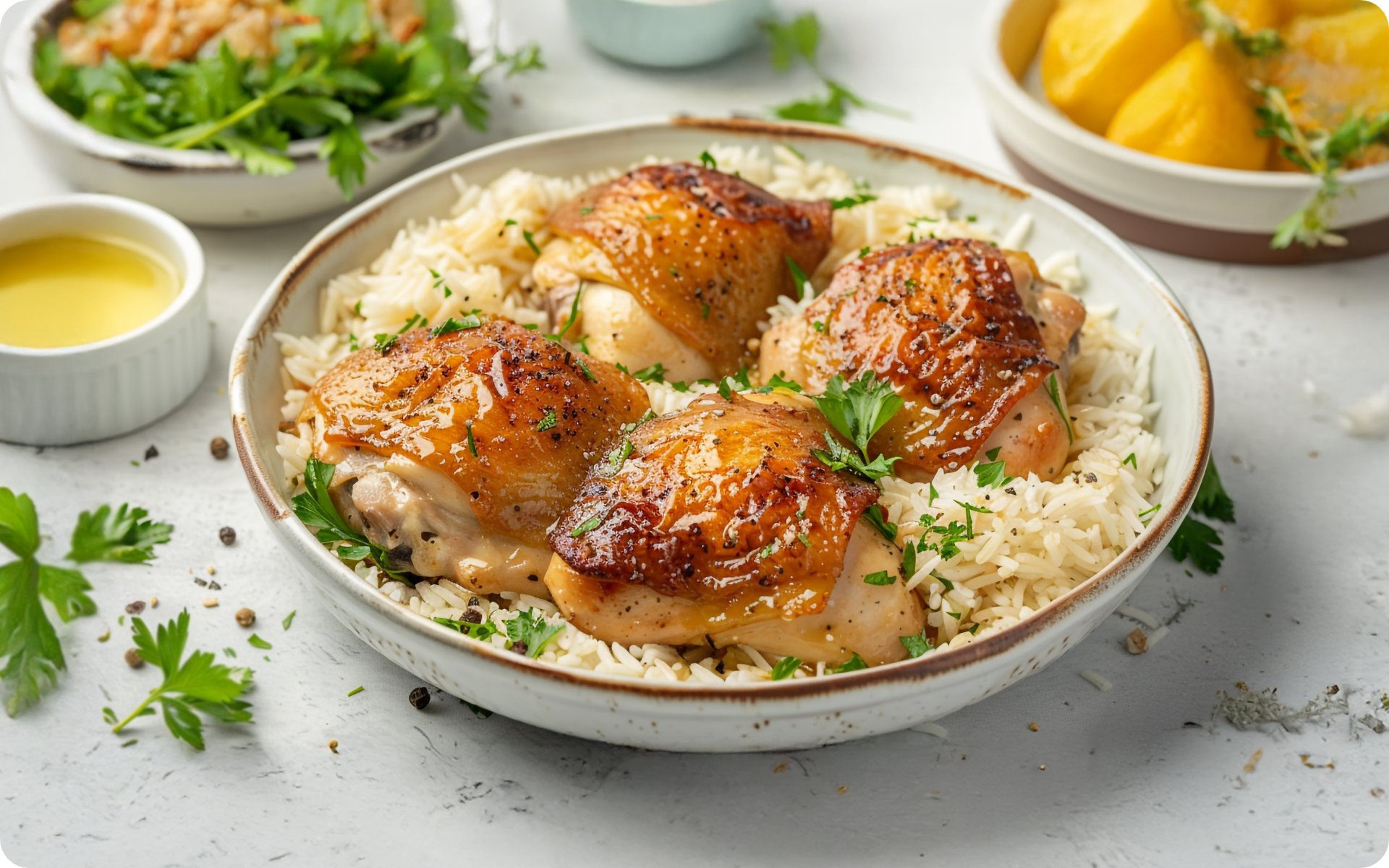
Eating broccoli every day doesn’t have to be monotonous, because it pairs well with almost any protein and grain you have on hand—one day with chicken and rice, another sautéed with garlic, egg, and noodles, another as the base of a warm salad with chickpeas and quinoa. Healthy broccoli recipes like these give you weeks of variety. It also works great in a stir-fry with meat and vegetables, in a soup with potatoes, or sautéed alongside fish and a bit of roasted potato.
The interesting thing is that you don’t need a fancy recipe to make it work. The plate can start with whatever you already have: some protein, a grain, a fat. That’s it.
It has that particular character—a flavor that doesn’t go unnoticed but doesn’t impose itself either, a texture that responds differently depending on how it’s cooked (steamed, sautéed, roasted, or air-fried broccoli for a crispy touch), and a color that brings any dish to life—so it doesn’t compete, it accompanies.

How Can You Replace Rigid Diet Rules with a Flexible Meal Framework?
Opening the fridge at mealtime, staring for a moment, and having no idea where to start. Chicken, rice, the leftover vegetables from yesterday? For many people, that moment of hesitation is the hardest part of the day. And the way to get through it without wearing yourself out is exactly what shifts when rigid diet rules give way to a flexible meal framework—instead of a list telling you what to eat, you move toward a simple guide that shows you the way without bossing you around.
It’s true that lists, with their precise portions and that “but I’m not supposed to eat this” that keeps coming back, could bring a sense of order at first. However, for plenty of people, they end up feeling exhausted over time. They demand too much, they leave little room for a craving or for real life, and that’s why it’s common for them to be dropped after a few weeks.
A flexible meal framework works differently. It doesn’t chase you around with rules—it just gives you a reference to navigate by. Like the plate divided into three parts we already looked at, it’s not an order or a gram-perfect portion, it’s a starting point that bends to what you have on hand, to what you feel like that day, and even to yesterday’s leftovers.
And this is where the real difference comes from. Rigidity tends to lean on willpower, and willpower tends to run out. A flexible meal framework, by contrast, rests on simple references, as it doesn’t ask you to overthink each meal, and that’s why it fits around your days instead of asking you to fit your life around it.
When Should You Consult a Dietitian?
There’s no need for something to be wrong before talking to a dietitian. That’s the first idea that’s worth making clear, because a lot of people wait until they have a problem to look for guidance. However, a dietitian doesn’t only work to “fix” something—they also help you find direction, sort out doubts, and walk alongside a process that’s already underway.
When in doubt, it’s generally always okay to check in. If you’re not sure whether a way of eating works for you, if a plan brings up questions, or if you’d simply like a framework that fits your life and you don’t know where to start, that’s a good enough reason.
What’s interesting is that a dietitian works a lot like a flexible framework. They don’t impose rigid rules or chase you with lists—they listen, they guide, and they help you find a reference that fits your days. It’s the same spirit we’ve been talking about—less control, more support.
So if you ever find yourself with doubts, there’s no need to overthink it. Checking in is a way of looking after yourself and adding a professional perspective to your own path. And over time, that tends to make a difference.
BetterMe Well-Being Coach app can help you build a more structured approach to your wellness routine with meal plans, workouts, and habit-tracking tools. Start using the app to explore options that may support your personal fitness and nutrition goals.
FAQs
How much broccoli can you include in a meal?
You can include broccoli in a meal without needing an exact measurement, but as we’ve seen in the article, broccoli and vegetables in general are the base of the plate. A good starting point is a portion that takes up half of your plate. However, this is just a reference—some people feel good with more and others with less. The key is that broccoli is present without the plate losing its variety.
Is raw or cooked broccoli a better choice?
Between raw and cooked broccoli, each form brings its own thing, and this holds for vegetables in general. Raw has the advantage of keeping more nutrients, but it could be harder on digestion for some people—cooking softens the texture and flavor, and could be tolerated better in larger amounts and in more preparations. The choice will depend on how it sits with you and what you like, not on a fixed rule.
Can broccoli replace a source of protein?
Broccoli can’t replace a source of protein. As we’ve already mentioned, every food brings its own thing, and broccoli isn’t a main source of protein. But that’s okay, because it doesn’t have to be! Its role is to accompany a protein, such as chicken, eggs, or legumes, not to replace it. In the article, we’ve explained what to combine it with so your plate stays balanced.
Which vegetables can you use instead of broccoli?
You can replace broccoli with other cruciferous vegetables such as cauliflower, cabbage, or kale, which share a similar texture and nutrients. As we’ve mentioned throughout the article, including other vegetables adds variety and brings different nutrients to the plate. Spinach or asparagus also work. None of them are identical, and they don’t have to be—if you don’t have broccoli on hand one day, any of these options does a similar job.
What are some balanced ways to prepare broccoli?
Preparing broccoli in a balanced way has less to do with a special technique and more with the company you put on the plate. As we’ve seen in the article, the simplest thing is to combine it—alongside a protein (chicken, eggs, or legumes), a grain (rice, quinoa, or potatoes), and a touch of fat such as olive oil or seeds. In this way, any preparation could become a complete meal.
The Bottom Line
What we’ve covered throughout the article could be summed up in a single idea: broccoli has its place, and it’s good to keep it close, but no food on its own does the work of a complete meal.
The 5-day diet could work as a starting point, as a way to take the first step and pay more attention to your meals. However, the changes that last don’t come from a week of restriction—they come from what you manage to keep up afterward. That’s why what tends to pay off most is a flexible meal framework, a reference that fits whatever is in your kitchen and your real days, and not a list of rigid rules.
If you have any doubts along the way, asking for help is also part of taking care of yourself. A dietitian could bring a professional perspective without imposing a plan that doesn’t fit your life.
Ultimately, eating better isn’t a five-day promise—it’s a way of relating to food that could hold up on its own. And when it’s well paired, broccoli could be a great place to start.
DISCLAIMER:
This article is intended for general informational purposes only and does not serve to address individual circumstances. It is not a substitute for professional advice or help and should not be relied on for making any kind of decision-making. Any action taken as a direct or indirect result of the information in this article is entirely at your own risk and is your sole responsibility.
BetterMe, its content staff, and its medical advisors accept no responsibility for inaccuracies, errors, misstatements, inconsistencies, or omissions and specifically disclaim any liability, loss or risk, personal, professional or otherwise, which may be incurred as a consequence, directly or indirectly, of the use and/or application of any content.
You should always seek the advice of your physician or other qualified health provider with any questions you may have regarding a medical condition or your specific situation. Never disregard professional medical advice or delay seeking it because of BetterMe content. If you suspect or think you may have a medical emergency, call your doctor.
SOURCES:
- Broccoli: A Multi-Faceted Vegetable for Health: An In-Depth Review of Its Nutritional Properties and Health Benefits (2023, pmc.ncbi.nlm.nih.gov)
- How does the liver work? (2023, ncbi.nlm.nih.gov)
- Renal Function Tests (2024, ncbi.nlm.nih.gov)
- The fundamentals of a healthy and sustainable diet (2024, pmc.ncbi.nlm.nih.gov)
- The Use of Portion Control Plates to Promote Healthy Eating and Diet-Related Outcomes: A Scoping Review (2022, pmc.ncbi.nlm.nih.gov)
- Protein Nutrition: Understanding Structure, Digestibility, and Bioavailability (2022, pmc.ncbi.nlm.nih.gov)
- Exploring the reporting, intake and recommendations of whole-grain food in national dietary guidelines (2024, pmc.ncbi.nlm.nih.gov)
- Mediterranean diet and oxidation: nuts and olive oil as important sources of fat and antioxidants (2011, pubmed.ncbi.nlm.nih.gov)
- Pros & cons of some popular extreme weight-loss diets (2018, pmc.ncbi.nlm.nih.gov)
- A Review of the Science of Colorful, Plant-Based Food and Practical Strategies to “Eat the Rainbow” (2019, pubmed.ncbi.nlm.nih.gov)

 Reviewed by