
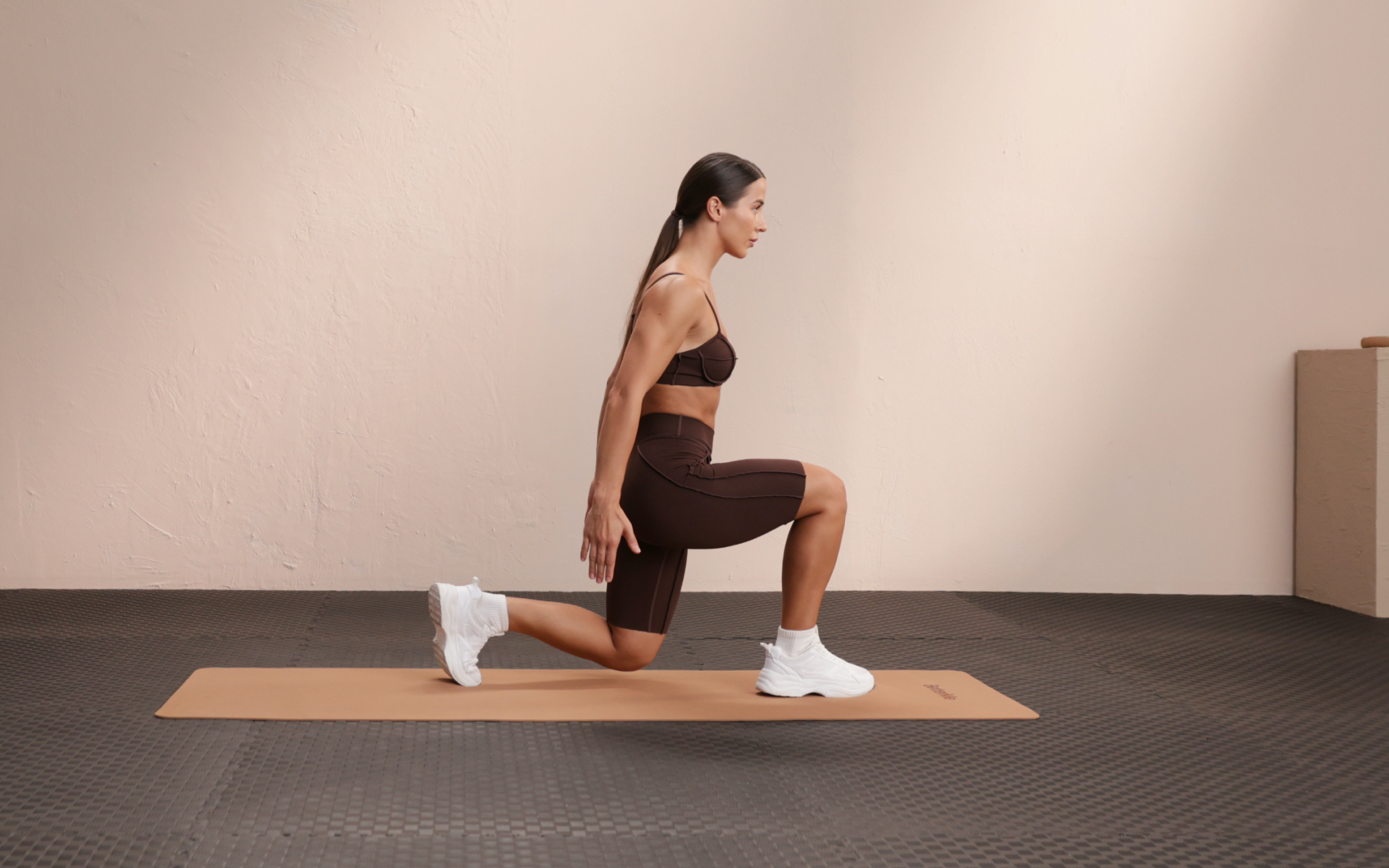
A 2-day split workout divides your weekly training into two separate sessions, so you cover all major muscle groups in just two visits. When it’s programmed properly, a full-body workout twice a week provides sufficient volume for muscle growth and strength. This makes it a perfect option for those with limited time.
Time is sometimes the biggest barrier to training. You want to make progress, but fitting many gym days into a packed week feels unrealistic. A 2-day split workout is useful for such schedules.
This guide is for busy people—beginners, returning trainees, and anyone who wants a simple, repeatable routine. You’ll learn how to schedule your sessions, which muscles to train, what exercises to pick, and how to progress over time. Keep reading, and you’ll walk away with a clear plan you can adjust to fit your life.
Is a Full-Body or Upper/Lower Split Better for Two Workout Days?
When you only lift twice a week, full-body workouts are generally the best choice. It allows you to train each muscle group twice a week and spreads your effort more evenly (1).
Here’s the logic. Each muscle group gets trained twice weekly instead of once. This gives you more practice with key movements and helps you build strength steadily.
One randomized trial compared a full-body workout twice a week with a 4-day upper/lower plan. When total weekly sets matched, results for strength and muscle looked similar (2).
Therefore, training more days a week has minimal effect if you use the same volume. However, this means that your sessions will be longer when training just two days a week.
A quick comparison:
- Full-body (2 days): Trains all muscles both sessions, simple, time-friendly
- Upper/lower (2 days): Trains each half once weekly, which may limit practice
For two sessions, full-body wins on balance and frequency. Save the 2-day upper/lower split for weeks when you can add more days.
If you’d like a gentler entry point, check out our guide to a Beginners’ Upper/Lower Split.
How Can You Schedule a 2-Day Workout Split Across the Week?
You can schedule a 2-day workout split by placing your two sessions on non-consecutive days, with at least 48-72 hours to recover between them (3). Recovery time helps you train with better quality each session.
Ideally, you can place them 72 hours apart for the most spread, but there’s no single magic layout. What matters most is consistency and enough rest. Pick two days that suit your real schedule.
Popular non-consecutive layouts:
- Monday and Thursday
- Tuesday and Friday
- Wednesday and Saturday
| Weekly layout | Session 1 | Session 2 | Rest gap | Best for |
|---|---|---|---|---|
| Mon/Thurs | Monday | Thursday | ~72 hours | Even spacing across the week |
| Tues/Fri | Tuesday | Friday | ~72 hours | Midweek starters |
| Wed/Sat | Wednesday | Saturday | ~72 hours | |
| Sat/Sun | Saturday | Sunday | ~24 hours | Only if weekdays are full |
Back-to-back days can still work if that’s all your week allows—just expect the second session to feel a bit harder. Aim for the wider gap when you can.
BetterMe offers a variety of workouts, recipes, challenges, and support tools to help you stay more consistent with your wellness routine. Explore the app to find features that fit your goals, preferences, and schedule.
Which Muscle Groups Should You Train on Each Day?
You should train all major muscle groups across the week (4), ideally twice. This means that each of your two days includes both upper- and lower-body work.
This allows you to train each muscle group twice. Furthermore, as the sessions are generally longer, it spreads out the volume of exercises in a more balanced manner.
Think in movement patterns rather than single muscles. Each session can hit these five patterns.
The core patterns to include:
- Knee-dominant lower body: Squats, leg press, split squats
- Hip-dominant lower body: Romanian deadlifts, hip thrusts
- Upper-body push: Bench press, overhead press, push-ups
- Upper-body pull: Rows, pulldowns, pull-ups
- Optional accessories: Arms, calves, core
A simple structure looks like this:
- Day A: Squat + horizontal press + horizontal pull + accessory
- Day B: Hinge + vertical press + vertical pull + accessory
This is a true upper body and lower body workout that’s done twice weekly. Both days share the same job—train everything—but swap the exact movements. That variety keeps things interesting and covers your whole body.
What Exercises Can You Include in a 2-Day Split Workout?
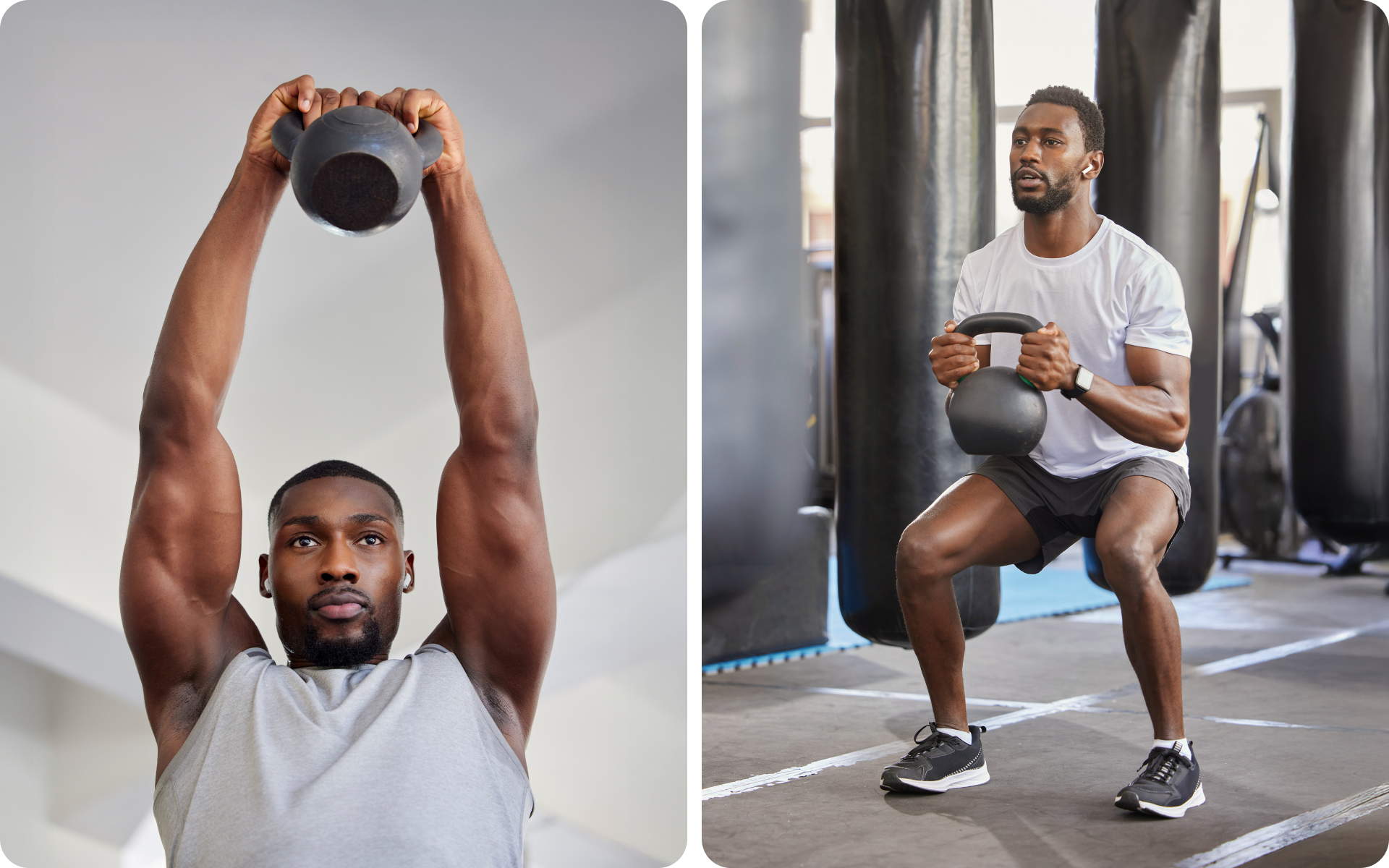
You can include multi-joint exercises that work several muscles at once, which gives you the most value from limited training time (1). Movements such as squats, presses, and rows form the backbone of a solid two-day workout plan.
Below is a sample 2-day gym workout using a Full-Body A/Full-Body B setup. Both days train your whole body, but weekly volume is fairly low for some muscle groups, so you may need to add sets depending on your goals.
| Day | Movement pattern | Example exercise | Sets | Reps |
|---|---|---|---|---|
| Workout A | Knee-dominant | Goblet squat | 3 | 6-10 |
| Workout A | Horizontal push | Dumbbell bench press | 3 | 8-12 |
| Workout A | Horizontal pull | Dumbbell row | 3 | 8-12 |
| Workout A | Core | Plank | 3 | 20-40 secs |
| Workout B | Hip-dominant | Romanian deadlift | 3 | 8-12 |
| Workout B | Vertical push | Overhead press | 3 | 8-12 |
| Workout B | Vertical pull | Lat pulldown | 3 | 8-12 |
| Workout B | Lower accessory | Calf raise | 3 | 12-15 |
This setup works well as a 2-day dumbbell workout too, as most moves swap easily to dumbbells.
Exercise Instructions
Use these cues to perform each movement in the sample program.
Goblet Squat
- Hold one dumbbell or kettlebell close to your chest.
- Stand with your feet shoulder-width apart and your toes slightly out.
- Bend your knees and hips, lowering until your thighs reach about parallel.
- Keep your chest tall and your heels down.
- Push through your feet to stand back up.
Dumbbell Bench Press
- Lie back on a flat bench with a dumbbell in each hand.
- Start with the dumbbells near your chest, your elbows about 45 degrees from your sides.
- Press the weights up until your arms are nearly straight.
- Lower with control back to chest level.
- Keep your feet flat and your back steady.
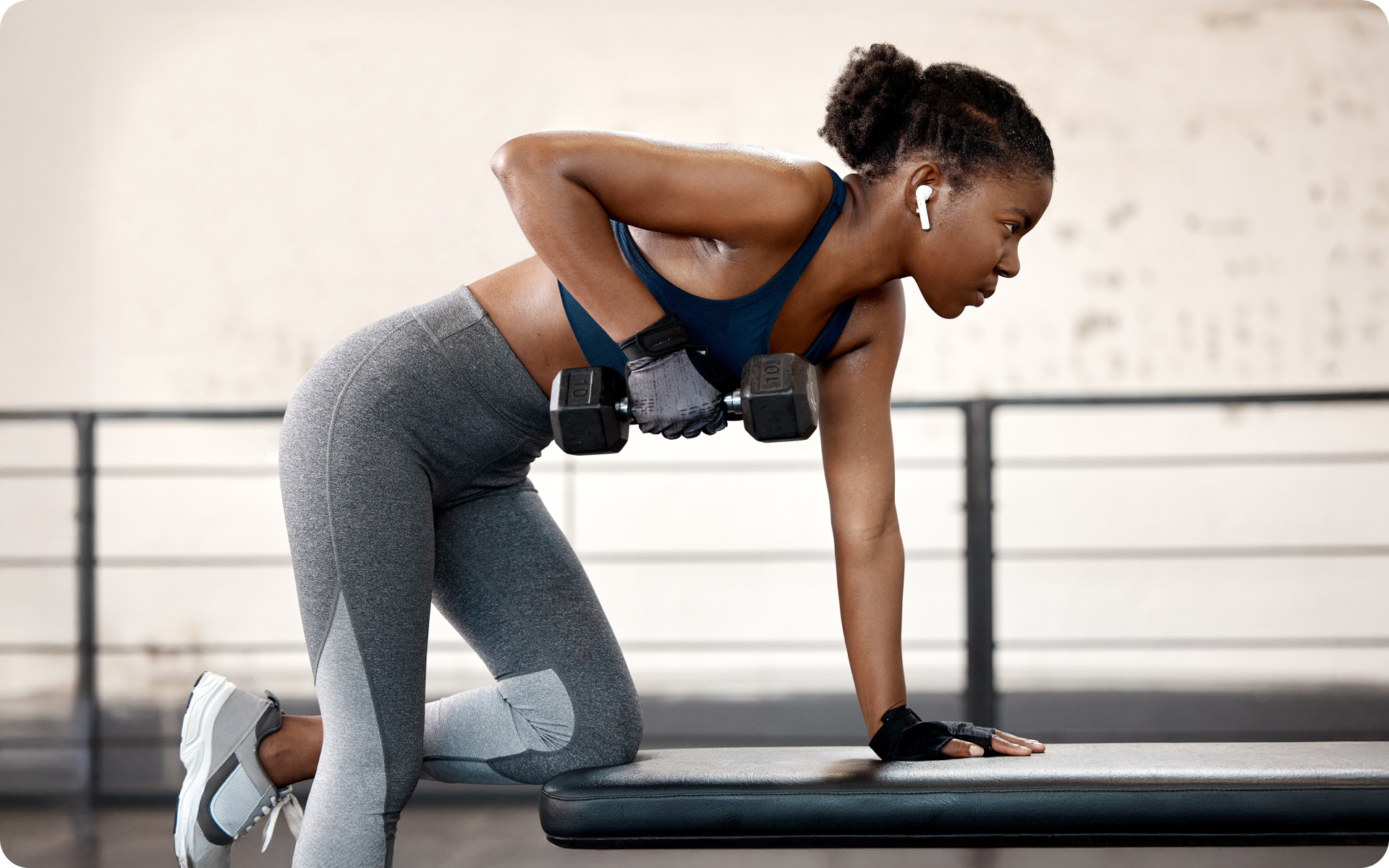
One-Arm Row
- Place one knee and one hand on a bench for support.
- Hold a dumbbell in the opposite hand, your arm hanging down.
- Pull the dumbbell toward your hip, leading with your elbow.
- Squeeze your back at the top.
- Lower slowly and repeat, then switch sides.
Plank
- Rest on your forearms and toes, your elbows under your shoulders.
- Keep your body in a straight line from your head to your heels.
- Tighten your core and squeeze your glutes.
- Avoid letting your hips sag or lift.
- Hold for your target time, breathing steadily.
Romanian Deadlift
- Hold dumbbells or a barbell in front of your thighs.
- Keep a soft bend in your knees.
- Hinge at your hips, pushing them back as the weight lowers.
- Stop when you feel a stretch in your hamstrings.
- Drive your hips forward to stand tall again.
Overhead Press
- Hold dumbbells at shoulder height, your palms facing forward.
- Brace your core and keep your ribs down.
- Press the weights straight overhead until your arms are nearly locked.
- Lower with control back to your shoulders.
- Keep your lower back neutral throughout.
Read more: The Best 6 Pack Ab Workout For Toning And Bodybuilding
Lat Pulldown
- Sit at the machine and grip the bar with your hands wider than shoulder-width apart.
- Secure your thighs under the pad.
- Pull the bar toward your upper chest, leading with your elbows.
- Squeeze your back muscles at the bottom.
- Let the bar rise slowly and repeat.
Calf Raise
- Stand tall, your feet hip-width apart, holding dumbbells if you wish.
- Rise onto the balls of your feet as high as you can.
- Pause briefly at the top.
- Lower your heels slowly toward the floor.
- Repeat with a steady, controlled rhythm.
For more layouts you can mix and match, browse our full Split Workout Plan collection.
How Many Sets, Reps, and Rest Periods Should You Use?
You should aim for enough weekly sets, reps that match your goal, and rest periods that fit each exercise, as these variables shape your results more than any single detail (4). A consistent 2-day strength training routine keeps these numbers steady week to week.
Here are practical starting ranges.
Sets per week (per muscle group):
Reps by goal (6):
- Strength focus: 1-5 reps with heavier loads (around 80% of your one-rep max)
- Muscle and general fitness: 6-12 reps for most moves
- Accessories: 8-15 reps
Rest between sets: 2-3 minutes (4)
Some research has suggested that both lighter and heavier loads build muscle when you push effort close to your limit (7, 8). So the exact numbers can flex. Pick a range, stay consistent, and adjust as you learn what feels right.
Workouts, weight management tools, and recipe ideas come together in the BetterMe Well-Being Coach app, giving you practical support for building a more consistent wellness routine.
How Can You Choose a Starting Weight and Manage Effort?
You can choose a starting weight by picking a load that leaves 1-3 reps in reserve, meaning you stop before you fully run out of energy. This approach helps you train hard without grinding to failure every set (9).
Here’s a simple example. If your target is 8 reps, pick a weight you could probably do for 9-11 reps with good form, then stop at 8. This leaves a small buffer.
Some research has suggested that you don’t need to hit failure on every set to gain strength or muscle (10)—leaving a couple reps in the tank tends to work well.
A simple way to dial in your weight:
- First set: use your best estimate
- Second set: adjust up or down based on how it felt
- Let your form guide the load—clean reps come first
Effort should feel like real work, not a struggle that breaks your form. When the last rep gets messy, the weight may be too heavy for now.
How Can Beginners Adjust a 2-Day Workout Plan?
Beginners can adjust a 2-day workout plan by keeping it simple, modest, and easy to repeat, which builds confidence and steady habits. A beginners’ 2-day workout routine doesn’t need many exercises to work.
Start light and focus on learning the movements. Progress comes naturally once the basics feel comfortable.
A beginner-friendly structure per session:
- 4-6 exercises total
- 2-3 sets each
- Mostly 6-12 reps
- Stop with 1-3 reps in reserve
A sample beginner template:
- Squat or leg press
- Hinge or glute bridge
- A press (bench or overhead)
- A row or pulldown
- Optional arm or core work
Some research has suggested that new trainees respond well to almost any sensible plan (11). You don’t need fancy programming—simply show up twice a week, hit all the major movement patterns, move with good form, and let your body adapt.
If something feels too hard, drop a set or lower the weight. Small adjustments keep you moving forward without burnout.
How Can You Progress a 2-Day Split Over Time?
You can progress a 2-day split over time by using progressive overload—gradually increasing the demand placed on your muscles. (12). Small, steady increases keep your two-day lifting routine effective.
You have several ways to add challenge. Pick one at a time so change stays manageable.
Ways to progress:
- Add 1-2 reps to a set
- Add a small amount of weight
- Add an extra set
- Improve your range of motion or control
A simple double-progression example:
- Your target is 3 sets of 6-8 reps.
- Once you hit 8, 8, 8 with good form, add a little weight next time.
- Rebuild from the lower end (6 reps) and climb again.
- For example, pretend you’re using 100lbs:
- Session 1: 3 X 6 w/ 100lbs
- Session 2: 3 X 7 w/ 100lbs
- Session 3: 3 X 8 w/ 100lbs
- Session 4: 3 X 6 w/ 105lbs
Research supports progression as a core principle (13). Track your sessions in a notebook or app. Seeing your numbers rise keeps motivation high and progress clear.
How Can You Add Cardio or Other Activities to This Schedule?
You can add cardio to a 2-day split schedule by placing it on separate days or after your lifting sessions, so it doesn’t drain your strength work. Combining the two tends to work well for general fitness.
Here are two simple ways to fit it in.
Option A: Separate days:
- Monday: Lift
- Tuesday: Cardio
- Thursday: Lift
- Saturday: Cardio, a sport, or a hike
Option B: Same day:
- Lift first
- Add 10-20 minutes of cardio after
While both options can work, your best option would be to do cardio on separate days, as you only lift weights twice a week. Some research has suggested that hard endurance work right before heavy lower-body lifting may reduce your lifting performance (14), so if strength matters most, lift first.
Activities that fit around two lifting days:
- Walking
- Cycling
- Swimming
- Light jogging
- Yoga or mobility work
General guidance often points to 150-300 minutes of moderate activity per week (15)—spread it across the days when you’re not lifting. Individual results vary, so adjust based on how you recover.
Read more: Keto Workout Plan: How To Exercise On A Low-Carb Diet
How Can You Modify a Workout When an Exercise Does Not Feel Right?
You can modify a workout when an exercise doesn’t feel right by swapping the movement while keeping the same goal. Change the exercise, not your plan.
Discomfort during a lift can come from the load, angle, or your body’s structure. A small tweak often fixes it.
What you can adjust:
- The weight you use
- Your range of motion
- Your grip or stance
- The equipment or variation
Simple swaps to try:
- Back squat feels awkward → goblet squat or leg press
- Bench press bothers your shoulders → dumbbell press or push-up
- Deadlift feels off → Romanian deadlift or hip thrust
- Pull-up too hard → assisted pull-up or lat pulldown
Some research supports movement patterns over any single “must-do” exercise. Machines, free weights, and bands can all build strength (1, 16).
One note on effort versus discomfort: hard work feels challenging, but sharp or lasting discomfort is different. If something keeps bothering you, ease off and consider checking with a qualified professional.
What Equipment Can You Use for a 2-Day Split at Home or at the Gym?
You can use free weights, machines, bands, or bodyweight for a 2-day split, as research has suggested that each option can build strength and muscle (1). Your equipment choice depends on access and preference, not on one “best” tool.
Both the gym and home offer plenty of options.
Gym equipment:
- Barbells and dumbbells
- Machines and cables
- Benches
- Pull-up and pulldown stations
Home equipment for a 2-day home workout plan:
- Adjustable dumbbells
- Resistance bands
- A bench
- Your own body weight
Optional home upgrades:
- A kettlebell
- A pull-up bar
- A suspension trainer
If you’re buying minimal gear, adjustable dumbbells, bands, and a bench give you the most flexibility. That trio covers nearly every movement pattern.
This full-body setup suits many people, including those who are following a 2-day workout plan for women who want balanced strength across the whole body. Body weight works too, but lower-body progress becomes harder over time without added load.
Do you want more sessions later? See our guide to a 4-Day Gym Split Female routine for ideas on scaling up.

FAQs
Is a 2-day workout split enough for beginners?
Yes, a 2-day workout split is often enough for beginners to build strength and muscle. New trainees tend to respond well to consistent, sensible training, even at a lower frequency. Some research has suggested that two full-body sessions per week can produce real progress when you train with good effort (17). Focus on showing up regularly, learning the movements, and adding small challenges over time.
How far apart should two strength workouts be?
Two strength workouts tend to work best with 48-72 hours between them (3). This gap gives your muscles time to recover, so you train each session with better quality. Layouts like Monday and Thursday or Tuesday and Friday space things nicely. Back-to-back days can still work if your week is packed, though the second session may feel harder than usual.
Can I do a 2-day split with dumbbells only?
Yes, you can do a 2-day split with dumbbells only, and it covers nearly every movement pattern you need. Adjustable dumbbells let you press, row, squat, hinge, and curl without extra gear. Some research has suggested that free weights build strength just as well as machines (18). Add a bench for more variety, but a pair of dumbbells alone can carry a solid full-body routine.
How long should each 2-day split workout take?
Each 2-day split workout usually takes about 45-60 minutes, including warm-up and rest between sets. With 4-6 exercises and 3 sets each, that timing fits most people. If you’re short on time, trim rest periods or drop a set. Quality effort matters more than clock time, so a focused 40-minute session can still deliver results.
What should I do if I miss one workout day?
If you miss one workout day, simply do that session on the next available day and continue as normal. One missed day won’t undo your progress. You can shift both sessions later in the week or combine your schedule the following week. Consistency over weeks and months matters far more than any single session—just pick up where you left off.
The Bottom Line
A 2-day split workout gives busy people a realistic way to train the whole body, build strength, and stay consistent without living at the gym. Pick two days, cover every movement pattern, and add a little more over time. Your two sessions are enough to make real change—lace up, load the bar, and let your progress build week by week.
DISCLAIMER:
This article is intended for general informational purposes only and does not serve to address individual circumstances. It is not a substitute for professional advice or help and should not be relied on for making any kind of decision-making. Any action taken as a direct or indirect result of the information in this article is entirely at your own risk and is your sole responsibility.
BetterMe, its content staff, and its medical advisors accept no responsibility for inaccuracies, errors, misstatements, inconsistencies, or omissions and specifically disclaim any liability, loss or risk, personal, professional or otherwise, which may be incurred as a consequence, directly or indirectly, of the use and/or application of any content.
You should always seek the advice of your physician or other qualified health provider with any questions you may have regarding a medical condition or your specific situation. Never disregard professional medical advice or delay seeking it because of BetterMe content. If you suspect or think you may have a medical emergency, call your doctor.
SOURCES:
- No Time to Lift? Designing Time-Efficient Training Programs for Strength and Hypertrophy: A Narrative Review (2021, link.springer.com)
- A randomized trial on the efficacy of split-body versus full-body resistance training in non-resistance trained women (2022, link.springer.com)
- The Importance of Recovery in Resistance Training Microcycle Construction (2024, pmc.ncbi.nlm.nih.gov)
- American College of Sports Medicine Position Stand. Resistance Training Prescription for Muscle Function, Hypertrophy, and Physical Performance in Healthy Adults: An Overview of Reviews (2026, ovid.com)
- Resistance Training Variables for Optimization of Muscle Hypertrophy: An Umbrella Review (2022, frontiersin.org)
- Loading Recommendations for Muscle Strength, Hypertrophy, and Local Endurance: A Re-Examination of the Repetition Continuum (2021, mdpi.com)
- Comparison of traditional vs. lighter load strength training on fat-free mass, strength, power and affective responses in middle and older-aged adults: A pilot randomized trial (2023, sciencedirect.com)
- The Effects of Low-Load Vs. High-Load Resistance Training on Muscle Fiber Hypertrophy: A Meta-Analysis (2020, pmc.ncbi.nlm.nih.gov)
- Influence of Resistance Training Proximity-to-Failure, Determined by Repetitions-in-Reserve, on Neuromuscular Fatigue in Resistance-Trained Males and Females (2023, link.springer.com)
- Influence of Resistance Training Proximity-to-Failure on Skeletal Muscle Hypertrophy: A Systematic Review with Meta-analysis (2023, link.springer.com)
- Neuromuscular adaptations to resistance training in elite versus recreational athletes (2025, frontiersin.org)
- Exercise progressions and regressions in sports training and rehabilitation (2024, sciencedirect.com)
- Effects of Resistance Training Overload Progression Protocols on Strength and Muscle Mass (2024, pubmed.ncbi.nlm.nih.gov)
- Muscle fatigue and interference phenomenon during concurrent aerobic and strength training: An alternative hypothetical model (2025, sciencedirect.com)
- American Heart Association Recommendations for Physical Activity in Adults and Kids (2024, heart.org)
- Using Machines or Free Weights for Resistance Training in Novice Males? A Randomized Parallel Trial (2020, mdpi.com)
- ACSM Unveils Landmark 2026 Resistance Training Guidelines — First Update in 17 Years (2026, acsm.org)
- Effect of free-weight vs. machine-based strength training on maximal strength, hypertrophy and jump performance – a systematic review and meta-analysis (2023, link.springer.com)

 Reviewed by
 Reviewed by

 Reviewed by