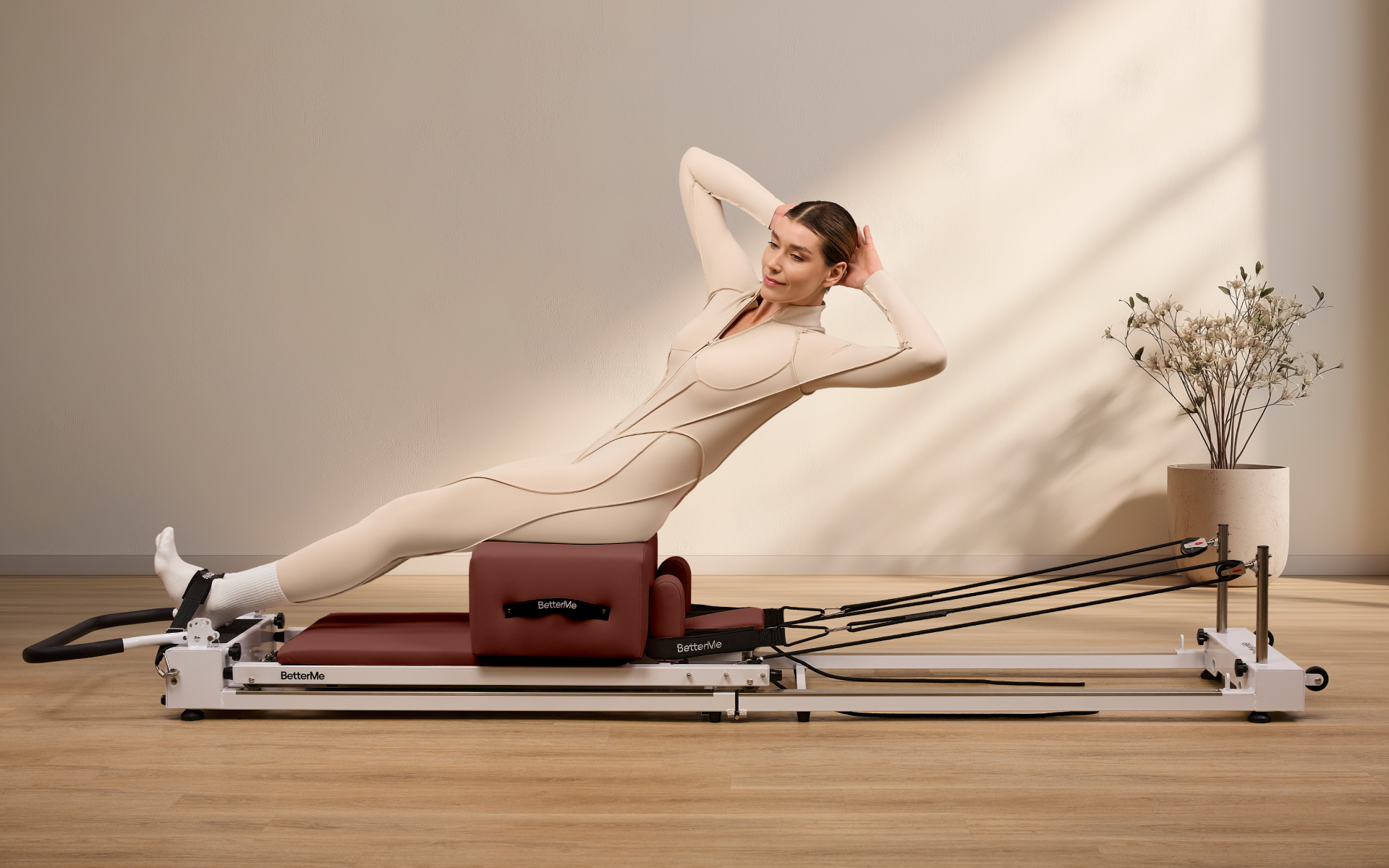
Have you ever looked at a Pilates reformer and wondered how people move on it with such continuous, effortless precision? It takes time to reach this level of movement but doing so can help build strength, endurance, and body awareness. Yet, for many beginners, the machine itself—with its springs, straps, and moving carriage—can seem intimidating.
This guide breaks down reformer training. We will explore how to transition seamlessly between movements. By the time you finish reading, you will have a clear understanding of how to approach a structured Pilates reformer flow sequence for beginners.
What Is the Flow Method in Pilates?
The flow method refers to the seamless transition from one exercise to the next without resting or breaking form. Instead of approaching a workout as a series of isolated movements with distinct start and stop points, flow connects them into a continuous, rhythmic sequence.
By eliminating extended rest periods, a flow sequence can keep you moving at a steady pace throughout the sequence (1). This steady pace can:
- Supports steady movement
- Supports a smooth workout rhythm
- Help build consistency over time
If you are looking to expand your routine without the machine, you might want to explore the principles of a home Pilates workout.
Read more: 3 Wall Posture Exercises to Practice at Home
Is Pilates Flow Good for Beginners?
Is it beginner-friendly to start with continuous movement? It can be, provided the intensity and complexity are appropriately scaled.
A well-designed Pilates reformer flow sequence for beginners prioritizes foundational movements over advanced acrobatics. The focus remains on:
- Core stability
- Proper form during the exercise
- Controlled breathing
Beyond these foundational improvements, beginners can benefit in a few ways:
First – The reformer provides tactile feedback that can help you better notice how your body moves in space—a concept known as proprioception (2).
Second – For those concerned about strain, the flow method encourages a smooth, controlled tempo. This deliberate pacing can reduce jerky, momentum-driven movement and encourage more control.
Third – Using a reformer to stretch under tension increases flexibility and can feel more manageable for beginners (3, 4)
Fourth – Many beginners find this approach helpful because it can help build consistent movement habits (5). You learn to move with intention, approaching exercise as a practice of precision rather than a test of sheer exhaustion.
To understand the foundational mechanics before stepping on the machine, it helps to review some basic Pilates moves.
Intense sweat sessions, working weight loss tips, lip-smacking recipes come in one package with the BetterMe: Health Coaching app—all at your fingertips, start transforming your life now!
How to Structure a Pilates Reformer Workout?
Structuring an effective routine requires more than just picking exercises at random. It’s good to have a logical progression that warms up the body, challenges the major muscle groups, and gradually helps you slow down at the end of the session.
Here is how you can structure a full body Pilates reformer flow sequence:
- Preparation and Warm-Up (5-8 minutes): Start with supine (lying on the back) exercises like footwork. This reduces overall intensity while warming up the lower body (ankles, knees, hips) and establishing a steady breathing rhythm.
- Core Activation (5-10 minutes): Transition to exercises that challenge the core muscles. Using light to moderate spring tension (e.g., 1 red or 1 blue spring) ensures the resistance does not overpower the smaller supporting muscles.
- Back and Upper Body (10-15 minutes): Incorporate movements that move the body through different ranges of motion. Add upper body pulling and pushing movements using the straps.
- Lower Body Integration (10-15 minutes): Move to seated, kneeling, or standing positions on the reformer. This demands more balance and core control, translating the strength built earlier into functional, more challenging upright positions.
- Cool Down and Stretching (5-10 minutes): Conclude with a reformer stretching flow. Use light spring tension to assist in longer, static stretches held for 30-60 seconds each, supporting a calmer finish to the workout.
What Is a Beginner-Friendly Pilates Reformer Flow Sequence?
To assist you in navigating your training, here is a beginner-friendly program. This routine minimizes the need for frequent spring changes, allowing you to maintain the “flow” aspect of the workout.
Program Notes
- Spring Tensions: Most reformers use a color-coded system. For context: Red = Heavy (approx. 30-40 lbs), Blue = Medium (approx. 15-20 lbs), Yellow = Light (approx. 5-10 lbs).
- Rest: Transition directly from one exercise to the next with 0-15 seconds of rest.
- Pacing: 2 seconds on the effort, 2 seconds on the return.
The Beginner Flow Program
| Exercise Name | Repetitions | Spring Tension | Primary Focus |
|---|---|---|---|
| Footwork (Parallel) | 10-12 | 2 Red, 1 Blue | Lower Body Warm-up, Alignment |
| Leg Circles | 8-10 per direction | 2 Blue | Hip Mobility, Core Stability |
| Hundred (Modified) | 10 breath cycles | 2 Blue | Core Activation, Rhythm |
| Elephant | 8-10 | 1 Red, 1 Blue | Hamstring Stretch, Rounded Back Position |
| Knee Stretches (Round Back) | 8-10 | 1 Red | Hip Control, Core Control |
Below is the step-by-step breakdown for executing this Pilates reformer flow sequence for beginners.
Read more: 6 Advanced Pilates Reformer Exercises to Progress Your Practice
Footwork (Parallel)
Footwork is a common starting point in reformer Pilates, helping you find alignment and warm up the legs.
- Lie supine on the carriage with your head on the headrest and shoulders resting gently against the shoulder blocks.
- Place the balls of your feet on the footbar, hip-width apart, with your feet and knees staying parallel.
- Inhale to prepare. As you exhale, extend your hips and knees to push the carriage away, keeping your movement controlled and comfortable.
- Inhale to control the carriage back to the starting position, taking 2-3 seconds to control the return against the spring tension.
Leg Circles
This movement encourages mobility while challenging the core and keeping the movement steady.
- Lie supine and place your feet into the long loops of the straps. Extend your legs up toward the ceiling (or as far as your hamstring flexibility allows within a range that feels comfortable for you).
- Inhale as you open your legs slightly wider than your shoulders and press them down toward the footbar in a circular motion.
- Exhale as you draw your heels together at the bottom of the circle and hinge at the hips to return the legs up to the starting position.
- Keep your pelvis as steady as possible; keep the movement smooth and controlled.
Hundred (Modified)
A classic reformer exercise for core control and steady movement.
- Lie supine with your knees bent in a “tabletop” position (with your hips and knees bent). Hold the short loops in your hands with your arms reaching straight up over your chest.
- Exhale, nod your chin toward your chest, and flex your upper back to lift your head and shoulder blades off the carriage. Simultaneously press your arms down until they are hovering parallel to the carriage.
- Maintain this lifted position. Pump your arms in a small, controlled motion up and down about 2-3 inches.
- Inhale for 5 arm pumps, and exhale for 5 arm pumps. Complete 10 full breath cycles (100 pumps total).
Elephant
This is an excellent movement for improving mobility through the back of the legs while integrating upper body support.
- Stand on the carriage facing the footbar. Place your heels flat against the shoulder blocks and grip the footbar firmly with both hands, shoulder-width apart.
- Round your back into a ‘C-curve,’ dropping your head between your arms and lifting your abdominals upward. Your body should resemble an inverted ‘V’ or an elephant’s shape.
- Inhale as you press the carriage backward by moving from the hips, keeping your arms straight and your back rounded. Move the carriage about 10-15 inches.
- Exhale to pull the carriage all the way back to the stopper by engaging your core and pulling your hips forward.
Knee Stretches (Round Back)
This exercise teaches you how to move your legs independently of your pelvis while maintaining control through the movement.
- Kneel on the carriage with your knees resting against the shoulder blocks and your hands gripping the footbar.
- Round your back upward toward the ceiling, engaging your core to create a strong, stable position.
- Inhale as you push the carriage backward by extending your hips, allowing your knees to move away from the footbar. Keep your back in its rounded shape.
- Exhale to pull the carriage back to the starting position by engaging your core and legs. If you want to expand this sequence, consider integrating it with a comprehensive full body Pilates workout.
Want to spring-clean your diet, skyrocket your self-confidence, and shatter your insecurities? Check out the BetterMe: Health Coaching app and set this plan in motion!
Is Reformer Pilates 2 Times a Week Enough?
How often should you train to notice progress? A twice-weekly routine can be a practical starting point for beginners to build consistency, strength, and mobility (6).
When you perform a full body Pilates reformer flow sequence two times a week, you give your body time to practice and adjust, with time to rest between sessions. This frequency can feel manageable over time (7).
However, if your primary goal shifts toward more advanced strength or cardio-focused goals, two days a week on the reformer may start to feel limited over time.
At that point, you may need to increase your reformer frequency to 3-4 days a week. Or, you can supplement your routine with other types of exercise, such as resistance training or zone 2 cardio, to build a more varied fitness routine.
Is the Flow Pilates Reformer Worth It?
Investing time and potentially money into flow Pilates reformer sessions can be a worthwhile addition to your routine.
The specialized equipment offers a unique environment where resistance can be adjusted gradually, making it suitable for different experience levels and movement preferences (8).
One of the main benefits lies in the machine’s ability to provide both support and resistance simultaneously (9). The springs support your body weight during complex movements, allowing you to explore a range of motion with control. Conversely, they challenge your stability in ways that more traditional forms of training cannot replicate.
When you execute a Pilates reformer flow sequence for beginners, you are building strength, coordination, posture awareness, and control.
Frequently Asked Questions
Does reformer Pilates burn fat?
Reformer Pilates can support strength and muscle engagement (10), which can play a role in your overall routine (11). However, visible changes usually depend on many factors, including eating habits, activity levels, and consistency over time (12) rather than Pilates alone.
Which form of Pilates is most effective?
The most effective form of Pilates depends entirely on your personal goals. Reformer Pilates provides adjustable resistance that can support strength and control (13), whereas Mat Pilates is effective for mastering bodyweight control and movement awareness (14).
Which is harder, yoga or Pilates?
Difficulty is subjective and depends on the specific class and your personal fitness background.
Yoga often demands more static stretching and balance (15), while Pilates generally requires more dynamic core work and control against resistance (8).
Can I do reformer Pilates if I’m unfit?
Yes, many beginners start with reformer Pilates. Reformer Pilates can be adjusted to different experience levels, as the machine’s springs can provide more support or more challenge, making movements more beginner-friendly. This flexibility makes it suitable for a wide range of movement settings (8).
Will Reformer Pilates flatten my stomach?
Reformer Pilates can help strengthen the muscles through your midsection (13), which can support posture and core engagement. However, achieving a visibly “flat” stomach depends on many factors, including routine, eating habits, and overall activity levels.
The Bottom Line
Mastering the reformer does not require an elite athletic background; it simply requires a commitment to deliberate, controlled practice. By understanding the idea of continuous movement and prioritizing proper execution of each exercise, you can transform a seemingly complex machine into a useful tool for building strength, control, and consistency.
DISCLAIMER:
This article is intended for general informational purposes only and does not serve to address individual circumstances. It is not a substitute for professional advice or help and should not be relied on for making any kind of decision-making. Any action taken as a direct or indirect result of the information in this article is entirely at your own risk and is your sole responsibility.
BetterMe, its content staff, and its medical advisors accept no responsibility for inaccuracies, errors, misstatements, inconsistencies, or omissions and specifically disclaim any liability, loss or risk, personal, professional or otherwise, which may be incurred as a consequence, directly or indirectly, of the use and/or application of any content.
You should always seek the advice of your physician or other qualified health provider with any questions you may have regarding a medical condition or your specific situation. Never disregard professional medical advice or delay seeking it because of BetterMe content. If you suspect or think you may have a medical emergency, call your doctor.
SOURCES:
- Target Heart Rates Chart (2024, heart.org)
- Impact of Pilates on Proprioception: A Review (2025, researchgate.net)
- Effects of 12-week pilates reformer training on the biomechanics of Latin dance Cha-Cha circle chasing technique (2025, frontiersin.org) 3
- Investigation of the Effect of 8-Week Reformer Pilates Exercise on Flexibility, Heart Rate and Glucose Levels in Sedentary Women (2020, researchgate.net)
- The Impacts of Pilates and Yoga on Health-Promoting Behaviors and Subjective Health Status (2021, mdpi.com)
- Progression Models in Resistance Training for Healthy Adults (2009, journals.lww.com)
- The Importance of Recovery in Resistance Training Microcycle Construction (2024, pmc.ncbi.nlm.nih.gov)
- Effect of Reformer Spring Resistance Modifications on Core Muscle Activity During Basic Core Muscle Exercises (2024, mdpi.com)
- Pilates: how does it work and who needs it? (2011, pmc.ncbi.nlm.nih.gov)
- Reformer Pilates vs Mat Pilates and Muscle Mass: Current State of Knowledge (2026, researchgate.net)
- The relationship between resting metabolic rate and quality of life is moderated by age and body composition in women: a cross-sectional study (2024, link.springer.com)
- Optimal Diet Strategies for Weight Loss and Weight Loss Maintenance (2020, pmc.ncbi.nlm.nih.gov)
- Effects of reformer pilates on body composition, strength, and psychosomatic factors in overweight and obese women A randomized controlled trial (2025, nature.com)
- Effect of mat pilates exercise on postural alignment and body composition of middle-aged women (2016, pmc.ncbi.nlm.nih.gov)
- Neurobiological and anti-aging benefits of yoga: A comprehensive review of recent advances in non-pharmacological therapy (2024, sciencedirect.com)
 Reviewed by
 Reviewed by