
The push-up is a foundational exercise for building upper-body strength, but not all push-ups are created equal. The Pilates push-up is a highly controlled, full-body movement.
It emphasizes precision, core stability, and mindful execution over raw repetition count. This sophisticated exercise demands more than just arm strength; it requires stability, mobility, and muscular control from head to toe.
This guide will answer the popular question –
What are Pilates push-ups?
We will explore the core components of a Pilates push-up, its unique mechanics, the muscles it targets, and the substantial benefits it offers for both athletic performance and daily functional strength.
You will learn the proper technique, step-by-step instructions, and understand how to build the foundational strength required to perform Pilates push-ups safely and effectively.
What Is A Pilates Push Up?
A Pilates push-up is a full-body exercise that integrates a standing spinal articulation (roll-down), a walk-out to a plank, one or more controlled push-ups, and a return to standing.
Unlike a standard gym push-up, it focuses on core control, scapular stability, and a specific, narrow arm path that targets the triceps and shoulders while protecting the joints.
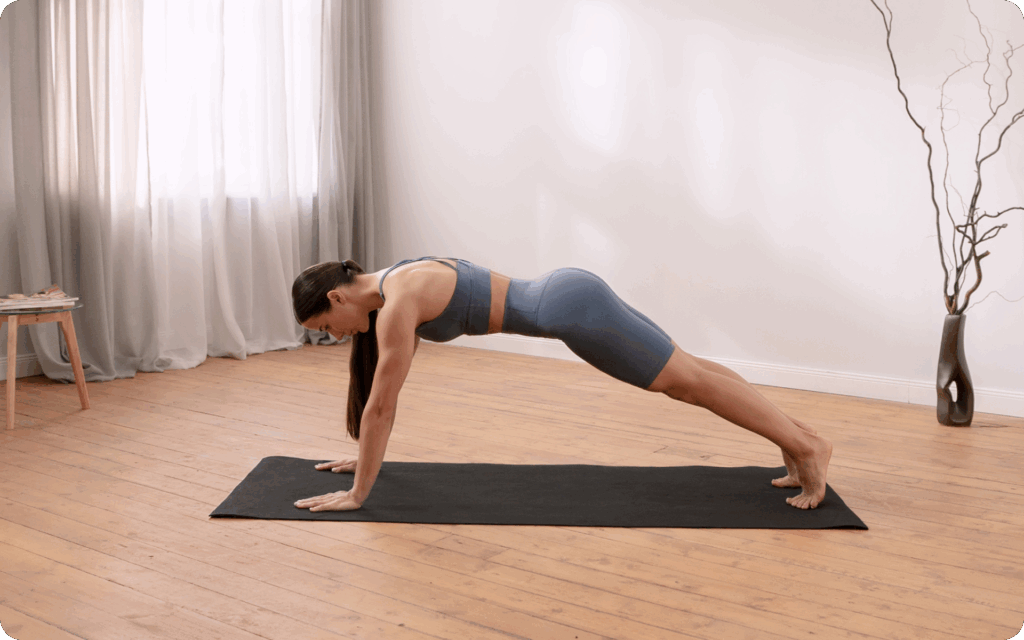
The complete sequence starts standing, where you articulate your spine down vertebra by vertebra until your hands reach the floor. From there, you walk your hands out into a high plank position. This position is where the push-up occurs, with a distinct emphasis on keeping the elbows tucked close to the body, typically at a 30- to 45-degree angle from your torso.
The movement is performed at a slow, controlled tempo to maximize time under tension. After completing the push-ups, you walk your hands back toward your feet and articulate the spine back up to a standing position. This entire sequence completes a single, seamless exercise.
How Do Pilates Push-Ups Differ From Regular Push-Ups?
The main difference lies in intent and execution. Pilates push-ups prioritize control and integration over speed and volume, involving a specific sequence that begins and ends with spinal articulation. Regular push-ups typically focus on muscular hypertrophy and endurance, often performed with a wider hand position and faster tempo.
Let’s break down the key distinctions in this Pilates push-up vs regular push-up comparison –
The Sequence
- The Pilates version is a flow. It includes a standing roll down and a walk-out, making it a comprehensive warm-up or cooldown that mobilizes the spine and challenges the entire kinetic chain.
- A regular push-up is a pressing movement performed from a static plank.
BetterMe: Health Coaching app helps you achieve your body goals with ease and efficiency by helping to choose proper meal plans and effective workouts. Start using our app and you will see good results in a short time.
Arm and Elbow Position
- Pilates push-ups almost exclusively use a narrow, triceps-focused position. The elbows track straight back, hugging the ribcage.
- Regular push-ups often use a wider hand placement, which shifts more emphasis to the pectoralis major (chest) muscles but can increase stress on the front of the shoulder if performed with excessive elbow flare (greater than 60-70 degrees) (1).
Core Engagement and Spinal Position
- Both require a strong core.
- The Pilates method emphasizes maintaining a neutral to slightly posteriorly tilted pelvis. The “scooped” abdominal position minimizes lower-back sag. The exercise is initiated from the “powerhouse” (the deep abdominal, back, and pelvic floor muscles) to create a rigid lever from head to heels.
Tempo and Control
A Pilates push-up requires a deliberate, slow tempo, especially during the lowering (eccentric) phase. This phase often lasts 3-4 seconds, increasing mechanical tension and strengthening connective tissue (2).
Regular push-ups require a much faster 1-1 tempo.
Scapular (Shoulder Blade) Control
Pilates demands that the shoulder blades remain stable on the back without “winging” or collapsing together. There is a strong focus on using the serratus anterior muscle to protract (push away) at the top of the movement, which is a key component for shoulder health (3).
Read more: Transform Your Body With These 10 Mat Pilates Back Exercises
What Muscles Do Pilates Push-Ups Target?
Pilates push-ups engage muscles throughout the body, functioning as a full-body integration exercise. The prime movers are in the upper body, but the movement requires a significant network of stabilizers to maintain form from your neck down to your ankles.
Primary Movers (The Pressing Muscles)
- Triceps Brachii – Because of the narrow elbow position, the triceps (the muscles on the back of your upper arms) are the primary drivers of the press. They work intensely to straighten the elbow joint against your body’s weight (4).
- Pectoralis Major (Sternal Head) – While the triceps dominate, the lower and inner portion of your chest muscles are heavily involved in adducting the arm (bringing it toward the body’s midline) and pressing (5).
- Anterior Deltoid – The front portion of your shoulder muscle assists with shoulder flexion and the pressing motion (6).
Key Stabilizers (The Control System)
- Serratus Anterior – Located on the side of your ribcage, this muscle is critical for preventing scapular winging, a typical postural inefficiency (7). The Pilates cue to “push the floor away” at the top of the plank is specifically designed to activate it.
- Core Musculature – This includes the transverse abdominis (your deepest abdominal layer), obliques, and rectus abdominis. Their work isometrically prevents your hips from sagging and your spine from extending (8), creating what Pilates instructors call “the powerhouse.”
- Rotator Cuff – These 4 small muscles work tirelessly to stabilize the head of the humerus (upper arm bone) within the shoulder socket (9), especially given the exercise’s closed-chain nature.
- Glutes and Quadriceps – Your glutes and quads are not passive. They must remain engaged to maintain a straight line from your shoulders to your heels, locking the pelvis and legs into a single, stable unit.
You can learn more about which muscles are involved in different variations by reading about push-up muscle groups.
What Are The Main Benefits Of Pilates Push Ups?
The unique structure of the Pilates push-up delivers benefits that extend beyond simple upper-body strength. The emphasis on control and integration translates into better movement quality, improved posture, and enhanced core stability, which support all other physical activities (10).
One of the main Pilates push-up benefits is its focus on eccentric control.
By slowing down the lowering phase to 3-4 seconds, you build superior strength and resilience in your muscle tendons and ligaments (11). This controlled loading is a potent stimulus for tissue adaptation and injury prevention (12).
Here are some other key advantages –
- Enhanced Core Strength and Stability
The entire sequence, from the roll down to the plank hold, is a masterclass in core control. Maintaining a rigid torso against gravity develops deep abdominal strength, protecting your spine and improving force transfer during athletic movements such as running, throwing, and swinging (13).
- Improved Shoulder Health and Mechanics
The focus on a narrow arm path and serratus anterior activation promotes healthy shoulder mechanics (14). By keeping the elbows tucked and preventing scapular winging, you train the shoulder to move efficiently and reduce the risk of impingement that can occur with wide, flared-elbow push-ups.
- Increased Full-Body Coordination
The push-up is not an isolated arm exercise. It teaches you to connect your upper body, trunk, and lower body into a single, cohesive unit. This skill of creating and maintaining full-body tension is fundamental to athletic performance and functional strength (15).
- Greater Spinal Mobility and Awareness
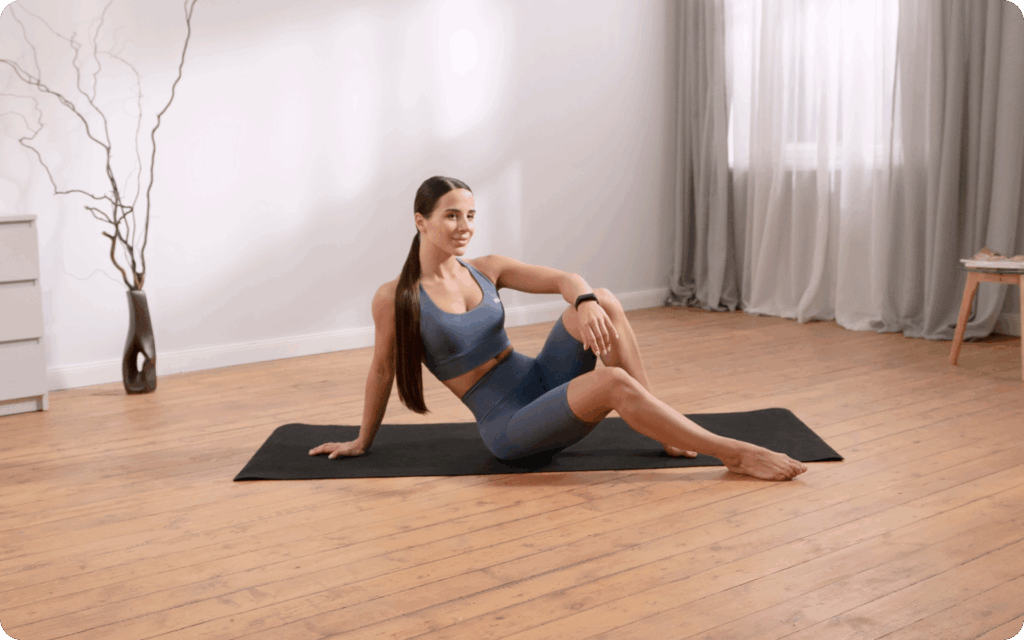
The standing roll-down and roll-up that bookend the exercise are fantastic for improving spinal articulation. Moving one vertebra at a time enhances your body awareness and gently mobilizes your back, which can help alleviate stiffness (16, 17).
- Progressive and Accessible
The exercise can be modified to suit any fitness level. For Pilates push-ups for beginners, starting with an incline variation against a wall or countertop is ideal. This reduces the load while allowing you to perfect the form, making it a safe and effective progression.
You can explore the broader benefits of this foundational exercise by reading more about push-up benefits.
What Is The Proper Technique For Pilates Push Ups?
Executing a Pilates push-up correctly requires focus and precision. The goal is quality over quantity.
Follow this step-by-step guide to master the form.
Step 1 – The Standing Roll Down
- Starting Position – Stand tall with your feet parallel and hip-width apart. Your sides should relax by your arms. Take a deep inhale to prepare.
- Articulation – As you exhale, nod your chin to your chest and begin to peel your spine off an imaginary wall behind you, one vertebra at a time. Soften through the sternum and allow your arms to hang heavily.
- Reach the Floor – Continue rolling down until your hands touch the floor. Bend your knees as much as needed to make this happen without straining your hamstrings.
Step 2 – The Walk-Out to Plank
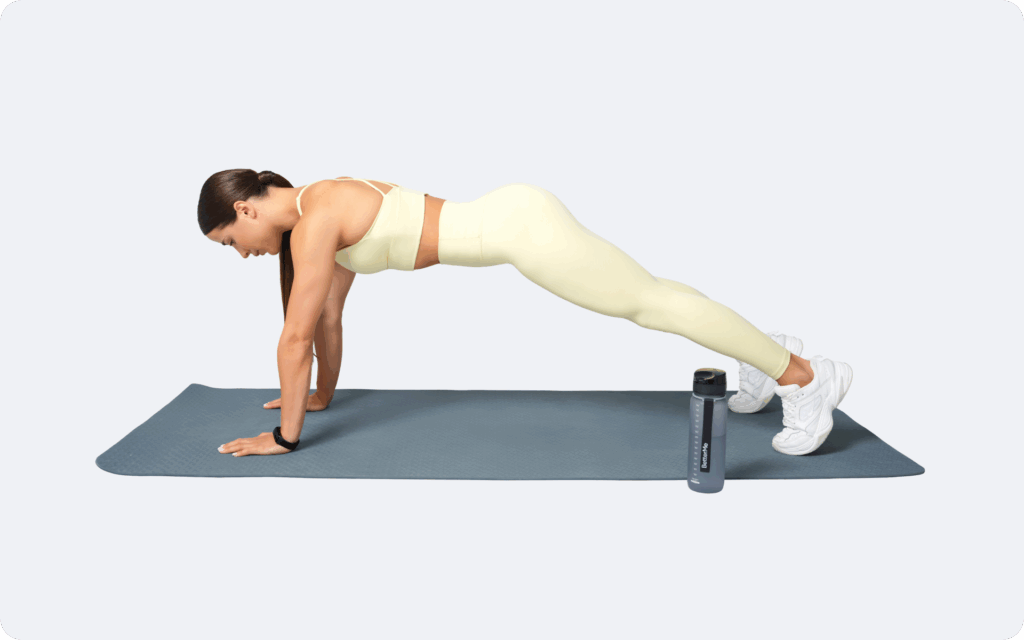
- Walk Forward – Inhale as you walk, keeping your abdominal muscles engaged. Stop when your hands are slightly wider than your shoulders, and your body forms a straight, solid line from your head to your heels.
- Plank Position – Your wrists should be directly under your shoulders. Engage your core by drawing your navel toward your spine and slightly tucking your pelvis. Squeeze your glutes and quads. “Push the floor away” to activate your serratus anterior and create width across your upper back.
Step 3 – The Push-Up
- The Descent (Eccentric Phase) – Inhale and begin bending your elbows, lowering your body as one unit. Your elbows should track straight back toward your heels, staying close to your ribcage (at a 30- to 45-degree angle). Lower for a slow count of 3-4 seconds.
- The Bottom Position – Lower your chest until it is a few inches from the floor, or as far as you can go without losing your plank alignment. Do not let your head drop, or your hips sag.
- The Ascent (Concentric Phase) – Exhale forcefully as you press the floor away, straightening your elbows to return to the high plank position. Maintain a rigid line throughout your body.
Step 4 – The Return
- Walk Back – After completing your desired reps (even one is excellent!), exhale as you walk your hands back toward your feet, keeping your legs as straight as comfortable.
- Roll Up – Once your hands are back at your feet, inhale. As you exhale, press through your feet and begin to roll your spine back up to standing. Stack your vertebrae one by one, with your head being the last thing to come up.
Read more: Does Pilates Give You Abs? Here’s What Science Says
How Many Pilates Push-Ups Should Beginners Start With?
For beginners, the focus should be on mastering the form of each component, not on achieving a high number of repetitions. A great starting point is to perform the whole sequence with just one perfect push-up per set.
The goal for Pilates push-ups for beginners is to build the necessary stability and control.
You can start with 3-5 sets of the full sequence –
- roll down
- walk out
- one push-up
- walk back
- roll up
If a full push-up from the toes is too challenging, there are excellent modifications.
Whether you’re a workout beast or just a beginner making your first foray into the world of fitness and dieting – BetterMe has a lot to offer to both newbies and experts! Install the app and experience the versatility first-hand!
Progressions For Beginners
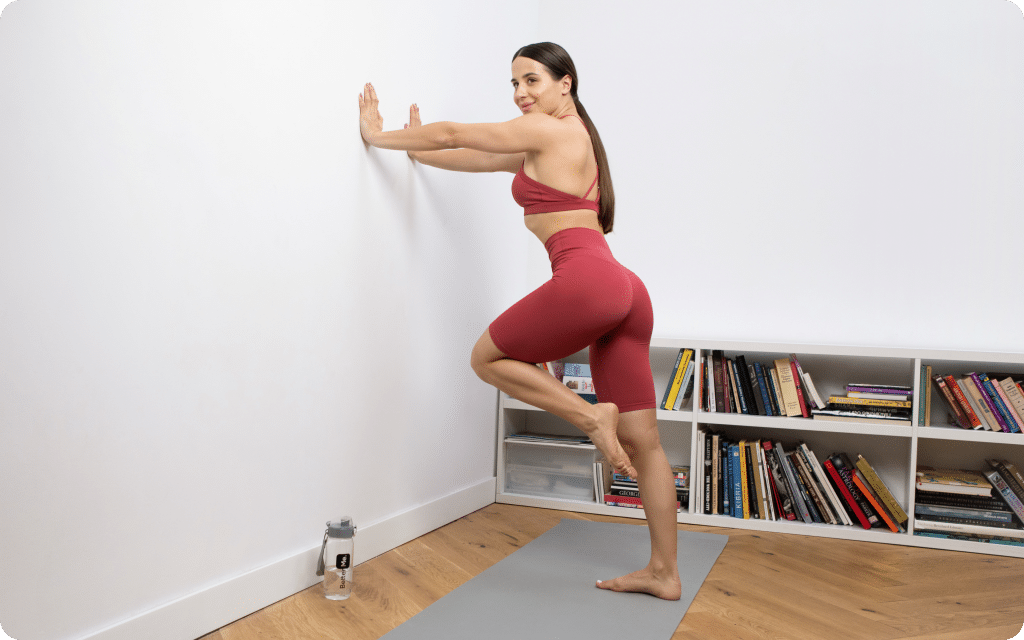
- Wall Push-Ups
Stand facing a wall and place your hands on it. The further you stand from the wall, the more challenging it becomes. This is the safest way to learn the arm path and scapular control.
- Incline Push-Ups
Use a kitchen counter, a sturdy bench, or stairs. The higher the incline, the less bodyweight you are lifting. This is a superior modification of the Pilates push-up on knees because it teaches you to maintain full-body tension, a critical component of the exercise.
A 2018 kinetic analysis of push-up exercises confirmed that altering the body’s angle is a reliable way to modify load (18).
Eccentric-Only Push-Ups
From a full plank, focus only on the lowering phase. Lower your body for a slow 4-5 second count, then drop your knees to the floor to push back up. This builds the specific strength needed for the full movement. Maintain a plank for 30-45 seconds with perfect form before attempting a full push-up.
- Prop-Assisted Push-Ups
Some Pilates studios use a Magic Circle or a block under the sternum or pelvis.
As noted by the Pilates Encyclopedia, a prop like the Magic Circle can provide physical feedback and slight assistance, helping you groove the correct arm path and maintain torso alignment (19).
To learn more about the best starting variations, you can check out our guide on wall push-ups Pilates.
What Mistakes To Avoid With Pilates Push Ups?
The precision required for a Pilates push-up means there are several common mistakes that can compromise its benefits and increase injury risk.
Being mindful of these errors is the key to a safe and effective practice.
- Letting the Hips Sag – This is the most common fault. It indicates a lack of core engagement and places significant stress on the lower back.
- The Fix – Actively “zip up” your abdominals and squeeze your glutes throughout the entire movement. If you still sag, regress to an incline or plank holds to build more core stiffness. Placing a yoga block under your pelvis for tactile feedback can also be very effective.
- Flaring the Elbows Too Wide – Allowing your elbows to flare out to the sides (beyond a 60-degree angle) shifts the stress from your triceps to the front of your shoulder joint.
- The Fix – Think of making an “arrow” shape with your body, not a “T.” Keep your upper arms tight to your sides as if you were holding a piece of paper in your armpits.
- Winging the Shoulder Blades – This occurs when the shoulder blades lift off the ribcage, especially at the bottom of the push-up. It signals weakness in the serratus anterior.
- The Fix – Practice the “pushing the floor away” cue in your plank. Also, perform scapular push-ups (moving only your shoulder blades while in a plank) to strengthen this muscle specifically.
- Dropping or Jutting the Head – Your cervical spine should remain in line with the rest of your body. Dropping the head or reaching for the floor with your chin misaligns your spine.
- The Fix – Keep your gaze about 6-12 inches in front of your fingertips on the floor. Imagine a long line of energy running from the crown of your head through your heels.
- Rushing the Tempo – Moving too quickly, especially on the way down, negates the benefit of eccentric control and turns the exercise into a generic push-up.
The Fix – Be deliberate. Count to 3 or 4 as you lower your body. If you can’t control the descent, you are not ready for that range of motion. Reduce the depth or move to a more straightforward progression.
A push-up can be a Pilates exercise when it is performed within the Pilates method’s principles – concentration, control, center, flow, precision, and breath. The Pilates push-up, integrated with the standing roll down and walk-out, is one of the 34 original exercises created by Joseph Pilates. A generic, fast-paced push-up performed outside of these principles would not be considered a Pilates exercise. While there are hundreds of variations, push-ups can be broadly categorized by hand placement, which determines the primary muscle emphasis – This idea is a common misconception rooted in biological generalizations rather than individual capability. On average, females have less upper-body muscle mass and a higher percentage of their muscle mass in the lower body than males do. This biological factor can make push-ups, which rely on upper-body relative strength, more challenging initially. However, this is not a permanent barrier. With consistent and proper training using progressions like incline push-ups, anyone can build the strength to perform push-ups. The difficulty is about relative strength and training history, not gender. Breathing is fundamental in Pilates and is synchronized with the movement to facilitate core engagement and control. The standard breath pattern is –Frequently Asked Questions
Do push-ups count as Pilates?
What are the three types of push-ups?
Why do girls have a hard time doing push-ups?
How do you breathe during Pilates push-ups?
The Bottom Line
The Pilates push-up is more than an exercise; it is a practice in mindful movement, control, and whole-body integration.
By focusing on the precise details of its execution and respecting the progressions, you can unlock a new level of functional strength, improve your posture, and build a more resilient and coordinated body.
This sophisticated movement challenges you to be present and connected, offering rewards that go far beyond building bigger arms.
DISCLAIMER:
This article is intended for general informational purposes only and does not serve to address individual circumstances. It is not a substitute for professional advice or help and should not be relied on for making any kind of decision-making. Any action taken as a direct or indirect result of the information in this article is entirely at your own risk and is your sole responsibility.
BetterMe, its content staff, and its medical advisors accept no responsibility for inaccuracies, errors, misstatements, inconsistencies, or omissions and specifically disclaim any liability, loss or risk, personal, professional or otherwise, which may be incurred as a consequence, directly or indirectly, of the use and/or application of any content.
You should always seek the advice of your physician or other qualified health provider with any questions you may have regarding a medical condition or your specific situation. Never disregard professional medical advice or delay seeking it because of BetterMe content. If you suspect or think you may have a medical emergency, call your doctor.
SOURCES:
- Effect of the push-up exercise at different palmar widths on muscle activities (2016, pmc.ncbi.nlm.nih.gov)
- The Influence of Movement Tempo on Acute Neuromuscular, Hormonal, and Mechanical Responses to Resistance Exercise—A Mini Review (2020, journals.lww.com)
- EMG activity of the serratus anterior and trapezius muscles during the different phases of the push-up plus exercise on different support surfaces and different hand positions (2016, researchgate.net)
- Effect of elbow joint angles on electromyographic activity versus force relationships of synergistic muscles of the triceps brachii (2021, pubmed.ncbi.nlm.nih.gov)
- Anatomical and surgical considerations of the pectoralis muscle (2024, pmc.ncbi.nlm.nih.gov)
- Activation of the three deltoid muscle portions during common strengthening exercises – A systematic review (2024, sciencedirect.com)
- Winging of the Scapula (2025, ncbi.nlm.nih.gov)
- Core Stability (2003, sciencedirect.com)
- Rotator Cuff (2023, my.clevelandclinic.org)
- Remote Pilates Training Is Effective in Improving Physical Fitness in Healthy Women – A Randomized Controlled Study (2024, pmc.ncbi.nlm.nih.gov)
- The Effect of Pilates Exercises on Eccentric Knee Flexor Muscle Strength (Nording Hamstring) and Bilateral Balance in Athletes (2024, researchgate.net)
- Chronic Adaptations to Eccentric Training – A Systematic Review (2016, link.springer.com)
- Effect of Core Training on Skill Performance Among Athletes – A Systematic Review (2022, frontiersin.org)
- Effects of scapular retraction/protraction position and scapular elevation on shoulder girdle muscle activity during glenohumeral abduction (2019, sciencedirect.com)
- The effects of functional training on physical fitness and skill-related performance among basketball players – a systematic review (2024, frontiersin.org)
- Spinal articulation exercise using an exercise ball enhances dynamic postural control (2024, bodyworkmovementtherapies.com)
- The effect of mind-body exercise on cervical spine mobility of people with neck discomfort – A systematic review and meta-analysis of randomised controlled trials (2022, journals.plos.org)
- Kinetic analysis of push-up exercises – a systematic review with practical recommendations (2018, tandfonline.com)
- Why and How To Add a Magic Circle to Feet in Straps on the Reformer (2024, pilatesencyclopedia.com)
 Reviewed by
 Reviewed by