Many people turn to exercise as a tool for managing stress and improving mental well-being. While activities such as running or weightlifting are common choices, Pilates offers a unique, mind-body approach that is gaining recognition for its profound effects. This structured practice emphasizes control, breath, and precision, and many people find it helps them feel calmer and more mentally focused.
This guide explores the connection between Pilates and mental health. We’ll look at its historical roots, examine what research has explored so far, and provide a practical routine you can use to de-stress. We’ll also cover actionable strategies to integrate Pilates into a holistic approach to manage stress effectively.
What is the Link Between Pilates and Mental Health?
In his foundational book, Return to Life Through Contrology, Joseph Pilates defined his method as the “complete coordination of body, mind, and spirit”. He argued that modern life led to poor posture and inefficient breathing, and his exercises were designed to counteract these effects (1).
For Pilates, physical fitness was inseparable from mental and spiritual well-being. He claimed that Contrology “develops the body uniformly, corrects wrong postures, restores physical vitality, invigorates the mind, and elevates the spirit” (2).
One of his central tenets was “gaining the mastery of your mind over the complete control of your body” (1). He believed this process could reawaken dormant brain cells, leading to a clearer mind and the ability to calmly meet personal problems.
Since the time of Joseph Pilates, research into the mental benefits of his method has grown, though it is not as robust as the research on more mainstream forms of exercise such as aerobic training.
Many initial studies were small or lacked rigorous control groups. However, the body of research is still developing, with newer Pilates research articles pointing toward significant psychological benefits (3, 4, 5, 6, 7, 8).
These studies are beginning to provide validation for the claims Joseph Pilates made nearly a century ago, exploring how the practice influences stress and overall mood.
Does Pilates Help Your Mental Health?
Yes, available research suggests that Pilates may benefit your mental health. The practice combines physical movement with deep, focused breathing and concentration – elements many people associate with feeling calmer and more focused.
Below are some of the key Pilates mental health benefits:
- Enhanced Body Awareness (Proprioception)
Pilates demands a high level of concentration to control small, precise movements. This focus enhances proprioception (9), which is your sense of where your body is in space (10). This improved mind-body connection can help you become more attuned to physical sensations of stress, such as muscle tension, which allows you to address them before they escalate.
- Stress Reduction
Like other forms of exercise, Pilates can help lower stress (7). However, controlled, diaphragmatic breathing may help support relaxation, particularly when it’s practiced consistently. This type of breathing may help support the body’s relaxation response (sometimes described as “rest and digest”), which can feel like the opposite of “fight or flight” (11). Some research has explored how regular physical activity may influence stress-related hormones over time, though results can vary by person and training style (12, 13).
Reasons why BetterMe is a safe bet: a wide range of calorie-blasting workouts, finger-licking recipes, 24/7 support, challenges that’ll keep you on your best game, and that just scratches the surface! Start using our app and watch the magic happen.
- Improved Mood and Reduced Worry
Physical activity may support mood, in part through chemical changes in the body that can include endorphins (14).
Several Pilates research articles have specifically linked the practice to improved mood and reduced worry (7, 8, 15).
For example, a study involving postpartum women showed that those who participated in a Pilates program reported significantly lower levels of mood-related symptoms (16). The combination of physical exertion, mindful focus, and a sense of accomplishment after a session contributes to these positive psychological outcomes.
- Better Cognitive Function
The intense focus required to perform Pilates exercises correctly can be considered a form of moving meditation. This practice of concentrating on breath and movement can improve cognitive functions like attention and memory.
One study indicated that older adults who practiced Pilates showed improvements in working memory and cognitive flexibility (17). This suggests the mental benefits of Pilates extend to keeping the mind sharp.
For those who are looking to start, a consistent practice can lead to a noticeable Pilates transformation in both body and mind.
Read more: Pilates vs Somatic Pilates: What’s the Difference?
What Is the Best Pilates Exercise for Mental Health?
While all Pilates exercises contribute to the mind-body connection, certain movements are particularly effective for releasing tension and promoting a sense of calm. The following program includes six exercises that emphasize breath, spinal mobility, and core control to help you de-stress.
Program Notes:
- Equipment: A comfortable mat.
- Frequency: Perform this routine 3-4 times per week or whenever you feel stressed.
- Focus: Pay close attention to your breath. Inhale to prepare for a movement and exhale to execute the most challenging part of it. Move slowly and with intention.
Destress Pilates Program
| Exercise | Sets | Repetitions | Rest |
|---|---|---|---|
| The hundred | 1 | 100 breaths | 30 seconds |
| Roll up | 1 | 5-8 reps | 30 seconds |
| Spine stretch | 1 | 5-8 reps | 30 seconds |
| Saw | 1 | 3-5 reps per side | 30 seconds |
| Seal | 1 | 6-8 reps | 30 seconds |
| Shoulder bridge | 1 | 5-8 reps | - |
Exercise Instructions
The Hundred
The hundred is a classic Pilates warm-up that syncs breath with movement, stimulates circulation, and engages the deep abdominal muscles.
- Lie on your back with your knees bent into your chest. Lift your head and shoulders off the mat, gazing toward your navel.
- Extend your legs out to a 45-degree angle (or higher if your lower back feels strained). Extend your arms long by your sides with your palms facing down, hovering a few inches off the mat.
- Begin pumping your arms up and down in a small, controlled motion. Inhale for five pumps and exhale for five pumps.
- Repeat this breath cycle 10 times for a total of 100 pumps.
Roll Up
The roll up articulates the spine and stretches the hamstrings and back muscles, releasing tension held in the vertebral column.
- Lie on your back with your legs straight and together and your feet flexed. Extend your arms overhead.
- Inhale as you lift your arms toward the ceiling, followed by your head, neck, and shoulders, peeling your spine off the mat one vertebra at a time.
- Exhale as you continue rolling forward into a “C” curve, reaching toward your toes while keeping your abdominals engaged.
- Inhale to begin rolling back down, and exhale to slowly lower your spine back onto the mat with control.
Spine Stretch
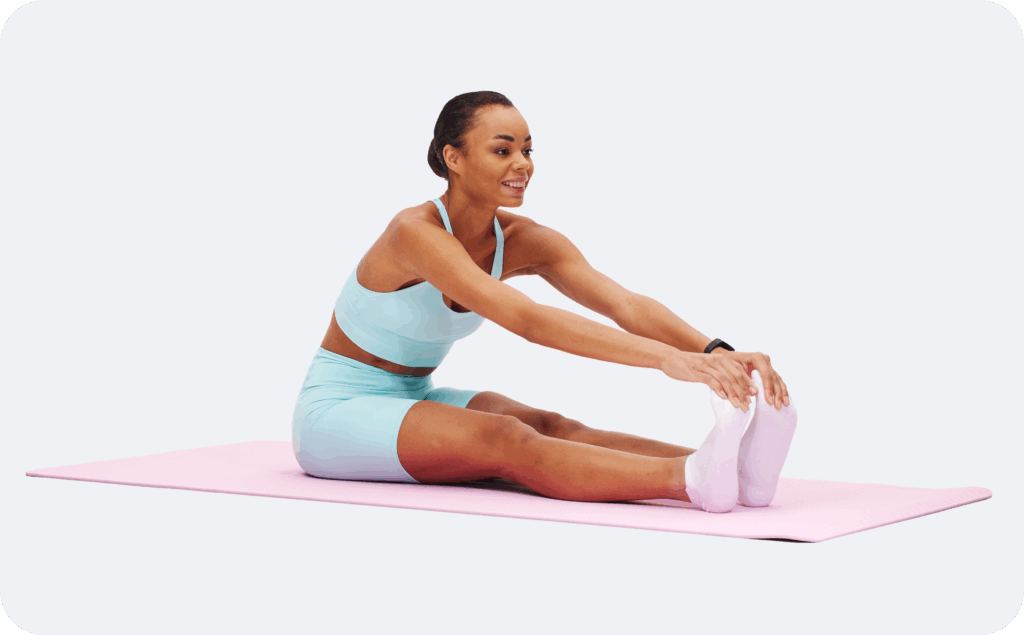
This exercise promotes spinal flexibility and helps release tension in the back, shoulders, and hamstrings. It’s a great way to counteract the effects of sitting for long periods.
- Sit tall on your mat with your legs extended straight in front of you, about shoulder-width apart. Flex your feet.
- Inhale and sit up even taller, imagining your spine lengthening toward the ceiling.
- Exhale as you round your spine forward, starting from the top of your head. Imagine you’re peeling your spine off an imaginary wall behind you.
- Reach forward, keeping your abdominals pulled in. Inhale to stack your spine back up to the starting position, one vertebra at a time.
Saw
The Saw encourages spinal rotation and stretches the hamstrings, hips, and obliques. The twisting motion can feel incredibly liberating for a stiff back.
- Sit tall with your legs extended in a wide “V” shape and your feet flexed. Extend your arms out to the sides at shoulder height, your palms facing forward.
- Inhale and twist your torso to the right.
- Exhale as you round forward, reaching your left hand toward your right little toe. Your back arm reaches behind you with the palm up. Pulse gently three times, as if “sawing” off your toe.
- Inhale to return to the upright, twisted position, and exhale to untwist back to the center. Repeat on the other side.
Seal
The seal is a playful exercise that massages the spine and challenges balance and control. It helps release tension along the entire back.
- Sit on your mat and hug your knees toward your chest. Dive your hands between your knees and grab the outside of your ankles.
- Balance on your sit bones and lift your feet off the floor. Before you roll, clap your heels together three times like a seal.
- Inhale and roll back to your shoulder blades, keeping your curved shape.
- Exhale and roll back up to the starting position, finding your balance. Clap your heels together three times again.
Shoulder Bridge
This exercise strengthens the glutes and hamstrings while opening the hips and chest.
- Lie on your back with your knees bent, your feet flat on the floor hip-width apart, and close enough that you can touch your heels with your fingertips. Your arms should be long by your sides.
- Exhale and press through your feet to lift your hips off the mat, peeling your spine up one vertebra at a time until you form a straight line from your shoulders to your knees.
- Inhale at the top, feeling the stretch across your chest and hip flexors.
- Exhale to slowly roll your spine back down to the mat with control.
Many people find that a guided approach provides the best foundation for exploring Pilates for mental health.
Read more: Morning Pilates Routine for Beginners to Practice at Home
How to Destress Fast Doing Pilates Exercises
A single Pilates session can feel relaxing, but meaningful changes in how you handle stress usually depend on broader habits over time. Integrating Pilates into a broader wellness strategy can amplify its benefits.
Here are some actionable tips to supplement your Pilates practice
- Schedule “Movement Snacks”
You don’t need a full hour to benefit from Pilates. Break up long periods of sitting with 5-10 minute “movement snacks”.
Choose one or two exercises from the destress program, such as the spine stretch or shoulder bridge, and perform them slowly.
This practice interrupts the build-up of physical tension and mental fatigue throughout the day. Set a recurring alarm on your phone to remind you to move every 60-90 minutes.
- Pair Pilates with Mindful Breathing
Before you begin your Pilates routine, spend three minutes focusing solely on your breath.
Lie on your back with one hand on your belly and the other on your chest. Inhale deeply through your nose for a count of four, allowing your belly to rise. Exhale slowly through your mouth for a count of six.
This practice, which is known as diaphragmatic breathing, primes your nervous system for relaxation (11) and enhances the Pilates and meditation aspect of your workout.
- Create a Sensory-Calm Environment
Your environment plays a significant role in your ability to relax.
Before your session, dim the lights, put on some calming, ambient music without lyrics, and silence your phone notifications. This ritual signals to your brain that it’s time to transition from a state of high alert to one of calm focus.
Minimizing external stimuli allows you to turn your attention inward more effectively.
- Keep a Post-Pilates Journal
Immediately after your practice, take five minutes to jot down how you feel physically and mentally.
Use simple prompts: “What tension have I released?” or “What am I feeling now that I wasn’t feeling before?” This habit reinforces the mind-body connection and helps you recognize the tangible Pilates mental health benefits, which can increase your motivation to practice consistently.
Acknowledging these positive shifts strengthens the neural pathways that are associated with relaxation and well-being.
The consistent application of these strategies can also support other wellness goals, and many have found that there are also significant benefits of Pilates for women, including improved core strength and posture (3, 18).
You feel good after Pilates due to a combination of physiological and psychological factors. Regular movement is commonly linked with improved mood and stress regulation. Paired with slow, controlled breathing, the practice may encourage a “rest-and-digest” state and help reduce the sensation of tension in the body (2, 19). The intense focus required also provides a mental break, which leaves you feeling refreshed and clear-headed. Crying during or after Pilates isn’t uncommon and can be a form of somatic release. The practice can help unlock stored physical and emotional tension from the body, particularly from areas such as the hips and psoas muscle, which play a role in how the body responds to stress (20). As this tension is released through movement and breath, it can trigger a corresponding emotional release. Yes, as with many forms of mindful exercise, regular Pilates practice can help regulate and lower cortisol levels in the long term. While any exercise can cause a temporary, acute spike in cortisol, consistent practice may help improve the body’s overall stress response (12). Deep breathing and mindful movement may support stress regulation and can be associated with changes in stress-related hormones, including cortisol, though individual responses vary. Yes, physical activity, including Pilates, can help increase dopamine levels temporarily (21). Dopamine is commonly linked with pleasure, motivation, and reward (22). A sense of accomplishment can feel rewarding and may be associated with short-term shifts in brain chemicals involved in motivation, including dopamine, though individual responses vary. This contributes to the feeling of satisfaction and motivation you may experience after a session. Neither is inherently “better” – they serve different purposes and offer different benefits. The gym is often focused on building strength and cardiovascular endurance through weightlifting and cardio machines (23). Pilates focuses on core strength, flexibility, posture, and the mind-body connection through controlled movements (24). The best choice depends on your personal goals, preferences, and physical needs. Many people find that combining both provides a well-rounded fitness regimen. Both yoga and Pilates are excellent for mental health, and the “better” choice is highly subjective. Both practices emphasize breath, mindfulness, and body awareness. Yoga often incorporates more explicit spiritual and meditative components (25), while Pilates maintains a strong focus on precise physical control and core stabilization (24). The best option is the one you enjoy more and are more likely to practice consistently. Trying a few classes of each can help you decide which modality resonates most with you.Frequently Asked Questions
Why do I feel so good after Pilates?
Why did I cry after Pilates?
Does Pilates release cortisol?
Does Pilates increase dopamine?
Which is better, the gym or Pilates?
Which is better for mental health, yoga or Pilates?
The Bottom Line
Pilates offers more than just a physical workout – it provides a structured path toward integrating your mind and body.
By focusing on breath, precision, and control, you can cultivate a sense of inner calm and resilience that extends far beyond the mat. This practice isn’t a quick fix, but a sustainable tool for managing stress and enhancing your overall well-being.
The key is to approach it with intention and consistency, allowing the principles of Contrology to bring balance to your body and your life.
DISCLAIMER:
This article is intended for general informational purposes only and does not serve to address individual circumstances. It is not a substitute for professional advice or help and should not be relied on for making any kind of decision-making. Any action taken as a direct or indirect result of the information in this article is entirely at your own risk and is your sole responsibility.
BetterMe, its content staff, and its medical advisors accept no responsibility for inaccuracies, errors, misstatements, inconsistencies, or omissions and specifically disclaim any liability, loss or risk, personal, professional or otherwise, which may be incurred as a consequence, directly or indirectly, of the use and/or application of any content.
You should always seek the advice of your physician or other qualified health provider with any questions you may have regarding a medical condition or your specific situation. Never disregard professional medical advice or delay seeking it because of BetterMe content. If you suspect or think you may have a medical emergency, call your doctor.
SOURCES:
- PILATES’ – Return to Life Through Contrology (1945, books.out.csli.me)
- The Pilates method: history and philosophy (2001, academia.edu)
- Physical and psychological benefits of once-a-week Pilates exercises in young sedentary women: A 10-week longitudinal study (2016, pubmed.ncbi.nlm.nih.gov)
- The effects of pilates on mental health outcomes: A meta-analysis of controlled trials (2018, pubmed.ncbi.nlm.nih.gov)
- Effects of Pilates Training on Physiological and Psychological Health Parameters in Healthy Older Adults and in Older Adults With Clinical Conditions Over 55 Years: A Meta-Analytical Review (2021, frontiersin.org)
- Effect of pilates on the physical and mental health of drug-dependent individuals — a randomized controlled trial (2025, link.springer.com)
- Benefits of Pilates on Depression, Anxiety, and Stress: An Observational Study Comparing People Practicing Pilates to Non-Active Controls (2025, pmc.ncbi.nlm.nih.gov)
- Is Pilates effective in improving depressive disorders? A comprehensive overview (2025, journals.lww.com)
- Impact of Pilates on Proprioception: A Review (2025, researchgate.net)
- Proprioception: An Evidence Based Narrative Review (2017, researchgate.net)
- Effects of Diaphragmatic Breathing on Health: A Narrative Review (2020, pmc.ncbi.nlm.nih.gov)
- The effects of exercise intensity on the cortisol response to a subsequent acute psychosocial stressor (2021, sciencedirect.com)
- The effects of physical activity on cortisol and sleep: A systematic review and meta-analysis (2022, sciencedirect.com)
- Role of Physical Activity on Mental Health and Well-Being: A Review (2023, pmc.ncbi.nlm.nih.gov)
- The impact of Pilates exercise for depression symptoms in female patients: A systematic review and meta-analysis (2023, journals.lww.com)
- Effects of Pilates Exercises to Depression and Sleep Quality on the Postpartum Period: A Randomized Controlled Study (2023, dergipark.org.tr)
- The Effects of 12 Weeks Pilates Exercises on Functional and Cognitive Performance in Elderly People (2023, researchgate.net)
- Effects of Pilates on health and well-being of women: a systematic review (2023, link.springer.com)
- Pilates: What Is It? Should It Be Used in Rehabilitation? (2011, pmc.ncbi.nlm.nih.gov)
- Sensations You May Notice When Beginning Your Clinical Somatics Practice (2023, somaticmovementcenter.com)
- Bidirectional Association between Physical Activity and Dopamine Across Adulthood—A Systematic Review (2021, pmc.ncbi.nlm.nih.gov)
- Dopamine: The Neuromodulator of Long-Term Synaptic Plasticity, Reward and Movement Control (2021, pmc.ncbi.nlm.nih.gov)
- The Need for Gym Exercises and the Imminent Benefits (2021, researchgate.net)
- Pilates: how does it work and who needs it? (2011, pmc.ncbi.nlm.nih.gov)
- Exploring the therapeutic effects of yoga and its ability to increase quality of life (2011, pmc.ncbi.nlm.nih.gov)
 Reviewed by
 Reviewed by