

Rest days often bring up more questions than workout days. When it’s time to move, you probably more or less know what to do. However, when it’s time to stop, the questions show up: Do I need to eat less? Does protein change? These are normal questions, and maybe the most useful answer isn’t an exact number, but understanding what’s happening in your body on those days and how to support it. In this article, we’ll go over the most common questions about eating on rest days, so you can find an approach that suits you.
Is It Better to Eat More on Rest Days or Workout Days?
Let’s start with what many people wonder when trying to organize their eating around their workout. The most natural thought would be that the workout day is the one that “deserves” more food, because that is when the body spends more. And there’s some sense to that—on the days you move, your body is using energy more actively, so it’s likely that you need a bit more energy, particularly if your workouts are intense or long (1).
But rest isn’t an “empty” day—it’s quite the opposite! Your body keeps working. Rest supports the body’s response to training, and adequate nutrition remains important on non-training days (2).
So perhaps the most useful thing is not to think in terms of “more or less,” but rather about how your body feels each day. A rest day doesn’t have to be a day of eating less out of obligation, particularly if you work out hard the day before and your body is asking to recover. And if fasting on rest days sounds appealing to you, the same logic applies: it could work, as long as it matches how you feel and not the other way around. Some people feel better eating about the same every day, while others prefer to adjust their macronutrients (carbohydrates, proteins, fats) a little more around their more active days. Both ways can work, and what usually matters most is listening to yourself.
A rest day invites you to think with a little more calm about what suits your body today, what kind of foods, how to spread them out, and in what amount. That is what we’ll explain next.

How Many Calories Should I Eat on a Rest Day?
This is probably the most concrete question, because here, we’re no longer talking about “more or less”, but about numbers.
As a starting point, you could use your own workout days, the amount that already makes you feel good when you’re active. Because, as we mentioned, a rest day doesn’t always change your energy expenditure as much as people tend to think. There might be a slight decrease, but nothing that needs to be drastic. Rest is less intense, and that shows, but it doesn’t have to mean eating noticeably less.
And this is where quality starts to matter more than quantity. When these are the days that help your body recover, what you put on your plate counts, and it’s worth looking at what you put on your plate.
Let’s talk about carbohydrates first, as there could be a lot of advice about carbs on rest days and they tend to be the first thing to disappear from the plate. In part, this makes sense—they’re the energy source you use the least when you’re not moving. However, you shouldn’t cut them out entirely. Complex carbs are what give you that energy that lasts over time, and you need them on rest days too (3) (4). Instead of cutting them out, the idea is to adjust the amount and choose good sources.
Something similar happens with the rest of the plate. Protein supports muscle recovery, healthy fats help everything work properly, and fruits and vegetables round things out (3). None of these groups should be left out just because you’re not training today.
That being said, one important thing is that the exact amount depends on your situation, and there’s no one-size-fits-all answer here. If you have questions, consider asking a nutrition professional for guidance based on your weight, activity, and goals.
Read more: Lifting Weights While Fasting: Benefits And How To

How to Eat on a Rest Day
Once you know that a rest day doesn’t have to mean eating a lot less, the next question is how to put it into practice in a simple way. Because the “how” usually makes more of a difference than the “how much”.
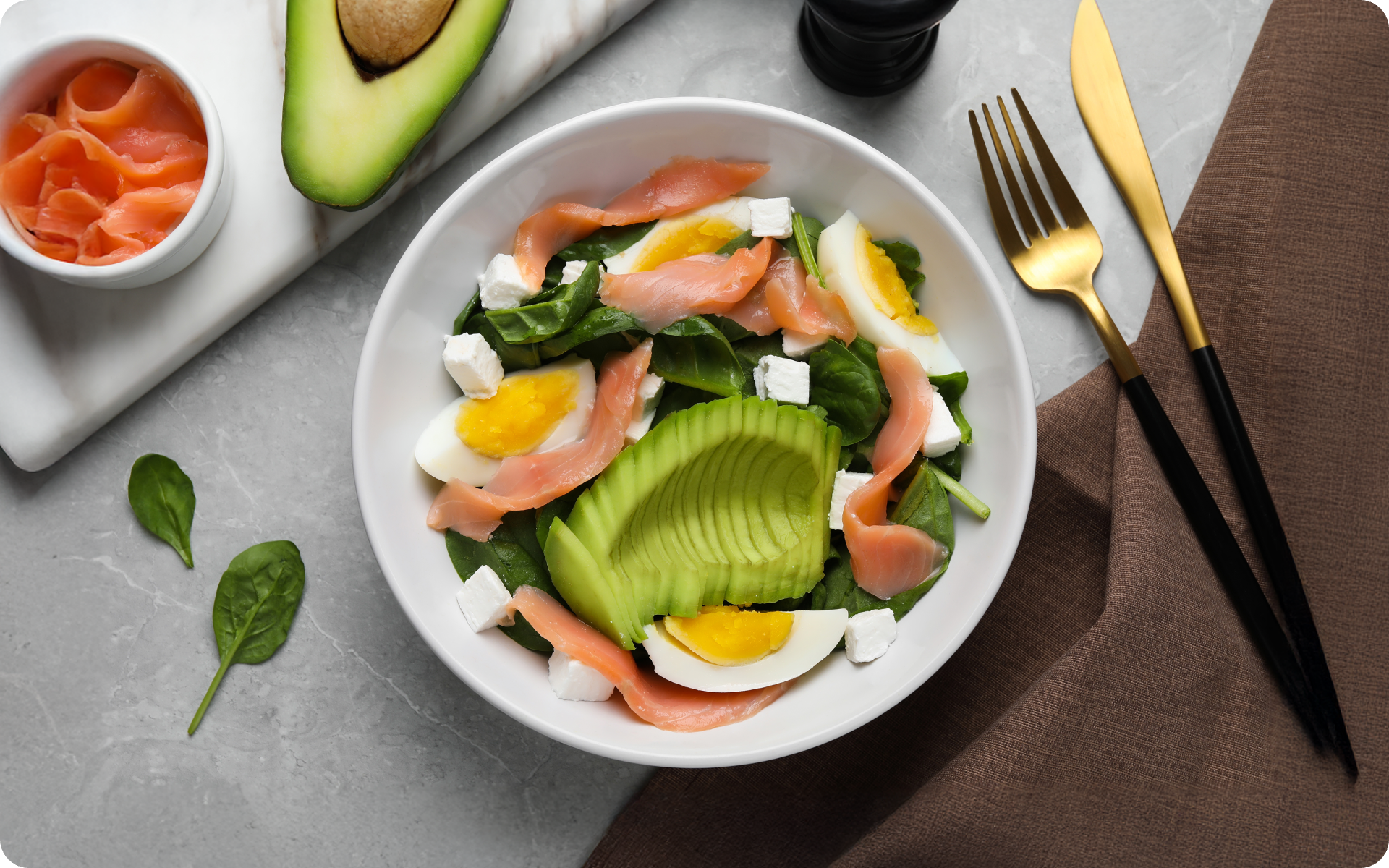
On a rest day, a simple approach is to lean on balanced meals that include all the food groups. Protein can come from options such as eggs, chicken, fish, tofu, legumes, or plain yogurt (5). Carbs come from oats, brown rice, quinoa, potatoes, or whole-wheat bread (6). Healthy fats come from nuts, avocado, olive oil, or seeds (7). And vegetables can be whatever varieties you enjoy, whether in salads, steamed, or sautéed.
One practical option is to keep a meal rhythm similar to the one you already follow. Because when a rest day becomes an excuse to skip meals, it may not support your energy or fullness. On a rest day, it could also be easier to fall into snacking without actually being hungry, perhaps out of habit or simple boredom. This is where paying attention makes a difference—learning to tell real hunger apart from the urge to snack could be more useful than any strict rule (8). It’s what’s known as mindful eating: eating with attention, listening to what your body is asking for in each moment, instead of doing it without thinking.
In short, a rest day doesn’t ask for big gestures or complicated strategies, but for balanced, varied meals that support your body’s recovery. Above all, it’s about balance and listening—eating calmly, enjoying your food, and giving your body just what it needs today.
BetterMe offers a variety of workouts, recipes, challenges, and support tools to help you stay more consistent with your wellness routine. Explore the app to find features that fit your goals, preferences, and schedule.
What Should I Avoid on Rest Days?
If you’ve made it this far, you probably already have one idea in mind: that a rest day isn’t a day to eat less, but a day to keep your usual balance. Even so, there are a few things that are worth paying attention to.
The key is to remember why these rest days matter, as they’re a fundamental part of your progress. As we’ve seen, your body needs time to recover and get stronger.
One of those things could be the idea of “making up for it”. Sometimes the thought appears that as you’re not training today, maybe you “shouldn’t” eat the same. In those moments, it could be easy to skip a meal, when in reality, your body might still be asking for nutrients to recover.
At the other extreme, it could also happen that a rest day gets lived as a kind of “free pass” to eat in a more disordered way. That’s not the idea either—it’s about keeping a balance similar to your usual days, neither restricting nor losing control, but continuing to take care of what you put on your plate with the same ease as always.
Something else that sometimes goes unnoticed is hydration. As there’s no workout to remind you of it, it can be easier to forget to drink water throughout the day on a rest day, and your body still needs it just the same. Keeping a bottle handy or including teas or water with a bit of flavor could be a simple way to remember to drink.
Read more: Intermittent Fasting with a Morning Workout: How to Build a Sustainable Schedule

Should I Eat 100g of Protein on Rest Days?
100 grams of protein a day is a total that comes up often. It sounds good, round, easy to remember, and maybe that’s why it sticks. But it isn’t a fixed amount that works for everyone and is more of a rough reference point.
As we’ve seen, protein on rest days still matters. Your body doesn’t stop working when you’re not training, and that’s where rest days for muscle growth come into play. Muscles repair and rebuild, and this process needs nutrients, protein included.
Protein needs are often estimated in grams per kilogram of body weight and adjusted for activity level, age, goals, and individual circumstances. Using the article’s broad reference range of 0.8 to 1.5 grams per kilogram per day, a 70 kg adult would calculate approximately 56 to 105 grams, while a 60 kg adult would calculate approximately 48 to 90 grams. These figures are general estimates rather than individual recommendations (9).
Does your protein intake need to change on rest days? As we’ve seen, it might not need much adjusting, or it might, depending on how demanding your workout was and how you spread your meals across the day. What usually matters more isn’t the exact number, but that your intake is adequate and well distributed. In any case, these are rough figures—everyone is different, so if you have doubts, the wisest thing is to have a nutrition professional guide you based on your own situation.
Finally, let’s remember where to find it. Protein can come from animal sources, such as eggs, chicken, turkey, fish, seafood, lean meats, plain yogurt, or fresh cheese, and also from plant sources, such as legumes (lentils, chickpeas, beans), tofu, tempeh, edamame, seitan, nuts, and seeds. Even grains such as quinoa or oats contribute some protein, although it’s in smaller amounts (5). Having several sources on hand makes reaching that figure easier, without relying on a single food.

Is 2 Rest Days in a Week Too Much?
For many people, 2 rest days a week could be just what the body needs. But as with almost everything in nutrition and training, it depends.
Remember: rest isn’t time off from training, it’s part of it. It doesn’t have to mean spending the day on the couch, either! An active rest day (a walk, some stretching, or gentle mobility) could keep you moving while still letting your body recover. Movement and recovery don’t cancel each other out (10). If you train with intensity, 2 rest days could make the difference and improve recovery and progress.
What matters is listening to how you feel. Most of the time, this means a simple rest day here and there. Persistent fatigue, poor sleep, or workouts that repeatedly feel unusually difficult may indicate that your schedule needs adjustment. Consider reducing training temporarily and consulting a qualified professional if these concerns continue.
Workouts, weight management tools, and recipe ideas come together in the BetterMe: Health Coaching app, giving you practical support for building a more consistent wellness routine.

FAQs
Do muscles grow on rest days?
On rest days, your muscles still have work to do, even if you’re not pushing them with workouts. Training provides a stimulus, while rest and adequate nutrition support the body’s adaptation process. This is why we keep saying that these days aren’t lost time, but just one more part of training.
Do you need protein on rest days?
Protein on rest days still matters a lot because your body doesn’t stop working when you’re not training, and that work requires nutrients. Instead of thinking about a number, it usually works better to keep it present throughout the day, in each meal. In this way, your intake supports recovery without you having to count every gram.
Do you need carbs on rest days?
Carbs on rest days don’t need to disappear from your plate. Your body still uses them for basic functions. The key is more about quality than quantity. The idea is to adjust the portion a little if needed, and choose good sources, rather than cutting them out completely.
Should I eat less on rest days?
There’s no need to eat less on rest days just because you’re not training, but it’s an idea that comes up often. There may be a small adjustment, but it doesn’t need to be a big difference, and it will depend a lot on each individual case. What usually matters more is to keep a balance that’s similar to your usual days and listen to how you feel on those days.
Do you get hungrier on rest days?
Hunger on rest days could feel different, and it doesn’t always follow the same pattern. Some people feel like eating a bit more than usual, while others barely notice any change. It’s difficult to say what’s behind it in each case, because many things come into play at once and it doesn’t work in the same way for everyone. Perhaps the most useful thing is to listen to that feeling calmly and see what it’s asking for that day.
The Bottom Line
Rest days aren’t a pause in the way you eat—they should be part of the same rhythm. On workout days, you give your body a reason to adapt, while on rest days, you give it the room to do so. This is why eating on those days doesn’t need to look that different from any other: protein still matters, carbs still have their place, and meals shouldn’t lose their balance. Rest days are an important part of the process, and the habits you keep on those days matter just as much as the ones you keep on your workout days.
DISCLAIMER:
This article is intended for general informational purposes only and does not serve to address individual circumstances. It is not a substitute for professional advice or help and should not be relied on for making any kind of decision-making. Any action taken as a direct or indirect result of the information in this article is entirely at your own risk and is your sole responsibility.
BetterMe, its content staff, and its medical advisors accept no responsibility for inaccuracies, errors, misstatements, inconsistencies, or omissions and specifically disclaim any liability, loss or risk, personal, professional or otherwise, which may be incurred as a consequence, directly or indirectly, of the use and/or application of any content.
You should always seek the advice of your physician or other qualified health provider with any questions you may have regarding a medical condition or your specific situation. Never disregard professional medical advice or delay seeking it because of BetterMe content. If you suspect or think you may have a medical emergency, call your doctor.
SOURCES:
- Eating and Exercise: 5 Tips to Maximize Your Workouts (2023, mayoclinic.org)
- Nutrition and Muscle Recovery (2021, pmc.ncbi.nlm.nih.gov)
- From Food Supplements to Functional Foods: Emerging Perspectives on Post-Exercise Recovery Nutrition (2024, pmc.ncbi.nlm.nih.gov)
- The 4R’s Framework of Nutritional Strategies for Post-Exercise Recovery: A Review with Emphasis on New Generation of Carbohydrates (2020, pmc.ncbi.nlm.nih.gov)
- Physiology, Proteins (2023, ncbi.nlm.nih.gov)
- Physiology, Carbohydrates (2023, ncbi.nlm.nih.gov)
- Dietary Fat, Blood Lipids, and Coronary Artery Disease Risk: A Review of the Evidence (2026, pubmed.ncbi.nlm.nih.gov)
- ‘Am I really hungry?’ A qualitative exploration of patients’ experience, adherence and behaviour change during hunger training: a pilot study (2019, pubmed.ncbi.nlm.nih.gov)
- Protein for Life: Review of Optimal Protein Intake, Sustainable Dietary Sources and the Effect on Appetite in Ageing Adults (2018, pmc.ncbi.nlm.nih.gov)
- Effectiveness of Recovery Strategies After Training and Competition in Endurance Athletes: An Umbrella Review (2024, pmc.ncbi.nlm.nih.gov)

 Reviewed by
 Reviewed by