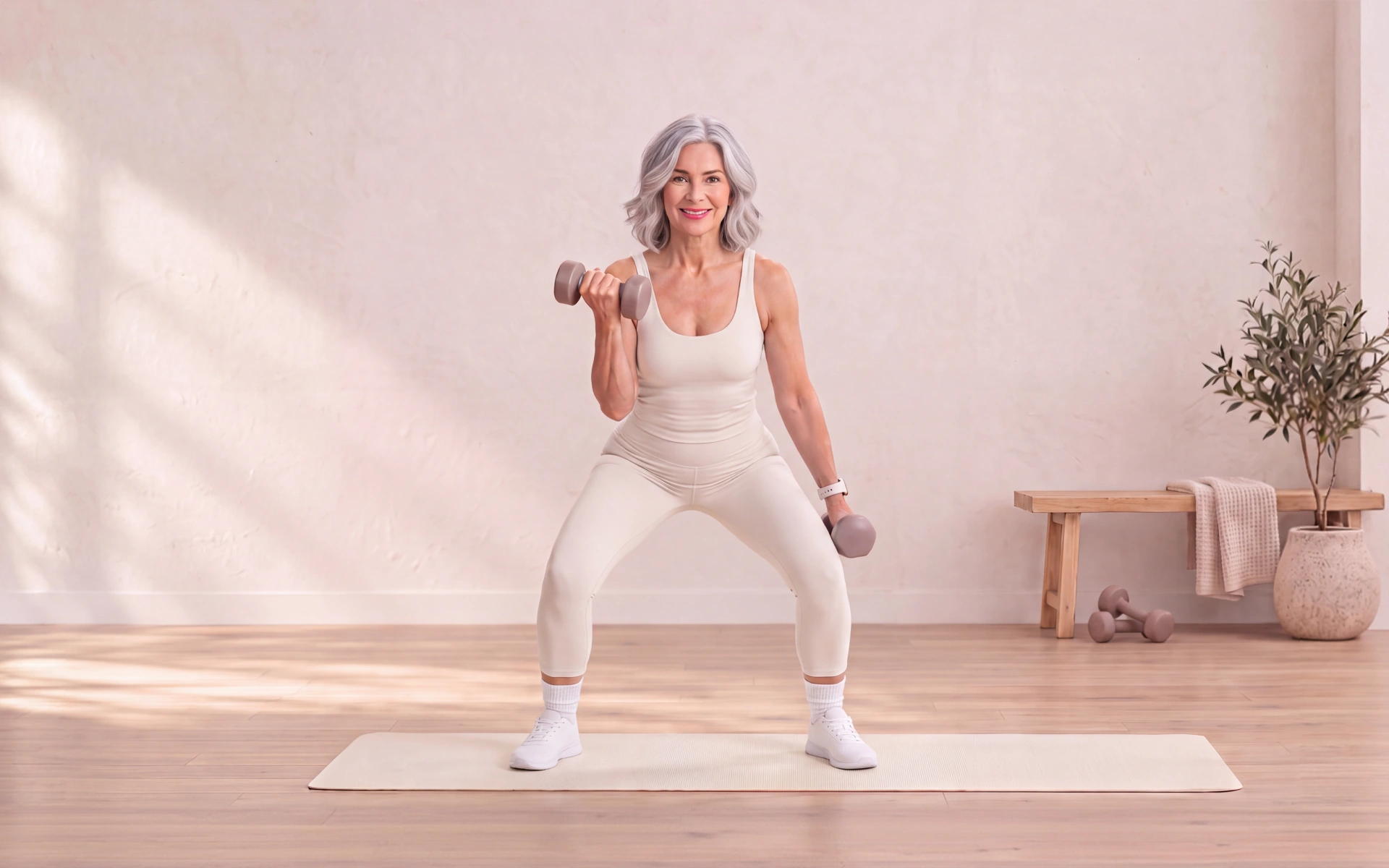
A HIIT workout for seniors alternates harder effort with easier recovery and may support aerobic fitness in selected older adults (1). Suitability depends on medical circumstances, activity history, and the movement used. Low-impact walking or cycling can be adapted, but this guide cannot establish whether vigorous intervals are appropriate for an individual.
Intervals alternate a harder phase with rest or easier movement. Low impact and low intensity differ: seated cycling can still require vigorous effort.
This guide includes sample routines, checked timings, and ways to adjust the work periods. Start with movements you can already control. Our strength exercises for older adults guide covers resistance movements that can be considered separately from the interval sessions.
If you have joint, muscle, or spine-related concerns, please consult your physician before starting this workout.
Key takeaways
- HIIT may support aerobic fitness in selected older adults, but research does not establish an optimal individual prescription (1).
- Vigorous aerobic activity is commonly rated 7 or 8 on a 0-to-10 effort scale, while moderate activity is 5 or 6 (2).
- General older-adult guidance includes at least 150 moderate or 75 vigorous aerobic minutes weekly, plus strengthening and balance activities (2).
- The first sample session totals 27 minutes with four rounds, or 30 minutes when the fifth round is included.
- The second sample totals 30 minutes, including three harder minutes across six rounds.
- The resistance-training statement recommends selecting and progressing loads individually; it does not supply one dumbbell weight for every reader (3).
- Daily easy activity and vigorous interval sessions are different choices; the editorial sample spaces harder sessions apart.
Should a 70-year-old do HIIT?
Some 70-year-olds may consider HIIT with an appropriate activity base and professional guidance where needed. Feeling steady or tolerating a walk does not establish clearance for vigorous intervals.
Useful planning questions include:
- What activity can I already perform consistently?
- How long do I need to recover after moderate exercise?
- What support do I need to move steadily?
- Have I experienced chest discomfort, dizziness, or unusual breathlessness during activity?
These questions provide context for a professional discussion. They are not a yes-count test or a substitute for individual assessment. Any concerning exertional experience should be addressed before vigorous intervals.
A clinician can assess medical concerns and restrictions. Stop for chest discomfort, faintness, or unusual breathlessness, and seek prompt help for severe or persistent symptoms.
A review of older-adult intervention studies found the clearest improvements in cardiorespiratory fitness, or the capacity to support aerobic activity (1). Results varied by program and participants. The review did not establish an optimal prescription or comparative safety.
Older-adult guidance includes aerobic, strength, and balance activities (4). A beginner HIIT workout for seniors is one possible component; moderate intervals may be more appropriate.
Read more: 6 Bodyweight Exercises for Seniors to Build Muscle and Improve Strength
How do you do a HIIT workout as a senior?
You do a HIIT workout as a senior by alternating short bursts of harder effort with longer easy recovery, using low-impact movement.
Adjust effort, interval duration, and recovery separately. Keep the movement controlled throughout the work period.
Start with low-impact modes that feel steady:
- Brisk or incline walking
- Stationary or recumbent cycling
- Elliptical work
- Pool-based movement
These formats avoid jump landings, but demands vary with pace, resistance, and balance. Low impact alone does not establish suitability for vigorous exercise.
Vigorous activity makes it difficult to say more than a few words without pausing for breath (2). Keep recovery easier before another work period.
Vigorous aerobic effort is commonly 7 or 8 on a 0-to-10 scale; moderate effort is 5 or 6 (2). These describe intensity, not individual clearance.
This HIIT workout for seniors at home is an editorial example using walking or cycling. It totals 27 minutes for four rounds, or 30 minutes with the optional fifth round. Ten minutes of preparation and five minutes to finish are included.
| Exercise | Sample effort | Impact level | Equipment |
|---|---|---|---|
| Air-bike intervals | High | Low | Air bike |
| Phase | What to do | Time | Effort (0-10) |
| Warm-up | Easy walking or cycling | 10 mins | 3-4 |
| Interval 1-4 | 1 min brisk, 2 mins easy | 12 mins | 7-8 hard/3 easy |
| Optional round | 1 min brisk, 2 mins easy | 3 mins | 7-8 hard/3 easy |
| Cool-down | Easy walking, light stretching | 5 mins | 2-3 |
The four or five rounds include four or five harder minutes. Each round includes its two-minute recovery; shorten the work or use moderate effort as needed.
Keep a few pointers in mind:
- Begin at an easy pace before increasing effort.
- Stop an interval if your form slips.
- Finish the work period while your movement remains controlled.
- Rest fully between hard efforts.
Record the format and recovery afterward. Change one variable at a time so you can assess the response.
Workouts, weight management tools, and recipe ideas come together in the BetterMe: Health Coaching app, giving you practical support for building a more consistent wellness routine.
What can an interval workout plan for older adults include?
An interval workout plan can combine aerobic sessions with strength and balance work. Moderate intervals use manageable changes in pace; HIIT uses vigorous work periods. The weekly example below includes two interval days, but its frequency is an editorial choice rather than a requirement.
Interval-day totals include ten preparation and five finishing minutes. Monday’s four rounds add twelve interval minutes; Friday’s five shorter rounds add ten. Adapt the dose to your capacity.
| Exercise | Sample effort | Impact level | Equipment |
|---|---|---|---|
| Air-bike intervals | High | Low | Air bike |
| Day | Focus | Details | Duration |
| Monday | Interval session | 4 rounds: 1 min brisk, 2 mins easy | 27 mins |
| Tuesday | Easy movement | Relaxed walk | 20-30 mins |
| Wednesday | Strength | Full-body basics, light load | 25-30 mins |
| Thursday | Rest or mobility | Gentle stretch, balance drills | 15-20 mins |
| Friday | Interval session | 5 rounds: 30 secs brisk, 90 secs easy | 25 mins |
| Saturday | Strength | Full-body basics, light load | 25-30 mins |
| Sunday | Rest | Light walk if desired | Optional |
This sample has two interval days and two resistance days. General older-adult guidance includes strengthening and balance activities as well as aerobic work (4). The full-body HIIT workout for seniors does not replace a separately planned resistance routine.
Choose weights according to technique and capacity. The resistance-training statement emphasizes individualization and progression, not one pound range for every reader (3).
This sample strength-and-movement circuit is not a complete resistance prescription. Sets and rests are editorial examples; the standing march is a movement drill.
| Exercise | Sample effort | Impact level | Equipment |
|---|---|---|---|
| Air-bike intervals | High | Low | Air bike |
| Exercise | Sets | Reps | Rest |
| Chair sit-to-stand | 2 | 8-12 | 45-60 secs |
| Wall push-up | 2 | 8-12 | 45-60 secs |
| Standing dumbbell row | 2 | 8-12 | 45-60 secs |
| Heel raise | 2 | 10-15 | 30-45 secs |
| Standing march | 2 | 20 steps | 30-45 secs |
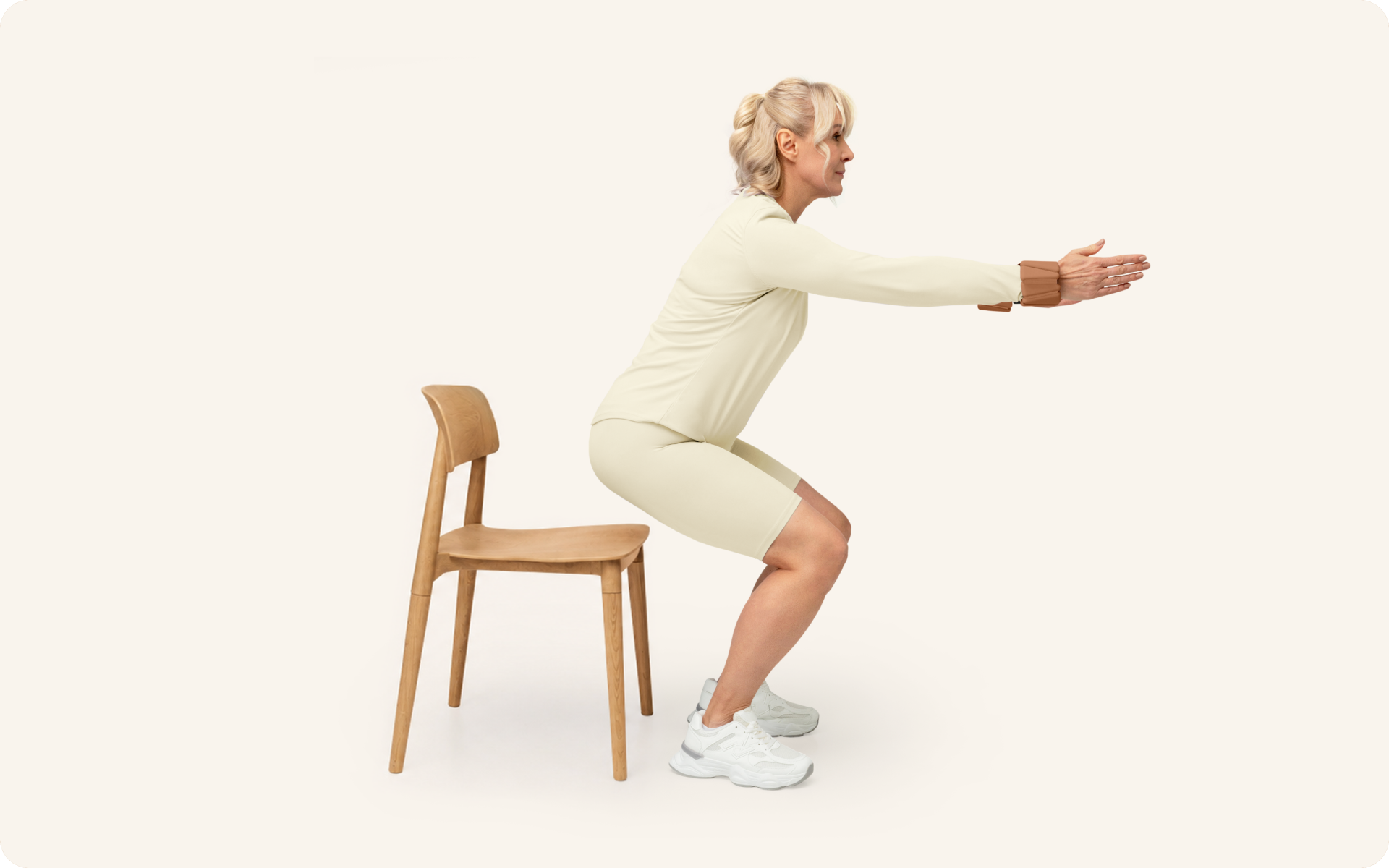
Chair sit-to-stand
- Sit tall near the front of a sturdy chair.
- Place your feet flat, about hip-width apart.
- Press through your heels to stand fully.
- Lower slowly back to the seat with control.
Wall push-up
- Stand an arm’s length from a wall.
- Place your hands slightly wider apart than your shoulders.
- Bend your elbows to bring your chest toward the wall.
- Push back to the start, keeping your body in a line.
Standing dumbbell row
- Hold a light dumbbell in each hand.
- Hinge forward slightly at the hips, back flat.
- Pull the weights toward your ribs, keeping your elbows close.
- Lower the dumbbells with control.
Read more: HIIT Workouts at Home Without Equipment: Your Complete Guide
Heel raise
- Stand tall, holding a counter for support.
- Rise onto the balls of your feet.
- Pause briefly at the top.
- Lower your heels slowly to the floor.
Standing march
- Stand tall near support if needed.
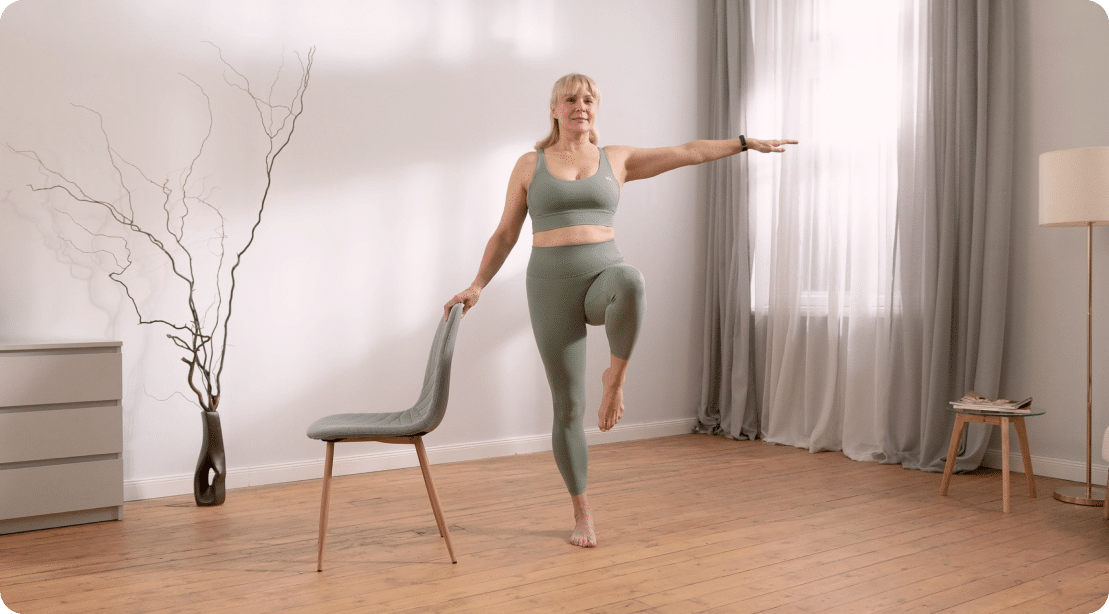
- Lift one knee to a comfortable height.
- Lower the raised foot to the floor.
- Alternate knee lifts at a controlled rhythm.
Our low-impact cardio workout guide covers other formats. Keep strength progression separate from the interval timer, and seek guidance for unfamiliar movements.
How many minutes a week should a 70-year-old exercise?
Older-adult guidance includes at least 150 moderate or 75 vigorous aerobic minutes weekly, or an equivalent combination (2). Strength and balance activities are also included. Warm-up, easy recovery, and finishing minutes do not automatically count as vigorous time.
Approximately one vigorous minute counts like two moderate minutes (2). A 30-minute interval session therefore does not necessarily contribute 30 vigorous minutes.
Older-adult guidance includes strengthening on at least two days weekly and balance activities (4, 2). The chosen movements and supports should fit ability.
The table separates general guidance from this article’s sample interval frequency.
| Exercise | Sample effort | Impact level | Equipment |
|---|---|---|---|
| Air-bike intervals | High | Low | Air bike |
| Activity type | Suggested amount | Example | |
| Aerobic activity | At least 150 moderate or 75 vigorous mins/week, or equivalent mix | Walking, cycling, intervals | |
| Interval sessions | Sample: 1 or 2 days | 27 or 30 mins in first example | |
| Strength training | 2+ days/week | Full-body basics | |
| Balance and mobility | Include appropriate balance practice | Stretch, march, stand drills |
If you feel run-down, use easier movement or rest. Reassess the work/recovery periods before increasing effort.
Our treadmill HIIT workout guide gives machine-based examples. Adapt speed and incline, and learn the stopping controls before starting.
What is a disadvantage of HIIT training for seniors?
A disadvantage of HIIT training for seniors is the higher effort per minute, which some people find to be hard on comfort and recovery.
Consider these trade-offs:
- Harder effort can feel unpleasant for some people.
- Poor exercise intensity choice may raise strain on joints or muscles.
- It’s easy to overshoot intensity when you’re new to it.
- It may not suit as a first step for those who are returning after a long break.
The older-adult review describes varied adverse-event reporting across the included studies (1). This limits what can be concluded about comparative safety or an individual’s risk. Supervision and participant selection also affect how research findings apply to unsupervised exercise.
You can lower these downsides with smart choices:
- Pick low-impact modes over jumping or sprinting.
- Progress slowly rather than all at once.
- Keep hard efforts vigorous, not maximal.
- Build a base of easy activity first.
Both approaches improved aerobic fitness in the cited review, with larger pooled gains after HIIT (5). This concerns one measured outcome, not every goal.
Persistent discomfort is a reason to reduce the load and seek advice as needed. Check technique and interval structure before adding effort.
How can seniors make HIIT workouts easier?
Seniors can make HIIT workouts easier by shortening hard intervals, extending recovery, and choosing gentler movement modes.
Try these adjustments to soften the load:
- Swap running for cycling or incline walking.
- Cut hard intervals to 20-30 seconds.
- Stretch recovery to 90 seconds or longer.
- Do only 3-4 rounds instead of 6-8.
- Limit interval days to 1-2 per week.
This editorial example uses short work periods and longer recoveries. Its total is 30 minutes; use moderate effort if vigorous work is inappropriate.
| Exercise | Sample effort | Impact level | Equipment |
|---|---|---|---|
| Air-bike intervals | High | Low | Air bike |
| Phase | What to do | Time | |
| Warm-up | Easy walking or cycling | 10 mins | |
| Intervals | 6 rounds: 30 secs brisk, 90 secs easy | 12 mins | |
| Cool-down | Easy walking, light stretching | 8 mins |
Six rounds total twelve minutes, including final recovery. Ten preparation and eight finishing minutes make 30 overall, with three harder minutes.
A few more comfort tips can help:
- Train on nonconsecutive days for better recovery.
- Use a recumbent bike if balance feels tricky.
- Avoid slippery surfaces and very hot rooms.
- Stop before your form starts to fade.
Nutrition, hydration, sleep, and appropriate easy activity contribute to exercise rest. The professional guide discusses broad recovery practices, not a precise individual HIIT dose (6).
Read our HIIT for beginners guide for interval structure. The HIIT calories burned article discusses estimates, which should not be treated as individual predictions.
Whether you’re just starting your fitness journey or looking to add more structure to your routine, BetterMe offers tools that can support different wellness goals. Explore the app and see how its workout, nutrition, and habit-building features can fit into your lifestyle.

FAQs
Should seniors exercise daily?
Yes, daily movement can include easier activities such as walking or appropriate balance practice. Vigorous intervals are a separate choice, and the sample here spaces them apart with easier days.
Is HIIT too hard on the heart?
HIIT increases cardiovascular demands, and this article cannot establish whether that effort fits your medical circumstances. Discuss vigorous activity with a qualified professional when concerns apply. Stop for concerning exertional experiences and seek prompt help for severe or persistent symptoms.
Is HIIT better than cardio?
HIIT is a form of cardio; the useful comparison is with continuous moderate exercise. Both improved aerobic fitness in the cited review, while HIIT had larger pooled gains in that measured outcome (5). Other goals and individual suitability need separate consideration.
Is 30 minutes of HIIT a day enough?
A 30-minute session includes preparation, recovery, and finishing. These examples contain three to five harder minutes and are not scheduled daily. Easy activity and vigorous intervals place different demands on recovery.
Which strength exercises may suit a 70-year-old?
Chair sit-to-stands, wall push-ups, and supported resistance movements are options depending on capacity. Guidance emphasizes individual selection and progression (3). The circuit is an example, not a ranking.
The bottom line
Choose an appropriate mode and checked session timing. Adapt the sample to current capacity, seeking professional guidance when concerns apply. Keep strength and balance in the wider routine.
DISCLAIMER:
This article is intended for general informational purposes only and does not serve to address individual circumstances. It is not a substitute for professional advice or help and should not be relied on for making any kind of decision-making. Any action taken as a direct or indirect result of the information in this article is entirely at your own risk and is your sole responsibility.
BetterMe, its content staff, and its medical advisors accept no responsibility for inaccuracies, errors, misstatements, inconsistencies, or omissions and specifically disclaim any liability, loss or risk, personal, professional or otherwise, which may be incurred as a consequence, directly or indirectly, of the use and/or application of any content.
You should always seek the advice of your physician or other qualified health provider with any questions you may have regarding a medical condition or your specific situation. Never disregard professional medical advice or delay seeking it because of BetterMe content. If you suspect or think you may have a medical emergency, call your doctor.
SOURCES:
- Effects of High-Intensity Interval Training in Older Adults: A Systematic Review of Randomized and Non-Randomized Intervention Studies (2026, mdpi.com)
- What Counts as Physical Activity for Older Adults (2025, www.cdc.gov)
- Resistance Training for Older Adults: Position Statement From the National Strength and Conditioning Association (2019, nsca.com)
- International Exercise Recommendations in Older Adults (ICFSR): Expert Consensus Guidelines (2021, sciencedirect.com)
- The effect of high-intensity interval training and moderate-intensity continuous training on cardiorespiratory function in healthy elderly individuals: Systematic review and meta-analysis (2026, pmc.ncbi.nlm.nih.gov)
- Recovery That Keeps You in the Game (2025, acsm.org)
 Reviewed by