
A 5-minute HIIT workout can add a short interval block to a busy day, but its value depends on effort and the wider routine. Research on varied HIIT protocols does not establish this sample as a complete exercise program (1). Preparation, a gradual finish, and recovery still need time outside the five-minute block.
HIIT alternates harder work with easier recovery. It describes effort, not one required exercise. Walking, cycling, and bodyweight movements can use intervals at different intensities.
This guide covers sample timings, energy-use limits, and scheduling choices. For a longer structure, see our 30-minute HIIT workout for beginners guide. The examples here are editorial samples; keep unfamiliar movements separate from a timed routine until you can perform them with control.
Following exercise and diet plans is the key in your fitness journey and greatly impacts results. In 4 weeks users can typically expect to lose not more than 1-2 lbs per week. Individual results may vary.
Key takeaways
- The sample five-minute circuit contains ten 20-second work periods and ten 10-second recoveries, including the final rest.
- Preparation and finishing time sit outside the five-minute block; warm-up and cool-down guidance commonly uses five to ten minutes (2).
- Research reports aerobic-fitness benefits across varied HIIT protocols but does not validate every five-minute routine (1).
- General adult guidance includes at least 150 moderate or 75 vigorous aerobic minutes weekly, plus strengthening on at least two days (3).
- The twelve-week treadmill trial compared approximately 35-minute HIIT with 46.5-minute continuous sessions, not five-minute workouts (4).
- This sample does not establish a fixed calorie total or an individual fat-loss timeline.
- The sample week contains two harder interval days, with easier activity or rest between them.

Is a 5-minute HIIT workout effective?
Reviews study varied HIIT protocols, participants, and doses (5, 1). They do not validate this sample as a complete program or establish five minutes as a universal minimum effective dose.
Reviews report aerobic-fitness improvements after repeated HIIT training (1). They do not establish equivalent effects from a single short session or every five-minute circuit.
Harder-work time and full session time differ. Preparation, recoveries, and finishing need to remain visible when comparing routines.
A five-minute block can provide:
- A defined period of activity that fits a limited time slot
- Practice using a work-and-recovery timer
- A starting structure that can be adapted without a fixed result timeline
Its limits also matter:
- It does not establish a predictable fat-loss outcome.
- It does not replace the broader activity components in general guidance (3).
- It does not establish one calorie total for every person.
For a 5-minute HIIT workout for beginners, choose movements that you can control before increasing pace. Extend the recovery when needed, even if that makes the block longer. Moderate intervals may be a more appropriate starting format than vigorous work.
Our bodyweight HIIT workout guide covers exercise selection. Practice unfamiliar movements separately before using a timer.
Read more: High Intensity, Low Impact Workouts: The Ultimate Guide for Beginners

What are some examples of 5-minute HIIT exercises?
Walking, cycling, and suitable bodyweight movements are options. A 5-minute HIIT workout at home still requires an appropriate effort and recovery pattern; short duration does not establish beginner suitability.
These sample structures total five minutes including every recovery. The 20/10 pattern has short rests. Extend recovery or lower effort when needed, even if the block becomes longer.
These are editorial timing examples. Add preparation and a gradual finish outside the five-minute block.
| Routine type | Sample structure | Equipment | Suits |
|---|---|---|---|
| Bodyweight burst | 20s work/10s rest × 10 | None | People familiar with the chosen movements |
| Cardio intervals | 30s hard/30s easy × 5 | None or jump rope | A cardio-focused interval block |
| Weighted circuit | 40s work/20s rest × 5 | Light dumbbells | Adding resistance |
| Low-impact flow | 30s work/30s rest × 5 | None | People choosing movements without jump landings |
For a 5-minute HIIT workout without equipment, choose familiar movements. The jumping circuit requires controlled landings and floor transitions; walking or marching intervals offer a simpler movement pattern.
A 5-minute HIIT workout with weights adds an external load. Choose it according to technique and capacity, rather than a fixed pound range.
This is a sample for people already familiar with the movements, not a required beginner circuit. Ten 20-second work periods with ten 10-second recoveries total five minutes, including the final rest. Add five to ten minutes of gradual preparation and finishing where appropriate (2).
| Round | Exercise | Work | Rest |
|---|---|---|---|
| 1 | High knees | 20s | 10s |
| 2 | Squat jumps | 20s | 10s |
| 3 | Mountain climbers | 20s | 10s |
| 4 | Skaters | 20s | 10s |
| 5 | Burpees | 20s | 10s |
| 6-10 | Repeat rounds 1-5 | 20s | 10s |
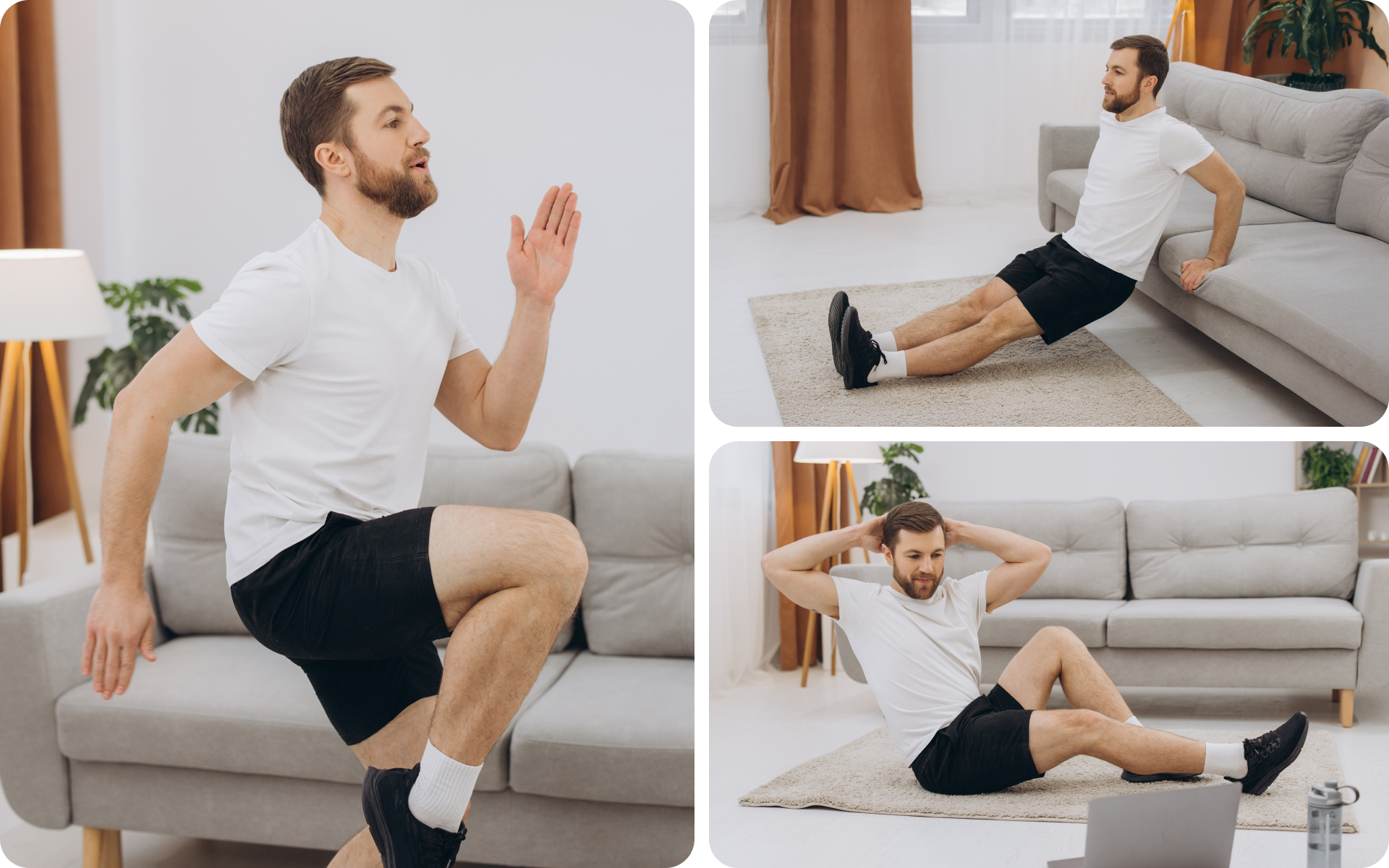
High knees
- Stand tall with your feet hip-width apart.
- Lift one knee toward hip height.
- Switch quickly to the other knee.
- Pump your arms as you jog in place.
- Keep a steady, controlled rhythm.
Squat jumps
- Start with your feet shoulder-width apart.
- Lower into a squat, your hips back.
- Push through your feet and jump up.
- Land softly with bent knees.
- Reset and repeat.
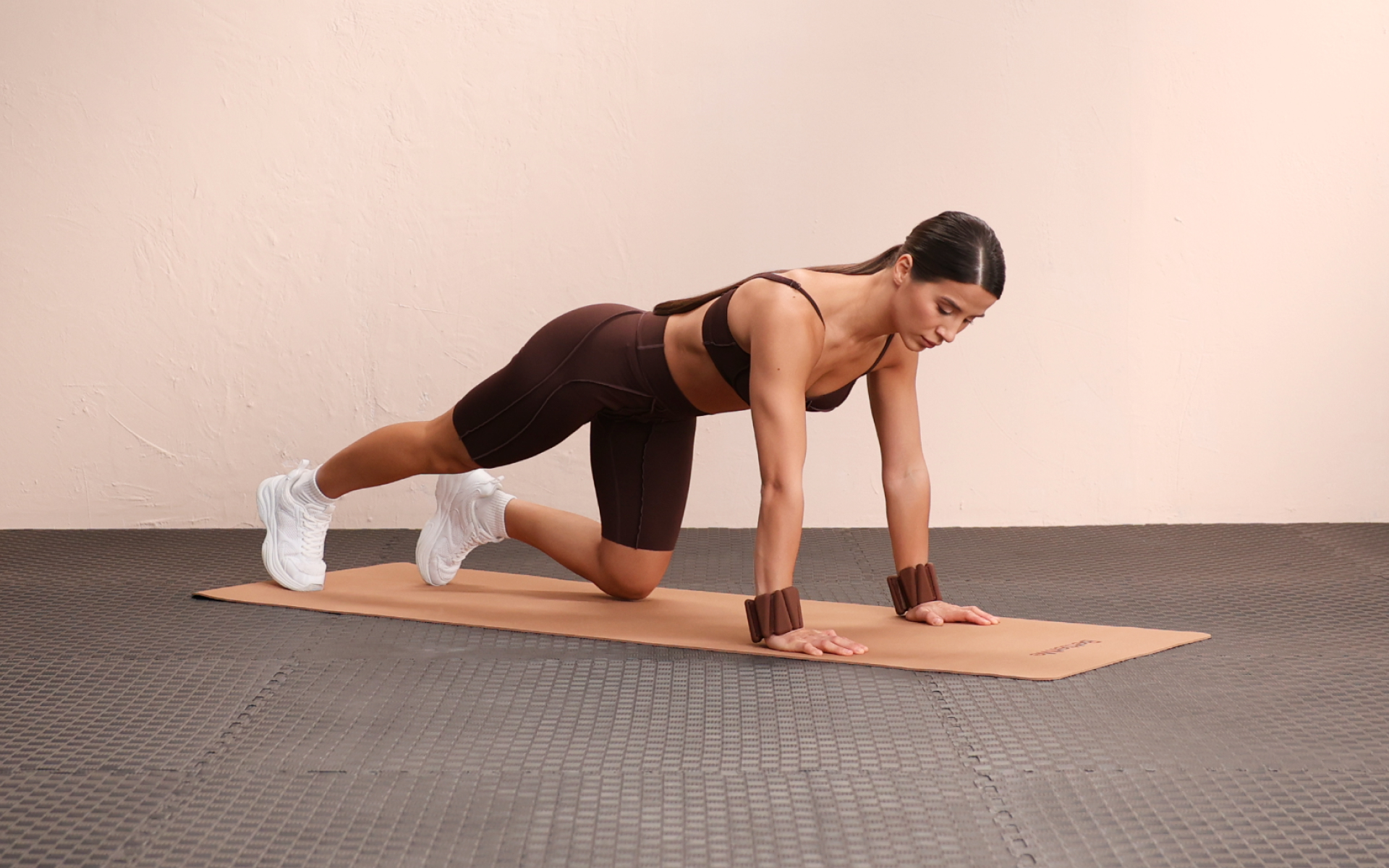
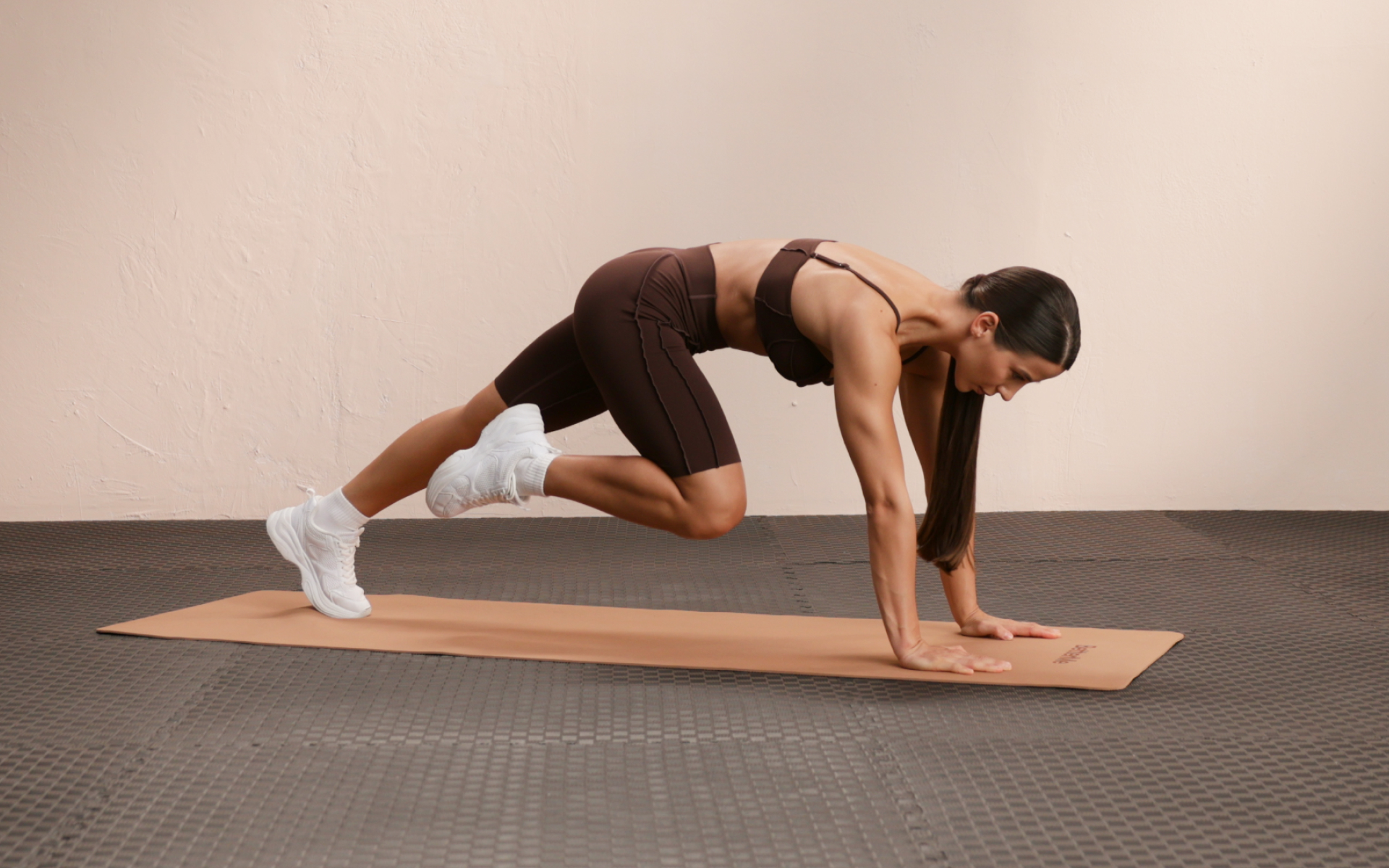
Mountain climbers
- Begin in a high plank position.
- Keep your hands under your shoulders.
- Drive one knee toward your chest.
- Switch legs in a running motion.
- Keep your hips low and level.
Skaters
- Stand on one leg, your knee slightly bent.
- Leap sideways onto the other leg.
- Let the trailing leg cross behind.
- Swing your arms for balance.
- Bound side to side with control.
Burpees
- Begin the burpee by lowering into a squat.
- Place your hands on the floor.
- Hop your feet back into a plank.
- Jump your feet back toward your hands.
- Return to standing with control.
For a 5-minute low-impact workout, replace high knees with marching, squat jumps with controlled squats, and skaters with side steps. An elevated plank knee drive or standing knee lift can replace a floor mountain climber. Step back one foot at a time in the burpee, or omit the floor transition. Choose only substitutions you can perform with control.
Workouts, weight management tools, and recipe ideas come together in the BetterMe: Health Coaching app, giving you practical support for building a more consistent wellness routine.
How many calories does a 5-minute HIIT workout burn?
This sample establishes no reliable calorie total. Body mass, movement, effort, and recovery affect energy use. A twenty-minute study cannot substantiate frame-specific five-minute ranges without a supported calculation.
Use the table to understand what affects an estimate rather than treating body frame as a calorie category.
| Estimate factor | Why it changes the estimate |
|---|---|
| Body mass | Mass alone does not define pace, effort, or technique. |
| Work and recovery | Both phases contribute to elapsed time; intensity differs. |
| Movement and effort | Different modes and resistance settings use different amounts of energy. |
A timer is not a calorie measurement. Treat a device estimate as an estimate, and avoid raising intensity simply to reach an arbitrary number.
One experiment in twelve trained males found different post-exercise oxygen responses after isocaloric protocols (6). This acute result does not establish long-term fat loss or this sample’s energy cost.
Fit the block into a wider activity routine. Other days can include longer aerobic or strength sessions; general guidance covers those broader components (3).
Is 5 minutes of HIIT a day enough?
Five minutes can add activity, but five minutes of daily HIIT is not required and does not replace general activity guidance. Adults are advised to include at least 150 moderate or 75 vigorous aerobic minutes weekly, or an equivalent mix, and strengthening on at least two days (3). Adapt activity to ability and circumstances.
A short block can help organize:
- Time set aside for movement
- A work/recovery pattern that can be adjusted
- Practice with familiar exercises
The broader routine still needs attention to:
- Aerobic activity at an appropriate total dose (3)
- Suitable strength work and easier activity
- Recovery and the demands of the rest of the week
A 5-minute workout for beginners at home can use moderate intervals. Increase only one variable at a time when movement and recovery remain manageable.
Read more: 30-Minute HIIT Workout for Beginners: A Complete Guide with Examples
Is it better to do HIIT or cardio to lose weight?
HIIT and steady cardio can both contribute to activity. The cited weight-loss trial used longer, energy-matched treadmill sessions, not this five-minute sample (4).
Forty-four adults with obesity were randomized and 32 completed the twelve-week trial. Weight changes were comparable; HIIT produced larger aerobic-fitness gains with approximately 35-minute sessions versus 46.5 minutes of continuous exercise (4).
The comparison below describes that trial where indicated and keeps practical scheduling choices separate from its findings.
| Factor | HIIT | Steady cardio |
|---|---|---|
| Time needed | About 35 minutes in the cited trial (4) | About 46.5 minutes in the cited trial (4) |
| Fitness gains | Larger VO2peak improvement in the cited twelve-week trial (4) | VO2peak also improved in the continuous-training group (4) |
| Recovery | Plan recovery around the work dose; the sample spaces harder sessions apart. | Effort and recovery still depend on the chosen continuous pace. |
| Calorie burn | Total depends on movement, effort, and work/recovery durations. | Total depends on movement, effort, and session duration. |
VO2peak is the highest measured oxygen uptake during an exercise test. Keep this fitness outcome separate from a fat-loss measure.
When reviewing a weight-related goal, consider:
- Diet and overall calorie intake
- Consistency week to week
- Total weekly activity
A 5-minute cardio workout at home for beginners can use moderate intervals. Our HIIT workout plan for weight loss guide covers wider scheduling; this block cannot predict individual results.
For machine-based examples, see our treadmill HIIT workout guide. Our comparison of HIIT and steady cardio explains the different structures; HIIT itself can be a form of cardio.
How many times should HIIT be done weekly?
There is no single HIIT frequency established as appropriate for every reader. The sample below uses two harder days, separated by easier activity. It is an editorial schedule rather than a recommendation proven for this five-minute protocol.
General guidance covers weekly aerobic and strength components (3). Decide how sessions fit those components, ability, and recovery.
A sample weekly rhythm might look like this:
- Monday: HIIT session
- Wednesday: HIIT session
- Friday: easy activity or rest
- Other days: walking, mobility, or rest
Daily easy movement differs from daily HIIT. The exercise mode, work periods, and recovery matter more than labeling every short session high intensity.
What happens if you do HIIT every day?
Daily vigorous intervals may leave inadequate recovery or reduce technique quality. This sample spaces harder days apart and uses easier activity between them.
A review of single-session studies found muscle-damage-marker changes after some HIIT protocols, with mostly male participants (7). It does not establish the effects of five-minute daily training.
Reasons to reassess the dose include:
- Accumulated tiredness
- Lower workout quality
- Discomfort that persists or worsens with movement
- Reduced motivation
The editorial sample uses:
- 2 harder interval days
- Easy walking or mobility on other days
- At least one full rest day
Use gentle activity between harder sessions. Call moderate intervals moderate activity, even with a timer. Extend recovery or stop when controlled movement becomes difficult.
BetterMe offers a variety of workouts, recipes, challenges, and support tools to help you stay more consistent with your wellness routine. Explore the app to find features that fit your goals, preferences, and schedule.

FAQs
Can I burn 100 calories in 5 minutes?
This article cannot substantiate a 100-calorie result for its five-minute sample. The movements, effort, recovery, and individual circumstances affect energy use, so a timer alone cannot establish the total.
What HIIT burns the most fat?
No fat-loss ranking is established by this sample. A trial found comparable weight changes with longer HIIT and continuous exercise sessions (4). Choose an appropriate wider routine instead of a top-fat-burning label.
Will HIIT burn belly fat?
Some interval studies report waist changes, but the cited trial used supervised, higher-volume cycling over two months (8). It does not establish targeted belly-fat loss from this sample. Individual changes vary.
Is HIIT better than running?
Running is an exercise mode, while HIIT describes an effort pattern. Running can be performed continuously or with harder intervals separated by recovery. These labels alone do not establish which option fits your circumstances.
Do burpees count as HIIT?
Burpees can use an interval format when harder work alternates with recovery. A slower or supported version may be moderate activity. Choose technique and rests according to capacity.
The bottom line
Treat the five-minute block as part of a wider routine. Allow preparation, finishing, and recovery time. Use familiar movements without expecting a fixed calorie or weight-loss result.
DISCLAIMER:
This article is intended for general informational purposes only and does not serve to address individual circumstances. It is not a substitute for professional advice or help and should not be relied on for making any kind of decision-making. Any action taken as a direct or indirect result of the information in this article is entirely at your own risk and is your sole responsibility.
BetterMe, its content staff, and its medical advisors accept no responsibility for inaccuracies, errors, misstatements, inconsistencies, or omissions and specifically disclaim any liability, loss or risk, personal, professional or otherwise, which may be incurred as a consequence, directly or indirectly, of the use and/or application of any content.
You should always seek the advice of your physician or other qualified health provider with any questions you may have regarding a medical condition or your specific situation. Never disregard professional medical advice or delay seeking it because of BetterMe content. If you suspect or think you may have a medical emergency, call your doctor.
SOURCES:
- High-intensity interval training and cardiorespiratory fitness in adults: An umbrella review of systematic reviews and meta-analyses (2024, onlinelibrary.wiley.com)
- Warm Up, Cool Down (2024, www.heart.org)
- Adult Activity: An Overview (2023, www.cdc.gov)
- Effectiveness of high-intensity interval training for weight loss in adults with obesity: a randomised controlled non-inferiority trial (2021, pmc.ncbi.nlm.nih.gov)
- Effect of High-Intensity Interval Training vs. Moderate-Intensity Continuous Training on Fat Loss and Cardiorespiratory Fitness in the Young and Middle-Aged a Systematic Review and Meta-Analysis (2023, pmc.ncbi.nlm.nih.gov)
- Isocaloric High-Intensity Interval and Circuit Training Increases Excess Post-Exercise Oxygen Consumption and Lipid Oxidation Compared to Moderate-Intensity Continuous Training (2025, mdpi.com)
- Exercise-Induced Muscle Damage after a High-Intensity Interval Exercise Session: Systematic Review (2023, pmc.ncbi.nlm.nih.gov)
- Effects of high intensity interval training on sustained reduction in cardiometabolic risk associated with overweight/obesity. A randomized trial (2022, pmc.ncbi.nlm.nih.gov)

 Reviewed by