HIIT for seniors alternates harder activity with easier recovery and may support aerobic fitness in selected older adults (1). Suitability depends on current activity, medical circumstances, and the exercise format. Walking or cycling intervals can be adjusted, but this guide cannot establish whether vigorous exercise is appropriate for an individual.
HIIT uses short work periods separated by rest or easier movement. Reducing effort creates moderate intervals. Low impact describes the movement; intensity describes how hard you work.
This guide covers formats and checked sample timings. Our low-impact cardio workout guide offers gentler movement ideas. The examples below need adapting to ability and professional guidance.
If you have joint, muscle, or spine-related concerns, please consult your physician before starting this workout.
Key takeaways
- HIIT may support aerobic fitness in selected older adults, but the evidence does not establish one suitable protocol for everyone (1).
- Vigorous aerobic effort is commonly rated 7 or 8 on a 0-to-10 scale; moderate effort is 5 or 6 (2).
- Older-adult guidance includes 150 moderate or 75 vigorous aerobic minutes weekly, or an equivalent mix, plus strengthening and balance work (3, 2).
- The sample 22-minute session includes four harder minutes, four two-minute recoveries, and five minutes each for preparation and finishing.
- Warm-up and cool-down guidance recommends gradually changing effort, often over five to ten minutes (4).
- The home HIIT trial studied 30 independent older adults; its findings do not establish suitability for every senior (5).
- An editorial circuit of marching, sit-to-stands, wall push-ups, and step-ups totals 16 minutes 10 seconds before preparation and finishing, including every listed recovery.
Should a 70-year-old do HIIT?
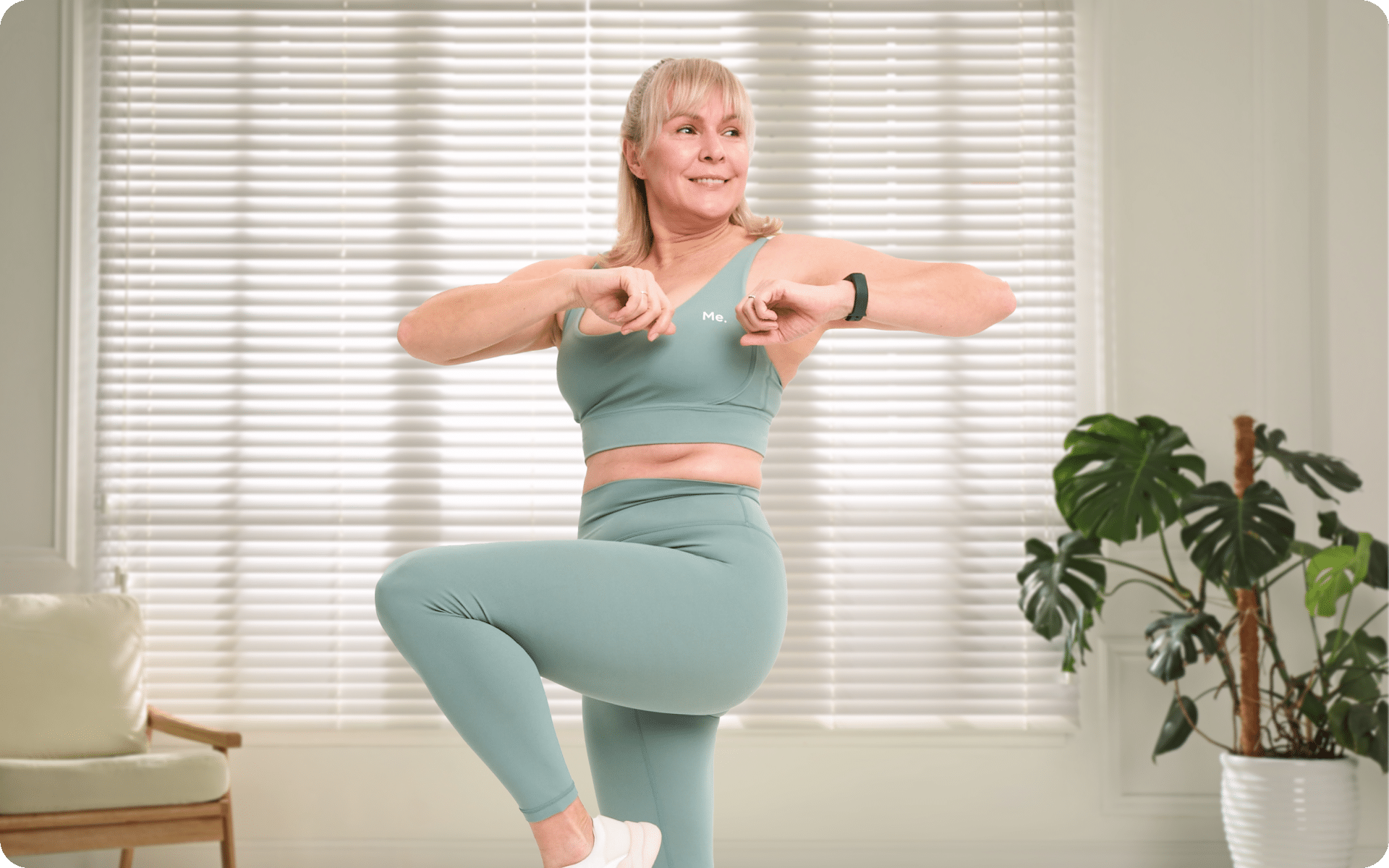
Some 70-year-olds may consider HIIT after establishing regular activity and discussing any relevant concerns with a qualified professional. Age, exercise history, medications, and medical circumstances can all affect suitability. Feeling steady or recovering quickly does not by itself establish clearance for vigorous exercise.
A review of intervention studies in adults with a mean or median age of at least 60 found the clearest benefits in cardiorespiratory fitness. This describes how well the heart, lungs, and muscles support activity. The studies varied in participants, protocols, and outcomes, so the findings do not establish one appropriate program for every older adult (1).
Useful information for that discussion includes:
- How often you currently walk, cycle, or exercise
- How you feel during and after moderate activity
- Any chest discomfort, dizziness, or unusual breathlessness during exertion
- Balance difficulties, falls, or support needed for movement
Regular walking can provide a starting point before intervals. Our HIIT for beginners guide explains the structure, but its examples still need adapting to your circumstances.
Which HIIT workout formats may suit older adults?
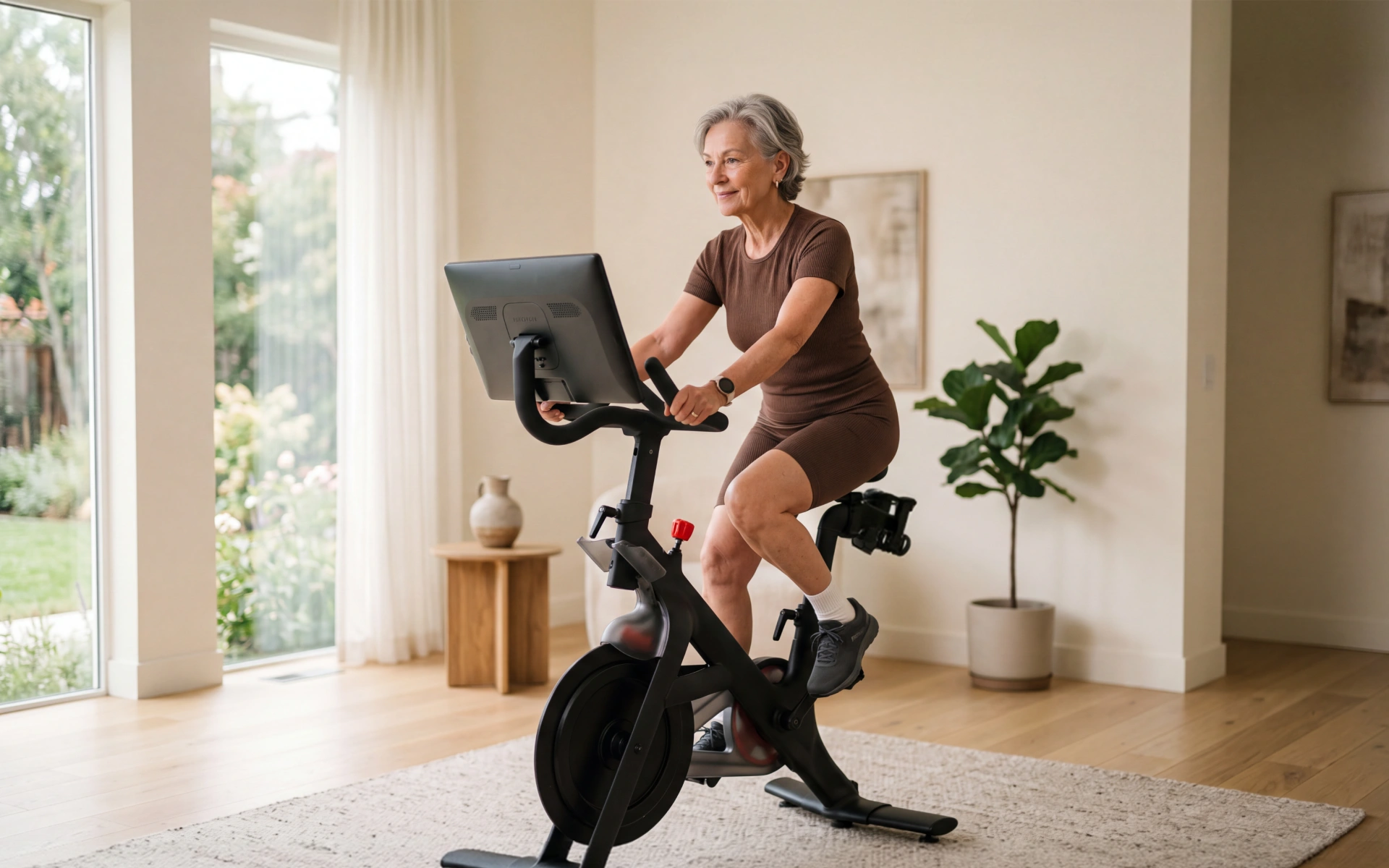
Walking, stationary cycling, or supported bodyweight movements are possible interval formats. The choice depends on balance, current capacity, equipment, and comfort. A low-impact format can still require vigorous effort, so exercise selection alone does not establish suitability.
On a 0-to-10 relative-effort scale, vigorous aerobic activity is commonly described as 7 or 8. Moderate activity is 5 or 6, and the same movement may feel different to different people (2). These ratings describe effort; they do not replace individual assessment.
Walking keeps a foot on the ground, while stationary cycling removes the need to land after a jump. Step-ups require more balance and a stable support surface. Choose movements you can control, and avoid increasing speed when you need support to complete the movement.
The table compares editorial examples. Session ranges include preparation and a gradual finish; they are not study-derived prescriptions.
| Format | Session length | Work interval | Recovery interval | Who it may suit |
|---|---|---|---|---|
| Walking intervals | 15-25 minutes | 1 minute brisk | 2 minutes easy | People already comfortable with walking |
| Stationary cycling | 18-30 minutes | 30-60 seconds harder | 60-90 seconds easy | People who prefer seated cycling |
| Step-up intervals | 15-20 minutes | 40 seconds steady | 60-80 seconds rest | People comfortable using a stable low step |
| Chair-based intervals | 12-20 minutes | 30-45 seconds | 60 seconds rest | People using seated or supported movements |
A full-body HIIT workout for seniors can mix suitable movement patterns. Choose a format you can control, and shorten the session if technique or recovery becomes difficult.
Read more: HIIT workouts for women over 50: a sample plan

How many times a week should a 70-year-old work out?
Older-adult guidance includes 150 moderate or 75 vigorous aerobic minutes weekly, or an equivalent mix, alongside strengthening and balance work (3, 2). The sample interval frequency is an editorial choice.
Only the harder intervals count as vigorous minutes when that effort is actually reached. Warm-up, easy recovery, and cool-down periods usually occur at a lower intensity. Keep the weekly total separate from the total clock time of an interval session.
The sample week below includes:
- Interval work: 1 or 2 days, depending on current capacity
- Strength work: 2 sessions that target major muscle groups
- Balance and mobility: Several brief sessions
- Easy walking: Most days
Here’s how a sample week might look:
| Day | Focus | Approx. time |
|---|---|---|
| Monday | Walking intervals (HIIT) | 20 minutes |
| Tuesday | Strength work | 30 minutes |
| Wednesday | Easy walk + balance drills | 25 minutes |
| Thursday | Cycling intervals (HIIT) | 20 minutes |
| Friday | Strength work | 30 minutes |
| Saturday | Gentle mobility + walk | 25 minutes |
| Sunday | Rest or light stroll | Optional |
This sample includes two interval days. A person returning to exercise may use only one, keeping strength and balance work appropriate to ability.
Workouts, weight management tools, and recipe ideas come together in the BetterMe: Health Coaching app, giving you practical support for building a more consistent wellness routine.
How long should a HIIT workout for seniors be?
Add preparation, work periods, easy recoveries, and finishing time to calculate the session total. Hard-effort minutes alone do not describe the whole workout.
For example, five minutes of preparation, four rounds of one minute harder plus two minutes easy, and five minutes to finish total 22 minutes. That includes four harder minutes. This is a worked example, not a validated starting dose for every senior.
A 30-minute HIIT for seniors can use short work periods and longer easy phases. Adjust one variable at a time, according to capacity.
These examples use five-minute preparation and finish periods. Adapt them as needed; the stages are not assigned to fixed weeks.
| Stage | Total session | Hard-effort time | Weekly frequency |
|---|---|---|---|
| Shorter example | 16 minutes | 2 minutes | 1 sample day |
| Middle example | 22 minutes | 4 minutes | 1 or 2 sample days |
| Longer example | 28 minutes | 6 minutes | 1 or 2 sample days |
Warm-up and cool-down guidance recommends gradually increasing and decreasing effort, often over five to ten minutes (4). The table assumes one-minute work periods with two-minute easy recoveries, including the final recovery. Its two, four, and six rounds total six, twelve, and eighteen interval minutes respectively.

Can you do HIIT at home as a senior?
Some older adults can perform interval training at home, but suitability depends on the person and the movements. Choose an open space, a stable support, and a format you have already practiced. Start with moderate intervals when vigorous work is not appropriate.
A four-week trial studied 30 independent older adults, with a mean age of 71. Its home and supervised programs used five one-minute bodyweight intervals separated by 90-second recoveries. Both groups improved the main fitness measure, but this small, selected trial does not validate every home circuit (5).
The sample uses marching, chair sit-to-stands, wall push-ups, and low step-ups. Practice unfamiliar movements separately before adding a timer, using stable support as needed.
This editorial circuit totals 16 minutes 10 seconds, including every listed recovery. Add preparation and a gradual finish; five minutes for each makes 26 minutes 10 seconds overall.
| Exercise | Work | Recovery | Rounds |
|---|---|---|---|
| Marching in place | 40 seconds | 60 seconds | 3 |
| Sit-to-stand | 30 seconds | 60 seconds | 3 |
| Wall push-ups | 30 seconds | 60 seconds | 2 |
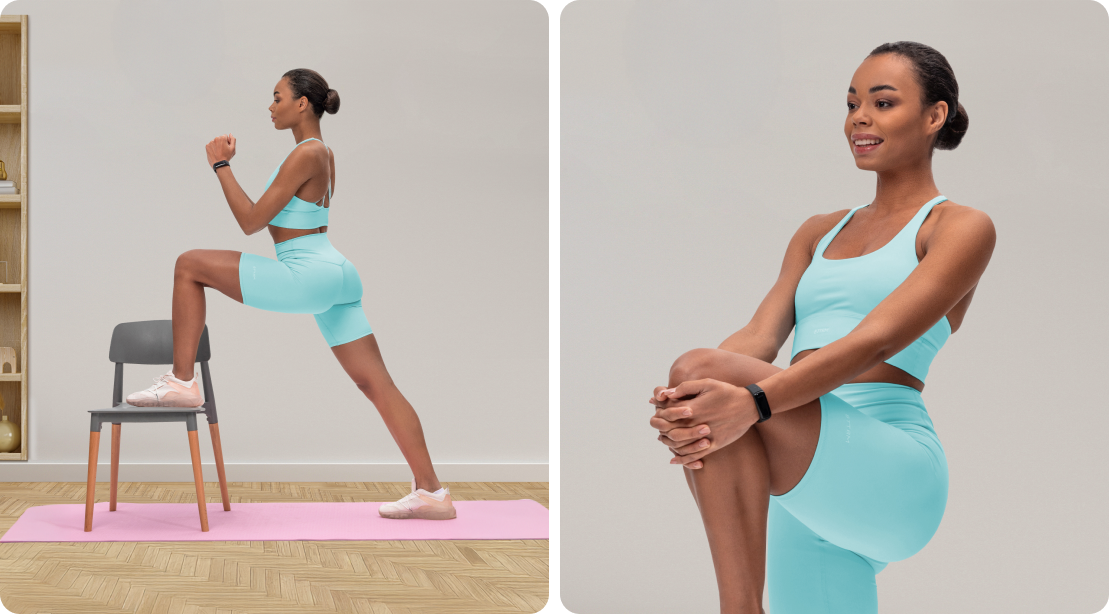
| Step-ups (low step) | 40 seconds | 70 seconds | 2 |
Read more: HIIT workout for seniors: a guide to gradual intervals
Marching in place
- Stand tall near a wall or chair for support.
- Lift one knee to a comfortable height.
- Lower the raised foot to the floor.
- Alternate knee lifts at a controlled rhythm.
Sit-to-stand
- Sit toward the front edge of a sturdy chair.
- Press through your feet and stand up fully.
- Lower yourself back down with control.
- Repeat smoothly for the work period.
Wall push-ups
- Face a wall, your arms extended at shoulder height.
- Place your palms flat, slightly wider than shoulder-width apart.
- Bend your elbows to lean toward the wall.
- Push back to the start with control.
Step-ups (low step)
- Stand facing a low, stable step.
- Place one foot fully on the step.
- Bring the second foot onto the step.
- Lower one foot back to the floor.
- Lower the other foot to the floor.
- Use the rail throughout if support is needed.
Check the surface and support first. Extend recovery or omit a movement if technique slips.
Who should not do HIIT training?
People with unresolved exertional concerns, recent medical events, or significant balance limitations need individual advice before attempting vigorous intervals. The same applies when a clinician has restricted exercise. A general article cannot establish a return-to-activity plan.
Reasons to seek professional assessment before vigorous exercise include:
- Unmanaged medical conditions
- Unusual symptoms during exertion, such as chest tightness or shortness of breath with little effort
- Dizziness, faintness, or poor balance
- Recent illness, surgery, or a medical event without a clear return-to-activity plan
- Significant joint discomfort that worsens with impact
A supervised program may be an option for some people managing ongoing conditions, but that decision requires individual assessment. The research review did not establish comparative safety, and adverse-event reporting was inconsistent (1). Do not infer suitability from a program being described as low impact.
Stop exercising if you develop chest discomfort, faintness, or unusual breathlessness. Seek prompt medical help for severe or persistent symptoms rather than continuing the session. A clinician can advise on any subsequent return to exercise.
What can seniors do instead of HIIT?
Moderate aerobic activity, strength work, and balance practice are alternatives to HIIT, with different roles in a routine (2). Adapt the pace and support to ability.
A review of trials in older adults found similar changes with HIIT and continuous moderate exercise for many measured outcomes (6). Another review in adults with excess weight found no overall advantage for HIIT in reducing body or visceral fat (7). These comparisons concern different outcomes and populations.
Consider these gentler paths:
- Moderate walking or cycling: Relative effort around 5 or 6 out of 10 (2)
- Strength training: At least 2 days weekly in general older-adult guidance (2)
- Balance practice: Heel-to-toe walking, single-leg stands with support, or tai chi
- Moderate intervals: 1-2 minutes brisk, then 2-3 minutes easy, repeated a few times
Moderate intervals alternate a manageable pace with easier movement. For example, a person may choose one minute brisk and two minutes easy without reaching vigorous effort. Call this moderate interval training; its alternating structure alone does not make it HIIT.
Resistance-training guidance for older adults describes support for strength, mobility, and daily function (8). Balance practice is another component of activity guidance (2). For exercise selection, our calisthenics workout plan for over 50 offers bodyweight examples to discuss with your exercise professional.
HIIT for seniors with weights combines timed movement with an external load. Choose a load according to your technique and current capacity, and seek guidance for unfamiliar exercises. Progressive resistance work can also be scheduled separately from intervals (8).
Whether you’re just starting your fitness journey or looking to add more structure to your routine, BetterMe offers tools that can support different wellness goals. Explore the app and see how its workout, nutrition, and habit-building features can fit into your lifestyle.

FAQs
Can you reshape your body at 60?
Many people can build strength or support body composition in later adulthood, but visible changes vary. A review of resistance training in adults 65 and older found muscle-size gains under supervised programs (9). This does not establish an individual appearance outcome at 60 or an equivalent effect from HIIT.
What age is too late to start exercising?
Starting exercise later in life can still be worthwhile, with the activity adapted to current ability. Older-adult guidance includes aerobic, strengthening, and balance activities rather than an age cutoff (2).
What is the most beneficial exercise for seniors?
A useful routine can combine aerobic activity, strengthening, and balance work, adjusted to your circumstances (2). These components serve different purposes, so a single movement does not cover the whole routine.
What is the opposite of a HIIT workout?
Steady-state exercise maintains a fairly consistent effort, without repeated harder work periods. HIIT alternates harder work and recovery; walking or cycling can use either structure.
What type of HIIT is most effective?
No one HIIT format is established as suitable for every older adult. A review found aerobic-fitness benefits across varied formats, populations, and protocols (10). Choose according to individual circumstances.
The bottom line
HIIT for seniors requires a suitable format, appropriate preparation, and enough recovery. Use the checked sample totals as examples, then discuss vigorous exercise with a qualified professional when concerns apply. Pair interval work with the other activity components appropriate to your routine.
DISCLAIMER:
This article is intended for general informational purposes only and does not serve to address individual circumstances. It is not a substitute for professional advice or help and should not be relied on for making any kind of decision-making. Any action taken as a direct or indirect result of the information in this article is entirely at your own risk and is your sole responsibility.
BetterMe, its content staff, and its medical advisors accept no responsibility for inaccuracies, errors, misstatements, inconsistencies, or omissions and specifically disclaim any liability, loss or risk, personal, professional or otherwise, which may be incurred as a consequence, directly or indirectly, of the use and/or application of any content.
You should always seek the advice of your physician or other qualified health provider with any questions you may have regarding a medical condition or your specific situation. Never disregard professional medical advice or delay seeking it because of BetterMe content. If you suspect or think you may have a medical emergency, call your doctor.
SOURCES:
- Effects of High-Intensity Interval Training in Older Adults: A Systematic Review of Randomized and Non-Randomized Intervention Studies (2026, mdpi.com)
- What Counts as Physical Activity for Older Adults (2025, cdc.gov)
- International Exercise Recommendations in Older Adults (ICFSR): Expert Consensus Guidelines (2021, sciencedirect.com)
- Warm Up, Cool Down (2024, heart.org)
- Equipment-free, unsupervised high intensity interval training elicits significant improvements in the physiological resilience of older adults (2022, pmc.ncbi.nlm.nih.gov)
- Effects of high-intensity interval and continuous moderate aerobic training on fitness and health markers of older adults: A systematic review and meta-analysis (2024, sciencedirect.com)
- High-intensity interval training is not superior to continuous aerobic training in reducing body fat: A systematic review and meta-analysis of randomized clinical trials (2023, sciencedirect.com)
- Resistance Training for Older Adults: Position Statement From the National Strength and Conditioning Association (2019, nsca.com)
- Lower extremity muscle hypertrophy in response to resistance training in older adults: Systematic review, meta-analysis, and meta-regression of randomized controlled trials (2024, pubmed.ncbi.nlm.nih.gov)
- High-intensity interval training and cardiorespiratory fitness in adults: An umbrella review of systematic reviews and meta-analyses (2024, onlinelibrary.wiley.com)

 Reviewed by