
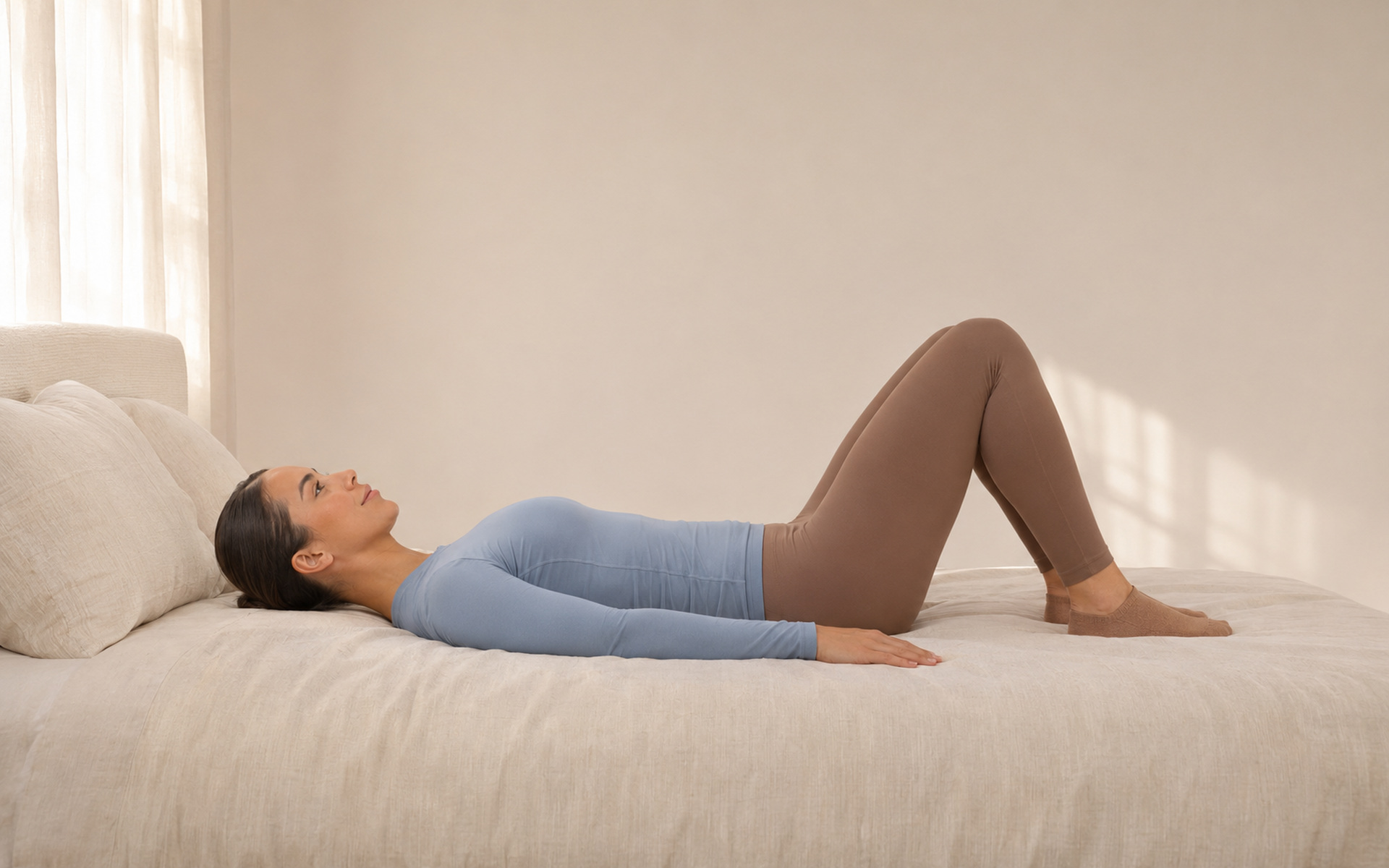
A bed Pilates workout is a short set of Pilates-based moves done on a mattress. Sessions last 10 to 20 minutes and suit beginners who want a gentle start or end to the day. A firm mattress works better than a soft one. This guide gives nine moves and a 7-day plan. See also our exercises to do in bed.
Following exercise and diet plans is the key in your fitness journey and greatly impacts results. In 4 weeks users can typically expect to lose not more than 1-2 lbs per week. Individual results may vary.
Key takeaways
A bed Pilates workout is a low-effort way to practice controlled movement, with modest and realistic benefits.
- A beginner Pilates session needs little equipment beyond a comfortable surface and clothes you can move in (1).
- In a 12-week trial, twice-weekly Pilates classes improved abdominal endurance and hamstring flexibility (2).
- That trial used 60-minute mat classes, twice a week for 12 weeks (2).
- Adults are advised to do muscle-strengthening activity on at least two days a week (3).
- The same guidelines recommend 150 minutes of moderate aerobic activity each week (3).
- At moderate effort, you can talk but not sing (4).
- In a 6-week trial in healthy adults, abdominal exercises improved endurance but did not reduce abdominal fat (5).
What is a bed Pilates workout?
A bed Pilates workout adapts classic mat exercises to a mattress. The moves are small and slow, with attention on breathing and control.
The bed replaces the mat. That makes the session easy to start, because you are already there. The bed also changes the exercises, since a mattress gives way under your weight.
Many people use bed Pilates as a gentle routine in the morning or evening. The routine can be a first step toward mat sessions on the floor.
Does bed Pilates really work?
Bed Pilates can help you practice control and build a habit, but it is lighter than a mat class. Research on Pilates used longer sessions on firm surfaces.
In one trial, 50 active adults were assigned to Pilates classes or a control group. The classes lasted 60 minutes and ran twice a week for 12 weeks (2). Abdominal endurance, upper-body endurance, and hamstring flexibility improved in the Pilates group (2).
A 15-minute bed session is a different dose. Expect smaller effects, and see the routine as regular gentle movement.
A soft surface also lowers the challenge of some moves and raises it for others. Bridges feel less stable. Stretches feel more comfortable.
How do you set up for Pilates in bed?
Set up by clearing the bed and finding its firmest area. A minute of preparation makes the moves steadier.
Beginner Pilates guidance suggests a comfortable surface and clothes that let you move freely (1). The same advice applies in bed.
- Remove pillows and heavy blankets from the middle of the bed.
- Lie across the firmest part of the mattress.
- Keep one thin pillow for your head if your neck prefers it.
- Move to a mat on the floor if the mattress is very soft.
- Leave space to stretch your arms and legs fully.
Which 9 moves are in the bed Pilates workout?
The workout uses nine moves that cover the trunk, hips, and spine. The table shows the position and a starting amount.
| Move | Position | Starting amount |
|---|---|---|
| Pelvic tilt | On your back, knees bent | 8 slow repetitions |
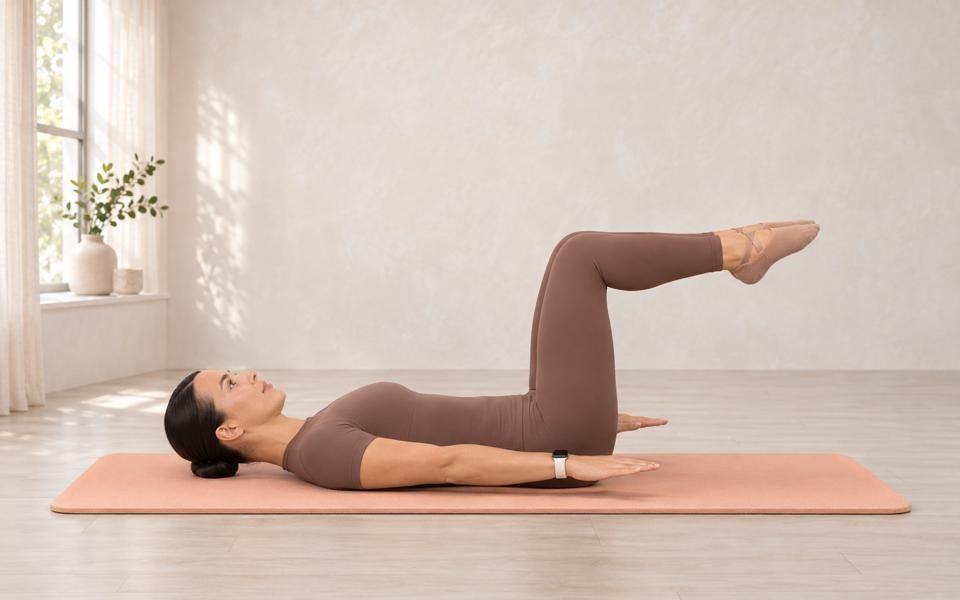
| Single-leg stretch | On your back | 5 on each side |
| Toe taps | On your back, knees lifted | 5 on each side |
| Bridge | On your back, knees bent | 6 repetitions |
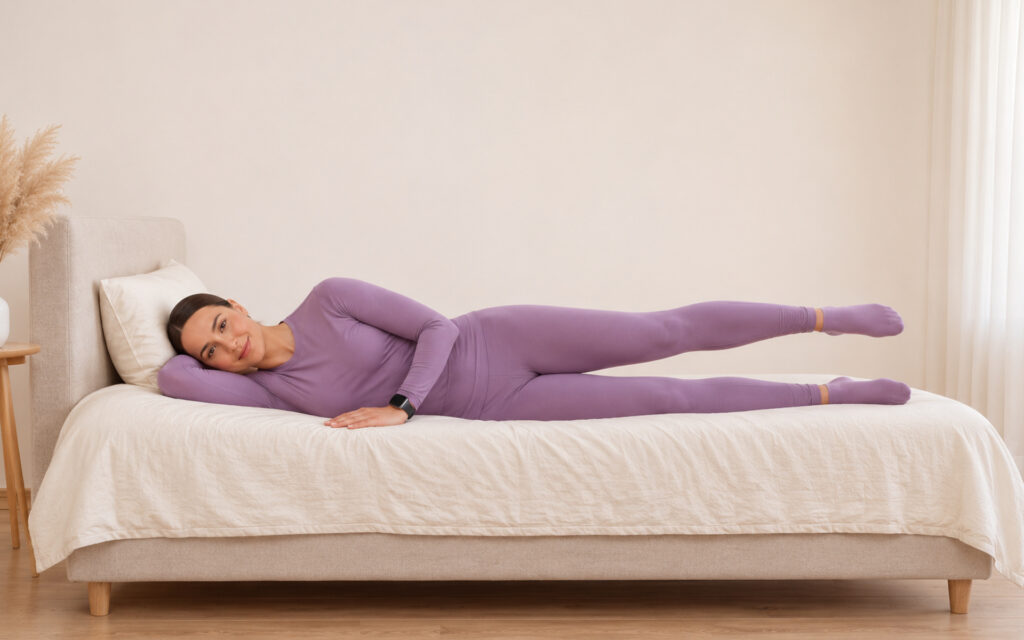
| Side-lying leg lift | On your side | 6 on each side |
| Spinal twist | On your back | 3 slow turns each way |
| Cat-cow | On hands and knees | 5 rounds |
| Modified roll-up | Sitting, knees bent | 4 repetitions |
| Seated spine stretch | Sitting, legs forward | 4 repetitions |
The amounts are editorial starting points. Do fewer when a move feels hard to control.
Read more: Pilates weekly workout plan: a beginner calendar with rest
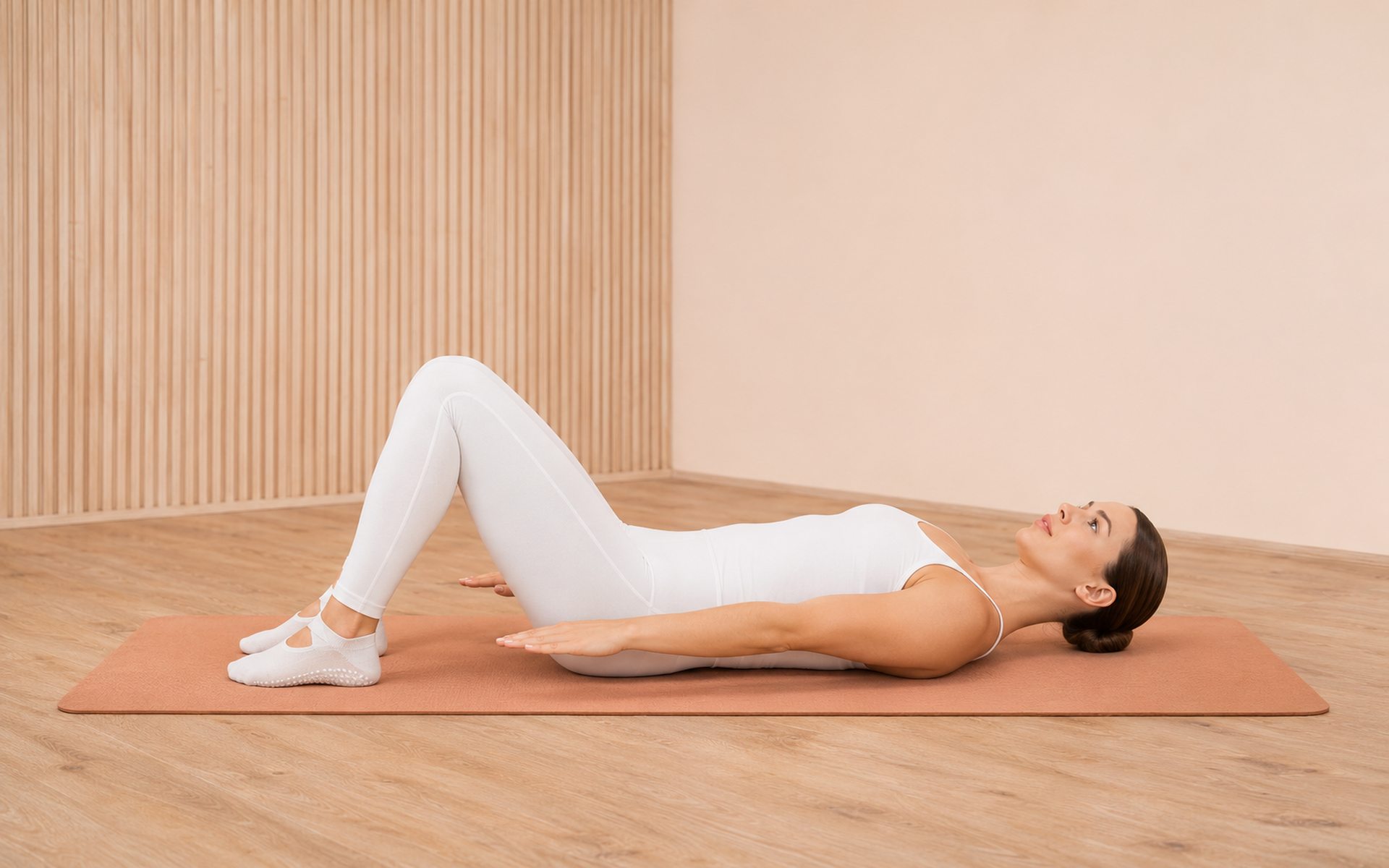
1. Pelvic tilt
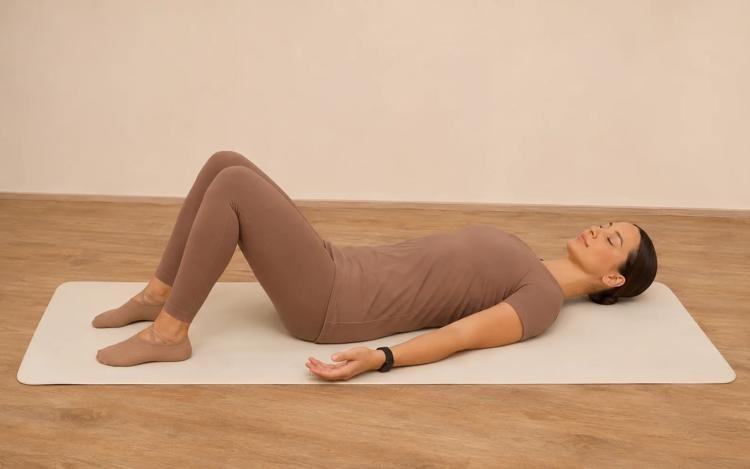
The pelvic tilt teaches gentle control of the lower back and pelvis.
- Lie on your back with your knees bent and feet flat.
- Breathe out and press your lower back lightly into the mattress.
- Breathe in and return to the start.
- Keep the movement small.
2. Single-leg stretch
The single-leg stretch trains the abdominal muscles while the legs move.
- Lie on your back and bring both knees toward your chest.
- Keep your head down or lift it slightly.
- Stretch one leg out at a height that keeps your lower back steady, while holding the other knee.
- Switch legs slowly.
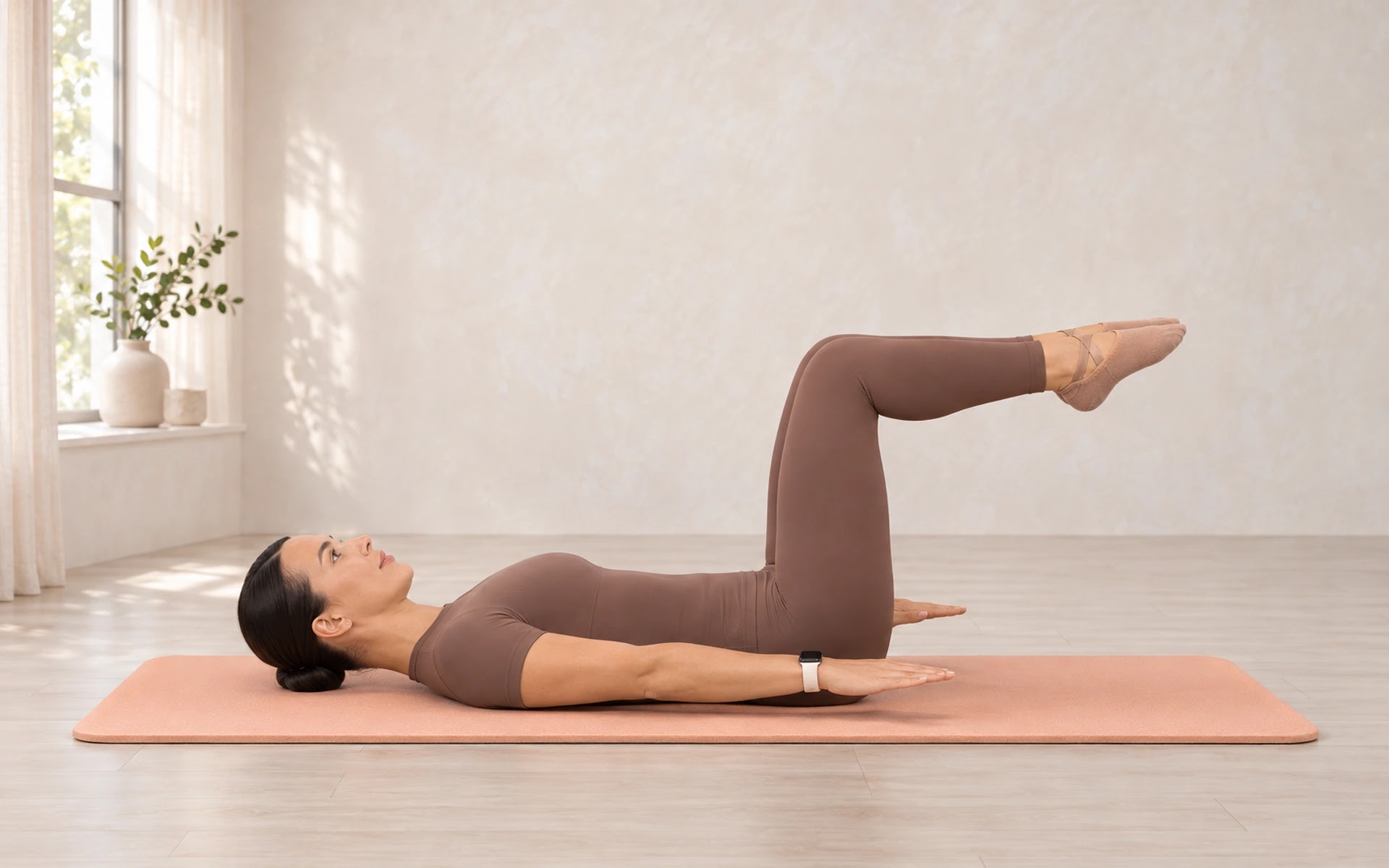
3. Toe taps
Toe taps train the lower abdominal area with a small leg movement.
- Lie on your back with your knees bent at a right angle, stacked above your hips.
- Keeping the knee bend the same, lower one foot until the toes touch the mattress.
- Lift the leg back to the start.
- Repeat with the other leg.
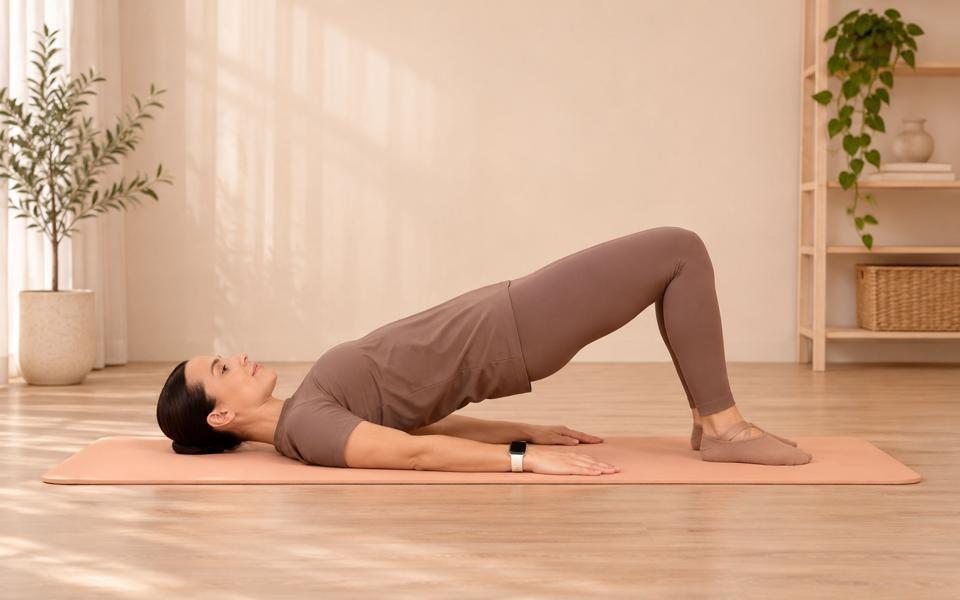
4. Bridge
The bridge trains the hips and the back of the thighs.
- Lie on your back with your knees bent and feet hip-width apart.
- Press through your feet and lift your hips.
- Pause when your body forms a line from shoulders to knees, with your weight on your shoulders, not your neck.
- Lower slowly.
Place your feet closer to your hips if the mattress makes the lift unsteady.
5. Side-lying leg lift
The side-lying leg lift trains the outer hip.
- Lie on your side with your bottom knee bent.
- Straighten your top leg in line with your body.
- Lift the top leg a few inches.
- Lower with control.
BetterMe offers a variety of workouts, recipes, challenges, and support tools to help you stay more consistent with your wellness routine. Explore the app to find features that fit your goals, preferences, and schedule.
6. Spinal twist
The spinal twist gently rotates the spine and stretches the back.
- Lie on your back with your knees bent and arms out to the sides.
- Let both knees drop slowly to one side, only as far as your shoulders stay on the mattress.
- Pause for a breath.
- Return to the center and change sides.
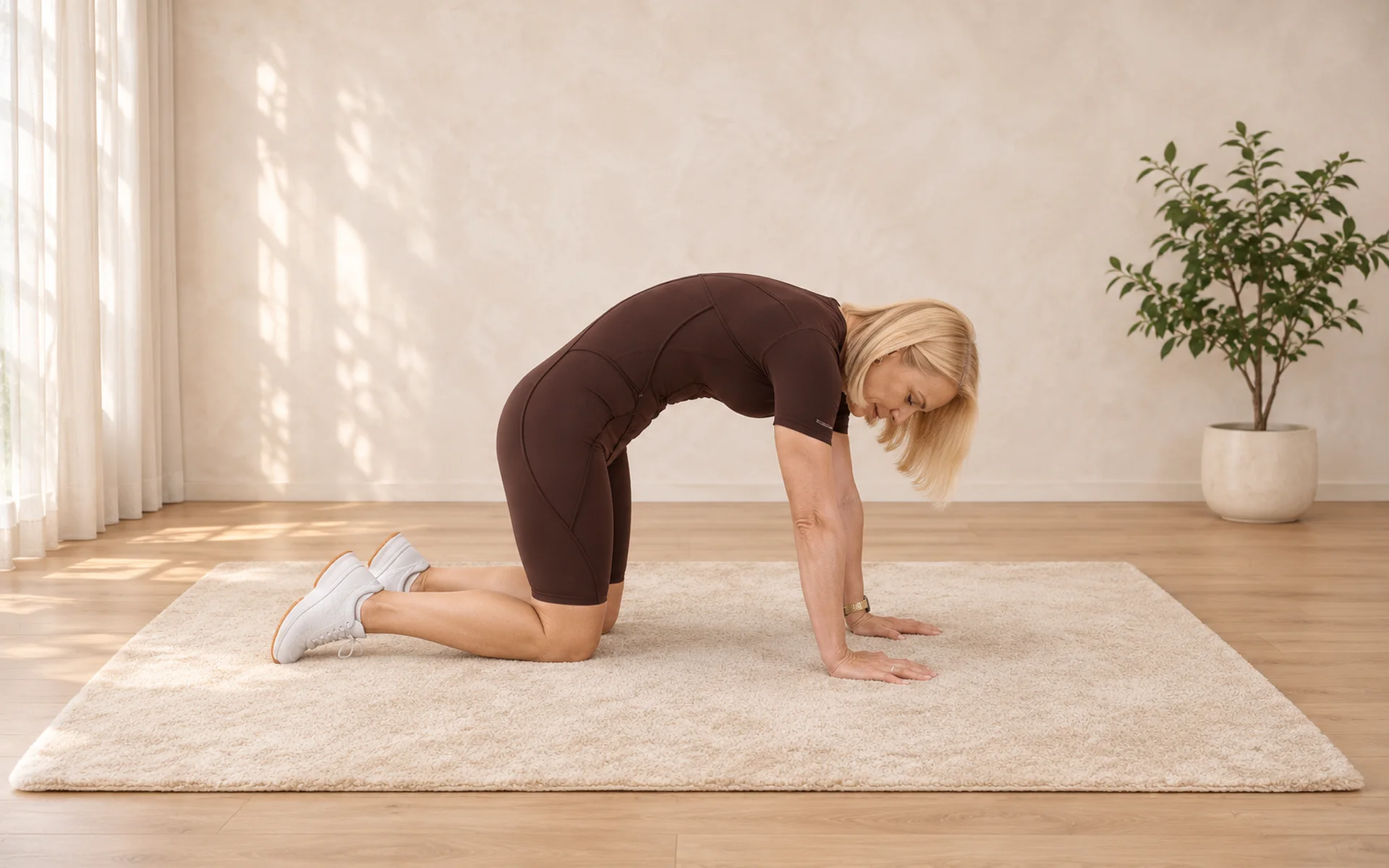
7. Cat-cow
Cat-cow moves the spine forward and back from hands and knees.
- Come onto your hands and knees, with your hands under your shoulders and your knees under your hips.
- Breathe in, lift your chest, and let your back dip slightly.
- Breathe out, round your back, and lower your head.
- Move slowly between the two positions.
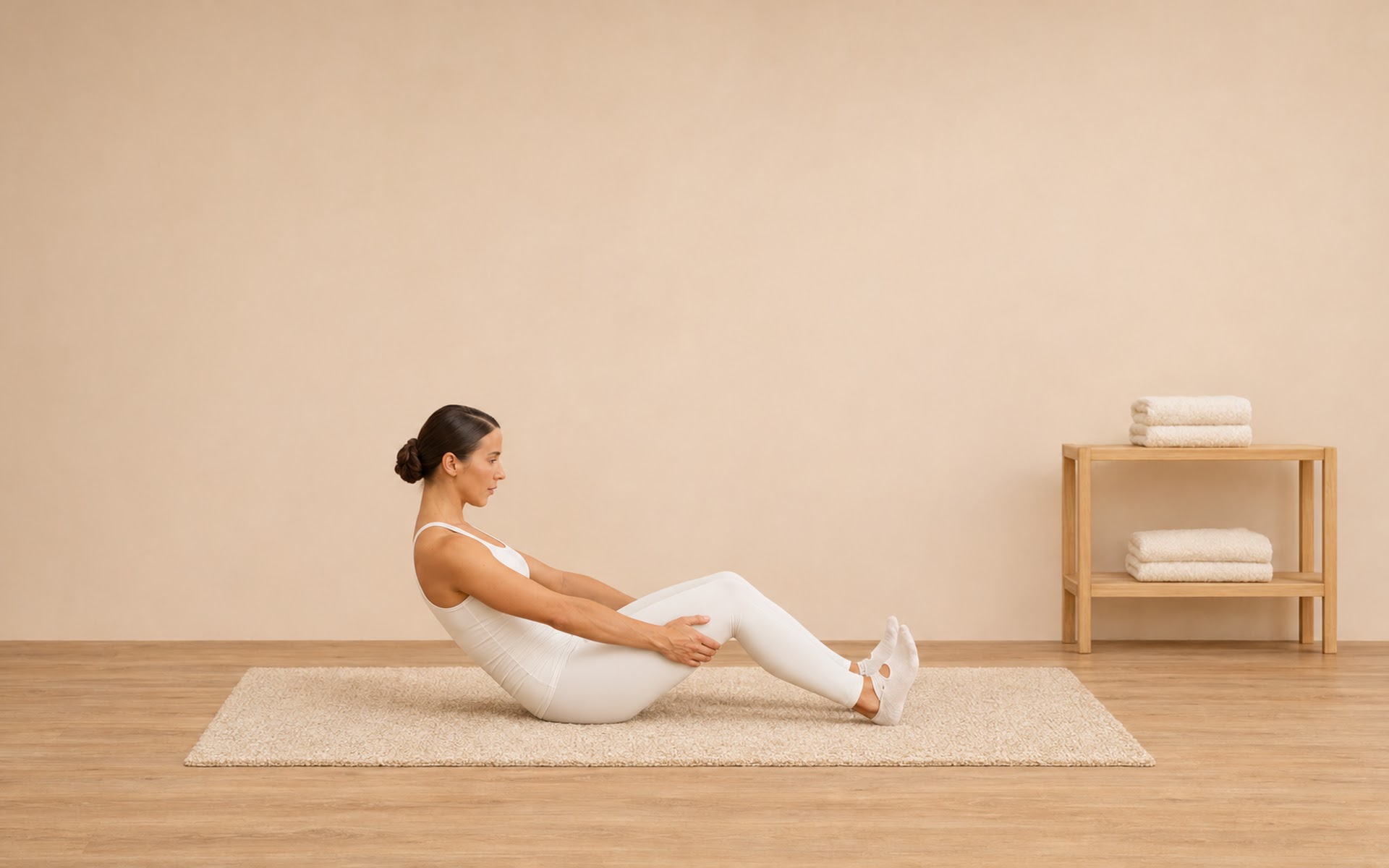
8. Modified roll-up
The modified roll-up trains the abdominal muscles through a short range.
- Sit with your knees bent and feet flat.
- Hold the backs of your thighs.
- Lean back a little while rounding your lower back.
- Return to sitting tall.
9. Seated spine stretch
The seated spine stretch lengthens the back of the body.
- Sit tall with your legs forward and slightly apart.
- Reach your arms forward at shoulder height.
- Breathe out and round forward from the top of your head.
- Roll back up to sitting.
Sit on a folded blanket if your lower back rounds when you sit.
Read more: 10 Pilates ball exercises for a controlled core workout
What does a 7-day bed Pilates plan look like?
A 7-day bed Pilates plan alternates short sessions with rest or walking days. The table is an editorial example for beginners.
| Day | Session | Time |
|---|---|---|
| 1 | Pelvic tilt, toe taps, bridge, spinal twist | 10 minutes |
| 2 | Walk or rest | Your choice |
| 3 | Single-leg stretch, side-lying leg lift, cat-cow | 10 minutes |
| 4 | Walk or rest | Your choice |
| 5 | Moves 1 to 6 | 15 minutes |
| 6 | Walk or rest | Your choice |
| 7 | All nine moves | 15 to 20 minutes |
Notes for the week keep the plan gentle.
- Move slowly enough to breathe normally.
- Rest for a few breaths between moves.
- Repeat day 1 or day 3 if a longer session feels like too much.
- Write down which moves felt easy and which felt hard.
After the week, repeat the plan or try our bed Pilates challenge for a longer program.
Can bed Pilates reduce belly fat?
Bed Pilates is unlikely to reduce fat in one specific area. One trial of abdominal exercise found better endurance, not less abdominal fat.
In a 6-week trial, 24 healthy adults were assigned to abdominal exercises or no exercise. The exercise group trained five days a week (5). Abdominal fat, body weight, and body fat percentage did not change significantly. Abdominal endurance did improve (5).
Body fat responds to overall intake and activity over time. Bed Pilates can be one small part of an active week.
How does bed Pilates fit into a weekly routine?
Bed Pilates fits as a gentle add-on to a week that also includes aerobic and strength activity. Short bed sessions alone do not cover the guidelines.
Adults are advised to get 150 minutes of moderate aerobic activity a week. The guidelines add strength work for all major muscle groups on at least two days (3).
Most bed moves feel light. At moderate effort, a person can talk but not sing (4). Add brisk walking, cycling, or a mat class to reach that level.
A planned week helps. Our Pilates weekly routine shows how to combine short sessions with walking.
What mistakes should you avoid?
The main mistakes are rushing and working on a surface that is too soft. Both make the moves less controlled.
- Moving fast to finish sooner
- Holding your breath
- Lifting too high in the bridge on a soft mattress
- Pulling on your neck during the single-leg stretch
- Skipping rest between moves
Stop a move that feels uncomfortable, and choose a smaller range next time. Stop and seek medical advice if pain persists or spreads, or if you feel dizzy or unwell. Talk to a doctor first if you are pregnant, have osteoporosis, or have a back concern, since lying on your back, rounding, and twisting moves may need changes.
When the nine moves feel easy, try them on a mat. Our beginner Pilates exercises guide lists the next steps.
Frequently Asked Questions
Is bed Pilates better in the morning or at night?
Either time works. Morning sessions can ease stiffness, and evening sessions can help you slow down before sleep.
Can you do bed Pilates every day?
Yes, for many people the moves are gentle enough for daily practice. Take a rest day when your muscles feel tired.
Is a bed too soft for Pilates?
A very soft mattress makes bridges and seated moves unsteady. Use a firm mattress or move to a mat on the floor.
Is 20 minutes of Pilates a day enough?
Twenty minutes a day is a solid habit for beginners. One 12-week trial used two 60-minute classes a week (2).
Can beginners start with bed Pilates?
Yes, bed Pilates is a comfortable entry point. Learn the first four moves, then add the others over a week.
The bottom line
A bed Pilates workout offers nine gentle moves for a firm mattress. A session takes 10 to 20 minutes. Use the 7-day plan to build the habit, and keep walking and strength work in your week. Move to a mat when the bed feels too easy.
DISCLAIMER:
This article is intended for general informational purposes only and does not serve to address individual circumstances. It is not a substitute for professional advice or help and should not be relied on for making any kind of decision-making. Any action taken as a direct or indirect result of the information in this article is entirely at your own risk and is your sole responsibility.
BetterMe, its content staff, and its medical advisors accept no responsibility for inaccuracies, errors, misstatements, inconsistencies, or omissions and specifically disclaim any liability, loss or risk, personal, professional or otherwise, which may be incurred as a consequence, directly or indirectly, of the use and/or application of any content.
You should always seek the advice of your physician or other qualified health provider with any questions you may have regarding a medical condition or your specific situation. Never disregard professional medical advice or delay seeking it because of BetterMe content. If you suspect or think you may have a medical emergency, call your doctor.
Some visuals may be AI-generated.
SOURCES:
- Pilates video for beginners (2025, nhs.uk)
- Pilates for improvement of muscle endurance, flexibility, balance, and posture (2010, pubmed.ncbi.nlm.nih.gov)
- Adult Activity: An Overview (2023, cdc.gov)
- How to Measure Physical Activity Intensity (2025, cdc.gov)
- The effect of abdominal exercise on abdominal fat (2011, pubmed.ncbi.nlm.nih.gov)
 Reviewed by
 Reviewed by
 Reviewed by
 Reviewed by