Pilates ring exercises use a flexible circle to add pressure-based resistance to arm, thigh, and mat movements. Choose exercises by their action and your available control. Begin with supported positions before adding longer reaches. The ring workout provides a wider selection when you are ready to organize a session.
Key takeaways
- A Pilates ring is optional; you can practice mat movements without a prop.
- Some rings have inner and outer padded handles for different placements (1).
- Inward thigh pressure and outward leg movement are different actions.
- A ring press adds a task; stronger compression does not automatically mean better technique.
- Pilates research has measured endurance and flexibility improvements in specific adult groups (2).
- Choose a few manageable exercises and record the setup before adding difficulty.

Do you need a Pilates ring?
You can practice Pilates without a ring. The circle adds resistance and a reference point for hand or leg placement. Decide whether that extra task helps you follow the exercise.
Try an unweighted bridge before combining the bridge with a thigh squeeze. Learn a supported arm position before adding hand pressure. You can keep the unweighted exercise when the ring distracts from movement control.
A prop is useful when the setup fits the task. A ring that pinches your legs or forces your shoulders upward changes the exercise. Remove the circle and choose another version when fit remains awkward.
The beginner ring setup guide covers first-use checks. Keep the manufacturer’s directions available, especially for placements that use the inside of the ring.
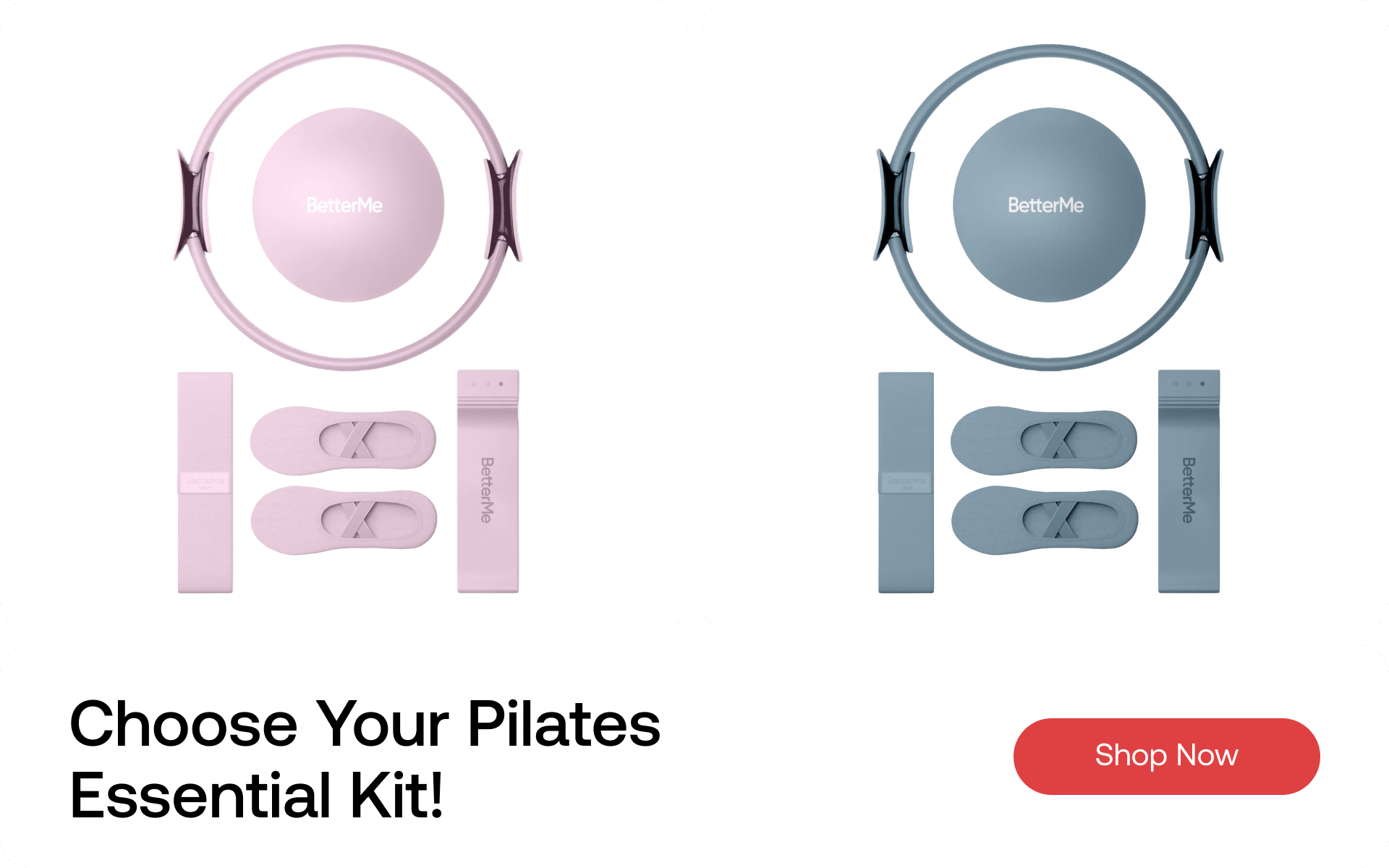
Get ready to circle your way to success! BetterMe’s Pilates Essential Kit brings the gym to your living room with a pop of padded perfection. Tone, tighten, and take your workout to the next level — one ring to rule them all!
How should you choose ring size and resistance?
Choose a ring you can position comfortably and compress without distorting your stance. Size and resistance vary by model. A larger circle is not automatically a more suitable choice.
Manufacturer listings show that some models use flexible plastic and provide inner and outer padded handles (1). Check your own model’s specifications. Avoid applying another manufacturer’s diameter or resistance label to your equipment.
|
Check |
What to look for |
When to change the setup |
|---|---|---|
|
Hand placement |
Comfortable wrists and relaxed shoulders |
Ring forces your arms too far apart |
|
Thigh placement |
Pads above the knees |
Pads pinch or press on kneecaps |
|
Resistance |
A squeeze you can release gradually |
Pressure changes your body position |
|
Equipment condition |
Intact padding and frame |
Cracks, loose parts, or damaged surfaces |
|
Permitted use |
Clear instructions for the placement |
Ring is being used as a bodyweight support |
Test the ring with light hand pressure before trying lower-body placement. Keep your elbows comfortably bent. Release slowly so the circle remains stable between your palms.
A ring’s firmness does not need to match someone else’s equipment. Record the model and your exercise setup when comparing sessions. A different ring may change the task even when the repetition count stays the same.
Which exercises use the inner thighs?
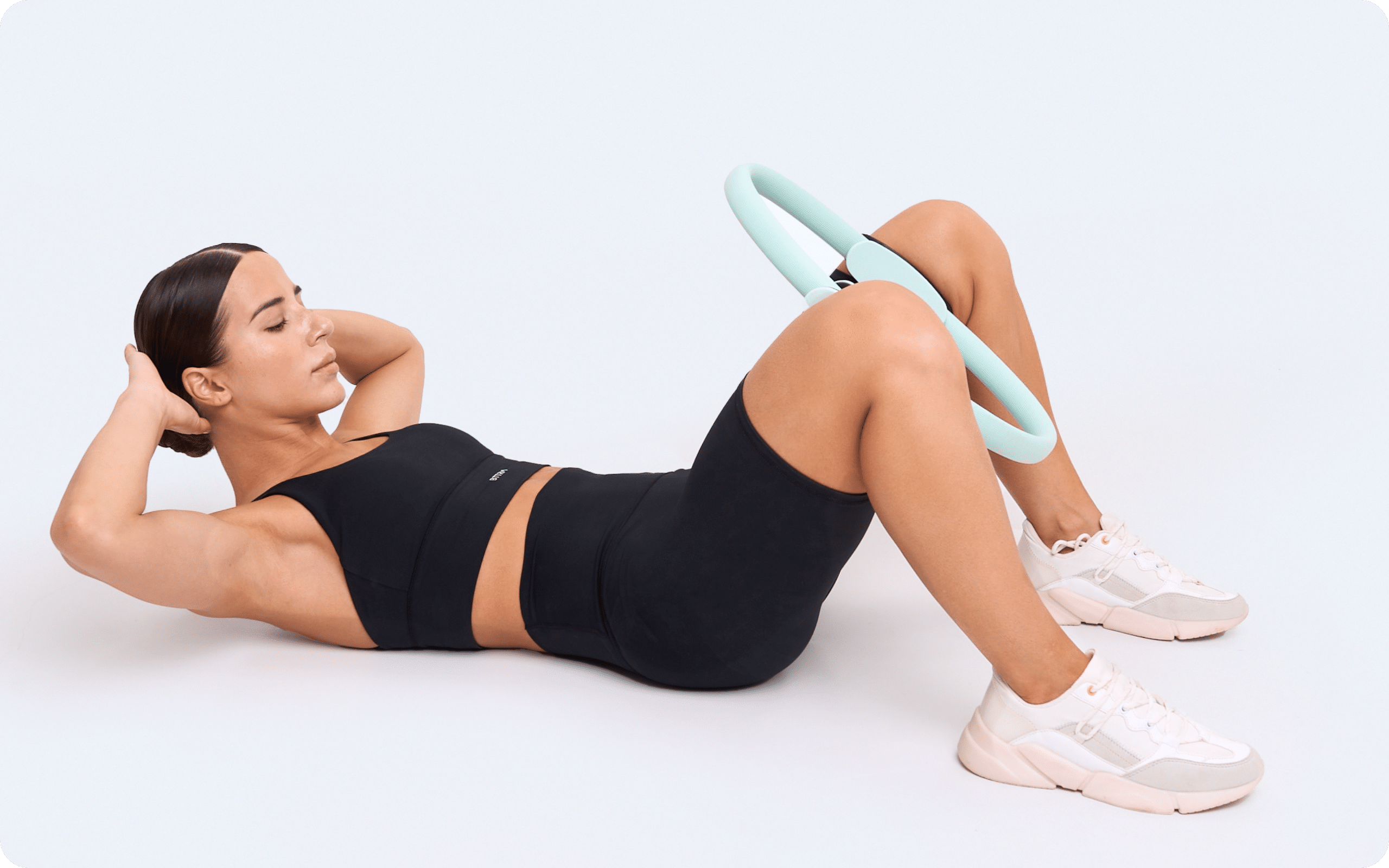
Exercises that press your thighs inward against the ring use an inward movement pattern. Start with your feet supported and knees bent. A small squeeze lets you monitor placement.
Supported thigh press
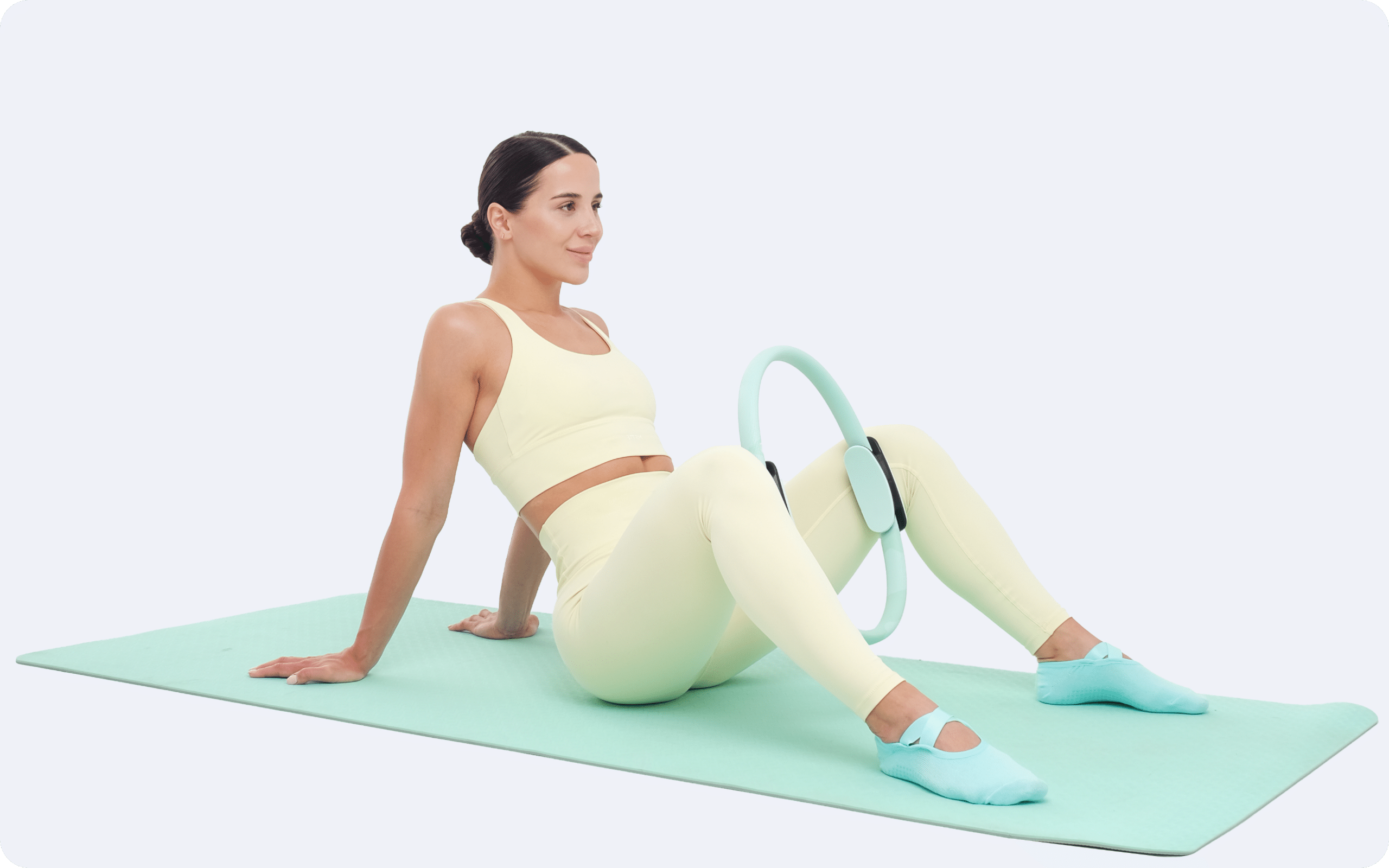
The supported thigh press keeps the trunk and feet on the mat. Position the pads above the knees.
- Lie on your back with both knees bent.
- Place the ring between your thighs above the knees.
- Press your thighs inward gently.
- Release the pressure slowly.
- Remove the ring before sitting up.
Keep your feet where they can support the movement. Avoid forcing the knees together beyond a comfortable position. Stop and reset if the pads slide.
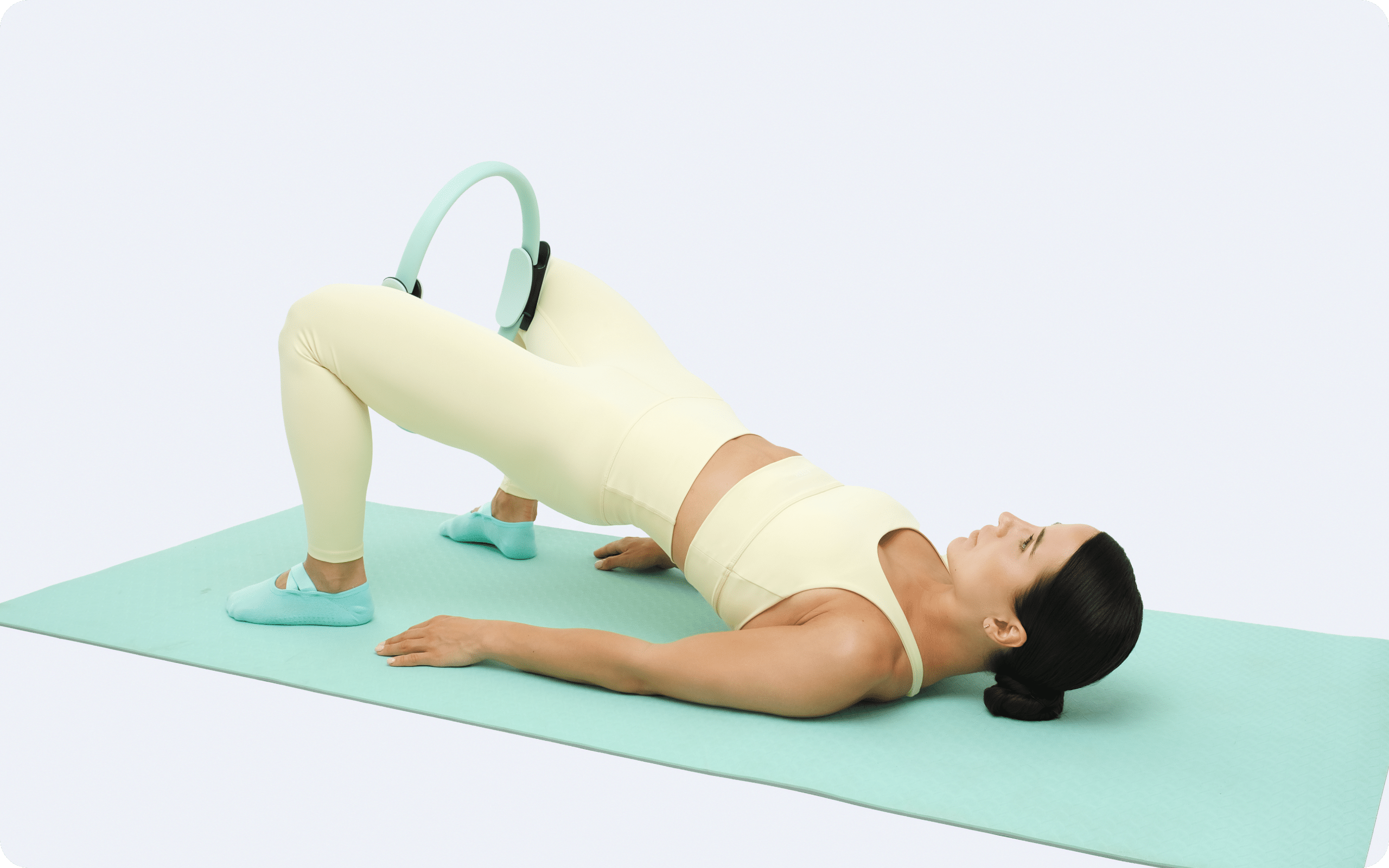
Bridge with a thigh press
A bridge adds hip movement while you maintain light inward pressure. Learn the bridge separately before combining the actions.
- Lie on your back with feet flat and knees bent.
- Place the ring above your knees.
- Lift your hips through a comfortable range.
- Apply a gentle inward press.
- Lower your hips with control.
The squeeze should not dominate the bridge. Your feet remain the support for the hip lift. Use a smaller lift or remove the ring when the combined task changes your back position.
Inward pressure does not establish a promise about thigh size. Training an area and changing fat distribution are different goals. Keep the immediate focus on a controlled press and stable equipment placement.
How can ring exercises involve the glutes?
Ring exercises can involve the glutes through hip lifting or outward pressure, depending on the setup. A bridge uses hip extension. An inward thigh squeeze adds another action to that movement.
A supine outward press uses the inner pads against the outside of your thighs, if your ring permits that placement. Begin with feet on the mat. Check that the circle fits without forcing your knees apart.
- Lie on your back with feet supported.
- Position the permitted inner pads against your outer thighs.
- Press your thighs outward a small distance.
- Return gradually to the starting position.
Keep the ring secure throughout the press. Avoid pushing to the widest possible position. Choose an unweighted hip movement or suitable loop band when the ring does not fit.
The band exercise guide describes outward hip movements with elastic loops. Those exercises require their own setup. A ring cannot be stretched like a band simply because both provide resistance.

How can a ring change abdominal exercises?
A ring can add hand pressure during abdominal movement, but the trunk exercise supplies much of the control challenge. Begin with a supported reach. A full roll-up is optional when you can perform it smoothly.
Supine arm reach
The supine arm reach lets you practice hand pressure while keeping your head on the mat. Use a comfortable arm height.
- Lie on your back with knees bent.
- Hold the ring above your chest.
- Apply a light inward press.
- Reach the ring a short distance toward your knees.
- Return your arms to the starting position.
Keep your ribs from lifting as your arms move. Release the squeeze if breathing becomes difficult to maintain. You can practice the same arm path without the circle.
Partial curl option
A partial curl adds a small upper-body lift to the supported reach. Use instructor guidance if the movement is unfamiliar.
- Begin on your back with feet supported.
- Hold the ring toward your knees.
- Lift your upper body a small distance.
- Lower to the mat gradually.
- Rest your arms before repeating.
Avoid pulling your head forward or jerking the ring. A full roll-up requires a larger movement and different control demands. Progress only when you can maintain comfortable technique.
A Pilates trial measured changes in trunk-pelvic control after a structured program (3). That trial does not show that adding a circle automatically improves abdominal training. Your movement and load remain relevant.

Which ring exercises involve the arms?
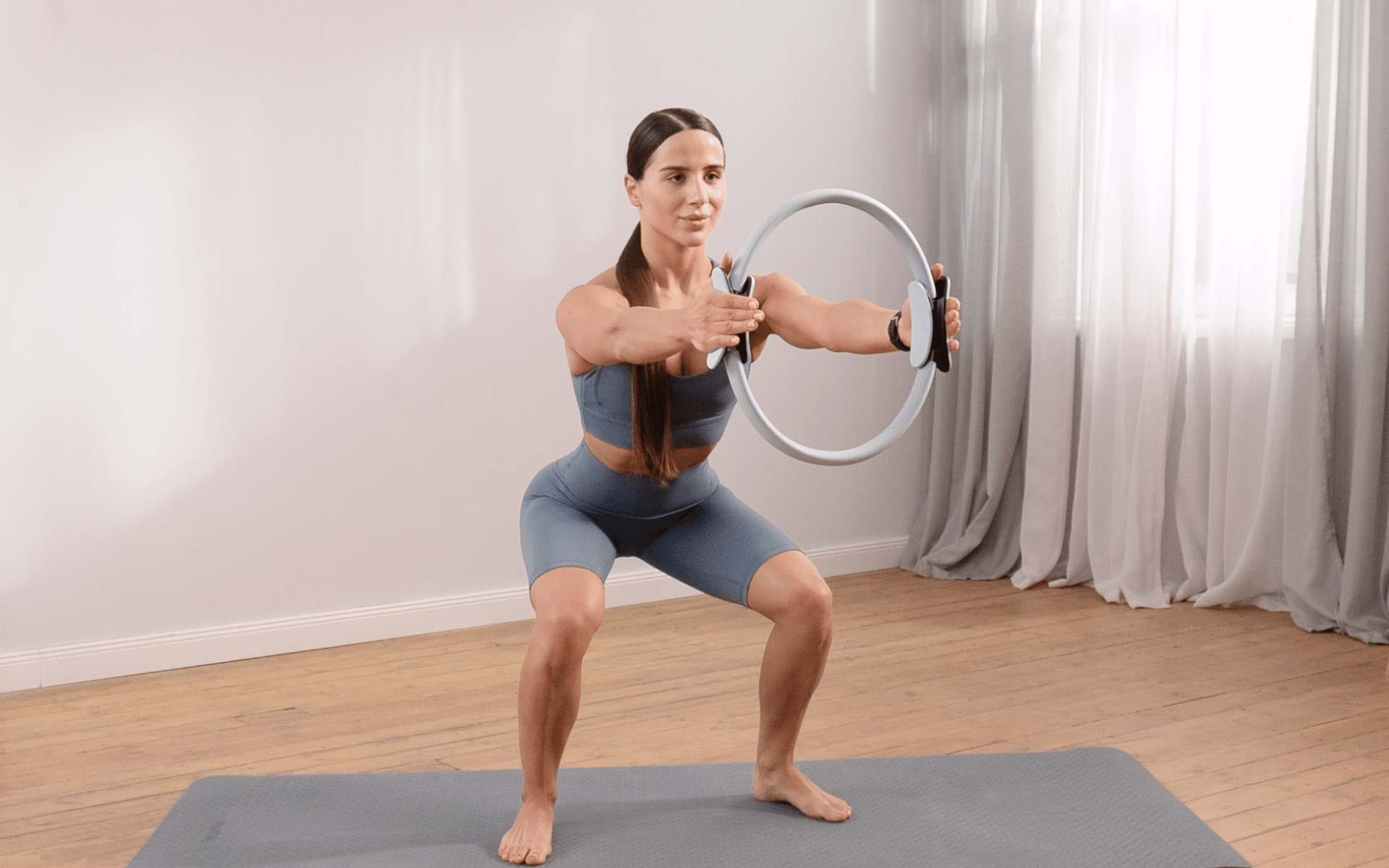
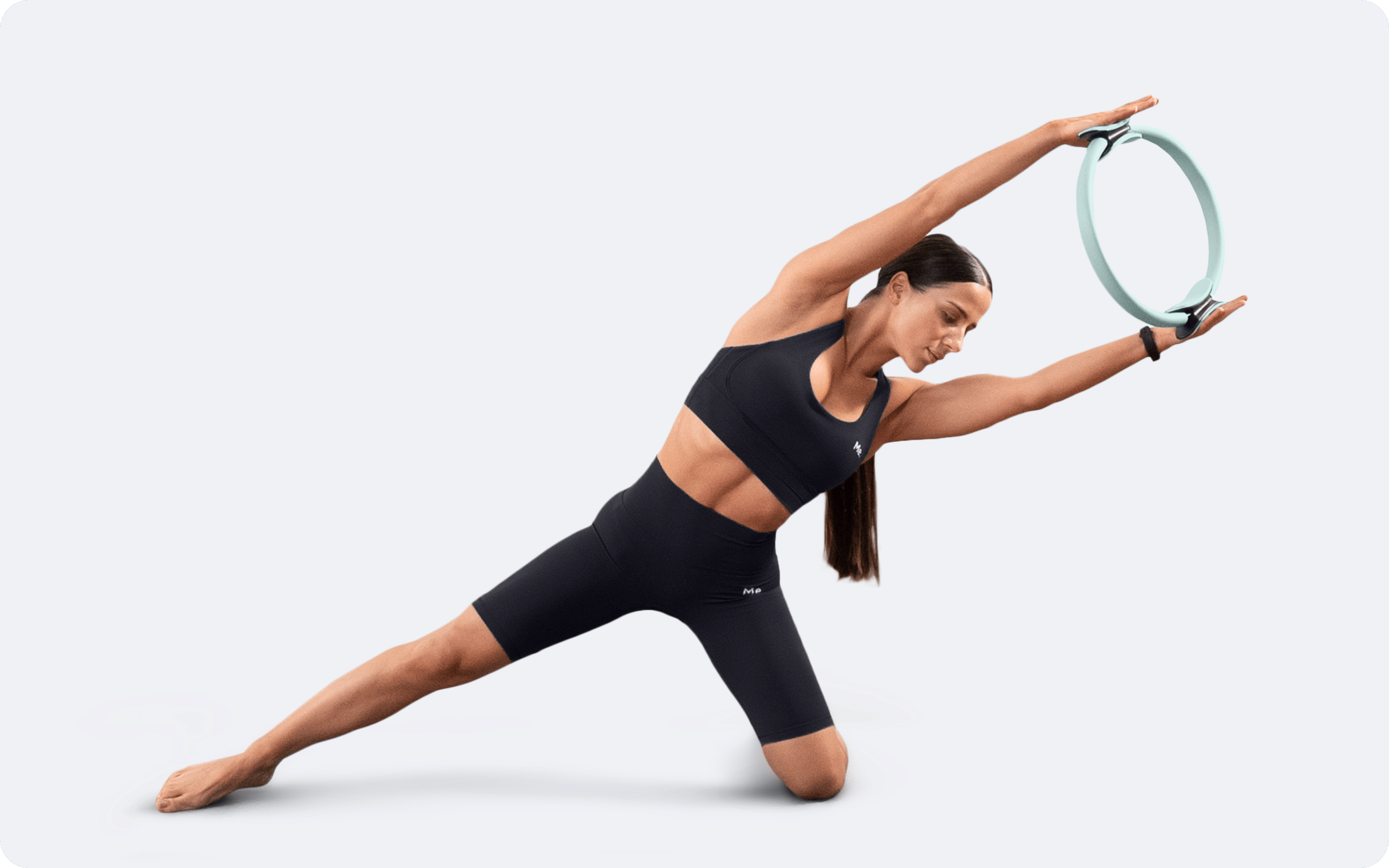
Hand presses, arm reaches, and controlled circles involve the arms while you hold the prop. The ring mainly resists compression. Moving a lightweight circle does not provide the same load as a heavy weight.
Chest-height hand press
- Sit or stand with the circle in front of your chest.
- Rest your palms on the outer pads.
- Press inward gently.
- Release while keeping your elbows comfortable.
Keep your shoulders relaxed. If your wrists bend sharply, reposition the hands or choose another ring. Use enough pressure to feel the task without losing your starting position.
Small arm circles
- Hold the ring in front of your body.
- Raise your arms to a manageable height.
- Draw a small circle with the ring.
- Reverse the direction after a comfortable set.
- Lower your arms before resting.
Begin below shoulder height. Circles should remain smooth, without pushing through shoulder discomfort. A smaller path is easier to regulate.
Comfortable overhead reach
- Hold the ring near chest height.
- Raise the circle through a comfortable arc.
- Pause before your ribs lift or shoulders become uncomfortable.
- Lower the ring gradually.
An overhead reach is optional. You do not need to place the circle behind your head. A chest-height press can remain your upper-body choice when the overhead range is unsuitable.
Can ring exercises build strength?
Ring exercises can provide a muscular challenge, with strength development depending on the resistance and overall training program. Progressive resistance training supports muscle function (4). A fixed ring eventually limits how much load you can add.
One Pilates trial measured abdominal and upper-body endurance improvements in active middle-aged adults (2). Another trial measured static balance and abdominal endurance improvements in young women (5). Neither establishes results from a ring alone.
Use a training record to describe what changed. You might complete the same press with steadier shoulders or a smoother release. Those observations describe execution without implying a guaranteed appearance change.
Who knew a ring could reshape your routine? With BetterMe’s Pilates Essential Kit , resistance meets comfort in every squeeze to snap you into shape. Ideal for any fitness level, this ring’s padded handles ensure your workout is a pleasure, not a chore. Add it to your routine and watch as it circles you closer to your sculpting goals.
How can you organize a short practice?
Organize practice around a few distinct movements rather than many nearly identical squeezes. The following table is an editorial starting example. The amounts can be reduced when you need more practice or rest.
|
Practice stage |
Movement |
Optional amount |
|---|---|---|
|
Preparation |
Easy unweighted movement |
A comfortable warm-up |
|
Supported pressure |
Supine thigh press |
6 to 8 presses |
|
Hip movement |
Bridge with optional ring |
6 to 8 repetitions |
|
Upper-body pressure |
Chest-height hand press |
6 to 8 presses |
|
Trunk control |
Supine arm reach |
6 repetitions |
|
Finish |
Easy movement and equipment removal |
Unhurried transition |
Rest between movements and leave enough time to reposition the prop. The practice has no exact duration because your pace varies. You can stop after the supported presses when learning the equipment.
General adult guidance includes aerobic activity and work for the major muscle groups (6). A short ring practice covers selected movements. Consider walking, other strengthening work, and your usual activity when planning the week.
The barre and Pilates comparison explains how class formats differ. Choose your next activity according to the task you want to practice.
FAQs
Can I use a household object instead of a ring?
No, a rigid book or breakable object is an unsuitable replacement for a flexible exercise prop. Choose the unweighted movement instead.
Do I need a ring for every exercise in a class?
No, you can use an unweighted version when the prop placement does not suit you. Ask the instructor for the corresponding movement.
Can a ring teach me pelvic-floor exercises?
No, a thigh squeeze alone does not establish pelvic-floor technique. Seek individual guidance from a qualified professional for that specific task.

The bottom line
Choose ring exercises by the movement you want to practice. Start with supported hand or thigh presses and a comfortable fit. Add combined movements gradually, with unweighted options available whenever the circle changes your technique.
DISCLAIMER:
This article is intended for general informational purposes only and does not serve to address individual circumstances. It is not a substitute for professional advice or help and should not be relied on for making any kind of decision-making. Any action taken as a direct or indirect result of the information in this article is entirely at your own risk and is your sole responsibility.
BetterMe, its content staff, and its medical advisors accept no responsibility for inaccuracies, errors, misstatements, inconsistencies, or omissions and specifically disclaim any liability, loss or risk, personal, professional or otherwise, which may be incurred as a consequence, directly or indirectly, of the use and/or application of any content.
You should always seek the advice of your physician or other qualified health provider with any questions you may have regarding a medical condition or your specific situation. Never disregard professional medical advice or delay seeking it because of BetterMe content. If you suspect or think you may have a medical emergency, call your doctor.
SOURCES:
- Ultra-Fit Circle (n.d., www.pilates.com)
- Pilates for improvement of muscle endurance, flexibility, balance, and posture (2010, pubmed.ncbi.nlm.nih.gov)
- Effects of Pilates Training on Lumbo-Pelvic Stability and Flexibility (2011, pmc.ncbi.nlm.nih.gov)
- American College of Sports Medicine Position Stand. Resistance Training Prescription for Muscle Function, Hypertrophy, and Physical Performance in Healthy Adults: An Overview of Reviews (2026, pmc.ncbi.nlm.nih.gov)
- Can a pilates exercise program be effective on balance, flexibility and muscle endurance? A randomized controlled trial (2016, pubmed.ncbi.nlm.nih.gov)
- Adult Activity: An Overview (2024, www.cdc.gov)
 Reviewed by
 Reviewed by