Many people believe that an effective workout requires a gym membership, heavy equipment, or high-impact movements. This common problem often discourages individuals who are new to fitness, recovering from an injury, or have mobility limitations. The truth is, you can achieve a comprehensive, full-body workout using one simple tool you already have at home: a sturdy chair. This guide will provide a structured approach to getting started.
This article will break down everything you need to know about full body chair workouts. You’ll learn what they are, how they work, and which muscles you can train. We’ll also provide a beginner-friendly routine you can do right away, clarify the results you can expect, and highlight common mistakes to avoid.
What Are Effective Full Body Chair Workouts?
Effective full body chair workouts are structured exercise routines that use a chair for support to train all major muscle groups. These workouts are not simply about sitting; they leverage the chair as a tool to modify traditional exercises, making them more accessible while still challenging your muscles (1). For many beginners, this can serve as a basic full body workout that builds strength, balance, and confidence without requiring a gym.
The primary goal is to improve strength, flexibility, and overall fitness without putting excessive strain on the joints.
How Chair-Supported Training Works
The effectiveness of these workouts hinges on a core principle of exercise science: progressive overload (2). To build muscle and strength, you must challenge your muscles beyond their current capacity.
While chair exercises are low-impact, they can be intensified to create the necessary stimulus for growth. This is achieved by manipulating several variables.
- Mechanical Tension: This is the force placed on muscles during an exercise. Research consistently identifies mechanical tension as the primary driver of muscle hypertrophy (growth) (3). Even with bodyweight exercises, you can generate significant tension by focusing on controlled movements and holding contractions (4).
- Volume: This refers to the total amount of work performed, calculated as sets multiplied by reps (5). Increasing the number of repetitions or sets you perform over time is a key way to apply progressive overload.
- Intensity: This relates to how difficult the exercise feels. For resistance training, it’s often measured as a percentage of your one-rep max (5). In bodyweight or light-weight exercises, intensity can be increased by increasing exercise complexity, reducing rest times, or adding resistance like bands or dumbbells (6).
Full body chair workouts at home can be designed to apply these principles in a safe, supported manner, making them an excellent starting point for a fitness journey.
Are Chair Workouts Effective for Full-Body Training?
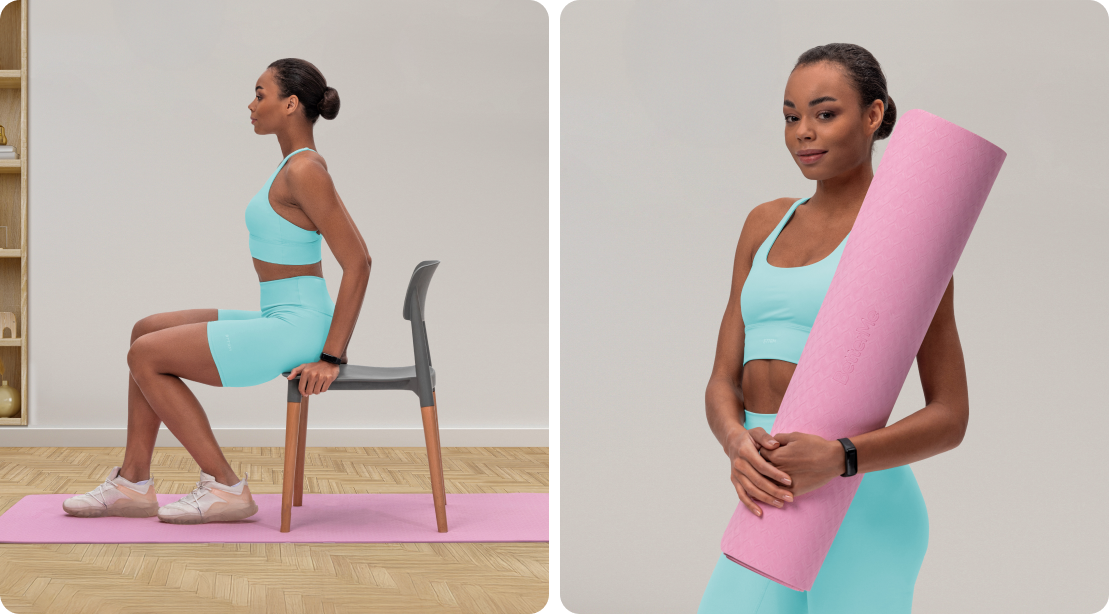
Yes, chair workouts can be highly effective for full-body training, provided they are structured correctly. A well-designed routine targets muscles from your upper body, lower body, and core. The chair provides stability, which allows you to focus on proper form and muscle engagement–a critical component for both safety and results (7).
The key is to select exercises that work multiple muscle groups simultaneously or to sequence exercises to ensure every part of the body is addressed. For example, a chair squat primarily targets the lower body, while a seated row works the back and arms. Combining these into a single workout ensures a balanced approach. These routines can be adapted for all fitness levels, from beginners to more advanced individuals looking for a low-impact training day.
Reasons why BetterMe is a safe bet: a wide range of calorie-blasting workouts, finger-licking recipes, 24/7 support, challenges that’ll keep you on your best game, and that just scratches the surface! Start using our app and watch the magic happen.
What Muscles Can Be Trained Using a Chair?
A chair is a surprisingly versatile piece of equipment that allows you to train nearly every major muscle group in the body. By using it for support, stability, or as a bench, you can effectively target specific areas.
Upper Body
- Chest (Pectorals): Modified push-ups with your hands on the seat of the chair can effectively target the chest muscles. The incline reduces the amount of body weight you have to lift, making it a great progression toward standard push-ups.
- Back (Latissimus Dorsi, Rhomboids): Seated rows, performed with resistance bands anchored to a stable object in front of you, are excellent for strengthening the back.
- Shoulders (Deltoids): Seated overhead presses, with or without light weights, work the shoulder muscles. You can also perform lateral raises while seated to target the side deltoids.
- Arms (Biceps and Triceps): Triceps dips using the edge of the chair are a classic and effective exercise. Bicep curls can be done while seated, using dumbbells or resistance bands.
Lower Body
- Thighs (Quadriceps and Hamstrings): Chair squats, where you lower yourself until you lightly touch the chair before standing back up, are a fundamental exercise for leg strength. Leg extensions and hamstring curls can also be performed from a seated position.
- Glutes (Gluteus Maximus): Glute bridges, with your feet on the chair, increase the range of motion and challenge the glutes and hamstrings more intensely than the floor version.
- Calves (Gastrocnemius and Soleus): Seated or standing calf raises using the chair for balance are simple yet effective for strengthening the lower legs.
Core
- Abdominals and Obliques: Seated crunches, Russian twists, and knee-to-chest movements all engage the core muscles. Maintaining an upright posture during all seated exercises also provides constant core stabilization work.
Read more: Seated Upper-Body Workout for Seniors: 5 Exercises for Strength
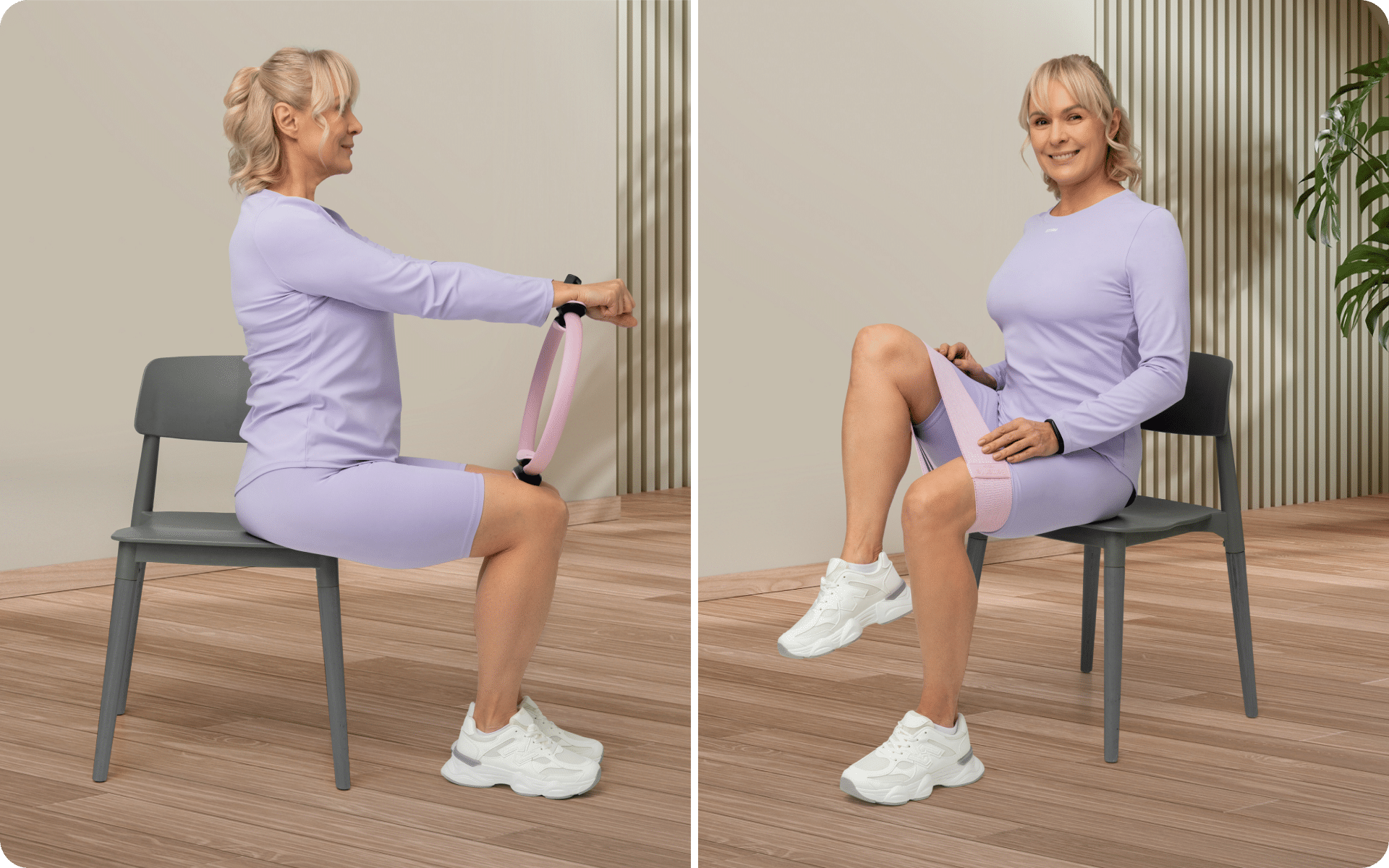
What Are Beginner-Friendly Full Body Chair Workouts?
This program is designed for individuals new to exercise. It requires only a sturdy chair and can be performed with or without light weights. Focus on maintaining proper form throughout each movement. This is a full body chair workout for beginners that can be done right at home.
Program Notes
- Equipment: A sturdy chair without wheels. Optional: light dumbbells (2-5 lbs or 1-2 kg) or resistance bands.
- Glossary:
- Rep: One complete execution of an exercise.
- Set: A group of consecutive reps.
- Rest: The recovery period between sets.
- Reps and Sets: Perform 10-15 reps for each exercise. Complete 2-3 sets of the entire circuit.
- Rest: Rest for 45-60 seconds between each set.
- Frequency: Aim to perform this workout 2-3 times per week on non-consecutive days.
Beginner Full Body Chair Workout Routine
| Exercise | Sets | Reps | Notes |
|---|---|---|---|
| Warm-Up: Marching in Place | 1 | 2-3 min | Lift knees high to elevate heart rate. |
| Chair Squats | 2-3 | 10-15 | Touch the chair lightly; don't sit down. |
| Incline Push-Ups | 2-3 | 10-15 | Hands on the edge of the chair seat. |
| Seated Rows | 2-3 | 10-15 | Use a resistance band or light weights. |
| Seated Leg Lifts | 2-3 | 10-15 | Alternate legs each rep. |
| Triceps Dips | 2-3 | 10-15 | Keep your back close to the chair. |
| Seated Bicep Curls | 2-3 | 10-15 | Use light weights or resistance bands. |
| Seated Russian Twists | 2-3 | 10-15 | Twist from your torso, not your arms. |
| Cool-Down: Seated Stretches | 1 | 3-5 min | Hold each stretch for 20-30 seconds. |
Exercise Instructions
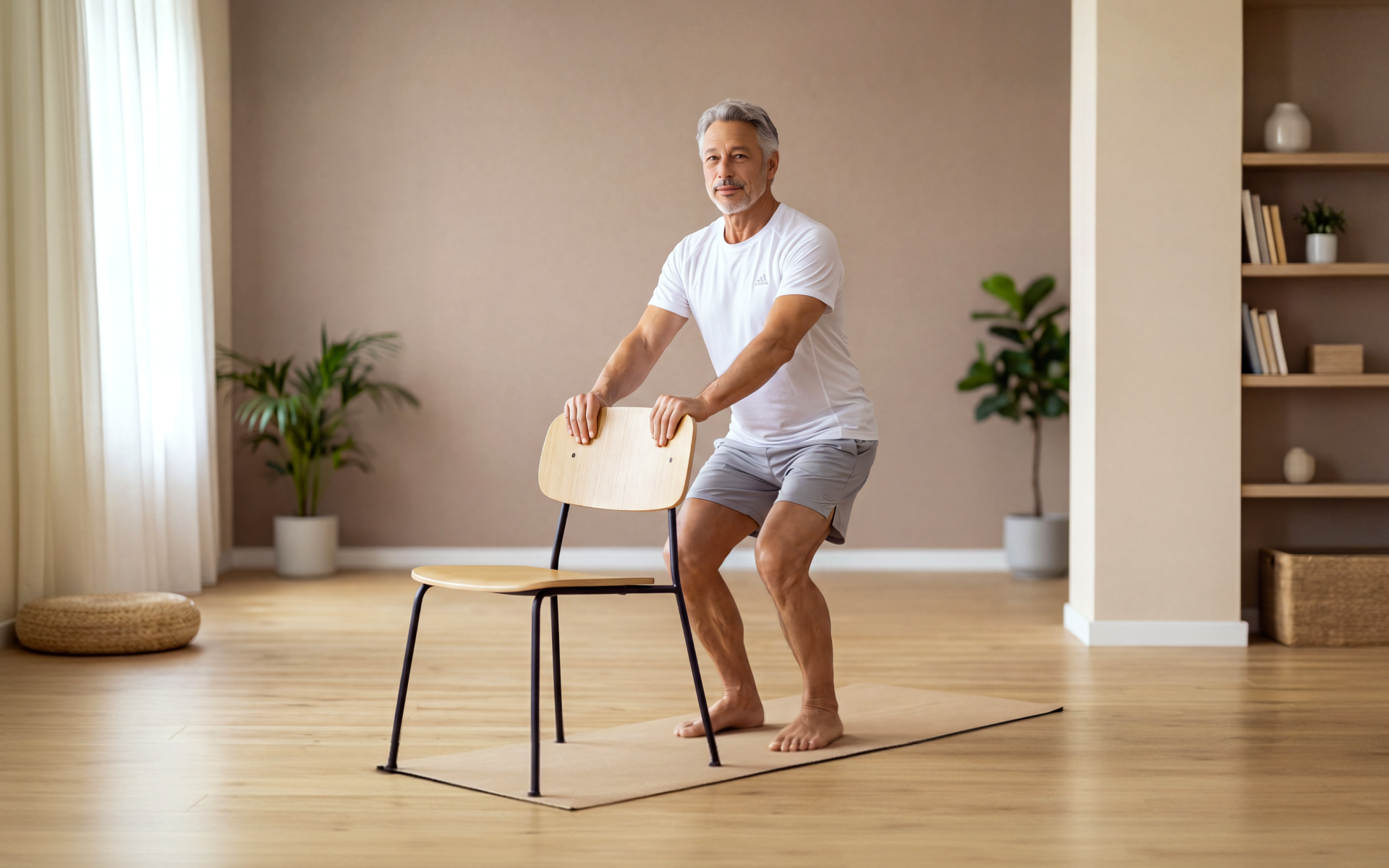
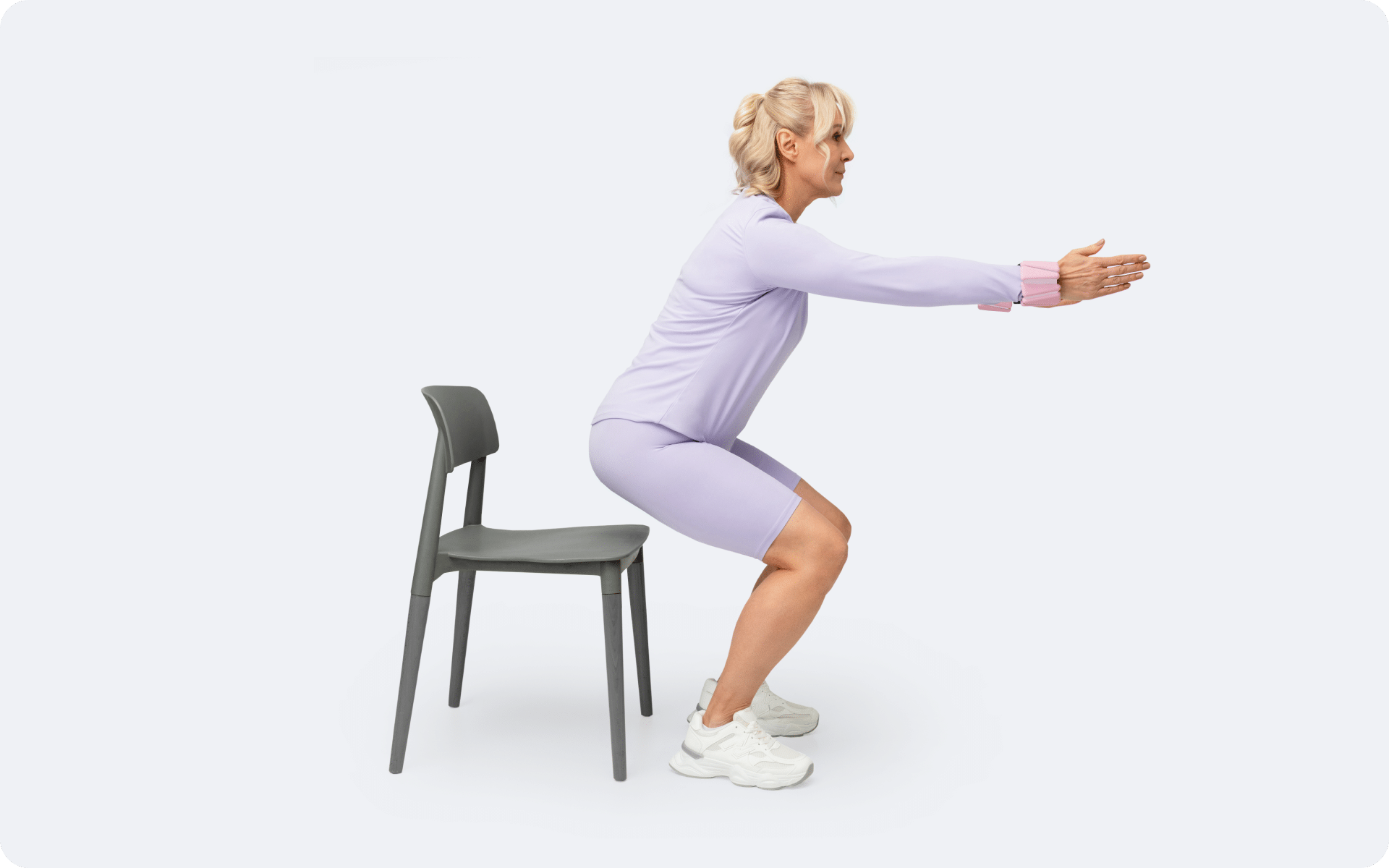
Chair Squats
- Stand in front of the chair with your feet shoulder-width apart, toes pointing slightly outward.
- Keeping your chest up and back straight, hinge at your hips and bend your knees as if you are about to sit down.
- Lower your hips until your glutes lightly touch the edge of the chair.
- Push through your heels to return to the starting standing position, squeezing your glutes at the top.
Incline Push-Ups
- Place your hands on the front edge of the chair seat, slightly wider than shoulder-width apart.
- Extend your legs behind you so your body forms a straight line from your head to your heels.
- Keeping your core engaged, lower your chest toward the chair by bending your elbows.
- Push back up to the starting position until your arms are fully extended.
Seated Rows
- Sit upright on the edge of the chair, with your feet flat on the floor. If using a band, anchor it to a stable object in front of you.
- Hold the handles of the band or light dumbbells with your arms extended forward.
- Pull the handles toward your lower abdomen, squeezing your shoulder blades together.
- Slowly extend your arms to return to the starting position.
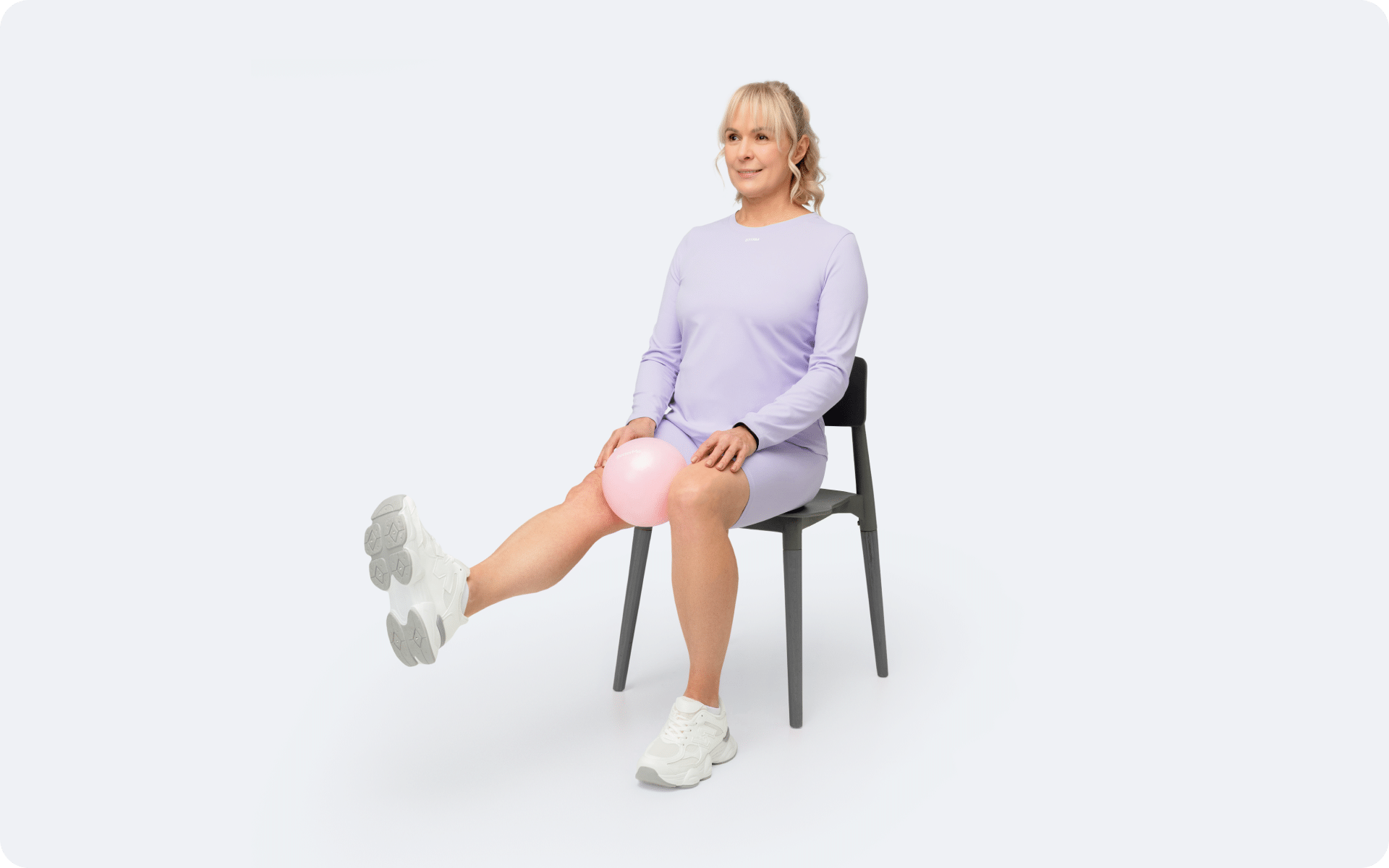
Seated Leg Lifts
- Sit tall on the edge of your chair with your back straight and feet on the floor.
- Engage your core and slowly lift one leg until it is straight out in front of you, parallel to the floor.
- Hold for a second, then slowly lower it back down.
- Repeat with the other leg. This completes one repetition.
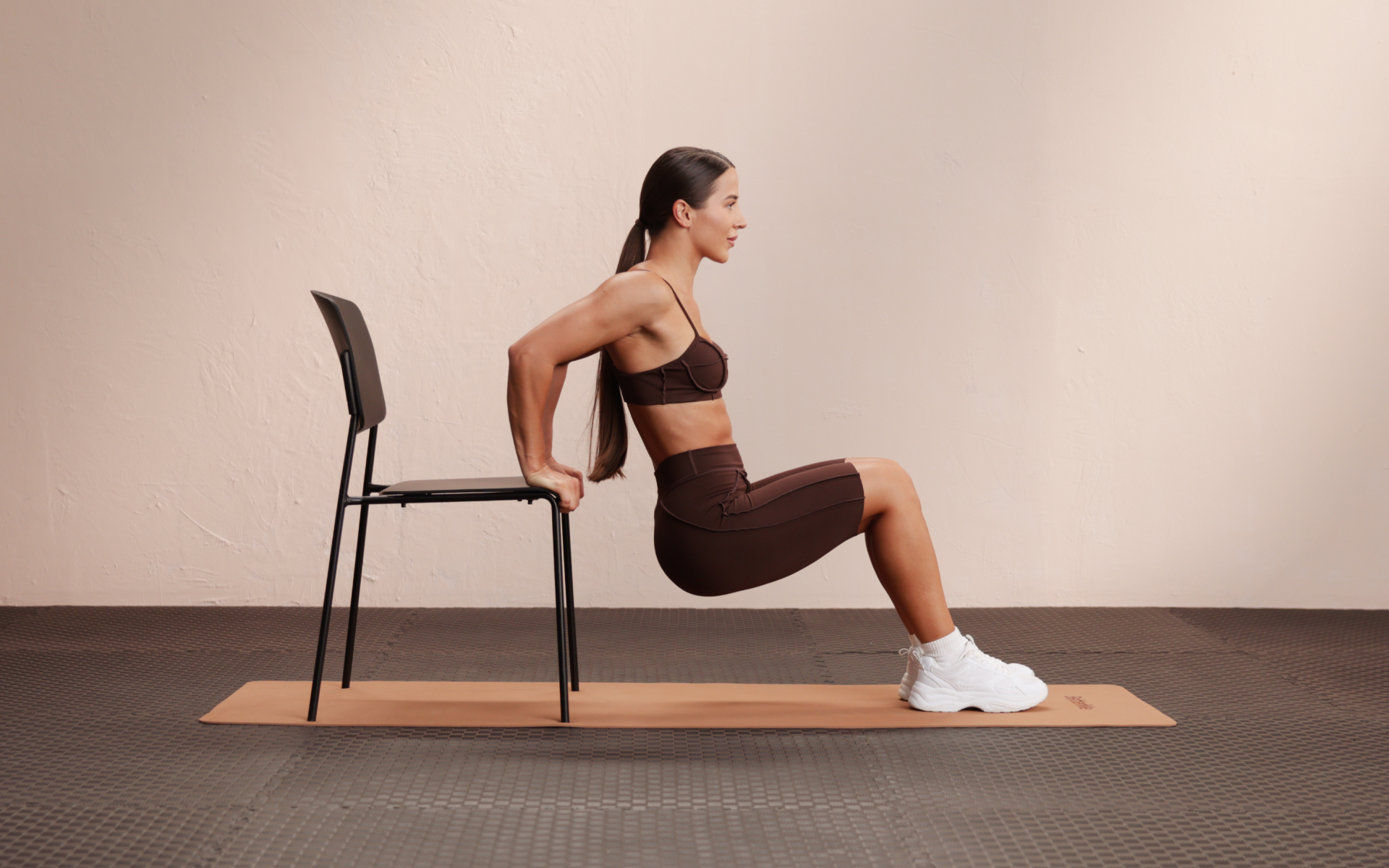
Triceps Dips
- Sit on the very edge of the chair and place your hands on the seat next to your hips, fingers pointing forward.
- Slide your hips forward off the chair, supporting your weight with your arms. Your legs can be bent or straight for more of a challenge.
- Lower your body by bending your elbows until they are at a 90-degree angle.
- Push through your palms to straighten your arms and return to the starting position.
Seated Bicep Curls
- Sit upright on the edge of the chair, holding a dumbbell in each hand with your palms facing forward.
- Keeping your elbows tucked into your sides, curl the weights up toward your shoulders.
- Squeeze your biceps at the top of the movement.
- Slowly lower the weights back to the starting position.
Seated Russian Twists
- Sit on the edge of the chair and lean back slightly, engaging your core to maintain a straight back. You can cross your ankles and lift your feet off the floor for more of a challenge.
- Clasp your hands together in front of your chest.
- Slowly twist your torso from side to side.
- Focus on rotating your ribcage, not just moving your arms.
Read more: Seated Yoga Poses Sequence: How to Build a Balanced, Senior- and Beginner-Friendly Routine
What Results Can You Expect from Full Body Chair Workouts?
Consistency is the most important factor in achieving results from any fitness program. With regular practice, you can expect to see several positive changes within 4-8 weeks. However, if you are wondering whether you should do a full body workout everyday, it is usually better to include rest or lighter movement days so your muscles have time to recover.
- Increased Muscular Strength and Endurance: You will notice daily activities like climbing stairs, carrying groceries, and getting up from a chair become easier. This is a direct result of improved strength in your legs, core, and upper body.
- Improved Mobility and Flexibility: Many chair exercises involve movements that take your joints through their full range of motion. This can help reduce stiffness and improve your ability to move freely (8).
- Enhanced Balance and Stability: Exercises that challenge your balance, even in a supported manner, help strengthen the small stabilizer muscles around your joints and improve your proprioception–your body’s awareness of its position in space (9).
- Potential for Body Recomposition: While nutrition plays the largest role in weight management, building muscle increases your resting metabolic rate (10). Consistent chair workouts, especially full body chair workouts with weights, can contribute to losing fat and gaining lean muscle over time (7). For this reason, a chair workout for weight loss can be a helpful part of a broader plan that also includes balanced nutrition, regular movement, and adequate recovery.
What Mistakes Can Reduce the Effectiveness of Chair Workouts?
To get the most out of your full body chair workouts no equipment, it’s important to avoid common errors that can limit your progress and increase the risk of injury.
Using an Unstable Chair
Always use a strong, sturdy chair that does not have wheels. A dining room chair is often a good choice. An unstable chair can move during an exercise, leading to a fall or improper form.
Poor Posture
Slouching or rounding your back during seated exercises disengages your core and can place unnecessary strain on your spine (11). Focus on sitting or standing tall, with your shoulders back and your core engaged, throughout every movement.
Rushing Through Movements
Performing exercises too quickly relies on momentum rather than muscle strength. This reduces muscle activity, making the exercise less effective (12). Perform each repetition in a slow, controlled manner to maximize muscle engagement. Aim for a 2-second lifting phase and a 3-second lowering phase.
Not Progressing
Your body adapts to exercise. If you continue to do the same routine with the same reps and sets indefinitely, your progress will plateau (13). To continue making gains, you must progressively overload your muscles. You can do this by:
- Increasing the number of reps or sets.
- Reducing your rest time between sets.
- Adding light weights or resistance bands.
- Choosing a more challenging exercise variation.
Whether you’re looking to simply pep up your fitness routine, jazz up your diet with mouth-watering low-calorie recipes or want to get your act together and significantly drop that number on your scale – BetterMe Well-Being Coach app has got you covered! Improve your body and revamp your life!
Who Benefits Most from Full Body Chair Workouts?
While anyone can incorporate chair workouts into their routine, certain groups may find them particularly beneficial.
- Beginners: Chair workouts provide a safe and structured entry point into fitness, helping to build a foundation of strength and confidence.
- Older Adults: Low-impact exercises help maintain muscle mass, bone density, and balance, which are crucial for healthy aging and fall prevention.
- Individuals with Mobility or Balance Issues: The support of a chair makes exercise accessible for those who may struggle with traditional standing exercises.
- People in Rehabilitation: Chair exercises are often recommended during recovery from injury or surgery as they allow for controlled, gentle movement.
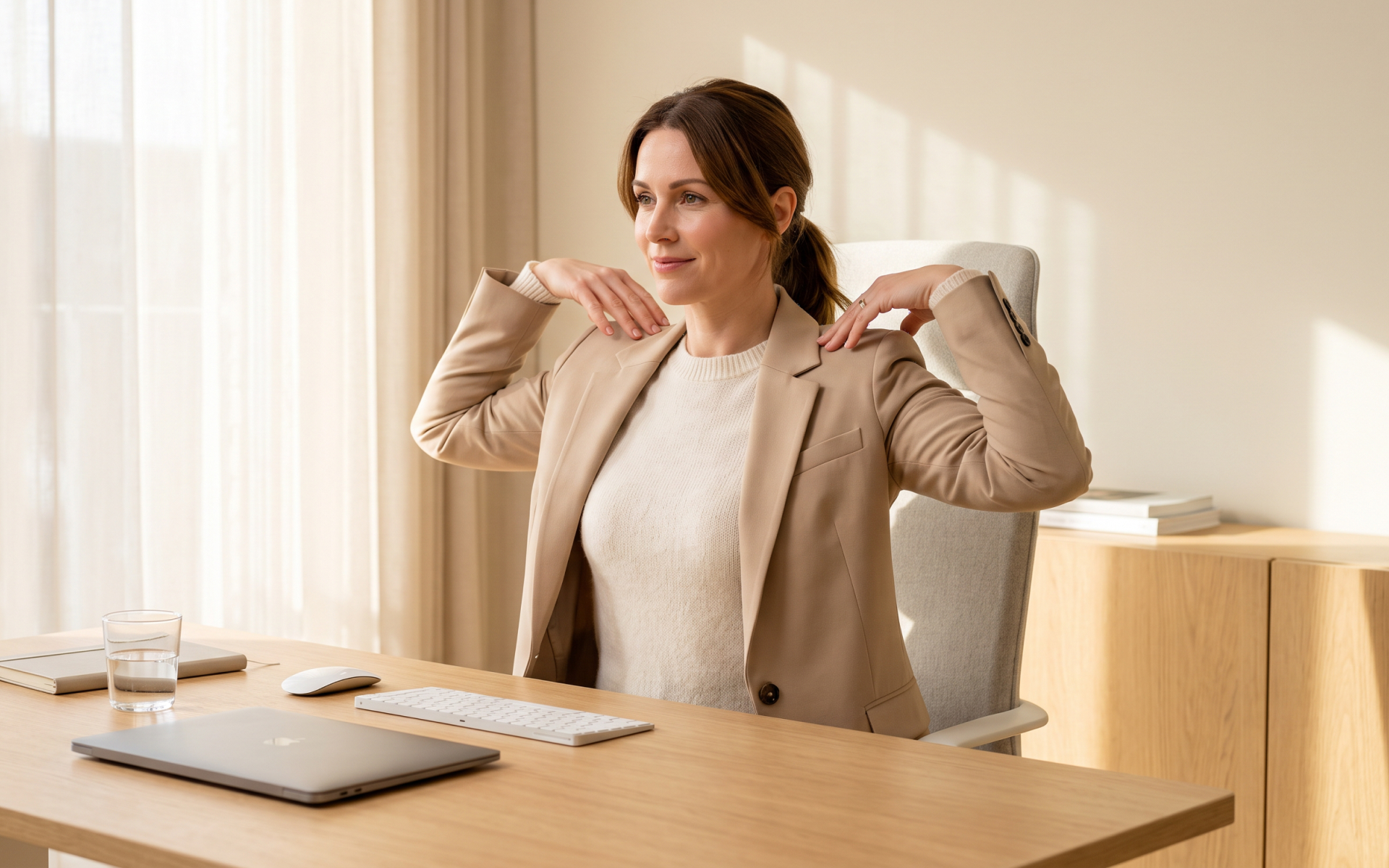
- Office Workers: Taking short breaks for a few chair exercises can help counteract the negative effects of prolonged sitting, improving posture and reducing stiffness.
Frequently Asked Questions
Can you lose belly fat with chair exercises?
Chair exercises can contribute to overall fat loss (14), which includes belly fat, but they cannot spot-reduce fat from your stomach. Fat loss occurs when you are in a consistent calorie deficit, meaning you burn more calories than you consume (15).
Chair workouts help by burning calories and building muscle, which slightly boosts your metabolism (16). Combining these workouts with a balanced diet is the most effective strategy for reducing body fat.
Can chair workouts help build strength?
Yes, chair workouts can absolutely help build strength (1). By applying the principle of progressive overload–gradually increasing the difficulty of your workouts–you create the necessary stimulus for your muscles to adapt and become stronger. Starting with bodyweight and then adding resistance like bands or weights will ensure continued strength gains.
Are chair workouts effective without equipment?
Yes, they are highly effective without any equipment. Many exercises, such as chair squats, incline push-ups, and leg lifts, use your own body weight as resistance. These are perfect for building foundational strength. A full body chair workout no equipment is an excellent and accessible option for almost anyone.
How many times a week should you do chair exercises?
For general fitness and strength gains, aiming for 2 to 4 full-body chair workout sessions per week is a great goal. It’s important to have rest days in between sessions to allow your muscles to recover and rebuild. Listening to your body is key; if you feel overly sore, take an extra day off.
What is the best time of day for chair workouts?
There is no single “best” time to exercise; the optimal time is whenever you can consistently fit it into your schedule. Some people feel more energized working out in the morning, while others prefer the afternoon or evening. Consistency is far more important than the specific time of day.
The Bottom Line
Getting started with fitness doesn’t have to be complicated or intimidating. By using a simple chair, you can build a strong, capable body from the comfort of your own home. The key is to begin with proper form, stay consistent, and challenge yourself gradually over time. You have the tools and the knowledge to start your journey toward better health and strength today.
DISCLAIMER:
This article is intended for general informational purposes only and does not serve to address individual circumstances. It is not a substitute for professional advice or help and should not be relied on for making any kind of decision-making. Any action taken as a direct or indirect result of the information in this article is entirely at your own risk and is your sole responsibility.
BetterMe, its content staff, and its medical advisors accept no responsibility for inaccuracies, errors, misstatements, inconsistencies, or omissions and specifically disclaim any liability, loss or risk, personal, professional or otherwise, which may be incurred as a consequence, directly or indirectly, of the use and/or application of any content.
You should always seek the advice of your physician or other qualified health provider with any questions you may have regarding a medical condition or your specific situation. Never disregard professional medical advice or delay seeking it because of BetterMe content. If you suspect or think you may have a medical emergency, call your doctor.
SOURCES:
- The Effect of Chair-Based Exercise on Physical Function in Older Adults: A Systematic Review and Meta-Analysis (2021, mdpi.com)
- Exercise progressions and regressions in sports training and rehabilitation (2024, sciencedirect.com)
- Anabolic signals and muscle hypertrophy – Significance for strength training in sports medicine (2025, sciencedirect.com)
- Bodyweight Training for Muscular Strength & Endurance (2022, researchgate.net)
- Resistance Training Variables for Optimization of Muscle Hypertrophy: An Umbrella Review (2022, frontiersin.org)
- Complexity: A Novel Load Progression Strategy in Strength Training (2019, frontiersin.org)
- A Chair-Based Music–Kinetic Combined Exercise Program as an Alternative Approach for Increasing Health, Functional Capacity, and Physical Fitness Indices in Middle-Aged Pre-Menopausal Women (2013, mdpi.com)
- The effect of chair-based exercise on physical functioning in postmenopausal women: a meta-analysis (2025, link.springer.com)
- Sensorimotor and proprioceptive exercise programs to improve balance in older adults: a systematic review with meta-analysis (2024, pmc.ncbi.nlm.nih.gov)
- The relationship between resting metabolic rate and quality of life is moderated by age and body composition in women: a cross-sectional study (2024, link.springer.com)
- Sitting and low back disorders : an overview of the most commonly suggested harmful mechanisms (2018, researchgate.net)
- The Influence of Movement Tempo During Resistance Training on Muscular Strength and Hypertrophy Responses: A Review (2021, link.springer.com)
- The Plateau in Muscle Growth with Resistance Training: An Exploration of Possible Mechanisms (2024, link.springer.com)
- Effect of Exercise Training on Fat Loss—Energetic Perspectives and the Role of Improved Adipose Tissue Function and Body Fat Distribution (2021, frontiersin.org)
- Optimal Diet Strategies for Weight Loss and Weight Loss Maintenance (2020, pmc.ncbi.nlm.nih.gov)
- Exercise and metabolic health: beyond skeletal muscle (2021, link.springer.com)
 Reviewed by