
For the most part, modern professional life is characterised by long office hours spent sitting at a desk. While we no longer have to hunt for daily sustenance like our early ancestors did, a life spent sitting, often in rigid positions, can lead to posture problems.
Desk exercises may offer a simple yet impactful way to help combat posture problems caused by the regular 9-5 work schedule. Here’s a guide of exercises to do at your desk that could help you sit better and alleviate musculoskeletal pain.
How Does a Desk Job Affect Your Body?
According to research, sitting for long hours, e.g. while working a desk job, could lead to a sedentary lifestyle. Spending too much time sitting with very little movement can negatively impact your long-term wellness. Staying inactive is closely linked to a lower life expectancy and a higher likelihood of facing long-term health challenges (1).
However, this isn’t all. Some studies have found links between having a desk job and posture, as well as posture-related discomfort:
- One study that looked at the adverse effects of prolonged sitting found that office workers were the most prevalent demographic to show discomfort with neck, lower back, and shoulders (2).
- Another study that looked at office workers’ health and posture found that a significant number of them complained about (3):
- Having an awkward posture during working hours.
- Experiencing some physical strain that required professional assistance to manage.
- Another study that looked at the effects of lengthy sitting in professionals found that many of them reported strain in varying areas, such as the neck, shoulders, upper back, wrists/hands, lower back, knees, and ankles/feet. Of all the areas reported, lower-back strain and discomfort were the highest-suffering region (4).
- In a more recent study, researchers found that using digital gadgets, e.g. using a computer at your work desk, has raised concerns over physical strain due to poor posture. Users of such gadgets experience discomfort in their neck, shoulders, and hands. They may also experience tension in their muscles, tendons, and joints. This leads to worsening posture and changes how a person walks or maintains their balance (5).
Spending too long sitting during office work can also negatively impact your creativity and lead to more problem-solving errors (6).
What Are Some Exercises to Do at Your Desk to Prevent Bad Posture?
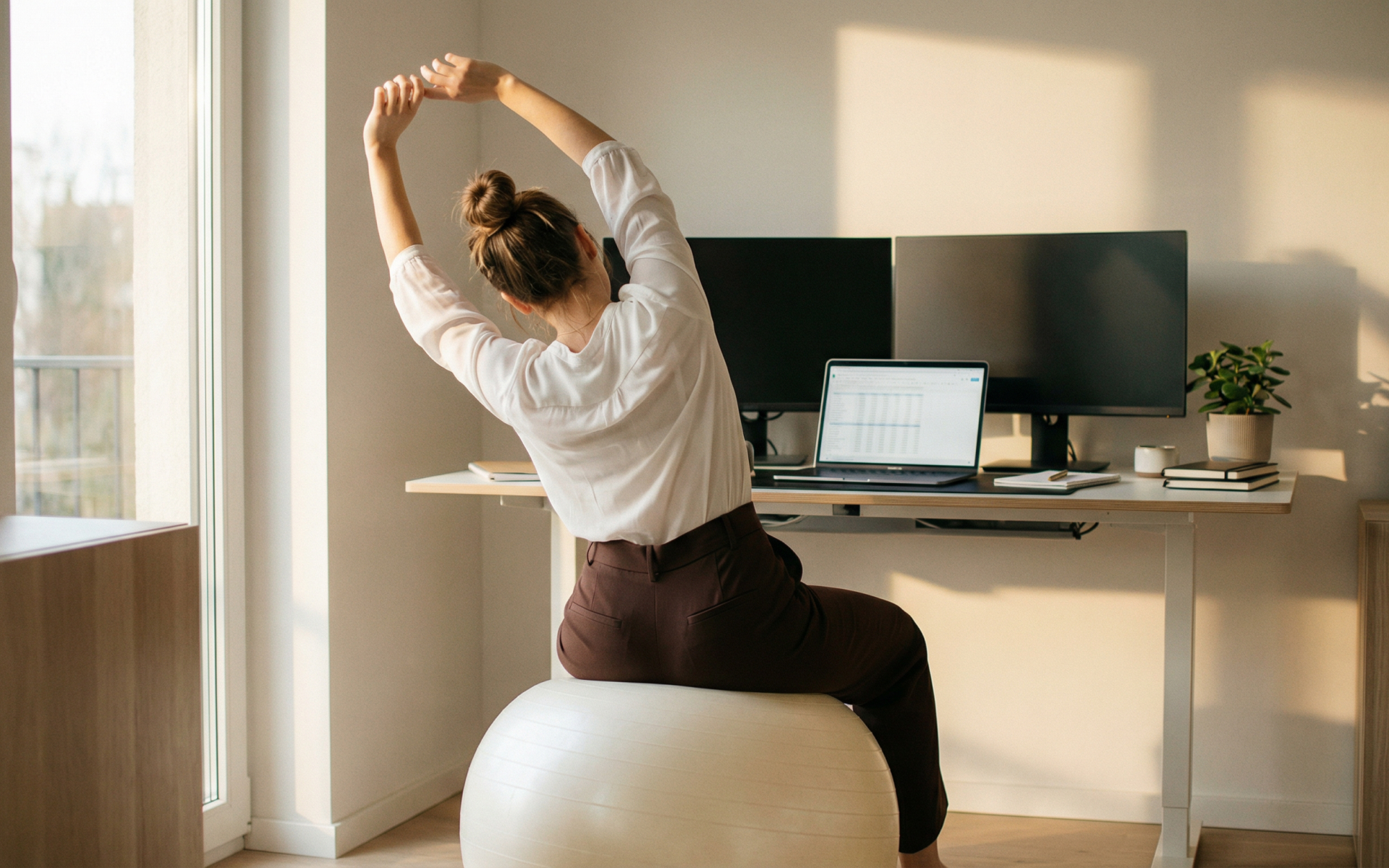
Desk posture exercises are stretches that you can do throughout the workday to adjust and refresh your seated position. Doing these stretches to improve posture will help prevent holding the same seated position for too long.
It can also work as a subtle way to help increase your daily physical activity, combating a sedentary lifestyle.
Here are some stretches and exercises that you can do at your desk while seated to help work on your posture. The best part is that you don’t need any specialized desk exercise equipment to complete them.
Chin Tucks
If your head sits forward of the shoulders, this stretch may help you realign your head and neck. This can improve your seated position and reduce physical tension (7).
How to perform chin tucks:
- Sit up straight.
- Nod your head to pull your chin straight back toward your chest, as if creating a double chin.
- Relax your jaw muscles and hold this position for 3-5 seconds.
- Relax your muscles and move your chin back to the starting position. This is one rep.
- Perform up to 10 reps.
BetterMe: Health Coaching app helps you achieve your body goals with ease and efficiency by helping to choose proper meal plans and effective workouts. Start using our app and you will see good results in a short time.
Neck Circles
As the name suggests, this stretch targets the neck and may help relieve tightness in the area, leading to a more comfortable neck position.
How to perform neck circles:
- Sit upright in your chair with your feet planted on the floor and your arms holding on to the seat of your desk chair.
- Relax your shoulders and neck, then lean your head forward.
- In a slow and controlled motion, roll your head toward one side and hold for 10 seconds.
- Repeat the movement on the other side.
- Relax again and lift your chin back to the starting position. This is one rep.
- Repeat this movement up to 5 times. Remember to keep the movement slow and controlled to avoid injury to the neck or dizziness.
Shoulder Shrugs
This exercise helps strengthen and stretch the muscles in your shoulders, neck, and upper back. This helps you maintain a balanced upright position and may also benefit you in relieving everyday tension and stress.
How to perform shoulder shrugs:
- Sit upright in your chair with a straight back.
- Engage your core and grasp the sides of the chair for stability.
- Inhale and lift your shoulders toward your ears. Hold for 3-5 seconds.
- Exhale and relax, dropping your shoulders back down to their neutral position.
- This is one rep. Repeat the movement 10-15 times.
Seated Cat-Cow
This popular stretch helps promote spinal flexibility in the back, which is useful for anyone who spends a lot of time sitting in one position. It also helps relieve tightness in the shoulders, neck, and lower back.
How to perform the seated cat-cow stretch:
- Sit comfortably on a chair. Place your feet hip-width apart and firmly plant them on the floor. Rest your hands on your knees or thighs.
- Inhale as you lift your chest toward the ceiling, arch your back gently, and draw your shoulders back and down. Hold for 3-5 seconds. This is the cow pose.
- Exhale as you round your back, tuck your tailbone, and pull your belly button toward your back, allowing your chin to drop to your chest. Hold for 3-5 seconds. This is the cat pose.
- Slowly continue flowing through these two poses for up to 10 breaths.
Seated Chest Opener
If you tend to sit in a hunched position, this stretch may help balance your alignment. It also helps you take a break from this hunched position throughout the day. This may reduce the risks and physical strain that are associated with slouching.
How to perform the seated chest opener:
- Sit upright and clasp your hands behind your back. This is the start position.
- Gently straighten your arms, lifting them slightly and opening your chest.
- Hold this position for up to 5 slow, deep breaths.
- Release going back to the starting position. This is one rep.
- Repeat the stretch 8-10 times.
Combine these exercises into a 10-minute office workout routine for better posture. You can do the routine whenever you have a break. However, if you don’t have set breaks, try your best to be intentional about practicing proper posture and movement techniques when working.
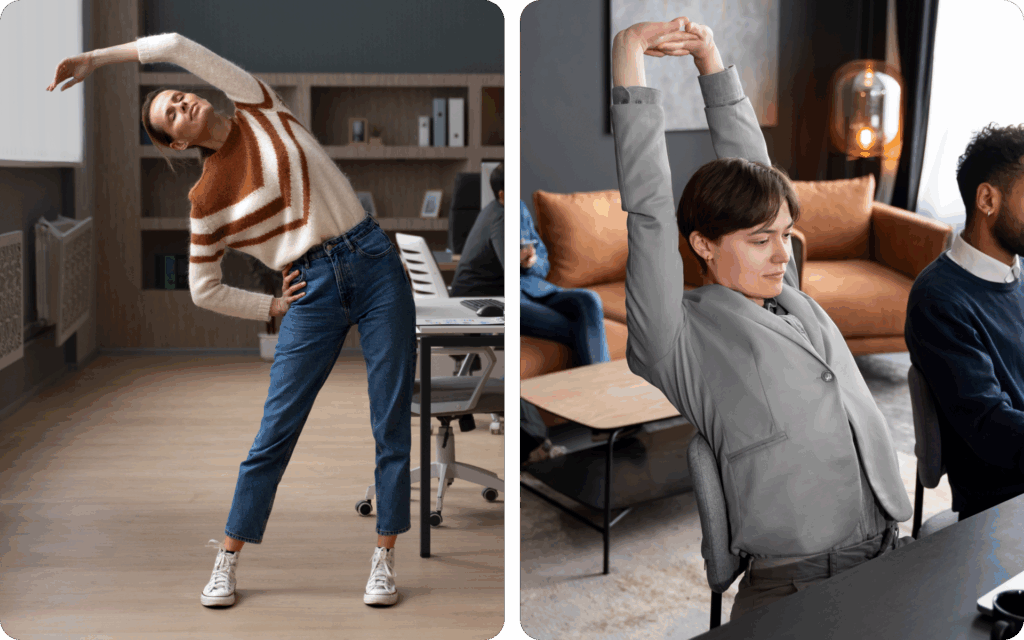
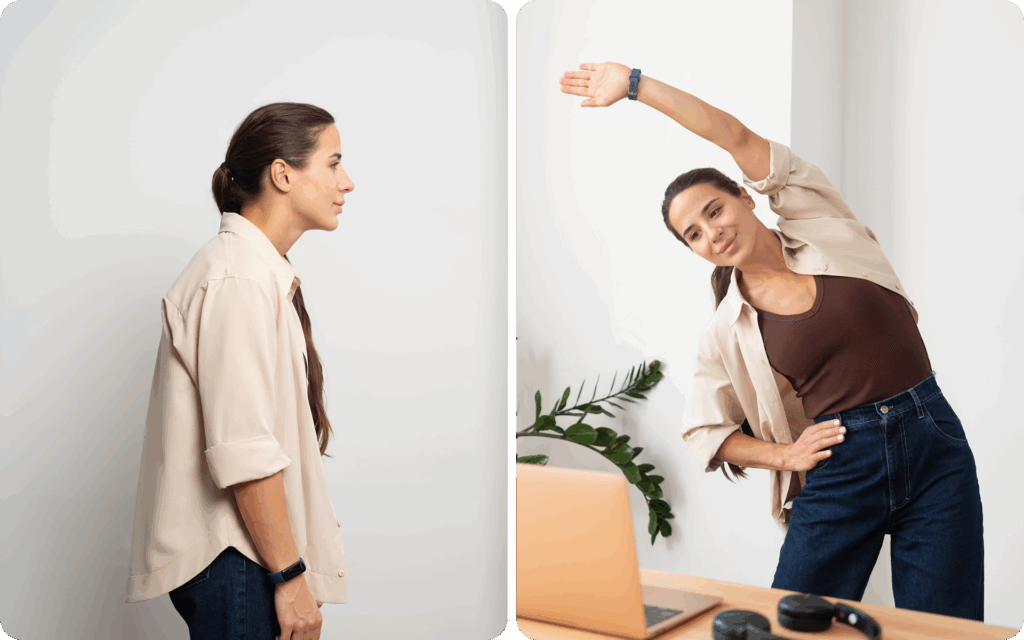
If you have some extra free space, standing desk workouts can also be beneficial. Some posture and strength exercises to do at work while standing include:
Wall Angels
This is great for targeting the upper back as it focuses on the muscles in the shoulders, upper back, and neck.
How to perform wall angels:
- Stand with your back against a wall, your feet shoulder-width apart.
- Press your lower back, upper back, and head against the wall.
- Raise your arms with your elbows bent at 90 degrees, so your upper arms are parallel to the floor and the backs of your hands are touching the wall.
- Slowly slide your arms up overhead, keeping them close to the wall, then return to the starting position.
- Repeat for 10-15 repetitions.
Standing Back Extensions
This exercise may help relieve any lower back pressure that’s caused by prolonged sitting. By relieving the pressure and supporting the back, the exercise may eventually help you stand and sit more comfortably.
How to perform standing back extensions:
- Stand upright with your feet shoulder-width apart. Place your hands on the back of your hips for support.
- Gently lean backward, allowing your hips to drift slightly forward while lifting your chest toward the sky. Aim for a relatively even curve in the lower back (lumbar spine).
- Hold this position for approximately 10 seconds before returning to the standing position. This counts as one rep.
- Repeat this stretch for 10-12 repetitions with slow, controlled movements.
Read more: Desk Chair Yoga for Office Workers: 6 Poses to Support Your Back
How to Exercise at Your Desk in Secret
Some subtle exercises you can do at your desk without drawing attention include:
- Neck rolls/circles
- Shoulder blade squeezes – squeezing the shoulder blades together for 10 seconds, then releasing
- Shoulder shrugs
- Chin tucks
Unlike some of the other stretches that were mentioned in the previous section, these are more subtle and won’t draw too much attention to you, if at all.
How to Have Good Posture when Working at a Desk
Consistently engaging your core and performing posture exercises at your desk can help you achieve better posture. It may also help prevent long-term discomfort caused by poor sitting habits.
Research has also stated that switching to a standing desk can positively impact positioning, reduce physical fatigue, and alleviate discomfort in individuals who carry their head forward. This could protect your physical well-being (8).
However, the best option for this is to learn how to sit properly at a desk.
Whether you’re a workout beast or just a beginner making your first foray into the world of fitness and dieting – BetterMe has a lot to offer to both newbies and experts! Install the app and experience the versatility first-hand!
How to Sit at a Desk Properly
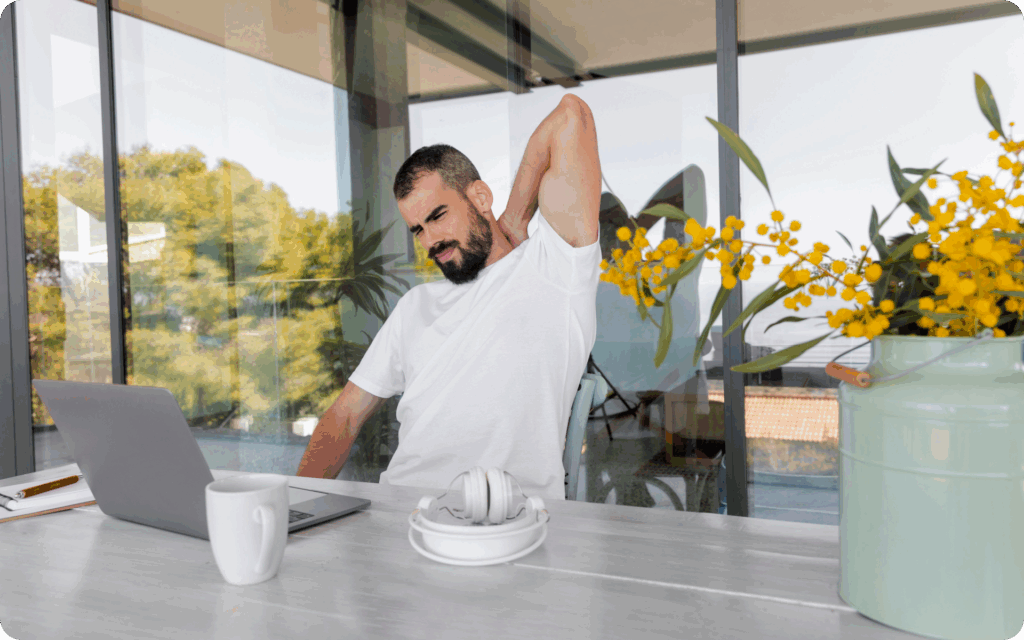
To sit properly at a desk, you should:
- Sit with your back against the chair.
- Keep your feet flat on the floor, and your knees at a 90-degree angle to your hips.
- Keep your shoulders relaxed and your elbows close to your body at 90-120 degrees.
- Ensure the top of your monitor is at eye level.
The right office equipment/furniture can help you achieve better desk posture:
- The chair – It should support your back properly and be the right height. When you sit, your feet should rest flat on the floor. If the chair cannot be adjusted for this, use a footrest and ensure your thighs are parallel to the floor.
- The desk – Should have enough room for your legs and feet. If the desk or chair are adjustable, adjust their height to make sure your legs and feet move freely under the desk.
- Keyboard and mouse – Should be in front of you so your wrists and forearms remain in line and your shoulders are relaxed. Keep both at an easy-to-reach distance.
- Monitor/laptop – If you’re using a monitor, place it straight in front of you about an arm’s length away from your face. The top of the monitor screen should be at or slightly below eye level.
If you’re working with a laptop, place it on a laptop stand and get an external keyboard and mouse. This will help mimic a monitor setup, which is easier on your wrists, shoulders, and neck
- Elbow and shoulder placement – Your elbows should always be close to your body, and your shoulders relaxed.
How to Prevent Tech Neck at Work
To prevent tech neck, you should:
- Learn to sit properly at work, as explained in the section above.
- Place the monitor or laptop at the correct eye level, as mentioned in the above section.
- If you’re using a phone, hold it higher.
- Take breaks every 2 hours and do chin tucks and neck circles. This helps to stretch and ease any tension or tightness in the neck area.
Read more: Chair Yoga for Office Workers: 6 Poses to Combat Stiffness and Fatigue
Can Exercises Help Improve Posture at Your Desk?
Yes, it can. Specialized posture exercises such as the ones mentioned above can help improve your posture at your desk. According to research, posture-specific exercise programs have led to improvements in study participants. (9, 10).
However, they aren’t the only options that are available.
Strength training exercises may also help improve any imbalances in posture (11). Some studies have specifically mentioned deep abdominal muscle workouts as a catalyst for better posture (12, 13).
Check out this article for seated exercises you can do at your desk for belly fat and abs.
How Long Does It Take to Correct Posture?
It can take anywhere between a few weeks and several months to see changes in your posture. It all depends on the severity of the issue and your consistency with exercise.
There’s no fast way or trick to improve your posture overnight. As mentioned above, it takes time. However, you can succeed in improving your posture by: The answer to this remains a point of contention. Some sources say that lying on your back is best, while others say that side sleeping works best. Similar to many other aspects of health and fitness, the best position is often unique to each individual. In one study, researchers recommended that the side-lying position was the best, but they also stated that side-lying and supine sleep positions had been recommended as the best for people with lower-back pain. They further mentioned that there was a need for further research to come up with firm recommendations (14). Therefore, we can say that there is no consensus regarding which sleep position is best for posture. However, what we can say is that proper sleep is an essential component of any wellness plan (15). Some signs of bad posture include: There’s no single best posture workout. You need a combination of better sitting posture, targeted postural workouts, and strength training to see the best results. Lying flat on the floor could help improve your posture as it promotes a neutral back. Research has also stated that supine and supportive side-lying positions are better for overall spinal comfort (14, 16).Frequently Asked Questions
What’s the fastest way to improve posture?
What’s the best sleeping position for posture?
What are some signs of bad posture?
What’s the best exercise for posture?
Does lying flat on the floor help with posture?
The Bottom Line
Exercises you can do at your desk can be a good way to gradually improve your posture and relieve any issues that are caused by bad posture. They can also help increase your daily physical activity levels, which will prevent a sedentary lifestyle. However, they alone aren’t enough. You need to incorporate strength training and adjust how you sit at work to see the best results.
DISCLAIMER:
This article is intended for general informational purposes only and does not serve to address individual circumstances. It is not a substitute for professional advice or help and should not be relied on for making any kind of decision-making. Any action taken as a direct or indirect result of the information in this article is entirely at your own risk and is your sole responsibility.
BetterMe, its content staff, and its medical advisors accept no responsibility for inaccuracies, errors, misstatements, inconsistencies, or omissions and specifically disclaim any liability, loss or risk, personal, professional or otherwise, which may be incurred as a consequence, directly or indirectly, of the use and/or application of any content.
You should always seek the advice of your physician or other qualified health provider with any questions you may have regarding a medical condition or your specific situation. Never disregard professional medical advice or delay seeking it because of BetterMe content. If you suspect or think you may have a medical emergency, call your doctor.
SOURCES:
- Sedentary Lifestyle: Overview of Updated Evidence of Potential Health Risks (2020, pmc.ncbi.nlm.nih.gov)
- Adverse Effects of Prolonged Sitting Behavior on the General Health of Office Workers (2017, pmc.ncbi.nlm.nih.gov)
- The Impact of Improper Body Posture on Office Workers’ Health (2020, researchgate.net)
- Prevalence of work-related musculoskeletal disorder in sitting professionals (2022, ijcmph.com)
- The modern epidemic—digital era bad posture and its musculoskeletal consequences: A questionnaire-based study (2025, pmc.ncbi.nlm.nih.gov)
- The Short Term Musculoskeletal and Cognitive Effects of Prolonged Sitting During Office Computer Work (2018, mdpi.com)
- Immediate Effect of Chin Tuck Exercises on Craniovertebral Angle and Shoulder Angle Among Collegiates with Forward Head Posture (2021, biomedpharmajournal.org)
- Effects of Postural Changes Using a Standing Desk on the Craniovertebral Angle, Muscle Fatigue, Work Performance, and Discomfort in Individuals with a Forward Head Posture (2024, pmc.ncbi.nlm.nih.gov)
- Effect of an exercise program for posture correction on musculoskeletal pain (2015, pmc.ncbi.nlm.nih.gov)
- The effect of exercise on postural alignment: A systematic review (2024, sciencedirect.com)
- Effects of Stretching or Strengthening Exercise on Spinal and Lumbopelvic Posture: A Systematic Review with Meta-Analysis (2024, link.springer.com)
- Effects of selective exercise for the deep abdominal muscles and lumbar stabilization exercise on the thickness of the transversus abdominis and postural maintenance (2015, pmc.ncbi.nlm.nih.gov)
- The Effects of Abdominal Hypopressive Training on Postural Control and Deep Trunk Muscle Activation: A Randomized Controlled Trial (2021, mdpi.com)
- Identifying relationships between sleep posture and non-specific spinal symptoms in adults: A scoping review (2018, bmjopen.bmj.com)
- Implications of sleep loss or sleep deprivation on muscle strength: a systematic review (2025, pubmed.ncbi.nlm.nih.gov)
- Relationship Between Sleep Posture and Low Back Pain: A Systematic Review (2025, pubmed.ncbi.nlm.nih.gov)
 By
By 
 Reviewed by