

Easy warm-up exercises gradually prepare you for the activity ahead. A practical routine combines light movement, joint-friendly mobility, and movements related to your planned workout.
A warm-up cannot prevent every injury, and no single sequence suits everyone. Choose movements you can control, and stop if you feel sharp pain, dizziness, or unusual shortness of breath.
For more movement ideas, explore these dynamic warm-up exercises.
What are simple warm-up exercises?
Simple warm-ups raise your effort gradually and rehearse movements you plan to use. You can adjust the range, speed, and duration to match your fitness level and the session ahead.
Jumping jacks
Jumping jacks provide light-to-moderate cardio and involve the upper and lower body. Use step jacks if jumping feels unsuitable.
- Stand with your feet together and your arms by your sides.
- Jump or step your feet apart while lifting your arms overhead.
- Return to the starting position.
- Continue smoothly for 15–25 repetitions.
Arm circles
Arm circles move the shoulders through a controlled range and may fit an upper-body warm-up (1).
- Stand tall with your feet about shoulder-width apart.
- Extend your arms to the sides at shoulder height.
- Make 10–15 small forward circles.
- Repeat in the opposite direction.
Read more: 7 exercises to do every day: a beginner’s movement guide
Lunges with rotation
This movement combines a lunge with gentle torso rotation. Use a shorter step or hold a sturdy support if balance is challenging.
- Stand with your feet hip-width apart.
- Step forward and bend both knees within a comfortable range.
- Rotate your torso gently toward the front leg.
- Return to the center, step back, and switch sides.
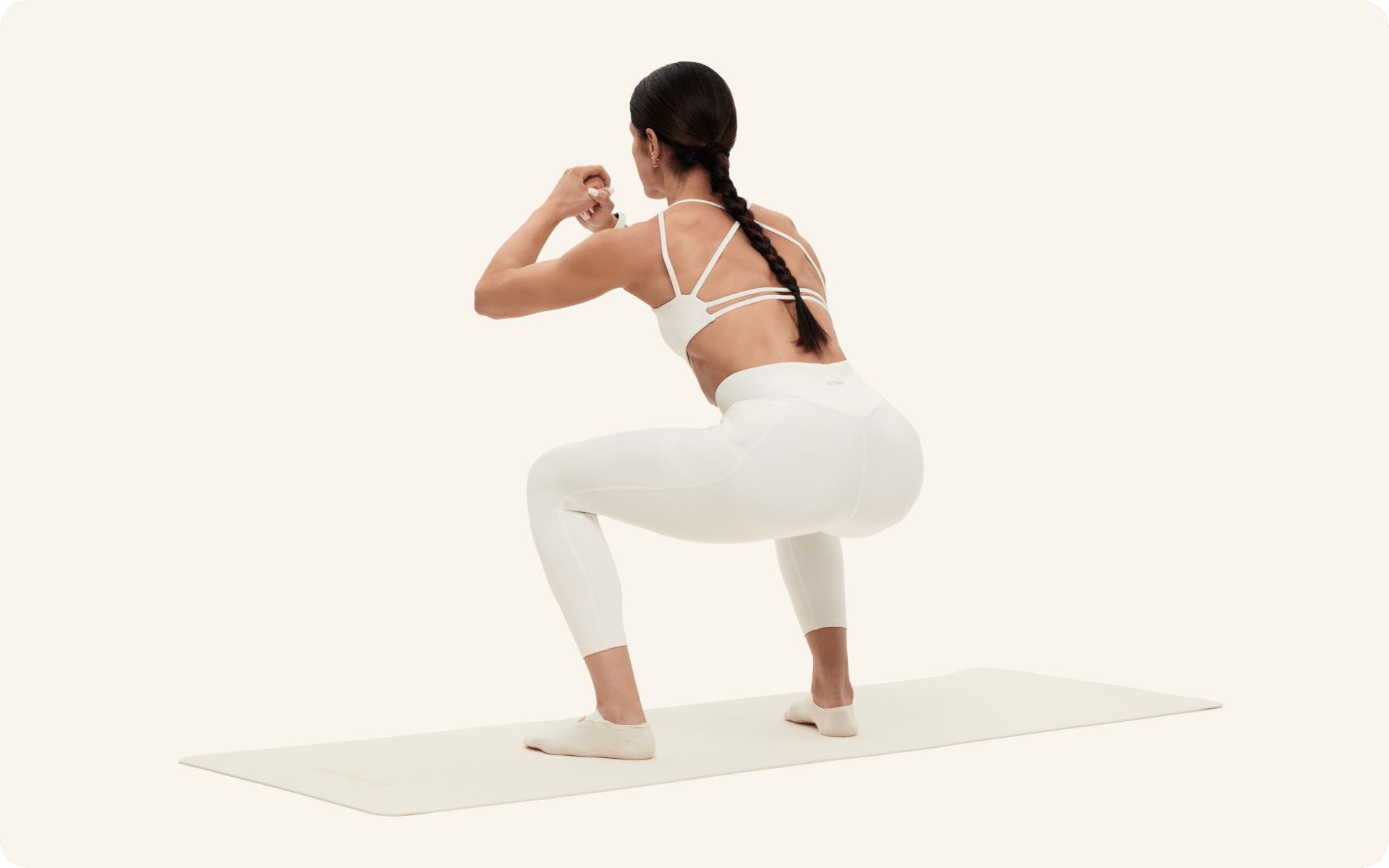
Bodyweight squats
Bodyweight squats rehearse a common lower-body movement. Research has examined their use before jumping activity, although results from a specific protocol do not apply to every workout (2).
- Stand with your feet about shoulder-width apart.
- Move your hips back and bend your knees.
- Lower only as far as you can maintain control.
- Stand and repeat for 8–12 repetitions.
Leg swings
- Hold a wall or chair for support.
- Stand on one leg with a soft knee.
- Swing the other leg forward and backward within a controlled range.
- Complete 10–15 swings, then switch sides.
High-knee march
- Stand tall with your feet hip-width apart.
- Lift one knee toward hip height.
- Lower it with control and switch sides.
- Continue for 20–30 seconds while moving your arms naturally.
A broader full-body warm-up routine can combine several of these movements.
Gentle neck turns
Slow neck turns are easier to control than full neck circles. Keep the movement small and stop if you feel dizziness or discomfort.
- Sit or stand tall with relaxed shoulders.
- Turn your head slowly to the right.
- Return to the center, then turn left.
- Repeat 4–6 times per side.
Torso rotations
- Stand with your feet shoulder-width apart and your knees soft.
- Keep your hips mostly forward.
- Rotate your upper body slowly to one side.
- Return to the center and repeat on the other side for 10–12 repetitions.
Ankle circles
- Hold a wall or chair.
- Lift one foot slightly.
- Make 8–10 slow circles in each direction.
- Lower the foot and repeat on the other side.
Hip circles
- Stand with your feet about shoulder-width apart.
- Place your hands on your hips.
- Move your hips in a small, controlled circle.
- Complete 8–10 circles, then change direction.

Is it okay to skip a warm-up?
A warm-up is not mandatory for every light activity, but it can help you transition into a demanding workout. Research suggests that an appropriate dynamic warm-up may support performance, while effects on injury risk depend on the activity and protocol (4).
The warm-up should match what follows. A slow walk may be enough before an easy walk, while strength training or sport may benefit from movement rehearsal and gradually heavier practice sets.
What can happen without an appropriate warm-up?
Starting a demanding session at full intensity may leave you less prepared for the speed, force, or range of motion required. Rather than listing overlapping dangers as certainties, focus on a gradual transition and technique you can control.
Warm-up duration and intensity can affect immediate performance, but the response depends on the activity and timing (3).
What should a general warm-up include?
- Light cardio: Walk, march, or cycle at an easy pace.
- Dynamic mobility: Move the joints you will use through a comfortable range.
- Movement rehearsal: Practice the main exercise with less speed, load, or complexity.
- Gradual progression: Increase effort in small steps before the working sets or main activity.
How should you begin a warm-up?
Begin at an easy pace that slightly increases breathing without causing fatigue. Add dynamic movements and activity-specific practice only after you feel ready to move more quickly or handle more resistance.
Workouts, weight management tools, and recipe ideas come together in the BetterMe: Health Coaching app, giving you practical support for building a more consistent wellness routine.
Which warm-up exercises work well before lifting?
Combine a few minutes of light movement with dynamic mobility and practice sets for the exercises you plan to perform. Before squats, for example, you might march, complete bodyweight squats, and then perform lighter squat sets.
For bodyweight training, a calisthenics warm-up can focus on wrists, shoulders, hips, and movement patterns used in the session.
Which activities may not fit a warm-up?
Avoid beginning with maximal sprints, heavy lifts, or movements you cannot yet control. Long, intense stretches that create fatigue may also be a poor fit immediately before activities requiring speed or force.
Read more: 6 active recovery day workout ideas for gentle movement
How long should a warm-up be?
There is no universal duration. One study found that warm-up intensity and the delay before activity influenced jump performance, which shows why timing and purpose matter (3).
Five to 15 minutes may be practical for many recreational workouts, but the routine can be shorter for light activity and longer for demanding sport. Stop before the warm-up itself becomes tiring.
FAQs
Can I work out without a warm-up?
You can, but a gradual warm-up may help prepare you for a demanding session. The amount of preparation should reflect the intensity and complexity of the activity.
What are three types of warm-up activity?
A simple structure includes light cardio, dynamic mobility, and activity-specific rehearsal. Each part should progress gradually without creating fatigue.
What are five stages of a warm-up?
A longer warm-up may include light cardio, joint mobility, dynamic movement, activity-specific drills, and short efforts near the planned intensity. Not every recreational session needs all five stages.
Is walking a useful warm-up before lifting?
Walking can start the transition from rest to movement. Follow it with mobility and lighter practice sets that resemble the lifts you plan to perform.
What warm-up should I do before lifting?
Use light movement, dynamic mobility, and progressively heavier practice sets. The exact sequence depends on the exercises, loads, and your current readiness.
The bottom line
Easy warm-up exercises should prepare you without exhausting you. Begin gently, use movements related to your planned workout, and increase effort in small steps. Choose controlled options that match your ability and the activity ahead.
DISCLAIMER:
This article is intended for general informational purposes only and does not serve to address individual circumstances. It is not a substitute for professional advice or help and should not be relied on for making any kind of decision-making. Any action taken as a direct or indirect result of the information in this article is entirely at your own risk and is your sole responsibility.
BetterMe, its content staff, and its medical advisors accept no responsibility for inaccuracies, errors, misstatements, inconsistencies, or omissions and specifically disclaim any liability, loss or risk, personal, professional or otherwise, which may be incurred as a consequence, directly or indirectly, of the use and/or application of any content.
You should always seek the advice of your physician or other qualified health provider with any questions you may have regarding a medical condition or your specific situation. Never disregard professional medical advice or delay seeking it because of BetterMe content. If you suspect or think you may have a medical emergency, call your doctor.
SOURCES:
- The best exercises for your warm-up (2022, health.harvard.edu).
- Bodyweight squats can induce post-activation performance enhancement on jumping performance: a brief report (2025, researchgate.net).
- Warm-Up Intensity and Time Course Effects on Jump Performance (2020, pmc.ncbi.nlm.nih.gov).
- Dynamic Warm-ups Play Pivotal Role in Athletic Performance and Injury Prevention (2025, sciencedirect.com).

 Reviewed by



 By