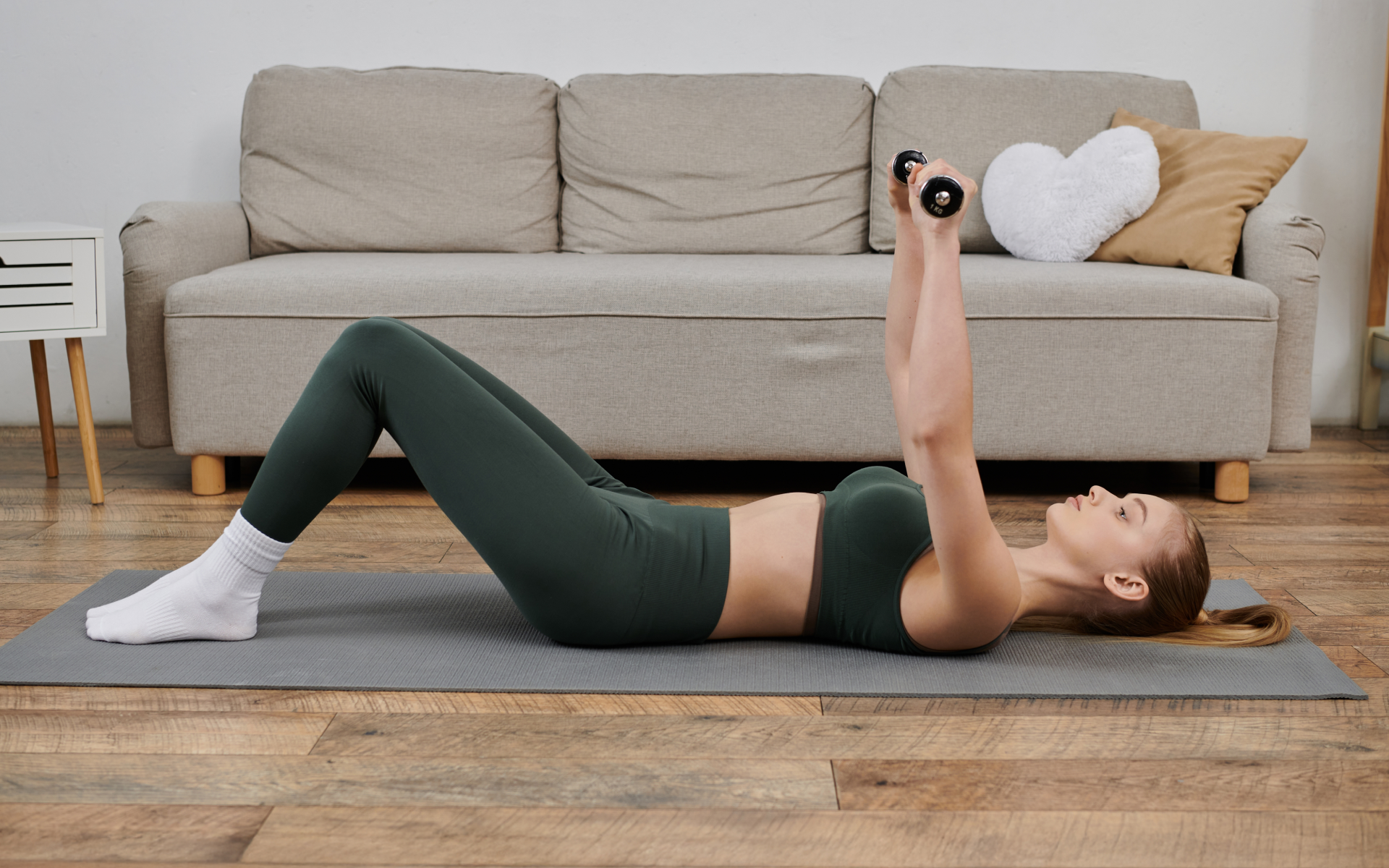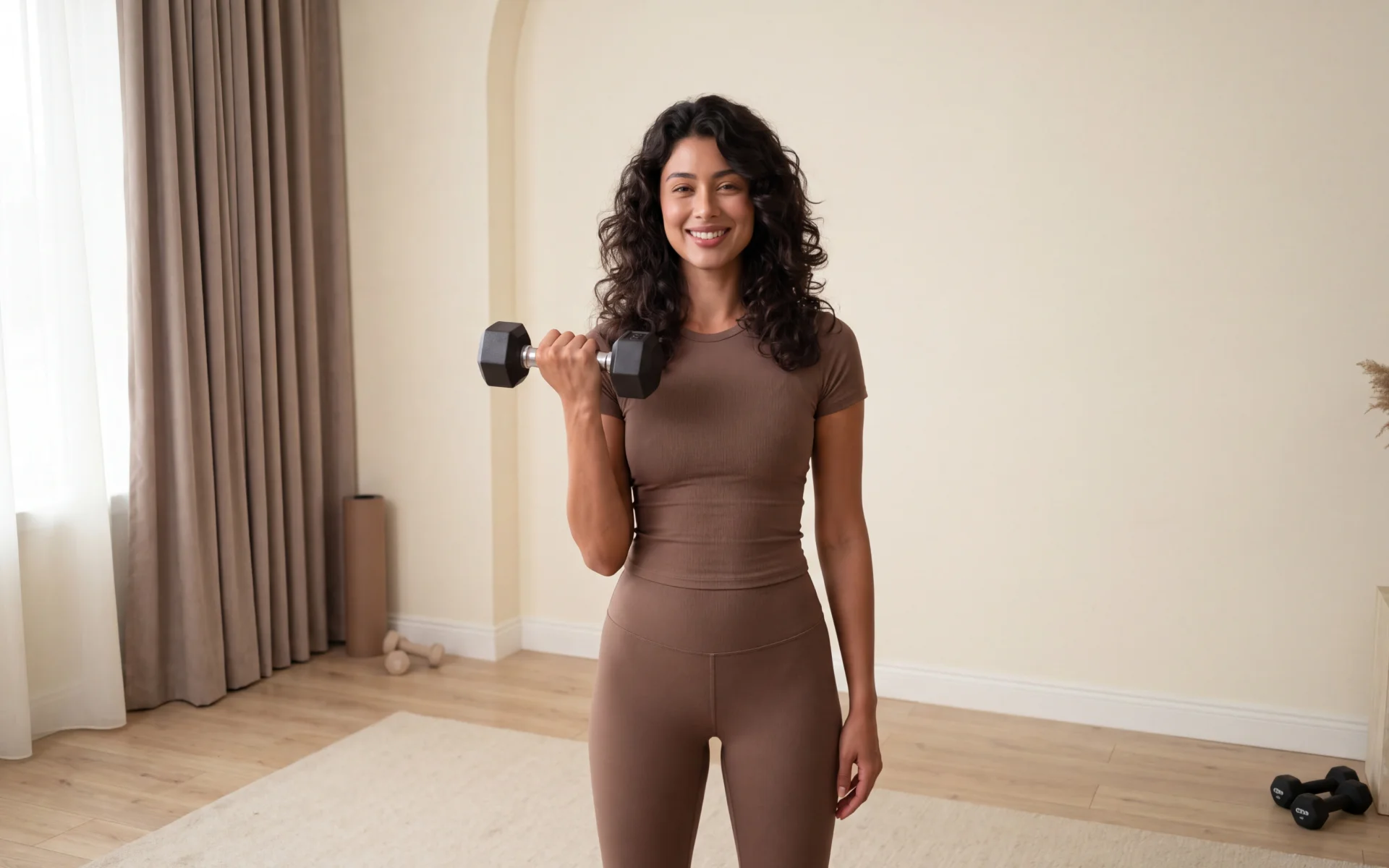

Body composition exercises are compound strength moves such as squats, deadlifts, rows, and push-ups, done 2 to 3 times a week alongside regular cardio. Strength work can help you build muscle and lose fat over time, while cardio adds to the energy you use. Weight, waist size, and clothing fit may change over time; timelines vary.
This guide covers how exercise changes your fat-to-muscle balance, 10 useful moves, a beginner week, and simple ways to track progress. For the bigger picture, read our body recomposition guide.
This article is for general information only and isn’t medical advice. Changes in weight and body makeup depend on many factors, and individual results vary. If you’re pregnant, managing an ongoing condition, or returning after a strain, check with a doctor before starting a new routine.
Key takeaways
Lasting change usually comes from strength training, cardio, enough protein, and patience. The main points are:
- Body composition describes how much of your body is fat mass compared with fat-free mass, such as muscle, bone, and water (1).
- In one study of middle-aged adults with obesity, both resistance and aerobic training improved the ratio of fat to muscle (2).
- Fat doesn’t turn into muscle, but you can lose fat while building or keeping muscle (3).
- In adults with overweight or obesity, aerobic exercise was linked with a smaller waist size (4).
- Adult guidelines suggest muscle-strengthening work on 2 or more days a week, plus 150 to 300 minutes of moderate activity (5).
- Scale weight alone may not show body composition changes, so waist measurements and strength logs add useful context.
How can exercise improve body composition?
Exercise can improve body composition by helping you build or keep muscle while using more energy. It tends to work well when strength training and cardio are paired with a healthy diet. No single workout does the job on its own.
Body composition means the share of your body made of fat mass versus lean mass. Lean mass is everything that isn’t fat, such as muscle, bone, and water (1).
| Habit | Common weekly target | What it may support |
|---|---|---|
| Strength work | 2 or more days (5) | Building or keeping muscle |
| Cardio | 150 to 300 minutes of moderate effort (5) | Energy use, heart rate, and heart and lung fitness |
| Daily steps | About 7,000 or more per day (6) | Energy use outside workouts |
| Protein | Enough at each meal (7) | Muscle repair and upkeep |
How can strength training and cardio help improve body composition?
Strength training creates a signal for muscle growth or upkeep, while cardio adds to your weekly energy use. In one study of middle-aged adults with obesity, both resistance and aerobic training improved the ratio of fat to muscle (2). Resistance training means any exercise where your muscles work against a load, such as dumbbells, bands, or your own body weight (8).
A systematic review of people with overweight or obesity found that resistance training reduced body fat percentage and increased muscle (9). Another review linked aerobic exercise with a smaller waist size in adults with overweight or obesity (4).
Read more: Body Recomposition Diet: Pull Off The Ultimate Fitness Dream
Can you lose fat and build muscle at the same time?
Yes, many people can lose fat and gain muscle at the same time, especially beginners, though fat doesn’t turn into muscle (3). They’re two different tissues with different jobs.
Fat tissue stores energy (10). Muscle tissue moves your body and is built from protein (11). With regular training and eating habits, both can change together. For example, your waist might shrink while your squat gets heavier.

What is a good diet for body recomposition?
A body recomposition diet usually pairs enough protein with a calorie intake near maintenance or a small calorie gap. Body recomposition means losing fat while gaining or keeping muscle; that is the goal of body recomposition (12). Maintenance calories are the amount that keeps your weight steady.
Reviews of weight-loss diets often describe a deficit of about 500 calories a day (13). A meta-analysis suggests higher protein intake may help adults with overweight or obesity keep muscle while losing fat (7). The table shows what 1.2 to 1.6 g per kg a day works out to:
| Your size | Approximate daily protein | Per meal (3 to 4 meals) |
|---|---|---|
| 132 lb (60 kg) | 72 to 96 g | 20 to 30 g |
| 165 lb (75 kg) | 90 to 120 g | 25 to 35 g |
| 198 lb (90 kg) | 108 to 144 g | 30 to 40 g |
Lean meat, fish, eggs, dairy, beans, and tofu are common protein sources. A registered dietitian can help you find numbers that suit your needs. Our body recomposition diet guide covers meal ideas.
What activities can you do to improve your body composition?
Strength training, circuits, brisk walking, cycling, rowing, and intervals all help, either by building muscle or by helping you burn calories. Everyday movement counts too.
HIIT, or high-intensity interval training, means short bursts of hard effort, each followed by easy recovery (14).
| Activity | What it mainly supports | Sample session |
|---|---|---|
| Strength training | Building or keeping muscle (15) | 5 moves, 2 to 3 sets of 8 to 12 reps |
| Circuit training | Muscle plus heart and lung fitness (16) | 6 moves, 40 sec on, 20 sec off, 3 rounds |
| Brisk walking | Low-impact energy use | 30 to 45 min |
| Cycling | Leg endurance | 20 to 40 min at a steady pace |
| Rowing | Back, legs, and endurance | 15 to 25 min |
| HIIT | Fitness and calorie burn in less time (14) | 8 rounds of 30 sec hard, 90 sec easy |
One review of circuit-style resistance training found it reduced total body fat and increased muscle mass in adults (16). That makes circuits a useful middle ground on busy days.
Daily life adds up too. Non-exercise activity means the energy you use during everyday tasks (17). Short walks after meals, taking the stairs, carrying groceries, gardening, and walking during phone calls all count.
Which body composition exercises work well?
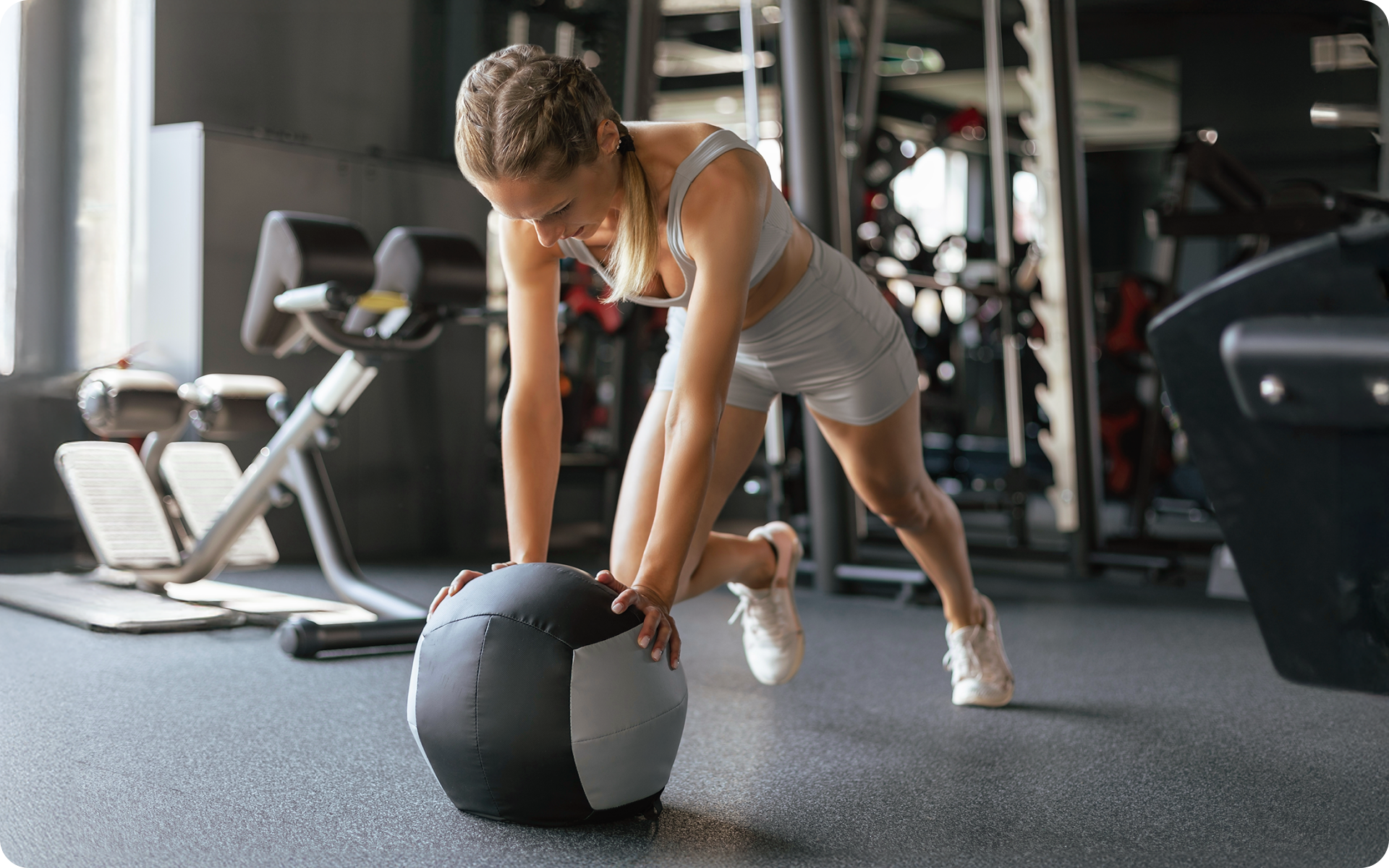
Squats, deadlifts, split squats, push-ups, rows, presses, pull-downs, swings, and carries work well, because these compound exercises train several different muscle groups at once. Each has an easier version, so different levels can join in.
| Exercise | Main muscles | Beginner version | Sample weekly dose |
|---|---|---|---|
| Squat | Quads, glutes, core | Sit-to-stand from a chair | 2 to 3 sets of 8 to 12 reps, 2 to 3 days |
| Romanian deadlift | Hamstrings, glutes, back | Hip hinge holding a light backpack | 2 to 3 sets of 8 to 12 reps, 2 days |
| Dumbbell or trap-bar deadlift | Glutes, thighs, back, grip | Dumbbell deadlift from a low step | 2 to 3 sets of 6 to 10 reps, 1 to 2 days |
| Split squat | Quads, glutes | Split squat holding a chair | 2 to 3 sets of 8 to 10 reps per side, 2 days |
| Push-up | Chest, shoulders, triceps | Wall or incline push-up | 2 to 3 sets of 6 to 12 reps, 2 to 3 days |
| Row | Upper back, lats, biceps | Band row | 2 to 3 sets of 10 to 12 reps, 2 to 3 days |
| Overhead press | Shoulders, triceps | Seated light dumbbell press | 2 to 3 sets of 8 to 12 reps, 2 days |
| Pull-up or lat pulldown | Lats, upper back, biceps | Band lat pulldown | 2 to 3 sets of 6 to 10 reps, 2 days |
| Kettlebell swing | Glutes, hamstrings, core | Glute bridge, then light swings | 3 to 4 sets of 10 to 15 reps, 1 to 2 days |
| Farmer's carry | Grip, core, shoulders | Carry 5 to 10 lb in each hand | 3 rounds of 30 to 45 sec, 2 days |
The doses are samples, not study findings. Spend your first 1 to 2 sessions learning each pattern with light loads.
1. Squat
The squat trains your lower body in one move. Stand with feet about shoulder-width apart, push your hips back as if sitting into a chair, and lower as far as feels comfortable. Press through your whole foot to stand.
2. Romanian deadlift
This hinge targets the back of your legs. Hold dumbbells in front of your thighs, soften your knees, and push your hips back with a flat back. Squeeze your glutes to stand tall.
3. Dumbbell or trap-bar deadlift
The deadlift trains your whole posterior chain and grip. Hinge to grip the handles, brace your stomach, and push the floor away to stand. Lower the load by pushing your hips back first.
4. Split squat
The split squat works one leg at a time. Take a long step forward, lift your back heel, and lower straight down. Push through your front foot to rise, then switch sides.
5. Push-up
The push-up trains your chest, shoulders, and arms. Keep your body in a straight line, bend your elbows to about 45 degrees from your body, and push the floor away.
6. Row
The row balances pushing work by training your upper back. Anchor a band at chest height, pull your elbows back toward your hips, pause, and return slowly.
7. Overhead press
The press trains your shoulders and arms. Brace your stomach, press dumbbells overhead until your arms are nearly straight, and lower them over 2 to 3 seconds.
8. Pull-up or lat pulldown
This move trains your lats and upper back. Draw your shoulders down, pull your elbows toward your ribs, and lower with control.
9. Kettlebell swing
The swing trains your hips with a fast hinge. Hike the kettlebell back between your legs, then snap your hips forward to swing it to chest height.
10. Farmer’s carry
The carry trains grip and core. Stand tall with a dumbbell in each hand, brace your stomach, and walk with short, steady steps for 30 to 45 seconds.
To arrange these moves into a weekly training plan, see our lose fat, gain muscle workout plan guide.
How do you train body composition as a beginner?
Start a body recomposition program with 2 to 3 full-body strength sessions and 2 to 3 easy cardio sessions each week. Simple plans tend to work well, and many focus on 5 basic movement patterns:
- Squat: bending knees and hips, like sitting into a chair
- Hinge: pushing your hips back with a flat back
- Push: pressing away from you, like a push-up
- Pull: drawing toward you, like a row
- Carry or core: holding steady while you move or brace
Aim to finish each set with 2 to 3 reps in reserve (RIR) (15). RIR is the number of reps you could still do before your form slips.
Workouts, weight management tools, and recipe ideas come together in the BetterMe: Health Coaching app, giving you practical support for building a more consistent wellness routine.
What does a 7 day at home body recomposition workout look like?
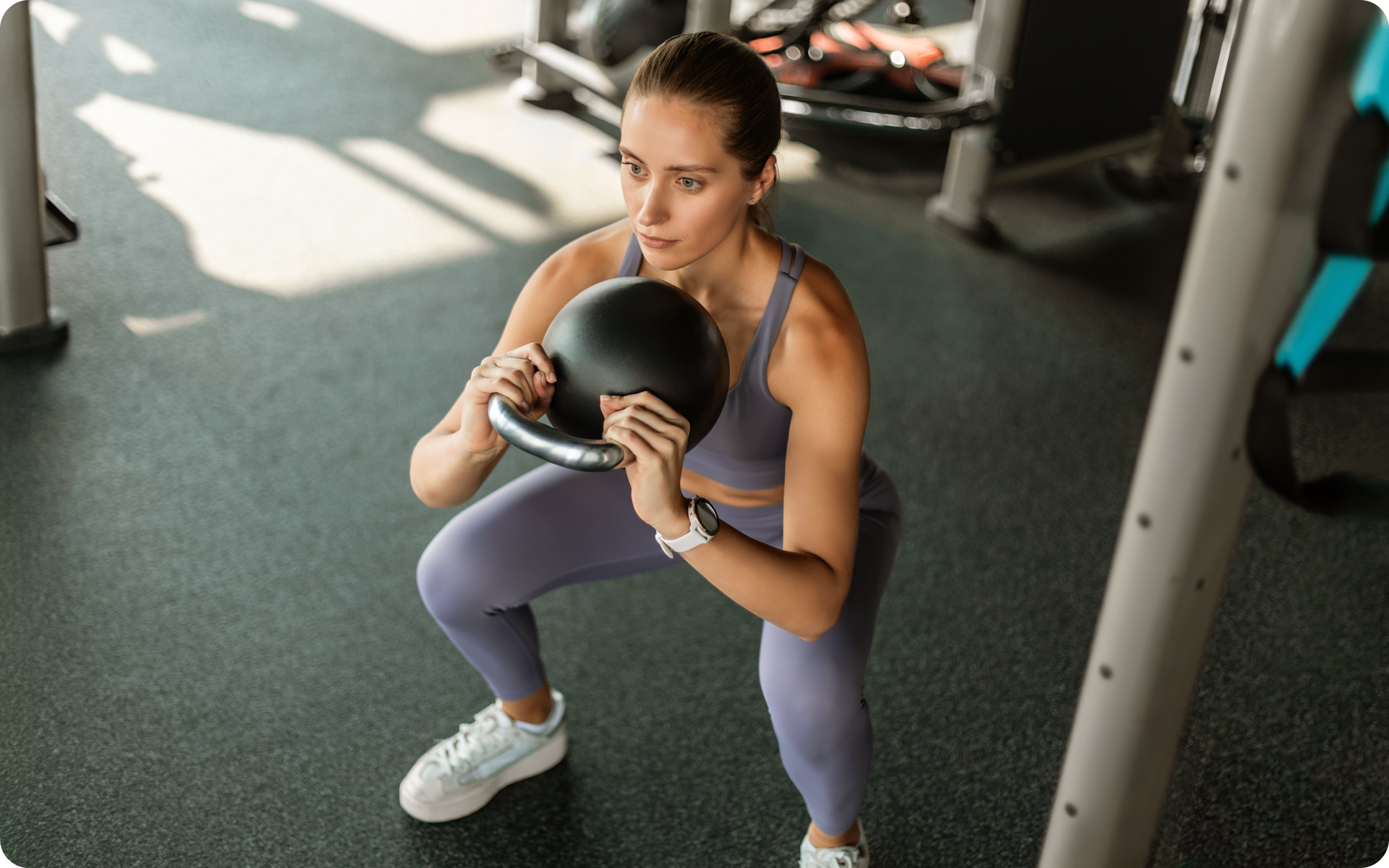
A sample 7 day at home workout plan for beginners can mix 3 strength days with 2 cardio days and 2 lighter days.
| Day | Workout | Duration | Effort |
|---|---|---|---|
| Monday | Strength A: squat, push-up, band row, glute bridge, plank | 30 to 40 min | Moderate: 2 to 3 RIR |
| Tuesday | Brisk walk | 20 to 30 min | Easy |
| Wednesday | Strength B: split squat, overhead press, Romanian deadlift, band pulldown, carry | 30 to 40 min | Moderate: 2 to 3 RIR |
| Thursday | Rest or gentle stretching | 10 to 15 min | Very easy |
| Friday | Strength A | 30 to 40 min | Moderate: 2 to 3 RIR |
| Saturday | Cycling, brisk walk, or easy jog | 20 to 40 min | Moderate |
| Sunday | Rest or easy walk | 0 to 30 min | Easy |
How do you progress as a beginner?
Change one variable once a workout feels steady for 1 to 2 weeks. This is called progressive overload, which means gradually adding challenge so your body keeps adapting (18).
| Method | How much to add | Example |
|---|---|---|
| Reps | 1 to 2 reps per set | 3 sets of 10 squats becomes 3 sets of 12 |
| Load | A small step | A 100-lb deadlift becomes 105 lb |
| Sets | 1 set after 1 to 2 steady weeks | 2 sets of rows becomes 3 sets |
Do women need a different plan?
No, the same training basics apply to most adults, including women. Adjust load and exercise choice to suit your body and fitness goals. When you’re ready for a structured next step, see our body recomp workout plan guide.
How often should you exercise to improve body composition?
Many adults with a body composition goal train 4 to 6 days a week, split between strength and cardiovascular exercise. Guidelines suggest muscle-strengthening work on 2 or more days and 150 to 300 minutes of moderate activity weekly (5).
You can judge cardio effort with a talk test. At a moderate effort you can talk but can’t sing; at a vigorous effort you can say only a few words before pausing for breath.
| Goal | Weekly strength sessions | Weekly cardio sessions |
|---|---|---|
| Getting started | 2 | 2 |
| Reduce fat while keeping muscle | 3 | 2 to 3 |
| Build muscle | 3 to 4 | 1 to 2 |
| Older trainees | 2 to 3 | 2 to 3, plus balance work |
How do you know when to ease off?
You may benefit from an extra rest day if soreness lasts several days, strength drops across sessions, or your sleep feels worse for several nights. Cutting back by 1 session or 1 set for a week is a common adjustment.

How can you tell if your body composition is changing?
Track your waist, strength, photos, and clothing fit, not just scale weight, to see your overall body composition. Scale weight mixes fat, muscle, water, and food in one number, so a steady scale may hide real progress.
| Method | How often | What to look for |
|---|---|---|
| Waist measurement | Every 2 weeks | A slow downward trend |
| Strength log | Every session | More reps or load over time |
| Progress photos | Every 1 to 4 weeks | Changes in shape |
| Clothing fit | Every 2 to 4 weeks | Looser waistband |
| Weekly average weight | Several mornings a week | A trend over weeks, not daily swings |
What do body fat scales and scans tell you?
Body fat scales and scans give an estimate of fat versus everything else. Home scales use a small electrical signal, and readings can shift with hydration. A DXA scan is a low-dose X-ray scan that estimates fat, muscle, and bone in more detail (19). If you use either to assess your body composition, test under the same conditions each time.
Read more: How Many Squats A Day Will Give You That Peach Booty Look?
How long does body recomposition take?
There is no fixed timeline. Waist size and clothing fit may change over time, and timelines vary from person to person.
Early strength gains often come from your nervous system learning each move (20). Visible change in muscle and fat usually takes longer. Your pace depends on training history, protein intake and calorie balance, sleep and stress, age, starting fat and muscle levels, and how consistently you train.
Do beginners change faster?
Yes, beginners often see faster muscle gain because muscles respond strongly to new training. People with years of lifting behind them may see slower progress (20). That’s a common pattern, not a sign that training has stopped working.
Can you improve body composition at home?
Yes, you can change your body composition at home with simple strength moves and regular walking. A gym membership isn’t required.
Muscles respond to challenge, not location. A review found that functional training, which uses everyday movement patterns, may support building lean muscle in older adults (21). Useful home gear includes resistance bands, a pair of dumbbells or a kettlebell, a sturdy chair or step, and a backpack filled with books.
How do you train without equipment?
Bodyweight moves can build strength when you make them harder over time (22). Add 1 to 2 reps, slow the lowering part of each rep, add a set, cut rest, or switch to a harder variation.
| Level | Push-up variation | Move on when you can do |
|---|---|---|
| 1 | Wall push-up | 3 sets of 15 reps with control |
| 2 | Incline push-up on a counter | 3 sets of 12 reps |
| 3 | Incline push-up on a low step | 3 sets of 12 reps |
| 4 | Knee push-up | 3 sets of 10 reps |
| 5 | Full push-up | Keep adding 1 to 2 reps over time |
BetterMe can help you add more structure to your daily wellness routine with workouts, meal planning tools, and habit-building features. Explore the app and take a practical step toward a routine that feels more manageable for you.

FAQs
Can walking help body composition?
Yes, walking can help by adding to the energy you use each day (23). On its own, it does little to build muscle for most people, so it pairs well with 2 to 3 strength sessions a week. Some research links about 7,000 or more daily steps with markers of long-term health (6, 24).
Do bodyweight exercises build muscle?
Yes, bodyweight exercises can build muscle when each set ends close to your limit. Research suggests lighter loads can build muscle much like heavier ones when sets are taken close to fatigue (25). As moves get easier, harder variations keep the challenge going.
What age is hardest to gain muscle?
Gaining muscle tends to get harder with age, though there’s no single cutoff. Some research suggests muscle mass slowly declines from around age 40 (26). Older adults can still build lean muscle mass with regular resistance work, though progress may be slower (27).
How can you lose body fat?
You may lose body fat by keeping a modest calorie deficit while you keep strength training (13). Activities that use large muscles for longer tend to use more energy. Strength work uses less energy per session but helps you keep muscle. Fat loss and weight change depend on your energy balance over weeks, not one workout.
What are healthy body fat percentages?
There is no single healthy body fat percentage, because typical ranges differ by sex, age, and measurement method (1). Body mass index does not separate fat from muscle, so methods such as DXA can measure the amount of body fat in more detail (19). A doctor can help you interpret your percent body fat and visceral fat in context.
The bottom line
Body composition exercises work as a team: 2 to 3 strength sessions, regular cardio, daily steps, and enough protein. Track your waist, strength, and photos alongside the scale, and remember that timelines vary. Pick 1 strength day and 1 walk for this week, put them on your calendar, and build your body recomposition plan from there.
DISCLAIMER:
This article is intended for general informational purposes only and does not serve to address individual circumstances. It is not a substitute for professional advice or help and should not be relied on for making any kind of decision-making. Any action taken as a direct or indirect result of the information in this article is entirely at your own risk and is your sole responsibility.
BetterMe, its content staff, and its medical advisors accept no responsibility for inaccuracies, errors, misstatements, inconsistencies, or omissions and specifically disclaim any liability, loss or risk, personal, professional or otherwise, which may be incurred as a consequence, directly or indirectly, of the use and/or application of any content.
You should always seek the advice of your physician or other qualified health provider with any questions you may have regarding a medical condition or your specific situation. Never disregard professional medical advice or delay seeking it because of BetterMe content. If you suspect or think you may have a medical emergency, call your doctor.
SOURCES:
The list covers body composition and recomposition reviews, resistance, cardio, and protein research, activity guidelines, and measurement standards. Each number in the text links to the matching source below.
- The Utility of Body Composition Assessment in Nutrition and Clinical Practice: An Overview of Current Methodology (2021, mdpi.com)
- Effects of resistance training and aerobic training on improving the composition of middle-aged adults with obesity in an interventional study (2025, nature.com)
- Resistance training as a key strategy for high-quality weight loss in men and women (2026, frontiersin.org)
- Effect of aerobic exercise on waist circumference in adults with overweight or obesity: A systematic review and meta-analysis (2022, onlinelibrary.wiley.com)
- Adult Activity: An Overview (2023, cdc.gov)
- Daily steps and health outcomes in adults: a systematic review and dose-response meta-analysis (2025, thelancet.com)
- Enhanced protein intake on maintaining muscle mass, strength, and physical function in adults with overweight/obesity: A systematic review and meta-analysis (2024, sciencedirect.com)
- What is resistance exercise? A review of current uses and potential ways forward (2026, link.springer.com)
- Resistance training effectiveness on body composition and body weight outcomes in individuals with overweight and obesity across the lifespan: A systematic review and meta-analysis (2022, onlinelibrary.wiley.com)
- Lipidomics of brown and white adipose tissue: Implications for energy metabolism (2020, pubmed.ncbi.nlm.nih.gov)
- Skeletal muscle: molecular structure, myogenesis, biological functions, and diseases (2024, pmc.ncbi.nlm.nih.gov)
- A Review of Strategies for Achieving Simultaneous Muscle Mass Gain, Maintenance, or Minimal Loss During Fat Reduction: Insights from the Last 5 Years (2025, apcz.umk.pl)
- Optimal Diet Strategies for Weight Loss and Weight Loss Maintenance (2020, pmc.ncbi.nlm.nih.gov)
- Evidence-Based Effects of High-Intensity Interval Training on Exercise Capacity and Health: A Review with Historical Perspective (2021, mdpi.com)
- American College of Sports Medicine Position Stand. Resistance Training Prescription for Muscle Function, Hypertrophy, and Physical Performance in Healthy Adults: An Overview of Reviews (2026, ovid.com)
- Effects of Resistance Circuit-Based Training on Body Composition, Strength and Cardiorespiratory Fitness: A Systematic Review and Meta-Analysis (2021, mdpi.com)
- Non-Exercise Activity Thermogenesis in Human Energy Homeostasis (2022, ncbi.nlm.nih.gov)
- Attention to Progression Principles and Variables of Exercise Prescription in Workplace-Related Resistance Training Interventions: A Systematic Review of Controlled Trials (2022, frontiersin.org)
- Methodological standards for body composition assessment: an expert-endorsed guide for research and clinical applications: bioimpedance, dual-energy X-ray absorptiometry, computerized tomography, and ultrasound methods (2026, sciencedirect.com)
- Neuromuscular adaptations to resistance training in elite versus recreational athletes (2025, frontiersin.org)
- Is functional training an efficient approach to improve body composition in older people? A systematic review (2023, frontiersin.org)
- Bodyweight Training for Muscular Strength & Endurance (2022, researchgate.net)
- Energy Cost of Walking and Running (2022, intechopen.com)
- Association of Daily Step Patterns With Mortality in US Adults (2023, jamanetwork.com)
- Effects of Resistance Training Performed with Different Loads in Untrained and Trained Male Adult Individuals on Maximal Strength and Muscle Hypertrophy: A Systematic Review (2021, mdpi.com)
- An Overview of Sarcopenia: Focusing on Nutritional Treatment Approaches (2025, mdpi.com)
- Effects of Resistance Training Volume on Physical Function, Lean Body Mass and Lower-Body Muscle Hypertrophy and Strength in Older Adults: A Systematic Review and Network Meta-analysis of 151 Randomised Trials (2025, link.springer.com)
 Reviewed by

 Reviewed by